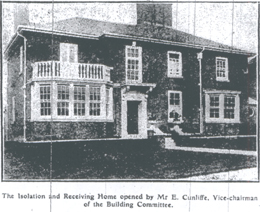
Mr. E. Cunliffe, chairman of the Building Committee of the Blackburn Board of Guardians and vice-chairman of the Board on Thursday afternoon opened a new Isolation and Receiving Home for children. The building, which adjoins the Cottage Homes of the Blackburn Union, has been erected at a cost of about £1,500, and the opening ceremony took place in the presence of a large gathering of Guardians and others interested in the scheme.
In the course of a short statement the Clerk (Mr. C. E. Bygrave) said that when the Cottage Homes were opened, 14 years ago, it was understood that the children would be received direct in the Homes, but special provision for that purpose was not made, and as it was found that all the cottages provided were required for the maintenance of the children, they continued to be received at the Workhouse, to which they were taken in the ordinary way. Although that went on for some time, it was undesirable in many ways. Temporary provision was made for the receiving them at the Workhouse, but even then, children were often kept there for some days before being drafted to the Cottage Homes. The Cottage Homes Committee had also under consideration the treatment of minor infectious diseases, such as measles and finally the sanction of the Local Government Board having been obtained; it was decided to put up the present building.
Mr. Cunliffe, declaring the Home open, described it construction in detail and said that although the buildings were under one roof they were intended to serve the dual purpose of receiving home and isolation home. Mr. Cunliffe added that everything about the Home was substantial without being costly. Mr. Wilson, the architect, then presented to the opener a gold Key, inscribed; “Blackburn Union. Presented to Edwin Cunliffe, Esq., Chairman of the Building Committee, on the occasion of his opening the Children’s Isolation Home. July 30th 1914.” Several speakers congratulated Mr. Wilson on the building, and afterwards they were speechmaking inside the house.
The house was then formally handed over to the chairman of the Cottage Homes Committee, the Rev. J. P. Wilson, who, in reply said that the facilities given by the Home were needed. There had been various theories as to the best way of dealing with children who came under the control of the Board of Guardians. Years ago they were allowed to associate with the men and women in the Workhouse, but the undesirability of their freely mixing with adults, many of whom had lived a life of pauperism, became evident, and the boarding-out system came into being. In some parts of the country that system was satisfactory, but 14 years ago the Blackburn Board, although adopting in part that idea, thought that Cottage Homes would be better, so that by now they had passed the experimental stage. Before such methods were tried 50 per-cent of those who occupied our Workhouse were the decedents of people who themselves were Workhouse inmates, pauperism begetting paupers, but, on account of the improvements he had mentioned he had every reason to believe that boys and girls who passed through those Homes had gone into the world to take their part as honourable men and women. Indeed, very few had failed to live decent lives. Mr. Wilson went on to quote figures showing that children had in nearly every case become respectable citizens. A number of boys had entered the army, navy, or mercantile marine, others had become weavers, miners, or farm servants, and others had been sent to grocers’ or butchers’ shops. None of them had been apprenticed. As there was plenty of work in the town, there had been no necessity for sending them abroad, but in the way to which he had referred no fewer than 30 had been found work during the last three years. The Blackburn Guardians also had a Working Boys’ Home, because they recognised that when the lads began work there was always a danger that they might get into bad ways. Most of the boys in that Home were practically keeping themselves, and were probably being better cared for than would be the case if they were boarded out in the ordinary home, because, not only were they under the discipline of the Committee, but were looked after by a foster-mother, who was almost as good as a mother to them all. Work in connection with children was one of the most hopeful efforts being put forth by human society. He was not there to speak about national decadence, but they could not disregard the fact that there were sad and lamentable indications that there was much that was very perplexing to all who cared for the state of human nature. “This Home,” he added, “is one of the antidotes against that process of decadence which is ever going on in human society, and the effort is one which calls for the sympathy and support of all. More and more must we do all we can on behalf of the rising generation.”
Mr. Elias, a Local Government Board Inspector, congratulated the Guardians on their forward movement. He appreciated the improvements carried out—and at a very moderate cost—believing that the money been well spent. Not only was the building a must suitable one but the furnishing and everything connected with it had been carried out in good taste. He added that the Local Government Board laid down no definite lines for Guardians to work upon. It was left to the discretion of each Board, and that was why so many different systems were seen. There were some towns—large ones, too—that had no Homes of their own. In time more provision for children would be required, but it would be for the Board to decide which way to proceed. But they did not want children to remain in buildings which were part of a Workhouse. During recent years the work done by Guardians had been wonderful, but he hoped they would not be “weary in well doing.” Let them tackle the many different problems that arose.
Moving a vote of thanks to Mr. Cunliffe, Mr. E. Rennison spoke with the pleasure of the work done in connection with the Home by the Building and Cottage Homes Committee. The task of bringing up the children was one of the most important given to them, because often with adults it was almost hopeless to induce them to refrain from bad habits. He reminded his hearers that, despite much adverse criticism from the Poor Law Commission on their work generally, the reports were at one in commending the scheme of Cottage and Scattered Homes.
Seconding the resolution, Mr. R. Wolstenholme said he rejoiced that in a recent speech Mr. Samuel, the President of the Local Government Board, said that after the end of April next all children under the age of three would have to come out of the Workhouse. This was a children’s age, and for this happy state of affairs nobody was responsible more than Charles Dickens, who brought home to the country many of the inhumanities suffered by children in the workhouse of those days.
On behalf of himself and his wife, Mr. Cunliffe then invited the company to afternoon tea which was served in the open air.
Blackburn Weekly Telegraph 1st August 1914
EUROPEAN WAR THREATENED
ENGLANDS EFFORTS FOR PEACE
One of the most momentous crises in European history as arisen from the quarrel between Austria and Servia, and the whole world is watching with alarm the developments which have followed Servia’s rejection of Austria-Hungary’s ultimatum and the latter’s declaration of war. Deeds quickly followed words. Within a few hours of peaceful relations between the two countries being broken off, hostilities began with an artillery attack upon Belgrade, the bombardment causing immense damage and considerable loss of life, and fighting is still proceeding.
But the conflict between these two countries, whose racial jealousy and hatred has led to a series of troubles culminating in the recent assassination of the archduke, is of but little significance compared with the complications which may follow, involving, possibly, some of the greatest European nations in a war appalling in its magnitude and devastating in its consequence. Russia, Germany, and France are liable to be drawn by their alliances and treaty obligations into the vortex of war. Assurance of a backing from Russia is said to have inspired Servia—while conceding the greater part of demands contained in Austria’s ultimatum—to have refused compliance with what Austria regards as a vital point in her requisition. Following closely upon Servia’s partial rejection of the ultimatum, and practically coinciding with Austria’s declaration of war, came news which suggests that Russia expected that result. Information from reliable sources showing that she was engaged in a considerable mobilisation of her troops near the Austrian frontier. The position immediately became one of the gravest international importance, for if Russia’s preparations were to be interpreted as an intention on her part to give Servia armed assistance as against Austria, then the latter country, under the terms of her treaty was in a position to count on the aid of Germany in repelling Russian interference. Nor do the dread possibilities end here, for the alliance between Russia and Franc would looking at the situation in its worst aspect bring the latter country into the conflict, and set aflame the embers of hate which have smouldered since France bent the knee to Germany forty years ago.
STATEMENT BY THE PREMIER
In the House of Commons yesterday Mr. Asquith stated that the Government had just heard that Russia had proclaimed a general mobilisation of their army and navy. In consequence of this martial law has been proclaimed in Germany. “We understand this to mean,” he added, “that mobilisation in Germany will follow if Russian mobilisation is general and proceeded with.”
MESSAGES FROM MANY QUARTERS
So far as last night’s news was concerned, the facts embodied in the Premier’s statement represented the latest word in regard to the war in its more vital aspect. Reuter’s correspondent at Berlin wired that a telegram form Mystovitz in the extreme south of Germany where the German, Russian and Austrian frontiers meet, stated that Russia is reported to have blown up a railway bridge between Szlezakowa and Grisieze in Austria.
Last night the press association received the following announcement from the Chancellor of the Exchequer: Interviews have taken place to-day between Prime Minister, the Chancellor of the Exchequer, and representatives of the Bank of England with regard to the financial situation. It is understood that it has been decided that the situation is not at present such as to justify an emergency action with regard to the supply of legal tender, but in the event of further development necessitating Government action, the Treasury will be prepared to take such action immediately.
Sir Edward Carson in replying to a correspondent, states that if required by the Government, a large body of the Ulster Volunteers will be willing and ready to give their services for home defence, and many will be willing to serve anywhere they are required.
From Athens last night it was reported that the yacht Deglora, which had arrived at Corfue, sighted Austrian war-ships closely blocking the Montenegrin coast.
By way of New York the statement was made that the North German, Lloyd Company have announced that none of their steamers will sail from New York until further notice. The President Grant Hamburg American liner, which had left New York, has been recalled by wireless message.
A Brussels wire last night stated that the Belgian Government have decided to mobilise.
An order calling out reservists in St. Petersburg was placarded yesterday morning.
A Pekin Telegram via St. Petersburg states that a German squadron has concentrated at Tsing-tao, and that an Austrian detachment is also proceeding thither. German war munitions and colonial troops are also being hurried to Tsing-tao...
POSITION OF ENGLAND
Happily for England, she is not involved in the Quarrel, though her interests—national, financial, and commercial—in all that affects it are tremendous; and her role so far has been that of endeavouring to so influence the other great powers as to ensure that the world shall be spared the great conflagration which threatens it. Her own internal troubles—the grave issue of Ireland—are for the time set aside, and she has bent all her Diplomatic energies to bring about such understanding as shall limit the quarrel to its two principles, and preserve the peace as between Russia, Germany and France. It is not necessary to follow the minutiae of the negotiations to that end, or to indicate the precise points of difficulty, which prevented Germany responding fully to Sir Edward Grey’s suggestion for a peace conference. Of Germany’s desire for peace no better evidence, perhaps, can be given than the fact that a special envoy bore a message from the Kaiser to the Czar, and that it is felt that upon the reply depends whether there shall be peace or war. The possibility that England may be embroiled is a contingency not to be lost sight of, and thus the participation of Japan as England’s ally is rendered feasible.
RISE IN FOOD PRICES
One of the serious effect of the continued strain and uncertainty in the European situation is the sensational rise in the price of grain. From wheat it extended quickly to flour, which has advanced 3s 6d per sack in three days on the Liverpool market, and an extra ½ d on bread is one of the inevitable consequences. Other commodities, such as sugar, butter, bacon, etc., are also advancing rapidly in the wholesale market, and the rise must presently react upon the prices demanded from consumers. If Austria-Hungry and Servia at war can produce such far reaching effects, food would be at famine prices in the event of all the other countries becoming embroiled in the quarrel.
LABOUR PARTY’S APPEAL
The Labour party, at a meeting held in the House of Commons, adopted the following resolution:
!That the Labour party is gratified that Sir Edward Grey has taken steps to secure mediation in the dispute between Austria and Servia, and regrets that his proposal has not been accepted by the Powers concerned. It hopes however, that on no account will this country be dragged into the European conflict, in which, as the Prime Minister has stated we have no direct or indirect interest, and the party calls upon all Labour organisations in the country to watch events vigilantly so as to oppose, if need be in the most effective way, any action which may involve us in war.”
BLACKBURN CONSERVATIVES AND THE WAR
At a meeting of the Executive Committee of the Blackburn Conservative and Unionist Association...the following resolution was passed: “That this meeting sincerely hopes that the efforts of the Government to prevent a general European conflict may be successful, and further welcomes and approves the attitude of all parties in Parliament in putting aside party political differences during the period of national and Imperial stress.

 Loading more