Loading more
Page 2
The chilly days we have been experiencing lately found a really sensible garment in the shape of the ubiquitous cape; for a while the sun was showing his power at the rate of 92deg. in the shade it did seem a trifle unnecessary to wear a cloak, even if it were only slung from one shoulder. When his majesty hid his face, however, a real use was found for it; and one wisely wrapped oneself in its fold a snugly as a protection while the cold wind was blowing. The prettiest example of the fashionable cape-wrap are those of reversible, as, made in that material, one really can claim to have two capes. A lovely one I saw a few days ago was black one side, grey the other, and the collar and straps of reversible plaid silk. The grey side, worn over black was very smart indeed, and the same might be said of the black side worn over grey. Anyhow, it was a very useful possession.
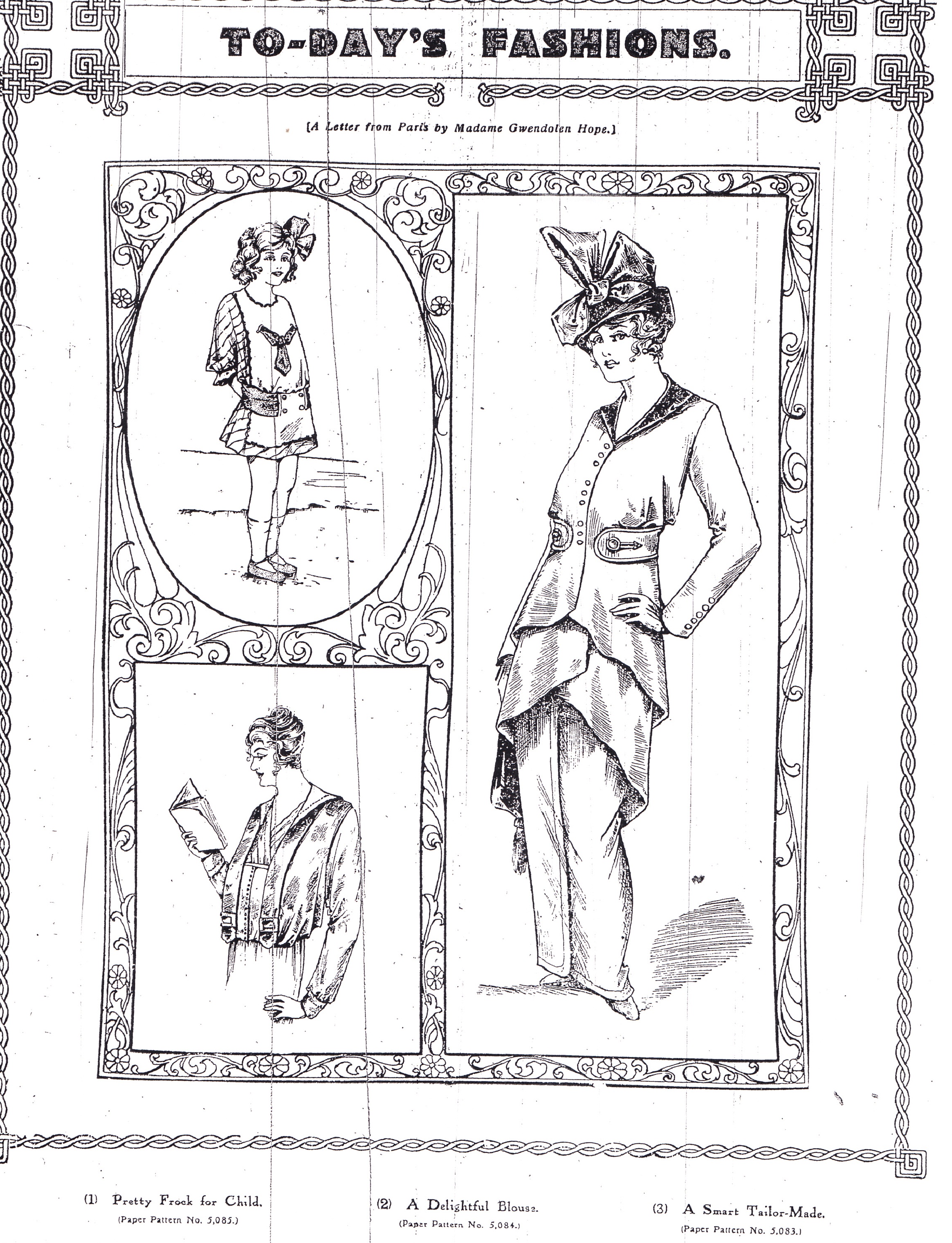
PRETY FROCK FOR CHILD
a pretty little frock for seaside wear is represented here, made up of red and white striped zephyr cut on the cross. There is a pinafore effect which is a novelty likely to please its small wearer, cut from plain white linen. This is buttonholed in red, and the tie and smart little slotted sash match the stripes perfectly, and so does the hair ribbon. The sleeves are loose, being only very slightly drawn in at the elbow, with a ribbon like the sash, tie, and bow, It will be noted that the tie which so smartly completes the pinafore front is drawn through worked slots, and knotted loosely.
A DELIGHTFUL BLOUSE
Depicted here we have a very smart blouse in shell-pink crepe de chine. The trimming consists of the small pearl buttons down the centre. The dainty collar, the cuffe, and the folded vest are of spotted ecru net, and the buckles are of mother-o’-pearl to match the buttons. It will be noted that the waist line is about in the place where Nature intended it, and that a considerable amount of pouch is permitted. The sleeves are set in the shoulder, and are quite long.
SMART TAILOR-MADE
In the Illustration is shown the much-favoured double tunic coat, made of tussore. The accompanying collar is of the satin, and the buttons are covered with tussore. The delightful hat to accompany the costume is in tete-de-negre straw and is trimmed with cherry-red ribbon. It will be noted that the skirt is rather severely plain with a seam up the centre front. The coat is really the feature, and is completed by a three-quarter belt and huge buttons and simulated loops. Altogether a most useful and practical costume for general wear when the days are too warm to allow the use of the ever popular lingerie frock.
Blackburn Weekly Telegraph 15th August 1914
BLACKBURN’S HOLIDAY AT HOME
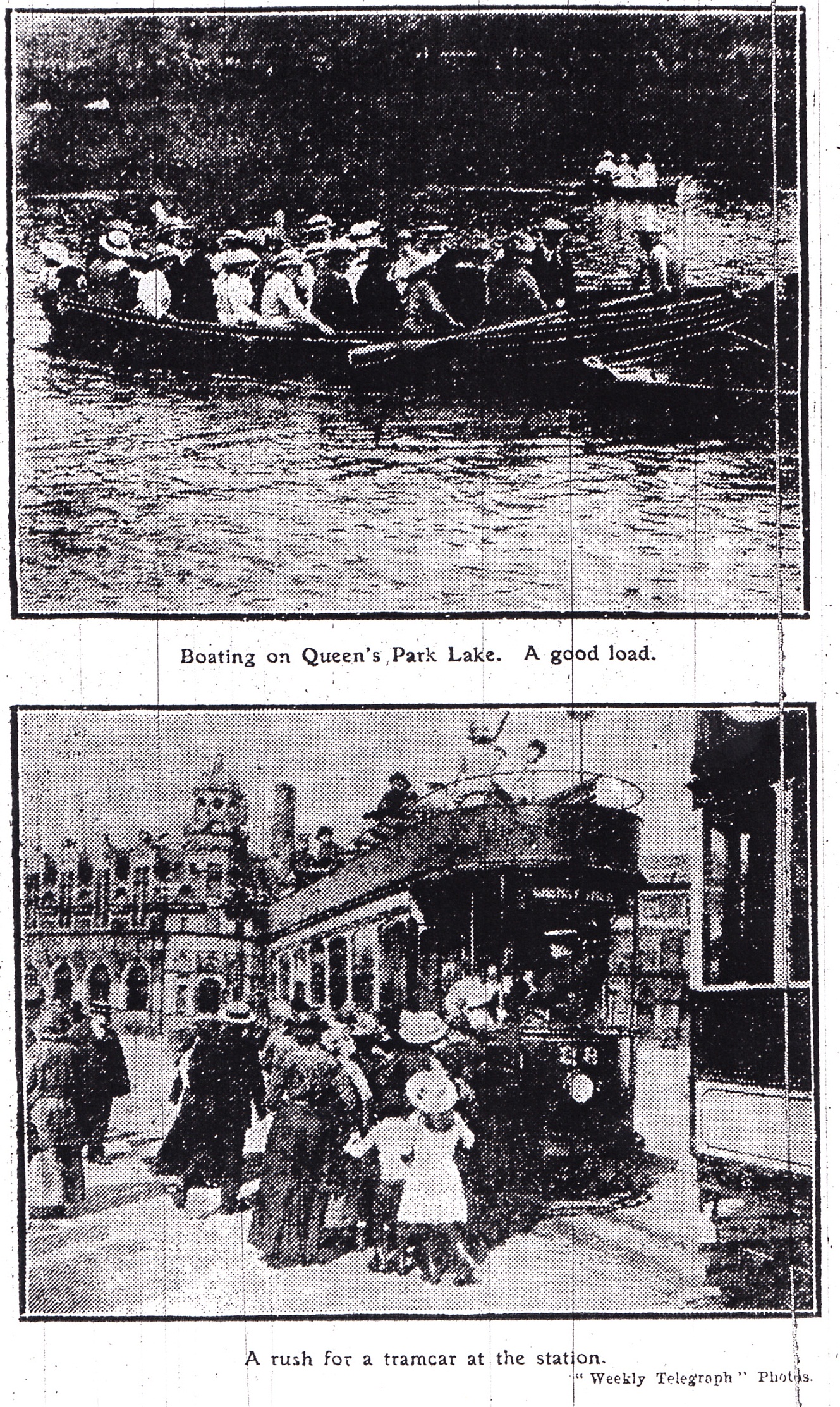
Those who had said that people, having saved their money, would go away for their holidays whatever threatened, would have received a surprise had they gone to Blackburn Railway station on Saturday morning. Everywherethere were unmistakable signs that folks were staying at home. Te o’clock is usually the time for seeing the annualexodus in its numerical impressiveness, its gaiety, and the height of its bustle, for at that time traffic has become somewhat congested, and those whom the crowded trains have perforce left behind are being reinforced by those who have breakfasted before starting out. The result has been packed platforms, thronged subways and an entrance alive with vehicular traffic. At that hour a week to-day, however, the station possessed none of the customary features of the “Great Exodus.” Cabmen were idle, and temporarily forsaking the protection of their shelter were standing in the pouring rain looking for “fares” that did not come. This unemployment was not due to the success of their rival, the taxi, but rather to the dearth of holiday-makers, and possibly to the spirit of economy which possessed even those who were going away. It must be a long time since the “cabby” had such a lean harvest. One was able to walk along the passages with comfort, while it was possible to perambulate the platforms themselves without being in danger of losing one’s temper because of the jostling. Excursionists had been arriving since about seven o’clock but the service of trains, though not so liberal as on previous occasions had been quite adequate to convey them to their destinations without leaving disappointed ones behind to wait “for the next.” For the most part of the day things seemed no brisker than on an ordinary Saturday afternoon. Obviously people had heeded the warnings to sacrifice their pleasure in order to prepare for the possibilities of the war. The character of the trippers was instructive in this respect. They were chiefly of the age when distress in the distance is lightly thought of, and there were comparatively few parents with their young children. For these the spectre of want had been too fearsome, and they had prudently stayed at home with, doubtless a promise that the youngsters should go to Blackpool for the day. Striking as was the contrast regarding numbers, it was even more pronounced respecting the demeanour of the crowd. The joyous agitation, the happy-go-lucky spirit that are ordinarily such conspicuous characteristics were almost entirely absent. The excursionists were just pleasant, without the exuberance of former years. Possibly the war and all that it might mean was weighing more heavily upon them than they themselves realised, or was it that many were going away under some sense of disappointment because they were not able to go to the place of their original choice and the one that had made so bright their expectations. Really there were few resorts one could visit on excursion terms. One might go to Blackpool, Southport, Isle of Man, Liverpool, at cheap rates, but for many places usually prominent in holiday programmes there were only tourist or ordinary tickets available, and at times like this these were prohibitive. In a case like that of Morecambe the tourist fare was little more than the long date excursion, and, of course, a large number availed themselves of this. The hardship was, however, that one had to pay tourist prices even for the day or half-day trip. In the matter of the number going away, appearances have not been deceptive. At one agency the takings have amounted to about £2,000 whereas in normal circumstances they would have reached £5,000, while another agency reported their own bookings to Morecambe were fewer by seven hundred than last year.
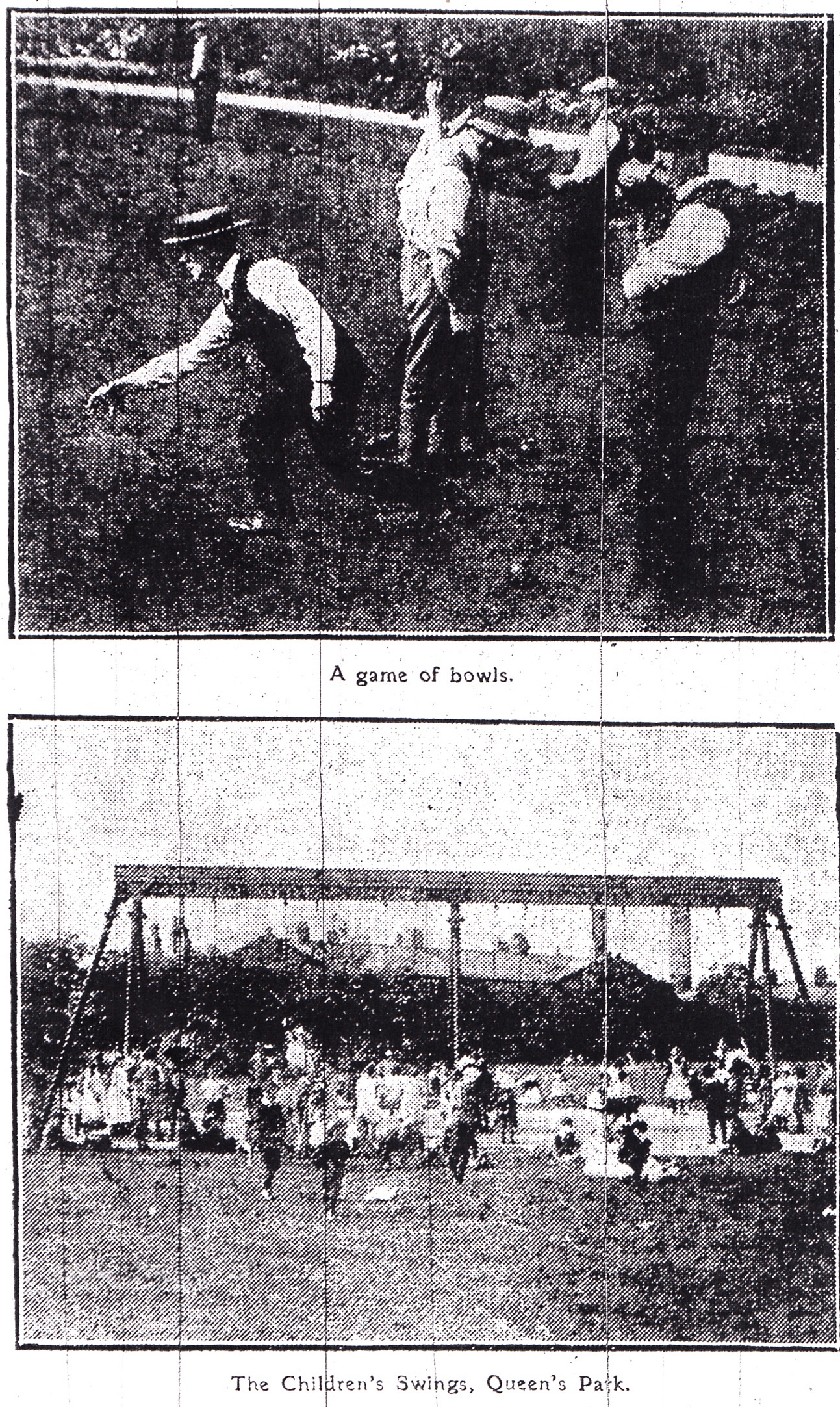
The stay-at-homes have been able to pass their time pleasantly enough, and probably a good many have realised as never before the attractions of the town and district. It was gratifying to find that the charms of the Ribble Valley have been amply exploited, for in such delightful weather as there has been during the week few places further afield yield such quiet enjoyment as those picturesque spots along the Ribble. The Parks have been crowded. Any day and almost any hour one might have found groups of happy children in the Preston-road Park. Most of them had brought their meals, and were as merry at their “parties” as they called them as they would have been on the sands. Queen’s Park, however, claims some superiority in the matter of facilities for diversion. There you may boat or bowl and the opportunities to do so have been fully taken advantage off. The main thoroughfares, instead of being deserted as formerly, have been crowded promenades.
Stories Taken From The Blackburn Weekly Telegraph For August 1914
FILLING THE LARDER
RISING PRICES OF FOODSTUFF
Blackburn householders have had to pay considerably increased prices for their commodities this week. Wholesale provision dealers have experienced the greatest difficulty in securing supplies, and orders have only been met in limited quantity. They have endeavoured to supply each retail customer with some portion of his orders, but the shortage of supply, coupled with increased demand, as naturally had the result of forcing up prices. At a meeting of the Wholesale Grocers’ Association on Wednesday the following resolution was adopted:
“Owing to the war, and the disorganisation of trade and scarcity of supplies, we regret to notify customers that we cannot allow further credit, as merchants have insisted on cash payments before delivery of goods.”
At the same meeting it was unanimously decided to advice the public to use their holiday money wisely, and to buy only such classes of as are necessary.
The corn millers in the town have experienced a great demand for sacks of flour from private customers, and at a meeting on Tuesday the Master Bakers’ Association decided to increase the price of bread a halfpenny per loaf. The following retail prices were quoted yesterday: Butter, 1s 6d per pound, bacon, 1s 2d to 1s 6d per pound, ham, 1s 6d, cheese, 10d, sugar 4d per pound, and flour, 3s 6d per stone.
Many firms have had to part with horses the demands made by officials being proportionate to the number kept.
SCOUT YARNS
BY LIEUT.-GENERAL
ROBERT BADEN-POWELL
IN TIME OF WAR
Sir Robert Baden-Powell, the chief scout has issued the following appeal to village lads;
“Boys of Britain,--Don’t go about waving flags because there is a war. Any ass can do that. And don’t stay idle doing nothing—that is almost worse. Come and do something for your country. She needs your help. The Boy Scouts are now a Service in all parts of the kingdom. Come and Join the nearest Troop in your district. And do duty like a man.”
Though only mobilised on Sunday, the Scout Service is already providing the Admiralty with 1,200 Scouts and 3,000 are assisting the police. Other public offices in London have requisitioned their aid, and headquarters have received many gratifying letters written in appreciation of the service. Another party have been sent to York House in connection with the National Fund. The American Committee have asked for and received sixteen Scout cyclists. The Hon. Miss Morgan, whose brother is equipping a hospital ship, rang up for eight Scouts to requisition hospital stores in the West End. To show how perfectly the service is organised it may be mentioned that after six o’clock on Monday night a party of Scouts was telegraphed for to headquarters for duty on the East Coast. The East London district was at once communicated with, and by seven o’clock a telegram announced at Victoria-street that the boys had already left from Liverpool-street. An amusing illustration of the versatility of the Boy Scout followed the receipt of a message from the War Office mess to the effect that there was a great shortage of waiters and waitresses, and asking if the service could help. The work, it was pointed out, was hard and responsible, and therefore probably not of a kind to be undertaken by the boys, but it was suggested that they might find a supply of regular waiters. The service, however, was equal to the call, for four six-foot Scouts were immediately despatched.
A few days ago the Chief-Scout Commissioner for Suffolk in securing 1,000 Scouts to aid local civil or defence authorities in such duties as collecting or distributing information re supplies, billeting, guarding culverts and telegraphs, assisting police, fire brigades and ambulances, and in poor relief distribution. The response of Suffolk is being repeated all over the country, the lads entering upon their duties with a zest that is infectious.
The Scouts have already done service, or preparing to take on such duties as
Signallers;
Wireless telegraphists;
Soup kitchen organisers;
First-aid treatment;
Guides;
Coastguards assistants;
Despatch riders;
Watching telephone and telegraph wires;
Cycling across country with emergency news;
The corps of wireless operators and signallers number 120, and every one of them has volunteered. The cyclists’ camps are ever watchful. Cycles and motor-cycles are to be seen outside 116, Victoria-street London, at all hours, and Scouts squat in corridors and offices ready to go anywhere and do anything that a lithe, alert, and intelligent youth can be expected to do.
The establishment of an Old Scouts Corp is now under consideration, but actual organisation will not take place until Lord Kitchener has obtained 100,000 men.
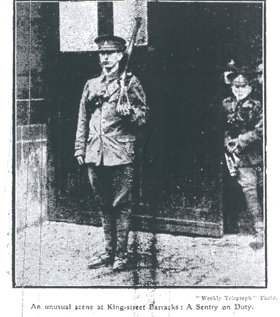
THIS CONCERNS YOU
STRIKING REGULATIONS FOR THE NATION
A Supplement to the “London Gazette” details the measures which may be taken by naval and military authorities under the new Defence of the Realm Act*. The most important regulations are:
Any building may be seized by the military authorities and, if necessary, destroyed.
No one may spread reports likely to alarm the civilian population.
No one may loiter near a railway bridge.
No one my give or sell liquor to a soldier on duty.
The authorities are also given the right, among other things, to
Take possession of any land and construct military works, including roads, thereon, and to remove any trees, hedges, and fences therefrom.
Take possession of any building or other property, including works for the supply of gas, electricity, or water, and of any sources of water supply.
Take such steps as may be necessary for placing any building or structures in a state of defence.
Cause any building or structures to be destroyed, or any property to be moved from one place to another, or to be destroyed.
Order the inhabitants of any area near a defended harbour to leave the neighbourhood.
Order public-houses near any defended harbour to close between specified hours.
Order people at a defended harbour to remain indoors between specified hours, unless they have a permit allowing them to leave their homes.
Enter by force any building or ship and seize anything which there is reason to suspect is intended for any purpose prejudicial to the public safety.
It Is announced that ordinary civil offences will be dealt with by the civil tribunals, but a number of offences will be dealt with by courts-martial. These offences include:
Unlawfully publishing naval or military information which might be useful to the enemy.
Making photographs, plans, sketches, or models of naval or military works.
Tampering with telegraph or telephone wires.
Giving or selling Liquor to a member of His Majesty’s Forces when on sentry or other duty.
Damaging a railway or railway bridge.
Spreading reports, by word of mouth or writing near a defended harbour likely to create disaffection or alarm among the troops or civilian population.
Lighting a fire on a hill near a defended harbour without permission.
Courts-martial will have power to inflict sentence of penal servitude for life.
The regulations are prefaced by the declaration that ordinary avocations of life and enjoyment of property will be interfered with as little as may be permitted by exigencies of the measures required to be taken, and ordinary civil offences will be dealt with by civil tribunals in the ordinary course of law.
Any building may be seized by the military authorities and, if necessary, destroyed.
No one may spread reports likely to alarm the civilian population.
No one may loiter near a railway bridge.
No one my give or sell liquor to a soldier on duty.
The authorities are also given the right, among other things, to
Take possession of any land and construct military works, including roads, thereon, and to remove any trees, hedges, and fences therefrom.
Take possession of any building or other property, including works for the supply of gas, electricity, or water, and of any sources of water supply.
Take such steps as may be necessary for placing any building or structures in a state of defence.
Cause any building or structures to be destroyed, or any property to be moved from one place to another, or to be destroyed.
Order the inhabitants of any area near a defended harbour to leave the neighbourhood.
Order public-houses near any defended harbour to close between specified hours.
Order people at a defended harbour to remain indoors between specified hours, unless they have a permit allowing them to leave their homes.
Enter by force any building or ship and seize anything which there is reason to suspect is intended for any purpose prejudicial to the public safety.
It Is announced that ordinary civil offences will be dealt with by the civil tribunals, but a number of offences will be dealt with by courts-martial. These offences include:
Unlawfully publishing naval or military information which might be useful to the enemy.
Making photographs, plans, sketches, or models of naval or military works.
Tampering with telegraph or telephone wires.
Giving or selling Liquor to a member of His Majesty’s Forces when on sentry or other duty.
Damaging a railway or railway bridge.
Spreading reports, by word of mouth or writing near a defended harbour likely to create disaffection or alarm among the troops or civilian population.
Lighting a fire on a hill near a defended harbour without permission.
Courts-martial will have power to inflict sentence of penal servitude for life.
The regulations are prefaced by the declaration that ordinary avocations of life and enjoyment of property will be interfered with as little as may be permitted by exigencies of the measures required to be taken, and ordinary civil offences will be dealt with by civil tribunals in the ordinary course of law.
*The Defence of the Realm Act (DORA) was passed in the United Kingdom on 8 August 1914, four days after it entered World War I. It gave the government wide-ranging powers during the war period, such as the power to requisition buildings or land needed for the war effort, or to make regulations creating criminal offences.
From Wikipedia.
From Wikipedia.
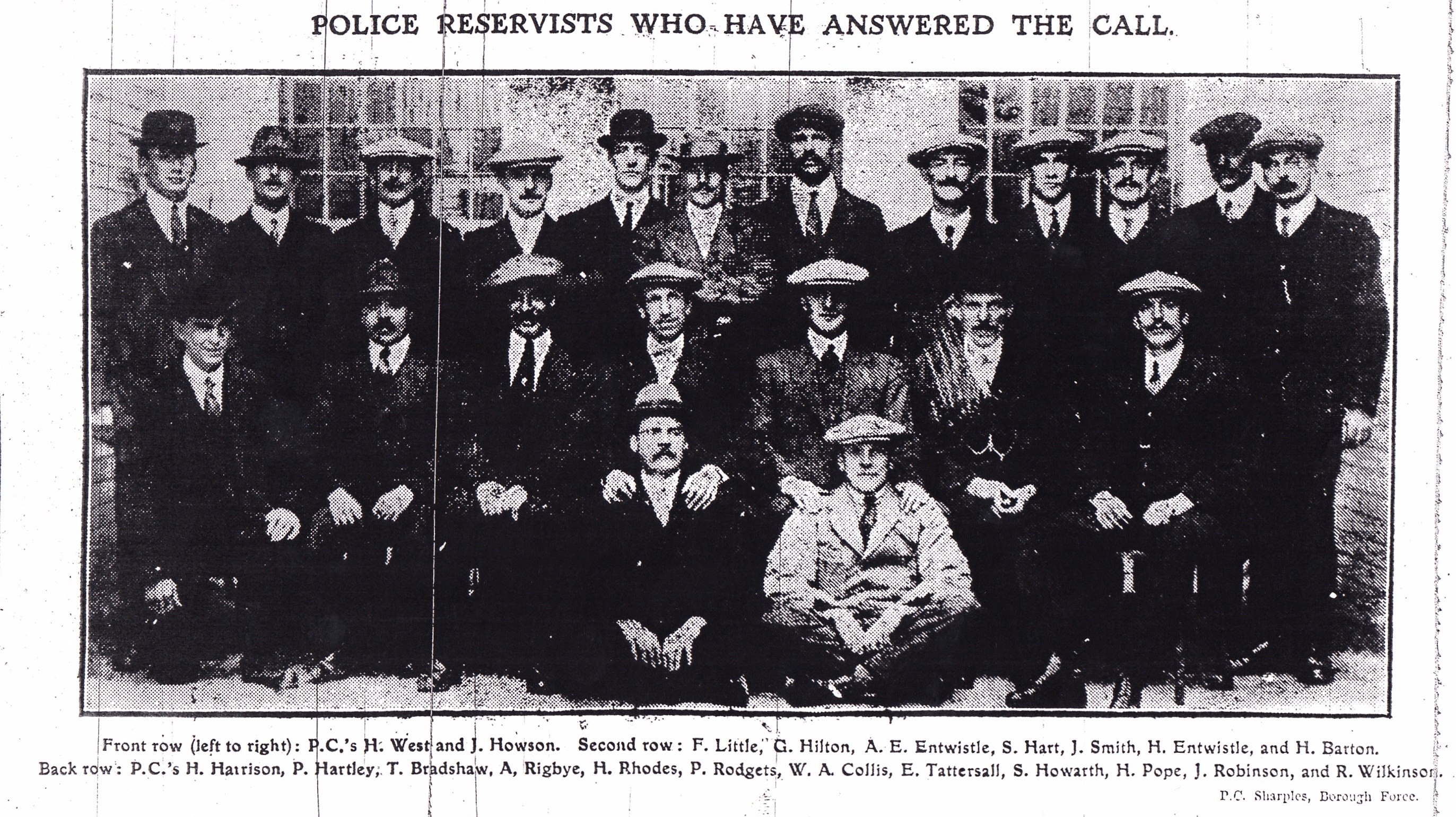
FROM DUTY TO DUTY
The Blackburn Borough Police Force has been depleted by 22 men, who rejoined their regiments at such remote places as Chelsea, Athlone, Dublin, Edinburgh, Leth, and Pembroke.
The men left on Wednesday morning after assembling in the parade yard where they were addressed by Chief Constable Hodson. Mr. Hodson wished them “Good luck” and a safe return and shock hands with each man. Twenty eight postmen and one clerk in the post office hae responded to the call, and five members of the Blackburn County Police, six members of Church County Police, and three railway men are numbered among the reservists>
Members of the Blackburn section of “D” Squadron of the Duke of Lancaster’s Own Yeomanry left on Wednesday morning having received orders to proceed to the north of Ireland.
Sergeant McDonald, recruiting officer, has had an exceedingly busy time. His offices in Ainsworth-street have been crowded by reservists, with a multitude of questions to ask and papers to be signed and a number of recruits have come forward.
The Blackburn Borough Police Force has been depleted by 22 men, who rejoined their regiments at such remote places as Chelsea, Athlone, Dublin, Edinburgh, Leth, and Pembroke.
The men left on Wednesday morning after assembling in the parade yard where they were addressed by Chief Constable Hodson. Mr. Hodson wished them “Good luck” and a safe return and shock hands with each man. Twenty eight postmen and one clerk in the post office hae responded to the call, and five members of the Blackburn County Police, six members of Church County Police, and three railway men are numbered among the reservists>
Members of the Blackburn section of “D” Squadron of the Duke of Lancaster’s Own Yeomanry left on Wednesday morning having received orders to proceed to the north of Ireland.
Sergeant McDonald, recruiting officer, has had an exceedingly busy time. His offices in Ainsworth-street have been crowded by reservists, with a multitude of questions to ask and papers to be signed and a number of recruits have come forward.
BLACKBURN TROOPS RETURN FROM CAMP
The 1st East Lancashire Brigade Royal Field Artillery (Territorial Forces), in accordance with the orders of the War Office, struck camp at Bellingham, Northumberland, on Monday, and returned to the respective battery headquarters in Blackburn, Church and Burnley.
The brigade only reached Bellingham early on Sunday morning. Sunday was spent in camp in order, but at eight o’clock on Monday morning just about twenty-four hours after arrival, orders were received to return immediately to headquarters. Arrangements were at once made with the railway companies, and at two o’clock the homeward journey had been commenced. The Blackburn battery and ammunition column reached the town about ten o’clock at night. The men had a hearty reception, and marched from the station to the King-street Drill Hall, with a band playing, and accompanied by cheering crowds.
The Blackburn, Accrington, Darwen, and Clitheroe contingent of the East Lancashire Regiment (Territorial Forces), numbering about 800, left Carnarvon, where they had gone for their annual training, and arrived at their respective headquarters on Monday afternoon. The men had had one night under canvas, and they left by special trains about seven o’clock in the morning. A large crowd had gathered in and around Blackburn railway station, and the men cheered loudly as the train steamed into the station.
The 1st East Lancashire Brigade Royal Field Artillery (Territorial Forces), in accordance with the orders of the War Office, struck camp at Bellingham, Northumberland, on Monday, and returned to the respective battery headquarters in Blackburn, Church and Burnley.
The brigade only reached Bellingham early on Sunday morning. Sunday was spent in camp in order, but at eight o’clock on Monday morning just about twenty-four hours after arrival, orders were received to return immediately to headquarters. Arrangements were at once made with the railway companies, and at two o’clock the homeward journey had been commenced. The Blackburn battery and ammunition column reached the town about ten o’clock at night. The men had a hearty reception, and marched from the station to the King-street Drill Hall, with a band playing, and accompanied by cheering crowds.
The Blackburn, Accrington, Darwen, and Clitheroe contingent of the East Lancashire Regiment (Territorial Forces), numbering about 800, left Carnarvon, where they had gone for their annual training, and arrived at their respective headquarters on Monday afternoon. The men had had one night under canvas, and they left by special trains about seven o’clock in the morning. A large crowd had gathered in and around Blackburn railway station, and the men cheered loudly as the train steamed into the station.
BLACKBURN RELIEF FUND
THE BOER WAR BALANCE
The Mayor of Blackburn [John Higginson] at the Town Council said that there was now only one dependant—the mother of a soldier who was killed—on the fund generously subscribed for by the townspeople during the Boer War of 1899. He proposed to call a meeting of the subscribers to re-form the committee and ask their consent to divert the balance to that fund for the benefit of persons in need of help in consequence of the present war. He sincerely hoped that it would not be necessary to make any further appeal to the public.
THE BOER WAR BALANCE
The Mayor of Blackburn [John Higginson] at the Town Council said that there was now only one dependant—the mother of a soldier who was killed—on the fund generously subscribed for by the townspeople during the Boer War of 1899. He proposed to call a meeting of the subscribers to re-form the committee and ask their consent to divert the balance to that fund for the benefit of persons in need of help in consequence of the present war. He sincerely hoped that it would not be necessary to make any further appeal to the public.
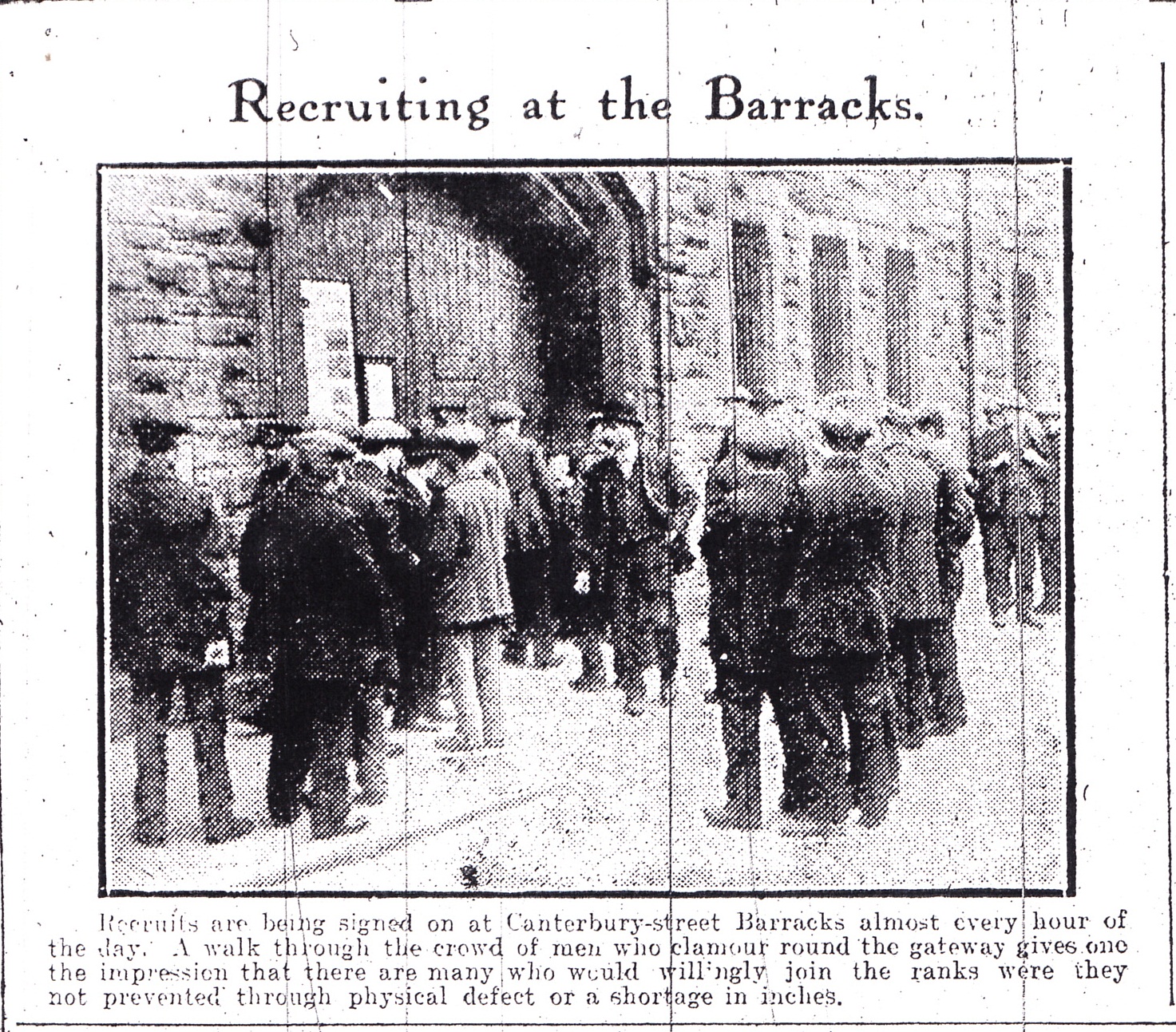
ARMY RESERVISTS IN BLACKBURN
The calling up of the army reserves in pursuance of the measures being adopted by the Government will immediately over a thousand families in Blackburn. The army reserve is composed of regulars who enlist for so many years’ service with the colours, and many in the reserve, seven and five in the case of the infantry. They are liable to be called upon at any time of national danger such as the present, and to be sent abroad if necessary. Taking an average of the reservists who have re-engaged at the recruiting office at Blackburn since 1910, there are about 1,000 residing in the town. Of these 418 enlisted in Blackburn, the others having come to reside here since. In addition to the army reserves, there are the special reserves, liable to be called on in times of international danger or war for the defence of the country. Since 1910 six hundred and fifty-six men have been accepted in Blackburn for this branch of service.
The calling up of the army reserves in pursuance of the measures being adopted by the Government will immediately over a thousand families in Blackburn. The army reserve is composed of regulars who enlist for so many years’ service with the colours, and many in the reserve, seven and five in the case of the infantry. They are liable to be called upon at any time of national danger such as the present, and to be sent abroad if necessary. Taking an average of the reservists who have re-engaged at the recruiting office at Blackburn since 1910, there are about 1,000 residing in the town. Of these 418 enlisted in Blackburn, the others having come to reside here since. In addition to the army reserves, there are the special reserves, liable to be called on in times of international danger or war for the defence of the country. Since 1910 six hundred and fifty-six men have been accepted in Blackburn for this branch of service.
MOTORISTS AND THE WAR
Mr. James Campbell, Kensington-place, Blackburn, secretary of the Lancashire Automobile Club, has sent out a circular to members as following:
“n view of the grave position of affairs the Royal Automobile Club are obtaining for the War office the names and addresses of motorist who are willing to place their cars at the disposal of the military authorities for home or foreign service, Full details of the scheme will be obtained as early as possible and communicated to those who are willing to assist. In the meantime my committee will be obliged if those members who are willing to help will kindly fill in and return to me as early as possible the enclosed form.”
Mr. Campbell will also be pleased to hear from non-members who are willing to assist. The particulars asked for are: Horse-power and make of car; seating accommodation additional to driver; whether car is volunteered for home or foreign service; district in which the owner would prefer the car to be used; whether driver will be supplied.
Mr. James Campbell, Kensington-place, Blackburn, secretary of the Lancashire Automobile Club, has sent out a circular to members as following:
“n view of the grave position of affairs the Royal Automobile Club are obtaining for the War office the names and addresses of motorist who are willing to place their cars at the disposal of the military authorities for home or foreign service, Full details of the scheme will be obtained as early as possible and communicated to those who are willing to assist. In the meantime my committee will be obliged if those members who are willing to help will kindly fill in and return to me as early as possible the enclosed form.”
Mr. Campbell will also be pleased to hear from non-members who are willing to assist. The particulars asked for are: Horse-power and make of car; seating accommodation additional to driver; whether car is volunteered for home or foreign service; district in which the owner would prefer the car to be used; whether driver will be supplied.
HORSES COMMANDEERED AT BLACKBURN
Colonel W. Sandman V.D. of Church, formerly commanding officer of the 1st East Lancashire Brigade Royal Field Artillery (Territorials), and Alderman A. Nuttall J.P. of Blackburn have been busy during the week acting under instructions from the War Office, purchasing about a hundred horses, with harness, and a number of wagons, etc., required by the Brigade. Many of the horses were selected from local livery stables whose proprietors are paid an annual fee as a “retainer”, giving the War Office the right of taking a certain number of horses for service. Other horse-keepers, however, are liable to be called upon to part with such animals which may be selected by the appointed officials. If the price offered is not satisfactory to the owner, the County Court Judge is the referee to decide the dispute, the horses being meanwhile taken.
Colonel W. Sandman V.D. of Church, formerly commanding officer of the 1st East Lancashire Brigade Royal Field Artillery (Territorials), and Alderman A. Nuttall J.P. of Blackburn have been busy during the week acting under instructions from the War Office, purchasing about a hundred horses, with harness, and a number of wagons, etc., required by the Brigade. Many of the horses were selected from local livery stables whose proprietors are paid an annual fee as a “retainer”, giving the War Office the right of taking a certain number of horses for service. Other horse-keepers, however, are liable to be called upon to part with such animals which may be selected by the appointed officials. If the price offered is not satisfactory to the owner, the County Court Judge is the referee to decide the dispute, the horses being meanwhile taken.
LADIES AND HOSPITAL WORK
The Blackburn detachments of the Red Cross Society and St. John’s Ambulance Brigade have this week taken over the Blakey Moor School and been busy preparing it for use as a hospital during the war, should the occasion arise. Nearly two hundred ladies have assembled each day to perceive instructions as to their places and duties in case of emergency, and it can confidently be stated that the work done at the Blackburn hospital will be second to none. The strength of the Blackburn sections calls upon them to provide two hundred beds in time of war, and nearly the whole of this number have already been promised. Mrs. Atkins is commandant of the joint sections, under her being Dr. Aitkin and Dr. Moffat, in charge of the Red Cross Society members, and Dr. Jones in charge of the Ambulance Brigade.
A section of the school is being fitted up in order that the nurses may be kept in regular practice, and thus be fully prepared when they are needed for actual service.
The lady president of the Red Cross Society is Mrs. F. T. Thomas and Alderman S. Crossley has consented to act as chairman. A personal appeal for flannel shirts for day and night is being made to men connected with the various social, political, and sports clubs, and the committee would be very glad to receive them from all quarters. The beds and equipment have been promised.
Miss Wolfenden, St Michael’s Vicarage, hon. Secretary of the local Girl Guides, has in response to an appeal from headquarters, offered the voluntary services of the Guides to the Red Cross detachment and the St. John’s Ambulance Brigade, in connection with the hospital. Mrs. Aitkin has thankfully accepted the offer. The guides will undertake cooking, needlework, and laundry work if required, and will also give household assistance to families in distress or in case of illness. A working party will shortly be formed for making garments which will be of service to soldiers and sailors, their families, the hospital, and those among the poorer classes of the community who will suffer from any stress that may arise. Gift a of material will be gratefully received.
Mr. John Duckworth, “The Knowle,” Wilpshire has placed his large recreation room and garage at the disposal of the authorities, to used as a hospital or nursing home for convalescents.
The following appeal of the Hospital Equipment Committee of the Blackburn Division of the British Red Cross Society, signed by Mrs. F. T. Thomas, vice-president, has been sent to all golf and social and political clubs in Blackburn, Pleasington and Wilpshire; “The committee have been requested to provide an emergency hospital in Blackburn with 200 beds for the sick and wounded. The following articles are immediately required: 200 men’s nightshirts, 200 men’s woollen shirts, 200 men’s day shirts. Will every member of your club kindly supply one or more of these—they need not be new ones—and leave them with the steward, is empowered to receive them and forward them to a central depot. Should any articles not be used, the committee will dispose of them amongst other war hospitals or convalescent homes. The shirts to be sent in before August 29.”
The Blackburn detachments of the Red Cross Society and St. John’s Ambulance Brigade have this week taken over the Blakey Moor School and been busy preparing it for use as a hospital during the war, should the occasion arise. Nearly two hundred ladies have assembled each day to perceive instructions as to their places and duties in case of emergency, and it can confidently be stated that the work done at the Blackburn hospital will be second to none. The strength of the Blackburn sections calls upon them to provide two hundred beds in time of war, and nearly the whole of this number have already been promised. Mrs. Atkins is commandant of the joint sections, under her being Dr. Aitkin and Dr. Moffat, in charge of the Red Cross Society members, and Dr. Jones in charge of the Ambulance Brigade.
A section of the school is being fitted up in order that the nurses may be kept in regular practice, and thus be fully prepared when they are needed for actual service.
The lady president of the Red Cross Society is Mrs. F. T. Thomas and Alderman S. Crossley has consented to act as chairman. A personal appeal for flannel shirts for day and night is being made to men connected with the various social, political, and sports clubs, and the committee would be very glad to receive them from all quarters. The beds and equipment have been promised.
Miss Wolfenden, St Michael’s Vicarage, hon. Secretary of the local Girl Guides, has in response to an appeal from headquarters, offered the voluntary services of the Guides to the Red Cross detachment and the St. John’s Ambulance Brigade, in connection with the hospital. Mrs. Aitkin has thankfully accepted the offer. The guides will undertake cooking, needlework, and laundry work if required, and will also give household assistance to families in distress or in case of illness. A working party will shortly be formed for making garments which will be of service to soldiers and sailors, their families, the hospital, and those among the poorer classes of the community who will suffer from any stress that may arise. Gift a of material will be gratefully received.
Mr. John Duckworth, “The Knowle,” Wilpshire has placed his large recreation room and garage at the disposal of the authorities, to used as a hospital or nursing home for convalescents.
The following appeal of the Hospital Equipment Committee of the Blackburn Division of the British Red Cross Society, signed by Mrs. F. T. Thomas, vice-president, has been sent to all golf and social and political clubs in Blackburn, Pleasington and Wilpshire; “The committee have been requested to provide an emergency hospital in Blackburn with 200 beds for the sick and wounded. The following articles are immediately required: 200 men’s nightshirts, 200 men’s woollen shirts, 200 men’s day shirts. Will every member of your club kindly supply one or more of these—they need not be new ones—and leave them with the steward, is empowered to receive them and forward them to a central depot. Should any articles not be used, the committee will dispose of them amongst other war hospitals or convalescent homes. The shirts to be sent in before August 29.”
September 1914
Blackburn Weekly Telegraph 5th September 1914
WAR ITEMS
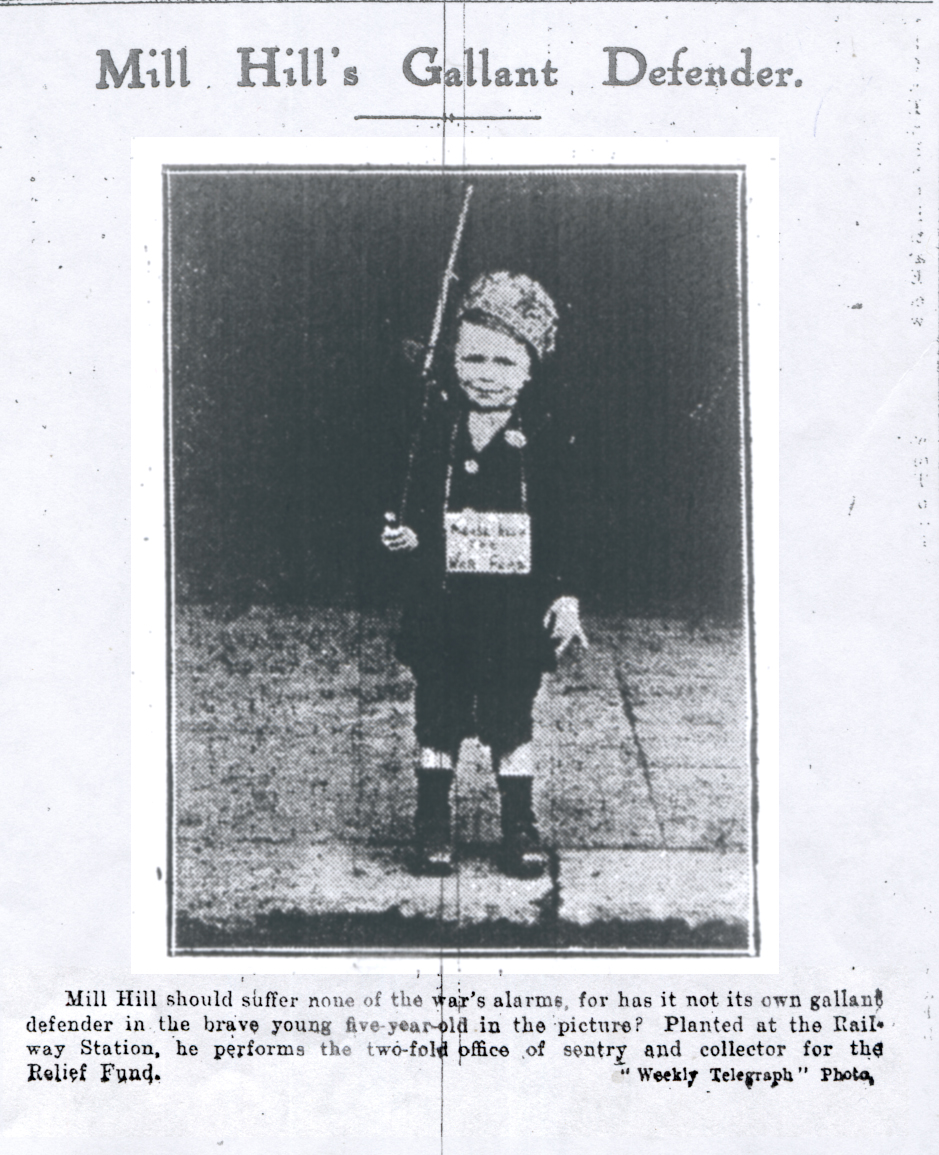
Wallpaper Limited, Messrs A. Carus and Sons (Hoddlesden) and Messrs Pickup and Holden (Bank Top Mill) are offering bounties of £2 to each of their workpeople who will join the Army, and are guaranteeing that they shall have their situations again on returning from the war.
The workers at the Corporation gasworks have agreed to make weekly collections during the period of the war, and Mr. A. H. Smith, the chief engineer will lead the list with 7s 6d per week.
The Darwen and Mostyn Ironworks Company are paying 10s a week to the families of reservists in their employment who have re turned to the colours. The directors of the Company have paid £1,000 to the Prince of Wales’s Fund in London.
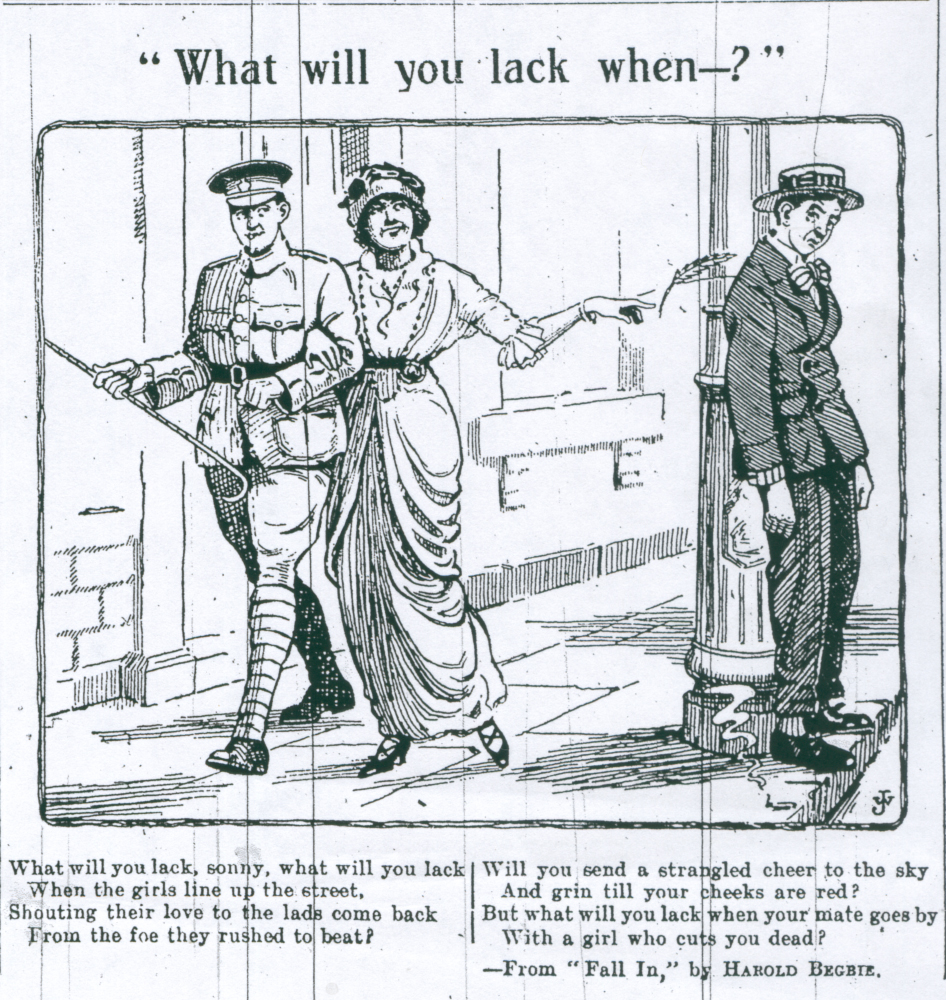
The recruiting in the town has been responsible for a great rush on the part of men to serve their country. Up to last week-end there had been about 90 recruits enrolled, but since then the staff at the recruiting office has had to be increased. On Wednesday nearly a hundred men submitted themselves to the doctor, and 83 were passed. During Thursday there were 63 enlistments and yesterday the staff were again kept busy with applicant.
Speaking at Darwen last night, Mr. F. Hargreaves, secretary of the Lancashire Football Association said it had been asked why all the football players and referees did not join the Army, but it might be asked “Why did not all the people in other businesses also join.” Eleven clubs in Lancashire had been disbanded owing to the war, three because all their players had enlisted, and others because their grounds had been taken for military purposes.
The Darwen police on Thursday took into custody a German Army reservist named Briann Brunn Johnke, at his lodgings in Bank-street, and he was conveyed to the military camp at Lancaster. Johnke is a music hall artiste and a member of a star acrobatic turn. During this week he has been giving a performance in the town, and was arrested just as he was about to leave his lodgings for the entertainment. He was conveyed to Lancaster by Detective-sergeant Cairns.
Blackburn Weekly Telegraph 12th September 1914
English Made Corsets
A manufacturer in the Cotton trade appeals on behalf of an industry which may prove another prosperous branch to Lancashire’s cotton trade. Most of the *coutil which corsets are made of comes from Germany. Many English-made corsets are made of German cloth. The women of England should insist on being supplied with English-made corsets by firms giving a guarantee that English coutil is used in their manufacture. By so doing they will help to improve and build to a larger extent another branch of Lancashire’s industry.
*Coutil is a woven cloth produced specifically for making corsets
Recruiting And Football
My pride at being a Britisher, writes Mr. W. Woolley, JP, Blackburn is greater than at any period of my life; to see the glorious response made by our young men to the call of King and country rouses within one feelings of admiration difficult to put into writing and at this time every home in our land may feel proud if represented either by father, brother or son in the ranks of our gallant men on land or sea.
I heartily agree with and appreciate the facilities offered by the committee of football clubs in making arrangements for rifle practice on the various football grounds, also in affording facilities for addresses to be givento spectators before play begins and during the interval to lay before our young men the splendid opportunity that they have of serving their country at this time. But I differ entirely with those who wish to disband the game during the war. The football committees have already paid thousands of pounds in wages and are under contract to pay between £150,000 and £200,000 during the forthcoming season. That in itself is not a little matter, yet I feel that there is even a more important reason. We must have the workers equally with the fighters. These men will require diversion of mind, and so many of them look forward with keen interest to the Saturday’s football match that unless you can substitute something equally interesting and diverting it would I fear, in thousands of cases lead them to seek diversion by entering public-houses for the discussion of the war, which would mean wages spent in drink, homes made miserable, men demoralised, and the whole tone of our nation lowered. Go on recruiting with all the earnestness you possess, but do not stop football. Far better results would follow by shortening the hours of sale of all places that sell intoxicating drinks

Blackburn Weekly Telegraph 19th September 1914
THE BATTLE OF MONS,
DESCRIBED BY A WOUDED BLACKBURNIAN
Private James Harkin, of the Royal Scotch Fusiliers, whose home is at 19 Rockcliffe-street, Blackburn, has escaped from the terrible fighting at Mons with a comparatively slight wound in the left hip, and is now enjoying a few days’ furlough at home. He is well known in local football circles, having been a member of the St. Mary’s Club in the Amateur League.
Harkin has served eleven years in the Fusiliers, and went through the South African War which, by the way, he regards as child’s play in comparison with the present campaign. He left Blackburn on August 8 for Ayr, from which town the regiment moved first to Gosport and then to Southampton, where they embarked for Havre. Their ultimate destination was unknown. All that was clear was that they were all keen to be in the firing line. They had as colleagues the Northumberland Fusiliers, the Royal Irish Rifles and the Lincolns, among others.
At the very outset they were reminded –if any reminder were needed –that they were not out for picnic. For fifteen hours after they landed there was an incessant and torrential downpour of rain Without tents, or even the waterproof sheets which serve as a substitute the men had a very rough time the first night. Standing in ploughed fields they kept erect as long as they could, but gradually fatigue overcame them. The next day they started on their march to the front. After four days’ hard tramping they reached Mons, tired out owing to the great heat and load of about 80lb which each man had to carry.
The men marched into Mons about 4 o’clock on a Sunday afternoon. A party of fourteen cyclists went out to reconnoitre but only two returned and then the cavalry pickets came in with the news that the enemy’s scouts were advancing. The men entrenched to receive the scouts but found very shortly that they had to face the attack of the German hosts. The foe were allowed to come within short range and then a terrific fire was poured into their ranks. Line after line went down, but so great was their number that the opposing force could not be checked, and it became necessary to retire. It was during this retreat that the British suffered most severely.
The German artillery had an excellent range and did great damage, but the rifle fire of the foe was a very negligible quantity. The German sacrifice of men was enormous. It was impossible to miss them. They came on in a solid mass, and as fast as one rank went down the gaps were filled up.
The Fusiliers were engaged for seven hours in holding a bridge over a canal, but at length the artillery fire became so hot that they had to fall back, and it was during this operation that Private Harkin received his wound. He scarcely felt it at the time, and it certainly did not interfere with the celerity of his retreat. The men were mixed up and separated from their regiments in the rush for cover, the reputation of the Germans not being such as to inspire the wounded with any desire for their company. On this point Private Harkin testifies to the truth of the stories of the barbarous treatment meted hot to the fallen, stating that he has seen a corporal of the R.A.M.C., both of whose hands had been cut off. He had to go into hospital at Beauvais, but the enemy shelled it and blew it up, many wounded perishing. Fortunately he got away in time and was taken on to Amiens and Rouen, and thence to Netley, where he remained until he was fit to take his fourteen days’ furlough. He reached Blackburn on Wednesday, and may be recalled to go to the front any time. He is anxious to have a share in the “final,” and be a member of the army marching to Berlin.
Private Harkin speaks in high appreciation of the kindness of the French, who gave the British soldiers an embarrassing enthusiastic reception. His opinion as to the duration of the war is that it will be either a short one or a very long one. The Germans are deeply halted by the French, and it required thirty British soldiers to guard three German prisoners from the crowd. The captured warriors seemed very pleased to be in the hands of the English, and not at all disappointed at having got out of the fighting. They do not appear to be very enthusiastic about the war, and in some cases, he says, have had to be driven on by officers, who seemed more comfortable at the rear of their men than in the front.
Private Harkin has harrowing stories to tell of the ghastly effects of shrapnel, having seen men blown to pieces and others lose arms and legs. One English “Tommy” twice fetched in wounded men but the third time he did not return from his errand of mercy, being blown to bits. In their retreat the English were followed by women and children who had been driven in front of the Germans and it was a common sight to see a stalwart Khaki warrior trudging along with youngster in his arms or astride his soldiers. The men have no cause to grumble at the way in which they are being looked after. They have good food and plenty of it, and if sometimes things go astray, as in the case of the retreating movement, it is taken as part of the day’s march, and there is very little complaint. The arrangements for the care of the wounded are admirable, and all who had to retire from the fight in its early stages by reason of disablement are anxious to get back to the front as soon as possible. Having had to bear the brunt of the German attack while retreating, they are naturally keen on setting a few accounts now that the tables are being turned.
UPROOTED BY STORM AT BLACKBURN
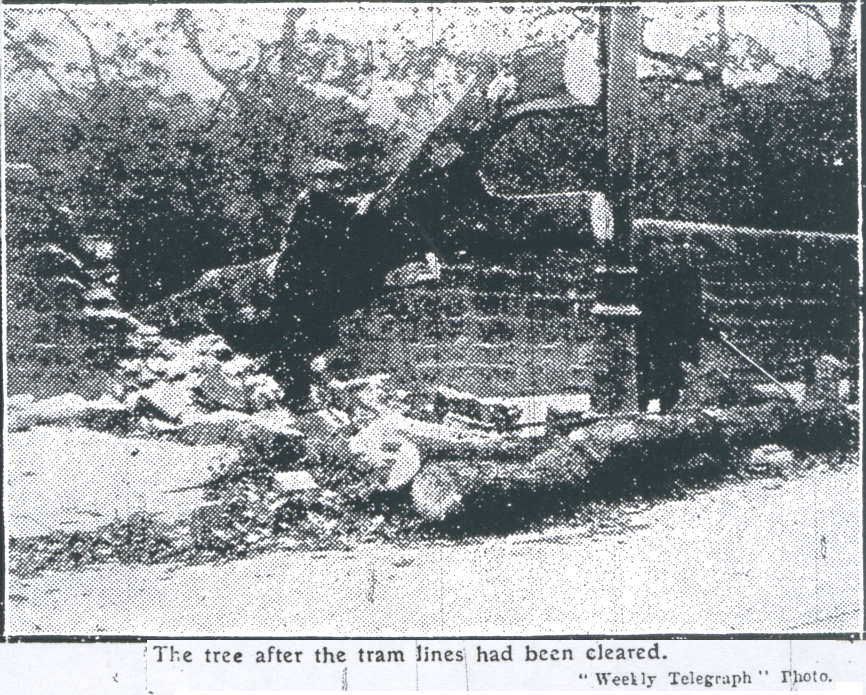
The storm in Blackburn was of quite unusual violence for September, and residents on the hilltops surrounding the town felt its full force. Happily no personal injury or serious damage to property is reported, but one or two mishaps were of an alarming character. Shortly after eight o’clock on Monday night a huge tree in Witton Park overhanging the road at Feniscliffe Brow was uprooted by the gale and smashing down the wall fell across the highway. At the moment a man was coming down the Brow, and was just in time to see it fall and escape being caught in the network of branches. He ran back and warned the driver of an approaching tramcar, who was thus enabled to pull up and avoid the danger. The tree fell just short of a tramway pole, but caught and tore down the wires. The falling of the tree is attributed to its having been undermined when Feniscliffe Brow was altered. Traffic was stopped till well after eleven 0’clock.
WOMEN AND THE WAR
CONDUCTED BY THE RED CROSS
How We Can All Help
There will be a very limited amount spent by women this season on clothes and finery. Thank goodness we are not less alive to what is suitable than our neighbours and allies. There never were such bargains offered in Paris as at the present moment, and to the eternal credit of woman kind, be it said never were there fewer buyers. Everyone feels that this will not be a season when fashion or style will count. Each one will sacrifice something in the matter of personal adornment for the sake of our brave and gallant defenders by land and sea. Money saved through economies in dress will go into one of the funds which supply those dependent upon our heroes for the measures of life. Do not be lulled into the belief that there will be plenty of money to go round. Even if this were so, still that fact does not absolve each one of us from the responsibility that duty to contribute our share. We are only partakers of the results of those who by night and day fight and keep watch and ward that we in England shall be able to sleep and live in security. The horrible deeds which have been perpetrated upon Belgian soil would inevitably be re-enacted here did our guardians relax their vigilance, or our defenders weary of the terrible fight. If every single dependent upon our own troops were amply provided for we still owe a great and solemn duty to the Belgians.
In regard to shirts, nightshirts and socks to be made for the use of the wounded and the troops, let me urge that before sending anything to be forwarded you should have the article washed, and put a label saying “Washed” on the outside. Washing is admittedly one of the greatest expenses in the working of hospitals in times of peace, and therefore, some idea can be formed of the necessity for constant change and cleanliness this means. In times of war the need is still more acute and widespread. On the field of action it is an impossibility to get anything washed, and consequently washed articles are the only ones that can be used. Little children can be pressed into the service of making bandages: it only means tearing up strips of unbleached calico. After it has been laundered, the strips must be tightly rolled and pinned with safety pins. Tablets of soap are not very expensive nor important looking presents but hey will be most gladly welcomed by our men at the front. During the Boer war, the lucky man who provided himself with soap was envied by his comrades. After a long march or an exhausting fight a good wash is almost as great a boon to the soldier as a good meal. Remember this item when making up parcels for the front.
What To Do
those who cannot afford much money, either for the funds or for materials to make up can save up magazines or look out books and send them for the sailors of the fleet, or the soldiers in hospitals. Hundreds of wounded soldiers will be landed daily now onward and there will be great numbers of them whose convalescence may be prolonged: a good stock of reading matter is a great lightener of sick beds. I think I have said enough to convince my readers that there is no danger of there being too many books and magazines. Tobacco is another welcome present. I daresay the hospital authorities will stretch a point in the case of our brave defenders and relax their established rule against smoking. Anyway it is well that the patients should not be in the position of having the permission without the possibilities to smoke.
It is to be hoped that the sound, sensible appeals made by Lady Lansdowne and others that those who lose their dear ones in this terrible war should refrain from wearing mourning will be adopted. That is, the accepted form of mourning. A white band round the arm is the type advised, that wealthy and poor people alike should agree to. There is much advantage to be gained by it. It shows that the death we are deploring was a glorious one and worthy to be distinguished from the call that sooner or later we must all answer. It will save much needed money in poor homes: mourning money is often the worst result of a death amongst a certain class of poor people. The “bit of black” not infrequently absorbs all or most part of what ever insurance money comes into the house. If the better class and the more wealthy people are satisfied to display the fact of their loss to the world by this touching , simple inexpensive means, there can be no shadow of excuse for the others not to follow so good an example.
Garments For The Wounded
If every woman and child who could use a needle were each to make some useful garment, such as a shirt, bed-jacket, socks, nightshirt ,or any other article of men’s wear, so much needed during the present crisis, there would still be many more wanted.
The very serious nature of wounds and injuries sustained by our brave soldiers and sailors make it not only advisable but undoubtedly necessary, that garments should be changed at very frequent intervals—perhaps several times each day. If only for this reason it is easy to understand that there could not be too many of anything at this period of great stress. This fact alone will induce many women to snatch a few moments, may be from a well earned rest, after a hard and tiring round of household tasks have been fulfilled, and devote them with a cheery heart to make some necessary garment happy at the thought that it will prove of great service to some poor wounded man.
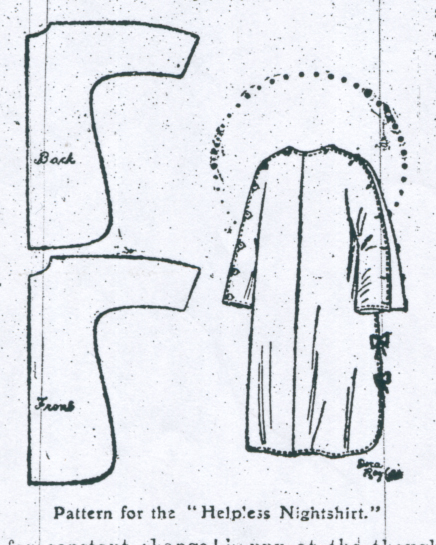
The “Helpless Nightshirt”
The illustration here given shows the “Helpless Night Shirt.” The greatest demand must certainly be for shirts of this description. As its name implies it is indispensable to the “helpless” and the dangerously wounded, being made in such manner that it does away to a great extent with the ordeal of moving the patient about—which causes such unspeakable agony to the poor sufferer. This most necessary garment which, as can been seen by the diagram, is quite easy to put together and complete in a very short time, takes about five yards of 36in. material.
These shirts are made very long, and arranged to open all the way down the front, the sleeves also are left open and brought close together by means of tapes tied from the shoulders downwards. In a word, the “Helpless Nightshirt” is splendidly adapted for its special purpose, and the demand for it is sure to be enormous.
As these patterns will be used for the benefit of others, I have now completed arrangements to supply all patterns dealing with Red Cross work at a specially reduced price, and according to the cost of cutting out and modelling, these will cost from 3½d to 4½d each post free to any address. Inside each one of my patterns will be found a small printed slip of directions, with a diagram like the one illustrated, showing how to proceed with the cutting out and making of the complete garment.
The “Helpless Nightshirt” here sketched is for a full-size figure, and the pattern cost 4½d post free, which can be sent by return.
October 1914
Blackburn Times 3rd October 1914
WOMEN AND WAR
Preaching on “Women and War” at Oxford-street Primitive Methodist Church , on Sunday, the Rev. N. Brown, pastor, said he believed that as a class women were the stoutest opponents of war. Some people contended that it was the business of man to make war. Women had been refused any place in the consideration and decision of such matters. In America thousands of women met to mourn with their sisters of other nations whose husbands, sons and brothers were engaged in the present conflict. To him that was a symbol of women’s deep hatred of war. In Blackburn services of intercession had been held. What had struck him was the preponderance of women who attended the meetings had been a disgrace to the men and honour to the women. That was another sign of women’s hatred of war. In his opinion women were morally and spiritually superior to men. Patriotism demanded equality between men and women in the matter of war. That was to say, women should share equally with men in the right to discuss and decide the question of war. The Church should support the women’s claim in the interest of the church and of religion. Universal peace would come the sooner if women had s say in the matter. The Church would be prepared to use women in the interests of peace when women had a real voice and power in the matter. The Church ought not to lag behind in this demand for women’s proper place. Again and again the Church had been lukewarm in support of things which were right and good, but when the battle had been won she had come in to shout “Alleluia” and share in the happy results. Let the Church stand in the front to demand, in the interests of the nation and especially of the religion, that women should share with men equally in discussing and deciding the question of war and peace.
Blackburn Times 3rd October 1914
A BRAVE BOY