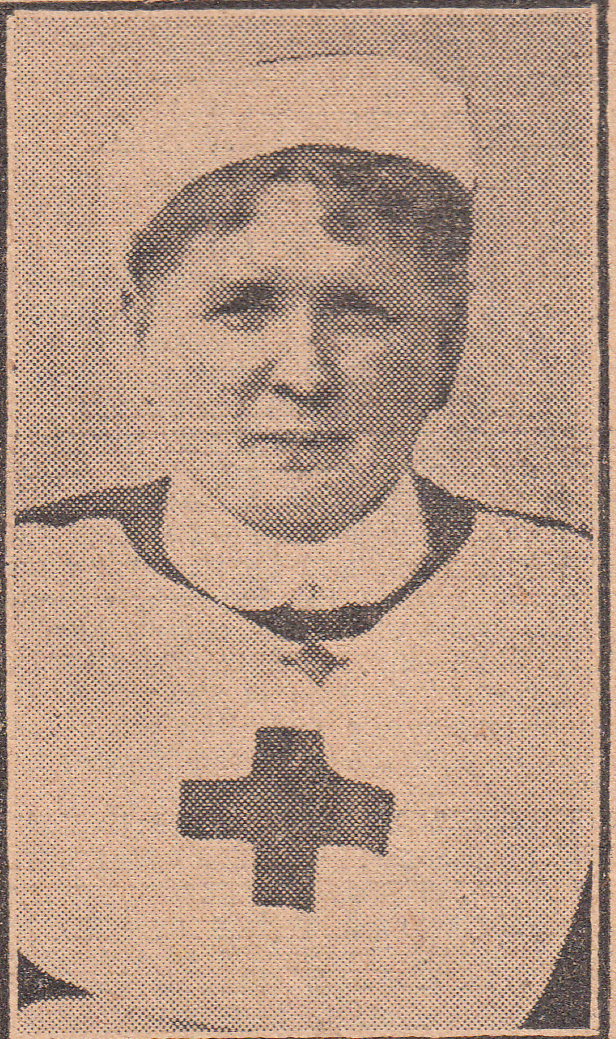
Mrs. Aitken Matron of Ellerslie Hospital
“We owe a great deal to the men who are fighting for us and we are ready and willingto do what we can for them.” Those words, spoken by a member of the British Red Cross Society, yesterday afternoon to a “Blackburn Times” reporter during an inspection of “Ellerslie,” East Park-road, are representative of the spirit of the ladies of the Red Cross Society and the St. John’s Ambulance Association who have volunteered their services in connection with the nursing of wounded soldiers. “Ellerslie,” situated in a commanding position overlooking the Corporation Park, was offered to the Blackburn War Hospital Committee, of which alderman S. Crossley, J.P., is the chairman, by Mr. J. G. Ramsbottom of Whalley, a residuary beneficiare under the will of the late Mrs. Stock, for the use as a war hospital, and the committee gratefully accepted the offer. The house, which was the residence of Mrs. Stock, is a well-built structure and is in every way adapted for the purpose for which it is about to be utilised. The best possible use has been made of the many rooms which the house contains, and in all there are thirty beds. The Largest number of beds—six—are in what was formerly the library, while the drawing-room accommodated five and the dining room four beds. The various rooms are spotlessly clean, and there is an air of quiet and repose which will be greatly appreciated by the gallant soldiers after the strenuous times they have passed through. The larger rooms are fitted with heating apparatus in addition to the ordinary fire-range and lighting throughout is by electricity. Retiring rooms for the nurses have been arranged and there is ample provision for cooking and domestic purposes. Care has also been taken to see that the soldiers who are convalescent have a room where they can gather for a smoke or quiet chat. This is in the conservatory in which a number of comfortable chairs have been placed. Three dining tables have also been erected in a room close at hand and these will probably be utilised by the men capable of walking about. A generous response has been made to the appeal for gifts for furnishing the home, and almost everything required in that direction has been lent or given. The hospital will be worked under the auspice of the British Red Cross Society and the St. John Ambulance Association. All are voluntary workers and will take duty in turns as arranged. Mrs. Aitken of the British Red Cross Society occupies the position of commandant and Mrs. McCarthy is at the head of the St. John Ambulance detachments. Dr. Jones is the surgeon in charge and he will have the assistance of Dr. Moffatt, while the staff of the Royal Infirmary, Dr. Aitken, Dr. Rigby, Dr. Bannister, and Dr. Taylor have consented to act as consulting physicians. Miss Howard is in charge of the trained nurses; Mrs. T. C. Robinson, head cook; Miss Wilson in charge of the laundry. The ladies who have volunteered as nurses have been at some pains to qualify themselves for the work, and the numerous certificates which have been obtained by them show that they are anxious to do what they can to relieve the sufferings of the brave soldiers. Nothing is yet known as to when any of the wounded will arrive and their nationality is also not yet stated. In all probability all will be nursing cases, and should the necessity arise for any operation, this will most likely be carried out at the Royal Infirmary.
The articles most needed by the comforts section of the Blackburn branch of the British Red Cross Society are flannel shirts, socks, body belts, vests and pants, mufflers, cardigan jackets, and bandages. The stock of garments in hand is now quite small and further contributions are urgently needed. Very few parcels have been received this week. No parcels have been sent to headquarters during the week, but the hospital equipment and garments for the use of the wounded have been sent to the hospital at “Ellerslie.”
Blackburn Times 24th October 1914
BLACKBURN’S NEW TERRITORIAL BATTALION
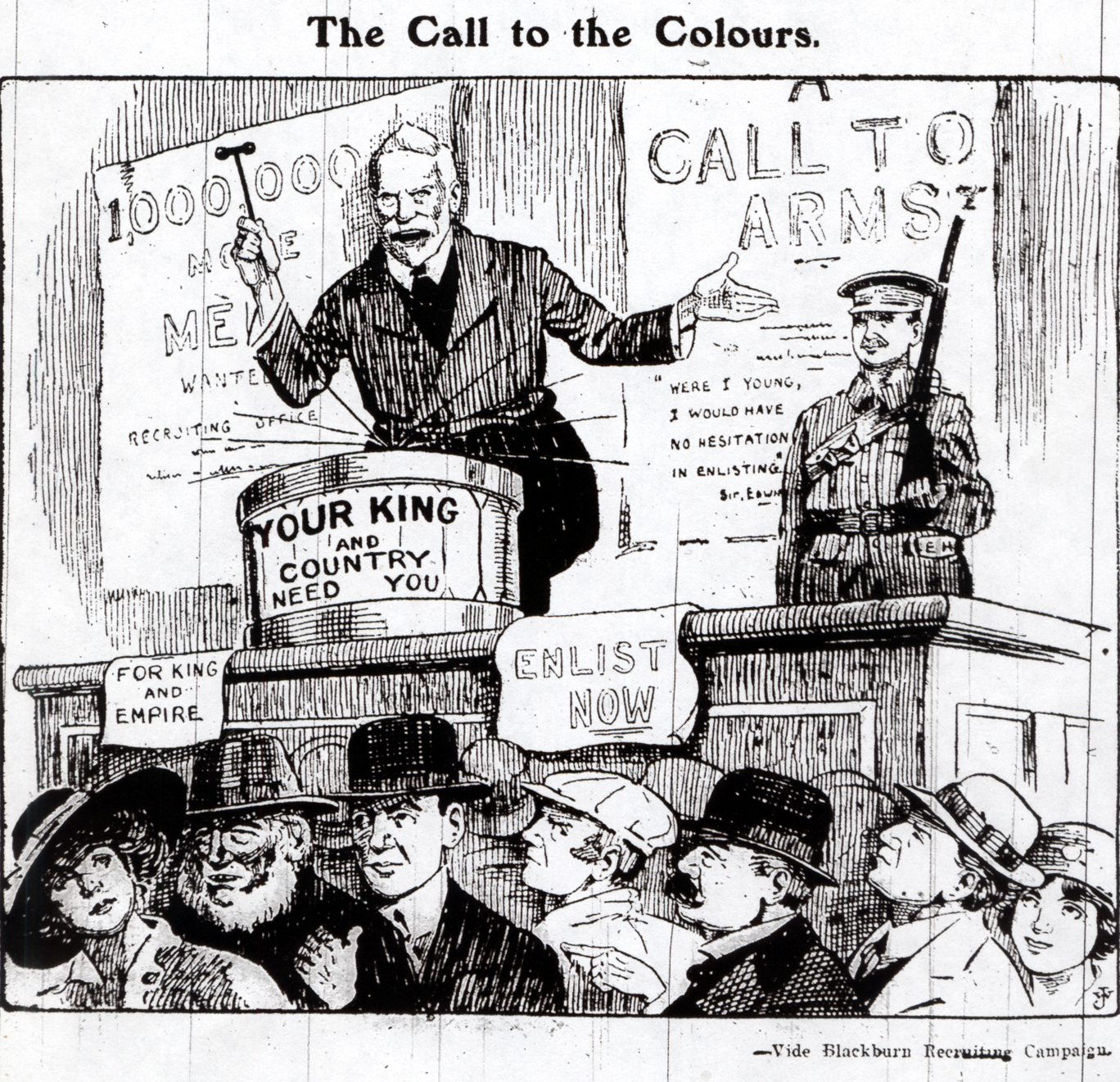
SEVEN HUNDRED RECRUITS IN THREE WEEKS
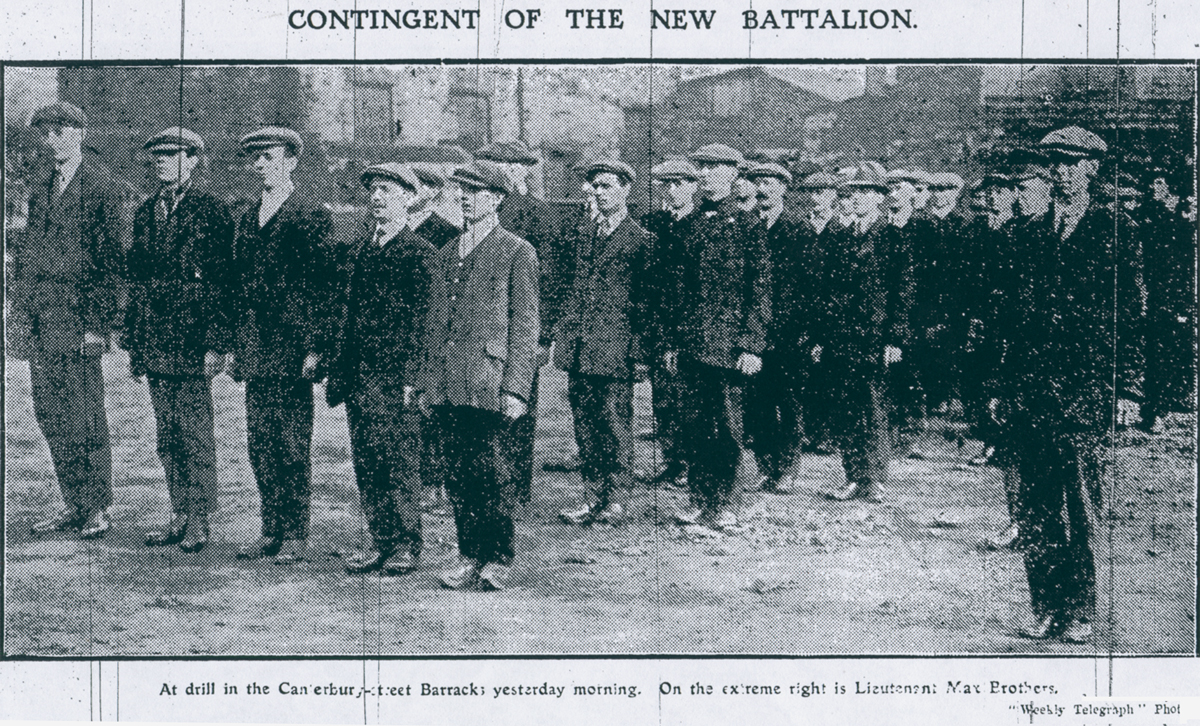
A welcome impetus has been given to recruiting in the town during the week, and the 4th Reserve Battalion of the East Lancashire Regiment (Territorial) is rapidly approaching establishment strength. Recruiting for the new unit only began on on October 1st, but up to yesterday 700 men had been enrolled and billeted temporarily at their homes. The men are receiving 3s a day, 2s of this amount being subsistence allowance. Counting the number of young men who signified their intention of joining after the town’s recruiting meeting last week, and the number who joined on Saturday, it is computed that fully a hundred recruits were secured as a result of the meeting—a return which made the recruiting well worthwhile. The actual number of Territorial recruits up to noon on Thursday was 645, but Darwen, which is contributing two companies to the battalion, sent another batch of men in the afternoon. It is therefore not improbable that the battalion will secure the complement of men during the weekend. So far not a single recruit has refused to sign the paper on which the men notify their willingness to serve abroad. The battalion will include the 137 men (now billeted at Southport) of the 4th Battalion, East Lancashire Regiment (Territorial), who did not volunteer for foreign service. These men were transferred from the mobilisation camp at Bury after the departure of the main body for Egypt, and thus have the advantage over the new units of useful experience of mobilisation smartness. A depot staff of the battalion now serving abroad is on duty at the Canterbury-street Barracks, in charge of Captain G. R. Wilson, Sergt-Major R. Wood, and Sergt. P. Thompson. Captain Wilson has carried out unaided the medical examination of all the men of the new battalion.
Darwen as already mentioned is contributing two companies each of 120 men to the new battalion, and about 50 men joined on Thursday, whilst about 70 recruits have been obtained from Clitheroe, which will have a company of its own. Great Harwood, Mellor and other outlying districts have each contributed recruits, and it has been decided to form a half company in the first named township, where the United Methodist Free Church School and the recreation ground opposite have been secured for drilling purposes.
Captain H. Bailey, of the Territorial Reserve, formally of the Battalion E.L.R. (T), is the acting adjutant, and he is supervising the drills of the new battalion. Captain Bailey is well pleased with the type of recruit, and he remarks that they are all very keen to serve.
The Daily scene at the barracks is a busy one, as squads of recruits are being put through the initial stages of drill. The routine is as follows—8 to 9, physical training; 9 to 10, squad drill; 10 to 11, extended order drill (Sundays, church parade); 11 to 12 squad drill; 2 to 3, extended order drill; 3 to 4, musketry; 4 to 5, musketry. It has not yet been possible to carry out the last-named order as the men have not yet bee served with rifles. Some little time will elapse before they receive their uniforms. They are, however, enjoying their work, and on their route marches through the town, have joined enthusiastically in singing the marching song: “It’s a long way to Tipperary.” On Monday, Wednesday, and Friday the men engage in simple night operations. On Wednesday they have a bathing parade to the Frekelton-street Baths. The battalion will probably be stationed at the Canterbury-street Barracks for a month or two, and will then, it is expected, join the men of the 4th Battalion at Southport.
During the week end the recruiting office for the regular army was moved back from the Barracks to the permanent office in Ainsworth-street. The recruits during the week have been; Saturday 6; Sunday 2; Monday, 30; Tuesday 7; Wednesday 1; Thursday, 6. Monday’s Figure was the highest for about a month. 30 out of 40 men who presented themselves being accepted. The single figure for Wednesday was the smallest return for any day since was declared. The number of recruits obtained in Blackburn for the regular army since the war began is 3,027, whilst 670 men have presented themselves for enlistment but failed to pass the medical test.
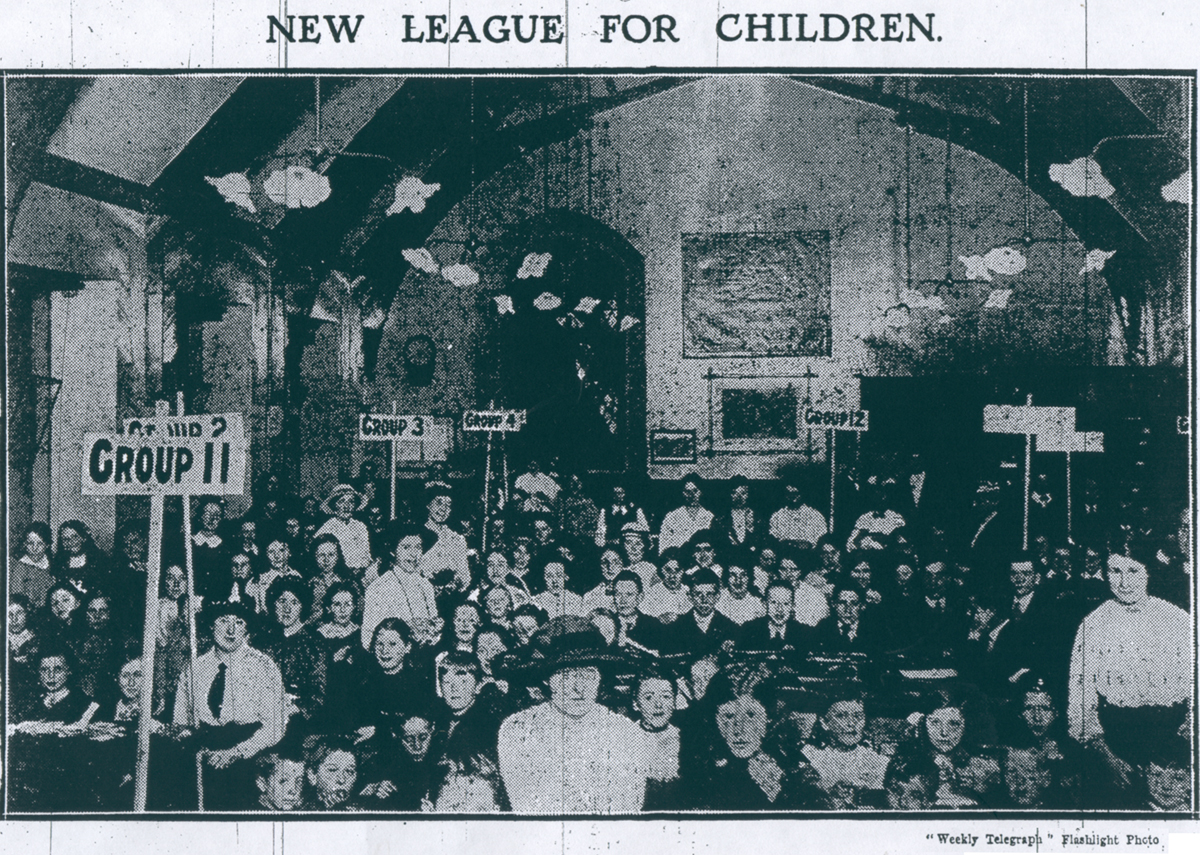
NEW LEAGUE FOR CHILDREN
A fellowship and service league has been formed in connection with St. George’s Presbyterian Sunday School for the purpose of gathering together in the week-time the children whose ages range from 9 to 16, and of giving them a deeper interest in the work of the church and school. The Rev. J. H. Chambers Macaulay is manifesting an active interest in the organisation, and Miss Taylor and Miss Kenyon will act as secretaries, and Mr. H. Bourne and Mr. R. Gibson as treasurers. The children who now number 130, will be addressed on temperance, missionary, and social service topics, and will be given occasional instruction in music by Mr. Percy Elton, organist at the church. They will be divided into groups each of which will have a leader and at least one helper, and they will meet at the school one evening each week from 7.15 to 8.30. It is proposed to instruct them in making of articles for the distribution amongst children of soldiers and sailors at Christmas.
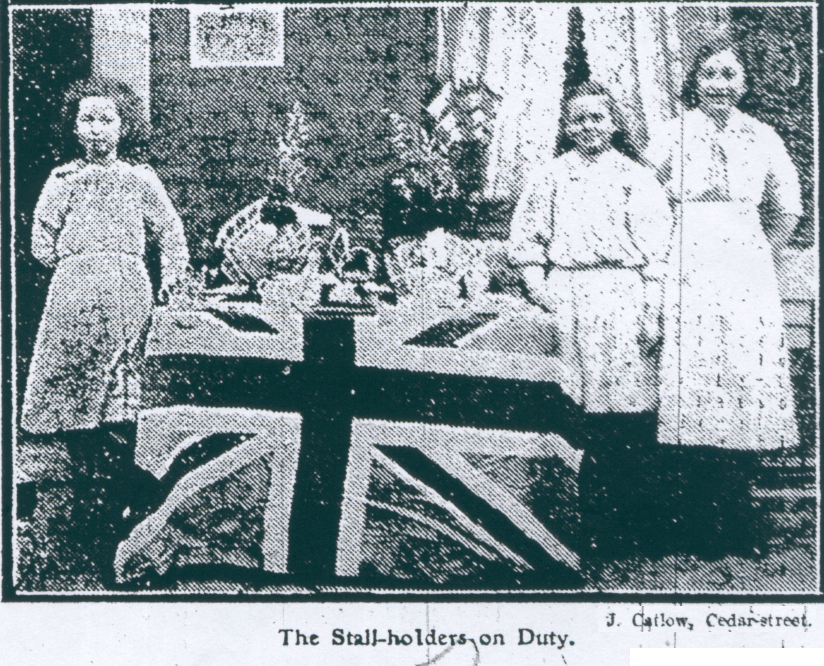
HELPING THE BELGIAN FUND
The accompanying photo is of a stall outside the residence of Mr. J. Catlow of Cedar-street, Blackburn, last Saturday, when the Misses Janie Catlow, aged 9, and Annie Hodkinson, aged 11, assisted by Miss Marie Forrest, raised nearly 30s by the sale of various articles of use and ornament. Of the sum £1 has been has been forwarded to the Belgian Relief Fund and the remainder applied to the purchase of comforts for soldiers.
Blackburn Weekly Telegraph 30th October 1914
PROPOSED CONVALESCENT HOSPITAL FOR BLACKBURN PATIENTS
The accompanying picture shows the Convalescent Home which the Blackburn Charity Organisation Society purpose erecting on a plot of land between the Thursby Home and the North Promenade at St. Anne’s, fronting the sea. The ground floor will consist of the administration block, containing dining and day room, 42ft by 19ft; matron’s room, 14ft by 12ft; kitchen 16ft by 12ft; large scullery, larder, china closet, washhouse, etc. Flanking same on each side will be the women’s ward and men’s ward respectively, each containing four separate rooms, two beds in each, with lavatory, bathroom etc. Each ward will have a separate entrance, and one of the wards is to be provided with an extra entrance for visitors. The upper floor will consist of two bedrooms for two patients each (or Children if required), matron’s bedroom, servant’s bedroom, spare bedroom, bathroom, linen-room, boxroom, and conveniences. This floor is arranged so that access can be easily made to another floor, to be erected over each of the ground floor wards at some time in the future as the demand is needed, thus affording further accommodation for eight beds in each ward. The outside walls are to be finished in rough cast, and the roof covered with green slates. The elevation facing the sea above the first floor to the central portion will be finished in half-timber work and plaster panels. The accommodation for the portion to be erected now will be for sixteen beds on the ground floor and four beds on the first floor, and the cost will approximately be £3,000, exclusive of furnishing. The architects are Messrs Briggs, Wolstenholme, and Thornely, of Blackburn and Liverpool, and the contract has been let to Messrs E. Lewis and Sons, Blackburn.
In October The Blackburn Weekly Telegraph began a series called “The Poets and the War”. The poems printed were by local people, and included both sentimental and patriotic work. They may not always be the greatest works but they certainly showed how ordinary people viewed and reacted to the early months of the War.
Over the coming months I will include some of the poems in “100 years ago.”
“Killed In Action.”
Who dies? Those, whose epitaph
Records a duty nobly done
In a just cause. For such as these
A deathless life is but begun.
Dear form, now stilled in death, that once
Lay folded in a mother’s arms,
No more the loud reveille’s call,
The sudden clash of war’s alarms.
Dear eyes, that once to other eyes
Responsive beamed their tender love,
Devotion deeper you have shown,
In deeds that only death could prove.
Dear hands, that other hands have held,
In loyal friendship, lasting, true,
the clasp is loosed; but memory
Shall firmly fasten it anew.
Fond heart, brave heart, and true as brave,
That beat for others, nor in vain—
Dead! “Death is not of life the sum”:
while others live, you live again.

 Loading more