
 Loading more
Hundred Years Ago
January 1912 | February 1912 | March 1912 | April 1912 | May 1912
June 1912 | July 1912 | August 1912 | September 1912
After a two year gap the topic “100 years ago” is being resurrected, starting with July 1914. Life in Blackburn is carrying on as normal, the weather is good, garden parties are being held and, until the end of the July, there is no indication of the carnage to come. The world would never be the same again!
Click on 1915 to read what was happening in Blackburn each month.
1914 | 1915
One hundred years ago, January 1912
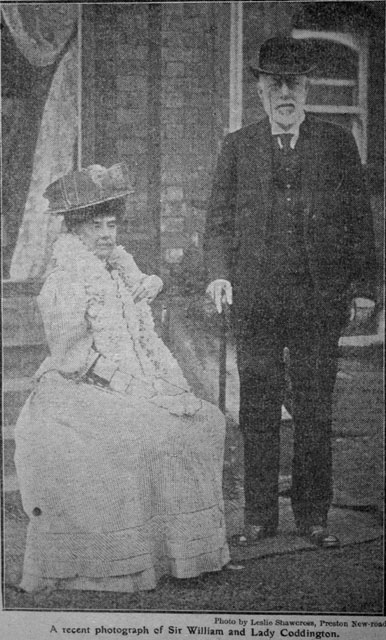
The Blackburn Times of 6th of January 1912
DEATH OF LADY CODDINGTON
A PROMINENT FIGURE IN SOCIETY.
A PROMINENT FIGURE IN SOCIETY.
We regret having to chronicle the death of Lady Coddington, wife of Sir William Coddington, Bart., J.P. D.L., which occurred on Sunday evening. Her Ladyship was only ill about a week, starting with bronchitis. Pleurisy supervened, and on Saturday her condition was so serious that Sir James Barr, the eminent physician of Liverpool, was called into consultation. All the medical knowledge and skilful nursing could do for the patient was done, but without avail, and Lady Coddington breathed her last about nine o’clock on New Year’s Eve. It was not until the following forenoon, when flags were put at half-mast on “Wycollar,” the Town Hall, political clubs, and the mills owned by Sir William, that the sad news became generally known. On all hands the greatest sympathy was expressed with the bereaved husband, who is in his 81st year.
Sarah Katherine Lady Coddington was the third daughter of the late Mr William Thomas Hall, of Wakefield. Mrs Wade of Kirkella Hall , near Hull, is her sister. The deceased lady was in her 70th year. She was married to Sir William (then Mr Coddington) in 1864. They have one surviving daughter, the wife of Mr Arthur Cayley, J.P., D.L., formally of Lovely Hall, Salesbury, and now of Beal, Northumberland, and three grandsons. Lady Coddington was a great help to her husband during his long public career, both as Mayor in 1874-5, at which time he was a town councillor, and as one of the Conservative Members for Blackburn from 1880 to 1906, a period of 25 years. Sir William was created a baronet in 1896, this being one of the New Year honours. After her husband was elected M.P., Lady Coddington spent a good deal of her time in London, and became a noted hostess in society. She entertains on a princely scale at 143, Piccadilly, one of the most magnificent mansions in London, which was formerly occupied by the late Baron Ferdinand Rothschild. The baron, who had excellent taste, had all the principal rooms superbly decorated regardless of the question of expense. When in September, 1905 H,R.H. the princess Louise, with the Duke of Argyll, visited Blackburn, the former to unveil the memorial statue to Queen Victoria, Sir William and Lady Coddington had the honour of entertaining her Royal Highness from Friday till Monday.
MAGISTERIAL REFERENCE.
Before proceeding with the ordinary business of the Blackburn Borough Police Court on Monday morning, Alderman E. Hamer (the presiding magistrate) said it was with great regret he had to announce the death of Lady Coddington, who had always played her part as a lady of position in the borough. She had been ready at all times to assist in everything that had for its object the benefit of the town in which she has lived so long. He was sure they would join with him in conveying deep sympathy with Sir William Coddington and his family in the very painful affliction that had fallen upon them in the last day of the old year.
The Chief Constable Mr I.G. Lewis, on behalf of the Clerk, the solicitors, and the police force joined in the expression of deep sympathy. He had known Lady Coddington for a great many years. During the time her husband was Member of Parliament for the Borough, he was frequently brought into contact with Lady Coddidngton, and he had always found her exceedingly nice to everyone.
THE MAYOR’S TRIBUTE.
At Blackburn Town Hall Council on Thursday afternoon the Mayor (Alderman Crossley) referred to the death of Lady Coddington, who, he said had played a very important part in the life of Blackburn. The long and happy union between her and Sir William had at length been broken, and he was sure that, in common with his fellow-townsmen, they would join with him in expressing deep sympathy with Sir William Coddington, and family.
THE FUNERAL.
The funeral took place at Blackburn on Thursday morning. The obsequies were of a quiet character though there were unmistakable evidences of the regret occasioned by the sad event, blinds being drawn all along the route of the procession from Wycollar to the cemetery.
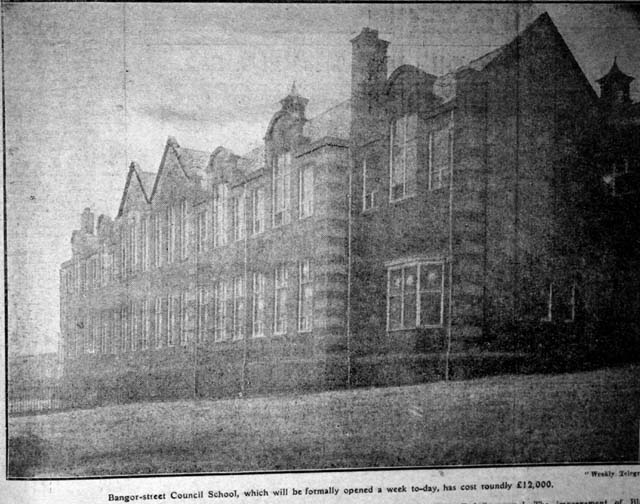
From the Blackburn Weekly Telegraph of 13th of january 1912.
BLACKBURN’S NEW SCHOOL.
The formal opening of the new Elementary Council School erected in Bangor-street took place on Saturday [6th of January], the ceremony being performed by Councillor J. Higginson. In spite of the inclement weather there was a large attendance, including the leading educationists of the town, great interest being taken in the school by reason of the special attention devoted by the Education Committee to making it a model building for elementary education purposes. Surrounded by large open playgrounds and built upon an ample site, the school has been constructed on the most up to-date principles, and the spaciousness and lighting of the rooms, as well as their generally attractive appearance, gained the admiration of the visitors. It is to provide for a “mixed” school for junior and senior scholars, the former (with infants) on the ground floor, and the latter in the upper rooms. The total accommodation is for 905 scholars. The building is well supplied with class-rooms, and senior schools can be conducted independently of one another, making practically two schools. The architects are Messrs. Cooper and Slater, Richmond-terrace, the contractors Messrs. Thomas Higson and Sons, and Mr William Parker clerk of works.
The severity of the weather caused the usual formality outside to be dispensed with, and the company assembled in one of the upper schoolrooms—a very handsome apartment… Alderman Henry Lewis, J.P. remarked that they were met on a very momentous occasion in the history of education in Blackburn. Last July many of them met at the opening of the higher elementary school on Blakey Moor. They were then celebrating the opening of a great school which was necessary for special purposes for the whole of Blackburn. Now they met for the purpose of opening an elementary school to take the place of certain existing schools, and which would also add largely to the facilities of education in the district. That school was one of a different character and nature, built on a more spacious design, and would afford larger opportunities than had been previously been possible in the ordinary elementary schools of Blackburn. For that reason it was not only an addition of a positive character to the educational facilities of Blackburn, but must in a certain sense serve as a standard to which other schools would desire, so far as they could to approximate.
Alderman Lewis went on to refer to the appropriateness of the invitation to the Councillor Higginson to perform the principle part in the opening ceremony, because of that gentleman’s zealous devotion to the interests of education in the borough and his great service as chairman of the secondary and elementary sub-committees. On behalf of the architects he presented Councillor Higginson with an ornamental Key as a memento of the interesting occasion.
BLACKBURN’S BILL OF COST.
Councillor Higginson expressed his gratitude to the chairman for his remarks and said it was true he had taken part in the educational work of the town for a number of years, but he had done so because he liked the work. To him it was deeply interesting. He had derived great pleasure from meeting a number of those who were practically engaged in teaching in the town, and was proud to say he had made many friendships amongst them, besides obtaining much valuable information and knowledge in regard to the practical work of education. A great many members of the Education Committee who were—should he say “distinguished” or “undistinguished” amateurs readily and gratefully admitted that they had obtained valuable information and help from those who had had a life long experience of teaching.
Dealing with the cost of education in the town, Mr Higginson said when they considered that in a comparatively small town like Blackburn they spent £80,000 per annum upon elementary education and £14,000 on higher education, they would realise that they were not neglecting their duty. Of that sum they got about £40,000 from the ratepayers. They had had considerable difficulty with the Board of Education, who insisted that schools should be placed in a sanitary condition, and in other ways fitted for the education of children. Though he did not always agree with the extent to which the Board went, he thought they did right to insist upon the healthy and good conditions for the children. As the children were compelled by law to go to school, the buildings ought to be in every way suitable for them. They ought not to be put in cellars or unsanitary buildings, or rooms devoid of sunlight. He thought they might congratulate themselves in Blackburn that they had done something both to increase the facilities and improve the buildings. The Blakey Moor school cost over £26,000; the Bangor-street school, when completed would cost £14,500; they had spent £9,000 in altering Cedar-street school and erecting a new building; £3,600 on the special school at Regent-Street; £4,200 on the extension at Accrington-road—representing a total in round figures of £57,000. It seemed a considerable sum, but, remembering the annual outlay on education, he did not think the amount was extravagant. Moreover, he thought they would see they got value for their money. In that school in particular they had got their full value, and the building reflected great credit on their young townsmen who had been architects. He was sorry the opening of that school would involve the closing of the Whalley Range Schools. Those schools had done great and good work. They were started in 1884 under voluntary management, and continued efficiently by the trustees until the demands of the Board of education pressed heavily upon them, and the schools were taken over as Council school. Since then the Board had made other suggestions, and the result was that the Education Committee decided to build the Bangor-street School. He was quite sure the head master and mistress would continue to give their highest service to the new school, and would be ably assisted by the staff. They were hoping to carry out a scheme which had been in the minds of the Committee for some time, in regard to open-air teaching, especially for the weaker children. Much had been said about the benefits of such teaching, and they had ample facilities for trying it at Bangor-street.
THE MEN AND THE WORK.
In calling upon Mr J.A. Watson to propose a vote of thanks to Councillor Higginson, the Chairman mentioned that it was 41 years this month since he left Blackburn as a boy to go to Repton School, and it was exactly 41 years since Mr Watson became a member of the Blackburn School Board. Mr Watson was the “real old veteran of education” in Blackburn, and he hoped he would long be spared to continue his devoted service in that work.
Mr Watson paid warm tribute to the work of Mr Higginson, and thought Blackburn might congratulate themselves upon having at the head of the committee such men as Mr Higginson and Mr. Lewis—men of progress. The progress made during the last nine years had been very much more rapid than it was during the thirty years that proceeded that period. It was very encouraging to those who had taken part in education to see that progress being made. It was time—there was no doubt about that. He trusted the school would be a model one, and had every confidence in its being so under the competent staff that had been appointed.
Councillor Nuttall in seconding hoped the public, and particularly the people of that district, would appreciate the value of the school.
Alderman Thomas proposed a vote of thanks to the Chairman and said the town owed a great debt of gratitude to Mr Lewis for his services in the interests of education.
Mr E. Cooper, in seconding, remarked that education was a wide subject, and one upon which it was possible for men of the most divergent views to work harmoniously together. He looked back with satisfaction on Mr Lewis’s connection with education, and complimented him upon the successful results of his labours, and at the same time like Oliver Twist, he would like to ask for more of the same sort. He did not think all had been yet realised that some of them expected in connection with education in Blackburn, though Mr Lewis might congratulate himself upon having been largely instrumental in putting an end to the reproach that lay upon the town of being educationally twenty years behind the times. During the time Mr Lewis had taken an active part in education, considerable progress had been made and did not underrate Mr Lewis’s views in that direction. But they must see to it that they have as perfect an educational machine as possible. If it were true that our commercial supremacy depended to a large extent upon the education of the people, then they could not devote too much attention to making their education machine as perfect as they could get it.
In replying to the vote of thanks, Alderman Lewis recalled his early association with Mr Cooper in educational work, and mentioned that he and a few others met at Mr Cooper’s office to protest against Weir-street as a site for the Technical School. In September 1889, when the old Technical and Trades Schools Council was formed, Mr Cooper and he were amongst the original members, only four of whom were still in existence. Three of them remained in active educational work, the third being Mr W.E. Bickerdike. Mr Cooper had rightly remarked that the department of education provided a common basis of work for men of divergent views. In his (the chairman’s) opinion intelligent hostile criticism was worth a great deal more than undue appreciation, especially if it approached fulsome flattery. He did not think they were much troubled with the latter in public life in Blackburn. However the members of the Committee differed among themselves, he honestly believed that the results of their joint labours had for a considerable number of years worked out with profit to the town.
From the Blackburn Weekly Telegraph of 27th January 1912.
CRIME IN BLACKBURN.
From the annual criminal returns for Blackburn, prepared by Inspector Griffiths, and submitted by Chief Constable Lewis to the Watch Committee on Monday, We make the appended comparisons:
1911.........1910
Total apprehensions...........................1,132.........1,162.
Total summonses...............................2,012........1,825.
Indictable offences................................264...........311.
“ “ Apprehensions............................157...........227.
“ “ Summonses..................................13..............4.
Non-Indictable offences.......................2,136........1,887.
“ “ Apprehensions..........................869..........805.
“ “ Summonses...........................1,267.......1,082.
*Persons proceeded against for
drunkenness......................................1,466.......1,422.
Ditto for begging....................................166..........141.
*1910; 358 males and 108 females; 1911; 1,326 males and 96 females.
The chief offences under the head of “indictable” were malicious wounding, 1; indecent assult,2; burglary, 3, housebreaking ,17; shop breaking, 6; attempted shop breaking 1; larceny of horses, 3; larceny from persons, 7; larceny as servant, 13; embezzlement, 2; simple larceny, 174; obtaining goods by false pretences, 21; other frauds, 4; receiving stole goods, 1; malicious injuries to property, 2; counterfeit coin cases, 4; habitual drunkenness, 19. Forty-six persons were committed for trial for these offences, 2 discharged, and 122 persons summarily dealt with.
The following were the chief non-indictable offences; adulteration of food and drugs, 11; aggravated assaults, 14; police assaults, 26; common assaults, 167; betting and gaming, 10; cruelty to animals, 20; cruelty to children, 15; offences in relation to dogs, 41; offences under the Education Act, 30; unlawful possession of game, 2; offences by users and owners of vehicles, 22, under Motor-car Acts,10; cycle offences, 10; permitting drunkenness, 7; breaches of intoxicating liquor laws (refusing to quit licensed premises, &c.), 13; under Factory Acts, 9; malicious damage, 28; under local Acts and by-laws, 9bad language, fighting, &c.), 773; neglect of family, 33, railway offences, 26; offences under revenue laws, (dogs without licenses, &c.), 52; offences under Public Health Act, (diseased meat, &c.) 7; sleeping out, 37; found on enclosed premises for unlawful purposes, 4; frequenting with intent to commit felony, 5; acting as peddler without certificate, 18.
Twelve persons were placed under the probation officer.
Of the foregoing cases, 167 were dealt with in the Juvenile Court, and only 18 were indictable offences.
The applications for married women for separation orders numbered 141, and the orders made 124.
In December unionist workers in the cotton trade had been locked out of the mills in a dispute over non-unionised labour. By the 20th of January when the meeting of the Board of Guardians, shown below, took place, the dispute was over.
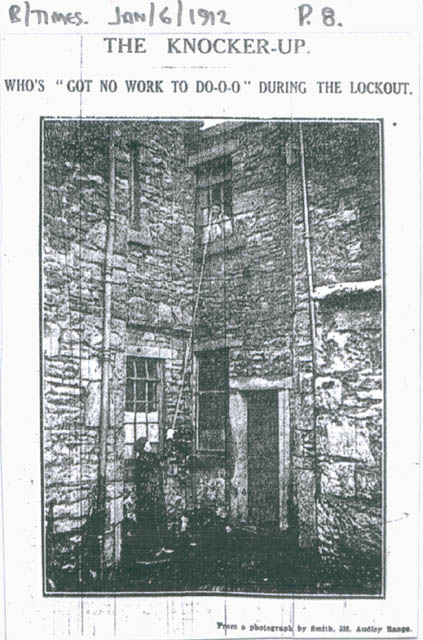
From the Blackburn Weekly Telegraph of the 27th of January 1912.
OUT-DOOR RELIEF.
THE GUARDIANS AND THE LOCKOUT
The fortnightly meeting of the Blackburn Board of Guardians was held on Saturday, Mr C.E. Kenyon presiding… Prior to the commencment of the business, the Chairman said he desired to express his deep feeling of satisfaction at the termination of the dispute in the cotton trade in which he was sure they were all in agreement. He hoped they would not have another dispute for some time to come; that a better feeling would exist between employers and employees in the future; that the leaders of capital and labour would refer their differences to arbitration, and thus prevent the country from being thrown into industrial disputes; and that the negotiations which were in progress in the colliery districts would prevent a strike taking place.
Mr Porter said that…He would like to move the suspension of the standing orders, so that he might briefly refer to the question of granting outdoor relief. He pointed out that, while some people had that and the previous day received relief, others had been re fused it without any reason whatever being given why such a course was adopted. There was, however, a clause in a Local Government Board Act which provided that outdoor relief could not be granted unless the recipients were in a position to perform task work the following week. In view of the fact that many of the applicants for relief would have to resume work on Monday, they would therrefore be unable to accomplish task work in return for relief. It was perfectly well known that those people, even if they recommenced work on Monday, would not receive any wages until the following Friday or Saturday and that , consequently, there would be just as much poverty next week as there had been during the past two or three weeks. The relieving officer informed him that morning that, if he granted relief without some authority, the Guardians would probably be surcharged by the auditor. However, the Guardians ought to see that the people had something to eat and fires in their homes, and be prepared to be surcharged.
Mr Michael Brothers seconded the motion to suspend the standing orders which was carried.
A Member; Will the Guardians or the relieving officer be surcharged?
The Clerk sad he had pointed out to the relieving officer that, if he paid relief, he did so on his own responsibility. The auditor would surcharge, not the Guardians, but the relieving officer. He did not think the applicants had been told they could not be granted relief; they had, no doubt, been asked to wait. He had been unable to speak on the telephone to the Local Government Board inspector, whom he intended to question with regard to position of the Guardians and relieving officer. The officer and individual members of the Board were anxious to pay relief. As far as he knew, no outdoor relief had been granted on that or the previous day to able-bodied weavers, who were likely to commence work on Monday.
Mr Porter pointed out that he came in contact the previous day with some persons who informed him that they had that day received relief.
The Clerk replied that the person in question must have received relief before the news of the settlement of the lockout was published.
In pursuance of notice given at the last meeting, Mr Cunliffe moved that two members of the Board be appointed to attend the annual meeting of the Central Poor Law Conference, to be held at London next month and that the expenses of the deputation be paid by the Gurdians. Mr D. Yates and Mr Pilkington were appointed.
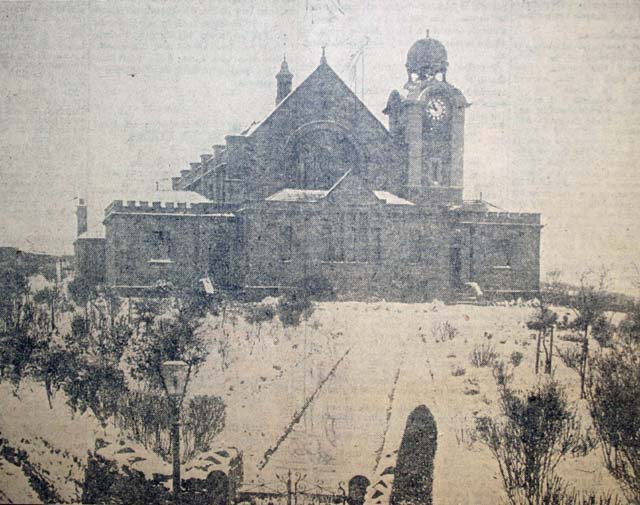
Snow scene showing the Lower Darwen United Methodist Church, with the “Aspin Clock Tower" which was opend in 1911.
BLACKBURN ROVERS RESULTS FOR JANUARY 1912
Jan. 1 Preston N.E. H. W. 3-0 Simpson, Chapman, Aitkinhead. Gate 36,195.
Jan. 6 Middlesbrough H. W. 2-1 Chapman, Aitkinhead. Gate 10,167
Jan. 20 Notts. C. A. W. 3-1 Cameron, Aitkinhead, Orr. Gate 3,000
Jan. 27 Tottenham H. D. 0-0 Gate 18,567
F.A. Cup, First Round.
Jan. 13 Norwich C. H. W. 4-1 Simpson 2, Chapman 2. Gate 22,947.
© LET - terms and conditions
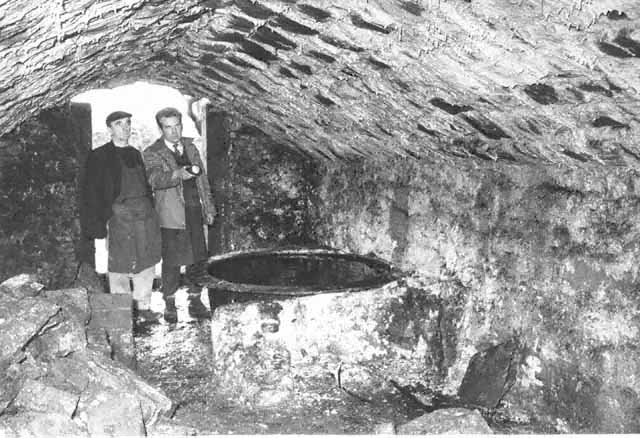
The Photograph shows Mr. Harry Cash (foreman gardener), left, and Mr Gordon Malthouse, examining the underground 'cavern' in Witton Park, Blackburn.
Harry was born on the 4th of January 1912, and so is celebrating his 100th birthday this month. Every one at Cotton Town would like to wish him a very happy 100th birthday.
One hundred years ago, February 1912
From the Blackburn Times of 3rd February 1912.
EAST LANCASHIRE INQUESTS.
CORONER ROBINSON’S ANNUAL RETURNS.
In accordance with the requirements of the Home Office, Mr. H.J. Robinson, the East Lancashire Coroner, has prepared returns of the number of inquests held by him or his deputy, Mr. D. N. Haselwood during the year 1911, in the county borough of Blackburn and Burnley and the hundred of Blackburn. We are indebted to Mr. Robinson for the following summary of the returns.
Ages of Persons on Whom County. B.Burn. Burnley
Inquests were held M. F. M. F M. F.
Illegitimate
Under 1 year 3 1 1 0 2 0
1 and under 7 years 3 2 0 1 0 1
Legitimate
Under 1 year 9 5 3 3 5 6
1 and under 7 years 9 9 8 6 7 2
7 “ 16 14 0 7 3 2 0
16 “ 25 13 9 4 2 3 2
25 “ 60 90 33 39 20 42 19
60 and above 25 28 16 16 18 7
Total 166 87 78 50 79 3
County. B.Burn. Burnley.
Juries Verdicts M. F. M. F. M. F.
Manslaughter 0 0 0 0 1 1
Felo de se 1 0 0 0 1 0
Suicide whilst insane 25 18 12 6 12 4
Want, exposure 2 0 0 0 0 0
Excessive drinking 0 0 0 0 4 0
Want of attention at birth 0 2 0 0 0 1
Accidental misadventure 73 39 38 24 37 10
Natural causes 46 25 25 20 20 18
Open Verdicts.
Drowning 7 2 2 0 1 0
Of unknown causes 11 1 1 0 3 3
Stillborn 1 0 0 0 0 0
Totals 166 87 78 50 79 37
In addition to the foregoing, inquests were held in four males and one female in the county who had been suffocated in bed with their parents or other persons, and in which a verdict of accidental death was returned; two males in Blackburn and one male and four females in Burnley. There were two inquests in the county on newly-born children (one Male and one female), and one in Burnley (a female). The aggregate number of inquests held were 511. There were besides, 350 deaths 131 in the county, 133 in Blackburn, and 86 in Burnley, in which cases the Coroner, after a preliminary investigation, decided an inquests to be unnecessary. To cover the inquests in the Hundred of Blackburn, the Coroner had to travel 2,836 miles.
From the Blackburn Weekly Telegraph of 3rd February 1912.
A THREE-MILLION GALLON RESERVOIR.
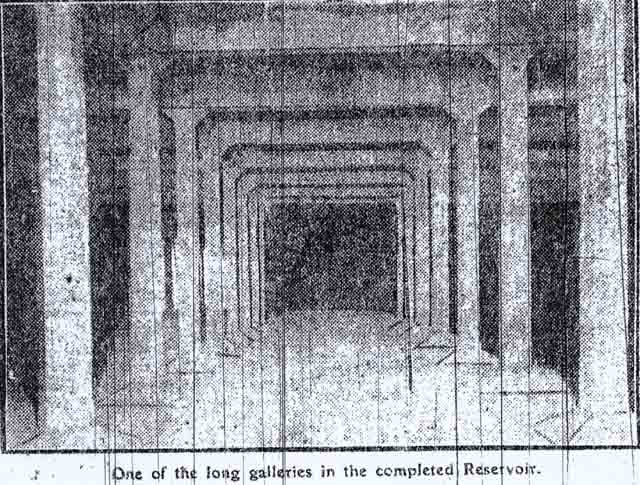
One of the biggest bits of constructional work undertaken and carried out by the engineering department of the Blackburn Corporation is now approaching completion—the new covered reservoir on Revidge, which is intended to supplement the south-western end of that road and the uppermost part of the Preston-road district. The plan was designed at the Borough Engineer’s Office, and work, which was begun in May 1910, has been carried out by direct labour, an average of 38 men having been employed. The reservoir, which has a holding capacity of about 3,000,000 gallons, is in length 182 feet and 165 feet wide, and the average depth of water will be 13 ½ feet. Imagine a vast hall of the dimensions just given, constructed entirely of Concrete—floor of concrete, walls of concrete, pillars of concrete, roof of concrete; everything of concrete save the inlet and outlet pipes, a veritable cavern of concrete so devised and constructed as to ensure the perfection of cleanliness by excluding everything of an opposite nature. The floor of the reservoir is about 12 inches thick, laid of course on a sound natural foundation; the walls, much thicker at the base than at the top, average 4 feet thick; from the floor spring 176 pillars of reinforced concrete, 12 inches thick, and about 10 feet apart; these support beams and a roof six inches in thickness, all reinforced concrete. This roof is now being covered with soil, and when properly levelled and turfed or sown, will become to all appearances a hugh grassy mound of the field in which it is situated. The whole of the interior walls and floor of the reservoir are finished off by a coat, one inch thick, of Medusa cement, a well-known water-proof mixing. Of this material, 880 bags have been used and also 17,000 bags of Earles cement, during the construction of the reservoir, the other material for the enormous quantity of concrete required being found on the spot. The “getting” and crushing of the rock for concreting purposes has served the useful purpose of widening the road at this point at Revidge, which it will be remembered was extremely narrow. There is still a few months’ work to be done in completing and sloping the embankment of this reservoir. Its Height, when completed, will be 723.87 feet above sea level, and 346.67 feet above the pavement level in front of the Blackburn Town Hall. We are indebted for these particulars and for the facilities for photographing the reservoir, to the courtesy of Mr. W. Stubbs, the borough Engineer, and to Mr. J.T. Shield, his chief assistant, under whose supervision the work has been carried out.
The purpose to which the roof of this reservoir shall be put has already given rise to some discussion. It is situated on land belonging to the Corporation, leased to the Golf Club, and there was an idea that it should form one of the putting greens on the club’s course. Since then, however, it has been urged that the public should have access to it, in the same way that they now have to the Iron Tank on Revidge a little further north—and which, by the way commands an infinitely finer view. How the matter will end depends upon the arrangement arrived at between the Corporation as landlord and the Golf Club as tenant.
From the Blackburn Times of 10th February 1912.
DARWEN GAS EXPLOSION.
HOUSE WRECKED AND FOUR PERSONS INJURED.
Hundreds of people were attracted to the Bolton-road district of Darwen, on Sunday, by the spectacle of a wrecked house. The damage was caused on Saturday afternoon as a result of a gas explosion, the house affected most being 37 Radfield Avenue, owned by Mrs. Betty Reeling, widow of a prominent Lancashire dog fancier, and occupied by her and her family of one son and four daughters and a son-in-law. During the afternoon a strong smell of gas was detected, and one of the daughters visited the next door, and asked Mrs. Brown if she too, could detect the smell. She replied in the negative. However at the request of the son-in-law, James S. Hindle, a postman, two daughters, Amy and Bessie Reeling, went to report the matter to the gas office, Whilst Hindle turned of the gas at the meter and opened the windows wide. Had these precautions not been taken, the results would undoubtedly have been far more serious.
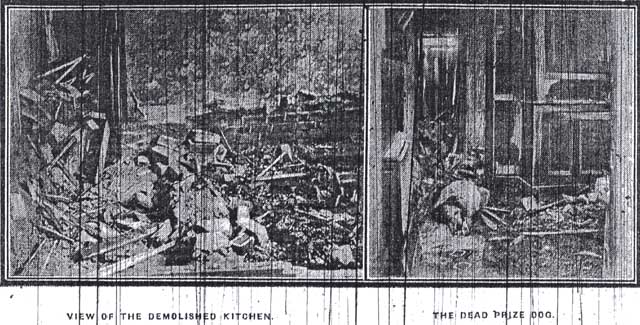
No sooner had the daughter’s names left the dwelling than there was a loud report, which was heard over half a mile away. The defective main had apparently became ignited and before the remainder of the family could make good their escape they had been covered with debris. The large house situated at the top of the avenue was completely wrecked. Furniture was scattered in all directions, the stairs and interior walls were demolished, and the doors were torn away.
The escaping gas caught fire, and very soon dense volumes of flames and smoke were issuing from the wreckage. In the Kitchen, where the explosion occurred, Were Mr. And Mrs. Hindle, and Miss Constance Reeling and the mother. The explosion attracted people from far and near and, there were plenty of people willing to render assistance.
Piles of debris had to be removed before the unfortunate persons could be got out of the house, and one of the daughters had to be rescued through the window. In the mean time the fire had spread, Mrs. Hindle and Miss Constance Reeling both sustained fractures of the leg, the former a compound fracture. Mr. Hindle was also jammed among the masonry, and when released he was found to have suffered internal injuries and from the effects of shock…A pet collie dog, valued at £60, which had won valuable prizes in all parts of the country, was killed by the explosion, as was also a pet cat. The house was not insured.
The Fire Brigade was summoned, and was soon on the scene. Under the superintendence of Mr. Stones, they Quickly extinguished the flames and a number of men from the gasworks, in charge of Mr. Smith, cut off the supply of gas.
In the adjoining house of Mrs. Brown, a number of windows were broken, pictures hung from the walls the inner walls and furniture damaged and ornaments broken.
On Sunday…the house was had been barricaded, and special policemen were on duty to prevent people from going to near the wrecked house as it was feared that some of the walls might give way.
Joseph H. Whittaker, weaver, 7 Radfield Avenue, [said] he was in the house when he heard the explosion. The noise was like the discharge of cannon. He rushed into the demolished house and went to see if the gas meter had been turned off. In the kitchen he found Mr. Hindle pinned down calling for help. It was a pitiable spectacle, which he would never forget ,Mr Hindle was gasping for breath. All the occupants in the kitchen were covered with debris and they were extracted with the greatest difficulty.
James Fletcher, spinner, of 8 Radfield Avenue said he was in a hencote about 50 yards away when he heard a terrible explosion. He assisted his father to free the persons from their positions. Mr Hindle was imprisoned near the fireplace. Mr. Fletcher telephoned the fire Brigade as the house was on fire. “The place was full of smoke and soot,” and he was afraid of “being gassed.”
James Fletcher sen., collier, said he heard a noise which was like a gun going of, and on going outside saw the windows of his and neighbouring houses blown out, masonry was thrown in all directions, tongues of flame issued from the building and the people appeared to be in a dangerous condition. He called for his son, and on entering the kitchen saw Mr. Hindle who appeared to be suffering a good deal. Mr. Hindle was near the place were the explosion occurred and there were flames near him. He was afraid of him being burnt. Owing to the gas, however, Mr. Fletcher had to give up his task. He was exhausted, and had to get into fresh air. Other men, however, came on the scene, and Mr. Hindle was extricated. The wonder to him was that they had escaped with their lives.
Mr. Elijah Brown, next door, stated that he was sitting by his fireside reading, when he heard the explosion. His sideboard was lifted off its feet, and its glass back and all the other ornaments were smashed. Alarmed, he naturally ran out of the house into the street, and then saw that all the windows had been blown out of their frames at Mrs. Reeling’s house, as well as the door. He made his way to the side or kitchen window, and heard cries for help inside the house. All was a cloud of dust, and the atmosphere was thick with gas. He reached through the window, and at that moment another man came on the scene, climbed through the window and assisted him to get Mrs. Hindle out into the street
The explosion is supposed to have been caused by a leakage in the gas main, which is about 2ft. 3in. deep, and the same distance from the gable end of the wrecked house. It is surmised that the gas entered the foundations of the house and came in contact with the fire, the grate of which was badly damaged. The injured making satisfactory progress.
CORPORATION OFFICIALS FREE FROM BLAME.
At a meeting of the Darwen Town Council on Monday afternoon, Alderman Cocker, on behalf of the members of the Gas Committee, the department and the officials, expressed their regret and sympathy with Mrs. Reeling and her family who had had their house wrecked as a result of an explosion, and expressed the hope that they would speedily recover from their injuries. Reports had been circulated, he continued, that the officials at the gas works were to blame in not seeing to the gas mains, as they had been warned of the escape of gas. As a matter of fact, none of the officials had had any such information. The first intimation they received of the smell of gas was just before three o’clock on Saturday afternoon, when two of Mrs. Reeling’s daughters made a complaint at the gasworks. Whilst they were at the gasworks the fire bell rang, and news was received that the house was on fire, and that there had been an explosion. Alderman Cocker had asked one of the daughters how it was the escape of gas was not reported sooner, and her reply was, “How could we report it sooner when there was no smell.” He had entered the house next door and noticed that the clock had stopped at 2.03 when the explosion occurred. The escape was only discovered a few minutes before the explosion. Their servants were no way to blame for the unfortunate occurrence.
© Blackburn Weekly Telegraph - terms and conditions
10 February 1912
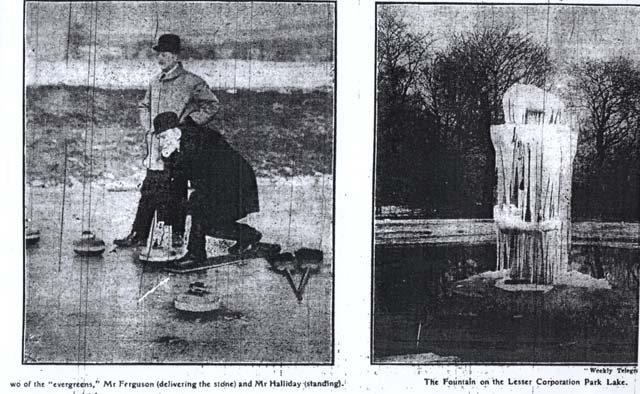
It is difficult to realise now, when we are back to mild open weather, that at the beginning of the week we were in the grip of hard frost. The "Weekly Telegraph" camerist was out to take pictures while the frost was on. The above photographs show the Caledonion Lake, where curling was engaged with great zest, and the Corporation Park, where King Frost, by his magic art, had made a thing of sparkling beauty of the new fountain. The photographs, now that the weather has changed, became souvenirs of the most severe frost experienced for seventeen years.
From the Blackburn Weekly Telegraph of 17th February 1912.
FIFTY YEARS TOMORROW.
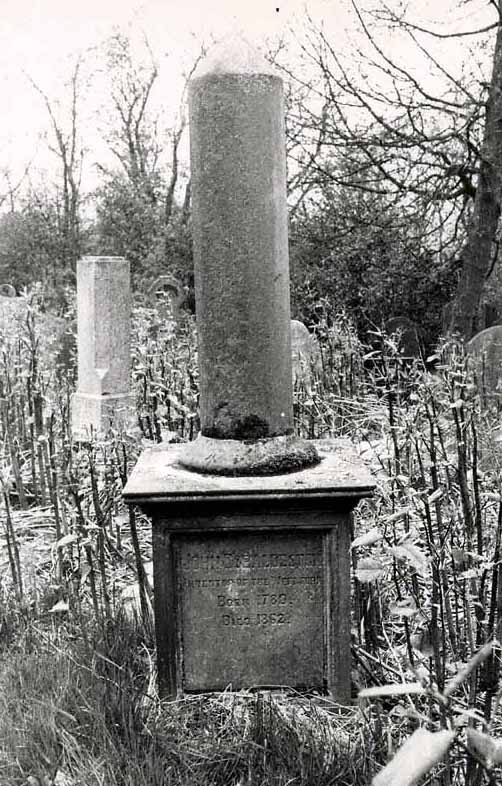
Fifty years ago to-morrow [18th February 1862] there died in Blackburn Workhouse, at the age of 84, John Osbaldeston, who patented in 1842 an improved power-loom and claimed to be the inventor of numerous important devices in machinery for cotton spinning and weaving. He was buried at Tockholes churchyard, and his grave is visited every summer by thousands of people who walk that way from Darwen to Blackburn, and other cotton towns. A well worn path leads to the grave, which is marked by a panelled memorial stone.
the photograph below shows the grave of John Osbaldeston. The inscription reads "John Osbaldeston. Inventor of the Weft Fork. 1780 1862"
From the Blackburn Times of 17th February 1912.
THE HORNBY STATUE.
A VISIT TO THE SCULPTOR’S STUDIO.
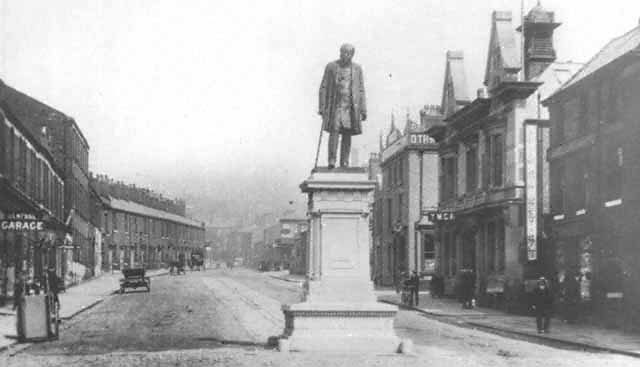
Mr. Bruce Joy has now practically completed the full sized Model for the big bronze statue of the late Mr. W.H. Hornby which is to be erected in Blackburn. The cost of the statue will be defrayed out of a handsome bequest made for the pupose by the late John Margerison who died in July 1907, and who for over 50 years was employed at Brookhouse Mills.
Permission to inspect the model was granted yesterday (Friday) to a representative of “The Blackburn Times”, who was shown round the studio at West Kensington by the distinguished sculptor who has already had so many successes in reproducing in bronze or marble the features of public men.
The new statue is not likely to disappoint the hope of those who knew Mr. Hornby and appreciated his rare combination of strength and kindly feeling which marked his career. The figure, which is some Ten feet high, represents the first Mayor of Blackburn standing in characteristic attitude as if listening and waiting his turn to reply. The sculptor has given great pains to the modelling of the features, and the effect of the whole figure is very striking and dignified. Modern dress particularly so far as men are concerned, is the despair of the sculptor, and Mr. Bruce Joy who has studied the subject very thoroughly, has managed, by the selection of particular curves and lines to hide, as far as possible its inartistic character. In the present instance the wearing of an overcoat, open across the chest and hanging well from the shoulders, lessens the inevitable stiffness, and subtle indications of movement give animation and reality to the statue. The finished casting will be set on a high and carefully designed pedestal of grey granite, and is sure of meeting with general approval when it is unveiled for public inspection in its designated position at the bottom of Limbrick, looking down Northgate.
The model has been seen, we understand, by members of the late Mr. Hornby’s family, who have expressed themselves well satisfied with the likeness and the design.
© LET - terms and conditions
The statue of W.H. Hornby in its position at Limbrick