
 Loading more
Page 4
One hundred years ago, July 1912
From the Blackburn Weekly Telegraph of July 6 1912.
FROM BLACKBURN TO LEVINS HALL.
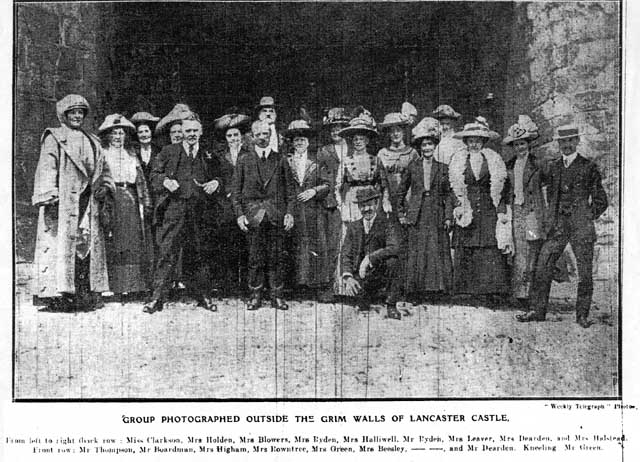
The annual picnic arranged by the Blackburn Reform Club took place on Thursday, and like its predecessors, was a pronounced success. The party travelled first to Lancaster, and thence to Levens Hall. The climatic conditions were excellent; indeed it would have been impossible to have had a more suitable day, and when the party, numbering 64, left Blackburn by the 8.13 a.m. train for Preston, the morning was cool and pleasant, and the prospects of the day were rosy. A couple of motor char-a-bancs had been chartered to await the arrival of the party at Preston, and by these they were conveyed via Garstang to Lancaster, this part of the journey occupying just over an hour and a half. The drive along roads splendidly adapted for motoring was very pleasant, and by the time the party arrived at Garstang the sun was shining with real brilliance, and caused one member to remind some of his comrades it had not rained on the first Thursday in the present month for fifteen years. Lancaster was reached shortly after 10.45, and here the tourists were met by ten others who had covered the whole journey by road. It will hardly be necessary to say that after exhilarating drive from Preston every one was ready for breakfast, half of the party dinning at the County Hotel, and the remainder at the King’s Arms Hotel. At each place a splendid breakfast was served, and after full justice had been done to the meal, the party were left with an hour to spare. This, however, was made good use of, batches visiting the castle, the Parish Church, Park, Town Hall, and Storey Institute. At one o’clock they left the County Hotel en route for Levens Hall, where an hour was spent in examining the magnificent gardens.
The return journey was commenced shortly after four o’clock by way of Dalham Park, the beauty of which was much admired, while a stop was also made at St. Michael’s Church, Beetham. The remainder of the journey was completed without a stop, and the party again disembarked at the hotels previously mentioned shortly after 5.30 for dinner. Subsequently a vote of thanks to the committee was passed, and the return to Preston was commenced at 7.15, the party joining the 9.16 for Blackburn. The arrangements for the outing, which were carried out without a hitch, reflect great credit on the secretaries, Mr. J. Kenyon and Mr. G. Halsted.
Among the members of the club present were: Mr. R. Thompson, J.P. (president), Mr. W. Syrie (vice president), Mr. W. Bury, sen., (Treasurer), Messrs J. Kenyon and G. Halstead (secretaries), Messrs R. Leaver, J. Rowntree, J. Holden, W. Bury, jun., A. Boaedman, J. Ryden, S. Lewis, E. Mercer, J. V. Horrocks, C. Pearce, C. Charnley, R. R. Mumford, T. H. Harchdale, T. Kenyon, E. Bradley. J. Parkinson, J. Boyle, W. Beesley, J. T. Henshaw, T. Halliwell, J. T. Green, and G. W. Blowers.
From the Blackburn Weekly Telegraph of July 6 1912
RUNAWAY MOTOR WAGON.
TWO MEN INJURED AT BLACKBURN.
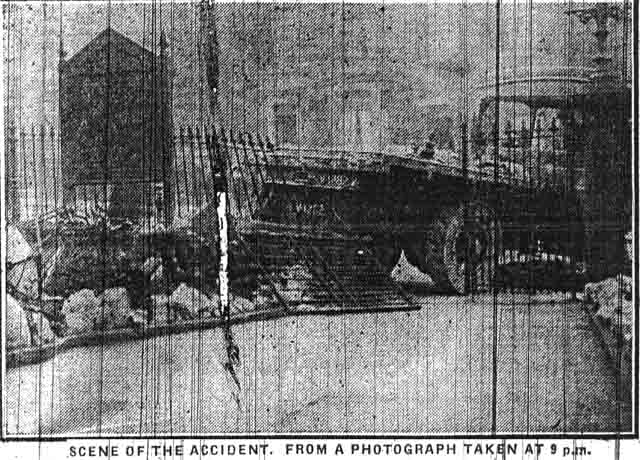
An alarming motor wagon accident resulting in injuries to two men occurred in Montague-street, Blackburn, on Thursday afternoon. A steam motor belonging to the Blackburn Haulage Company was turning out of Preston New-road to descend the incline, when the wheels began to skid, and, the driver losing control of the vehicle, it dashed down the road at a great speed. Richard Hunter, of 7 Shackleton-street, who was driving, and Mr George Woolley, 94, Lynwood-road, accompanying him, jumped off. The motor rushed onto the footpath, damaging the kerbstone and knocking down a street lamp, then partly turned round and backed across the street. It struck the railing in front of the Congregational Church, demolishing the gateway and one of the stone lamp-posts. It then came to a standstill. Mr. Woolley, when he jumped alighted against some railings. He was seriously hurt, his injuries including a compound fracture of the right leg and upper right arm and bruises to his head. Hunter received a lacerated wound in the right hand, and several of his ribs were bruised. Both men were removed in the horse ambulance to the infirmary.
From the Blackburn Weekly Telegraph of July 20 1912.
CORONATION ECHO.
MEDALS FOR BLACKBURN POLICE.
The first communication opened by the Chief Constable of Blackburn, Mr. I. G. Lewis, on taking possession of his new office and headquarters in Northgate on Wednesday was of a most interesting and gratifying character, alike to himself and to members of the force under his command. It was a letter from the Home office intimating that the King had been graciously pleased to confer the Police Coronation Medal, in commemoration of the crowning of their Majesties last year, upon the following members of the Blackburn borough police force:
Chief Constable I. G. Lewis.
Superintendent C. Hodson.
Inspector W. A. Sager.
Inspector R. Pomfret.
Inspector J. Heyes.
Inspector J. Greenall.
Sergeant J. Clark.
Constable W. Wade.
The conferment of these medals follows upon a request addressed to the Chief Constable to recommend a certain number of officers of all ranks for the decoration, under conditions then set forth, long service being one qualification. With regard to the Chief Constable, the regulation laid it down that those of ten years’ service in that capacity, or of twenty years’ service in all were entitled to the medal, so that Mr. Lewis’s qualifications more than met the requirements. Of the other officers on the list, the three last named have retired since the Coronation, but this is no disqualification, and they will receive the medal though no longer in the force. The medal is of silver, bearing on one side, relief, a representation of the King, and on the other the Royal crown, encircled by the inscription: “County and Borough Police. Coronation, 1911.” The ribbon is of Royal blue and crimson.
The Mayor, as chairman of the Watch Committee, has been notified of the receipt of the medals, and it is possible that they will be formally presented to the officers named.
From the Blackburn Weekly Telegraph of July 20 1912.
TENNIS TORNAMENT WINNERS.
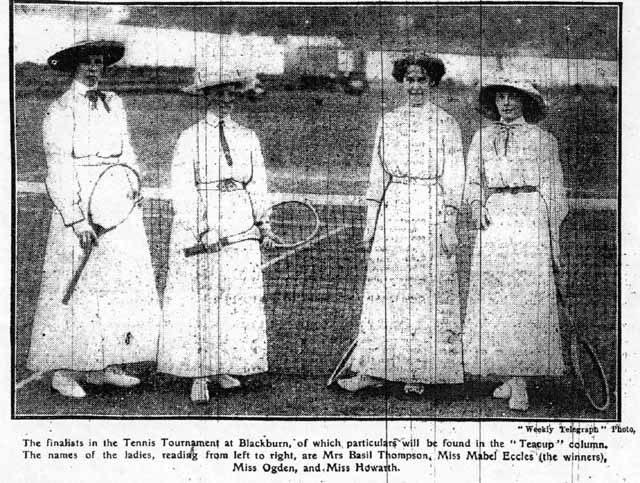
The tennis tournament promoted on behalf of the charitable work of the Girls’ Friendly Society has not yet been brought to close, but the ladies competition was decided on Tuesday afternoon, when about 120 people witnessed the semi-final and final rounds on the Alexandra Meadows.
About 170 competitors took part in the earlier rounds, which were played on Thursday last week. The object of the tournament is to help the branch of the Girl’s Friendly Society’s work, which gives the children of institutions and orphanages a good start in life by training them for domestic service, and afterwards providing suitable places for them.
On Tuesday the tennis was hardly so good as on the previous Thursday, when the delay caused by the rain made it impossible to finish the tournament, though it was generally agreed that those who were left in for the semi-finals thoroughly deserved the distinction.
In the semi-final Mrs. Basil Thompson and Miss E. Eccles beat Misses M. And A Thompson in the first game by seven to five and in the second by six to two. In the other semi-final Miss Thomas and Miss K. Thomas scratched, so that Misses Amy Ogden and E Haworth met Mrs. Thompson and Miss Eccles in the final. The latter pair had played consistently well, were again victorious. The final set, like the semi-final, did not run to a third game, for Mrs. Thompson and Miss Eccles won the first by six to nothing and the second by six to four. Mrs. Sale, who has taken a prominent part in organising the tournament, presented the prizes to the finalists, and in doing so expressed her appreciation of the good play they had the pleasure of witnessing
From the Blackburn Times of July 1912.
DESCRIPTION OF THE NEW SESSIONS HOUSE AND POLICE STATION.
The land on which the Sessions House and Police Station was built was part of a section of Blakey Moor bought by the Corporation for a “Great improvement Scheme”, the cost was over £80,000. The Sessions House and Police Station occupied just a fraction the land acquired, and was only the first part of a larger scheme which would eventually include the Public Halls. After demolition of the old property which occupied the site building work began in February 1910. The estimated cost excluding cost of site and furnishings was £46,788. The Times reported that: “The new courts are a substantial stone built square building. Geometrically it has a greater breadth than depth. Excluding the passage on the south side and west side, and the outbuilding beyond the west passage at the rear, the building has a frontage of 165ft. and a depth of 118ft. It is built of stone from Butler Delph [Pleasington]. On the Northgate frontage the structure has an elevation of 54ft, to the top of the balustrades and is an imposing appearance. Perhaps the most striking features are the four massive Ionic columns, the rustic base and pilasters, the cornice, enriched with modillions, and the two huge figures of Justice and Mercy sit in alcoves over the main entrance. There are four semi-circular headed doorways in Northgate giving access to the staircase leading from the street to the corridors of the upper ground floor. Over the two principal entrances is a small balcony from which important declarations can be made. Above the balcony a carved bulls-eye window shows up prominently. Then come the cornice and figures referred to. The sloping roofs at the front are finished with green slates and the flat roofs at the rear are asphalted. The style of architecture is a restrained Renaissance.
Internally... The two principle staircases have marble dados, and the pilasters in the grand corridor are also of marble. The grand staircases give access to a suite of five good rooms and the two courts at the rear. At right-angles to this corridor are two others, one leading to the suite of offices used by the police staff, and the other giving access to the offices occupied by the magistrates’ clerk’s staff. The two main staircases, the great corridor, the courts, the recorder’s and the magistrates’ grand jury room and common jury room (also to be used as the children’s court0 have enriched fibrous plastered ceilings.
The session’s court is 56ft by 35ft, there are two jury boxes and a gallery for the public...The magisterial bench is semi-circular and space underneath the gallery is reserved for witnesses. All furniture is of Dantzic oak and the upholstering is in Rexine leather. The coloured leaded light over the recorder’s chair represents the figure of Justice, and the one at the back of the gallery the figure of Mercy. The windows on the side contain the emblems of England, Ireland, Scotland, and Wales. One ceiling light contains the Royal coat of arms and one the coat of arms of Lancashire. The dock rails are of coinage metal.
The second or small court is a duplicate of the session’s court, but with no jury boxes.
The Chief Constables and his staff are located on the south corridor. The first room at the head of the staircase is the Chief Constables private office which as one small window looking onto Northgate and a bay window with a south aspect. Then are the following rooms; Waiting room, the Chief Constables Confidential clerk, superintendent, Clerks, witnesses room, detective inspector and detectives which as a strong room for stolen property.
The lower ground floor is approached through an arched doorway giving access to a broad paved passage which runs down the south side and along the back of the building. The charge office, a square room with bay window, is placed at the bottom of the passage in such a positions to command complete supervision on all using the lower ground floor. Prisoners will be taken into the charge office to be “booked” before being placed in the cells. The master clock regulating all the timepieces in the building is in this department.
In the Town Hall [the old police station] there were 18 cells in three stories, connected by an iron staircase, there was only one way up and down. In the new building all the cells are on one level. The walls are of white enamelled brick with round corners. The wooden beds are of an improved type, and the ventilation and lighting are on the best principle. Males and females are kept entirely apart on separate corridors which are closed in with iron gates making escape or intercourse between the two sets of cells impossible. Two or more push bells are in each corridor for emergencies. There are sixteen cells in total, six for women and 10 for men with association cells for male and female. The cells are below ground level and communication is maintained by speaking tube. Prisoners are taken direct from the cells to the dock. There is also an exercise yard surrounded by high walls. Adjoining the charge office is the telephone room. Inter-communication exists between all departments, direct lines connect the sub-police stations and fire station with head quarters and there is communication with the public telephone exchange.
There is a second entrance to the lower ground floor at the back which is for the coroner’s office and children seeking street-trading badges.
The parade room is 71ft. by 27ft; it contains about 150 numbered lockers, one for each man, but no other furniture except a seat and a small desk on a slightly raised platform for the use of the inspector parading the men. Policemen are not like other men in that when off duty they can associate freely with kindred spirits in political clubs... So there has been provided for them a reading room and recreation room, 41ft by 16ft to which they can repair when off duty for social intercourse, A library is also being established. On the Northgate side is the tailors’ shop and large stores, fitted with numbered racks containing a complete outfit for each man, and large tables for working purposes. There is an armoury across the way from the parade room, a storeroom for records not in regular use and a dark-room for photography.
Abutting on the playground side of the Higher Elementary School is a range of one-storey buildings, the most important of which is an up-to-date mortuary. There are two rooms lined with white glazed brick. In one are six slabs, in the other an operating table for the conducting of post mortems. There are then 12 dog kennels, and two large food stores.
The building has been erected from designs and under the supervision of Messrs. Briggs, Wolstenholme, and Thornely, and Messrs. Stones, Stones, and Atkinson, joint architects; the principal contractors are Messrs. W. J. Woof Cronshaw and Sons; and the clerk of works, Mr. J. H. Colmar, of Liverpool.
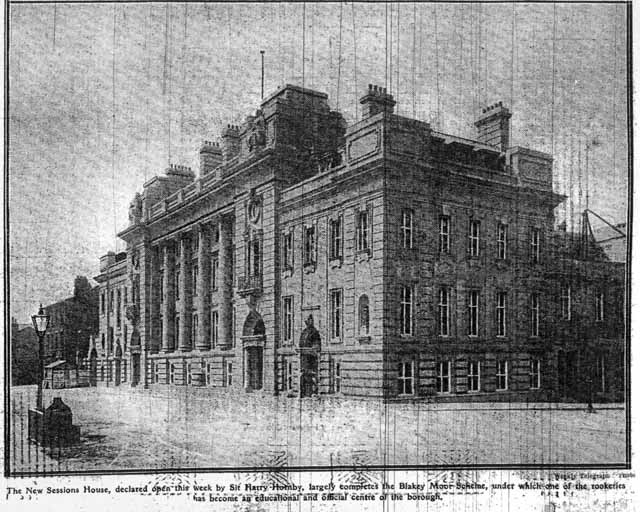
On Thursday 25 of July 1912 the new Sessions House, Northgate, was opened by Sir Harry Hornby. The Blackburn Weekly Telegraph reported that he was;
“Received with loud applause.” He went on to say; “This was the second instalment of the big scheme which the Corporation had undertaken. The first was the school on Blakey Moor, and the third would be the new Assembly-rooms upon which a start had been made. When they were completed, the transformation of Blakey Moor as a centre of municipal activity would have been effected…Proceeding, Sir harry said there was satisfaction in knowing that the schemes were undertaken by Blackburn architects and Blackburn contractors. He also referred to the really inadequate accommodation which the police had had to put up with, but he thought that from what he had seen the previous day they would have most commodious premises to work in. He should like to compliment Mr. Lewis and the police force under his command, for a finer body of men he did not think they would find. The Mayor [Samuel Crossley] referred to the days when there were only a few constables in the town…he was born in King-street, and he recalled that there was a special constable paid for by the inhabitants of that district.”
On Friday 26 July, the Quarter Sessions for the County Borough of Blackburn were held for the fist time in the new Sessions House.
The Blackburn Weekly Telegraph of July 27 1912 said:
“The Recorder [Miles Walker Mattinson K. C.] said; from one point of view it was an historic occasion as regards the administration of justice in Blackburn. That Court had met for the first time in the spacious and handsome Court of Justice which the municipality , with just pride in their institutions which did them credit, had provided. The even of that day recalled to him the occasion of 26 years ago, when the Court of Quarter Sessions sat for the first time in the Town Hall, Blackburn. He had then the honour to be the first Recorder of Blackburn to preside there, and he well remembered that the Grand Jury associated with him was comprised of leading citizens of Blackburn of the day. That was in October, 1886. Many years had passed since then. He was now senior Recorder for Lancashire, and indeed of the Northern Circuit, and he was grateful that he had been spared for all those years, and that he was able to preside that day on an occasion not less interesting than that on which the first Court of Quarter Sessions was held in Blackburn. He was pleased to note that, as 26 years ago, he was associated in the business of the day with a Grand Jury composed of everything which was representative of Blackburn. The Grand Jury represented every shade of opinion or thought in the Borough, and he appreciated the readiness with which he understood all of them, men full of many affairs had responded to the request to participate in the business of the day. The long lapse of years of which he had spoken had made many gaps amongst the public men of Blackburn. The mayor, who in 1886 sat by his side, had gone; the Clerk of the Peace, who sat below him—a man of great versatile ability—had gone, cut of in the plenitude of his power; the Clerk to the Justices, the Chief Constable of those days, and great majority of the Justices were not with them. But he was glad to think that in the present Grand Jury he found not a few who had survived them. He was glad to see the foreman, Mr. William Thompson, in his place. That gentleman was foreman of the Grand Jury of the Quarter Sessions of a quarter of a centaury ago …In the last quarter of a century Blackburn had grown in population, trade had grown, and he believed there was diffused and increased prosperity amongst the whole body of the population. Everything had grown except, thank God, crime, which had not grown. Not only relatively to the increased population, but absolutely, serious crime which went to the Assizes and the Quarter Sessions had diminished. He believed statistics showed that minor crimes dealt with in police courts like drunkenness had also substantially diminished…the 25 years of which he had spoken had brought many changes in the administration of the criminal law of England. Prisoners had been permitted to give evidence on their own behalf, and the effect of that change had been that not a few guilty persons who would have otherwise escaped had received their just deserts. The Court of Criminal Appeal had been established and the effect had in that case been that not a few persons who would have remained in prison on an ill-found charge had been liberated. Thirdly, a material mitigation in the severity of punishment had been witnessed, and contemporaneously there had been administrative changes, the effect of which had been to somewhat diminish the rigour of prison discipline, and by an extension of the system of awarding marks for industry and good conduct reduced terms of imprisonment materially. Hand in hand with the increased leniency had gone a reduction in crime whether the two were connected he could not say. At any rate it was gratifying that with the increased leniency there had been no increase in crime. It might be that there was a good deal in the outlook of the nation which gave thoughtful men cause to pause. But there was consolatory reflection that whatever else had happened in the last few years there had been progress in one direction; as far as crime was concerned the prospect was brighter than 25 years ago.
One hundred years ago, August 1912
From the Blackburn Weekly Telegraph of August 3rd 1912.
FIFTY YEARS AGO.
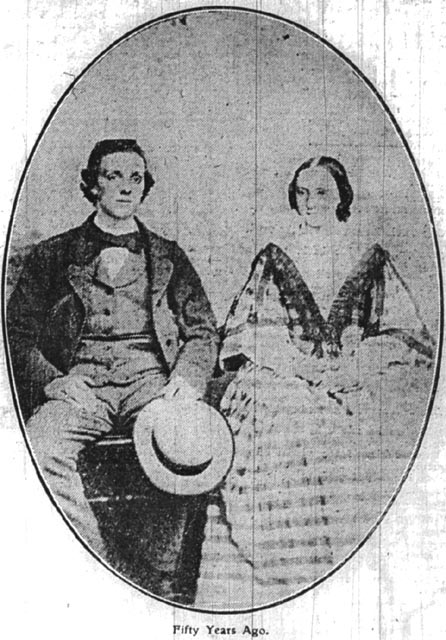
On the 3rd day of August, 1863 there was solemnised at Blackburn Parish Church the marriage of William Hulme, bachelor, and Christina Thompson, spinster*. Being happily spared to attain their golden wedding anniversary, the bride and bridegroom, who reside in Langham-road, are quietly commemorating that great event in their lives to-day, and their many friends will unite in cordially wishing them many happy returns. Born at Bolton, Mr. Hulme came to Blackburn at an early age, and was apprenticed to “Stamp” Wharton, printer and bookbinder, in King-street. After 27 years at the “Times” office, where he became foreman, he started in business for himself in 1889, and is now proprietor of the Borough Press printing works. His studious and observant character being brought into close association with journalism, Mr. Hulme began to write and his impressions of country rambles found expression in a series of newspaper articles that revealed the writer's love of Nature and knowledge of her varied works. In this and in other subjects to which he applied his pen Mr. Hulme achieved the first duty of a writer; he made what he had to tell interesting. This particular quality was also shown later on, when he contributed to a little personal history of the town under the title “Bits of Old Blackburn.” Chats with old characters provided a good deal of material form, and so helped to preserve many interesting and important links in the folklore of Blackburn, and facts connected with its social and industrial customs and progress. In his country walks Mr. Hulme had for many years the congenial companionship of the late Mr. Abram, the local historian, Mr. John Walker, and Mr. David Geddes, curator of the Free Library, and contemporary townsmen. These rambles have now to be restricted in mileage, for Mr. Hulme is seventy three; though no longer able to take afoot the long out-and-home jaunts in which he found such delight, he finds the cycle a very present help in reaching the more distant beauty spots in this pleasant corner of Lancashire. One of the founders of the Footpath Preservation Association, he has taken part in several assertions of public right that have involved somewhat militant proceedings. He is chairman of the North-East Lancashire Association of Master Printers, and a lifelong Oddfellow, being a trustee of the Albert and Victoria Lodge at Blackburn. His Liberalism was founded in the “hungry forties,” and has never faltered. A Wesleyan, he has been connected with Trinity for over thirty years. Of the six children born to Mr. and Mrs Hulme five survive, and their grand children number ten.
*The date of the marriage between William Hulme and Christina Thompson is given here as the 3rd of August 1863. This must be a misprint by the newspaper; they were actually married on the 3rd of August 1862.
From the Blackburn Times of August 10th 1912.
BLACKBURN'S POOR CHILDREN.
TRIPS TO THE SEASIDE AND COUNTRY.
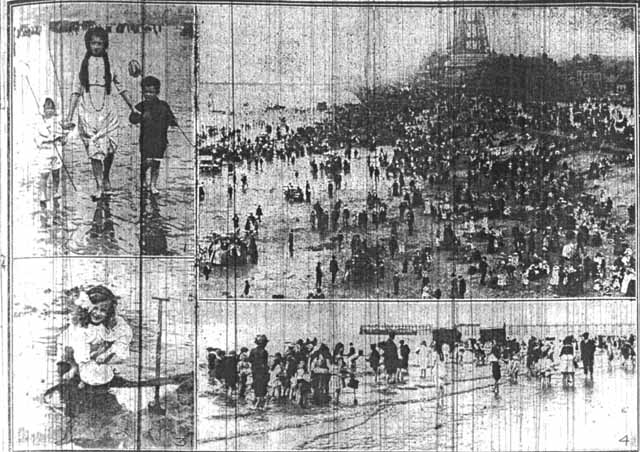
Many were the wishes that, amongst these days of continuing rain, Thursday, at least, might prove the exception. For Thursday was the day appointed for the annual treat to the poor children of Blackburn, and to those who have the arranging and organising of the event, as well as to the young holiday-makers, the weather is an item of great importance. The event is controlled chiefly by the Blackburn Ragged School and the All Saints’ Ragged school and is made possible by the yearly grant from Messrs. Pearson’s Fresh Air Fund of 9d. per head for 2,000 Blackburn children, supplemented by local voluntary contributions. For many years the trip has been repeated and it still represents one of the most deserving causes to which the well disposed can lend their support, whether financial or otherwise. There seems no cause for imagining that the number of Blackburn’s poor children who rely on this for practically their only yearly treat will ever grow less. This year it is as great as ever, and though the Bent-street Ragged School only receives 1,200 of the ninepenny grants, and All Saints’ 500, both schools take considerably more than that number of children on their respective trips. The remaining ninepences of the Pearson’s grant are administered by other organisations, such as the Blakey-street Mission, the Blackburn Orphanage, and Crippled Children’s Home. In each case the money is for the beneficent object of allowing poor children to be taken to the seaside or into the country. This year Bent-street Ragged School took about 1,500 children, and All Saints’ about 800. In both cases they were conveyed to their destinations by train, quite an experience to the majority, to judge by their enthusiasm whilst “getting aboard,” which is no means the least enjoyable part of the holiday. Previously they had been mustered at an early hour at the two schools, and got into what, considering the general excitement was something like orderly. They certainly represented a section of Blackburn’s children of all others demanding sympathy and assistance. Though provision is made for so many children, none but those well qualified by poverty were taken, as a glance at the jubilant but pathetic looking little trippers would show. Tickets are distributed by the school attendance officers and others, on the sole grounds of the recipient’s poverty. It is needless to say that no considerations of creed or politic enter into the humanitarian work. In order that the requirements of the town may be well met, the schools mentioned each serve their own particular district, All Saints’ dealing with children from Emmanuel, Christ Church, Park-road, Bartholomew’s, and St. Andrew’s schools, and Bent-street School with the remainder in other parts of Blackburn. Only the short preliminaries of assembling at the schools and proceeding to the station stood between the children and their enjoyment of the first stages of the outing. The Bent-street party was accompanied by the superintendent, Mr Chilman, and a band of from 70 to 80 workers, and a couple of Highlanders in full costume added the sound of music to the general rejoicing. In the case of All Saints’; the “concourse of sweet sound” was produced by the drum and fife band, which headed a party who waved flags, their tickets of permission, their pots for the coffee, and anything which would serve a medium for the expression of joy. At the station, the larger party was the first away, girls and boys of the Bent-street contingent leaving in two special trains for St. Anne's shortly before nine. Brungerley Bridge was as in the previous years the destination of the All Saints’ children. At the seaside the sands furnished an ecstasy of enjoyment, in which donkey riding, boating, and Punch and Judy show were amongst the most highly favoured, if most ordinary of the amusements. Stone-throwing and unauthorised contests among the boys were less orthodox, but not less appreciated pastimes. Beautiful weather was the happy experience, and until the time for the return it was the day of the year to each child. The meals consisted of meat-pie, bun and coffee for dinner, and bun and coffee for tea. Not a few youngsters made the return with some useful article of clothing added to his or her scanty score, and which had been won at the races held during the day. At Tucker’s farm Brungerley Bridge, the willing party of helpers in charge of the superintendent, Mr. Rogerson, and accompanied by the Rev. A. C. Duxbury, saw that nothing was left undone which could minister to the delight of their annual guests. Sports as at St. Anne's occupied the attention of many, there were wading and boating by the banks of the Ribble, and the meals were similar to those mentioned, and quite as heartily eaten. The return was safely made during the evening, and both parties reported a successful and most appreciated outing. In addition to the day trip several delicate children are, through the fund, sent into the country at this time of the year for the improvement of their health.
Whilst playing on the banks of the Ribble, a boy named Corbett, of Prince Albert-square, fell in the water. Mr. J. Stevenson, 15, Avenue-parade, Accrington, secretary for the Blind Society for that district, who was camping in the vicinity, saw the plight of the boy, and without divesting himself of any clothing, jumped into the water and was successful in affecting a rescue. He was none too soon; however, for it was only after artificial respiration had been resorted to that the lad regained consciousness. Shortly afterwards, another member of the party fell into the water—which is 6ft. deep—at the same place, and a stranger, who promptly went to his assistance, succeeded in bringing him to the bank.
From the Blackburn Weekly Telegraph of August 17th 1912.
SPEED OF MOTORS.
FURIOUS DRIVING TO BE STOPPED AT BLACKBURN.
At the Blackburn Borough Police Court on Thursday [15 August] Robert Edward Bibby, cotton salesman of “Edenholme,” Brownhill, Wilpshire, was summoned for driving a motor-car in King William-street in a manner dangerous to the public; and Joshua Cornthwaite, 3 Dale-street, appeared in answer to a similar summons for dangerously driving a motor-wagon. Mr. J. G. Radcliffe prosecuted on behalf of the police.
In the case against Bibby, P.C. Hartley said that he was on point duty at Sudell Cross on the afternoon of Monday week, when he saw the defendant coming along King William-street in the direction of Preston New-road. He was driving very quickly, and when he got to Exchange Buildings he could not turn properly and his car ran across the road very near the kerb. Although he was on his wrong side, defendant did not cross over but drove up past Sudell cross at a furious rate—the constable estimated the speed at twenty miles an hour—and he also disregarded the officers signal for him to stop.
P.C. Dent and another witness named Hepworth corroborated.
Defendant denied travelling at twenty miles an hour, and said he was going at no more than eight. He had stopped at Town Hall-street, and had to drop into bottom gear to start again. It was imposable therefore for him to get up to such a speed in a short distance like that.
The Mayor (Alderman S. Crossley, J.P.), the presiding magistrate, said there were many complaints received about furious driving, and one could not walk the streets without seeing how reckless a great many people drove. The bench were determined that so far as Blackburn was concerned, a reasonable rate would have to be observed by all motor-car drivers. Before fining Bibby £5 and costs, his worship remarked that defendant could also have been summoned for disregarding the officer’s notice to stop.
Giving evidence against Cornthwaite, P.C. Prescott said that on Saturday afternoon defendant drove a motor-wagon, with trailer attached, down Montague-street. The wagon was coming down in the centre of the road, and was travelling at a furious pace, gaining speed as it came down the incline. On reaching the house, 144, Montague-street, the wagon swerved to the left on to the footpath, where it ran for a distance of about 10 yards. Defendant then got the wagon back into the road, but it again swerved, and the front wheels came in contact with the kerbstone. The trailer, however, swerved completely, and smashed the iron railings and stone jambs in front of one of the houses, a man named William Pickup, of Preston, who was riding on the trailer, being thrown violently against the rails. He alighted on his head, which was badly cut, and had to be taken to the Infirmary in the horse ambulance.
Defendant said the cause of the accident was the skidding wheels. He was fined £2 and costs. The Mayor said it was a question whether motor-wagons should go down Montague-street at all, but if people persisted in driving down they must take their own risks. If similar cases came before them they would have to consider the advisability of inflicting such a penalty as would lead drivers to take a less dangerous road.
At the Borough Police Court yesterday Joseph Killingbeck, chauffeur, 70 Langham-road, was summoned for driving a motor-car in a manner dangerous to the public in Eanam. Mr. J. G. Radcliffe prosecuted and defendant was represented by Mr. Rowland, of Accrington.
Detective Constable Cooper said that about a quarter-past five on the 2nd inst. he saw a motor-car driven by the defendant coming in the direction of Copy Nook. It passed him at a speed which he estimated at over thirty miles an hour. He had no time to stop the car; it was going too quickly. At the time the road was fairly thronged with vehicular and pedestrian traffic, and the speed, in his opinion, was dangerous to the public. The morning after he saw the defendant in the car, and in reply to questions, the latter said that the car was not going at either twenty or fifteen miles an hour, adding “But when I put her on the third clutch she goes very fast for a time, and I have to be done for yesterday you know very little about motoring, and you want to look somewhere else.”
Mr. Rowland: I suggest you made a mistake in the car?—No, sir.
I suggest also that at 5.14 on this day the car was just coming out of the hands of the mechanics at the garage?—I don’t know about that.
If that is true then you must have made a mistake?—It was 5.15 by my watch when it passed us going up Eanam.
Mr. Rowlands said there was only one clutch but three gears and if the officer had made a mistake in that it was possible to have made a mistake in other things.
Detective Constable M’Cartney corroborated the evidence of the first witness, and William Robert Armstrong, a driver, said the passed him at a terrific rate.
Mr. Rowland contended that there was considerable doubt in the case, and his client should have the benefit of the doubt. It was quite possible that the officers had made a mistake in the number of the car, and that the defendant had been brought there instead of somebody else.
The defendant and two mechanics from the Briscoe’s garage Simmons-street stated that it was 5.14 on the day in question when the car left their hands after undergoing repairs. Defendant stated that after that he called at a shop up Eanam until about half-past five.
The Bench considered the case proved and fined Killingbeck £3 and costs.
From the Blackburn Times of August 17th 1912.
BLACKBURN HOLIDAY TRAFFIC
124 SPECIAL TRAINS.
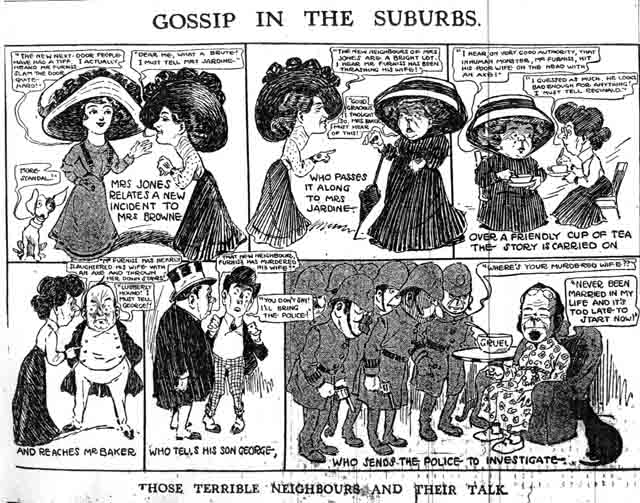
Since the word “exodus” was brought into use the fact which it represents has continued unaltered. Apparently, the periodical “outing” of people from their customary dwelling places is a permanent institution. Certainly this is so with Blackburn for this year the holiday “exodus” has taken place with quite as much thoroughness as usual. Memories of the railway strike which ended the holidays so dismally last year apparently have disappeared, so little did they deter the departure of this season’s merrymakers. From every source the opinions come that no fresh “record” has been set up, the holiday exodus has been at least as heavy as that of last year. An official at the Blackburn Railway Station told the writer that as far as it was possible to judge, traffic had been, on the whole, somewhat heavier than “the corresponding period last year,” to use that favourite phrase of the statistician, “The South of England and the North-East Coast generally and Bournemouth and Scarborough particularly,” he said, “have attracted a larger proportion than usual,” and Morecambe, too, has been better patronised by Blackburnians. In other respects the various resorts have claimed about average of holiday makers, and Blackpool still stands easily first in popular estimation.” That this latter remark was well grounded is shown by the fact that on Saturday and Monday alone no fewer than 34 special trains were sent from Blackburn to Blackpool. Altogether from Friday, August 9th to Thursday, inclusive, 124 special trains were sent to all parts, but to no resorts in such frequency as to Blackpool. As far north as Scotland and as far south as Bournemouth did Blackburnians travel by this means. The following figures show at a glance in what direction and in what numbers the special excursions were run for the week.
Blackpool…………..64
Bournemouth………..3
Belle Vue……………1
Eastern Counties……1
Fleetwood…………...7
Liverpool…………..10
London (Euston).........1
London (Pancras)……2
Morecambe………….9
Newcastle…………...1
Scarborough………...3
Scotland…………….4
Southport………….11
West of England……5
Worksop……………2
In addition to the above mentioned “specials,” there are every day 360 ordinary trains stopping at Blackburn; whilst during the week the station officials had to deal with 50 special trains, mostly Blackpool specials from Yorkshire, which did not stop at Blackburn, not to mention goods traffic. The fact that the holidays commenced on Friday [9th August] relieved the pressure of the traffic somewhat, for numbers travelled on Friday evening, where, long distances such as the west of England and Scotland were to be travelled. Members of the Chapel-street H.S.A. went to Paris, the Parish Church Bible Classes have spent the week at Bournemouth, and a party in connection with St. Matthew’s Church went to the same resort. The bulk of the traffic however was on Saturday morning, when thousands made their departure and the steady stream of trippers continued to flow out of Blackburn throughout the day. The habit of the public of obtaining their tickets in advance greatly facilitates matters, for the crush at the booking office is to some extent avoided, and travellers reach their various platforms earlier, and in a state of comparative calm and composure which assists the officials in their efforts to minimise the difficulties and annoyances of holiday travelling. There is no doubt that the travelling public is becoming educated and experienced. There is a constantly lessening amount of the noisiness, confusion, and uproariousness for which excursionists are supposed to be famous. The share which the many officials of the railway have in this transformation is a considerable one, and at Blackburn one can have nothing but praise for the manner in which, from, Mr. J. Mottershead, the stationmaster, downwards, every member of the staff co-operates to ensure the smooth working of the elaborate system. The small proportion of the inhabitants who were left in the town throughout the week have had the usual tranquil and comparatively uneventful time. Most of the places of worship were closed, of had only one service on Sunday, whilst united services were held at the James-street and Furthergate Congregational Churches. The shops were all closed until Wednesday, Market day, after which the majority reclosed until Friday. Holiday fare at the theatres has been enjoyed by large audiences. Special facilities had been arranged for by Mr. J. H. Cowell, manager of the tramways, for a five minute service on all sections, but the weather, after breaking on Tuesday night remained so bad that the idea had to be abandoned. Rain has been responsible for a very unusual reduction in the number of persons using cars and a consequent lessening in the receipts by many pounds is expected. The usual crop of holiday accidents has been experienced, but amongst those left at home there has been no repetition of the sad fatality which claimed a Blackburn visitor at Blackpool. The postal facilities, have as usual, been somewhat curtailed, and the authorities report that hundreds of picture postcards “from absent friends,” have formed part of the local delivery.
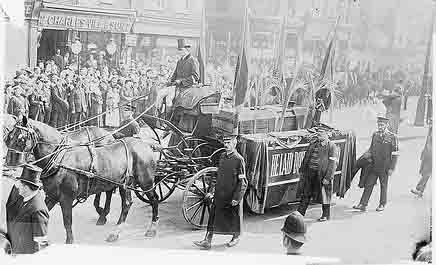
THE DEATH OF GENERAL BOOTH.
General Booth, founder of the Salvation Army died on the 20th August 1912 aged 83 years. William Booth was born on 10th April 1829 at Sneinton, Nottingham. He married Catherine Mumford on June 16 1855, they had nine children. He opened the “Christian Revival Society” in 1865 and later renamed it The Christian Mission. In 1878 it became known as the “Salvation Army” with its own uniform. He became the General and the other members were to be known as soldiers. They eventually became a worldwide organisation. His body lay in state for three days at the Congress Hall in Clapton where thousands filed past. His funeral took place on the 29th of August, 5,000 Salvationists taking part and 40 bands. His memorial service at Olympia was attended by 35,000 people. He was laid to rest next to his wife Catherine at Abney Park Cemetery, Stoke Newington.