
 Loading more
Page 3
From the Blackburn Weekly Telegraph of May 4th 1912
FIGHTING CONSUMPTION.
BLACKBURN C.O.S. AND THE SANATORIUM PROJECT.
At the monthly meeting of the Blackburn Charity Organisation Society on Tuesday evening, the organising secretary, Mr A. Mercer, reported that 57 cases had been dealt with during the month, 54 being local cases and one each from the Nottingham, London, and New York Societies. The cases had been dealt with as follows: One not requiring relief, 2 ineligible, 2 false addresses, 2 sent to the Guardians, 7 were dealt with by private persons, 6 were found employment, 4 received recommends to the East Lancashire Infirmary, 4 for Southport Convalescent Home, and 2 Devonshire Hospital, Buxton, 5 received gifts of clogs or parcels of clothing, and 22 received grants in money.
The hon. Secretary, Mr Malem Brothers, on behalf of the sub-committee appointed to inquire into the question of the provision of a sanatorium for the consumptives of Blackburn, read the following report: “The sub-committee have had various meetings, and are unanimously of the opinion that the system advocated by Dr. Phillips at the annual meeting of the Society should be carried out in Blackburn. The dispensaries should be started and maintained by the local authority; but with regard to a sanatorium the committee feel that the Insurance Act, which will come into operation in July next, has placed some difficulty in the way of building and maintaining such an institution for Blackburn by voluntary effort alone. It seems clear that help towards building and maintaining a sanatorium which may come under the new Act will only be given to an institution which is maintained by the local authority. Under these circumstances the committee wish to urge upon the local authority the desirability of obtaining, if possible, an institution for Blackburn, or at least for East Lancashire, in which event the committee hope that the site which has been purchased at Grindleton, and which has been pronounced by experts as an ideal one, will be adopted.”
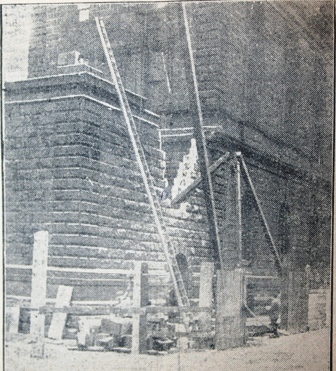
From the Blackburn Times of May 11th 1912
THE ALTERATIONS AT THE TOWN HALL
THE FIRST BREACH
The accompanying photograph shows the first breach in the wall of the Blackburn Town Hall, in connection with the extensive alterations and additions recently decided upon. The contractors, Messrs W. J. Woof Cronshaw and Sons, have laid hands upon the building which represents the most substantial work which the late “Dicky” Hacking was ever associated, and workmen are engaged dismantling the outer walls of the projection at the police station end, near Tacketts-street.
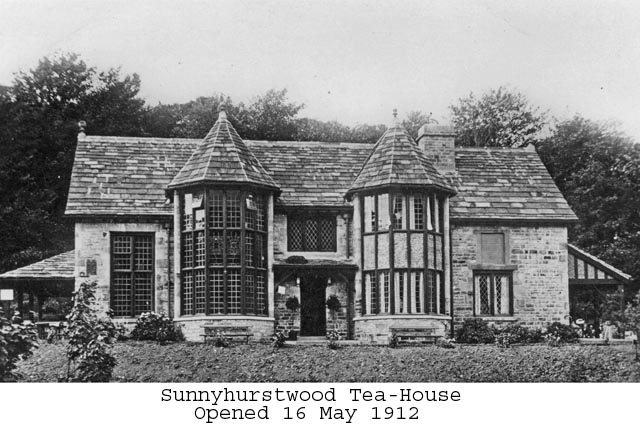
From the Blackburn Times of May 11th 1912
DARWEN’S CORONATION MEMORIAL
OPENING OF THE SUNNYHURST-HOUSE
The tea-house which has been erected as a permanent memorial of the Coronation of King George V, in Sunnyhurst Woods, Darwen, will be formally opened open Thursday next by the Mayor (Councillor John Pickup). Built upon the land previously occupied by a number of cottages in the heart of the woods, the tea-house is an adaption of the Elizabethan and Jacobean style, and has cost about £600. The front faces the stream running through the woods, and the building has been designed by the borough surveyor, Mr. R. W. Smith Saville, to be in harmony with the picturesque surroundings. A large tea-room is provided for the public, and there are smaller rooms for private parties, in addition to living accommodation for the lessee Mr. Ernest Haworth. Shelters for the public are erected at each end of the building. A stained glass window in the tea-room bears the following inscription—“To celebrate the Coronation of his Majesty King George V., a sum of £1,590 was raised by public subscription, out of which this building was erected and donations of £450 each made to the Darwen Nursing association, and the East Lancashire Infirmary—Walmsley P. Kay, Esq., Mayor. Opened May 1912, by John Pickup, Esq., Mayor.
From the Blackburn Times of May 11th 1912
THE NATIONAL RESERVES
SIR HARRY HORNBY OPENS NEW CLUB.
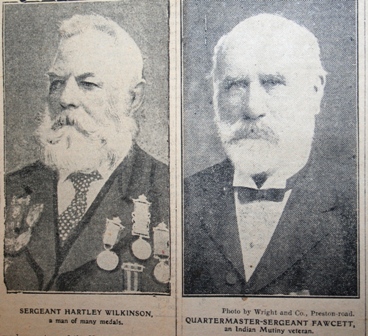
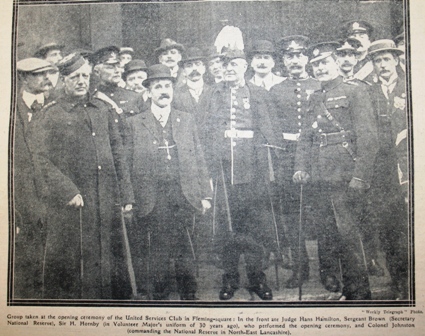
The Veteran Reserve movement, which exists for organising the men who have served under the national flag is now to have its social side in Blackburn, a new institution called “The United Service Club” being opened on Saturday. Besides ex soldiers and sailors, the membership will admit those at present serving in the Territorial’s, or army and navy men home on furlough. For the occasion of the opening ceremony a parade was organised by the National Reserve Battalion of the 4th East Lancashire Regiment. There was a fine muster of men at the Canterbury-street Barracks, where they were marshalled by Major A. Thomas, Colonel Johnston, took command, and was accompanied by Judge Hans Hamilton, wearing his old uniform of Colonel of the Northumberland Militia Artillery. The Veteran Reserve Band accompanied the procession from the barracks to the new club. The lively military airs they played so well quickened the pulse of the veterans and smartened up the old volunteers, and one and all stepped briskly forward. There were many in the procession who had seen active service and marched to a deadlier rumble than that of the drums. One of these interesting veterans was Sergeant Hartley Wilkinson, who fought in the Crimea, and was an eyewitness of the dreadful Balaclava charge. A fine figure of a man, he is still stalwart and straight, and held his head in the ranks as proud as any of the younger men. Attached to his coat was a Crimean medal with three bars for Sebastopol, Balaclava and Alma; another medal for assisting Turkey against Russia in 1855, a third for the Rhootan expedition, and a forth, most prized of all, for “Long service and good conduct.” Another veteran was Quartermaster sergeant Fawcett, who fought in the Indian Mutiny, and took part in the engagement in which Lord Roberts won his V.C. He wore his Mutiny medal and another for “long service and good conduct.” There also marched Corporal John Rainford, who was in the Canadian Fenian raid of 1866, and who also proudly pointed to his good conduct medal; Sergeant Clarkson, who also fought during the Canadian Fenian raid; and several who went through the South African campaign. Another interesting figure was that of William Walkden, who was bugler for Sir Harry when he joined the local Volunteers, and also served under Colonel Johnston’s father.
Arriving at Fleming Square, the processionists were joined by Sir Harry Hornby, who had donned his Volunteer uniform for the occasion, and entered the new premises. The latter building, which formerly was occupied as the Conservative Registration Offices, has been handsomely fitted up for the club, and comprises reading and recreation-rooms, and a billiard-room, a table for which has been given by Sir Harry. The men assembled in the upper room and the chair was taken by Colonel Johnston, who was supported by Sir Harry Hornby, Judge Hamilton, Lieutenant-Colonel Wesley, Major A. Thomas, Captain Carus, Major Kelly, Captain Steele (Burnely), Regimental Sergeant major F.J. Newing, Councillors A. Nuttall, J.P., and G. Whewell, and Mr. J. Hargreaves, hon. Secretary of the Blackburn branch Incorporated Soldiers’ and Sailors’ Help Society. Among those present were Sergeant F. H. Brown, the secretary of the new club, and Sergeant James Haworth, (the latter was formerly secretary of the National Reserve Battalion, and was the first to suggest the formation of that body in the town.
Addressing the gathering Colonel Johnston expressed the hope that the club would provide a happy meeting place for old comrades, and that other towns in the country would follow Blackburn’s example until the whole of the Empire was covered with such institutions. At whatever time or place the men who had served under the colours met together, and whatever their creed or rank, a spirit of good-fellowship sprang up at once, and a new club would foster that spirit in the men of Blackburn, with, no doubt, beneficial results.
Sir Harry Hornby, as President of the United Service Club, briefly declared the premises open. He added he hoped the club would be the means of drawing together those who had given their service to the country, and prove both a pleasure to them and an advantage to the town. The Blackburn Battalion of the National Reserve was steadily increasing, and now numbered 870, including Darwen (200) and Clitheroe (40). He was surprised at the handsome appearance of the building, and the cost of the Improvements must be at least £200. He would have pleasure giving £25 towards that expense. He complimented Colonel Johnston upon having the day before received an important appointment, the new command of the National Reserve over the whole of the East Lancashire Territorial Division having been given to him. He would have charge of 5,000 men and the number could be increased to 20,000. There was no man more capable of bringing about that result than Colonel Johnston, or of managing the force when it was organised.
Judge Hamilton said that he had read with great satisfaction that a great change was coming over our friend and neighbour France, and the spirit of patriotism appeared to be developing strongly owing to the influence of the ladies. The women of France were instilling patriotism into the children and into their husbands and brothers. He would like to see the women of England follow their example, for they could have no better work. His honour mentioned that the patrol jacket he wore that afternoon was the very same in which he stood up and learnt the “goose step” 42 years ago.
Colonel Johnston urged the need for patriotism, and said no country could exist without having all its men capable and competent to bear a hand in defence of the land. Those who could not give personal service could help by financial service. He hoped parents would realise the importance of this question, and instil it into their lads, if they could not see their way to joining the regular service to come into the Territorial Force. It was their bounden duty to keep the old flag flying over the land of our fathers and secured for the necessity and well being of the mother country.
He was glad to see that they had age and youth coming together for the benefit of their country, age in the grand new force known as the National Reserves and youth in the fine institution of the Boy Scouts. With this combined in embracing the experience and discipline of the veterans, and well trained and orderly youths, we should crush out that “infernal hooliganism” that sometimes broke out, and should “Improve our own civilisation and fit ourselves better for defending our land.”
The gathering then joined heartily in the singing the National Anthem. A smoking concert was afterwards held and between puffs old soldiers exchanged yarns and discussed with their Territorial juniors the changes that have taken place since their day, thus beginning what is hoped will result in many pleasant reunions.
From the Blackburn Times of May 18th 1912
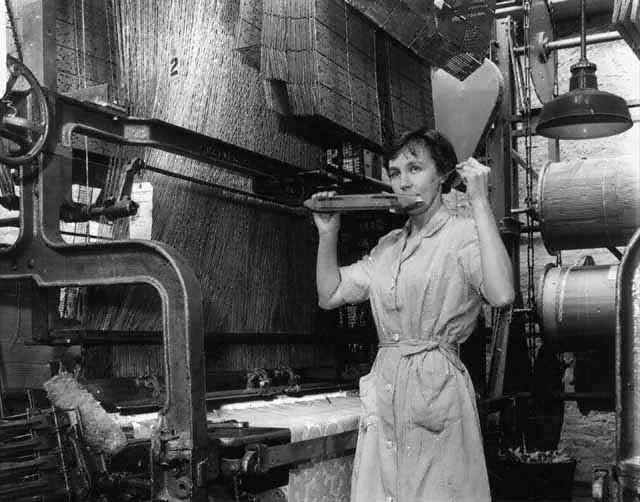
SHUTTLE KISSING REPORT
EVILS NOT SO SERIOUS.
There was published on Thursday the report of Mr. Gerald Bollhouse, a superintendent inspector of factories; Dr. W. W. E. Fletcher, of the Local Government Board, and D. J. Shackleton upon the dangers of disease transmission attending the practice of shuttle kissing in weaving sheds.
Inquiry letters were sent to a number of medical officers of health of Lancashire districts, and replies were received from 58, and it is stated that an overwhelming majority of the medical officers of health are opposed to the present prevailing custom. A list of diseases and afflictions arising, it is claimed, from the practice of “shuttle kissing” are enumerated, and it is pointed out that it was a remarkable fact that when definite instances of the infection were asked for, only five allegations of such an event were instanced, namely: cancer at Oswaldtwistle, tonsillitis at Rawtenstall, tuberculosis at Bacup, phthisis at Tyldesly, and scarlet fever at Burnley. With reference to the three deaths from tuberculosis which were stated to have occurred at Bacup, the Committee went fully into the cases, because of the very serious nature of the charge against “shuttle kissing” implied by Dr. Brown’s report, and they say that the evidence shows that the suggestion of origin in kissing the shuttle was advanced without proper or adequate investigation and that it is not confirmed by the careful inquires made at a later date. The committee add; “We have not found evidence in any instance which would justify suspicion that the shuttles have been the means of transmitting infection.” With a view to examining into the alleged ill effects of the practice upon the teeth of the workers, dental opinion was sought, and in the face of differences of opinion which had been pointed out it was difficult the committee explained, to form a definite judgement as to the actual source of the inciting cause of the dental cares. “So far as we are able to come to a conclusion, we incline to adopt the view put forward by Mr. Miller (Preston), namely, that the mischief has commenced before the work of weaving is entered upon. Subsequently fibre dye-dust, particles of size, etc., are sucked in during the process of “shuttle kissing,” and, impinging on the front teeth, and in the absence of habitual and effective cleaning of the teeth, apt to adhere to the teeth and to lodge in the intestines between them forming together with food masses which ferment and so encourage unusually rapid progress of the decay which has already commenced.” On this point, Mr. Miller said with ordinary care and cleanliness of the teeth shuttle kissing would not be injurious. In the general impressions and conclusions of the practice, so far as the medical and hygienic aspects are concerned, the Committee say that they are quite prepared to admit “prima facie” that some of the diseases mentioned, namely, tuberculosis, diphtheria, septic mouth and throat affections, scarlet fever infections, skin diseases, etc., might be transmitted in this way, but they had been unable to trace definitely and clearly a single instance. Some of the diseases mentioned may be due to the general condition of work apart altogether from the question of shuttle kissing, namely, anaemia, dyspepsia, chronic constipation, rheumatism, bronchitis, etc., while others are due to infection acquired either in the sheds or else where, such as phthisis, infectious mouth and throat disease, and catarrhal conditions. “Having regards then, to all the facts brought out by this inquiry,” the Committee go on to say, “we conclude that the evils of shuttle kissing are not nearly so serious either in their nature or in their frequency as they have been supposed to be.” They say, however, that the practice is objectionable. They hold this opinion on the ground simply of decency and cleanliness of habit.
The report goes on to mention four types of shuttle which have been designed and states that among them are practicable alternatives to the present type. “Shuttle kissing” no longer is a necessity. It is not thought, however, that the time is yet ripe for insisting either by regulations or by Act of Parliament on the abolition of the existing form of shuttle, and it is stated that the facts cited do not justify drastic legal action at present.
© BwD - terms and condition
BLACKBURN FORTUNE TELLER IN COURT.
WHAT SHE TOLD A MARRIED WOMAN.
At Blackburn Borough Police Court, on Thursday, Sarah Jane Lethbridge, widow, of 2 Hickory-street, was summoned for unlawfully pretending to tell fortunes on the 23rd inst.
Mr J. G. Radcliffe, who prosecuted, said the Chief Constable wanted to stop that kind of thing, and to do so he asked for the co-operation of the Bench.
A female witness who stated that she was married, said that on the afternoon of May 3rd she, accompanied by a lady friend visited the house of the defendant. She asked defendant if she was Mrs. Lethbridge, and also inquired if they were right for having hands read. Defendant replied in the affirmative and asked if anybody had sent them. Witness told her she had been before with her sister. Defendant invited them into the house, and whilst witness went into the parlour her friend remained in the lobby. Witness had taken off her wedding ring, and when defendant asked her if she was keeping company she said “Yes.” Defendant advised her to get married saying, “You have stopped at home a long time, and I think you ought to get married. I do not want to take you away from your mother, but the young man with whom you are keeping company wants to go abroad and wants to take you with him.” Later defendant said, “If you get married it will be the happiest day of your life. Your young man will make a good husband and will get on in the world. He has great prospects before him.” Defendant also told her that she would have three or four children and would be contented. When about to leave the room witness asked what the charge was, and being informed 1s she paid that amount.
The Chief Constable (Mr. I. G. Lewis) said that it was the defendants forth appearance for similar offences. The first time she was fined £10 and costs in two cases, and in the other two penalties of £25 and costs were imposed.
The Bench imposed a fine of £25 and costs.
From the Blackburn Times of June 15th 1912
NEW SWIMMING RECORD
BLACKBURN LADYS SUCCESS
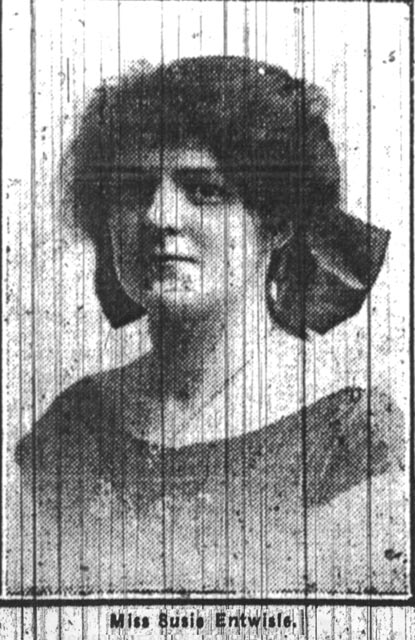
Miss Susie Entwistle of 53 Furthergate, vice captain of the Blackburn Ladies Swimming Club, has created a new record for Blackburn. She has been successful in swimming a distance of seven miles at the local baths. She has only been connected with the club for about four years, during which time she has won a number of prizes in open events and has been awarded the Royal Life-saving Society’s certificate and medallion for her knowledge of life saving methods. She is 21.
From the Blackburn Times of June 15th 1912
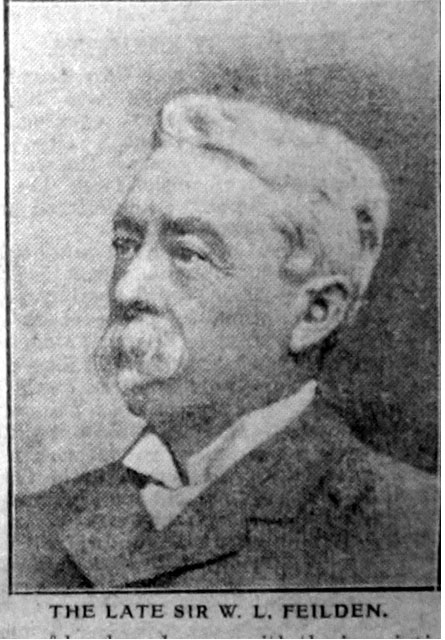
DEATH OF SIR W. L. FEILDEN, BART
A NOTABLE FAMILY OF SOLDIERS
FENISCOWLES AND ITS ASSOCIATION
Sir William Leyland Feilden, Bart, of Feniscowles Hall, Lancashire, and Feniscowles House, Scarborough, died at his Scarborough residence at half past four on Sunday morning. Sir William had been in failing health since about Easter, and for some days he had been in a critical condition.
The Feilden family claim decent from Rudolf of Hapsburg, the placing of the “e” before the “I” in the name denoting the family’s Austrian origin. They have been settled in Lancashire about four centuries, and Rudolf Feilden, born in 1510, was a governor of the Blackburn Queen Elizabeth Grammar School. The great-grandfather of the deceased baronet was Mr. Joseph Feilden of Witton, who married Margaret daughter and co-heir to Mr. William Leyland, of Blackburn. There was issue of the marriage six sons and a daughter. From Henry is descended the Witton Park branch of the family and from William the Feniscowles branch, with which we are now more particularly concerned. Mr William Feilden was born in 1772. He was for some time engaged in the cotton trade with his brothers Henry and John. In 1798 he purchased the Feniscowles Estate and built a new Feniscowles Hall in 1808. Shortly before he had acquired the moiety of Livesey manorial estate contiguous to Feniscowles, a portion of which he converted into preserves and a deer park. He was elected one of the first Members of Parliament for Blackburn, in 1832, when the electors only numbered 626, was re-elected in 1835, 1837, and 1841, retiring in 1847 at the age 75. In the July of the previous year (1846) he was created a Baronet. He died in 1850 and was buried in vault beneath the Blackburn Parish Church. The second holder of the title was his son, William Henry Feilden, who also succeeded to the estate, and when he died in 1879 the title and estate descended to his son William Leyland Feilden, the subject of this sketch, who was the third baronet.
The Feilden's are a race of soldiers. The late baronet’s father was a captain in the 17th Lancers, and he himself was educated at Sandhurst and served for a time as an officer in the 5th Dragoon Guards. His young brother, Mr. Henry Wemyss Feilden, C. B., is a retired colonel who served in the Indian Mutiny in 1857-58, in the China War of 1860, in the American Civil War as Assistant Adjutant general in the Confederates’ Army 1862-65, and went with the imperial Yeomanry to South Africa in 1900. He also served as a Captain in the Royal Navy, and went as naturalist to the Arctic Expedition of 1875-6. The late baronet’s cousin, the late Lieut-General Randle Joseph Feilden C. M. G., of Witton Park, of the 60th Rifles, served in the Red River expedition of 1870. At time of the South African War, Sir William and Lady Feilden had four sons at the front, and there were no fewer than fourteen Feilden’s serving with the Forces, all of whom were spared a safe return with the exception of Major Cecil W. M. Feilden, of Scots Greys Witton Park who was mortally wounded in action at Klippan on February 18th 1902.
The subject of this sketch was born on November 5th 1835. He was married on February 16th 1860 to Miss Catherine Jane Pedder, daughter of Mr. Edward Pedder, of Ashton Park, Preston, and they celebrated their golden wedding at Scarborough in 1910. Of the five military sons of Sir William and Lady Feilden, three are married, their eldest son, Major William Henry Feilden, late 3rd Battalion Royal Lancaster Regiment, and who succeeds to the baronetcy, to Evelyn, eldest daughter of Sir Morton and Lady Manningham Buller of Dilhorn Hall, Staffordshire, their second son, Captain Edward Feilden, late Highland Light Infantry, to Hon. Marjorie Graham-Murray, youngest daughter of Lord and lady Dunedin of Stenton, and Captain Rudolf Feilden, late 3rd Battalion Durham Light Infantry, to the youngest daughter of the late Colonel Ryder of Richmond, Yorkshire. Major Wemyss Feilden is Staff Paymaster of the Army Pay Department at Aldershot. Captain Randal Feilden, Oxfordshire Light Infantry, is at present Assistant Civil Secretary in the Sudan Government. Of their two surviving daughters one is now Mrs. D’Arey Asherton Grey.
The late Baronet was a good al-round sportsman, a well known rider to hounds, a good shot, a keen fisherman, and an enthusiastic golfer.
As previously mentioned, Feniscowles estate with the old hall was purchased by the first Sir William Feilden Bart., in 1798. This estate had been in possession of the Liveseys of Feniscowles for several centuries. Abram, in his “History of Blackburn,” mentions a Thomas de Livesey de Feniscowles, a branch of Livesey, lords of Livesey. Describing the old hall, the historian says it is a house of some antiquity situated on a high bank near the river Darwen. It fronts to the south, has a gabled porch, and retains some of the original features. In a passage near the kitchen are the initials, within a scroll, “T. A. L.” and the date “1726,” showing that the house was restored at that time by Thomas Livesey. In the wall of the barn are two sculptured stones, one bearing the letters “T. L.—A. L.” (Thomas and Alice Livesey) and the date “1732” and the other has the letters “I. L.” (For John Livesey.
Feniscowles new hall built by Sir William Feilden stands at the foot of a steep bank near Feniscowles Bridge, at the confluence of the Roddlesworth stream with the Darwen. It is an ordinary modern stone-built mansion. It contained at one time a gallery of valuable paintings acquired by the first baronet, and a varied collection of objects in natural history made by the second baronet, in whose time the pollution of the river became so offensive that he gave it up as a place of residence, not, however, before he had brought action against both the Blackburn Corporation and the Over Darwen Local Board of Health in the early 1870s. He obtained an injunction against the Blackburn Corporation, who were directed to erect tanks for the reception of sewage, and on their declining to do so the plaintiff received £1,250 damages. Shortly afterwards the Blackburn nuisance was entirely discontinued. The action twice heard against the Over Darwen Local Board of Health, for pollution with the town sewage failed. A great improvement was affected when the weir was removed by the Rural District Council a few years ago, and as effluents are now purified before being turned into the water, the pollution has practically ceased. Only the older generations remember the Feilden's living at Feniscowles, which as so long been known as a public holiday resort. In 1903 a large part of the estate was sold by public auction. Sir James De Hoghton added to his Hoghton Tower Possessions 103 acres in Higher Feniscowles farm, for which he paid £6,000. Feniscowles Old Hall was bought for £820, but the mansion which is said, cost Sir William Feilden £8,000 to build, did not find a purchaser, the highest bid being £2,400, at which it was withdrawn.
The remains of the late baronet were laid to rest in Scarborough Cemetery on Wednesday afternoon. A service was held at St. Martin’s Church, Archdeacon Mackarness (vicar) and the Rev. B. N. Keymen (curate) officiating. All the members of the family were in Scarborough, but Miss Feilden and Mrs. Darcy Gray (daughters) remained at home with the Dowager Lady Feilden, who is suffering from bronchitis and asthma.
From the Blackburn Weekly Telegraph of June 15th 1912
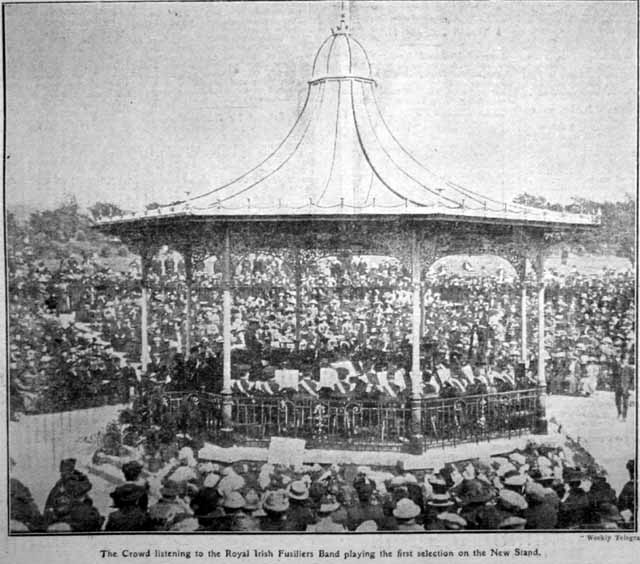
THE SCENE AT QUEEN’S PARK.
Much interest was manifested in the opening on Thursday afternoon of the handsome new bandstand which has been constructed on a convenient site in Queen’s Park at an expenditure of £1,500. The new structure, which is very similar to that in the Corporation Park, is of striking design, and affords on its circular terracing accommodation for some sixteen hundred chairs. Outside the amphitheatre there is a large open grass space, which was utilised on Thursday by the large numbers who could not find room within the well of the bandstand. The opening ceremony should have been performed by Ald. Green, the chairman of the Parks Committee, but in his absence through indisposition the duty devolved upon the vice-chairman, Mr. J. T. Ramsbottom. In a brief speech Mr. Ramsbottom stated the facts of the development of that part of the town since it came into the town’s possession. The land comprising the park, he said, covered about 33 acres, and was originally acquired from the Ecclesiastical Commissioners in 1882. No money was paid for the land, which was given for the purpose of a park or pleasure ground. From 1882 to 1887 it was known as the Audley recreation ground, and during that period £7,600 was spent in laying it out, draining, &c. In 1887 it was decided to open up the ground as a park, to be known as Queen’s Park, in commemoration of the jubilee of Queen Victoria. Since that time large sums had been expended in developing the park, including the construction of the lake, £2,770; roads &c., £2,330; pavilion, £1,462; and the new bandstand and chairs £1,500. Altogether the amount spent out of capital was £17,000, and in addition, £2,114 had been expended on bowling-green, pavilions, and laying-out of playgrounds out of revenue. The annual cost of maintenance was £650, but there was also the interest on borrowed money and the reduction of debt, which absorbed £350, so that the upkeep was £1,000 a year. He thought that the people would appreciate what the Parks Committee had done on their behalf. During the afternoon the Band of the Royal Irish Fusiliers discoursed an excellent programme, and in the evening gave other selections.
From the Blackburn Weekly Standard of June 22nd 1912
ROLL OF HONOUR FOR SCHOOLBOYS.
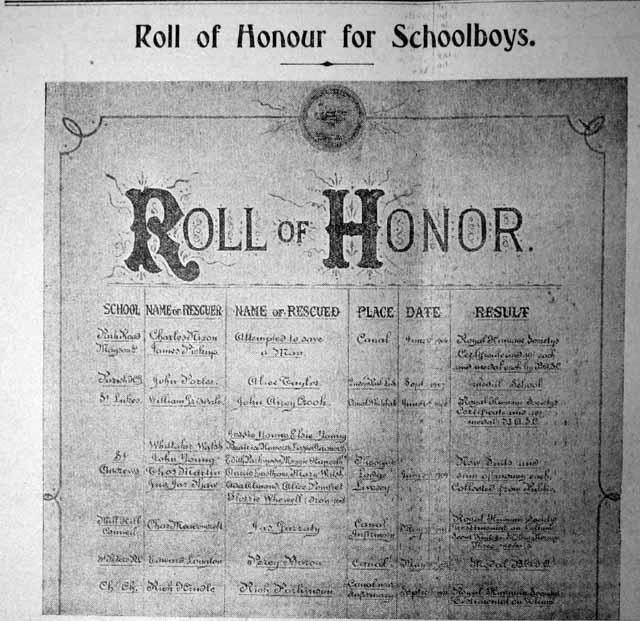
A very interesting memento of gallant deeds performed by Blackburn schoolboys during the past few years in is in course of preparation. It takes the form of a roll of honour, bearing the names of schoolboys, who have learnt to swim under Professor J. G. Kay at the Freckleton-street Baths, and who have been concerned in numerous rescues from drowning. The idea is Professor Kay’s and the work has been neatly executed by Messrs R. Dugdale and Son, of Preston New-road. In all there are eleven names on the roll, and the lads have been responsible for saving no fewer than sixteen lives at various dates between 1906 and last year. For their actions most of them have been awarded either the certificate or the testimonial of the Royal Humane Society, and on the roll particulars of their feats are recorded. The roll at present only goes as far as September last year, so that, as there have been other praiseworthy cases of rescues recently, additions will have to be made. The roll is a striking is an illustration attending the teaching of swimming to schoolboys locally.
From the Blackburn Weekly Standard of June 29nd 1912
THE BLACKBURN “CHIPPERS” ASSOCIATION
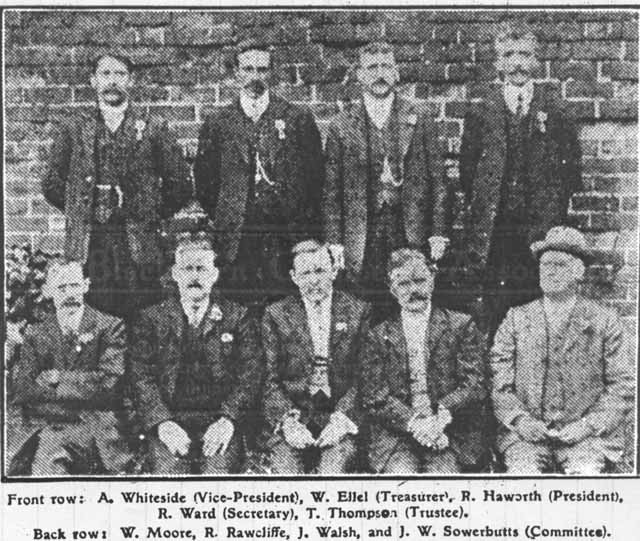
The ninth annual picnic in connection with this Association was held on Monday, when a large number of members and friends had a pleasant day. Starting from Railway-road, the party proceeded by waggonettes, via Brindle and Leyland, to Mawdesley, where a good Dinner was provided at the Black Bull Hotel. Bowling and other games followed, and the party spent an enjoyable time for an hour or so. They then drove, via Rufford and Tarleton, to Longton, where tea was served at the Red Lion Hotel. After tea the party made the most of their opportunities of recreation, and at half-past eight started for home, driving via Bamber Bridge Hoghton, and Brindle, to Blackburn, where “good-night” was said after an outing thoroughly enjoyed by everybody
From the Blackburn Weekly Standard of June 29th 1912
TO ASSIST THE BLIND
MR. AND MRS. NUTTALL’S GARDEN PARTY AT “GREYSTONES.
No effort is being spared to ensure the success of the bazaar to be held at the Town Hall next October to financially assist the work among the blind people of Blackburn. The sum aimed at is £1,000, and there are great hopes that this amount will be forthcoming. The movement received a decided impetus by a fete and garden Party at “Greystones,” Dunkley, on Thursday evening, through the kindness of Mr. Alf Nuttall, J. P., and Mrs. Nuttall, for, though the weather was dull throughout the afternoon, the event was a great success. Nothing had been left to chance. Every detail had been well thought out by the generous host and hostess, who had made provision for all contingencies. Over 650 tickets had been sold for the fete, and the guests were accommodated in two special trains which left Blackburn shortly after two o’clock. On arriving at Longhop there was a torrential downpour of rain. A dozen motor cars were soon in attendance, however, to convey the passengers to Dinkley, a distance of over three miles, the fares collected being devoted with the general proceeds, towards Mrs. Nuttall’s flower stall at the forthcoming bazaar. Those who placed their cars at the disposal of the organisers were Mr. And Mrs. Alf Nuttall of “Northwood”, Mr. and Mrs. Richard Greenwood of “The Gables”, Mr. And Mrs. Harold Eccles of “Sykes Holt”, Balderstone, Mr. W. W. Wilkinson, Mr. Richard Thompson, J. P., of “Lyndhurst”, and Mr Duckworth, of Wilpshire.
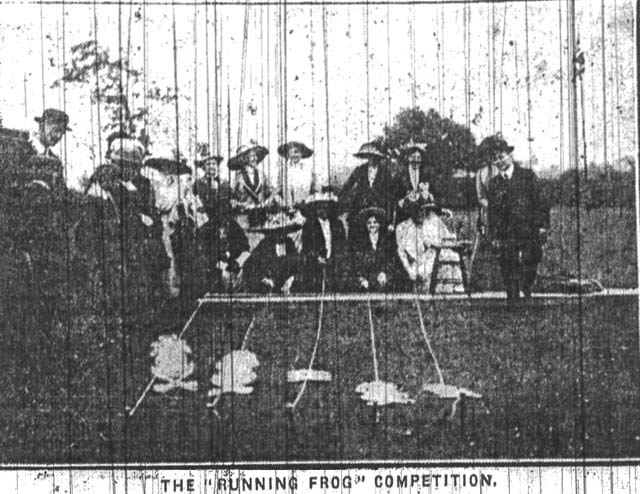
As the rain continued for some time the Kingston Pierrot Troupe entertained the guests in a large marquee, whilst strawberries and cream, ices and other delicacies were distributed by the workers. As the afternoon advanced the rain ceased and the multitude of side-shows—travelling frogs, aunt sallies, flying pigeons, homing pigeons, races, etc.—were well patronised. The children were given drives to the river on a jaunting-car belonging to Mr. Harold Eccles, and others had donkey drives in the commodious field adjoining “Greystones,” which were, with the house grounds, placed at the disposal of the visitors. “Prize drew” tickets were sold in respect of the donkey, but it was stipulated that the fees for these tickets should constitute “purely voluntary subscription.”
Among the visitors were the Mayor of Blackburn (Ald. S. Crossly J. P.), Misses Dug dale, “Claremont,” Canon and Mrs. Pickop, “Winston Hall,” Mrs. Taylor and party from “Crosshill”, Mrs. James Kay, Mrs Geo. Porter, Mrs. Albert Coddington, Mrs Walter Illingworth, Mr. and Mrs. T. B. Lewis, Mrs Winlock Holgate and party, Mrs. John Haddock, Mrs. Harry Mercer, Mrs. Wm Woodhouse, and party, Mrs. Bicker dike, Mrs John Stones, Mr. G. A. Stocks and party, Dr. and Mrs. Greg son, Mrs. Ritzema, Mrs Lavery, the rev. G. R. Pughe (Mellor),Mrs. John Thwaites, the Rev. J. E. and Mrs. Samuel, Miss Harrison, Mrs. Knack, Mrs. R. Y. Aitken, Mrs Tom Robinson, Dr. Jeffrey Ramsay, Capt. McBridges, Dr. and Mrs. Keighley. Mr. John Cartwright, Mrs. Tom Dean, Mrs Tom Hargreaves, and Mrs. Stones (Wilpshire).
The workers present included Mr. And Mrs. Nuttall, Miss Coward, Mr. E. Coward (secretary for the workshop) and Mrs. Coward, Miss Thwaites “Westbank,” Mr. Richard Greenwood and Party, of the “Gables,” Mrs. Sager, Mrs Tom Mercer, Mrs. Harry Backhouse, Mrs. Neale, Mrs. Albert Troupe, Mrs. Jack Wilson, Miss Schofield, Mrs. John Lucas, Miss Walker (Blackpool), Mrs. Gilbert Sames, Mrs. W. D. Ritzema, Miss Phyllis Nuttall, Mr. Nuttall junr., Miss Illingworth, Miss P Illingworth, Mrs. Gerald Greenwood, Mrs. Tom Fielding, Mrs. Lueas, and Mrs. Will Howard.
The projected bazaar will not only assist in extending the workshops for the clinic, for both men and women, but it will help forward the work of the society for instructing the blind. There are seven blind women engaged in the women’s workshop in Mason-street, and 17 men in the Byrom-street premises. The manufacturers of the district are supporting the institutions by purchasing all their mill skips here, and at the present time the workshops are crippled for want of additional space.
The series of summer events in aid of the bazaar will conclude on July 11th, when Mrs Richard Greenwood will give an American tea at “The Gables,” in aid Mrs. Coward’s refreshment stall.