
 Loading more
Page 5
One hundred years ago, September 1912
From the Blackburn Weekly Telegraph of September 7th 1912.
Pulled Up In A Tunnel.
An Alarming incident, happily with no serious consequences, occurred about midnight on Saturday in the Daisyfield railway tunnel. The 10.45 train from Blackpool to Colne was proceeding through the tunnel, when, through the communication cord being pulled, the train was brought to standstill. The reason for the cord having been pulled could not be ascertained, but whilst the train was standing some wagons which were being shunted ran into it. There was good deal of commotion, but nobody appears to have seriously hurt. A hard felt hat worn by an Accrington passenger saved his head from injury when he was thrown from his seat to the opposite side of the compartment. No damage was done to the rolling stock or rails, and after a delay of about 15 minutes the train proceeded. When it reached Accrington Dr. Gorden was summoned to attend a Burnley man, who complained of an injured back, and a man afterwards proceeded to Burnley in another train, which was put on to take passengers to Colne and the intermediate stations.
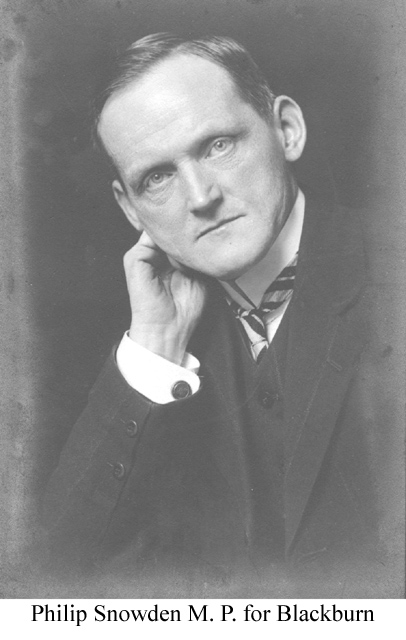
From the Blackburn Weekly Telegraph of September 7th 1912.
Militant Suffragists.
Mr. Snowden On Their Methods.
Mr. Philip Snowden, M.P. in the current issue of the “Christian Commonwealth,” deals with the Woman’s suffrage question, and makes some sharp comments on the policy of the militant section of the suffragist movement. Mr. Snowden points out that under the terms of the Prime Minister’s offer with regard to the Reform Bill the Woman’s Social and Political Union, who have clamoured for a Government measure, can have woman’s suffrage in a Government measure if they can induce the pledge supporters of it in the present House of Commons to vote for it.
“These Women,” continues Mr. Snowden, referring to the militants, “by their mistaken tactics, have handed over the control of the situation to the very men they say are their enemies, and have enabled them, if they are so disposed, to break their pledges and to put the responsibility upon the policy of the women. If the Woman’s Social and Political Union had decided to accept the concession of the Prime Minister, although like them I would have liked to see the Government shouldering the responsibility for woman suffrage from the introduction of the Reform Bill and had used all its unrivalled enthusiasm organisation to rouse public support amendment to the Reform Bill and to organise the support in the House of Commons, the chances of the success of such an amendment would have been of the rosiest hue. As it is, the policy of this body is doing as much to destroy the chances of woman suffrage in the Parliament as the heroic efforts of the reasonable and practical suffragist are doing to make the best of the present unequalled opportunity.”
Proceeding, Mr. Snowden says that militancy must have the appearance of justification. “At present there is no apparent justification for it. On the contrary, to everybody but the W.S.P.U., those tactics at the present juncture are so unjustifiable and fatuous as to take away from them all the element of heroism or even fanaticism, and to give to them the appearance of insanity.
“A discussion has been going on on the question of militant tactics, but it seems to me that the real matter at issue in the present situation is not whether militant tactics, terrorism, insurrection, are good polices to adopt in a reform movement or not. We cannot lay down the any law on this matter which shall be applicable under all circumstances. The question is whether certain tactics are desirable and useful in a given set of circumstances. I can well imagine circumstances under which I should be as militant as the most militant member of the Woman’s Social and Political Union, and it may be that even yet the whole woman’s suffrage movement will have to adopt militant tactics. But all that has really nothing to do with the present situation. The only concern we have with militant tactics at the present is to consider whether they are desirable and useful in present circumstances. And I have no hesitation in giving an answer to that question. They are not only doing no good whatever, but they are doing more to injure the cause of woman’s suffrage than all the follies and fallacies of the anti-suffragists…
The policy which is calculated to make the best of the situation created by the Prime Minister’s offer to leave the House of Commons free on the question of Woman’s suffrage is that which is being pursued by the constitutional suffragists. They are planning a great campaign for the autumn, and they are organising Parliamentary support. If the full vote of the pledged supporters of woman’s suffrage can be secured for the first amendment it will be carried, and that will commit the House of Commons to the enfranchisement of women by this bill in one form or another. I do not underestimate the difficulties in the way of getting complete unity among the various degrees and kinds of woman’s suffragists in the House of Commons. To attain that there will have to be give and take. Men who feel strongly that the political disfranchisement of a whole sex is an injustice which ought to be ended will not stand too much upon the order or the way of doing it. Mr. Dickinson expresses the view that the most likely form in which the final amendments can be carried will be the enfranchisement of women householders and the wives of men occupiers. We shall see. Meanwhile we canvass, deputations, and other means, it is necessary to ascertain the views of all supporters of woman’s suffrage as to the form of amendment they would prefer, and, what is equally important, whether they are prepared to give their support in the last eventuality to any form of enfranchisement which will command a majority, be it the widest or narrowest scheme. The Committee stage of the Reform Bill is not likely to be reached before January. But all the intervening time is not too much for the work which has to be done.
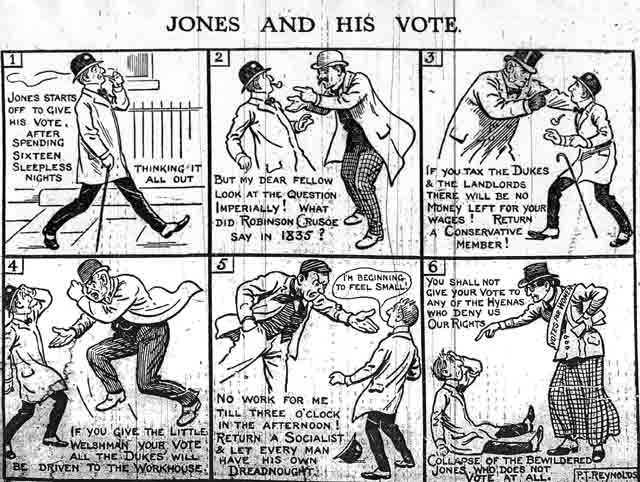
From the Blackburn Weekly Telegraph of September 14th 1912.
THE VOTERS LIST.
INCIDENTS AT THE REVISION COURT.
The annual revision of the voters list for the borough of Blackburn was commenced on Monday at the Police Court before Mr. S. Pope, revising Barrister. Mr. Riley appeared for the Liberals, and Mr Dowden for the Conservatives. The Labour and Socialist were represented by Councillor Higham.
Six Ladies Get Vote.
Miss Bertha Bradley claimed municipal votes on behalf of five sisters and herself for the joint tenancy of 387A, Haslingdon-road. Mr Maxwell (Conservative) said the six ladies were interested in politics, and paid all the rates.
The Revising Barrister, in allowing the six claims said, “They will all be having votes soon.”
The Barrister and his Vote.
George Holden claimed a vote for 7, Franklin-street. His mother appeared on his behalf and explained that her son was married nine years ago, and with his wife continued to live at home. In March last year he became the tenant of the house, which was the property of his mother.
Mr. Dowden supported the claim, but Mr. Riley objected, saying that the claim would not have been put in had not the mother’s right to municipal vote been objected to.
The Revising Barrister (addressing the lady); “I am in the same position as your son, but I cannot persuade my mother to do likewise. I had great difficulty in getting a lodger’s vote, and I am not sure it is a good one.” (Laughter.) “I will allow the claim because you have given evidence on oath.
Lodger Claims.
On the resumption of the court on Tuesday morning many lodgers’ claims were considered. Mr Pope remarked on the difficulty of ascertaining the real value of the rooms in respect of which votes were claimed. In the case of strangers the consideration paid was as good a guide as they could get, but it was not so as between relatives, and the bulk of the cases he had to consider were of the latter Kind. That was the stupidity of the stupid Act. “When this lodger franchise was framed,” he added, “I don’t think anyone in Parliament knew what he was doing.”
“I would like to see some bona-fide lodger claims,” said Mr. Pope later; “all these are cases of parents and their sons.”
With regard to joint occupier claims, Mr. Pope said the time was coming when the landlord would have to give evidence as to who was the real occupier. No matter how many names may be put in the rent-book as joint tenants, the landlord regarded as his tenant the person who owned furniture upon which he could distraint
Joint Tenants.
This question of joint tenancy again arose at the evening sitting the same day, when Hanna and Sarah Jane Corbridge claimed to be put on the list of municipal voters as joint tenants with their mother and sister, who were already on the register.
The Barrister asked Mrs. Corbridge what her idea was in having her daughters as joint tenants.
Mrs. Corbridge replied that they helped to support the home and pay the rates.
Mr. Pope remarked that it was perfectly easy to manufacture votes by an arrangement between landlord and tenants. He had had cases in which six or seven ladies claimed to be joint tenants of one small house. He did not see the force of such claims. He might be in sympathy with woman’s suffrage, but that was another question. In this case Mrs. Corbridge and her daughter had been for four years the acknowledged tenants, and if rent were owing the mother’s furniture would be distrained upon. He did not think it looked well when as many as six ladies claimed to be treated as joint tenants simply because they joined in maintaining the home. Joint tenancy was really a matter of contract with the landlord, and ought to be proved.
Mr. C. Higham said that if joint tenancy was merely a matter of arrangement with the landlord his party had been very slow; they ought to have got a lot more people on the list than they had done.
The Barrister; People seem to think that because they all share in the burden of maintaining a home, therefore they are entitled to be treated as joint tenants. That may be equity, but it is not law, and my view is that there should be a distinct contract entered into with the landlord, by which the parties are made joint tenants.
Both claims were disallowed.
Purity of the Blackburn List.
The Court sat again on Wednesday, but the time was spent in checking the list. When this work had been completed, Mr Dowden moved a vote of thanks to the revising Barrister for the courteous manner in which he had conducted the revision. In cases of doubt Mr. Pope leaned on the side of the claimant, and he (Mr. Dowden) thought that was the right attitude to take up.
In the absence of Mr. Riley, Mr. J. Makinson endorsed what Mr. Dowden had said.
Mr. Pope, in his reply, thanked the agents for the assistance they had given him in making as pure a list as possible. He was quite sure that in purity of its voters lists Blackburn compared very favourably with other towns. The accurate information gathered by the surveyors on each side had been of great assistance to him.
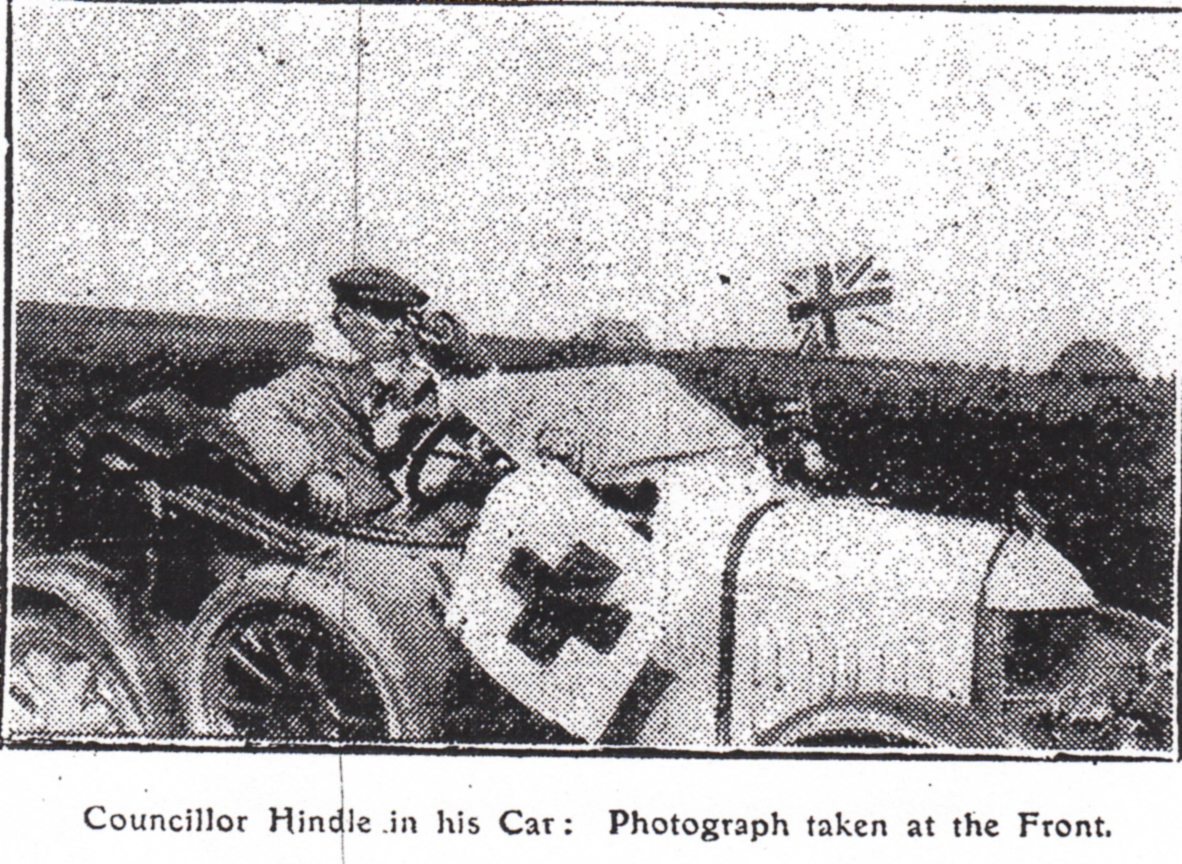
From the Blackburn Times of September 21st 1912.
DARWEN’S NEW MAYOR.
MR. FRITZ HINDLE ACCEPTS INVITATION.
Councillor Fritz Hindle, last night consented to be Mayor of Darwen in succession to Councillor John Pickup. He is the only son of Mr. F. G. Hindle, solicitor, who formerly represented the Darwen Division in Parliament. Educated at Rockley House School, Southport, and at Charter house, he served his articles with his father and his father’s Manchester agents (Messrs. Sale and Co.), and his London agents (Messrs. Woodcock and Co.) Whilst serving a portion of his articles with Messrs. Sale and Co., Mr. Fritz Hindle passed the advanced law examination with distinction, and was awarded the first place in the honours list in conveyancing and second in common law and equity. He won the prize given by the Vice Chancellor of the County Palatine to the most successful law student of the year, and finally he was awarded the Dauntesy legal scholarship, which was open to competition to students of both branches of the legal profession attending law lectures at any of the colleges of the Victoria University. In May 1899 he passed the solicitors’ final examination. He was the only one to gain first class honours. Although the youngest of 14o candidates at the examination. The result was the more remarkable seeing that the distinction of being first honours man was gained by his father at the same examination in the year 1870—a unique coincidence. Mr. Hindle, junr., was also awarded the prize of the Honourable Society of Clement’s Inn and the Daniel Reardon scholarship. This success was a brilliant conclusion to a remarkable successful career as a law student. Previous to this, he had carried off the first speaking and essay prizes at the Blackburn and Manchester Law Students’ Debating Societies, and three prizes in connection with the “Law Notes” competition. In July 1899, Mr. Hindle was taken into partnership by his father.
Councillor Fritz Hindle, last night consented to be Mayor of Darwen in succession to Councillor John Pickup. He is the only son of Mr. F. G. Hindle, solicitor, who formerly represented the Darwen Division in Parliament. Educated at Rockley House School, Southport, and at Charter house, he served his articles with his father and his father’s Manchester agents (Messrs. Sale and Co.), and his London agents (Messrs. Woodcock and Co.) Whilst serving a portion of his articles with Messrs. Sale and Co., Mr. Fritz Hindle passed the advanced law examination with distinction, and was awarded the first place in the honours list in conveyancing and second in common law and equity. He won the prize given by the Vice Chancellor of the County Palatine to the most successful law student of the year, and finally he was awarded the Dauntesy legal scholarship, which was open to competition to students of both branches of the legal profession attending law lectures at any of the colleges of the Victoria University. In May 1899 he passed the solicitors’ final examination. He was the only one to gain first class honours. Although the youngest of 14o candidates at the examination. The result was the more remarkable seeing that the distinction of being first honours man was gained by his father at the same examination in the year 1870—a unique coincidence. Mr. Hindle, junr., was also awarded the prize of the Honourable Society of Clement’s Inn and the Daniel Reardon scholarship. This success was a brilliant conclusion to a remarkable successful career as a law student. Previous to this, he had carried off the first speaking and essay prizes at the Blackburn and Manchester Law Students’ Debating Societies, and three prizes in connection with the “Law Notes” competition. In July 1899, Mr. Hindle was taken into partnership by his father.
Councillor Fritz Hindle, who is 35 years of age, is the youngest member of the Town Council, and is the first bachelor Mayor of the borough. Owing to the death of Councillor J. W. Gillibrand, ex Mayor in 1900, a vacancy was caused in the North East Ward, and though opposed to such a strong candidate as Mr. P. G. Holden, Mr. Hindle secured a majority of 89. This was in January of 1901 and Mr. Hindle had only been a burgess of the town about 8 weeks. He was returned unopposed in 1903, and continued to represent the Ward untill1906, when he was defeated by 152 votes by Mr. James Lord. Mr. Hindle was returned to the Council as a representative for North-West Ward in 1907 in succession to the late Mr. Alfred Cooper, since which time he has represented this ward on the local governing body. In February, 1907 he was returned unopposed as a County Council representative for Darwen, along with Alderman Carus. For the last three years he has occupied the position of chairman of the Finance Committee, previous to which he was chairman of the Burial Board and vice-chairman of various Corporation Committees.
Hr Hindle is secretary of the Darwen Division Liberal Association, is actively associated with the League of Young Liberals, is president of the Darwen Swimming Club, was secretary of the Golf Club in its early days, and takes an active interest in the local horticultural and agricultural shows. He is a staunch teetotaller, and attends the Belgrave Congregational Chapel, with which he and his father have been closely associated as day school managers. He is an expert motorist.
The duties of Mayoress will be performed by Mrs. F. G. Hindle, his mother. Mr. Hindle married the ex-M.P. for the Division in 1876. She is a daughter of the late Mr. Thomas Gillibrand of Hollins Grove House. Since its formation she has taken a keen interest in the work of the Darwen Woman’s Liberal Association. She has been president of the British Woman’s Temperance Association, and in connection with the Lancashire and Cheshire Band of Hope Union she has annually given a number of prizes for competition amongst day school children for essays on school.
From the Blackburn Times of September 21 1912.
FIRE IN RAILWAY GOODS YARD.
At an early hour yesterday morning damage estimated at £2,000 was done by fire to warehouse of the Lancashire and Yorkshire Railway Company, at their East Lancashire Depot, Bridge-street, Blackburn. The warehouse is a lean-to wooden structure, with corrugated iron roof about 100ft long by 40ft wide, built against the main warehouse, a huge stonework building, which lies behind the passenger station. There are hundreds of wagons of merchandise of great value always in the warehouse and spacious yard, and the danger of a fire was a serious one. How it originated is not known, but shortly after one o’clock P.C. 129 Bates was patrolling Mincing-lane when he noticed the reflection of flames in the sky showing that it had got a firm hold before being discovered. He ran to the fire station in Clayton-street close by, and summoned the Corporation Brigade. Inspector Simpson, with Sergeant Hall as second officer, responded with hose tender and an engine and 29 men. A few minutes after the brigade had left an official message was received by telephone. Owing to having to work from hydrants in Darwen-street and Bridge-street, over sixty lengths of hose had to be run out, the warehouse situated a long way from the street. The flames were cut off from the main warehouse and prevented from spreading in other directions, but a hour elapsed before the fire was got under control. Four empty railway trucks, a lurry, a stack of timber, a load of hay, a loading stage and the buildings were badly damaged. The company sent their Horwich brigade by special train with steamer and other equipment, but their services were not required.
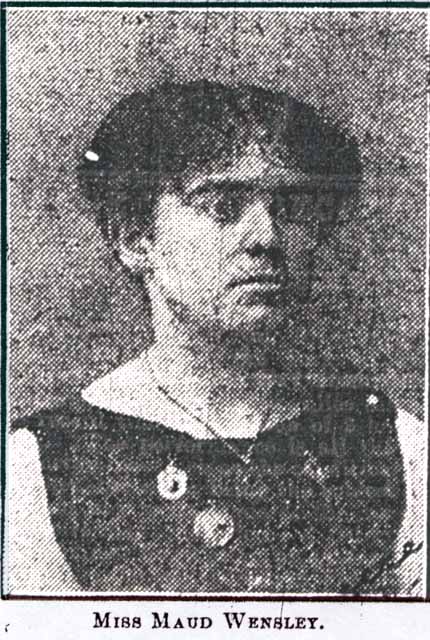
Fom the Blackburn Weekly Telegraph of September 21 1912.
Grange to Morecambe.
A Blackburn Lady’s Plucky Swim.
Miss Maud Wensley, of Blackburn, on Monday accomplished the task of swimming across Morecambe Bay from Grange to Morecambe, a good twelve miles distance, in the record time this season of 2 hours 20 minutes. The performance is all the more praiseworthy inasmuch as the conditions were against her, the water being the coldest experienced on any swim; indeed, the very low temperature had the effect of deterring a strong swimmer like Bailey, of Ashford, from entering, and the two gentlemen who did compete –Hill and Spence, both of whom have tried before—had to abandon the attempt solely on account of the excessive cold. When the news went round the town that Miss Wensley was likely to land some excitement prevailed on shore. From boats and yachts she received hearty cheers, the fishermen joyfully shouting, “Go on my lass, tha’ll do it yet.” Evidently encouraged, Miss Wensley stuck valiantly to her task although the tide was fast running out, and it was this that she had to face in order to get the proper and official landing-spot.
The last fifteen minutes was a most thrilling period. She was swimming hard, but appeared to make no headway, for the tide was rushing down like a mill-race. Miss Wensley did her best, but unfortunately she was carried out too far, and past the landing spot by a rather long distance.
Despite this struggle she finished quite fresh, dressed herself, and walked up the landing-stage amid applause. The disappointment was very keen when it became known that she had finished out of bounds. Still the performance is very meritorious, and is the best this season.
Henry Taylor, of Chadderton, wins the trophy, his time being 2 hours 34 minutes 10 seconds. The other lady competitor from Blackburn—Miss Crook—hardly did so well as on the last occasion.
BLACKBURN ROVERS RESULTS FOR SEPTEMBER 1912
September 2 Sheffield Wed. A. L 1-2 Simpson. Gate 15,000.
September 7 Derby County A. D. 1-1 Bradshaw (pen). Gate 7,000.
September 9 Sunderland H. W. 4-0 Simpson 2, Chapman 2. Gate 17,821.
September 14 Tottenham Hot. H. W. 6-1 Aitkinhead 2, Simpson, Latheron 2, Chapman. Gate 21,837.
September 18 Sunderland A. W. 4-2 Latheron 2, Anthony, Aitkinhead. Gate 18,000.
September 21 Middlesbrough A. D. 0-0 Gate 18,577.
September 28 Notts County H. W. 2-1 Bradshaw 2, (1 pen). Gate 20,104.
© BwD - terms and condition
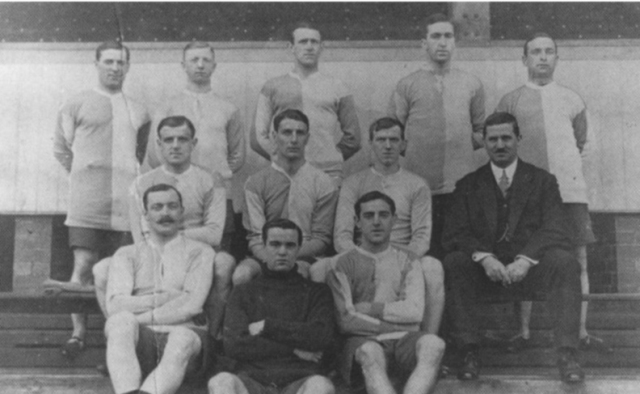
The 1911-12 Blackburn Rovers championship side,
Back row left to right; Simpson, Latheron, Chapman, Aitkinhead, Anthony;
Middle Row; Walmsley, Smith, Bradshaw, Middleton (Secretary);
Front Row; Crompton (Captain), Robinson, Cowell.