
 Loading more
M to Z
M N O P Q R S T U V W X Y Z
Letter M
McCarrick, Matthew | Mack, Michael | McGlin, Albert | Mainwaring, James G. | McKeown, Richard | Marsden, Richard T. Massey, George | Medcalf, William
Rifleman Matthew McCarrick
Royal Irish Rifles, 1650
Private Matthew McCarrick of 2nd Battalion the Royal Irish Rifles (Number 1650) was killed on 7th July 1916.
He was born in Darwen in 1884 to Patrick and Bridget (nee Durkin) and the family are listed on the 1911 Census living at Mount Street, Darwen, and Matthew’s employment is shown as a “Plasterer”.
Matthew’s enlistment papers have not survived but we know he went to France on 25th January 1915.
The 25th Division was established in September 1914 as part of Army Order 388 authorising Kitchener's Third New Army, K3. The units of the Division began to assemble in the area of Salisbury. Early days were somewhat chaotic; the new volunteers having very few trained officers and non-commissioned officers to command them, no organised billets or equipment. Inspected by Lord Kitchener on 12th August 1915, the units of the Division crossed to France 25th–30th September and concentrated in the area of Nieppe. The 25th Division thereafter served on the Western Front throughout the war, except for a period in 1918 when it underwent a major refit and reorganisation.
As the Somme offensive moved from its early phase (designated the Battle of Albert) to the next major push (the Battle of Bazentin), the 25th Division continued to carry out operations on a small scale in the Ovillers area. Casualties were heavy, with no gains of any significance being made. Relieved by 48th (South Midland) Division during the night 16th/17th July, the Division moved to Beauval.
Matthew McCarrick has no known grave and is remembered on the Thiepval Memorial Pier and Face 15 A and 15 B.
His parents would receive his 1914-15 Star together with the British War and Victory Medals.
Private Michael Mack
The King's (Liverpool Regiment), 27235
Not a lot is known about Michael Mack before the war, other than that he resided at 37 Bury Street and that he was a collier at Joseph Place’s Colliery, Hoddlesden.
As a Territorial soldier, Michael was immediately called back to his unit, 4th King’s Liverpool, as war broke out, although it was not until December 1915 that Michael embarked for France. From then on, his Battalion fought in the trenches around Ypres before moving to the Somme for the major summer offensive.
By August 1916, the Battalion was fighting around Bazentin Le-Grand. On 18th August, Michael was killed. The war diary reads:
“Fine – Heavies shelling enemy’s lines – men in front trenches withdrawn to support – barrage on enemy’s lines 2.45pm. B and D Companies went over in two waves followed by “C” Company in support and “A” company in reserve. Attack held up by enemy in false line + Machine Gun Fire. 20th R. Fusiliers came up between 6 and 8pm and took over front lines and supports. Survivors of Battalion came in at dusk and Battalion was collected in trench behind supports.
Captains SIMMANCE and BECK, 2nd Lts. GAULTER. NICKALLS and REID killed. 2nd Lts. GOODMAN and GRAY missing – 2nd Lts. VARNDELL and W. IRVING wounded. 48 men killed, 148 wounded, 22 men missing. 2 men to hospital. 1 to base under age. 4 men struck off and taken on establishment of other units.
19th August MAMETZ WOOD:
Relieved by 1st Cameronians who took over the whole line – Battalion moved out at 2am. to MAMETZ WOOD – search party sent out to get in wounded and officers’ bodies – fine day – Battalion moved to position S of FRICOURT WOOD – Bn. H.Q. in woods by 9pm.”
Michael’s body was never found, but he is remembered on the Thiepval Memorial to the Missing on the Somme, Pier and Face 1D, 8B and C.
Private Albert McGlin
Lincolnshire Regiment, 32878
Private Albert McGlin of the 2nd Lincolnshire Regiment (No. 32878) was killed on 4th March 1917 at Bouchavesnes on the Somme.
Albert was born on 14th February 1890 at 25 Alice Street, Darwen, the son of John McGlin and Alice (nee Holden). The family later moved to 16 Hesse Street and then 55 Sarah Street. By the time of the 1911 census he was working as a cotton weaver but later he took up employment, like two of his brothers, at Darwen Paper Mill.
In 1914 he married Elizabeth Hynes at Sacred Heart and St. Edwards, Darwen and their only child, Albert, was born the same year.
Albert’s military records have not survived but according to The Darwen News he joined the 2nd Lincolnshire Regiment in April 1916 and went to the Western Front about December 1916. He seems to have spent all his time on the Somme.
After the Battle of the Somme, which ended in November 1916, the Germans retreated back to the strong Hindenburg line. This would straiten, and thereby shorten, the line they had to defend. It soon became clear that it was not a premature measure. The allied command planned some new major attacks in 1917, in order to keep the pressure on the Germans. It was in this attack that Albert lost his life on 4th March 1917.
According to the War Diary the 8th Division carried out an attack east of Bouchavesnes at 5.15am. The object was to gain the high ground from which the enemy had observation of the Division position. The Battalion supported the 2nd Royal Berkshire Regiment who was the assaulting Battalion. The attack was most successful and all the objectives were achieved but over 65 men were killed or wounded, including Private Albert McGlin.
Albert McGlin has no known grave and is remembered on the Thiepval Memorial to the Missing on the Somme Pier and Face 1 C. He is also remembered on the St Joseph’s War Memorial where his name is recorded as McGlynn.
Private James Gray Mainwaring
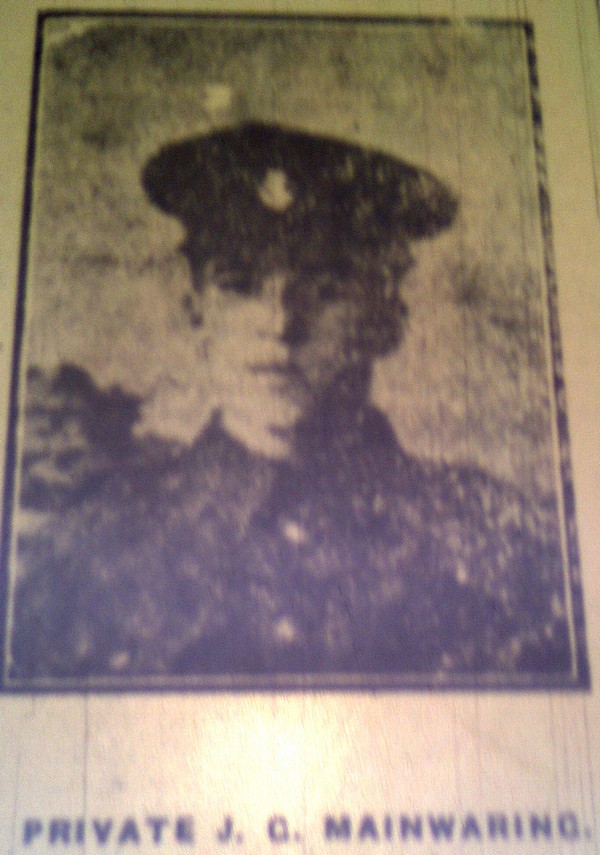
The Loyal North Lancashire Regiment, 19221
Private James Gray Mainwaring of 9th Battlion the Loyal North Lancashire Regiment (No.19221) was killed on 15th July 1916.
James was born in Fleetwood in 1895 to Dennis Mainwaring and Ann Rattray, and on the 1911 Census, he is shown to be living with his grandparents at 2 Cop Lane, Fleetwood, where his employment is listed as “Marine Fireman for a Railway Company”. He subsequently moved to Turton to take employment in a cotton mill and probably went to Bolton to enlist into the Loyal North Lancashire Regiment.
Battle of Bazentin (or the Bazentin Ridge), 14th–17th July 1916
By 13th July the British advance had taken it to a point where it was now facing the second German defensive complex. A well planned and novel night attack on 14th July took British troops through that line but they now ran into stiffening enemy defence at Guillemont, Delville Wood and Longueval, High Wood and Pozieres. Attack and counterattack ground relentlessly on as the British edged forward.
James Gray Mainwaring has no known grave and is remembered on the Thiepval Memorial Pier and Face 11 A.
His next of kin would receive his 1914-15 Star and the British War and Victory Medals.
Private Richard McKeown
East Lancashire Regiment, 168866
Private Richard McKeown of the 1st East Lancashire Regiment (No. 16866) was killed 1st July 1916 at Mailly-Maillet on the Somme.
Richard was born in 1892 at Lancaster, the son Robinson McKeown and Ellen (nee Jacobs). By the time the 1901 census was taken the family had moved to Darwen and were living at 7 Hollins Row. The family attended Sacred Heart and St. Edward’s and Richard worked as a labourer at the Anaglypta Wallpaper Mill.
Richard came from a military family, (his father had been a Staff Sergeant) and therefore on the outbreak for the war it was not surprising for Richard, along with his two brothers–John and Henry – to enlist. He joined the 1st East Lancashire Regiment and arrived in France on 17th March 1915.
Richard saw action at the Second Battle of Ypres and from there the Battalion moved to the Somme. By June they were based at Mailly-Maillet. During the afternoon of 30th June 1916 (the day before the commencement of the Battle of the Somme) saw the Battalion at rest and catching up on sleep. At 4pm. General Lambton went round the billets and wished us good luck.
During the night the troop took up their positions in the trenches. At 7.26am. six leading platoons left the trenches and took up their positions on “No Man’s Land” so as to be in line with the 1st Lancashire Fusiliers who were to attack Beaumont-Hamel. At 07.30am.
The artillery lifted and the Battalion advanced in extended lines towards the German trenches. For a few moments there was silence, and then suddenly machine guns opened up from behind largely unbroken wire and cut down the attackers in swathes.
Despite the heavy fire the Battalion advanced as steadily as if on manoeuvres until practically the whole of Battalion became casualties. The casualties, some 57,470 men, were the worst ever suffered by the British Army on a single day. It was during this action that Richard lost his life.
Richard McKeown has no known grave and is remembered on the Thiepval Memorial to the Missing on the Somme Pier and Face 6 C.
He is also remembered on the Sacred Heart and St. Edward’s War Memorial.
Private Richard Thomas Marsden
King's Own Scottish Borderers, 16922
Private Richard Thomas Marsden of the 6th King’s Own Scottish Borderers was killed on the 7th July 1916 at Montauban on the Somme.
Richard was born on 25th May 1892 at 17 Queens Street, Darwen. He was the son of Joseph Thomas Marsden and Ann Yates. His father was a well-known footballer and had played for Darwen and Everton, and also, for England, against Wales in 1891.
His father died when he was four and his mother remarried in 1902 to Peter Entwistle. By 1901, the family had moved to 59 Tockholes Road and Richard commenced working as a cotton weaver. He attended St George’s Church.
On the outbreak of war, Richard enlisted at Darwen and joined the 6th King’s Own Scottish Borderers. He underwent training at the Salisbury Training Centre and then in September 1914 at Bordon, Hampshire. In March 1915, they moved Bramshott, Hampshire and Richard sailed with his Battalion and landed at Boulogne on 12th May 1915.
The Battalion acclimatised themselves around Bailleul. Later that year, Richard took part at The Battle of Loos; this was his first major engagement. During early 1916, whilst on leave, Richard married Martha Ann Bentley at Railway Road Methodist Church.
After the Battle of Loos, the Battalion was in action in the Battle of the Somme. In the opening phase of the Battle of Albert, (1st–13th July 1916) the French and British assault broke into and gradually moved beyond the first of the German defensive systems.
For the British, the attack on 1st July proved to be the worst day in the nation's military history in terms of casualties sustained. On the first day, British forces at the southern end of the British line made an impressive advance alongside the French Sixth Army, capturing the villages of Montauban and Mametz and breaking through the enemy's defensive system.
On 3rd July the 9th (Scottish) Division the reserve of XIII Corps on 1st July, occupied Bernafay Wood east of Montauban, while the 19th (Western) Division took La Boisselle on the second attempt. An attack by the 12th (Eastern) Division on Ovillers, north of the Albert–Bapaume road, was a failure. The following day the 9th Division occupied Caterpillar Wood to the west of Montauban. The progress of XV Corps at Mametz Wood was not so easy.
The Germans had abandoned the wood on the first day but had reoccupied it on 4th July when the British made their first efforts to take it. It was during the action around the village of Montauban that Richard lost his life.
Richard Thomas Marsden has no known grave and is remembered on the Thiepval Memorial to the Missing on the Somme Pier and face 4 A and 4 D.
Private George Massey
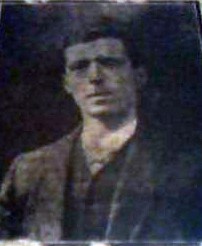
Lancashire Fusiliers, 5715
George Massey was born 12th August 1883 and he was baptised 9th April 1884. His parents were Richard and Ellen and, at the time of his birth, they were living on High Street, Darwen.
By the time of the 1901 census, the family were living at 73 Duckworth Street, and the census records show that George had three brothers and two sisters. George was 17 years, his brother John, 15 years, Harry was 13 years, Alfred 8 years, Eliza 3 years and Margaret was a one month old baby.
By the time of the 1911 census George was married to Mary and they had two daughters, Nellie aged four years and Eliza aged three years. The family lived at 5 Peel Street, Darwen.
Before enlisting George was employed at India Mill and attended Holy Trinity Church and he and Mary had another child prior to the War.
George enlisted in 1914 and left for France 15th July 1915 and landed at Boulogne, The Division engaged in various actions on the Western Front including in 1916; The Battle of Albert, and The Battle of Deville Wood.
On Saturday 12th August 1916 an announcement was placed in “The Darwen Gazette” "Lancashire Fusilier Missing ".
The report told how Mrs Massey of 3 Hanover-sister had received the information from the War Office that her husband Private George Massey of the Lancashire Fusiliers had been missing since an engagement on the 7th ult. He was thirty-two years old. His body was never found.
He is commemorated on The Thiepval Memorial; The Somme, France, Pier and Face 3 C and 3 D.
He received The Victoria Medal, The British War Medal and the 1915 Star.
Corporal William Medcalf
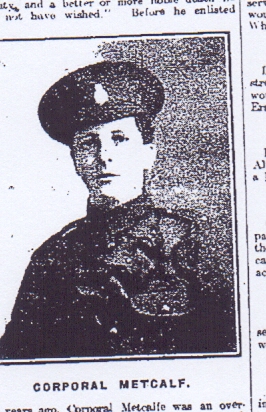
Royal Irish Regiment, 8515
William was the son of John and Charlotte Medcalf* of 8 Windsor Road. He was born in 1894, and was one of six children: Ethel, Ellen, Charlotte, James and Harry.
William Metcalf was an “overlooker” at Bottomcroft Mill, Darwen, and attended St Cuthbert’s church where, at one time, he was a member of the choir.
Willam enlisted on 3rd September 1914, into 2nd Royal Irish Regiment. Following extensive training, William was sent to France on 14th June 1915, and he was promoted to Lance-Corporal on 1st July 1915 and to Corporal on 5th September 1915. He was killed in action exactly two years after his enlistment.
A letter was received by his parents from a Lieutenant who wrote “he was respected by all and greatly admired by me. He died doing his duty and a better and more noble death he could not have wished”
The War diary reads:
2nd September: received orders from 47th infantry brigade for the attack on Guillemont.
3rd September: at 12.25.p.m the battalion advanced to the attack on Guillemont and sunken road, which latter was their final objective. The battalion went over the parapet with their pipes playing and the men went forward in excellent order.
The final objective was within our hands by about 3.p.m. and the line was at once consolidated and held despite three counter attacks. The casualties in the day’s fighting were heavy being 14 officers and 311 other ranks.
William Metcalf has no known grave, but is remembered on the Thiepval Memorial to the Missing on the Somme, Pier and Face 3 A.
*The Newspaper gives William’s name as Metcalf but all other sources say MedCalf.
Letter N
Norcross, Frank
Second Lieutenant Frank Norcross
23rd Manchester Regiment
Lieutenant Frank Norcross of the Manchester Regiment was killed 31st July 1916. He was 19 years old. Frank was born in Darwen during 1897. He was educated first at Darwen Secondary School and later at Manchester Grammar School where he won an entrance scholarship in Classics to study at New College, Oxford in December 1915.
He at once left school where he was trained in the first officers Cadet Battalion, Denham Buckinghamshire. He was nineteen years of age. His parents Mr. and Mrs. James Norcross, formerly of Darwen, resided at 1 Lynton Road, Heaton Moor, Manchester.
The following report appeared in “The Darwen News” Saturday August 19th 1916:
“Lieutenant Norcross will be well remembered by his school friends in Darwen. To Mr. Norcross who for many years was cashier at the Darwen branch of the Manchester and County Bank, and prominent in various local circles – and Mrs Norcross and family every sympathy will be extended in the anxiety which must have been caused them by the report that their son is missing”.
Frank was killed near Trones Wood as the Battalion was sent to clear the woods. He has no known grave but is remembered on the Thiepval Memorial to the Missing on the Somme Pier and Face 13 A and 14 C.
Letter P
Pickup, George | Pomfret, Benjamin | Proctor, James S. | Proctor, Thomas W.
Private George Pickup
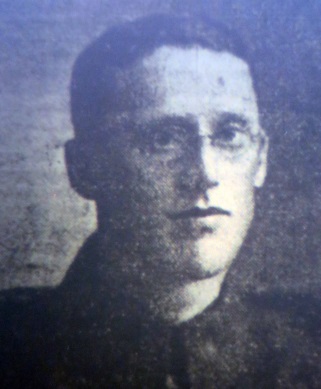
East Lancashire Regiment, 15552
Private George Pickup of the 11th East Lancashire Regiment (No 15552) was killed on 1st July 1916 at Serre on the Somme.
George was born on 10th October 1889 at Higher Marsh House Farm, Darwen. He was the son of John Pickup and Ann (nee Doig). His father played an imported part in the civic life of Darwen and was a former Mayor of Darwen. The family were connected with Duckworth Street Congregational Church and George was a member of the Sunday School cricket team. He was in partnership with his brother at Progress Mill; they were cotton manufacturers.
On the outbreak of war, George was one of the first to answer the call and enlisted in the 11th East Lancashire Regiment (Accrington Palls) at Accrington in early September 1914. On 23rd February 1915, they moved to billets in Carnarvon and training commenced.
In May, they moved to Penkridge Bank Camp, Staffordshire and came under command of 94th Brigade in 31st Division. Later in July, the Regiment moved to Ripon and, in August 1915, they were adopted by War Office and moved to Salisbury Plain during September 1915.
On 19th December 1915, they sailed from Plymouth for Egypt and landed at Alexandria on 1st January. Whilst in Egypt they were responsible for guarding the Suez Canal. From Egypt the Battalion moved to France during March 1916 and landed at Marseilles for service on the Western Front.
They first saw action in the Battle of the Somme. On the first day of the Somme 1st July 1916, the 31st Division was deployed to attack the village of Serre and form a defensive flank for the rest of the British advance. The 31st Division's attack on Serre was a complete failure, although some of the Accrington Pals did make it as far as the village before being killed or captured.
One of the Battalion's signallers, observing from the rear, reported "We were able to see our comrades move forward in an attempt to cross No Man's Land only to be mown down like meadow grass. I felt sick at the sight of the carnage and remember weeping."
Approximately 700 men from the Accrington Pals went into action on 1st July; 585 men became casualties, 235 killed and 350 wounded in about half an hour. It was during this action that George lost his life.
Whilst on active service George was a frequent letter writer and his parents became concerned they had not heard from their son. Fearing the worst, they sent letters to various military hospitals seeking news on their son. On Monday, 31st July 1916 they received a letter from Private J. Baron, George’s friend, who was in a Liverpool hospital. It was through this letter they learnt of their son’s last moments. In the letter Baron writes “Your dear son was killed by shrapnel about 8.20pm. on July 1st. He also had a bad wound upon his leg. He was along with two other comrades in a shell-hole about 95 yards off our own lines, when a shell burst behind us.” The following day George’s father, also with his uncle, visited Baron and they learnt that Private Pickup was badly shot in the leg and he crawled to the shell-hole, and it was in the evening of the same day that he was killed. It would be another nine months before George’s parents were officially notified of their loss.
George Pickup has no known grave and is remembered on the Thiepval Memorial to the Missing on the Somme Pier and Face 6 C.
He is also remembered on the Duckworth Street Congregational Church’s (now Central United Reformed Church) War Memorial.
Private Benjamin Pomfret
East Lancashire Regiment, 12314
Benjamin Pomfret, born 1892, was the second son of John Thomas and Lydia Pomfret. He enlisted at the beginning of the war and was sent to the front with the 2nd East Lancashire Regiment on 5th January 1915. Before the war, he attended St John the Evangelist Church, Darwen and was a fire beater at Almond’s Paper Mill. He was reported as wounded in the hands and was posted missing in October 1916. It was not until May 1917, however, that his parents were informed of his death.
The War diary of 23rd October 1916 reads:
“A dull misty morning, zero hour was postponed until 2.30p.m.
At 11.45 a.m. our heavies commenced to drop very short, one 8 inch shell falling in battalion HQ and others along rainbow trench, doing much damage to our trenches. In spite of repeated appeals, shells continued to drop short until 2.10p.m.
Battalion HQ was forced to evacuate the only dugout in the trench, and move about to avoid being blown up. At 2.30p.m. The assault was delivered under cover of our artillery barrage, ‘fixed’ and ‘creeping’. The men advanced with the greatest gallantry and were at once in the German trenches.
No precise news of what occurred reached Battalion HQ when it became clear from the somewhat conflicting reports that the attack has succeeded in carrying the enemy trenches with the exception of the point at junction of sunray and cloudy trenches, which turned out to be not an isolated enemy post but part of their main front line.
Between 5 and 6pm.
The enemy barrage was intense along the rainbow trench line. HQ had again to evacuate the dugout as it was frequently struck and the single entrance faced the enemy – it consisted only of 8 steps.
Rain came at about 7p.m. which rendered the work very difficult. The night was particularly dark which also hindered matters and the communications, always bad, had been rendered much worse by the enemy’s heavy shelling.
Rations and water failed to reach us. The collection and evacuation of the wounded was very difficult.”
It was in this assault that Benjamin was killed. He has no known grave, but is commemorated on the Thiepval Memorial to the Missing on the Somme, Pier and Face 6 C.
Corporal James Stephen Proctor
Middlesex Regiment, G/11118
Corporal John Stephen Proctor of 2nd Middlesex Regiment (No. G/11118) was killed on 23rd October 1916.
He was born in Keighley, Yorkshire in 1897 but on the 1911 Census he was recorded as living with his grandparents in George Street, Darwen. He worked as a van boy for the Lancashire & Yorkshire Railway.
His enlistment papers show Stephen and Eleanor, his grandparents, as next of kin (with whom he had lived since birth), and a younger brother Frederick. His grandparents inherited his estate following his death. His Army records show that he was 5 feet 7 inches tall with sallow complexion, blue eyes and fair hair. These records also indicate that he was employed as an Engine Cleaner.
The War Diary shows:
“MEAULTE Oct. 20th 3 am
Battalion paraded and marched to TRONES WOOD where it encamped.
TRONES WOOD Oct 21st
Battalion remained in TRONES WOOD where it prepared for action. The following officers were wounded whilst visiting the trenches: 2nd Lieuts. R.S. HARRIS and C.H. RICHARDS.
TRONES WOOD Oct 22nd
Battalion paraded and marched up to SPECTRUM TRENCH on N36.b. The following were the dispersion of coys.: Front Line “A” on right, “B” on the left. Support “CC on right “D” on the left.
TRENCHES Oct 23rd 2.30pm
The Battalion attacked as mentioned above. The attack was entirely successful except that the left flank of the Battalion was left exposed (owing to failure by the next Brigade.) and a new line was established about 200 yards beyond the old hostile front line. The Brigadier complimented the Battalion on its success.
Casualties – Officers killed: 2ndLieut. F.O. KEMP, 2nd Lieut. L. W. SMITH, 2ndLieut. G. HALL. Officers wounded: 2ndLieut. (T/Capt.) H.C. HUNT M.C., 2ndLieut. K.L.N. McCULLOCH, 2ndLieut. A.L. ST. JOHN-JONES.
Other Ranks: killed: 62, wounded 117, missing 47. Total 2 26.”
John Stephen Proctor has no known grave and is remembered on the Thiepval Memorial Pier and Face 12 D and 13 B.
His grandparents received his 1914-15 Star and British War and Victory Medals.
Private Thomas William Proctor
East Lancashire Regiment, 7262
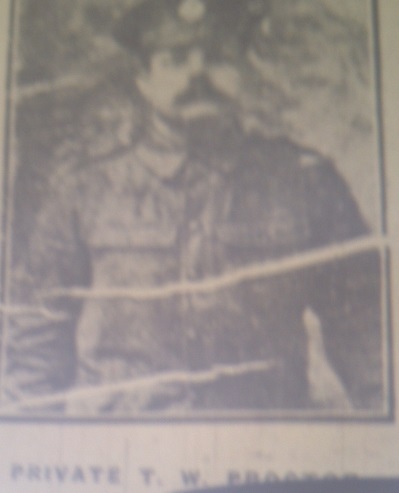
Private Thomas William Proctor of the 8th Battalion East Lancashire Regiment (Number 7262) was killed on 15th July, 1916. Thomas was born in Burnley in 1880. The 1911 Census records that he lived with his wife Emily and three sons at 1 Black Horse Court. At this point in time he was employed as a coal miner.
His enlistment papers have not survived but the medal rolls show he went to France on 1st August 1915.
An extract from the War Diary:
“14 July 1916
At 3.0 am Lt. MacQueen took out a patrol of 6 Grenadiers 1 Platoon and Lewis Gun Section and advanced about 500 yards from our Front Line towards POZIERES and consolidated existing trench there. 2ndLieutenant. Lightbown A. at the same time took a reconnoitring patrol out to the old German gun position at Point 97 about 200 yards from POZIERES-LIZIERES line which was afterwards held by 2ndLieutenants Dunmall and Speak 6 Grenadiers 1 Platoon 1 Lewis Gun Section.
At 4.0pm Lieutenant. MacQueen’s party was relieved by 2nd Lieutenant. Stout with 6 Grenadiers 1 Platoon 1 Lewis Gun Section. At 7pm 2nd Lieutenant Stout with his party attempted to enter POZIERES. This party arrived at the barrier on the POZIERES-ALBERT road where 3 Germans were seen.
Two were bayoneted by our men but the third escaped and gave the alarm. Our party then had to retire receiving very heavy casualties from Machine Guns situated in the houses and orchards around POZIERES.
15th July 1916 Pozieres
At 9.20am after heavy bombardment of POZIERES for one hour, the Battalion led a Brigade attack on the village: A and B companies in the Front Line and “C” and “D” companies in support. Owing to Artillery Barrage and Machine Gun Fire the battalion was unable to achieve its objective but was joined by other units of the Brigade and consolidated existing trenches to East and South East of POZIERES.
At 5.00pm a further bombardment of POZIERES was carried out and the Battalion with remainder of the Brigade attempted another assault on POZIERES at 6-8.00pm. This assault was again held up by Machine Guns and the wire not being cut in the hedges surrounding the village.
The Battalion handed over the trenches to the 10th Battalion. Loyal North Lancashire Regt. at 2.30am and proceeded to Trenches in Close Support. Casualties: Officers Killed 1, Wounded 8. Other Ranks Killed 56, Wounded 276, Missing 33.”
It would be many months before his death was confirmed and as Thomas William Proctor has no known grave he is remembered on the Thiepval Memorial Pier and Face 6 C.
At the end of the war his widow would receive his 1914-15 Star and British War and Victory Medals.
Letter R
Rainford, James | Richmond, James C. | Riding, John | Roberts, George | Rostron, Christopher
Private James Rainford
7th King's Own Royal Lancaster Regiment, 30231
Private James Rainford of the 7th Battalion (No. 30231) was killed 13th November 1916.
He is listed on the 1911 Census at Blackhorse Court with his wife Elizabeth Emma (Grime) whom he had married at Darwen at St John’s in 1909.
Originally, James served in the 1st Battalion Lancashire Fusiliers (Number 13201), with whom he first went overseas.
The 1st Battalion the Lancashire Fusiliers was in India in 1914. The Battalion returned to England in January 1915 and moved to Nuneaton, where they came under orders of 86th Brigade, 29th Division. On 16th March 1915 the Battalion sailed via Egypt and landed Gallipoli 25th April 1915.
A year later they were evacuated to Egypt and eventually landed at Marseilles in March 1916.
It is not known when Private Rainford was transferred to the 7th King’s Own (Royal Lancaster) Regiment following his stay in hospital as his service record has not survived.
This extract from the War Diary:
“ZOLLERN TRENCH
13th November 1916
The 39th Division with the 56th Brigade on the right took the offensive, the objective of the former being the fortified village of ST. PIERRE DIVION and the HANSA LINE, and the latter the continuation of this line from R14 C2.1 to R21 a 06. (Ref. Map 57 DSE 1/2000).
The attack of the 56th Brigade was carried out by the 7th East Lancs Regiment on the right and the 7th North Lancs. on the left with 7th Kings Own in close support, distributed as shown above.Zero hour was 5.45am.At 7.50am “D” Coy. Kings Own was placed at the disposal of the O.C. 7th North Lancs. and at 8.30am “B” Coy Kings Own was placed at disposal of O.C. 7 East Lancs Regiment.
“C” Coy. Kings Own was moved up from SCHWABEN into BAINBRIDGE TRENCH to replace them.“D” Coy. Was pushed up on to the right of the North Lancs. line and occupied the C.T. R20 a 5.9- R20 a 2.7.
“B” Coy. Was first placed in support in STUFF TRENCH, our original front line, two platoons being ultimately pushed up into LUCKY WAY in support of the 7th East Lancs Companies holding the new front line.
“D” Coy. Pushed a patrol up BATTERY VALLEY from R20 a 8.7 to R14 c 8.0 and finding this occupied took over the position and spent the night and part of the day 11/11/16 in digging a chord from R20 a 5.9 to R14 c 8.0.
The rest of the Battalion was used for carrying purposes During the whole of the period 5am 13th November 1916 until 8 pm 14th November 1916 when orders were received for the Battalion to sidestep to the left and take over the HANSA line from the 118th Brigade of the 39th Division.”
James Rainford has no known grave and is remembered on the Thiepval Memorial 5 D 12 B.
His widow would receive his 1914-15 Star and British War and Victory Medals.
Private James Chadwick Richmond
11th Lancashire Fusiliers, 7350
James Chadwick Richmond, born 1892, was the son of John George Richmond and Alice Chadwick, of Hollins Grove, Darwen. James was one of three boys and the family were cotton weavers, although John was a joiner.
James joined the war effort in October 1914 with the 11th Lancashire Fusiliers. They had formed at Codford in October 1914 and came under orders of 74th Brigade, 25th Division. Following a long period of training, the Battalion landed at Boulogne on 25th September 1915.
By 1916, the Battalion had worked hard at learning its craft, in preparation for the Somme Offensive. On 5th July, 74th Brigade was detached for duty with 12th (Eastern) Division at La Boisselle, where it took part in an attack on Ovillers. Divisional HQ moved to Henencourt on 8th July, and the following day, 25th Division took over the front held by 12th (Eastern) Division.
As the Somme offensive moved from its early phase (designated the Battle of Albert) to the next major push (the Battle of Bazentin), the 25th Division continued to carry out operations on a small scale in the Ovillers area. Casualties were heavy, with no gains of any significance being made.
It was on 8th July that James was killed. His body was never found. He is remembered on the Thiepval Memorial to the Missing on the Somme, Pier and Face 3 C and 3 D.
Private John Riding
Cheshire Regiment, 28771
John Riding of the 9th Cheshire Regiment (Number 28771) was killed on the 8th July 1916 at the Battle of Albert.
He was the son of Francis Frederick Riding and Rachael (nee Bryan) and married Emma Dalton at Holy Trinity in 1908. He is shown with his wife and child on the 1911 Census at Brook Street, Darwen, where his trade was shown as Labourer.
The 9th Cheshire’s were part of 58th Brigade who captured La Boiselle on 4th July. They had assembled along the railway embankment south of Albert on 1st July 1916 and on the 2nd July the Commanding Officer received orders to attack the German front line without delay.
Twenty minutes later the majority of the men went over into the crater and German front line adjacent. On arrival a report was received that there were already too many men in the German line and “C” Company was kept back to reinforce, in the crater. Communication was established with O.C. companies.
At about 4pm. orders were received from the Adjutant, who was still in the old front line, that the Battalion would attack La Boiselle and bomb through it, blocking and clearing out all dugouts.
In this opening phase, the British assault broke into and gradually moved beyond the first of the German defensive complexes on the Somme. Success on the first day in the area between Montauban and Mametz led to a reduction of effort to that area, for the initial attack was defeated with huge losses north of Mametz.
There was a stiff fight for Trones Wood and costly, hastily planned and piecemeal attacks that eventually took La Boiselle, Contalmaison and Mametz Wood.
Private Riding is included on the Battalion’s listed of killed, wounded and missing men between 1st and 4th July 1916, but presumably he was not confirmed as killed until the 8th July.
He has no known grave and is commemorated on the Thiepval Memorial Pier and Face 3 C and 4 A .
His widow would receive his 1914-1915 Star and British War and Victory Medals.
Private George Roberts
8th King’s Own Royal Lancaster Regiment, 21681
George Roberts, born 4th January 1898, was brought up by his widowed mother, who by 1911 was running a small local grocery shop. He attended St John the Evangelist Church, Darwen and he is commemorated on theis war memorial. Before the war broke out, George was a cotton weaver and lived at 15 Holker Street.
A boy soldier, on enlistment, he lied about his age stating that he was 19 years when actually he was only 16 years. He would not have been sent abroad until he was 19 years old. He had managed to enlist into the 8th Battalion King’s Liverpool Regiment on 9th November 1914, before being transferred to the King’s Own Royal Lancaster’s.
After arriving in France, the Battalion was sent to the Somme in preparation for the Summer Offensive on 1916.
On Wednesday 16th August 1916, the British were part of the successful assault by the French. Whilst the French were capturing over 2 miles of German lines on either side of Maurepas, our troops pushed forward their lines towards Guillemont, both west and south-west of the village. The British also won and established an advance of 300 yards on the northward facing front of high (Foureaux) wood.
It was in this fight that George Roberts was killed. He was only eighteen years old when he was killed and should not have been at the front at all. His pension was awarded to his mother. Worse still, he has no known grave, but is remembered on the Thiepval Memorial to the Missing on the Somme Pier and Face 5 D 12 B.
Rifleman Christopher Rostron
16th King’s Royal Rifle Corps, C/1405
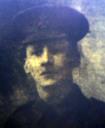
Rifleman Christopher Rostron of the 16th King’s Royal Rifle Corps (No. C/1405) was killed on 15th July 1916 at the Battle of Bazentin Ridge on the Somme.
Christopher was born on 30th October 1896 at 51 Radford Street Darwen. He was the son of Christopher Rostron and Elizabeth Ellen (nee Marsden). The 1901 census shows the family living at 4 Cobden Street, Darwen but they later they moved to 17 Springfield Street. Christopher attended Holy Trinity Church (now St Peter’s) where he was a member of the Church Lads’ Brigade and he was also a Sunday School teacher. He worked at Carr’s Mill as a weaver. Around 1910, he joined the local Territorials and gained the rank of Corporal.
He enlisted at Darwen when he was nineteen and joined the 16th King’s Royal Rifle Corps. It is unclear as to when he moved to France. The 16th Battalion was part of the 100th Brigade, 33rd Division, and they were involved in the Battle of the Somme. The Battalion was involved in the Battle of Bazentin Ridge, 14th- 15th July, 1916 and in action around High Wood. The French name for the wood was Bois des Foureaux (now Bois des Fourcaux).
The 100th Brigade attacked with the 9th Highland Light Infantry on the left, in the front line, the 16th King’s Royal Rifle Corps being in support. The Highland Light Infantry were held up from the start by enfilade fire from High Wood.
The Queen's reached the enemy's wire, and found it uncut. The 16th Battalion was then put in to fill the gap between the two Regiments. They advanced 1,000 yards over the open and lost heavily. The Battalion behaved most gallantly in this, its first big fight, and eleven Military Medals were awarded to NCOs and riflemen for their conduct in the attack. It was during this action that Christopher lost his life.
Christopher Rostron has no known grave and is remembered on the Thiepval Memorial to the Missing on the Somme Pier and Face 13 A and 13 B. He is also remembered on the Holy Trinity Church’s war memorial.