
 Loading more
Page 2
Seddon, William T. |
Shaw, William H. G. |
Shuttleworth, Benjamin |
Shuttleworth, John
Simpson, John H | Smith, Ernest | Smith, John | Smith, Thomas | Spooner, John | Standen, Joseph W.
Stuart, John | Sumner, James
Simpson, John H | Smith, Ernest | Smith, John | Smith, Thomas | Spooner, John | Standen, Joseph W.
Stuart, John | Sumner, James
Royal Irish Regiment, 972
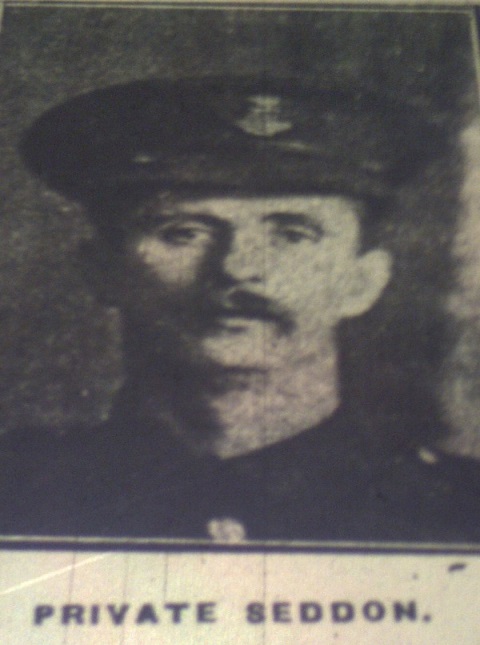 William Thomas Seddon of the 2nd Royal Irish Regiment (Number 972) was killed on 5th July 1916.
William was born in Darwen in 1872 and he married Margaret Ann Leaver in 1891. On the 1911 Census they were living with their family at Old Lane and William is shown as a labourer at a Brickworks.
His enlistment date is unknown but on the 8th July 1915 he went to the Balkans theatre of war with the Royal Irish Regiment, (possibly the 5th Service Battalion), sailing from Liverpool to Gallipoli via Mudros. The Battalion landed at Suvla Bay on 7th August 1915. William came home later in the year suffering from dysentery. Following this illness he was posted to the 2nd Royal Irish Regiment in France.
Between 2nd and 4th July, Fricourt was captured and the 7th Division inched forward. On these days the 7th Division pushed forward in the enemy trench complex and materially assisted in the eventually successful attack of 17th (Northern) Division that captured Fricourt on 2nd July. Two batteries of XIV Brigade RHA under command of 7th Division moved up into Queen's Nullah and began firing to cut the barbed wire defences in front of Mametz Wood. At 3pm on 3rd July, patrols were reporting that Mametz Wood was empty of German troops. This was not entirely true.
2nd Royal Irish Regiment and 1st Royal Welsh Fusiliers of 7th Division's 22nd Brigade were ordered up to occupy a line on the southern edge of the wood, but it was not until dawn on 4th July that they were fully in position. During the night, a detachment of 55th Landwehr was discovered in the wood by a patrol of the 2nd Royal Irish Regiment and driven off.
2nd Royal Irish Regiment and 1st Royal Welsh Fusiliers of 7th Division's 22nd Brigade were ordered up to occupy a line on the southern edge of the wood, but it was not until dawn on 4th July that they were fully in position. During the night, a detachment of 55th Landwehr was discovered in the wood by a patrol of the 2nd Royal Irish Regiment and driven off.
On the 5th July a rain-delayed attack to capture Mametz Wood, Wood Trench and Quadrangle Trench took place at 12.45am. 2nd Royal Irish Regiment and 1st Royal Welsh Fusiliers of 7th Division's 22nd Brigade, together with 9th Northumberland Fusiliers and 10th Lancashire Fusiliers of 52nd Brigade of 17th (Northern) Division, formed the assaulting force.
Quadrangle Trench and Shelter Alley were gained but the Irish were held up by uncut wire and enemy counter attack. Mametz Wood and Trench remained in German hands. Meanwhile, ground conditions were deteriorating due to heavy rain and the British right was waiting for the French, who could not be ready for the next phase until 8th July.
Private William Thomas Seddon has no known grave and is remembered on the Thiepval Memorial Pier and Face 3 A. At the end of the war his family would receive his 1914-15 Star and British War and Victory Medals.
Cameronians (Scottish Rifles), 20876
Lance-Corporal William Henry Goodwin Shaw of the 9th Cameronians (Scottish Rifles) (No. 20876) was killed on 18th July 1916 at Longueval during the Battle of the Somme.
William was born on 9th April 1889 at 2 Punstock, Darwen. He was the son of John James Shaw and Harriet (nee Orme). There is circumstantial evidence that John James Shaw had changed his name from John W Goodwin when the family moved to Darwen around the time of William’s birth. Following William’s birth the family moved to 4 Marsh House Lane and then later to 56 Redearth Road. By the time the 1911 census was taken William was working as a carter for Darwen Corporation and he was living at 12 Nancy Street. When he enlisted in 1915 he was living at Tockholes Conservative Club.
William sailed with his Battalion and landed in France on 2nd October 1915. He took part in the Battle of Loos which was the largest British offensive mounted in 1915 on the Western Front. From Loos that Battalion moved to the Somme. The Battle of the Somme had opened on 1st July 1916 and, on the 13th, the Battalion took up positions near Longueval, ready for an attack at dawn the next morning. They attacked at 3.25am capturing their objectives. There were many wounded, but fatalities, at 35, were comparatively light. The next time there were any deaths was on the 18th, when the Battalion was again in trenches near Longueval. The War Diary notes that they were "heavily shelled all day and night. Casualties heavy." Another 17 men were dead. One of the dead was William Henry Goodwin Shaw. His family were informed that he was missing and believed killed in mid-October 1916 by which time they were living at 14 Watery Lane, Darwen but it was not until January 1917 that there were officially notified of his death.
William Henry Goodwin Shaw has no known grave and is remembered on the Thiepval Memorial to the Missing on the Somme, Pier and Face 4 D.
8th Border Regiment, 16251
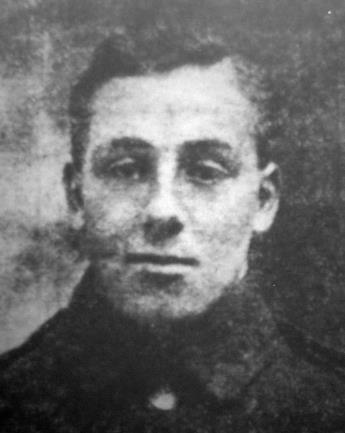 Private Benjamin Shuttleworth of the 8th Boarder Regiment (No. 16251) was killed on 5th July 1916 at the Battle of Albert on the Somme.
Benjamin was born on 4th September 1894 at 9.55am and his twin brother, John, was born five minutes later at 9, Cup Lane (now Bog Height Road), Darwen. They were the sons of Henry Shuttleworth and Betsy Ellen (nee Pomfret) and were baptised at St Cuthbert’s Church, Darwen on 30th September 1894. When the 1911 census was taken, the family had moved to 490 Blackburn Road, Darwen and Benjamin was working as a weaver at Messrs J and L Ward’s, Moss Bridge Mill. He attended Earcroft Sunday School.
Benjamin attested on 2nd November 1914, joining his regiment at Carlisle on the following day and he was posted to the 8th Battalion on 12th November 1914. His army record gives his height as 5ft 4ins, weight 128lbs, chest 33½ins with 3ins expansion and he had a fair complexion. He spent time at Aldershot and on 17th July 1915 was confined to barracks for five days for appearing unshaven on parade. On 10th September 1915, he appeared on parade with a dirty rifle and this time he was confined to barrack for seven days. Along with his Battalion, he was sent to France and landed at Boulogne on 26th September 1915.
In late December 1915, he suffered from a displaced cartilage in his left knee and he returned to England on the S.S. Copenhagen. Before returning to France, he spent ten days (15th–24th) January 1916 with his family at 490 Blackburn Road, Darwen. On 25th February he embarked on the S.S. Golden Eagle from Folkestone and arrived the following day at Etaples, France. His Battalion was part of the 25th Division which, in 1916, was concentrated around Nieppe and saw action in 1916 on Vimy Ridge. On 6th June 1916, Benjamin was complaining of a loose body in his left knee for which he required treatment; six days later, however, he re-joined his Battalion. The Division then moved to The Somme in late June 1916 and saw action in the Battle of Albert where Benjamin was killed.
In late December 1915, he suffered from a displaced cartilage in his left knee and he returned to England on the S.S. Copenhagen. Before returning to France, he spent ten days (15th–24th) January 1916 with his family at 490 Blackburn Road, Darwen. On 25th February he embarked on the S.S. Golden Eagle from Folkestone and arrived the following day at Etaples, France. His Battalion was part of the 25th Division which, in 1916, was concentrated around Nieppe and saw action in 1916 on Vimy Ridge. On 6th June 1916, Benjamin was complaining of a loose body in his left knee for which he required treatment; six days later, however, he re-joined his Battalion. The Division then moved to The Somme in late June 1916 and saw action in the Battle of Albert where Benjamin was killed.
Benjamin Shuttleworth has no known grave and is remembered on the Thiepval Memorial to the Missing on the Somme, Pier and Face 6 A and 7 C
The report of his death in “The Darwen News” mentioned that Benjamin had three brothers serving, two (William and Harry) being in India and the other (John) in Egypt. The following year his twin brother, John, would be killed on the Somme and his name would also be added to the Thiepval Memorial.
His father received the 1914-1915 Star on 21st May 1921 and the Victory & British War Medals on 17th December 1921.
His father received the 1914-1915 Star on 21st May 1921 and the Victory & British War Medals on 17th December 1921.
East Lancashire Regiment, 201518
Private John Shuttleworth of the 1st/4th East Lancashire Regiment (No. 201518) was killed on 3rd June 1917 at Havrincourt, north of Epéhy on the old Somme battlefield of 1916.
John was born on 4th September 1894 at 10am and his twin brother, Benjamin, was born five minutes earlier at 9 Cup Lane, (now Bog Height Road), Darwen. They were the sons of Henry Shuttleworth and Betsy Ellen (nee Pomfret) and they were baptised at St. Cuthbert’s Church, Darwen on 30th September 1894. When the 1911 census was taken, the family had moved to 490 Blackburn Road, Darwen and Benjamin was working as a weaver at Messrs. J. and L. Ward’s, Moss Bridge Mill. He had previously been employed at Messrs. Catlow’s Anchor Mill as a warehouseman. He attended services at St. Chad’s Mission Church, Earcroft.
John enlisted and joined the 3rd/4th East Lancashire Regiment (No. 4048) in August 1915 and the Regiment went to Egypt in January 1916. In Egypt, he served at Kantara on the Suez Canal and saw action at the Battle of Romani between 3rd to 5th August 1916. The Regiment had to operate in heavy sand in mid-summer heat, and with insufficient water many men fall victim to thirst and the blazing sun. Romani was an important victory, because from there the British forces pushed a railway and water line across the Sinai Desert that would enable an assault with the intention of clearing Palestine. The East Lancs’ were involved as advance guards as the building moved forward as far as El Arish. A decision, however, had been taken to restructure the force in Palestine, and, in consequence the Division was ordered for the first time to the Western Front. All units embarked at Alexandria by the end of February 1917.
On arrival in France, and, after being re-equipped for trench warfare in very different conditions to those the men had experienced in Egypt, the Division entered the line at Epehy, as part of III Corps. in Fourth Army. They remained in this area, soon moving to Havrincourt where they remained until 8th July. These positions faced the formidable German Hindenburg Line in front of Cambrai.
It was here that John lost his life on 3rd June 1917 but his body was never found.
John Shuttleworth has no known grave and is remembered on the Thiepval Memorial to the Missing on the Somme, Pier and Face 6 C. The report of his death in “The Darwen News” mentioned he had had two brothers; one serving in India and the other training on Salisbury Plain. The previous year his twin brother, Benjamin, had lost his life on the Somme and his name is also recorded on the Thiepval Memorial.
John Shuttleworth has no known grave and is remembered on the Thiepval Memorial to the Missing on the Somme, Pier and Face 6 C. The report of his death in “The Darwen News” mentioned he had had two brothers; one serving in India and the other training on Salisbury Plain. The previous year his twin brother, Benjamin, had lost his life on the Somme and his name is also recorded on the Thiepval Memorial.
The Loyal North Lancashire Regiment, 14526
John Horsfield Simpson of the 7th Loyal North Lancashire Regiment (Number 14256) was killed on 23rd July 1916.
He was baptised at Farrington St. Paul on 10th November 1895, the son of Robert (a Bricksetter) and Emma (nee Bretherton). On the 1911 Census the family are living at Charlotte Street, Turton where Robert is a Stonemason and John a Piecer at the Cotton Mill.
John went to Bolton to enlist into the Loyal North Lancashire regiment on 4th September 1914 and was initially posted to the 9th Battalion. He returned to England in December 1915 to be treated for a gunshot wound to his right thigh and on returning to France was posted to the 7th Battalion Loyal North Lancashire, part of the 19th Division.
The 7th Battalion Loyal North Lancashire Regiment had landed at Boulogne on 17th July 1915. A year later they were involved in the Somme battles from early July 1916, including the capture of the village of La Boiselle on 4th July. They went on to fight at High Wood 20th–25th July and the Battle at Pozieres.
The 7th were involved in heavy fighting at Bazentin le Petit and Mametz Wood between 23rd and 27th July, and the casualties for the four days totalled 11 Officers and 290 Other Ranks.
John Simpson has no known grave and is remembered on the Thiepval Memorial, Pier and Face 11 A.
At the end of the war his parents would have received his 1914-15 Star and the British war and Victory Medals.
At the end of the war his parents would have received his 1914-15 Star and the British war and Victory Medals.
Border Regiment, 25580
Lance-Corporal Ernest Smith of the 11th Border Regiment (No. 25580) was killed 19th May 1917 at the Operations on the Ancre and the German retreat to the Hindenburg Line in 1917.
Ernest was born on 22nd August 1891 at 13 Ellen Street, Darwen, the son of George Smith and Jane (nee Holden). Ten years later the family had moved to 7 Woodville Terrace, Darwen and when the 1911 census was taken he wasworking as an assistant grocer for the Co-operative Society. The family attended Bolton Road Congregation Church.
In 1916 Ernest joined the 11th Border Regiment and arrived in France during September the same year. The Battalion would remain on the Western Front for the rest of the war. At the end of The Battle of the Somme in November 1916 the Germans retreated back to the strong Hindenburg line. This would straighten, and thereby shorten, the line they had to defend. It soon became clear that it was not a premature measure. The allied Command planned some new major attacks in 1917, in order to keep the pressure on the Germans. It was during the Operations on the Ancre where Ernest lost his life.
Ernest Smith has no known grave and is remembered on the Thiepval Memorial to the Missing on the Somme Pier and Face 6 A and 7 C. He is also remembered on Bolton Road United Reformed War Memorial.
7th Rifle Brigade, B/203040
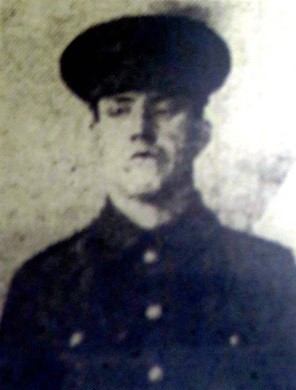 Rifleman John Smith of the 7th Rifle Bridge (No. B/203040) was killed on 15th September 1916 at the Battle of Flers-
Courcelette on the Somme.
John was born in Blackburn around 1882, the son of John Smith. It is unclear as to how he spent his early years but in 1907 he married Mary Jane Curran at Blackburn Register Office. They had two children – Ada, born in 1908 and Albert Edward, born 1911 (both were born in Blackburn Workhouse). When John married he was working as a carter for a coal merchant but after 1911 he commenced working at Darwen Paper Mill. He enlisted at Blackburn and joined the 13th King’s Royal Rifle Corps (No. Y/539) and he later moved to the 12th Battalion. John arrived in France on 25th August 1915 and he later moved to the 7th Rifle Bridge (No. B/203040) but it is unclear as to when the transfer took place.
The 7th Rifle Brigade was part of the 14th (Light) Division and was involved at the Battle of Flers-Courcelette. This battle involved both French and British troops and was launched on 15th September 1916. The initial objective was to cut a hole in the German lines by using massed artillery and infantry attacks. This hole would then be exploited with the use of cavalry. The battle is significant for the first use of the tank in warfare. It was on the opening day of this battle that John lost his life.
John’s widow was informed of his death in December 1916 and the following year she remarried at Blackburn Register Office to John Edward Hodgson. She later received john’s war medals - Victory & British War Medals; 1914-1915 Star.
John Smith is remembered on the Thiepval Memorial to the Missing on the Somme, and has no known grave.
7th Rifle Brigade, R/1528
Lance-Corporal Thomas Smith of the 7th Battalion the Rifle Brigade (Regimental Number R/1528) was killed on the 15th September 1916.
Thomas Smith was baptised on 28th January 1897 at St Michael and All Angels, Blackburn, the son of Robert and Permelia Smith. In 1911, the family lived at 119 Cobden Street, Blackburn, and Thomas is shown as a Weaver.
The Battle of Flers-Courcelette 15th– 22nd September 1916
A renewal of the offensive finally broke through the area that had proved to be so difficult since 14th July. Using a small number of tanks for the first time in history, the British Army finally captured High Wood and pressed on through Flers and up the Bapaume road to Courcelette.
“Tanks which were used for the first time came up on the battalion’s right flank. After a short time the tanks continued to advance and the 42nd Infantry Brigade passed through us but were unable to take their objective owing to heavy M.G. (machine gun) fire from both flanks.”
The total numbers of casualties for the two days were 13 Officers and 231 Other Ranks listed as killed, wounded or missing.
“Great gallantry was shown by all ranks”.
Thomas Smith is remembered on the Thiepval Memorial and has no known grave. After the war his parents would receive his 1914-1915 Star and British War and Victory Medals.
Rifleman John Spooner of the 9th Rifle Brigade (No. S/5327) was killed on 15th September 1916 at the Battle of Flers-Courcelette on the Somme.
John was born on 24th April 1891 at 10 Greenfield Terrace, Lower Darwen to John Spooner and Jane (nee Wall). His birth was registered under the name of Spooney. By the mid-1890s the family came to Blackburn, living first at 603 Bolton Road and, by the time the 1911 census was taken, they were at 558 Bolton Road and John was working as a cotton weaver. His mother had died in 1910 and was buried in Darwen Cemetery.
It is known that John enlisted in Blackburn and joined the 9th Rifle Brigade which was part of the 14th (Light) Division. John arrived in France on 21st May 1915 and he took part in the Action of Hooge, in which the Division had the misfortune to be the first to be attacked by the German flamethrower. He also saw action at the Second Attack on Bellewaarde. By 1916, the Battalion was on the fighting on the Somme at the Battle of Delville Wood.
John was then involved at the Battle of Flers-Courcelette. This battle involved both French and British troops and was launched on 15th September 1916. The initial objective was to cut a hole in the German lines by using massed artillery and infantry attacks. This hole would then be exploited with the use of cavalry. The battle is significant for the first use of the tank in warfare. It was on the opening day of this battle that John lost his life.
John Spooner is remembered on the Thiepval Memorial to the Missing on the Somme, and has no known grave.
At the end of the war his father received his war medals - Victory & British War Medals; 1914-1915 Star.
Northumberland Fusiliers, 16/1491
Joseph William Standen, born in 1890, was the son of William and Mary Standen. By 1901, his father had passed away, leaving Joseph and his brothers Frank, Bernard, George and Charles with his mother, who had moved in with her sister, Ellen Wadsworth.
Joseph was an educated man, and unlike many other men of the time, went to college – St. Mary’s, Hammersmith. He was in the middle of his studies when war started.
Joseph enlisted into A Company, 16th Northumberland Fusiliers, which had been formed by Newcastle and Gateshead Chamber of Commerce at Newcastle. Following training at Catterick and Codford, the Battalion was sent to France at the end of 1915 and immediately began trench familiarisation, gaining valuable experience before the major assaults in July 1916.
It was here, on 1st July 1916, that Joseph was killed, as the Battalion was sent in to attack the Thiepval ridge. This battle was costly, and Joseph was killed in the firefight. He has no known grave, but is remembered on the Thiepval Memorial to the Missing on the Somme, Pier and Face 10 B, 11 B and 12 B.
King's Shropshire Light Infantry, 17844
Private John Stuart of 5th King's Shropshire Light Infantry (No. 17844) was killed on 16th September 1916 East of Flers on the Somme.
John was born in 1886 at Rochdale, the son of John Thomas Stuart and Ellen Jane (nee Starkie). By 1911, John had moved to Belthorn and was living at 37 Top Fold and later in the same year he married Alice Lomax at Immanuel, Oswaldtwistle. They had two children John, born 1912 and William born the following year. John was employed at a weaver at N. and J. Eccles’s Waterside Mill.
On the outbreak of the war John enlisted at Darwen and joined the 5th King's Shropshire Light Infantry. The Battalionwas part of the 42nd Brigade in 14th (Light) Division and John arrived at Boulogne on 5th October 1915. By the time John had joined the Battalion in France they had already been involved at The Action of Hooge, in which the Division had the misfortune to be the first to be attacked by the flamethrower.
By July 1916, they were on the Somme in 1916 and John saw particularly heavy fighting at Delville Wood in September 1916. The Battle of Flers-Courcelette began on 15th September 1916 and the 14th Division had to attack to the East of Flers with the objective of cutting a hole in the German line by using massed artillery and infantry attacks. This hole would then be exploited with the use of cavalry. The battle went on for one week and it was significant for the first use of the tank in warfare. On 15th September the Battalion was ordered to advance two hours after “zero” until they reached a road running east out of Flers (this now the site of Bull’s Road Cemetery). They were enfiladed by machine gun fire and were unable to advance so consolidated just south of Bull’s Road. It was on the following day that John lost his life.
John Stuart has no known grave and is remembered on the Thiepval Memorial to the Missing on the Somme, Pier and Face 12 A and 12 D. He is also remembered on Belthorn’s War Memorial.
Lance Corporal James Sumner
1st King’s Liverpool Regiment, 29954
Lance-Corporal James Sumner of the 1st Battalion the King’s Liverpool Regiment (Regimental Number 29954) was killed on 8th August 1916.
He was born in Preston in 1879, the son of Richard Sumner and Margaret Crowley, who were married at Preston, St John in 1877. James is shown on the 1891 Census with his parents who were living at Ward Street East.
James married Ellen Wood on 3rd August 1908 at St James’, Over Darwen and by the 1911 Census the family were living at Holden Fold with four children. James states he was born in Preston and gives his trade as Blast Furnace man.
Battles of the Somme:
The 1st Battalion King’s Liverpool Regiment were part of the 2nd Division, 6th Brigade of the Army and took part in most of the major actions on the Western Front, including the battles around the town of Albert, one of which was Delville Wood, between 15th July and 3rd September 1916.
Delville Wood was fought over countless times and became a charnel house, choked with the dead of both sides. At the end of operations in which the 1st Battalion had been engaged on the 8th/9th August 1916, the casualties were numbered at 15 Officers and 235 Other Ranks killed, wounded or missing.
James Sumner has no known grave and is remembered on the Thiepval Memorial, Pier and Face 1 D, 8 B and 8 C. Although his enlistment papers have not survived the medal rolls show his widow would have received his 1914-15 Star together with the British War and Victory medals.
Letter T
Taylor, Ernest |
Taylor, John |
Taylor, John G. | Taylor, John L. |
Thompson, Albert |
Thornber, John
Townsend, Anthony
Private Ernest Taylor
East Lancashire Regiment, 20473
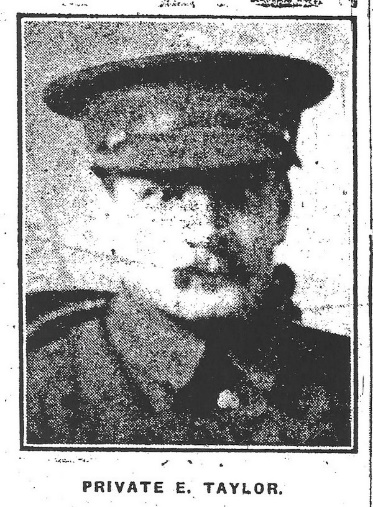 Private Ernest Taylor of the 1st Battalion East Lancashire Regiment (No. 20473) was killed on 1st July 1916 in the area of Beaumont-Hamel.
Ernest was born at Edgworth, the son of Samuel and Esther Taylor formerly of Radcliffe. The family are together on the 1901 Census at Thomasson Fold in St Anne’s Parish, Turton.
Ernest married Mary Nairn in 1908 at St Cuthbert’s Church, Darwen, but she is not with Ernest and young son James on the night of the 1911 Census.
The Darwen News
9th September, 1916 carried the following report.
"An intimation has been received at his home, 15 Finch Street, that Private Ernest Taylor, of a Lancashire regiment, is dead.An intimation has been received at his home, 15 Finch Street, that Private Ernest Taylor, of a Lancashire regiment, is dead. He took part in the “big push” in July, and was then reported missing. Twenty-six years of age, he leaves a widow and one child. He enlisted early in the war, and had been some time at the front. Two other brothers are also serving".
Ernest Taylor is remembered on the Thiepval Memorial and has no known grave. His next-of-kin would have received his British War and Victory Medals.
‘Soldiers Effects’ say he had completed a will showing the sole legatee as his father Samuel.
Lance Corporal John Taylor
7th King’s Own Scottish Borderers, 15608
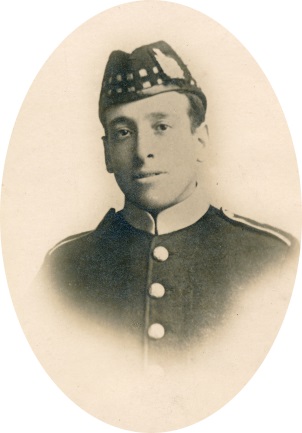
Lance-Corporal John Taylor of the King’s Own Scottish Borderers (No 15608), was the son of George and Ann Taylor of 2 Cambridge Street, Darwen. John is shown with his family on the 1911 Census and he was employed as a miner. He married Margaret Morrall later in the year on 15th July at St James’, Over Darwen, where he had been baptised on 29th December 1889.
On 28th May 1916 the Battalion was in Bethune and merged with 8th Battalion to form 7/8th Battalion. They took part in the Battle of Pozieres 23rd July to 3rd September 1916.
The 7th/8th Battalion were in trenches around Martinpuich (east of Thiepval) from early August 1916 before retiring to bivouacs near Albert on 19th.
Lance-Corporal Taylor is recorded as having been killed on 15th August 1916, aged twenty-six. He has no known grave and is commemorated on the Thiepval Memorial Pier and Face 4 A 4 D.
He was awarded the 1914-15 Star and the British war and Victory Medals.
Private John Gerald Taylor
1st East Lancashire Regiment, 21836
John Gerald Taylor was the son of John Taylor, a pawnbroker. He was a first grade student and at the time of his enlistment was studying for the civil service examinations with the intention of making this his career. The family attended St. Johns church, Darwen and John Gerald is commemorated on the Church’s War Memorial.
John enlisted into the 1st Battalion East Lancashire Regiment, joining at age eighteen years in late 1914. Following training, John joined the Battalion in late 1915, and began trench familiarisation. Throughout the summer of 1916, John would have suffered alongside his comrades as the Battalion was ravaged in the initial assaults on 1st July.
It was at the Battle of Le Transloy, on 18th October 1916, that John was killed. The War diary states:
“At zero hour 3.40 a.m. the weather conditions were appalling, pitch black, extremely cold and pouring with rain. 3 waves advanced under cover of the barrage. C company on the left had les boeufs/transloy road to guide it, a company in the darkness went too much to its right and got somewhat mixed up with 1st rifle brigade. Machine gun fire was opened by the enemy immediately the first wave advanced, and severe losses were incurred. Owing to the tremendous shell fire concentrated on the enemy trenches for some days past it was extremely difficult to tell where rainy and dewdrop trenches were, but from the distance traversed, the first 2 waves must have got past these trenches. No organised lines held by the enemy were met but heavy machine gun and rifle fire was directed on our wave’s front and flanks, and owing to the absolute darkness it must have been impossible for any officer or N.C.O. to organise the digging of any advance posts at the limit of the advances.”
“At zero hour 3.40 a.m. the weather conditions were appalling, pitch black, extremely cold and pouring with rain. 3 waves advanced under cover of the barrage. C company on the left had les boeufs/transloy road to guide it, a company in the darkness went too much to its right and got somewhat mixed up with 1st rifle brigade. Machine gun fire was opened by the enemy immediately the first wave advanced, and severe losses were incurred. Owing to the tremendous shell fire concentrated on the enemy trenches for some days past it was extremely difficult to tell where rainy and dewdrop trenches were, but from the distance traversed, the first 2 waves must have got past these trenches. No organised lines held by the enemy were met but heavy machine gun and rifle fire was directed on our wave’s front and flanks, and owing to the absolute darkness it must have been impossible for any officer or N.C.O. to organise the digging of any advance posts at the limit of the advances.”
John has no known grave, but is remembered on the Thiepval Memorial to the Missing on the Somme, Pier and Face 6 C.
John Leach Taylor of the 1st East Lancashire Regiment (No. 18832) was killed on 1st July 1916 at the Battle of Albert on the Somme.
John Leach Taylor was born on 20th October 1893 at 31 Nelson Street, Darwen, son of John Leach Taylor and Ellen (nee Norris) and be was baptised at St Cuthbert, Darwen on 9th November 1893. He attended Holy Trinity School and later worked as a weaver at Carrs Mill. By the time the 1911 census was taken the family had moved to 24 Belgrave Road.
On the outbreak of the war John enlisted, first joining the 3rd East Lancashire Regiment (No. 18832) but was soon transferred to the 1st Battalion and arrived in France on 26th March 1915. The 1st East Lancashires along with the 2nd, 4th and 5th South Lancashires all took part in heavy fighting in the course of the Second Battle of Ypres, which opened on 22nd April with a German offensive using poison gas for the first time. For the next month the four battalions struggled desperately to defend the Ypres Salient, wearing improvised cloth masks soaked with urine as partial protection from the choking gas. Fighting was particularly severe around Shell Trap Farm, where the 1st East Lancashires were supported by the 4th and 5th South Lancashires – the Warrington and St Helens Territorials.)
After the Battle of Ypres John found himself taking part in the opening day of the Battle of the Somme. At 7.30am on 1st July 1916 the artillery lifted and the British infantry, including the 1st and 11th East Lancashires, advanced in extended lines towards the German trenches. For a few moments there was silence, and then suddenly machine guns opened up from behind largely unbroken wire and cut down the attackers in swathes. The casualties, some 57,470 men, were the worst ever suffered by the British Army on a single day. Out of 700 officers and men of the 1st Battalion who went into action, only 237 were present to answer their names when the roll was called, while the 11th Battalion lost 594 killed, wounded and missing out of the 720 in the attack. John was one of the many who lost his life on 1st July 1916.
After the war his parents received his medals – the Victory & Birtish War Medals and the 1914-1915 Star.
John Leach Taylor is remembered on the Thiepval Memorial to the Missing on the Somme (Pier & Face 6C), and has no known grave and he is also remembered on the war memorial at St Peter’s Church (formerly Holy Trinity Church).
1st East Lancashire Regiment, 22514
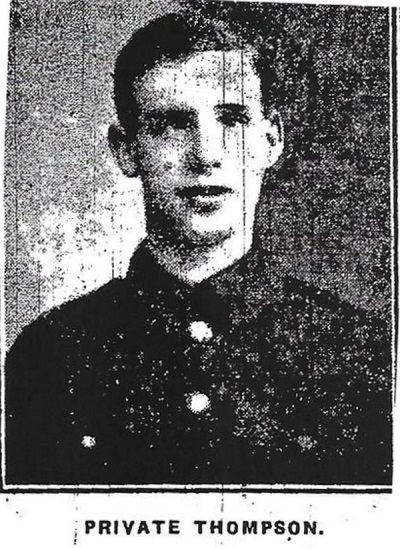 Born in Oswaldtwistle in 1895, Albert Thompson was the son of John William Thompson and Mary Ann Smith, of 5 William Street, Darwen.
A working family, Albert was one of five children, all working in the dirty industrial jobs that were typical of the time; cotton weavers, coal miners and paper mill work. After finishing at St. James School, Albert was employed as a “piler” at Almond and Co. Branch of the Wall Paper Manufacturers Ltd.
Albert enlisted into the East Lancashire Regiment, initially joining the 6th Battalion as they were sent to Salonica. After a brief respite, Albert was reposted to 1st Battalion, based in France, and arrived in time to join the Somme Offensive on 1st July.
At 0730 hours on 1st July 1916 the Artillery lifted and the British Infantry, including the 1st and 11th East Lancashires, advanced in extended lines towards the German trenches. For a few moments there was silence, and then suddenly machine guns opened up from behind largely unbroken wire and cut down the attackers in swathes. The casualties, some 57,470 men, were the worst ever suffered by the British Army on a single day.
On the far left of the British attack the 11th East Lancashire’s (the famous ‘Accrington Pals’) assaulted the village of Serre, while a mile to their South the 1st Battalion (the old 30th Foot) attacked to the north of Beaumont Hamel. Despite rapidly mounting casualties, the East Lancashire’s moved steadily forward, as if on parade, until they melted away under the fire. Small parties of both Battalions entered the German trenches, but they were never seen again.
Within a few hours The East Lancashire Regiment suffered more casualties than on any other day in its long history. Out of 700 officers and men of the 1st Battalion who went into action, only 237 were present to answer their names when the roll was called, while the 11th Battalion lost 594 killed, wounded and missing out of the 720 in the attack. This memorable devotion to duty is commemorated in the Regiment annually to this day, most notably by a Service in Blackburn Cathedral.
Albert has no known grave, but is remembered on the Thiepval Memorial to the Missing on the Somme Pier and Face 6 C.
Private John Thornber
2nd Cameronians, 17287
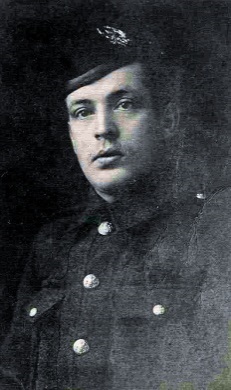 Private John Thornber of the Cameronians (Scottish Rifles) (No. 17287) was killed 14th April 1917 at Villers Guislain, on the Somme.
John was born on 10th May 1885 at Brunswick Street, Darwen and he was baptised at Holy Trinity, Darwen on 10th June 1885. He was the son of Andrew Thornber and Elizabeth Ann (nee Roberts) and was known as Jack by his family. The 1901 census shows that the family were living at 12 Ross Street, Darwen and John was working as a cotton weaver. In 1906 his father died and his mother remarried in 1912 to Alfred Riding. Alfred was connected with Holy Trinity Church. In 1908, John married Florence Robinson at Holy Trinity, Darwen and they had two children - John (1909) and Norman (1910). The 1911 census shows the family were living at 14 Naples Street, Darwen and John was still working as a cotton weaver. Later he became a “back-tenter” at Spring Vale Paper Mill.
On the outbreak of the war John was living at 9 Wellington Fold, Darwen and in December 1914 he enlisted and joined 9th Service Battalion Scottish Rifles. This was part of 28 Brigade of the 9th Division. He was a member of the Lewis-gun section. John arrived in France on 12th May 1915 at which time he had made his last Will. It is interesting to note that two other Darwen men enlisted with him in the same battalion - Harry Risby (No. 17286) of Redearth Road, Darwen and Joseph Bell Holding (No.17289) of 29 Devon Street who was killed at La Bassee in May 1915. He saw action at the Battle of Loos and was wounded on the Somme in 1916.
At some point John transferred to 2nd Battalion (“B” Company), which was part of the 23rd Brigade of the 8th Division, and he was with them until his death at Villers Guislains. The action in which he was killed was part of the German Retreat to the Hindenburg Line. The War Diary records the events of 14th April 1917 as:
“Villers Guislain; “B” Coy was to co-operate in the attack of the 2nd Devons against the village, two platoons of A Coy under the command of Lieutenant G. P. Thornton having first established themselves in front of Bois Gauche about three hundred years west of Villers Guislain.
At dawn the attempt was made and failed, the troops of both battalions being held up on the thick belt of wire by rifle and machine-gun fire. They were driven back, the 2nd Battalion of the Regiment on the left of the Devons losing two other ranks killed and fifteen other ranks wounded, one of whom died soon afterwards. That evening the battalion withdrew into 23rd Brigade reserve in Lieramont.”
“Villers Guislain; “B” Coy was to co-operate in the attack of the 2nd Devons against the village, two platoons of A Coy under the command of Lieutenant G. P. Thornton having first established themselves in front of Bois Gauche about three hundred years west of Villers Guislain.
At dawn the attempt was made and failed, the troops of both battalions being held up on the thick belt of wire by rifle and machine-gun fire. They were driven back, the 2nd Battalion of the Regiment on the left of the Devons losing two other ranks killed and fifteen other ranks wounded, one of whom died soon afterwards. That evening the battalion withdrew into 23rd Brigade reserve in Lieramont.”
An obituary notice was published in “The Darwen News” mentioned he had three children but research to date has only been able to find births for two children. It also recorded that two of his brothers were also serving. One contracted fever at Salonika, and the other was in France. Three brothers-in-law were also soldiers, one of whom had been wounded.
John Thornber has no known grave and is remembered on the Thiepval Memorial to the Missing on the Somme, Pier and Face 4 D. It is also remembered on the Holy Trinity’s war memorial.
John’s great-grandson, Ian Thornber, has a brass cross on a multiple mahogany plinth. On it are two names, Private J. Thornber and Private J. Riding.
Lancashire Fusiliers, 5867
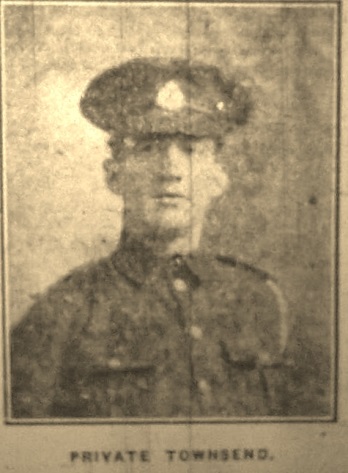 Anthony Townsend was born in 1881, the son of Simeon and Ann. He married Mary Clegg in 1905 but by 1911 they had no children. The 1911 census shows the couple living at 12 Ellen-street, Darwen. By profession Anthony was a coal miner, and, at some point, he worked for Messers. Place and Son’s.
Anthony enlisted into the 11th Battalion of the Lancashire Fusiliers on the outbreak of war, August 1914, and was sent to France on the 25th September 1915.
The 11th Battalion was formed in October 1914, part of Kitchener’s 3rd Army and came under orders of the 74th Brigade, 25th Division. They landed in France on the 25th September 1915 and were concentrated in the area around Nieppe. They afterwards served on the Western Front.
By 1916, the Battalion had worked hard at learning its craft, in preparation for the Somme Offensive. On 5th July, 74thBrigade was detached for duty with 12th (Eastern) Division at La Boisselle, where it took part in an attack on Ovillers. Divisional HQ moved to Henencourt on 8th July, and the following day, 25th Division took over the front held by 12th (Eastern) Division.
The Division was in action at The Battle of Bazentin.
The Battle of Bazentin was a subsidiary attack of the Somme Offensive, and having captured Mametz Wood on 12th July, the British moved onwards toward High Wood in a continuation of the push through German lines. The Battle of Bazentin Ridge ran from 14th–17th July 1916 and comprised part of the second phase of the Somme Offensive. It was during this action that Anthony lost his life.
The Darwen News of 26th July reported:
“Private Anthony Townsend of Marr’s Hill, is reported missing since the 15th inst. He enlisted in August 1914 and has been at the front about 12 months. About thirty-five years of age he formally worked for Messer’s. Place and Son’s, and was a collier.
Anthony Townsend has no known grave and is remembered on Thiepval Memorial Pier and Face 3 C and 3 D.
The 11th Battalion was formed in October 1914, part of Kitchener’s 3rd Army and came under orders of the 74th Brigade, 25th Division. They landed in France on the 25th September 1915 and were concentrated in the area around Nieppe. They afterwards served on the Western Front.
By 1916, the Battalion had worked hard at learning its craft, in preparation for the Somme Offensive. On 5th July, 74thBrigade was detached for duty with 12th (Eastern) Division at La Boisselle, where it took part in an attack on Ovillers. Divisional HQ moved to Henencourt on 8th July, and the following day, 25th Division took over the front held by 12th (Eastern) Division.
The Division was in action at The Battle of Bazentin.
The Battle of Bazentin was a subsidiary attack of the Somme Offensive, and having captured Mametz Wood on 12th July, the British moved onwards toward High Wood in a continuation of the push through German lines. The Battle of Bazentin Ridge ran from 14th–17th July 1916 and comprised part of the second phase of the Somme Offensive. It was during this action that Anthony lost his life.
The Darwen News of 26th July reported:
“Private Anthony Townsend of Marr’s Hill, is reported missing since the 15th inst. He enlisted in August 1914 and has been at the front about 12 months. About thirty-five years of age he formally worked for Messer’s. Place and Son’s, and was a collier.
Anthony Townsend has no known grave and is remembered on Thiepval Memorial Pier and Face 3 C and 3 D.
Waddicor, John J. |
Walkden, Jonathan |
Walker, William |
Walmsley, John |
Walsh, George
Warburton, James |
Watson, Harry |
Whalley, James I. |
Whiteside, Percy N. J.
7th East Lancashire Regiment, 12321
John James Waddicor was born 24th October 1896. He was the son of John and Sarah Ann Waddicor of 22 Blacksnape Road, Darwen.
His father worked in cotton spinning and his mother was a cotton weaver. His parents married at St. John the Evangelist, Darwen 21st July 1896. Like his parents, John became a cotton weaver before the war started.
John enlisted into the 7th East Lancashire Regiment in 1914, and following extensive training, he was sent to France in 1915 with the Battalion. After getting accustomed to trench warfare, the Battalion was moved to the Somme Region, in time for the Somme Offensive. John survived throughout all the Battles of the Somme, and moved North with the Battalion to defend the lines around the Ancre Heights. It was here that John was killed, 13th November, 1916.
The war Diary reads:
"On the night of November 12th we took over Stuff trench once more, the companies being in the same order as in October. Our role was simple in theory but difficult to execute; we had to form the pivot for the whole of the attack north of the Ancre. “D” Company had to advance only 50 yards on the right and some 150 yards on its other flank. The other companies on the left advanced correspondingly to a greatest depth of about 400 yards. The assault was timed to start at 5.45a.m.
"On the night of November 12th we took over Stuff trench once more, the companies being in the same order as in October. Our role was simple in theory but difficult to execute; we had to form the pivot for the whole of the attack north of the Ancre. “D” Company had to advance only 50 yards on the right and some 150 yards on its other flank. The other companies on the left advanced correspondingly to a greatest depth of about 400 yards. The assault was timed to start at 5.45a.m.
"The morning broke with a very heavy mist which did not lift until nearly ten o'clock, so that it was very difficult to see five yards ahead at any time during the first two hours and not much better until it lifted altogether. At 5.20a.m. we crawled out of the trench and lay down among the shell-holes about 20 yards in front. The two companies were distributed in two lines at intervals of about a dozen yards. Every endeavour was made to set the men facing in such a way that if they advanced in a straight line they would achieve the wheeling movement desired. We had barely seen to this when the barrage started and the attack began.
"This was our first experience of following a barrage. However, in a very few minutes we found that the difficulty lay in restraining the men from walking into it rather than in keeping them up to it. The barrage was timed to move forward very slowly, which no doubt was essential, for the troops on the left had very rough ground to cover and a considerable way to go, but it proved most irksome on the right.”
"This was our first experience of following a barrage. However, in a very few minutes we found that the difficulty lay in restraining the men from walking into it rather than in keeping them up to it. The barrage was timed to move forward very slowly, which no doubt was essential, for the troops on the left had very rough ground to cover and a considerable way to go, but it proved most irksome on the right.”
John James Waddicor has no known grave, but is remembered on the Thiepval Memorial to the Missing on the Somme, Pier and Face 6 C.
Private Jonathan Walkden
17th Lancashire Fusiliers, 14120
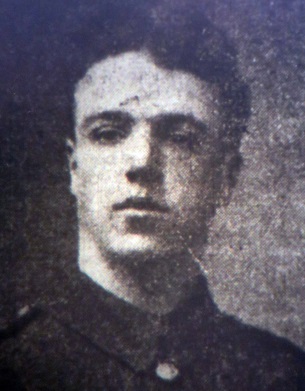 Private Jonathan Walkden of the 17th Lancashire Fusiliers (No. 14120) was killed 22nd July 1916 at Guillemont on the Somme.