
 Loading more
Page 4
< Back to page 3Proceed to page 5 >
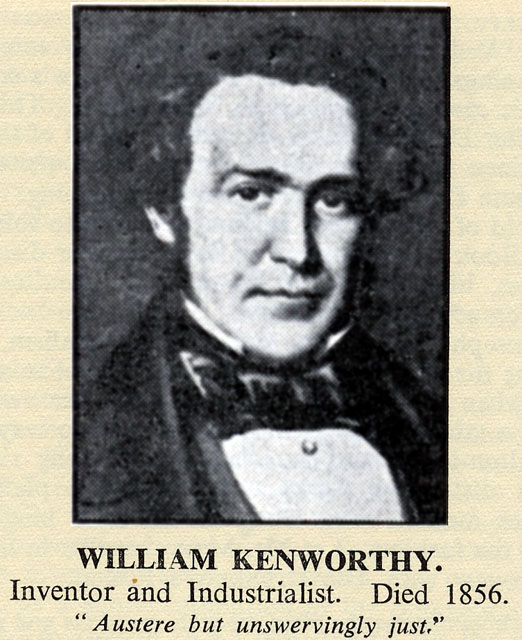
Introduction
William Kenworthy was not a native of Blackburn or of Lancashire but he saw himself both as a Lancastrian and a Blackburnian. Although he was a councillor and a magistrate for the town he never pushed himself forward. He never became an Alderman or Mayor, nor did he look for honours. He was very highly respected by the Mill workers, who he had a great understanding of, coming from that class himself. He was a campaigner for the “Ten Hour Bill” and received the appreciation of the Lancashire Short Time Committee for his tireless work to that end. Unlike many other wealthy men in the town Kenworthy tried to live a very private sort of life and to that end nothing his known about his first wife and child other than what is shown on the 1841 census. Not a lot more is known about his second wife and virtually nothing about his children. He was respected by both workers and mill owners as is shown by the number of people who attended his funeral. Today he is largely forgotten and I hope this short biography goes some way to make people who are interested in the cotton industry of Blackburn, or indeed the town, appreciate what a great man he was and what a great debt of gratitude we owe him.
William Kenworthy was born in 1802 at, according to most sources, Glossop Dale in Derbyshire, (however see inscription on Memorial below). All that is really known about this period is that as a young boy he worked in a Spinning Mill, but he must have had a reasonably good education. At the age of 24 (1826) he moved to Preston taking a position at Oxendale’s Mill in the spinning room. Showing great ability it was not long before he was appointed manager of the spinning mill. His next appointment was at Rodgett’s Mill, Bow-lane, Preston. Here again he was made manager of the spinning department. It was while he worked at this mill George C. Miller says, that he first met James Bullough who was to play a great part in his life... In about 1828 or 29 he came to Blackburn, one story says he was “poached” by Hornby to work in his Brookhouse Mill, as manager, he also persuaded Hornby to take on James Bullough.
On his arrival in Blackburn, Whittle says he went up a nearby hill to survey the town. From his position he could see only three mill chimneys. Many years later, climbing the same hill there were so many chimneys he was unable to count them.
By 1836 Kenworthy was sufficiently settled to be elected as a member of the Blackburn vestry which consisted of twenty rate payers, the vestry served the town until it became a borough in 1851.
© BwD - terms and conditions
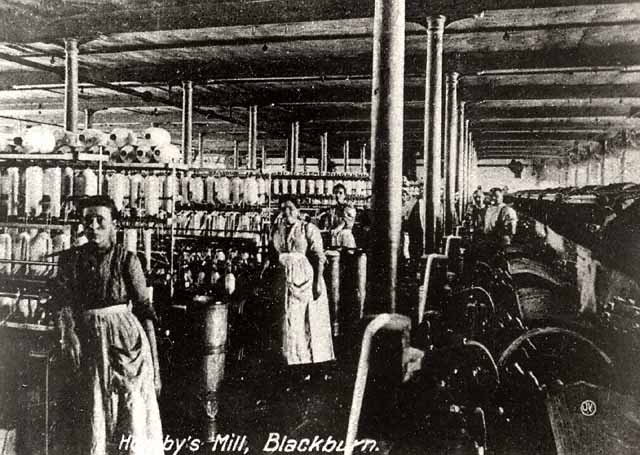
At Brookhouse Mills Kenworthy, together with James Bullough, made many improvements to the weaving and spinning machines. W.H. Hornby was so impressed with Kenworthy that he was made a partner in the firm, and he remained one until his death in 1856.
Early 1841 Hornby and Kenworthy built a Gymnasium for their workers. Situated close to their mill at Brookhouse, it was opened in August 1841. After the ceremony a public dinner was given for Kenworthy and Hornby, at the Craven Heifer public house; however Hornby was unable to attend. It was paid for by the mill operatives, of whom 150 attended together with other Blackburn dignitaries. The Blackburn Standard described the gymnasium; “...the land is laid out for a variety of interesting games, calculated to invigorate the youthful frame, such as quoiting football tennis ball, skittles &c.”
The prosperity of Hornby’s mill was due in no small part to William Kenworthy. Hornby acknowledged this when he said “While referring to the growth of this establishment I cannot avoid reminding you...I see him (Kenworthy) on whom, at an early period I cast my anchor.” He went on. “I saw in my partner a talent for business and an aptitude for machinery which qualified him for the management of such a concern; and I therefore did not hesitate to take him into partnership. When the first large addition was made to these premises, I received a great number of anonymous letters, in which I was warned that the costly outlay incurred would prove my ruin... I was determined to speak to my partner on the subject. I did so, and he fully convinced me that the extra strength of the machinery, and the great power employed were necessary for the increased speed which he contemplated.”
Both men were strong supporters of the “Ten Hour Bill.” Kenworthy, wrote a pamphlet in 1842 entitled, “Inventions and Hours of Labour, A letter to Master Cotton Spinners, Manufacturers and Mill Owners in General.” This pamphlet advocated shorter hours in the weaving and spinning industry. Kenworthy wrote; “give shorter hours of labour to those at present employed and we should then soon be enabled to find work for those who are idle.” And; “Too much importance by far has been attached to `foreign competition. ` What, I would ask, are the poor toiling factory hands our only security from foreign competition? If so, they are a vastly more important class of people than they have ever yet been generally considered.” He concluded; “... Believing, as I do most firmly, that the salvation of our commerce in a great measure, depends upon the adoption of shorter hours of labour for the working population employed in manufactures, I entreat all those who are interested (and who is not?) to give every consideration to a subject of such vital importance to the welfare of this country; and to lend an active and energetic helping hand to snatch from the vortex of disease, immorality, and crime in which they are engulf, the major part of the manufacturing artisans—the wealth of Great Britain.” This pamphlet was quoted in Parliament as an authority on the subject, and later Lord Shaftsbury, a keen advocate of the 10 hour act, visited the Brookhouse Mills. Kenworthy also gave his support to the Preston mill workers when they went on strike for better wages in October of 1853. During that strike nearly all the mills in Preston were closed and the workers suffered great hardship. He wrote several letters on the subject, trying to get an equality of pay between the workers at Preston to those at Blackburn.
William Kenworthy was a well-respected man, and not just in Blackburn. In July 1843 James German, of Grundy and Co. Preston presented him with a silver cup. The Mayor of Preston attended the presentation and dinner together with the main manufactures of the town. On the cup was engraved; “Presented to William Kenworthy, Esq., by Thomas Grundy and Co., to testify their admiration of the talents which he has so successfully devoted to the invention and improvement of machinery, connected with the cotton manufacture; and to mark their sense of benefits derived by them from his most useful and ingenious discoveries. July 1843.”
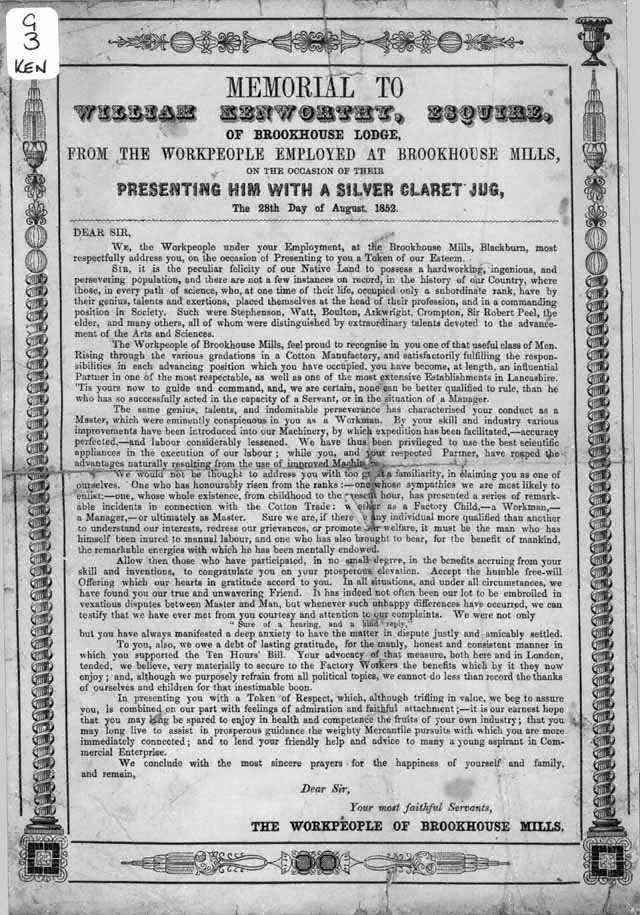
A presentation was made to Messrs Kenworthy and Hornby in August 1852 by the workpeople of Brookhouse Mill. The Blackburn Standard reported that on Saturday afternoon at 3 o’clock about 1,500 gathered in the Brookhouse mill yard. “The order of the procession”, the paper said, “corresponded exactly with that in which they were engaged in the mill, in reference to the various processes through which the cotton has to undergo, those employed in the earlier processes walking first, and those engaged in the later processes following.” Carrying flags and banners they were headed by a brass band from Harrisons and Sons and from the mill, paraded round Daisy Field, Cob Wall, and Whalley-road returning to the mill for the presentation. Kenworthy and Hornby were presented with a flower vase, a claret jug and a silver salver each. On Hornby’s salver was engraved; “Presented to W.H. Hornby, Esq., first Mayor of the Borough of Blackburn, by the workpeople employed at Brookhouse Mills—August 28th, 1852.” And on Kenworthy’s; “Presented to William Kenworthy, Esq., by the work people employed at Brookhouse Mills—Blackburn, August 28, 1852.” After the presentation, 150 of the workers together with other dignitaries retired to the Craven Heifer public house for a dinner
The first real information I can find about William Kenworthy is given on the 1841 census. Here it says he lived at “St. Albans,” (he was at Brookhouse Lodge at this time.) His age is given as 35 (on the 1841 census ages were rounded to the nearest 5 years.) He is married to Margret [sic] who is also 35, they have a daughter Maryan [sic] aged 10, he is a cotton spinner not born in the County, (at this time it was only required that people stated whether they were born in the County or not.)
© BwD - terms and conditions
It appears that his first wife, died sometime in the 1840’s but I can find nothing about this nor what happened to his daughter from this marriage. This part of his life now becomes quite interesting. On the 1851 census he is shown visiting a Martha Kenyon (whom he later married.) She is shown as living with her 21 year old sister, Elizabeth, at Wellington-terrace Birkenhead. Martha Kenyon was born at Preston in 1826, the daughter of Joseph Kenyon, a school teacher. Martha and her sister are shown as being annuitants, this seems strange for such young women, and probably Kenworthy was paying for their keep. The interesting thing is that she has a 5 month old son called on the census form, William Kenyon, but further research shows him to have been called William Kenworthy Kenyon and so probably his illegitimate son. He is shown as being a visitor to the house, 47 years old and born in Hyde Cheshire. It would seem that he wasn’t being altogether truthful on this census both about his age and birth place. I have tried searching for William Kenworthy Kenyon on later censuses but with no results.
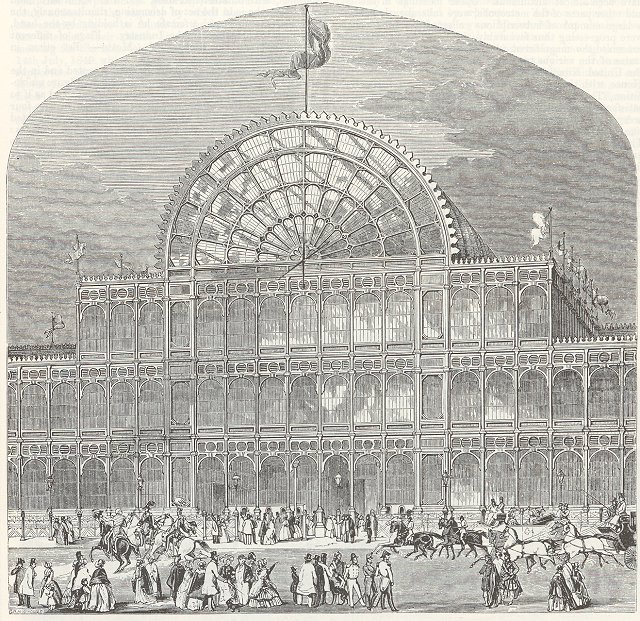
The Great Exhibition was held at the Crystal Palace, London, between May and October 1851. Hornby and Kenworthy had on display a model sizing or dressing machine for cotton and other material, and a model warping machine. Kenworthy, with James Bullough displayed the model of a power loom. All these machines were much appreciated and Hornby and Co. won a medal.
Some time in July or August of 1851 William Kenworthy travelled to London with Martha Kenyon, whilst there they no doubt visited Crystal Palace and saw the many exhibits there. They may also have gone for another reason, because while they were there they married at the Chelsea Registry Office. On their return to Blackburn they settled in Kenworthy’s house, at Brookhouse Lodge whether their son William Kenworthy Kenyon was with them I cannot find out. Whittle gives a short description of Brookhouse Lodge, he says; “this gentleman (Kenworthy) has a neat residence, after the cottage ornee style, at Brookhouse, consisting of gables equilateral, clustered Chimneys, Pyramidal roofs, &c., which is walled round, with the exception of the approach to the main entrance.” Over the next two years they had two children, Mary Jane born 1852 and Ann Elizabeth born 1853.
At Brookhouse Lodge on Tuesday the 2nd of July 1853 one of the Kenworthy’s servants, Hannah Harrison, died as a result of dinking prussic acid. Hannah worried that she might be pregnant and so in March, together with David Porter, the suspected father they visited a surgeon in Bolton-le-Moor for verification. The surgeon confirmed that she was expecting. Witnesses when questioned had not seemed over concerned about her state of mind at the time, although two of her closest friends suspected that she might be expecting but weren’t sure even so they could give no definite reason why she should take her own life. The jury at the inquest gave their verdict that they; “ are of the opinion that Hannah Harrison came to her death by taking prussic acid; but as to how she came into possession of the same, there is no evidence to show.”
Although Kenworthy never seemed, like some other men in the town, to push himself forward he did none the less take some small part in the running of the town. In November 1849 he was elected as a magistrate and then in 1851 was elected on to Blackburn Council for Trinity Ward, he served here until November 1854 when he retired. From 1848 until his death he was president of the Blackburn Choral Society which he enjoyed immensely. He also served on the committee of the Mechanics institute.
William Kenworthy died after a long illness at his home, Brookhouse Lodge, on the 14th of October 1856. He was 54 years old. His Funeral was held on Monday the 17th of October. The burial service was to take place at twelve noon at the Parish Church, but long before that hour the streets leading from Brookhouse Lodge to the Church were crowded with an estimated 30,000 people. Preceding the cortege were 600 mill workers from Brookhouse and other mills in the town walking four abreast at the church the coffin was carried by “principle hands” employed at Hornby’s Mill. The service was conducted by the Rev. Dr. Robinson, incumbent of Holy Trinity Church before interment in the parish church yard.
The following Sunday, at the Parish Church, a memorial service was held for William Kenworthy. It was attended by 2,500 people, which included most of the manufacturers and trades men of the town and a large proportion of workers. The vicar, John Rushton caused great shock and a lot of ill feeling among the congregation when he took the following passage as his text; “He rained flesh upon them as thick as dust: and feathered fowls like as the sand of the sea. He let it fall among their tents: even round about their habitation. So they did eat, and were well filled; for he gave them their own desire: they were not disappointed of their lust. But while the meat was yet in their mouths, the heavy wrath of God came upon them, and he slew the wealthiest of them.” (Psalm 78 verses 28 to 31.) The Blackburn Standard said: “If the text excited astonishment among the congregation the sermon seemed to be listened to with feelings of still greater wonder. We cannot but believe that much unnecessary pain was caused by so injudicious a discourse.” No indication of what the sermon was about is given. The following week a letter appeared in the same paper. The writer said; “I am sure I am uttering the sentiments of nine-tenths of the large congregation which was assembled, on Sunday morning last...when I say that the sermon preached by the Vicar on the occasion was one of the most unsuitable and uncharitable that could have been delivered under the circumstances. Many parties...with whom I have conversed with do not hesitate to pronounce the tone of the discourse to be the most un-Christian.” The writer went on: “The tone in which Mr. Kenworthy was evidently alluded to by the Vicar as the type of the manufacturers of Blackburn was, I am assured by great numbers, felt to be insulting to both the living and the dead.”
A memorial to honour the life of William Kenworthy, paid for by public subscription, was erected in the Parish Church in 1858. It was described by the Preston Guardian as; “A massive monument in the Gothic style of Architecture was erected in Blackburn Church in memory of the late Mr. William Kenworthy. A large base supports a table and four buttresses, placed at the angles, terminated by turreted caps, and the tablet is surmounted by a gable, richly ornated with large crockets, pateras, elaborate tracery, and a highly effective finial terminating the whole. A wreath of oak leaves surrounding the initials, “W.K.,” placed directly above the inscription, forms an attractive and effective feature. The material is British marble, the superiority of which consists in its imperishable hardness and its enduring whiteness. The monument is six feet wide and thirteen feet six inches high. It was designed and executed by Mr. T Duckett, of Preston.” It stood in the Church until the late 1940’s or early 1950’s when as George Miller put it; “It was demolished, apparently without protest, with not a single voice to cry: ‘Sweet friend for Jesu’s sake, forbear’”
The memorial bore the following inscription. “In Memory of William Kenworthy, a man of warm heart and benevolent disposition, energetic in business, and of great mechanical talent. He raised himself from a humble station, and obtained the respect and affection of the working classes by his kindness to them and his constant exertions for their welfare, especially in his successful efforts in support of the act for shortening the house of labour in factories. Born at Denton, near Manchester. Died at Brookhouse Lodge, Blackburn, 14th October, 1856, aged 54 years.”
It should be noted that on the inscription, according to the Blackburn Standard and Preston Guardian, Kenworthy’s birth place is given as “Denton near Manchester in Lancashire” and not “Glossop Dale in Derbyshire,” as the same papers gave in his obituary. Why this should be I do not know.
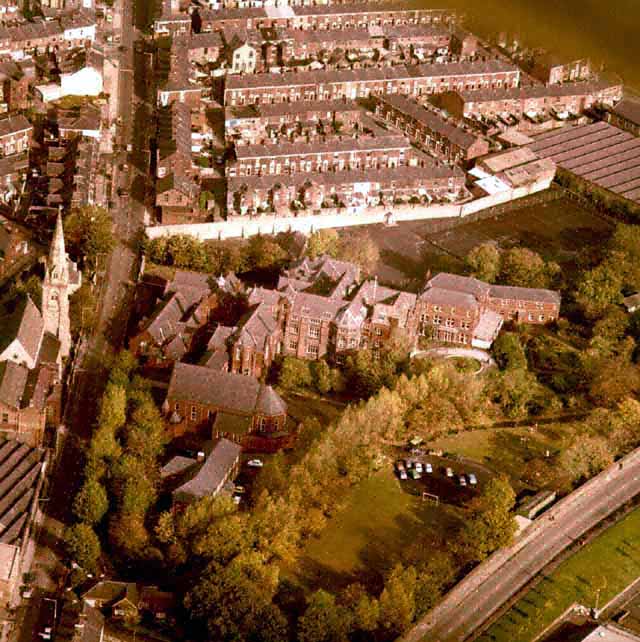
Two years after his death in September 1858, Martha Kenworthy remarried. Her new husband was Matthias Forshaw, a school master; they were married at St. Albans Catholic church, Blackburn. They had a daughter named Margaret. In December 1858 Brookhouse Lodge was put up for sale. It was described as a “Desirable Residence with building land.” It was advertised as being about 7.5 acres and contained; coach house, gardens, pleasure grounds, stocked with choice fruit trees. The house was bought in 1859 by the Sisters of Notre Dame they then began to turn it into a boarding and day school for girls which opened in 1862.
Martha and Matthias meanwhile removed to Clayton le Woods, living on his father’s farm.
In 1859 an action was brought by the bankers Brooks and Co. against the Forshaws to recover the balance due on a promissory note for £400. The bank won and the Forshaws had to pay.
Matthias Forshaw died at Clayton Green on 22 November 1864, and Martha died on the 15th of June 1868. She left in her will under £450.
Some Information about Brookhouse Mill:
Brookhouse Mill was established in 1828. By 1833 the firm was run by W.H. Hornby, John Newsham, and William Kenworthy. Newsham left the partnership in July 1839. Brookhouse was a spinning mill until 1830 when power loom weaving started, probable by James Bullough. Many improvements made to both the weaving and spinning process by William Kenworthy and James Bullough. By 1885 there were 76,316 mule spindles and 1,289 looms; the work force was in excess of 1,400 throughout the nineteenth century. W.H. Hornby went into voluntary liquidation in 1927-28 when Hornby’s Blackburn Mills Ltd was formed. The mill finished spinning and weaving in 1932.
The above was taken from “Industrial Heritage, Part one, the textile industry” pages 18, 19
Some Inventions by Kenworthy:
As well as being in partnership with Hornby at Brookhouse Mills, Kenworthy also spent time in improving weaving and spinning machines both with James Bullough and on his own account.
1834 Kenworthy patented a method of stopping a loom when the weft broke by means of a “vibrating fly reed.” This method, however, was not a success.
1839 Kenworthy and Hornby patented a sizing machine. This was a far superior and cheaper method for of sizing and preparing warps.
1841 January Kenworthy and Bullough patented various improvements for the power loom
1841 July Kenworthy and Bullough patented further improvements to the power loom.
1849 February Kenworthy suggested a construction for a whistle to enable the guard of a train to communicate with the driver.
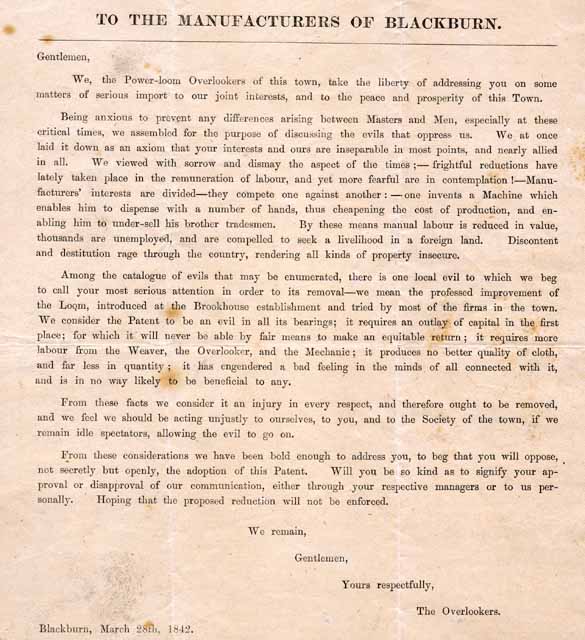
Although improvements in the power loom were meant to make life easier for the weavers it was not always appreciated by the workers as the letter below, addressed to the manufacturers of Blackburn shows. It should be noted that the “outlay” mentioned was made by the weaver, who had to pay to use the newly patented improvements.
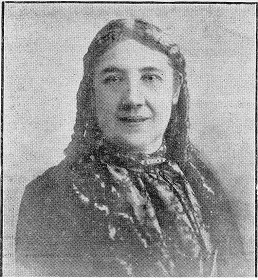
The Drunkard's Friend, the Temperance Queen – call her what you will this woman Elizabeth Ann Lewis embraced the people of Blackburn for forty years. She devoted her life to help and persuade so many unfortunate people to forsake alcohol and thus improve and better their lot for themselves and also their families. It seems she not only had great courage but also a great love for these people which enabled her to go out, time and time again, into their homes to ask them to sign the pledge of temperance. She then kept visiting to help them keep strong and was rewarded by many successes. She had no blame or criticism for any failures but simply kept trying to persuade in a motherly fashion. In fact she asked to be called mother and did not hold back in her affection for many of the most unfortunate. People with no hope, no clothes, no furniture, were able to turn their lives around with her help and became her ardent supporters. She was religious but did not push any particular religion on anyone – she was happy for them to return to the church of their youth as so many did and, as a result, she had the support of the churches in Blackburn. She became a wonderful and inspiring speaker but her work probably started at the Blue Ribbon Mission in 1882 when 19,000 pledges were taken in just three weeks. She followed this up by visiting many of these people over the next seven months but came to realise a full time missionary could make this more successful and so employed a Mr Kilshaw to help with this work, paying his wages herself.
In the 1881 census Blackburn's population was 129,000, with 255 Public Houses, 208 beer shops, 106 shops with beer licences and 35 shops with wine, spirit and sweet licences, 1 for every 34 houses or 117 inhabitants. Public records show 892 arrests – forty years later this dropped to 107 even with an increase in population of 25,000. Licences were reduced from 604 to 313 and hours reduced to 11.00am to 3.00pm and 6.00pm to 10.00pm.
She persuaded people to think for themselves – “Right doing always brings reward just as wrongdoing brings punishment“ She supported the young people and was very keen to educate them in domestic health and sexual subjects – it was a sin to send them out into the world unarmed and uninformed in these matters. She knew that if the mother was a drunkard that the whole family suffered and as alcohol was easily available without having to go into low dives she tried to approach Mr Gladstone at his home to ask him to intervene with regard to women and grocer's licences. He declined to meet Mrs. Lewis but Mrs Gladstone invited her to their home and discussed the problem with her. However Mrs. Gladstone agreed with her husband that it was better for women to go into grocer's shops than public houses – she did however become a subscriber to the mission.
Blackburn was not only a centre for the textile industry but also boasted several large breweries. The publicans were of course opposed to the work of Mrs. Lewis as often meetings were held outside their premises. This dislike of theTemperance Movement lead to an event which caused a great deal of unhappiness for Mrs. Lewis. Whilst she was attending a conference in Blackpool with her missionary Mr. Kilshaw, several publicans on holiday saw them and on returning to Blackburn spread malicious rumours to try and damage her reputation and put a stop to her work. At that time in 1881 for women only, unless the slander would cause financial loss there could be no case. Only her good name was at stake but undaunted Mrs. Lewis went to London to consult her father's old friend Samuel Pope, Recorder for Bolton and Hon Secretary for the United Kingdom Alliance. He could only confirm her solicitor's opinion but knowing the law was so unjust for women would consult with a Mr. Gully QC. They eventually proceeded on the premise that she being responsible for the missionary's wages was likely to suffer pecuniary loss through the slanderous statements. Finally in April 1890 the case was heard in Liverpool and won. Mr Gully was determined to get an amendment to the law and introduced a bill with this clause – “from and after the passing of this act, the false and malicious speaking and publishing of words which impute un-chastity to an unmarried woman or adultery to a married woman shall be actionable without proof of special damage". This Slander of Women Act 1891 is now an accomplished fact and every woman is indebted to her for the increased measure of justice they can expect. The strain of this case left a mark on her health.
Mr. Lewis supported his wife in all her work and in 1891 built a large hall for 600 people over his work's premises – it was named Lees Hall after Dr. Lees a great figure in the Temperance Movement. Later in 1897 a drinking fountain made of Aberdeen granite was erected to the memory of Dr. Lees. Mrs. Lewis also erected a fountain near Corporation Park in memory of her parents.
Mrs. Lewis insisted on being impartial in all political matters and could not be persuaded to promote any party. 1893 was the tenth anniversary of the mission and in this time 24 licences had been revoked. Although they tried to analyse the number of pledges and successes it was not possible to be accurate. It had to be sufficient to show that of 500 cases the households had made huge gains in their prosperity and the physical and moral benefits were countless.
The issue of fermented wine was an ongoing problem for the Temperance Society and some clergy did not use this for communion. Mrs. Lewis discussed this in 1902 with the Vicar of Blackburn pointing out that after all the hard work of helping men and women to abstain they could not take communion or if they did it was likely they would relapse. The Vicar remained unconvinced and asked if she believed in moderation to which she replied “certainly I do my Lord but if it takes six glasses to make a man drunk can you tell me which glass it is that makes him drunk?" The Vicar felt it was dangerous to urge people to make an irrevocable lifelong pledge against a thing not in itself sinful. People signed and broke it again and again which he felt was demoralising but Mrs. Lewis allowed people to sign over and over again as she saw that they were really sorry and so many after two or three attempts kept firm.
In 1905 there was great excitement in the rumour that a woman had married a couple at Park Road Congregational Church. This of course was Mrs. Lewis who had gone to the wedding to act as a witness but in the absence of the vicar, (the vicar was away, his colleague also then went away and the final minister was late.) had been asked to perform the ceremony by the bride. Mrs. Lewis had no doubts about the couple marrying having known them for a number of years and was happy to do so with the permission of the stand-in vicar who eventually arrived. It was reported in London and all the papers being the first time a woman had performed a wedding ceremony. The absent vicar was not happy but the family were extremely pleased. Mrs. Lewis held as strong a view on marriage as she did on temperance and advised young people on the many aspects of married life.
In 1908 the Suffragette Movement was gaining importance and Mrs Lewis expressed great sympathy with them. She argued that “taxation without representation is tyranny" adding the slogan “I am opposed to all tyranny and object as a woman to be classed for voting purposes with lunatics and criminals". She was positive that if women had the vote they would use it on the side of temperance. The leaders of the movement came to Blackburn and were allowed the free use of Lees Hall. Mrs. Lewis did attend some of the meetings in London but would not promote the movement as her mission in life was personal not political.
Another first for women came in 1909 when she was permitted to address the prisoners of Lancaster gaol. The Governor's wife had finally persuaded the powers that be that the prisoners would be helped by Mrs. Lewis and it was so. Many signed the pledge and she visited all the women in their cells. Mrs. Lewis was deeply moved by this and showed her love to these unfortunate people.
The King and Queen visited Blackburn in 1913 and many were presented to their Majesties. The last name on the list was Mrs. Lewis, and on approaching the platform outside the town hall, the crowd gave a great cheer showing the respect and affection in which she was held.
Mrs. Lewis worked tirelessly for forty years for the benefit of the people of Blackburn. She was disappointed that the town did not become teetotal but earned the respect of Lords, Ladies, prominent business men, the mayors and councillors, the Churches and most of all, the ordinary folk of Blackburn. She died in 1924 and her memorial inscription reads as follows:
“In loving memory of Elizabeth Ann Lewis, The Drunkard's Friend. Born at Market Drayton March 10th 1848 died March 14th, 1924". On the back in raised capitals –
“Inasmuch this stone was erected by loving admirers in all parts of the world to The Drunkard's Friend who devoted over forty years of her life to spreading the blessings of teetotalism and training the young to walk in wisdom's way. She went about doing good"
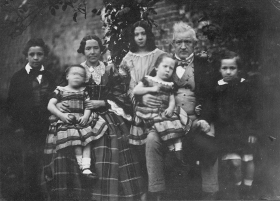
Photograph of Elizabeth Ann Lewis as a young girl
taken along with her Parents and Brothers. Date c 1856.
Elizabeth is standing behind her parents.
Two examples of letters sent to Mrs. Lewis
The first from Elizabeth Ann Greenwood:
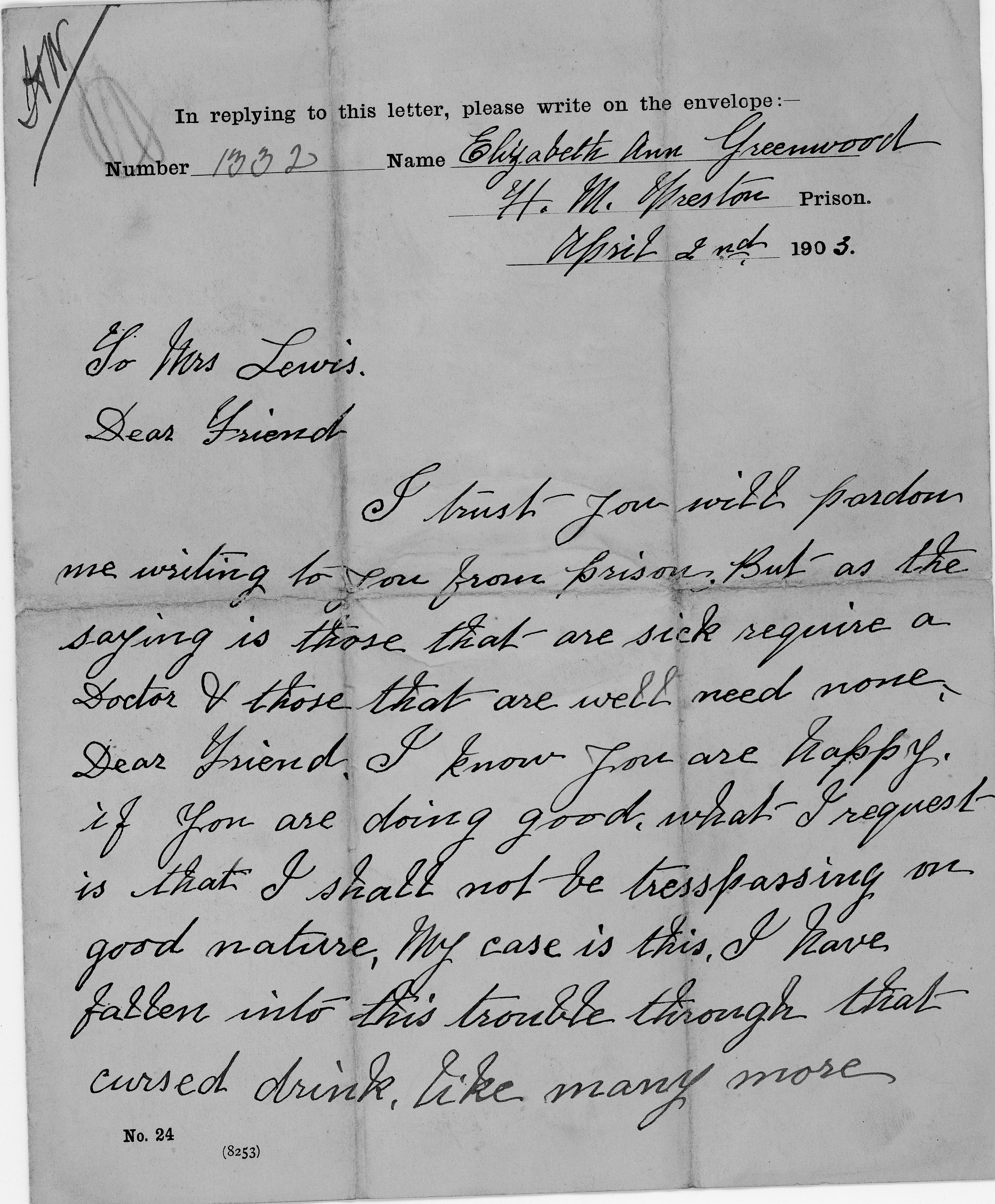
First Page of Letter from Elizabeth Ann Greenwood
Transcription of letter from Elizabeth Ann Greenwood.
Number 1332 Name Elizabeth Ann Greenwood
H.M. Preston Prison
April 2nd 1903
To Mrs Lewis
Dear Friend
I Trust you will pardon me writing from prison but as the saying is those that are sick require a Doctor and those that are well need none. Dear friend, I know you are happy, if you are doing good, what I request is that I shall not be trespassing on good nature. My case is this, I have fallen into this trouble through that cursed drink, like many more. Dear Friends I have been here several times through drink, and I am waiting for the Preston quarter sessions which commence next week, April 8th for felony. What I desire from you Mrs Lewis if you would grant me your favour, is that you would come and see men and speak for me at the trial, I told the chaplain this morning my intentions of writing to you and he strongly advised me to do so. I will take the pledge for life, I feel I want to be good but drink puts an evil, false, daring bold spirit in everyone that abuse it. Dear Friend you will be able to remember John Armstrong Broker of Bank Top, Blackburn, it was a happy day for him when he met you, he had got as low as possible with drink, now I dare say it is 15 years since he touched it, so I am going to take a sample from that, and think that it is never to late to mend. I feel confident, Mrs Lewis, that if you would take the case in hand that I should go free, for the last time I was sentenced was in 1896 so it gives me a better chance, with the exception of a fine of 2s 6d and costs for being drunk 12 months last New Years Day. It is simply this, having been laid up for a long time with Rheumatic at Darwen and Doctors attending, then an outpatient at the infirmary, I was ordered to drink plenty of whiskey, the result was I got I could eat very little with the effects of drink, it seems to turn my brain, so I have taken a vow that I will have no more whatever my ailment may be. For in drink I am not responsible for my actions, I was house-keeping in Darwen and [had] everything that was necessary, so I had no need to take anything. Mrs Lewis, if you case to call at my parent's house, it is 18 Roebuck Street off Bank Top, Blackburn.
Dear friend, you will you will have seen plenty of people that have fallen that would be good if they were lifted up, but some people throw water on drowned people. I do hope that I might come off better than like. But I beg of you Dear Friend, for the sake of my aged parents, that you will, if possibly can, come to the trial and should you succeed in getting me another chance, it shall be given out on your platform. I have had many attempts to come to your meetings but I thought I should be accused with having been in prison. I have on one to be-friend me and there are four against me at the trial and being troubled with disease of the breast, if I was to get a long time I don't feel able to do it. My case is more of kleptomania than stealing. So Mrs Lewis, Please write and ease my poor spirit and say if you will come and God will bless you in the end for lifting the fallen
Yours in Sorrow
E.A. Greenwood.
Biography
Elizabeth Ann Greenwood was born in Blackburn on the 19th April 1867
The Letter mentions Elizabeth's parents, they were Joseph Greenwood b1828 at Hoghton and Elizabeth b. 1839 at Blackburn.
her siblings were: Sarah b. 1855; Ann Ellen b.1865; James b. 1870; Alice b. 1872; Susannah b. 1874; Joseph b. 1877; Alice b. 1889.
The Family always lived in the Bank Top area of Blackburn
When Elizabeth Ann was born her father was a weaver. But he later (between 1876 and 1881) became the landlord of the Shakespeare Hotel, Bank Top. Perhaps this goes some way to why Elizabeth had a liking for drink. He was landlord in 1891 but by 1901 he had retired and living on "his own means" at 16 Roebuck Street (see letter)
Blackburn Standard 22nd April 1893
Elizabeth Ann Greenwood (24), 0F 60 Blakey-street was sent to prison for fourteen days for stealing a pair of boots from a pawn Shop in Northgate.
Blackburn Standard July 8th 1893
Elizabeth was jailed for three months for stealing nine Blouses from draper Thomas Haughton, 141 Bolton Road and stealing a dress skirt from 79 Bolton Road valued at 4s 11d and further with stealing an umbrella from a market stall.
The second from Laurence Culligan:
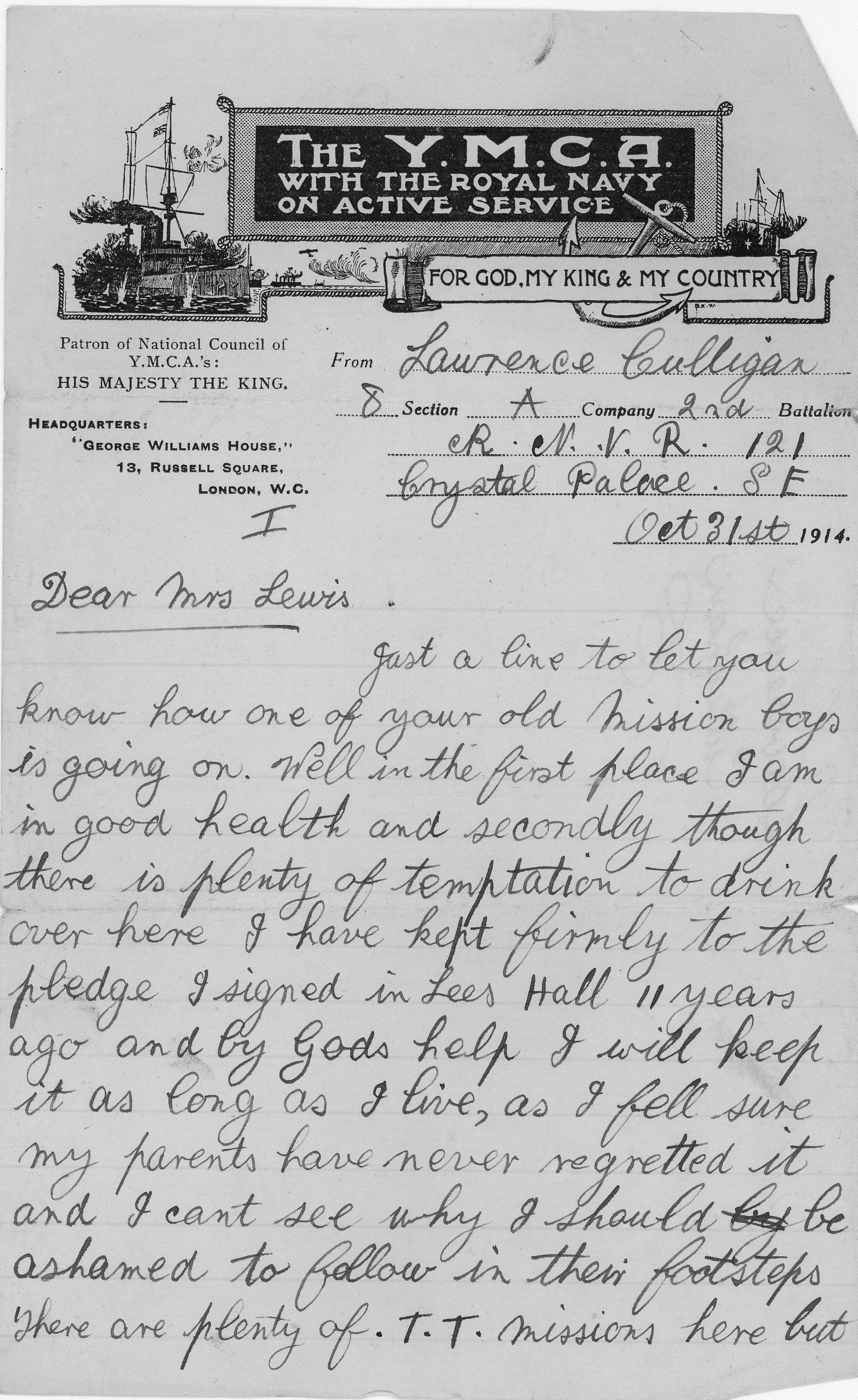
First page of letter from Lawrence Culligan
From Laurence Culligan
8 Section; A Company; 2nd Battalion.
R.N.V.R. 121
Crystal Palace, S.E.
October 31st 1914.
Dear Mrs Lewis,
Just a Line to let you know how one of your old mission boys is going on. Well in the first place I am in good health and secondly, though there is plenty of temptation to drink over here, I have kept firmly to the pledge I signed in Lees Hall 11 years ago and by Gods help I will keep it as long as I live, as I feel sure my parents have never regretted it and I can't see why I should be ashamed to follow in their footsteps. There are plenty of T.T. missions here but no Lees Hall or Mrs. Lewis's. We have plenty of work but I cannot go into details just now. I might here tell you we are the next lot to be sent away and I think it will be overseas. I must now close my short letter as the bugle is sounding for duty. Hoping you will say a prayer for me that I may come back by Gods help safe and sound and look into your intelligent face once more. You may make whatever use you wish of this note.
Best Love and Wishes to Mr. Lewis, Mr. Moss and yourself from L. Culligan
Remember me to the people at the mission.
Sources:
Newscuttings held in Blackburn Library
The following blog post regarding Mr W.E. Moss who worked closely with Mrs Lewis was sent to Cotton Town in 2018 by Chloe Pickard, a volunteer who works in the Healthy Options Library in Queensland, Australia.
https://hoaarchives.wordpress.com/2018/03/29/the-australian-temperance-magazine-the-oldest-item-in-the-collection/
Compiled by Janet Burke, Community History Volunteer.
Robinson Bradley Dodgson
The
President of The Power–Loom Weavers Protection Society
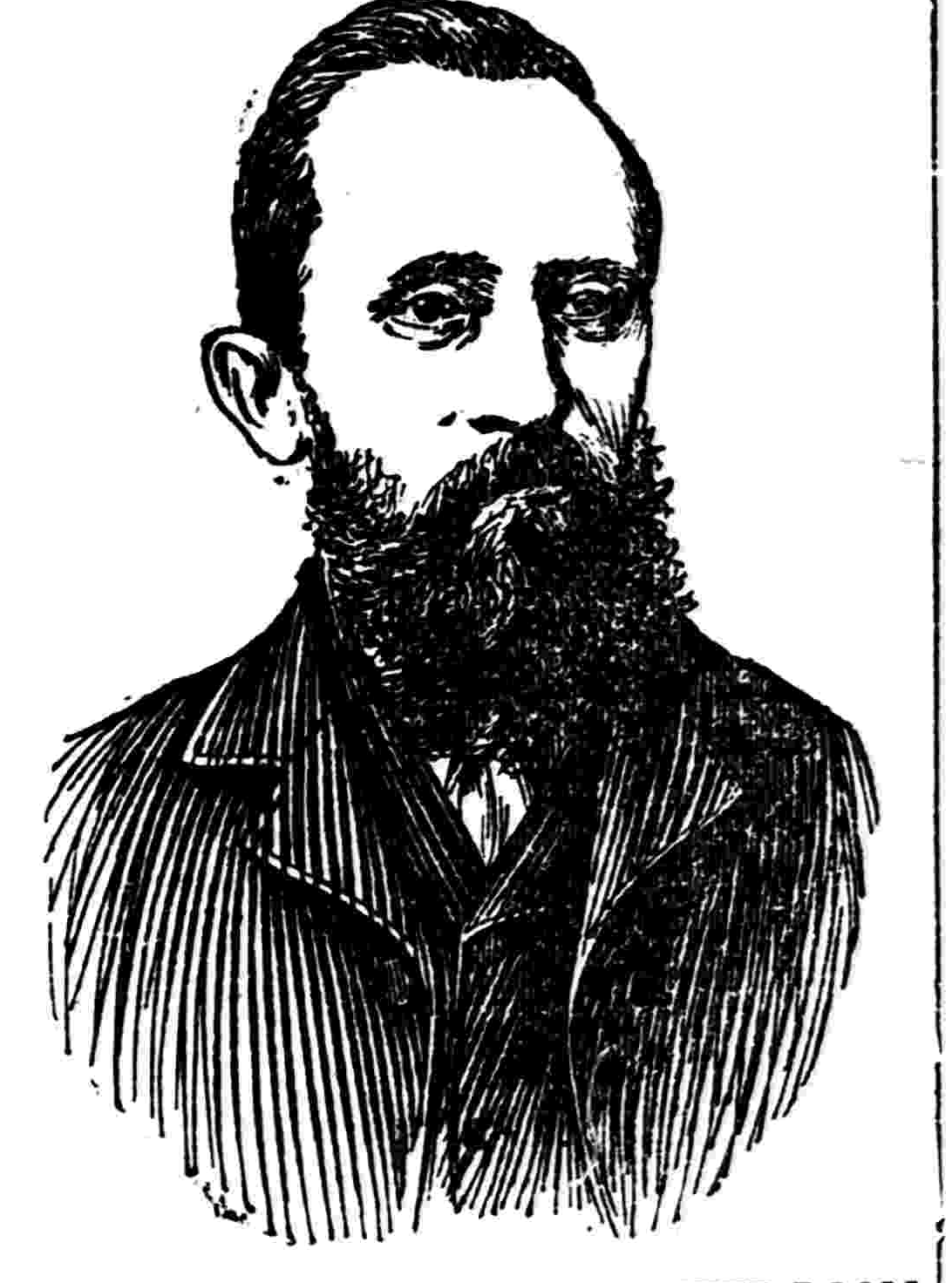
From the Blackburn Standard 8th June 1889
Mr. Robinson Bradley Dodgson, the President of the Power–Loom Weavers Protection Society, is cute and diplomatic, by nature. He adapts as his motto the principle that everything comes to him who knows how to wait, and allows that to animate and guide him in his private as well as public life. Take the tide of fortune at the flood by all means, he says, but do not attempt to sail along without it, unless you are not particular whether you come to grief or not. When he was asked to accept the presidency of the association he weighed the matter up in a calm, judicial way. He thought of the odium he would incur if the venture failed, rather more than he did of the glitter of office. Seeing things pretty much as they are he saw no reason to be afraid of the responsibility, which he accordingly undertook. He makes no pretence to public speaking, although he can talk hard enough on occasion. His conversational powers are good, and his common sense abundant. The society over which he presides is in no respect antagonistic to the older association. Mr Dodgson and others with him believed that there was room for two societies between which there need be neither rivalry, nor jealousy. Blackburn is a large town with over 20,000 of its inhabitants engaged in weaving alone. The existence of two societies working on similar lines means merely that the interest of the operatives will be closely watched and the more sturdily defended. Mr Dodgson is one of, and earns his daily bread along with the men he represents. He knows precisely what is wanted. He thinks the society is serving a useful purpose, and that its fusion with Blackburn and District Power–Loom Weaver’s Association, as suggested in some quarters, would be a mistake. If he has come to that conclusion it is not because he enjoys the sweets of office. His services are, and will be for as long as it may seem desirable, of an honorary character. The hopes he entertained of the ultimate success of the society became more and more justified, and while credit belongs to others in their several departments for the progress made, it will be in no sense invidious to give Mr. Dodgson, as a natural head of the organisation, the lion’s share.
He was born in the quiet village of Feniscowles, 45 years ago [1844] when the river Darwen was clear and limpid, and meandered gently through the grounds of Feniscowles Hall, which by its pollution, it afterwards blighted. His parents hailed from Yorkshire in 1838, and finding an opening in Chapel Street, Blackburn started business. The shop which the father had bought was found in the end not to answer, and the family removed to Feniscowles. The father had obtained a situation as a gardener to Mr., afterwards Sir William Feilden. Mr Dodgson was lucky in his parents and especially on the maternal side. His mother was the niece of the Rev. John Flesher, In his day and generation, a prominent figure in the Primitive Methodist Connexion, and herself a smart intelligent woman. The subject of the sketch was educated by the Misses Waddington, who together taught the school at Feniscowles for about half a century, and turned out pupils who have since attained to creditable positions both at home and abroad. He removed to Blackburn in 1853, and soon afterwards entered the weaving shed, with which he is still connected.
His public life, from choice rather than from lack of opportunity, has not been conspicuous. He has always been recognised by his own fellows as a man whose heart was good and whose views on questions of paramount interest to operatives were sound. He is and has been for many years an active member of the United Order of Free Gardeners, rendering useful service to his own particular lodge, the Ancient Abbey, which numbers amongst its honorary members the Mayor of Blackburn, Mr. Alderman Whiteley, and other gentlemen. He was District Master in 1881, and was one of the delegates in that year to the A.G.M. to Leeds. In 1886 he was again elected to the position. In religion he is a Churchman in spite of the Methodist connections of his mother’s family, and the fact that it has produced three ministers, or brought then into the family pale by marriage. If his Churchmanship be good, so is his Conservatism. From 1865 to 1885 he was an active worker for his party in all Parliamentary and other elections. In his position as president he knows no politics. He recognises the necessity of Keeping party matters at a distance in all organisations of a public character and for public good, and is determined, so far as he is concerned, to allow nothing to obtain that would impair the usefulness of his society or render it in any sense exclusive.
When the formation of the Blackburn Power–Loom Weavers Protection Society was first discussed, his opinion was courted and his advice sought pretty much as a matter of course. In due season the society was put on its way, and, as it may be hoped rejoicing, Mr. Dodgson being elected first president and meriting and receiving a renewal of confidence each year since. Some 12 months ago the committee and collectors in recognition of his services to the society presented him with a handsomely framed photographic group, and a carved shuttle emblematical of the weaving branch of the cotton trade. He married in 1865 the grand daughter of the late Thomas Harrison, who kept the Good Samaritan Inn in Grimshaw Park for many years, and who at one time, under the style of Houghton and Harrison, carried on the business of a manufacturer on premises which have since been pulled down. With a family of eight children Mr. Dodgson has had, what he forcibly calls a “rough time of it.” In 1865, before the terrible effects of the Cotton Famine had ceased to be felt, he found it necessary to try his hand as a labourer for the magnificent sum of 11s per week. For a man with a large family, it is hard to be passing rich on £30 a year. The troubled period got over at last, and as his children one by one began to be useful, the burden became lighter until he realised that life all was worth living, and was capable, notwithstanding its responsibilities, of yielding many pleasures domestic and other. Looking back on the last 35 years he has no disposition to repine for what are sometime called the good old days of that period. The condition of things in the mill is mightily changed since then. There is one–sixth more work he holds for every pair of hands to do in the course of the week through the speeding of the loom, and three hours less to do it in, not to refer to the inferior quality of the material to be worked. These are facts the significance of which he fully recognises, but he has no wish to reverse the wheel of time if it involve the living over again his stern and sometimes bitter struggles to keep the wolf from the door. The qualities of patient endurance and of endeavouring to be cheerful in all circumstances are the outcome of his early struggles, and are perhaps best recommendations for the post he occupies. His work for the society does not consist in proclaiming his existence from the house tops. He is a quiet but energetic worker for its good. He keeps the wheels well oiled, and secures the sweet running of the parts. There are no conflicting interests at work, and if the society had a small and humble beginning, if it were started more in a spirit of reliance on virtues of faith and hope and the excellence of the cause to be served, than upon a basis of unlimited capital, it has been demonstrated that the promoters did not depend upon a broken reed. It has merely existed for four years, it has made satisfactory headway. Should the day come, as it seems likely to do, when the society will be stable enough to stand the wear and tear of possible disputes between capital and labour, it would be well to remember haw carefully it was cradled by its first president, and how tenderly brought up and matured.
Robinson Bradley Dodgson was born at Blackburn on the 7th September 1844.
Robinson and Mary Ann Harrison were married on the 28th October 1865.
They had eight children:
1865 Elizabeth Ellen
1868 Christopher Flesher Bradley
1871 Robert Robinson
1873 Fanny
1875 John William Bradley
1877 Richard Bradley
1880 Mary Bradley
1883 Alfred George
He died at Blackburn on the 6th December, 1908 aged 64.
He was—but perhaps he did not know—the fifth cousin once removed of Charles Lutwidge Dodgson, better known as Lewis Carroll.
This article was suggested by Robert Dodgson.
Elma was born on the 30th July 1864 in London to Daniel and Eliza Thwaites, Elma was their only surviving child – a son having died in infancy. Elma was the granddaughter of the first Daniel Thwaites who had become involved in the brewing industry in Blackburn. Daniel Jnr. her father had inherited a successful business which he ran very profitably being able to buy an estate in Scotland, a property in London and the Woodfold estate outside Blackburn. He was also the MP for Blackburn from 1875 to 1880. It was no doubt expected that Elma would marry well and move amongst the society of the day. She was a very fortunate young woman and considered a good prospect for marriage. Robert Yerburgh came along, a smart young man both in appearance and wit, and had become the MP for Chester. He did not have great wealth but came from a very good family which suited Daniel and Eliza. There was not a long engagement and Elma brought stability and security to this marriage. Daniel died very shortly after and had made arrangements for the brewery to be put in trust and sold so that Elma would have an income of £3000 for life. Mr. William Ward, Daniel’s nephew, was the trustee and executor and was also the current manager of the brewery. Elma did not wish the brewery to be sold as yet but was busy in her family life and left the running of the business to William Ward. Two sons were born so, together with the management of the estates and property and, as the wife of an MP, Elma was kept very busy for the next seven years. She laid the foundation stone of a new literary Institute near Chester in 1889 and gave £1000 to Blackburn Ragged School the following year.
The country’s economy was stagnant for a while and Mr. Ward felt the company should become limited, (as Daniel had wanted before his death). In spite of fierce competition the brewery continued to prosper and Elma and Richard were urged to raise capital to enable more properties to be purchased. It was very unusual for a married woman to be involved with the running of such a company – widows often did so on the death of their husbands in order to provide for themselves and their families. Unmarried daughters also fell into a similar category but married women of substance were not expected to do so. This gives an indication of Elma’s character – she must have wanted to keep the family business going as well as supporting her husband in his political career, although neither of them had any business experience. Elma was said to have paid careful attention to detail, great conscientiousness in fulfilling her duties and very decisive in business matters. People called her an” honest, upright, just and unselfish woman who remained singularly modest and retiring all her life”. It appeared that on occasion she seemed brusque and forthright but apparently this disguised an inherent reticent shy nature – in spite of her generosity to employees and the wider public, she avoided publicity. At Christmas every worker received 10lbs of beef and office staff a turkey or a goose. Later this was amended to £1 for all and this was known as the Yerburgh pound or Elma’s pound – a bottled ale has recently been named as such.
Just before the start of the First World War, Robert’s health had deteriorated and they had gone to a health spa in Germany. When war broke out the couple were detained as prisoners of war but fortunately they were allowed to return home. Robert’s health did not improve and in December 1916 at the age of sixty three he died. Elma continued as Chairman of the company and for those workers on active service she ensured their wages were paid and their families comfortable. Their jobs were kept open and on return Elma made a special gift in addition to the back dated wages. A special holiday outing to Blackpool was arranged and each worker received an envelope containing £25 for each year served in the armed forces. Elma did this again after the Second World War and she also confined tenancies on her estates to families with members serving in the war.
Elma and her late husband had been associated with the Blackburn Royal Infirmary and she gave many donations - some anonymous. There was the Yerburgh Fund for the provision of surgery and other requirements for poor persons, gifts to the College of Nursing, the National Radium Fund and the Cancer Research Fund. Blackburn Orphanage received securities of £3000 to give an income of £100 per annum in perpetuity. Gifts were made to various clubs and groups of unemployed persons in particular the poor, sick or suffering. She was greatly concerned with slum clearance and patron of many societies. In 1924 Elma laid the foundation stone for the War Memorial Wing of the Royal Infirmary and performed the opening ceremony in June 1928.
In 1935 Elma was given the freedom of Blackburn. There have been only five people awarded this honour since the incorporation of the borough and all were men – King Edward V11, Sir W. H. Hornby, Alderman H. Harrison, Lord Morley and Sir William Coddington. This was in recognition of her great love for and generosity to Blackburn.
Darwen’s First Woman Magistrate
Mrs. C.R. Walsh [see Note Below]
Taken from the Darwen News 20th March 1920
Extension of the suffrage to women was only the initial step towards the fairer sex, sooner or later, becoming entitled to privileges and rank in public life on a more equal footing with men. Ten years ago [1910] “votes for women" was regarded by many as an impossibility. Not only have women the vote to-day, but we have women doctors, women Councillors, women barristers, a woman Mayor, a woman Member of Parliament, and now come women magistrates.
The honour and distinction of being the first woman Justice of Peace for Darwen fall to Mrs. C.R. Walsh [see not below] of Richmond Terrace, wife of C.R. Walsh, who as an official of the Corporation, combines duties of Sanitary and Meat inspector with those of Food Controller. The selection of Mrs. Walsh for magisterial duties is a most appropriate one. Long and efficient public service has been recognised and particularly much voluntary work over the period of the war. Further, Mrs. Walsh combines an intelligent mind with an impartial outlook and is ever cognisant of changing conditions, and as a Justice of the Peace she may be relied upon to temper justice with mercy.
Scholastic
The Scholastic profession claimed Mrs. Walsh's first activities in life. She was trained initially at Southlands Training College, Battersea, London, and later at the kindergarten College, Manchester, and upon leaving the latter institution she became headmistress at Higher Grade School, Chester. Then commenced her Teaching association with Darwen, and for a period of 18 years she was headmistress of the Central Wesleyan Day School and of the Central Council School, as it came to be known following the Education act of 1892. In that position her mind came to be finally moulded for the greater public service which awaited. The first duties, apart from calls of teaching, undertaken by Mrs. Walsh were those of secretary of the Woman's guild of the Industrial Co-operative Society. This was in the year 1897, when the Guild had been in operation for a period of four years, during which time there had been just as many secretaries. From that year the progress of the movement was marked with much success. Mrs. Walsh came under the influence of the late Mrs J.W. Bury, who was Guild President, which led to the establishment of a warm and inseparable friendship which was only severed by Mrs. Bury's sudden and lamented death, and the two were largely instrumental in increasing the popularity of the Guild until it became the largest institution of its kind both numerically and in the extent and diversity of its operations, in the whole country. For Twenty-two years Mrs. Walsh discharged the duties of secretary and the value placed upon her services was demonstrated on her retirement a year ago by the handsome gifts she received at the hands of the members and the many expressions in words conveyed to her.
War Service
Mrs. Walsh's war work, however, reveals the greatest sacrifice and activity. There was no obligation upon her to take over so many and varied duties as she has performed during the period of hostilities, many of which still claim her energies. Like many more men and women, however, she answered the call with a willingness upon which she placed no limit. What is this record? Mrs Walsh has been, or is to-day, a member of the Distress Committee, of the Sailors and Soldiers Families' Association, of the Patriotic Fund Committee, and of the Military and Naval War pensions Committee. Simultaneously she has discharged her other public duties—as a Poor Law Guardian, representative on the district Nursing Association, representative on the Maternity Centre of the Mothers' Club, and a member of the committee of the local branch of the National Society of the Prevention of Cruelty to Children. The amount of time all these offices must have called for cannot be accurately estimated, and especially where there is regularity in carrying out duties as so loyally adhered to by Mrs. Walsh, but it must have been at a considerable personal sacrifice she has been able to do so much and that without fee or any hopes of reward other than having tried to do her duty to help others. Further, throughout the period that the control of food has been in operation she has devoted approximately, one-half of each day of the working week assisting in the duties of the Food Control Office.
Politically Mrs. Walsh is a most ardent Liberal, and is one of the vice-presidents of the Central Ward Liberal Committee. She has been an active worker in connection with the Railway-road Wesley Chapel and the central Wesleyan Sunday School all her life, being class-leader, Sunday School teacher, a warm supporter of the missionary movement, and at all times ready and willing to co-operate in efforts for the welfare of both church and school.
To her many offices Mrs. Walsh now adds the duties of County Magistrate. As I have already observed, the honour is well won, and it is some recognition of public service, loyally and cheerfully rendered in face of difficulties, involving sacrifice of pleasure and the expenditure of much physical energy and mental application, with the one desire and aim to help and benefit fellow-beings.
My heartiest congratulations upon the distinction conferred this week.
Reflector
Note
This article begins with the heading “Mrs. C. R. Walsh Darwen's First Woman Magistrate" The assumption being that the C.R. was the initials of Mrs. Walsh's Christian Name; not so. The C R, in this case, is Christopher Ralph, the Christian names of her husband, while her name was Elizabeth Jane. It was common practice in those days to use the husband's initials or even his full name, so the headline could well have read Mrs. Christopher Ralph Walsh.
Biography
Elizabeth Jane Law was born at Darwen on the 1st December 1869. Her father was James Law, and her mother was Betsy Law (nee Eccles).
In 1911 Elizabeth was living at 65 London Terrace, Darwen with her aunt, Elizabeth Jane Law. At this time she was a head teacher.
She married Christopher Ralph Walsh on the 18th July 1914; they were both 44 years old. He was a widower and she a spinster. They were married at the Wesleyan Chapel, Plymouth Road, South Manchester.
Elizabeth died 1st February 1963.
Christopher Ralph Walsh was born 11th December 1869.
His father was James Walsh, Joiner.
In 1911 he was married to Lucy Walsh, they had 2 children. His profession was inspector of nuisances for Darwen Corporation. He died 2nd February 1949.