
 Loading more
Page 8
 Clementina eyed the breakfast of salad and oil with manifest disgust.
“Which paper are we following now, father?” she asked.
“The Daily M____” I find,” he said, turning to Clementina’s godmother, and speaking in his precise and affected manner, “I find that the ordinary breakfast of bacon, eggs and coffee is most injurious to the system. In fact, I am surprised that I have not died long ago.”
“We are, really afraid to open the papers nowadays, aunt,” cried Clementina. “Father- in case he should find he is poisoned; and I – in case grass or candles should be recommended.”
“Clementina,” said her father sternly, “desist.”
She desisted, and the meal was finished in silence.
Rex read his letters with all the conscious superiority of a son and heir; and Mrs. Farnell was too spiritless to speak unless she was spoken to. Finally, Mr. Farnell rose from the table and gave Clementina a shilling – her weekly allowance. She blushed as she took it. A shilling a week, and she had aspirations to independence! A shilling a week, and she was almost twenty-one. Her father was a rich man, and gave his son a lavish allowance, in accordance with his theory: “Give the boys free rein and keep the girls well in hand.” “A woman’s place is at home” was one of his constant platitudes.
“Even if there is nothing to do?” Clementina had asked.
“Find something to do, then,” he roared, for his temper was as short as his views, and he “would be master in his own house.” Clementina had tried; but golf was no game for women, and hockey – how dared she mention it? He did not approve of her friends because they laughed loudly and said “ripping” and “topping.” It was most unseemly, and they were forbidden the house. He did not like to see her pouring over books.
Why was she not more like other girls?
Why was she not more like other girls?
“Give me a chance,” said Clementina bitterly, “and I will be.”
But long ago she had realised that no chance would be given her, and she determined to take the law into her own hands. “Six pounds, eight shillings now,” she said to herself as she hugged the shilling in her hands.
“Clementina,” her father’s hard voice broke in on her dreams, “where were you yesterday?”
“In the woods, father.”
“Alone?”
“Yes.”
“Let me impress upon you the fact that you are not to wonder in the country alone and unprotected. Please remember that.”
“But, father, see! I have this with me.” She pulled a small pistol from her pocket.
There was a general cry of horror.
“It is not real,” Clementina hastened to assure them.
“Not real! How dare you – young lady – my daughter – stoop to frighten tramps with a toy pistol?”
“If I don’t frighten them, they’ll frighten me,” she cried. “And father, I don’t see why I should be denied the fields and the fresh air because no one will go with me.”
“You will not go again,” her father said firmly.
“Only two more weeks! Two more weeks,” murmured Clementina, to keep back the angry words.
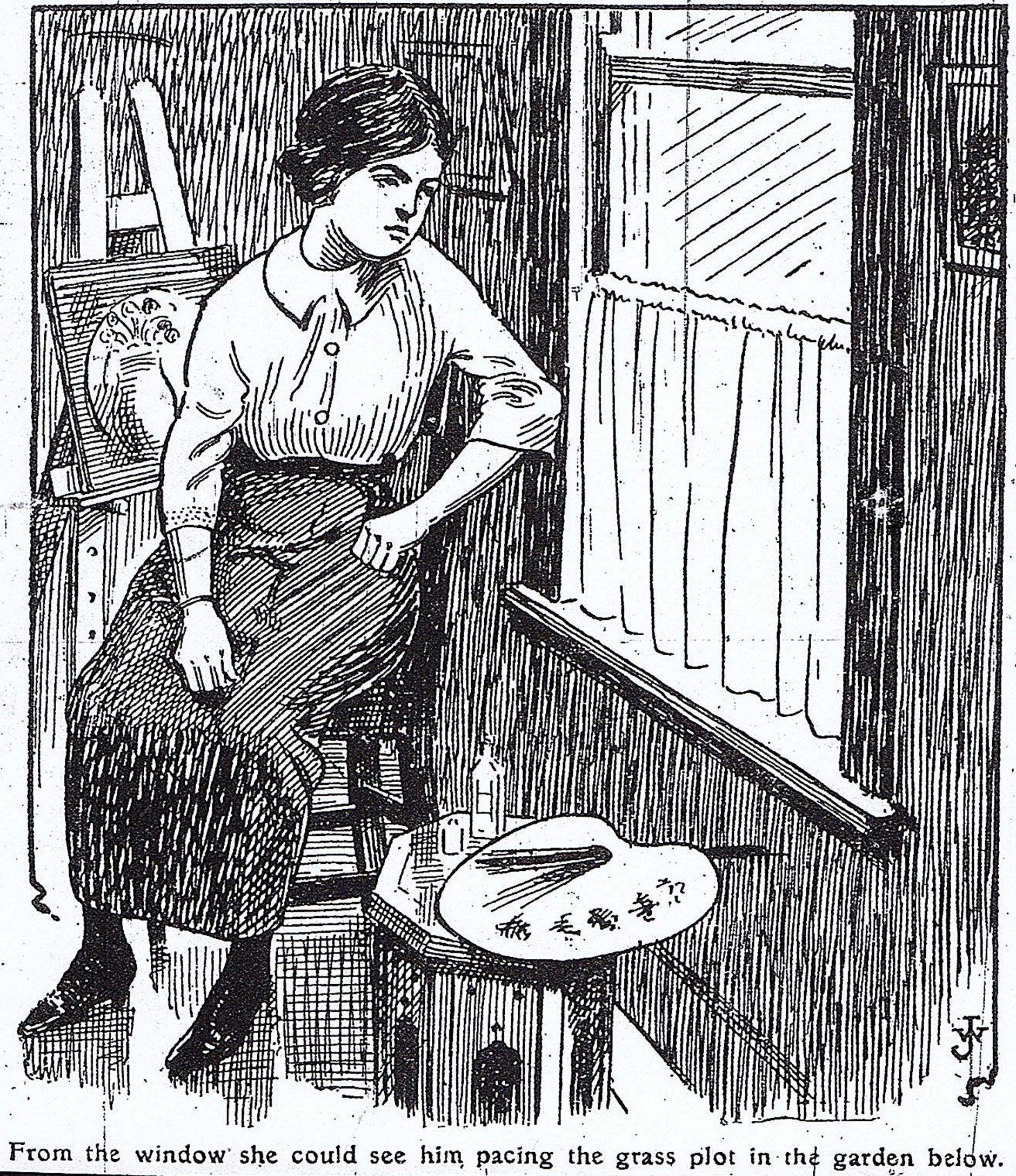
She went to her hated little studio, where her father insisted that she should paint pictures of the “light and shade” type. From the window she could see him pacing the grass plot in the garden below. His hands were clasped behind and his head was well thrown back; he threw proud glances from side to side.
“I am monarch of all I survey,” quoted Clementina, and then hated herself for it.
“But he has not been fair to me,” she insisted to herself. “He hasn’t been fair, and I am not doing wrong.”
Her godmother came in to her.
“Aunt, I am sorry you are going to-day,” said the girl.
“You are not looking very well or very happy, child,” said her aunt.
“I am quite well,” Clementina said, surprised.
“Are you happy?” asked her aunt, again.
Clementina turned and saw sympathy in her godmother’s eyes. She hesitated, and then said, vehemently,
“I am not free. I am too cooped up to be happy.
“I understand. Tell me what you are going to do.”
Clementina was glad that her godmother took it for granted that she was going to do something.
“I shall be twenty-one in a fortnight, aunt, and then I shall be as free to do as I like. I have saved six pounds and eight shillings, and on my birthday I leave this house.”
“Where will you go?”
“I have got a place as assistant mistress in a small girls’ school. I wanted a degree, you know, aunt. You can do so much more with a degree. Oh, there is a great deal to do, and I want to help!”
“What do you mean?” asked her aunt.
“Don’t laugh,” said Clementina “when I tell you that I used to spend hours trying to hammer out epigrams on men. Have you ever read those pages of epigrams on women in almost every paper? Have you? And didn’t you feel on fire with indignation? I spent hours trying to do it, but I had no talent, and now I have found a better way, aunt. I’ll try help to teach us to be perfectly proof against them. That’s the best way to avenge the insults that have been heaped on women in books and in life. How I hate the men who wrote them!”
“This is only an outlet for your cooped-up energy, Clementina, child,” remarked her aunt.
“That as may be, but all this is very serious to me. I know a girl, aunt, who was driven to marry a man she did not love, because she had no liberty at home.”
“I don’t suppose you would do that.”
“No! I know better than to fly from this bondage to a worse.”
“Ah! Clementina,” said her aunt. “You have a great deal to learn.”
“I know I have,” humbly, “I know I have. But, aunt, do you blame me for striking out for myself? I want to be free. I want to live – I want to help. I have never been anything in this house. They will not let me be of any use. Oh! I’m cramped.”
“I know; I have often thought so,” said her godmother. “I think you can go under the circumstances. Good luck, child. You will have to fight hard. The world seems very cruel to girls of your age. I remember thinking so. But you have grit, Clem dear, and will come through all right.” She smiled into Clementina’s excited eyes. “You are a strange child,” she said, and kissed her good-bye.
Clementina lived through the next fortnight in a fever of excitement. It made her colour and her eyes as brilliant as they might have been were she a happy, careless girl. Her brother began to think her pretty enough to go out with him. “I’ll take you to the dance’s next winter, Clem,” he said, condescendingly, if you won’t disgrace yourself and me.”
“I don’t think I will risk it, thanks,” said Clementina, sweetly.
“Oh! come, you’re not as bad as all that,” he consoled her.
“Thank you. You are very generous, but you might regret it.”
“Oh, all right,” he said, in a huff.
The night before her birthday Clementina packed her belongings, emptied the contents of her old tin money-box into her purse, and saw that everything was in readiness. The next morning she went down to breakfast feeling decidedly nervous.
Her parents kissed her.
“I have refitted your studio, Clementina,” said her father, and your mother has some books and pictures for you. Many happy returns.” He dismissed the subject with a wave of his hand.
“Thank you, father,” she said, with a gulp.
“I must get it over,” she thought.
A letter lay on her plate. She picked it up, and played nervously with it, without opening it. Then she made a bold plunge.
“Father,” she began, in a clear voice, “I am twenty-one to-day. I am of age now – and free.”
“Free?” he cried astounded.
“Yes,” she went on firmly. “I can do as I like now; and I want to go and earn my own living.”
“What?” he roared.
She repeated it.
“How dare you? How dare you?” he cried, livid with rage. “If you ever leave this house, you never enter it again as long as you live.”
“Mother!” cried the girl, throwing out her arms in passionate appeal.
“I have no sympathy with you,” said her mother, coldly.
“Oh, no! no!” cried Clementina, covering her face with her hands.
“You never enter this house again,” repeated her father.
“You do not regret it more than I,” she said, quiet now.
“Insolent!” he roared.
“I must go,” she said.
“Where is your money?”
“I have saved every penny you have given me since I left school. It comes to six pounds and eight shillings.”
He became suddenly very calm, and, leaning forward, said slowly, “You shall not take one thing out of this house. I have paid for your clothes. You ungrateful, shameful child, you shall not take any away. You shall stay here, and not another penny shall you have to save.”
Clementina gave a great cry but was still after that. If she let the flood of tears come, he would taunt her with being a weak, helpless woman. He had done it before, but he should never do it again. Her burning eyes fell on the letter in her hand. Her god-mother’s writing! she tore it open while they watched her. There was a note. She scanned it. “You must let me help …… would rather give you the money now than when I die ….. then it may be too late to be of any use to you. Take this …..”
She gave another cry when she saw a cheque for £100.
“Free!” she cried, “Free, in spite of all! Free! Oh!” She turned her brilliant eyes upon her father, and he shrank from the strange expression in them. What had he done to raise such a look in the eyes of his own child? He asked himself, and dared not answer.
“I shall send money for my things,” she said, “every penny. I must go; but I shall always be ready to come back when you can forgive me.”
She was gone and did not hear the hoarse bitter cry that broke from her father’s lips.
Blackburn Weekly Telegraph, Saturday 17th May, 1913
Transcribed by Philip Crompton
 FT01] - “Entrez done, Miss Cherie, c’est si bien.”
Marie-Cecile pushed back the great door, and from the aching glare of the hot streets Clementina entered a haven of cool beauty.
Mademoiselle Leonie followed, and at Clementina’s cry of “Oh! Mademoiselle! see how lovely!” the shadow of a smile passed in her glazed eyes. Then Clementina was glad, and pressed her hand.
Years ago a strange illness, contracted whilst devotedly nursing a little sister until her death had taken the life and light from Mademoiselle Leonie’s mind. Her sad case and her neat mending recommended her to Mdlle La Directrice; she took up her place in a far corner of the hall, and the years rolled back over her unconscious head, unceasingly bent over her work.
At first Clementina was startled when she saw the strange creature standing outside her door at nights, the eyes that never seemed to move, glittering in the candle-light, no sigh of life in the distorted face; but, on going to her Clementina generally found that she held something of hers in her hand, some lined she had been mending or a book the girl had left lying about. Thereupon Clementina would take it gently and by-and-by Mdlle would go away as quietly as she had come.
One particular night Clementina awoke in a fright to find her standing beside her bed holding a letter.
“For me?” she asked as soon as she recovered herself, and took it.
Mdlle Leonie held the candle for her to read it.
“Thank you, Mdlle”, said Clementina, preparing to lie down again, but Mdlle had turned her glassy look on the girl’s long, bright hair. She lifted a lock and stroked it; it fell through her rough fingers with a rasping sound, as satin does.
[FT02] - “Ah! Si joli! Si jol1!” she murmured, and to Clementina’s dismay great tears gathered in the awful eyes and fell on her hair.
“Oh! Mademoiselle,” she cried, sitting up again and impulsively putting her arms round Mdlle Leonie’s neck.
[FT03] - “Ma petite soeur,” said the poor creature. “FT04 - Ses cheveux.” Then Clementina understood. From that night they had been friends – strange, indeed, but non the less true.
Then Mdlle La Directrice gave her permission for Clementina to spend the day with little motherless Marie-Cecilie Vincent, Clementina took as chaperone – indispensable in France – Mdlle Leonie.
[FT05] - “’Pas mal,” was the general and malicious comment. “La pauvre n’en verra rein.”
Clementina’s idea, however, was that she should see something.
“Sit here, Mademoiselle,” she said now, opening out a garden chair in a shady place. “There are birds to sing to you, and all of this glorious wisteria hanging round, and roses without end to look at, Aren’t you happy? I am.”
For answer Mdlle Leonie caught at the girl’s hand. “Miss – come! Here is Le Petite Pere. He speaks English so well,” broke in Marie-Cecile.
Clementina turned and saw a small man, garden hat in hand, advancing up one of the paths. He wore eyeglasses, and, seemed to be shortsighted.
“Ah!” he cried, sighting the two, and speaking English with an indescribable accent. “Good afternoon, Mees. It is great pleasure for me to see you in my garden. I love England, and I love much all the Engleesh.” He made expansive gestures, as If he would gather them all into his arms. “Amuse yourself well, all is to you! Profit of it well. I come again to talk wis you all at the hour.”
Clementina thanked him and he went away.
“Doesn’t he speak well?” asked the delighted child, who could not be persuaded to speak a word in any but her native tongue. “He has been to England several times; he will come back. Now Miss Cherie, let’s play.”
They ran off through the garden, laughing and calling to each other. Clementina stopped every now and them to exclaim on the beauty of the luxuriant purple blooms of the wisteria that covered every wall, to ben over the roses, and to revel in the glorious colouring of the flowers masses on every side. It was a beautiful garden, quite unlike any English one she had seen. There were no lawns; the grass under the walnut trees was newly-mown; the paths were pebbled, and there was a little maze at one end of the garden in which, after wandering for a time, not too long, you came to the shadiest, prettiest little arbour imaginable, where there was a dark pool with goldfish.
It was here that “le Petit Pere” found them late in the afternoon; Clementina sitting very still with Marie-Cecile, tired out with playing in the heat, asleep on her arm.
Monsieur Vincent came in quietly and sat down, nodding to Clementina; he seemed to find the picture before him very charming, and after a time he said; “You love my little daughter?”
“Very much,” she said, looking down at the child sleeping against her, and lifting one of the heavy curls tenderly.
“You love the garden?”
“It is glorious.”
“You would love to live here – always near Marie-Cecile?”
“I think I should.” Clementina smiled, but was puzzled.
“You have not seen me perhaps before,” went on “la Petit Pere,” peering at her across the arbour.
“No Ah! But I have seen you many times, in the Cathedrale walking alone in dreaming; and when I see you, I say me, “She loves things beautiful” me too, I love also things beautiful. I see you in the streets, in the boulevards – always alone. You are quite different with our French young ladies. You do not fear nothing – you are free. In France young ladies cannot be free unless they are married. Would you love to me married? Say?”
“I do not think about it,” said Clementina, hiding her amusement.
“No! You are quite different with our French young ladies”. But there is the tea I have commanded. We will talk no more at the present about marriage. “You shall have tea as the Engleesh – with rum.”
“Oh! pardon, Monsieur” cried Clementina. “I never have rum with my tea!”
“How? Not of rum?” he cried in surprise, and you are English?”
“Certainly, but we do not take rum in tea!”
[FT06] - “I have always heard of it. What take you then? Milk!, Oh! quelle honneur! Yvonne apportez du lait pour mademoiselle!”
Marie-Cecile awoke, grimaced at the tea took a “petit pain” and a piece of chocolate and installed herself on Clementina’s knee.
Evening fell on the garden, and the birds were quiet. Then Clementina, her arms full of flowers, went away with Mademoiselle Leonie down the cobbled streets, where streams ran on each side and past the grey old cathedral, and “le Petit Pere,” watching from the gate said;
[FT07] - “Ma petit a raison. Elle est tres gentilley cette petit miss. Je vais voir Mdlle La Deatrice demain”.
***********************************************************
The next day Clementina was summond to the Principal’s room.
“Sit down,” said that austere person “ and let us get to business. No doubt you will be surprised, ma petit miss, at what I have to tell you. Monsieur Vincent has this morning made me an offer of marriage for you.”
Clementina came out of her chair with a leap.
“Mademoiselle!” she gasped in the most utter astonishment.
“Due! ……. An offer of marriage ……. Monsieur Vincent!” she stood stammering and staring.
“Sit down my child. This is nothing unusual,” said the Principal calmly. “You ought to consider yourself very fortunate. You have no ”dot.” Monsieur is rich and good, and very fond of you.
Mademoiselle! I have seen him once. He is old …..” “Thirty five”, interrupted Mademoiselle. “Bot you are not to speak about it now. Go and think about it for a week – a week. I say, no less. [FT08] - C’est un fort bon parti, je vous assure. Go now my dear child, I am busy. Do not speak another word – not another word.”
Clementina went like one in a dream.
“An offer of marriage – Monsieur Vincent – me!” she said again. “Good heavens! I have never in all my life imagined that anything like this could ever happen to anyone.”
During the lessons she gave that afternoon in the hot-classrooms with the children outside singing.
Frer-e Jac-ques Frer-e Jac-ques
Dor-mey vous! Dor-mey vous!
And the English class inside droning over their lessons, her mind kept flying back to stare at the idea, and a smile dimpted her cheek so often that the class whispered together, “Miss s’ amuse.”
She tried again to speak to the Principal; but she resolutely refused to listen.
“I have promised Monsieur that you should not decide before a week was out,” She said “and you must not hurt his feelings by giving so little consideration to a question that so nearly concerns him.”
Clementina was indignant at first; then she was vastly amused at the French method of proposal, and finally, she was worried to know how to refuse firmly, but gently.
“I wish I could find a way out,” she thought, leaning her arms on the window ledge of her room.
A knock came on her door, and as no one entered when she called “Come in,” she went to open it. There stood Mademoiselle Leonie, almost animated.
[FT09] - “Un Monsieur Anglais-au salon,” she said.
“My father? “asked Clementina.
“No – young.”
“Young! Who can it be!” she cried, beginning to run downstairs.
She opened the salon door and looked into the long room. A tall figure turned.
“Peter! You!
“Clem!”
They came together suddenly in the middle of the room, and a very incoherent greeting took place, with much shaking of hands, and a great many questions that they never dreamed of answering. Finally they sat down and tried to compose themselves. “I feel one big smile,” said Clementina, pressing her hands to her face to make it serious. “Peter, how did you get here?”
“Got the company to send me here for a month or two to polish up the language. I could choose my own place, so I came down here to be near to you. I thought you wouldn’t mind.”
“Mind!” she cried. “If you knew how I have longed for some one English! How long is it since I saw you Peter?”
“More than a year.”
“How are they all at home?”
Quite well. Your father talks of coming over to se you soon. Rex is getting very well.
“Oh, I can’t really believe you are hear,” she began again. “Why did you not let me know you were coming?”
“Thought you’d write and say I wasn’t to come.”
“Oh, Peter, why?”
“Don’t know, but I wasn’t going to risk it.”
[FT10] - “Les covenances are very queer here,” said Clementina with a sigh. “I wonder if I shall be able to see you much.”
“See me!” he cried. “Of course you’ll see me – every day. Hang French convention. It’s not going to touch us.”
“Oh, Peter, listen,” said Clementina, beginning to laugh again.” I have had a formal proposal of marriage from a Frenchman. I’ve only seen him once!”
“What?” said Peter in astonishment.
Clementina explained again.
“But, really, Peter,” she finished, I wish I could think of a nice way out, because he is very good and nice, and the father of the dearest little girl in the world, and, you know, he won’t be able to see – no one will be able to see – why I don’t say “Yes. They are so queer here. There’s Jeanne going to be married next month; she didn’t know her fiancé two months ago, and has only seen him three times now; and Anne-Marie is out “on approval” today. But what am I to do? Do think.”
Peter thought; then a brilliant idea seemed to strike him.
“I say, Clem.” He said, “get engaged to me for the time-being. You will get rid of the old man, then, and you will be able to come out with me too. You can break it off when you leave France – if you want to. Will that do?
“What a splendid idea!” cried the girl. “But can it be done.”
“Of course. Can you come out with me this afternoon?” he asked eagerly.
“I must see the principal first – and so must you, if we are to be engaged,” laughed Clementina.
“Clem, you need a ring.”
“I never had one” she said.
“I’ll buy one.”
“All right – a cheap one. You’ll probably be able to use it again,” she teased him.
He looked at her so strangely that she said; “Of course, this is only fun.”
“I quite understand,” he said. “I will come back after lunch. Good-bye, fiancé, mine.”
“Good-bye Peter, mon vieux, come back soon.”
Very early in the afternoon Clementina took Peter to the Principal’s room.
“Mademoiselle,” she said, boldly, “this is he – Peter Hicking, from England. I am engaged to him.”
It was the French woman’s turn to be surprised.
“I have heard nothing of this before,” she said, after greeting Peter. “In France this could not be.”
“But mademoiselle, in England the parents do not interfere with their children’s choice in this matter.”
“Yes! It is true. What a strange country!”
“So you see, mademoiselle, I cannot marry M. Vincent. Will you tell him I am honoured by his proposal, and explain to him the reason for my refusal.”
“Bon.”
“Will you give me permission to go out with my fiancé when I am at liberty, mademoiselle?”
“In France it is not unusual, ma petit miss,” said the Directrice.
“But we are English,” Peter urged.
“My English mistress must not scandalize my pupils parents.”
“I won’t do that, I assure you,” broke in Clementina.
“Well, I suppose I must let you have your way; and I must admit the English way is passed my French comprehension. But you are the best English mistress I ever had, and I cannot afford to lose you. Are you going to be married soon?”
“Oh! no,” said Clementina hastily, avoiding Peter’s eyes.
The Directrice kissed the girls forehead, shook hands with Peter, and thus they were dismissed.
“Come now! To the hills,” cried Peter, elated, and away they went, talking hard in their dear native tongue.
With the arrival of Peter, Clementina’s life was completely changed.
The English lessons were no longer dull, when there was a prospect of a walk with Peter afterwards. They were like the maze and the arbour in Marie-Cecile’s garden, she told him. The delay beforehand made the desired object all the sweeter. Mdlle Leonie often accompanied them to some especially lovely spot. Clementina was rewarded for her untiring efforts and little kind cares by the reawakening of intelligence in Mdlle’s mind; and while she brushed out the girl’s hair – a task she loved – the two made a compact that when Clementina left the pension Mdlle Leonie should go with her.
On a glorious evening in late spring, Clementina and Peter sat ubder the trees by the river, with the hills before them spread over with a patch-work quilt of Nature’s own making; strips of cornfields next to patches of grass; turnip fields side by side with orchards, and all set so much on end that Clementina wondered that the plough had not run straight down the hill-side into the river below.
“Well, Clem,” said Peter, suddenly.” How does independence taste?”
“Splendid!” she cried. I’m really happy.”
“It is a queer thing, this case for independence,” mused Peter. “I should have thought it most agreeable to stay at home comfortably and indulge all your favourite tastes.”
“Ah! Yes, perhaps, if you could,” she said.
“But even then it would not satisfy me, and you are wrong about the craze for independence. My object in life, had I known it, is simply to be happy. It is every one’s real object, I think, and if you’re not happy where you are, get somewhere where you can be. I did. I wasn’t happy at home doing the same things and seeing the same things every day of my life. Father did not understand that I wanted life and air and room to grow. He cooped me up on every side and insisted that I was a refractory blue-stocking whom it was his duty to reform. So I took things into my own hands and went. It hurt him, I know; it shocked all his canons of conventionality; but if I had to do it, and now it is all right; he understands and even likes me better.”
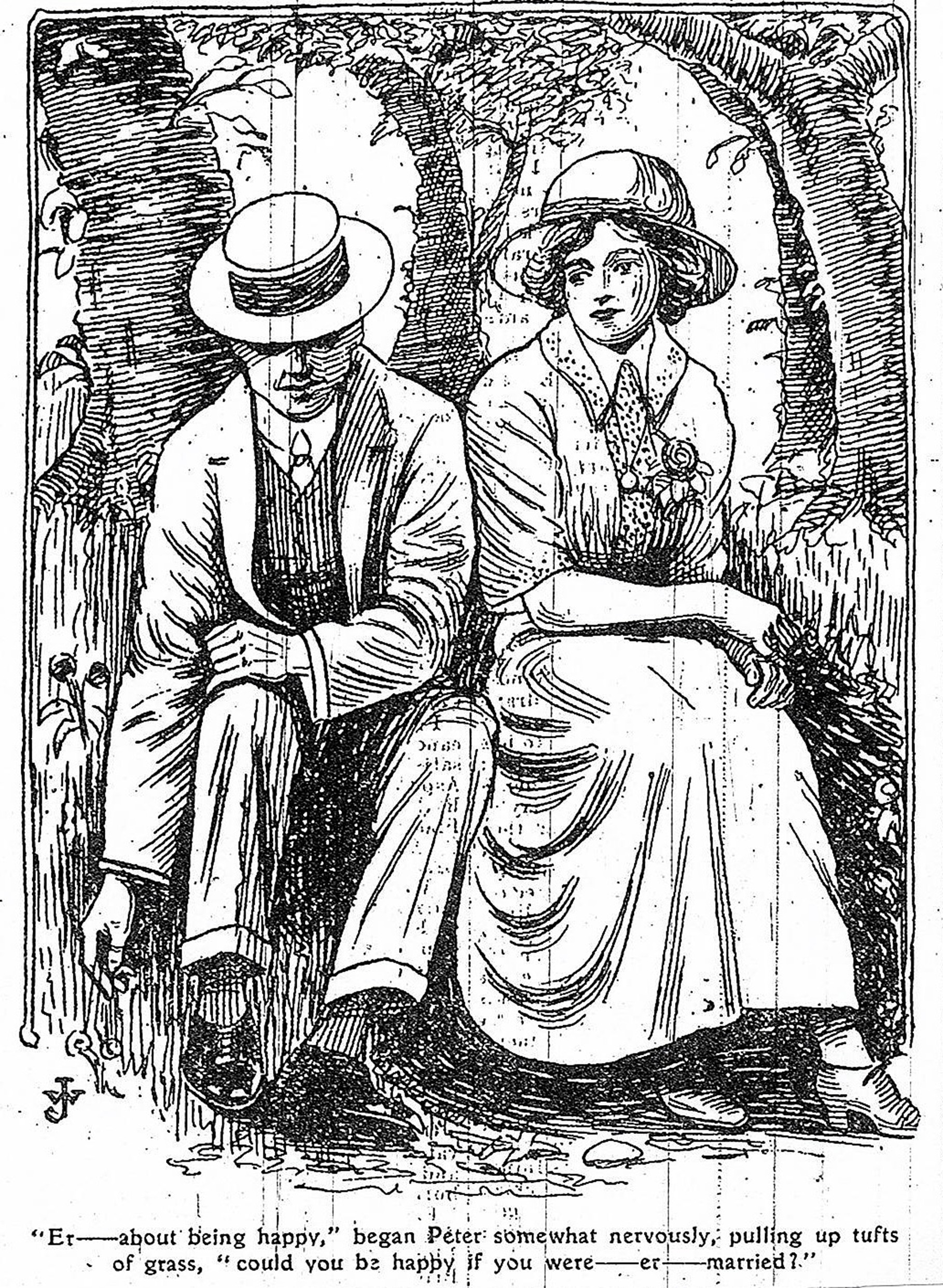
“Er – about being happy,” began Peter somewhat nervously, pulling up tufts of grass. “Could you be happy if you were – er – married?”
“Certainly,” said Clementina very seriously. “If I really loved the man I married, and he really loved me; and if I was sure of standing fair and square on an equal footing with him. No stopping at home, to drudge and bake and darn the stockings for me, while he weekended and enjoyed himself elsewhere.”
“Good heavens! No” Peter cried vehemently.
“Oh! you don’t need to be so horrified,” said Clementina the wise. “I have seen it done – often: But I think it is partly the woman’s fault if she is unhappy. She should have her own interests and look after herself; the best man on earth does not know how to look after her as she needs.”
“Jove! Clem, you seem to have thought a great deal about this.”
“I have, Peter, but it needs thinking about, don’t you think so?”
He agreed, and a silence fell on them; the Peter said,” Clem, it is only fair to tell you that this arrangement is not mere fun to me .”
“Peter!” she cried.
“I know this engagement is not serious of course; but I am.”
“I don’t understand. Explain it to me.”
“Simply this, Clementina,” he said, I’ve loved you all along – ever since the days when I used to come to your house with Rex.”
“I had no idea,” she said quietly, looking back over the pallid past.
“I know. You wouldn’t have known now if I hadn’t told you. You are curiously blind in these things, Clem.”
Another long silence; then she broke it again.
“You’ll tell me if ever you do love me, won’t you?”
“Yes,” said Clementina, with the strangest feeling at her heart, her cheeks aflame. “But don’t talk about it anymore.”
“Certainly not,” said Peter briskly. “Isn’t it a glorious evening? Have you read that book I gave you?”
They talked hard after that, shunning silence, but when they stopped outside the great door of the Pension, and Peter took her hand and said, with infinite tenderness –
“Good-night, chere petite fiancée.”
Clementina suddenly lifted her face and said. [FT11] - “Je t’aime.”
Oh give it me in English, my dearest.”
“I can’t. I’m braver in French.”
The Blackburn Weekly Telegraph, Saturday 30th August 1913
Transcribed and translated by Philip Crompton
Transcribed and translated by Philip Crompton
French Translation
FT01 Entrez done, Miss Cherie, c’est si bien. - Enter, Miss Cherie, it's so good
FT02 Ah! Si joli! Si joli - Ah! So pretty! So pretty
FT 03 Ma petite soeur - My little sister
FT04 Ses cheveux - Her Hair
FT05 Pas mal - Not bad
FT06 Oh! quelle honneur! Yvonne apportez du lait pour mademoiselle! - Oh! What an honour! Yvonne Bring milk for Mademoiselle!
FT07 Ma petit a raison. Elle est tres gentilley cette petit miss. Je vais voir Mdlle La Deatrice demain - My little one is right. This little miss is very nice. I'm going to see the Deatrice tomorrow
FT08 C’est un fort bon parti, je vous assure -He's a very good match, I assure you
FT09 Un Monsieur Anglais-au salon -An English gentleman - in the living room
FT10 Les covenances - The covenants
FT11 Je t’aime - I love you
Bella Vista; sea ft; coq; amus’ts; comf; bedr’ms, pte and pub, did not appeal to us. But Glan-y-mor was different. To begin with, we like the name. “Glan-y-mor,” “Bal-y-veg,” “Tall-y-rand” ; names like that are attractive.
“A roomy farmhouse situated directly on the beach; beautiful country round, combined with delights of sea. One party of visitors only accommodated at one time; 6gs weekly.” We read this, and it sounded inviting – all except the part about the six guineas. However, we sent for particulars. The landlady seemed to be a most superior person, for she wrote: “My visitors have always been drawn from the highest walks of life.” (We said afterwards it was a pity they had ever strayed from their path.) I should like to know that your connections are good. If so, it shall be my highest privilege and delight to minister to your every wish.” We felt that such caution was estimable on the part of the landlady of Glan-y-mor,” and we wrote to assure her as to our connections.
On a day in August we travelled down, smiling in anticipation, to the nook-shotten little village of T___. A sort of char-a-banc – met us at the station.
Some of us said afterwards that they felt rather sick and suspicious when they saw it; but the rest of us squashed them for pretending to clairvoyance. We all know quite well that we mounted that char-a-banc and rolled about in it like a few pills in a box – perfectly happy until we reached the sea shore, where there were two houses. One was big and white and nice, and we did not look at the other.
“Our place looks fine,” said one.
“The Vicarage,” said the driver, pointing to the big white house with his whip.
Then we looked at the other.
Listen! It was like one of those houses you draw when you’re little – before you get to putting in a second storey. It was small and low and red, with a grey roof squashing out all the light from the two ground floor windows. It was like this:
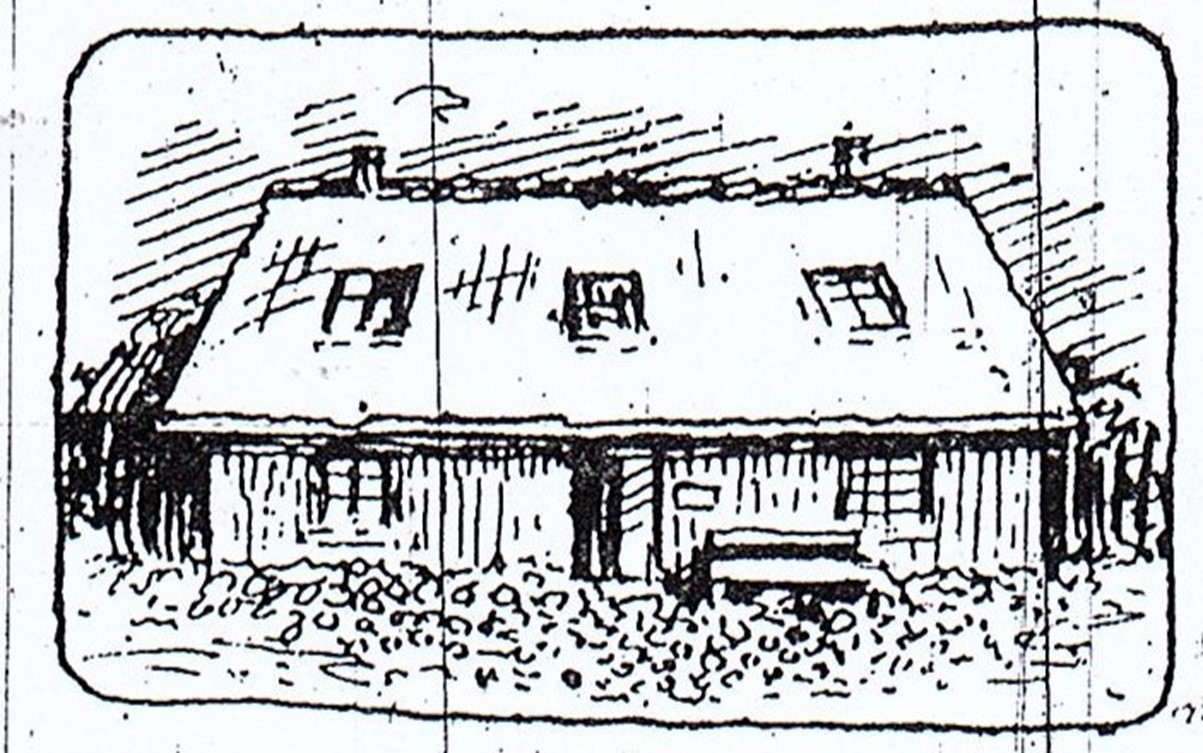 -But worse; and it was labelled “teas,” or we should have taken it for a cow-shed. There it was, plumped down right among the pedals, without any garden or railing. The only timber in sight was a green bench with “Glan-y-mor” painted brightly on it.
I am not going to describe our emotions. Some cried; some laughed horrid laughter; the more self-controlled of us walked round the place in silent horror until we were lured in by the smiling landlady.
We have no idea how we conducted ourselves during the welcoming. We think now that we that we stared dully and muttered, “Six guineas! Six guineas! Every week for a month.” But, going upstairs, we all bumped our heads, and that seemed to bring us to our senses. We all stood – as far as the roof would let us – in the first room we came to and groaned unanimously.
It happened that a little wind blew just then – the fifty odd papers on the walls bulged out like filled sails, and plaster rattled down behind like the scurrying of a thousand rats.
“What will it be in a storm?” we moaned and fell to punching the bulges to relieve our feelings, until we heard the landlady coming.
We were all afraid of that landlady as soon as she smiled; we felt different, then, from the rest of mankind, especially those who trod the highest walks of life.
After a while, we found enough courage to complain about the “TEAS” placard. But our mild ventures were met at the outset by such indignation at the “very idea of depriving a decayed gentlewoman of her means of subsistence” that we apologized abjectly, and slunk depressed to bed – feather bed!. There we stifled – flapped in on every side by restless wallpapers; the moon in our eyes; for the skylights boasted no blinds.
We rose dispirited at dawn, and dipped in the sea – where the stones would let us. Coming back, we saw three of us head and shoulders out of the three several skylights, completing their toilet. This happened every morning.
The landlady had hung the fireplaces over with plush, so on wet days – and they were many – we were obliged to huddle round an evil-smelling oilstove, with nothing to do but stare at the pressed seaweed in frames, and two black pot dogs eternally grinning on wool mats.
On fine days large parties of roysterers came in the char-a-banc for teas. They laughed and talked and played at rounders before our windows – filled our sea with orange-peel and paper-bags.
Before we had been there two days we were told that we had devoured forty eggs. The cheekiest of us demanded an outward and visible sign of eggs in the future; but the landlady smiled and we crumpled up altogether, and at once.
The thought of it makes me too dejected to continue, it is enough to say that we went back home after paying twenty-four guineas for a week.
How that landlady smiled!
Just remember this, though, “One may smile and smile, and still be a villain.” Shakespeare knew that, and so do we. And for heaven’s sake, or, rather, your own, go and look before you leap
into a place like “Glan-y-mor.”
into a place like “Glan-y-mor.”
The Blackburn Weekly Telegraph, 27th September 1913
Transcribed by Philip Crompton
1914
The Private Secretary
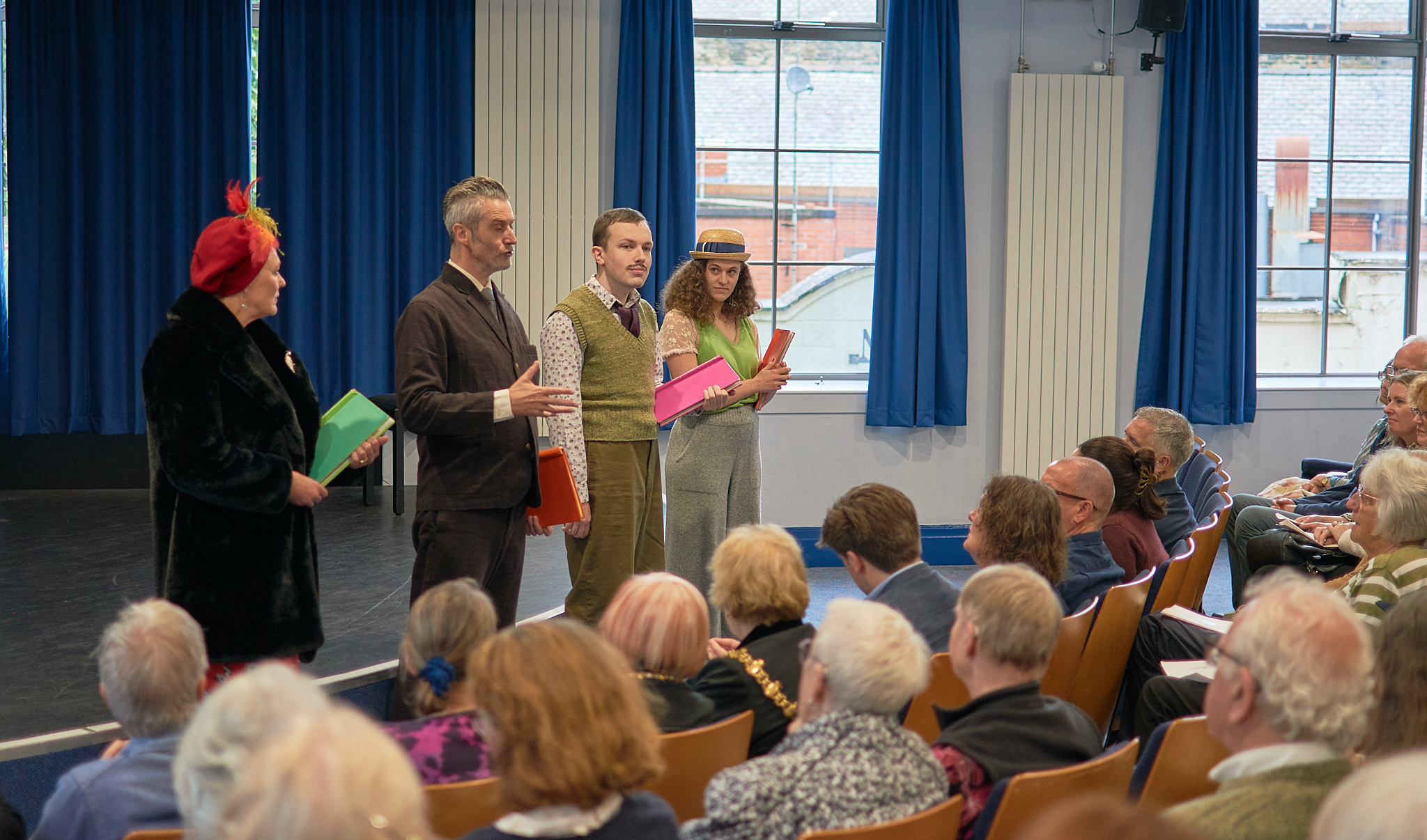
Beggars Belief Collective delivering a rehearsed reading of The Private Secretary at Blackburn Central Library, Saturday 7th June, 2025, (c) Suzana Matoh
“Wanted, a private secretary, by a lady of artistic temperament. Apply, personally, at Carlton, etc.”
“Carlton” proved to be a red brick villa, with Tudor additions, where Noel Ware was admitted for consideration. She was ushered into a room where the above-mentioned artistic temperament was but too painfully obvious. There was an extraordinary number of “petits objects,” as the French would vaguely and aptly call them; “petits objects” in wood – tables, stands, desks, bookcases, racks – those not scorched hideously in the process known as “poker work,” were carved into knobs and twists, or riddled by fretwork. More “petit objects” in plush, satin, muslin, daubed with paint inches thick; more “petit objects” again on the walls, that might be pictures, in which the signature only was distinguishable. And all were the handiwork of the incredibly fat little person who now paused on the threshold; she paused, silent, to allow for the effects of her entrance. It was well she did. Noel needed time to comprehend the grandeur of the crimson plush robe, decorated down the front with lumps of turquoise; the further lumps swinging on long chains, like clock pendulums, from the ears; the huge hat over which a fountain of ostrich feathers played.
“Sit down,” said the lady of artistic temperament, advancing.
“Are you competent to fill this post, or are you not?”
“Perhaps if you told me something about it I should be able to answer you,” said Noel. She felt nothing but amusement at having slighted on what promised to be such a ludicrous character. Moreover, this was to be her first step towards independence, and she determined that it should not be her fault if she was unsuccessful in her application.
It was in this frame of mind, then, that she answered several insolent questions; and finally gained her end. Before night she was installed at Carlton.
“You must come here to-day” Mrs. Merritt her employers had said. “I wish you to write a letter to order them to put in “Carlton Towers” on the gates, instead of Carlton. I want it doing in gold, too.”
Noel had promised herself amusement, but there was a good deal of unlooked for unpleasantness in store. It began that very evening.
When on her way to the dining room she heard a voice drawl:
“but I say, mater, is she going to dine with us; by Jove, why should she, I ask you? It’s dammed bad form, I swear it is. What if we had some people dining with us? It would be dammed awkward. I swear it would. What’s a private secretary; By Jove, she’s paid for it.”
At this juncture Noel came into the room, with a high colour and a curled lip, to find in the speaker a thin young man, with colourless hair and a face to match, “like a weed grown in the cellar” she mentally decided.
On the introduction he exclaimed: By Jove, you’re just like Popsi Toots, who was at the Hip last week. I swear you are.” And this seemed to reconcile him to her dining with him.
She turned from him, in disgust, to the master of the house, who was much too nervous to say anything but “This soup is very good, Maria.” “Maria this fish is very good,” and so on throughout the meal.
His wife, whom Noel had already christened the “Dilettante,” was too absorbed with herself to take any notice of anyone else. She gazed continually at her own pictures, screwing up her eyes to observe them in ball lights, and even going so far as to test the perspective with a fork or anything that came to hand.
The son and heir, whose name was Marmaduke, babbled aimlessly, so that Noel had plenty of time to think.
“I have noticed,” she said to herself, “that when the wife is a crank, the husband is always meek. Now does that prove that if the woman asserts herself, the man gives in.”
She was a serious young person, and had “theories.” People were surprised. She was so pretty.
“That son is just the sort of man I detest,” she went on thinking. “He thinks he is a rake; he has made himself one on principle. What a drab, unwholesome thing he is, I don’t think he ever has a real wash. I should say he “dry cleans.” None of them have the slightest idea of manners, and they think I am “some sort of underservant.”
But she smiled at the notion: so brilliantly, indeed, that Marmaduke was moved to remark again on her likeness to “Popsie.”
Noel felt anything but pleased by this resemblance, since it made him hang about, when, after dinner, the Dilettante, seated in a chair like a throne, dictated a letter to her new secretary. He contradicted, and interrupted, and insisted in looking over her shoulder, as she wrote. He proved to be more annoying still as time went on. He took to lolling about in the gaudy room where Noel worked.
“Works a bore. I swear it is,” he said one day.
“And how do you know that,” asked Noel.
“I work, by Jove, I do. Did you think I didn’t? he said.
“I have not seen any evidences of it since I came,” she explained.
“By Jove, that’s just like these new fangled girls you find all over the place now. They take their bit of typewriting so seriously. Of course they couldn’t do what we do.”
“Oh,” remarked Noel with a dangerous blush. “And what do you do?”
“Oh! I’m in cotton.”
“Cotton-wool?” she flashed.
“oh, no. Cotton isn’t the same as cotton-wool,” he explained for the benefit of feminine ignorance. It is different – for one thing, it’s a deuced slight harder. I swear it is. Every one’s in cotton nowadays, he continued, stoking his upper lip, and assuming an expression of insufferable conceit. “That is, everyone worth knowing. There’s a rush. I swear there is.”
“Yes,” said Noel. “Everyone without brains and without breeding is put into cotton nowadays. As if this generation of silly young things can carry on the best industry in the world – and one that has needed men of grit and character to build it up and keep it on.”
“By Jove, you speak so quickly I can’t hear what you say. But you do look jolly ripping when you go red like that! You’re prettier than Popsie. I swear you are. But she’s more agreeable. You don’t need to be so distant with a chap. What do you say to doing a theatre, tonight?”
Noel indignantly refused.
“This is the price one has to pay for independence,” she said, as she escaped him. “It is surprising how few men can leave a girl alone.”
“Lor! By Jove,” said Marmaduke gallantly.
“You jolly well know you don’t want to be left alone,” which is a fatuous remark often heard.
He was not to be repressed by her evident annoyance, and not long afterwards seized the opportunity to renew the tete-a-tete, while the Dilettante was walking in the garden with her monkey.
“by Jove,” he began as usual, “you do look ripping. You’re the rippingest girl I ever saw. I swear you are. And, I say, I’d better be quick before the mater comes back, I’ve taken an awful fancy to you – enough to marry you. I swear I have. I don’t mind a hang about you having to earn your own living. I did at first.” This is a burst of confidence. “But Jones has gone and married a schoolmistress, and a private secretary is ever so much better. Sounds it anyway. Oh! I say, I do want to marry you. I swear I do.”
Noel listened in the greatest amazement to this generous outburst. She stood up and faced him with flaming cheeks.
“You mean to say you are asking me to marry you?” she asked, a little breathlessly.
“I swear I am,” said he, delighted that she should realise to the full his condescension. He came hatefully near.
“Stand back! How dare you touch me,” she cried.
“By Jove, why not, I ask you. You’re surely not going to refuse me. By Jove, you can’t expect such a chance again.”
“I hope I shall never be insulted again by such a “chance,” as you call it,” she cried.
“Do you mean to say you won’t have me ,” he cried, his drab face flushing and his lip quivering with rage.
“Naturally,” said Noel.
“Naturally! There’s nothing natural in it! By Jove, I jolly well wish I’d not asked you. A gentleman born and bred asks a girl who works for her living to marry him and she say’s it is an insult. I wish I had not lowered myself to ask you. I swear I do. I’ll jolly well tell the mater about this, and you’ll see what she has to say.”
Noel’s angry retort was checked by the entrance of the Dilettante.
“What’s this? What’s this? She asked.
“I’ve been asking her to marry me, mater” put in Marmaduke, and she’d abusing me like mad for it.”
The apoplectic hue of the Dilettante’s complexion deepened perceptibly; her rage choked her; after several attempts she to speak she burst out.
“You shall never marry my son; You shall never marry my son; You shall never marry my son,” and would have said it many more times had Noel not interrupted.
“I should think not indeed.”
“What,” cried the Dilettante. “You have refused him! How dare you refuse him. How dare you. I have seen the attempts you have made on my son ever since you came into my house. Now, you can go. Leave my house.”
“Silence Maria,” cried another voice. Mr. Merritt stood in the room. He was transformed, his face, hitherto so weakly, was stern.
“Miss Ware, I apologise for the unpardonable behavior of my wife and son. I am sincerely sorry that you should have received such treatment in my house.”
“But John – “cried his wife.
“Be quiet, Maria,” he commanded sternly, and she obeyed.