
 Loading more
Page 7
Among the hundred passengers alighting from the high train on its arrival at the Gare de Nord there are half a dozen or so that venture to claim your attention for a very short time.
That gentleman, then, in clerical dress – with the battered Baedeker under his arm stammering out scholarly but unintelligible French to an impatient porter – is the Rev. H. Bairstow, who has unwillingly taken upon himself the task of conducting round Paris a select little party, drawn mainly from his own parish. The tall man looking on with an amused smile is Standing, the vicar’s friend. Mrs. Perkins and th’ mester are here, through the agency of the Rev. Bairstow’s brother, the village pastor. The young lady already jotting down notes in a reporters flapbook is, we may suppose, a journalist; so, too, is the faded, pince-nezed person by her jotting too, but less vigorously. Last, but not least – at any rate, not in his own estimation – is Newton, a downy youth, displaying to the best advantage his striped silk socks as he walks up and down in a small space, posing before the bloused porters and the mocking customs officers.
Now, after these introductions, give the poor things leave to go to their hotel. They are quite tired out by the long land journey in the jolting, rumbling, rickety train. Later in the evening Mrs. Perkins left th’ mester totting up the expenses in their room, and went to “recounter” the place, as she said. The hotel, not a large one, was situated in a quiet, unpretentious street branching off from one of the most important squares of Paris. It was well managed by a certain Madame Picquet and was almost exclusively patronized by English people.
Mrs. Perkins wandered into the empty dining room, and, finding the tables laid indulged in a favourite foible of hers, namely, a minute examination of the silver and glassware. The proprietress herself entered while Mrs. Perkins was critically pinching the tablecloth between her finger and thumb.
“Ah! Bon soir madame,” said Madame Picuet, suavely.
“E-eh now,” ejaculated Mrs. Perkins, surveying the profusely powdered little person. “Whatever can th’ woman be talking about?”
”Ah!” said Madame with a smile. “Good evening, madame!”
“Good evening to you,” said Mrs. Perkins, much relieved and shaking her by the hand. I’m right down glad to ‘ear you talk sense. Now, can you tell me where I can get a bite o’ somethin? to eat. I’m feeling right down peckish!”
“Mon Dieu”! Madame is feeling peekish! I go to find the docteur,” cried Madame, backing towards the door.
“No, no, no, not at all,” said the other, “you’ve misunderstood me. I’m peckish. I want somethin’ to eat. I’m hungry.”
She spoke very loudly and very softly, as if Madame was deaf.
“Aw, Aw,” said Madame, relived in her turn. “Madame is hungry. I understand. I understand. Peekish, peekish. It is a word to learn. Dinner is served in ten minutes, if Madame will mount again. The bell will sound when dinner is served.”
“Alright,” said Mrs. Perkins, “but I thought I could be goin’ on wi’ a bit o’ somethin’ like.”
Madame smiled, but did not understand.
“Come with me to the lounge,” said Standing, who had just come up, “and we’ll try and pacify the raging beast for a little.”
“E-eh! nay now,” remonstrated Mrs. Perkins, going with him; “you mustn’t say that, although she has got a good coat o’ whitewash on her face, and it seems hardly worth it. “You’ve no call to say that.”
“I meant that peckish feeling was as a raging beast,” explained Standing, as he took her to join the others.
The ten minutes before dinner passed slowly. The tourists were as quiet and uncomfortable as children at a party before tea.
At dinner, too, Standing noticed that an air of gentle frigidity pervaded the place. The other visitors, mostly traveling separately, ate in stony silence or discussed their pet theories in undertones with their neighbour.
Mrs. Perkins was too busy satisfying the peckish feeling to talk, or it might have been a little more animated.
Standing watched them all with his amused smile, and occasionally thought he saw an answering flicker at the corner of Hazel Crawfords lips. She had dimples! Dimples and journalism did not often go hand in hand, he reflected.
“I’ll startle them out of this freezing demeanor,” thought Standing – then said suddenly, in his deep voice.
“I’m going to the Moulin Rouge tonight,” is anybody coming?
A thrill of horror ran round the table. How dared anyone mention that place in respectable hearing? The Moulin Rouge! They turned horror surprised eyes at him.
“Standing, my dear boy,” expostulated the vicar, roused out of his abstraction by the mention of the dreadful place.
“What’ the harm?” Inquired Standing genially. “You don’t mean to say that you will go from Paris without visiting the Moulin. Why, it’s the best place for ‘copy’ in the city.”
Hazel Crawford flushed, and then said quickly, “I’ll come.”
Again a shiver of horror. Standing himself looked surprised. There was a terrible pause, during which poor Hazel was the butt of every genteel but glaring eye. Then Standing recovered himself, and passed it by as a joke.
The dinner ended in undisturbed gentility. Standing tried to avoid Hazel Crawford. “She’s quite serious he thought.” “I can’t understand it.”
But as he was going upstairs Hazel overtook him.
“Will you really take Passet and me to the Moulin Rouge?” She asked eagerly. “I must see some of the ‘café’ life while I’m here. I’m on the lookout for ‘copy’ you know.”
“Excuse me,” he said gently, “but I could not take you there. I don’t think you would want to go if you knew what the place is like. “I don’t think you ought to go.”
The girl drew back.
“Who are you to dictate to me,” she asked proudly. “Is Paris labelled – ‘Men only’ too”?
“You are unreasonable,” he said annoyed.
“You do not know Paris, and you ask me to take you to its worst den. Let me take you to the Café Riche instead.”
“No, I won’t”, thank you, of course.”
She turned and ran downstairs. He watched her go.
“She’s very young” he thought, “or she wouldn’t be so rude! What a queer child. Very keen about her work evidently. I’ll go and ask Bairstow if he knows anything about her.”
But Bairstow, absorbed in his Baedeker, could tell him nothing.
“I only know Miss Passet, and that but slightly. I know that they are wielders of the mighty pen; but of course, not in the same degree of ___”
“Sh! keep that quiet, Bairstow,” interrupted Standing. “I am here to help you – not a word of anything else. Think we are going to have some fun with the old woman, Mrs. Perkins, I mean.”
“Helas,” sighed the Rev. Bairstow. “The less the better, a mon avis! Now, come and help me plan out tomorrow.”
So they planned and talked until warned by hundreds of chimes that it was midnight.
Standing flung open the window and shutters then turned out the light. He stood listening to the deep-toned voices of the church clocks, threaded through by the silvery charms of the smaller ones.
At the end of the street he caught a glimpse of the mad, gay whirl of the Parisian world at midnight. Motors, cabs, carriages, taxis were moving swiftly among the throngs of pedestrians; the cries of the drivers and the warning note of the motor sirens mingling with the laughter and buzz of conversation. The little tables outside the cafes were crowded with merry, noisy bock drinkers. The radiance of brilliant Paris was reflected by a sullen glow in the sky – as if the heavens were angered by the beauty of an earthly rival.
So thought Standing; when a window was opened somewhere below his. He leant forward, and in the flood of light which poured out of the aperture he saw Hazel Crawford, and he heard the dreary voice of Miss Passet say;
“Turn the light out Hazel, do, if you don’t want all Paris to see into the room.”
The girl turned the light out. He knew that she came back to the window, for he saw the gleam of her white dress, in the light radiated from the square.
“Do go to bed, Hazel,” said the voice again.
“Listen Passet,” said the girl with determination. “I’ve got to make a good thing out of this visit,” I’ve got to see everything, and take it all in. And then I’ve got to write it down and get some money for it to help that brother of mine pay his debt, and it’s going to be hard work, Passet, because I don’t feel inspired.”
Standing hurriedly left the window, feeling like an eavesdropper.
He thought a good deal that night about the young disturber of his midnight meditation on the queen of cities. Next morning, at breakfast, the Rev. Bairstow proposed that they should visit the Louvre.
“Is that royalty, like” inquired Mrs. Perkins, biting the end of half a yard of bread and thereby trying the onlookers’ gravity to the utmost.
The Rev. Bairstow proceeded to explain in his kindly, if somewhat, pedantic, sort of way, and Mrs. Perkins, though disappointed, fell in with the general assent.
So away they went; the Rev. Bairstow, with the everlasting Baedeker under his arm, leading them through the pleasantest ways of Paris, along the broad, tree-shaded streets, into the delicious freshness of the Tuileries, to the vast palace itself.
Standing walked by Mrs. Perkins to save his already over-worried friend from the volley of questions with which he was sure to be assailed.
“And did you take the young lady to the ‘Moolang Roodge’?” she asked, after a time.
“Oh, that was merely a joke,” said Standing – while a slight flush rose to Hazel’s cheek.
“For shame!” said Mrs. Perkins. “You’d better go now and tell her what these ‘ere figgers are doin’ in a great place like this wi’out any hands or arms or any ‘ole limbs at all, for that matter. Somebody’s been careless i’ dusting them’ or somthin’.’
Standing turned to Hazel.
“If you will come Miss. Crawford,” he said, “I will take you to see the Chaucard Collection – there are some little jewels of Meissonier’s. I think you will like them.”
“Thank you; I prefer to stay here,” she said coldly, and as soon as she had spoken felt angry with herself.
Each turned away from the other. He saw her annoyed expression, and thought his proposal was the cause of it. He avoided her, until compelled to approach her by an amusing incident later in the day. The Rev. Bairstow arrived from his wanderings at the Peter Paul Rubens room. His little flock followed him, and he had begun to drone from Baedeker, when he was interrupted by a violent snort from Mrs. Perkins. That lady had cast a glance around the room, and then shut her eyes tightly.
“Get out of here!”, she cried, brandishing her umbrella. “Mr. Baistow, do you call yourself a Christian, bringin’ us to look at these ‘ere pictures. Get out, all of you!”
“But my good woman,” stammered the astonished man.
“Good woman, indeed!,” she cried; “I shouldn’t be a good woman if I stopped to look at these ‘ere. Get out!,” and she hustled the little party up the steps.
“But Mrs. Perkins, my dear lady, this is the great queen Marie de Medicis,” he expostulated, as she pushed him out.
“Meditchy she may be; but when I want to see exhibitions of muscles and fat women I’ll go to t’ fair shows at ’ome, Mr. Bairstow, and not come ere to see em.” She ended indignantly.
“Quite right, too, Mrs. Perkins,” laughed Standing, against whom Hazel had been unmercifully bustled.
The bystanders were highly amused, so much so that the nervous vicar suggested they should go back to their hotel. Fate seemed to have appointed Mrs. Perkins to be the thorn in this poor man’s side. The next day they drove to the Hotel Les Invalides to see tomb of Napoleon. In the general awe which fell upon the party on entering the magnificent dome no one noticed that Mrs. Perkins had not conformed to the order that all umbrellas must be left at the door. She hid hers under her cloak, and marched straight round the aperture in the middle. Hazel and Standing were the only two who really appreciated the solemn majesty of the great Emperor’s resting-place. The light streaming through the gold windows at each side of the altar seemed to make a perpetual sunshine in the place.
“The sun will never go down on his glory,” said Hazel, half aloud, in her enthusiasm, so that Standing heard her.
He shot her a sympathising glance, but she moved away into the colder blue light of the side tombs of the brothers. Standing’s eyes followed her, until she was roused by the sound of Mrs. Perkins voice, sounding strangely loud and out of place in the silent dome. She was leaning over the balustrade, pointing out something with her umbrella which had attracted her attention. Suddenly the umbrella fell from her hand and crashed onto the crypt floor below. The dome was suddenly filled with bustle and noise. Officials came running forward. Mrs. Perkins was loudly bewailing the loss of her umbrella, and everybody was asking questions. Mrs. Perkins was besieged on all sides, and was quite overcome by the unintelligible flow of language. The poor, trembling vicar did his little best to smooth matters over, and th’ mester unwillingly tipped the raging officials. Finally the umbrella was recovered, and the party left the building covered with confusion.
No one was sorry when she announced her intention of staying at the hotel next time with Madame Picquet, with whom, strange to say, she had become very friendly. Standing noticed on all the sightseeing excursions that Hazel was feverishly noting everything down. At lunch in the café’s, she hardly touched food, but looked round eagerly all the time. He wanted to help her in the task she had undertaken and with his experience of Paris and her moods he could have done so. He was interested in her, but resented what she chose to term his imagined masculine superiority and interfering manner, and therefore met all his advances towards friendship coldly.
He always managed to be near her, however, when they were sightseeing, to watch the effect on her of the dim, rich glory, of Notre Dame, the grace and beauty of the Luxemburg marbles, the memories of the concierge, and of the many wonders to be seen in Paris. She had made friends with two little children from the flower shop opposite the hotel. Standing used to watch the three from his window as they walked up and down before breakfast. When she was with them the anxiety left her face and she was as gay as her lively companions. Standing had made friends with them, too, but only went to them when Hazel was absent.
As the days flew by Standing amused himself by watching the gradual influence of the city on the party. The vicar’s conversation was freely interspersed with French words; so much so indeed, that it was quite unintelligible to everyone but himself. Mrs. Perkins, too had learned a few words and repeated them, parrot-like, on all occasions. It upset Standing’s gravity to hear her inquire in the shops “Combiong!”
Th’ Mester had taken to drinking bocks and white wine. Even Miss. Passet had adopted a fringe then much in vogue, long-toed boots, and a shrug. Young Newton wore a low collar and a great black bow a la Latin Quarter.
Hazel alone remained unchanged, indeed the tense anxiety in her face deepened every day. She no longer avoided Standing, she ignored him, wrapped up in her own work as she was.On the day before that fixed for the departure she did not appear at all. Standing haunted the hotel all day. At night he took up his favourite post at the hotel door. He watched the children at the flower shop over the way as they helped their mother to arrange lilies of the valley – Hazel’s favourite flower, so the children said.
“I’ll go and get some for her,” he said, impulsively. He crossed to the shop. The children were delighted to see their “bien bon Monsieur. But he escaped with promises for the morrow.
As chance would have it, as he was re-entering the hotel with the flowers Hazel came down the stairs.
She was very pale, and had a long envelope in her hand.
“Miss. Crawford,” said Standing, going forward, “let me take your letter to the post box for you. You look tired.”
She gave the letter to him without a word. The address was distinct-
“The Editor of the P___ S___.”
He gave a cry of surprise.
“This letter is addressed to me!”
“To you she cried, in amazement. “Are you the editor of the P___ S ___?”
“I am.”
She was silent for a moment, then cried.
“Oh! You will give me a chance, will you not? I have tried to good work, and it means so much to me.”
“I know,” he said very gently.” “I know. Come out and let us talk, as we should have done long ago. See! There is a taxi-cab. Then you won’t be tired.”
He drew her unresisting hand through his arm, and they went out together.
The next day they went back to England and, as Mrs. Perkins said “the tour ended very satisfactorily for all parties.”
The Blackburn Weekly Telegraph, 25th May 1912
Transcribed by Philip Crompton
Transcribed by Philip Crompton
“Oh, Mr D----,” she exclaimed, clapping her hands together and jumping up from her seat, “have you really brought my photographs?” how good of you!”
“I made a point of bringing it round myself, Miss R----,” he said, with a bow, “because I flatter myself I have made an exceedingly good think of it. An exceptionally good photograph – I consider it!” and he whisked the wrappings off, flicked up the tissue-paper cover and held the photograph out at arms’ length.
The young lady approached as if fascinated, stared upon it long and hard; and then said, putting her hand to her throat as if the words hurt it:
“Is that me?”
The man was utterly taken aback – he looked at her with blank amazement.
“You,” he said; “is that you?” You ask if that is you?”
“Yes,” she whispered, again ungrammatically – her hand still at her throat, “Is that me?”
“Miss R---,” remonstrated the man, “I do not understand you. Why, this photograph is so like that one could fancy it lives, moves, breathes – in fact, anything.”
“Am I like that?” she asked, still in the same tone.
“Like that! Of course you are,” cried the exasperated, disappointed man.
“Sit down, Mr D----,” she said, quietly, desperately. I’ll go for mother.”
The mother came – a stout, sensible person greeted Mr D----, and took up the photograph.
“My dear child! What an excellent likeness!”
“Mother!” cried the girl, “do you think so, too! Oh, am I like that?”
“Whatever is the matter with you, Alice? This is exactly like you.”
“Like me! Oh, like me!” groaned the girl. “That heavy, serious, that worthy face like mine.”
“It is exactly like you when you are serious.”
“A most remarkably good photograph,” urged the photographer, somewhat pacified by the mother’s approval. “May I venture to remind Miss R---- that she is not one of those frivolous, flippant, young ladies who fire their arch glances through a mist of tendrilous curls, looking – pardon me – more often than not like dissipated Skye terriers.”
(Had he been dealing with one of these fluffy young ladies, who may, though improbable, have been struck with the emptiness of her expression, he would have ventured to remind her that she was not of the heavy-eyed, flat haired, blue stocking type.)
Not at all soothed, the young lady in question walked up and down in great agitation.
“Mother, I ask you for a candid, a perfectly honest, answer. Am I like that?”
“You are,” flatly.
The girl stopped before the photograph.
“Worthy person,” she said to it. “Worthy, philosophizing, solid person, did you really think you could be pretty or animated for one single second. That was a wildness no one would suspect of you.” Her reflections were interrupted by the arrival of a friend.
“Eve,” said Alice, without further greeting.
“Come here, and, as a friend – now, as a friend, tell me, is that photograph like me?”
“Like you, darling? Why, of course it’s like you. I could almost imagine I see my sweet Alice breathe there!”
“Just what I said, just my words over again!” muttered the photographer, who was getting tired.
“My dearest, you do look clever – quite a genius, I declare. But, then, you always did want to look like that, didn’t you, darling?”
“I’ve succeeded this time,” said Alice bitterly.
The wearied photographer began to ask if he should not, then, proceed any further with them, when all were startled by a laugh from Alice.
“That dull eye,” she screamed, “stares like a dead codfish!”
“It’s a beautiful eye,” cried the photographer indignantly. “I’ve put my best work into that eye.”
“I don’t need to wait till I die to see myself as others see me,” sobbed the girl. “I’ve had a glimpse, and it’s almost unhinged my mind. I’ll live up to that photograph, I will. I’ll have it solemnly and fittingly framed in black, and I’ll have one in every room, and if ever I feel inclined to think I ever was nice looking, or ever has a spark of animation in that eye, I’ll go and look at it and know how wild such hallucinations have been.”
“Alice! Alice! You are behaving ridiculously,” expostulated the mother, while the friend giggled to the photographer.
“Fancy taking an eye like that to a ball,” cried the girl, laughing and sobbing. “Oh! Mr D----, why didn’t you give me the revelation before? To think I have been going about with an eye like this and never to have known it! Oh!”
This last sob was interrupted by the entrance of the fiancé, who seemed much startled on viewing the scene.
“Oh! Percy,” cried the girl, rushing to him and dragging him, bewildered, to the photograph. “Here’s my photograph, and they all say it is like me. I can’t ever marry you, Percy, if it is. I wouldn’t afflict you with an eye like that for anything. I’ll go to college and wear glasses to cover it up. Qh! Percy.”
The astonished young man supported her with his arm, looked at the portrait, and then said with real sincerity, A scandalous libel! An infamous caricature! Take it away and burn it.”
“Then it is not like me?” she asked.
“Like you!”
The others withdrew, and the photographer – enraged, disappointed, bewildered, and confounded by the amazing conceit of mankind – was obliged to wait until the young lady should eel inclined to sit for her portrait again.
He was, had he known it, in heartwhole sympathy with Bacon, when he says there is no flatterer like a man’s self, and “never a proud man thought so absurdly well of himself as the lover doth of the person loved.”
The Blackburn Weekly Telegraph, Saturday 17th August 1912
Transcribed by Philip Crompton
Transcribed by Philip Crompton
I was in Sussex, and as I stood at Harley’s gate for the first time late this spring, I mentally compared his quaint little house standing in its luxuriant garden with my bare, grey cottage and its adjoining plot of unrelieved black earth; I compared the well wooded downs, which rolled on every side, with my scarred northern hills. On the whole my cottage, and its surroundings lost nothing by the comparison; but on one point I was resolved: I must have a garden.
Harley was himself an enthusiast and as I watched him walking contentedly up and down his flagged paths, or working among the roses, the velvet snap-dragons and the deep purple Canterbury bells, the gardening fever, whose first symptoms I had felt on the day of my arrival, rose to such a height that I was all-impatience to get away and start a garden of my own.
I must inform you that I have no experience of gardening. I knew no botany, though I had feint recollections of experimenting with peas and beans in flannel and sawdust in my school days, but I could not remember that they ever reached any other than a greatly swollen, highly odoriferous stage. I managed, however, to obtain some advice from Harley without exposing my ignorance too much. He gave me a list of good rose-trees, which I was to buy at a certain store in London; so there I went as soon as I could decently leave him.
I was strongly suspicious that the man was trying to cheat me when he handed me a parcel of dried sticks, which he had selected from others, on my giving him the list.
I paid an exorbitant price for these sticks, but refrained from haggling because I feared to disclose how little I knew about rose-trees.
During the journey I turned them over and over, vainly wondering which end up to plant them. Suddenly a sentence from a school-book flashed across my brain, then left me in the dark again. All I could gather from this sudden visitant was: “Two parts to a plant …. Roots tough and brown, grow down into ground …. Stem and leaves-tender and green-above ground…”
I examined my sticks carefully. There was certainly no sign of tender green stem or leaves, so I came to the conclusion that the outgrowths were roots.
This problem solved, I spent the rest of the time conjuring up glorious visions of my garden to be.
I stopped at the town nearest the village and further provided myself with all the roots and seeds the shopman could palm off on me.
Half an hour later I was beginning the three-mile climb to my lonely little cottage.
It was too dark to begin work that night, so I was obliged to content myself with poring in bewilderment over my purchases. I spent the night in restless impatience and was up at day-dawn to put in a good two-hour’s work before breakfast and train time.
First I dug pits in the earth, planted my rose trees with the outgrowths downward, covered them with earth and placed sticks, with labels attached, to mark their burial places.
Next I arranged my cuttings in clumps here and there about the garden; several of the stems were broken, but I had time to put them in splints before breakfast.
Then I scattered seed broadcast and went in well satisfied with my mornings’ work.
“My garden,” said I to myself, as I ran to the village station, “shall be one of the real old-fashioned sort - all picturesque confusion. It will be a continuous source of surprise, too, because I have no idea what anything is.”
I was as impatient all day as I had been all night, I bought a gardening magazine. It was all Greek to me, but I hoped to be able to understand it by and by. I hurried up the rough hill road that evening, and fairly ran to my garden. I really think I expected to see something in flower. Damping disappointment fell upon me as I opened the gate.
The cutting I had carefully and hopefully planted that morning now lay in a state of limp exhaustion on the ground. I raised their little heads tenderly, but they were flabby, and fell back.
“They’re dead,” I said, with indescribable mournfulness. And I sat down on the cobbles and looked at them. A cold little breeze sprang up from the hills and, lifted their limp, loose leaves. It was too much for me. I got up and went into tea.
“Poor, poor little things!” I said with a backward look and a shudder at the site of the murdered cuttings, the rows of bare black sticks, the white labels flapping in the wind, and the bleak, accusing hills all round.
I shut the door, drew the curtains close, lit the lamp, and pulled my table to the roaring fire.
I spent the evening there with my gardening magazine from which I learned that I was to look out for an off shoot from my rose trees. It would come up a foot or so from the main plant, so it seemed, and was to be promptly amputated.
I made a note of this, and went to bed.
I rose at dawn again, and tenderly removed the dead cuttings. I made a mournful little bonfire with them and as the last pale wreath of smoke vanished into the clear morning air I suddenly realised the cause of their death. I had omitted to turn the garden over! Harley, I had noticed, was continually digging and raking his. How stupid of me to have forgotten it!
I hurried for the spade, and spent a good hour digging, taking care to avoid the rose trees.
I went to town in a cheerful frame of mind, meaning to get some more cuttings and begin afresh.
During the day, as I was walking down the main street, an advertisement concerning seeds caught my eye.
“Seeds! Why! I had some seeds.” I stopped still and clapped my hand to my head. “Where are my seeds? I’ve covered them up.” I shouted aloud. “Buried em’ yards deep!”
I set off wildly at a run. I had some vague idea of going straight back and digging them up again.
Suddenly I was stopped in my mad career.
“Nicols, my dear fellow, is there anything the matter?”
“Matter?” I shouted, trying to extricate myself from the butler’s grasp. “I’ve turned the garden over on the seeds?”
He looked at me in blank surprise, then set up a bellow of laughter.
“Let go!” I cried angrily, though forbearing to struggle for fear of attracting the further notice of the passers-by.
“No, I shan’t!” said Butler, still laughing. “Who on earth you would have thought you’d be the next victim of this gardening craze! Come to lunch like a reasonable human being! What’s done can’t be undone!.”
The truth of this was so obvious that I went. After lunch, however, nothing could alter my decision of going back to my garden.
I took more seeds and cuttings with me, and on reaching home through aside my coat and set to work.
I turned the plot over again, in the hope of exhuming some seeds, but it was in vain; they must have slipped down the clinks to the Antipodes.
About the middle of the hot afternoon, as I was resting on my spade from the delving and slapping and splitting of the great clods of earth, and was refreshing myself by looking round on my beloved hills, I was startled to hear a hoarse voice ask:
“ ‘ Ave yer any caterpillars?”
I turned to find a small urchin standing in his rags at my gate. One hand clutched a couple of matchboxes crammed with big leaves. The most curious expression of wistful anxiety was on his dirty, little face as he repeated;
“ ‘ Ave yer any caterpillars?”
“Caterpillars!” I ejaculated.
“Caterpillars!” I said again to the curiosity at the gate. “My small friend! Have the goodness to cast your eye around this garden and tell me what you see.”
The youngster did what he was told and, then said: “Nuthin’. “
“Quite right,” I assented bitterly, and stared at the plantless plot. The urchin stared likewise. We both stared until there was no speculation in the eyes that we did glare with. Then slowly I became aware that there was something of a reproach in the fact that even caterpillars should refuse to flourish in my garden. Harley had plenty.
“My friend,” I said suddenly, so that he started in his broken shoes. “come again sometime. I dare say there will be plenty for you later on. Going to stuff ‘em?”. I inquired facetiously.
“Tommy Briggs un me’s collectin ‘,” he explained eagerly. “We makes um run races on our wall, un Tommy Briggs say’s they’ll get inter a ard shell soon, un then the’ shell’ll bust on butterflies’ll come eat.”
“I see,” said l. “Well come again sometime. I’ll do what I can for you. There’s sixpence for you.”
“Thank yer,” he shouted.
He picked up the coin; I watched him as he walked down the lane polising it on his ragged sleeve, and whistling tunelessly on his way.
I went back to work thinking how I could rear caterpillars for his collection. I sympathised with him. I “collected” myself once; We all did at some times in our lives. Not caterpillars always. I began with nails and screw tops; then I went on to stamps, exchanged time after time for marbles and other like commodities. Birds eggs came next. This period I remember well, because of the rambles in the sweet spring days, and no less because of the spanking’s consequent on the rents in my clothes.
Then there was a blank for a time, until I took to collecting socks and ties. Now it is patent hair-restorers.
Well, I went back to my garden and planted all my cuttings and set all my seeds.
The next day I shut up house and went away for a month. I would rather have stayed to nurse and assiduously cultivate my garden; but I consoled myself with the thought that something would surely be out when I returned.
A month later I again toiled up the stony hill road, pleasantly excited and hopeful. I reached my garden.
Ah! The dessert blossomed – leafed rather! I hastened over the cobbles to examine my plants. Here was a fine, tall shoot! A rose tree! I rubbed my hands with delight, then stopped short.
Listen, reader-gentle or otherwise! It grew about a foot from the place where the tree should have been. I pulled out my pocket-book in suspense. I carefully compared it with the note I had made a month ago. It was no rose tree at all. It was the off-shoot that was to be amputated on appearance. “It must be done,” I said desperately.
I slowly pulled out my penknife, and deliberately razed it to the ground. I did the same to three others. I ran my hand over the pliant stems, regardless of thorns. I touched the broad leaves, and I sighed. Alas! Life is full of disappointments.
But if expectations are baulked today, there is still hope they may be realised tomorrow; So I turned to observe my garden more cheerfully. I bent to examine the row of bedraggled plantings, and I found them riddled with holes. Another disappointment!
“’Have yer any caterpillars?” same a voice from the gate.
I raised myself, with mingled feelings of anger and pride. “Come in,” said I, “and look for yourself.”
He came up the path, and searched eagerly among the leaves. “These isn’t caterpillars” he said after a time. “These is slugs”.
“Slugs!”
“Ay slugs,” in a tone of disgust. “Look at all this ‘ere slime on th’ leaves.”
“Where are the slugs?” I enquired timidly.
“Oh yer’ll ‘av tu go slugging when its dark, wi’ a lantern un a knife, un catch ‘em un chop em’ in arf.”
“Not really?” I said, laughing nervously.
“It’s th’ ony way them plants ill grow.” Said the urchin knowingly as he moved off down the path.
“Here!” I said, giving him another 6d respectfully. “Thank you for the tip, my boy. Just call in again sometime.”
He condescended to take the proffered coin and disappeared. I went into the house to wait until night should fall.
About 12 o’clock I lit the lantern, grasped the newly-sharpened carving-knife, extinguished the lamp, and sallied forth to slug.
‘Twas now the very witching hour of night-dark and still. I could hear the cows breathing hard and crunching grass two fields away, and the swollen beck rushing in the valley.
I crept up the valley, put my lantern down, and peered into the circle of yellow light. Ha! Here was a fine fat fellow. I flicked him off the leaf and slaughtered him. I cleared one plant of the ugly drab creatures. My spirits rose at the sport. I sliced them right and left.
“Soon shall we have gold-dusted snapdragon” I quoted contentedly. Hush! – I heard something - a step. I strained every nerve to listen.
Suddenly the knife was jerked out of my hand. I was firmly grasped from behind and thrown forward upon the garden. I struggled furiously, and finally forced my opponent under me.
“Lu”, Nichols! A burglar” Help! Help!” yelled my unseen assailant.
“I’m here, you fool! Who are you?”
“Oh ‘Lu’ Nichols, sir, is it you?” let go of my throat, sir! Take your knees of my chest, do!”
In spite of the gasps I recognized the voice of the village policeman.
“Green,” I shouted in amazement.
“It’s me sir,” groaned the man, as I helped him rise.” What on earth do you mean assaulting me in my own garden?” I thought you were a burglar.
“That’s precisely what I thought sir”
I burst out laughing, in spite of my bruises, and he joined in rather ruefully.
“It was rather smart, Green” I said at last.
“Well sir, I managed it quietly,” he said modestly.
“But you’re a pretty handful,” sir.
“Come in,” I said “and put yourself to rights.”
Before he went off, well satisfied, in the small hours of the morning, I learned that the shoots I had cut down were the main stems of my rose trees. I had planted them wrong side up and they had patiently righted themselves!
In the grew dawn I went out to view the scene of last night’s struggle.
What a wreck it was! Not a plant was left standing; leaves and shattered stems were strewn over the earth, together with broken sticks and mangled labels.
I was passing the Cross Roads on my way to the station a few days later; the world at large may have heard two boys, round the corner, speaking, or rather shouting, to each other across an intervening space of twenty or thirty yards, “Hast getten ony more sixpences from yon felly lately?” “Noah, aw think he’s stopped gardening; his bit looks as if Owd Frog’s bull hes bin at it. He’s nobutt terble daft at gardening, yon; but aw wish’t he’s a kep it up a bit longer; appen he’ll keep rabbits next, and then awse be able to show him sumatt else.
The Blackburn Weekly Telegraph, 21st September 1912
Transcribed by Philip Crompton
Transcribed by Philip Crompton
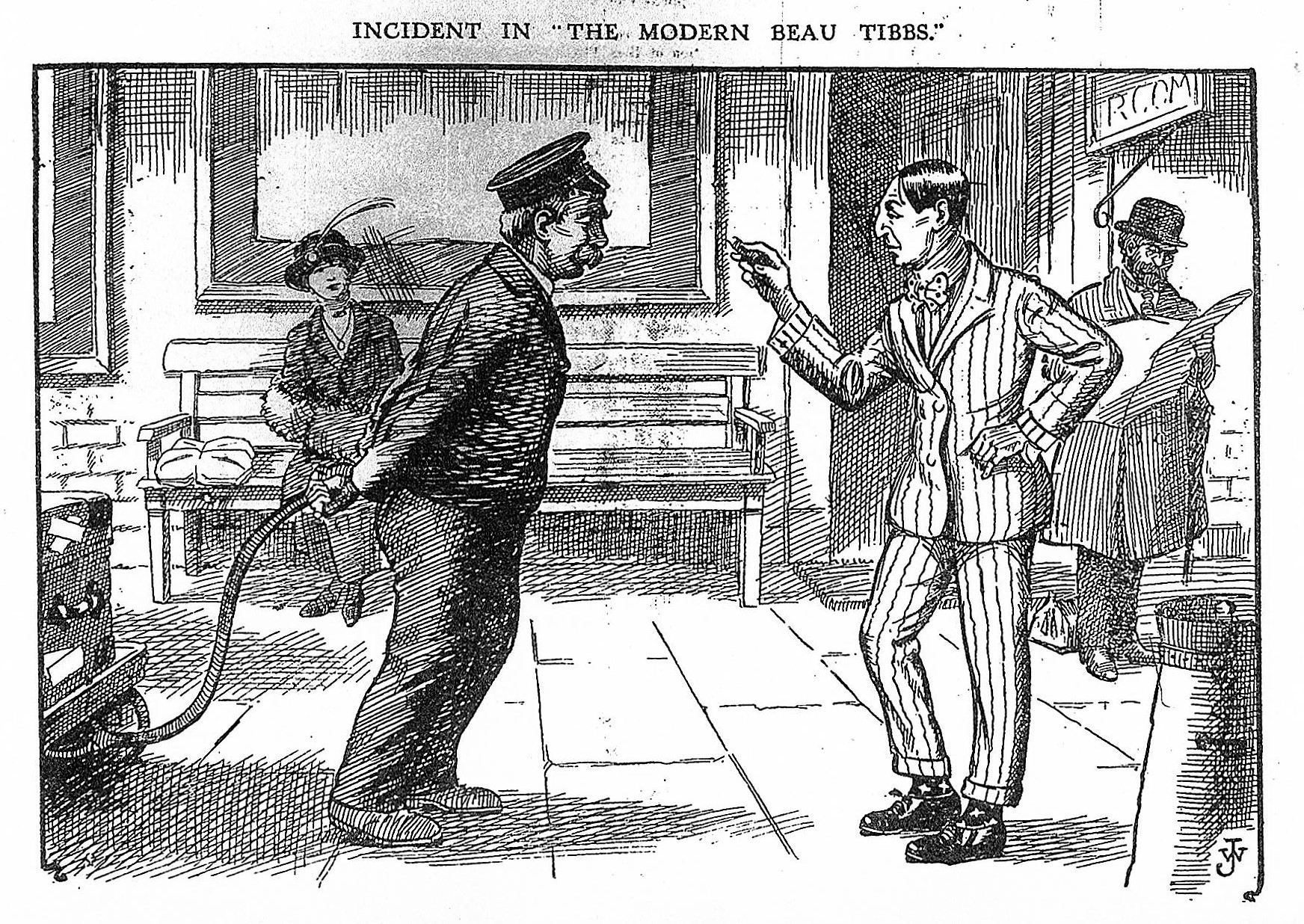 Nothing was wanting to make Tibbs the completest dandy in the town. Already soft and green of hat and head, and brilliant in nothing but socks and tie and collar, he added a monocle and a lisp; and if there is anything else that goes to make up a finished fop, be sure that he had it.
The other morning, as he sauntered up the high street, he met Brown conveniently near a group of young ladies.
Tibbs at once plunged into conversation; speaking very loud, with an eye to effect.
“How d’ yo’ do Brown? It’s a beastly age since I last saw yo.’”
“Only yesterday” said Brown, quietly, as usual. “Aw, yesterday,” said the unheeding Tibbs. “Yesterday I was down at Marton’s place. Wippin, shootin’! came back in his car. The Daimler, you know, not the Mercedes, I drove.”
Unfortunately for Tibbs, Marton passed at that moment without the slightest recognition.
“That’s Marton” said Brown.
“Yes; beastly short sighted, poor fellow! I used to be annoyed – fearfully annoyed at first. But he explained to me, you know! But I say, Brown” he shouted. The ladies were singularly indifferent, or perhaps hardened.
“You weally must come down to our place. My people will be delighted. We had a house party on last week. The mater and pater were in town. Deaf old aunt for chaperone, you know! Wather! We had a wippin time. ‘Bout thirty of us all together! Wondered wound the grounds all day; did a theatre in town after dinner, and -oh! Brown, my dear old boy,
you weally must come.”
you weally must come.”
He fixed his monocle with a hideous grimace, and at last captivated the lady’s attention.
Hugely elated, Tibbs flaunted a scented silk handkerchief, bent one knee gracefully, and placed one hand on his hip.
“I insist! I absolutely insist dear boy,” he drawled louder than ever. “You simply must come. My people will be awfully pleased. What do you say to this weekend?”
This ogling, this grimacing, this scent, this gabble of “people, places and grounds,” was all for the girls. Poor Brown might have been a statue or a picture for all Tibbs cared; he was a convenient excuse for a performance – that was all.
But Brown was to have his revenge.
“You weally must come” What do you say to this weekend? cried Tibbs again.
And Brown said, “I’ll come.”
Tibbs started. His monocle fell from his eye, his face straightened out wonderfully, and his mouth dropped open.
“What” he gasped.
“I’ll come”. said Brown again.
“Er–my dear boy-“ Tibbs began, but his eye, from force of habit, wandered to the ladies, and he saw that he still held their attention. He recovered himself with an effort, smiled feebly, and wagged Brown’s hand.
“Thanks awfully, Brown old boy. I’ll tell my people to expect yo’. Meet me for the 2.30 train on Saturday. Bye-bye!”
The ladies moved off and so did he.
On Saturday Brown found Tibbs, flamboyant in starred socks, pink collar and pea green hat, leaning over the station refreshment bar lisping and fibbing to the painted female behind it.
“Hullo old boy! There yo are” he cried as Brown made his appearance. “Aren’t yo goin to have a drink?”
Brown declined; he was not one of those men who need refreshment before undertaking a three mile railway journey. He was presented to the female as “My pal, who is goin down to my place with me.” He paid Tibbs account and went to the train.
Tibbs took care to find a suitable audience for himself as he prattled on incessantly on his usual topics – people, places and gwounds – that Brown began to entertain himself with the prospect of a pleasant weekend.
At the first station Tibbs stepped out onto the platform, and sauntered up and down, exposing his neatly plastered head to the view of the passengers. He called out once, “Por-ah! Is this the up-town twain?
But the porter did not seize upon the new appellation, and Tibbs was obliged to return to his carriage without the information.
He explained to the carriage in general that he wanted to know if that was the London train, because he was going up to the “waces”next week; and he discussed “vicious bwutes” his pater had kept until they arrived at their destination.
It was raining heavily over the dismal countryside, and Brown devoutly wished one of those same “vicious bwutes” had come to meet him.
But Tibbs took his arm, and they paddled up the lane together, whilst Tibbs prepared Brown for his entrance into the family circle.
“Yo’ see, old chap” he said, stepping daintily “to tell you the twuth, my pater’s rather a queer stick; got decided notions about the simple life; decent sort and all that, but wather a queer stick. Had to give up our town house, The Towers, you know, and come to live the simple life here.
“Watten! - you know – wather.
They turned the corner of the lane, and came insight of a square house, part in ruin and part evidently inhabited. It was completely covered with black, dead ivy roots, either burnt, or blasted in some way.
There was a small patch of garden in front and a dirty cobbled yard at the side.
Brown knew it for the Tibbs menage, because of a row of rainbow coloured socks dangled down a line in the yard.
So, these were Tibb’s gwounds.
Tibbs led the way up the garden path, and opened the door for Browns and a torrent of rain; then he ushered his friend into a dark little parlour, where, by the fitful flicker of a single flame, he saw an old man sitting alone. “Pater!” shouted Tibbs, “Here’s my fwiend Brown” The old man did not hear.
“Pater” shouted Tibbs, “Here’s my friend Brown”
The old man, without rising, drew a chair forward, and said, as if he was repeating a lesson.
“You are very welcome, sir. You are very welcome, sir! I-I-I prefer the simple life.”
Brown shook his palsied old hand and sat down by him.
“I prefer the simple life,” said the old man nodding his head at the fire. I prefer the simple life. Is that not right, Charlie?
For Tibbs had been showing signs of vexation and impatience.
“Of course, you Pwefer the simple life, pater, you always did. Brown, excuse me! Webbecca has forgotten to light up. The maids are so careless in the countwy!”
He lit the lamp and revealed the room. The damp had made grotesque figures on the walls – capes and bays and men on horseback!
The floor was of varnished wood, and had long splinters chipped out in places; strips of carpet were scattered here and there. Many of the chairs eked out their legs with little blocks of wood. The wind blew through the chinks in the faulty window frame and fluttered the dingy red curtain.
And this was Tibb’s place!
In a moment Tibb’s mater came in, gwaceful, isn’t it? Wants to go out every day to a beastly common school! And she’s a downwight suffwagist! I say, Brown, old fellow, what are the girls coming to?
“Their senses!” said Brown sharply.
“Aw! You funny chap” said Tibb’s. I’ll tell Mary that! Pwaps she’ll be more amiable to yow. Here’s your room. We won’t dress for dinner.
When Tibbs left him, Brown sat down on his bed and considered things, surrounded by a heterogeneous collection of objects – odd pictures on the walls, odd strips of carpet on the floor, with odd buffets strewn over them, like plush mushrooms.
He was alternately amused and irritated by Tibb’s fibs; touched by his pathetic puppets- the mater and pater; and interested in the slightly disdainful sister. And these were Tibb’s people!
He was startled by violent banging in the lower regions, and rushed downstairs to find Tibbs himself hiding a brass tray and a bottle mop in a cupboard.
“The gong!” Mary explained caustically. Mrs Tibbs led him to this place.
“Do make yourself comfortable, Brown; Pray be quiet at home. I am very glad to see you. And the old man mumbled from the top of the table “Simple life”
Brown determined to make them comfortable and quite at home, so he set himself to humour Tibbs, talk gently to the mater and pater, and sensibly to the sister. He was deaf to a summons from the door.
“Ere, missus! A mun be goin’, so a’ll trouble yer fer thad money. It’ll be sixpence extra I’ve stated till naw- and thur’s mi insterance!”
He was blind to the faults in the service. He managed all parties at once with the greatest dexterity, and considered himself well rewarded, after the meal was over, when Mary allowed him to help her lift things from the table.
Tibb’s, in a terrible rage, at last managed to push him into the drawing room which proved to be no better than the parlour.
Mrs Tibbs followed to beseech Brown to make himself comfortable; and Mr Tibbs senior, called in once more to remind him he preferred the simple life, and then went off to take his gruel in bed.
Tibbs rattled off some music-hall airs on the piano for Brown’s amusement, and, after what seemed a very long time, Mary came in.
She was sorry to be so late, but she had been correcting exercises.
So she had already gone to the “beastly common school” Tibbs relieved his feelings by a crash.
Mary sat down opposite to Brown, and, after frequent attempts, he broke through her reserve and made her talk to him.
When she was interested, she would talk well and vivaciously – now serious and earnest, now laughing and animated.
Brown was charmed and Tibbs was astounded. He left the piano and came to look at her, as if he had never seen her before.
It was late before they realised it. Mary ran off to lock up and turn the lights out, and Brown, feeling a good deal fonder of Tibbs than before went to his room and passed a good hour, stepping from one plush mushroom to another in the pleasant agitation of his mind.
When, at last, he went to bed and to sleep, after violent efforts “to make himself comfortable” it was to dream about the gwounds, place and people,” especially Mary.
In the morning he was awakened by a gentle knock and a squeak at his door. “Hot water, sir!” With a curiosity to see Rebecca, he opened the door a little and saw Tibbs himself stealing down the passage.
“What an uncomfortable life the poor fellow must lead,” he mused. “It must be and kicked the turf. He looked at the outstretched hand. He had never had a friend before.”
“You can trust me Charlie” Brown said.
Tibbs gripped his hand – not waged or fingered – but gripped it hard.
“Thank you, Bwown – I mean Brown – I’ve been a fool, but now I will be a man.”
Then they rushed back over the fields like two schoolboys.
“Mary”, shouted Tibbs, “we’ll dye those socks tomorrow; I’m not going to play anymore. I’m going to work: it’s Brown that’s done it”
Mary stared in amazement, then went to kiss her brother and give her hand to Brown. To express her own thoughts she felt as if she could have loved him for it ; and later, oh! Very much later, of course – she did.
The Blackburn Weekly Telegraph, 14th December 1912
Transcribed by Philip Crompton
Transcribed by Philip Crompton