
 Loading more
Page 2
< Back to page 1Proceed to page 3 >
James Cocker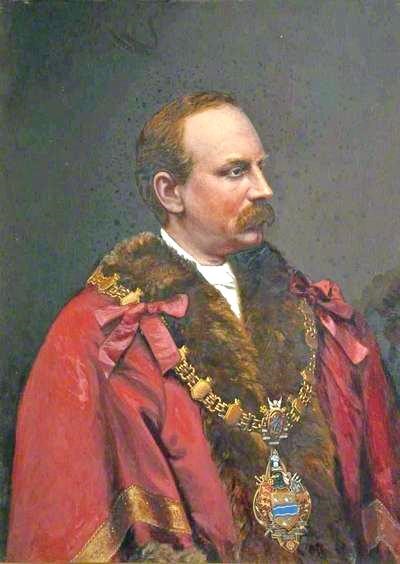
Mayor of Darwen 1892 – 1894,
1913 – 1915,
1927 – 1928
James Cocker was a member of the Cocker family from Tockholes, several of whom were active in the government of Darwen for many years. Mr Cocker's grandfather, James Cocker, came originally from Tockholes and settled in Sough. Amongst his other occupations he was the road surveyor for Over Darwen, appointed by the Manorial Court, with powers to levy a cess on the tenants of the manor for the repair and maintainance of the roads. This James Cocker married a Miss Entwistle and had four sons and three daughters.
One of the sons was named Samuel and he became a grocer and musician. He was also a member of the town council for three years. James Cocker the elder was associated with the Wesleyan Methodists in the town, working in the Sunday school, however Samuel connected himself with the Primitive Methodists when they came to Darwen in 1819.
He was an accomplished musician, playing bass viol in the band which accompanied the singing at the services in the Primitive Methodist Chapel in Redearth Road. This chapel was demolished in 1972 and Darwen Aldridge Community Academy was built on the site, but not until all of the bodies from the graveyard were re-interred at the local cemetery with an appropriate memorial. The council also commissioned an archaeological survey at the site, during which the remains of 131 individuals were recovered. The burial ground appeared to have been well organised, with well-ordered grave plots, many of which had been used for multiple, presumably family, interments. Surviving fittings suggested that the coffins had been modest, although a number of people had been buried with strings of beads, as well as finger rings and other vestiges of clothing and personal adornment.
Samuel Cocker married Alice Eccles, daughter of Richard Eccles, a grocer and coal dealer in Bolton Road. When Richard Eccles died his son-in-law, Samuel, succeeded to the business and carried it on for the rest of his working life.
James Cocker was the eldest of Samuel and Alice's seven children, and was born on 8th July 1850 at Bolton Road. He was sent to Astley Street school, which had been been built as a factory school by Eccles Shorrock. There he received the rudiments of his education, his schoolmaster being Squire Seddon. He afterwards went to Belgrave School and later to the night school run by Abraham Pinder, who was a noted mathematician.
He then had two quarters at the Mechanics' Institute to complete his formal education.
For a time James assisted his father in the shop and collected accounts, but in 1872 he went to work as a miner at one of the local coal mines. Two years later he began work at John Knowles' building contractors, firstly as bookkeeper and cashier and then as manager of the Thorney Heights and Radford Quarries.
In 1878 he married Ann, the daughter of John Knowles, and later became manager of the whole of the building firm, which at that time was one of the largest in East Lancashire. Contracts were secured and completed for mills and factories, reservoirs and public works, banks and places of worship, (including the Primitive Methodist Chapel in Redearth Road), as well as many houses in the town.
James and Ann had two children, Alice born in 1878 and John Stanley, born in 1893 during the first of his father's mayoralties, and the council presented him with a silver cradle to celebrate the event. Unfortunately John Stanley died when he was only 2 years old.
The family lived at various addresses in Darwen, and by the 1901 census they had moved into “Inglewood” on Whitehall Road, the property remaining in the family until at least 1946 when Alice Cocker died.
James Cocker served five terms as Mayor, the first time in 1892 – 1894 (two years), the second time in 1913 – 1915 (two years), and again in 1927 – 1928 when the town celebrated the golden jubilee of its incorporation, and when he presented a chain to the town to be worn by future mayoresses.Mr Cocker was also senior Borough Magistrate and senior County Magistrate, having been appointed to the borough bench in 1894, and to the county bench in 1917. He had had the Honorary Freedom of the Borough conferred upon him in 1920 at a presentation evening at the Library Lecture Room, along with fellow Aldermen Alex. T. Eccles and Alexander Carus.
 Silver Casket conferring Honorary Freedom of the Borough to Mr James Cocker
James Cocker was a Primitive Methodist all of his life, and when in 1870 Sandhills Chapel was built in Lark Street Darwen, it was at his suggestion that the building also became a day school. He devoted a lot of interest to the school, becoming a teacher, the secretary and then superintendent using his influence to ensure things were done in a well organised manner. In 1876 he was appointed day school manager and treasurer – a position which he held for more than 25 years.
When in 1895 it was decided to build a new chapel at the end of Park Road, he gave the site, valued at £500, suscribed further to the building fund and supervised its erection. He and Mrs Cocker also presented a magnificent five-pipe organ which was installed as a memorial to their young son who had recently died. For more than thirty years he was a teacher of the young womens' class at the school, at which there were regularly 70 attendees. For 36 years he was circuit steward of the Primitive Methodists (Darwen Circuit) having been re-elected at 146 quarterly meetings.
James Cocker held many positions in the borough of Darwen. He became a Town Councillor in 1886 as one of the members for the South West Ward, and he continued to represent that ward without ever having a candidate nominated against him. In 1896 upon the death of Alderman Pickup he was made Alderman of the borough, a position he resigned in 1932 after he had completed 46 years of service as a public representative. At various times he served many years as chairman of the Highways, Education and Old Age Pensions Committees.
He was a past Master of the Harmony and Industry Masonic Lodge (381) and member of the Hutchinson's Chapter of the Royal Arch Masons there. He was founder and treasurer of the Peaceful Valley Lodge (4111), both of which lodges held their meetings at the Masonic Hall, Hawkshaw Avenue.
Mr & Mrs Cocker had been married more than 50 years when she died in 1928. In her later years when poor health meant she was not able to support her husband in the duties of Mayoress, their daughter Alice proved to be a capable replacement for her, especially during his last mayoralty.
James Cocker passed away on 8th February 1935 at his home “Inglewood” in Darwen at the age of 84. The funeral service, which was held at Park Road Methodist Church was well attended by representatives of many groups in the town. The congregation filled the building and in the pulpit there were three former Ministers of the Circuit as well as the then Minister, Rev. H Smith who led the service. A full choir was in attendance accompanied by Mr. John Cocker at the organ.
Probate was granted to his daughter, Alice Cocker, Rev. William Barker and Rev. John Hodges, Methodist Ministers, and to Samuel Cocker, builders' clerk. His estate was valued at £19,233.
Compiled by Joyce Calder September 2023
Sources:
Image courtesy of Darwen Heritage Centre
findmypast.co.uk
ancestry.co.uk.
Darwen News
Primitive Methodist Leader
Index to Wills and Administrations.gov.uk
Published October 2023
William Pickup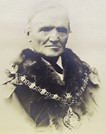
Mayor of Darwen 1894 – 1895
William Pickup was born 6th March 1827, the eldest son of the eleven children of George and Jane Pickup of Prince's Farm, Marsh House, Darwen. By 1841 the family had moved a little way to Hatton's Farm, Blacksnape where the family continued to farm for at least another 40 years.
As a child William attended the Lower Chapel School, becoming secretary to the Sunday school, and later treasurer and committee member for the church congregation. When the secession took place at Lower Chapel, which led to the formation of Duckworth Street Church, he associated himself with the new church, taking on similar responsibilities as he had previously. He continued his allegiance to the church throughout his life and was noted for the strict regularity of his attendance there.
In 1861 William married Hannah Thompson, the daughter of Jeremiah and Ellen Thompson of Blacksnape. There were four children born to the couple—George.0 (1862), John (1864), William (1866) and Jane Ellen (1870) but sadly George and William both died in infancy.
In 1857 William entered into partnership with Mr. James Halliwell of the George Street Mills, and afterwards in 1868 entered into partnership with his brother, John Pickup and his brother-in-law, James Holden at Bank Top Mill near the centre of Darwen. The mill had been built in 1859 as a weaving mill with just 124 looms, but was extended to operate with 816 looms. Until 1890 William was still in partnership with his brother-in-law's son, Mr. George Pickup Holden, but shortly after the disastrous fire that occurred at the mill about that time the partnership was dissolved.
After this time he was happy to return to his favourite occupation of farming. He was by then the owner of several farms and could regularly be found hard at work in the fields whatever the weather. His knowledge of livestock was great, and he was a familiar figure at the Blackburn Cattle Market.
Mr. Pickup first served the local authority as member of the Local Board, and then as a member of the Town Council on the incorporation of the borough on 1st July 1878. At the first meeting of this council he had the honour to be elected Alderman of the borough for Central Ward, a position he held unopposed for many years.
An almanac published for 1881 shows Alderman Pickup's many committee interests:
Chairman of the Finance Committee, member of the Gas and Water, Highways, Health and Nuisance, Buildings and General Purposes, and Town Improvements Committees.
He was elected Mayor and Chief Magistrate for the borough on 9th November 1894, and during his Mayoralty he gained a reputation for plain speaking and common sense in all his dealings with the council. He went about his work quietly and steadily, and during his 27 years of service to the council gained the respect of his peers. It is noted that he was seemingly indifferent to personal appearance and fashions, and was never seen wearing an overcoat in even the dreariest weather.
When his year as Mayor ended in 1895 he left £100 to the town council to spend as it thought fit. He was elected to be Deputy Mayor to Mr. Alexander Carus for the following year, but sadly soon after this he was suddenly taken ill and after only a couple of days died from pneumonia.
The funeral was planned for 25th November 1896 and as the cortege left his home in Beatrice Terrace, Redearth Road the street was lined with well-wishers who wanted to pay their respects to a well-regarded citizen of Darwen. The first part of the procession, consisting of the hearse and nine coaches, reached the Circus just before three o'clock, where it was joined by several Corporation officials, members of the Town Council, local gentlemen and workers from Bank Top Mill and a number of other mills and shops in the town which were closed for the day.
As the procession made its way up Bolton Road to the cemetery the many onlookers began to hear of the sad news that his widow Mrs. Hannah Pickup, who had herself been seriously unwell for some time, had passed away shortly before the cortege left their home. The funeral service was held in the cemetery chapel, conducted by Rev. W.C. Russell, Pastor of Duckworth Street Chapel and the interment took place in the Congregational section of the cemetery.
Compiled by Joyce Calder November 2023
Sources:
The Darwen News
ancestry.co.uk
findmypast.co.uk
Published November 2023
Alexander Carus
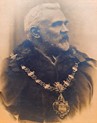
Mayor of Darwen 1895 – 1897
Alexander Carus was born 11th September 1842 in Blackburn to John and Catherine Carus and was baptised at St. Alban's Church one week later. His father was a well-known grocer and provision dealer in the town, trading from premises in Penny Street for many years.
Alexander received a private education and when he left school he went as a clerk in the employ of Messrs. Backhouse, solicitors in Blackburn. He left that position after four years, choosing instead to become involved in the cotton business, and for the next two years he worked at the renowned firm of Messrs. Tootall, Broadhurst and Lee, handloom and fabric manufacturers. He then spent a number of years with Mr. Richard Greenwood at Duke Street Mill, Blackburn.
By the age of 23 his experience was such that he could take over management of one of the mills belonging to Mr. James Astley of Blackburn. He subsequently became associated with Mr. Edward Healey of Preston, maintaining his connection with this gentleman for 10 years – five as manager and five as managing partner.
On 2nd August 1870 he married Agnes Shakeshaft, daughter of Richard, a tallow chandler of Blackburn. Alexander and Agnes set up home in Little Hoole, Preston before moving to Lytham St. Annes for a number of years with their growing family. By 1891 the family were living at 135 Bolton Road, Darwen and Alexander gives his occupation as J.P., Town Councillor and Cotton Manufacturer. He and Agnes went on to have 10 children altogether, five boys and five girls.
It was in 1882 that Alexander was appointed Borough Magistrate and about the same time he purchased St. Paul's Mill, Hoddlesden from Messrs. J. & R. Knowles. In 1890 he leased from Hoddlesden Manufacturing Company the weaving shed which they had rebuilt after a disastrous fire the previous year, and fitted it with new machinery. In the two mills there were more than 1039 looms.
From these mills, assisted by his sons, he ran a large and flourishing business which provided employment for many of the residents of Hoddlesden. The employees were expected to work 55 hours per week – Monday to Friday 6am to 5.30pm with 30 minutes break for breakfast and 1 hour break for lunch, and Saturday mornings 6am to1pm. A whistle was blown each morning at 5.15 am, followed by a 2nd whistle at 5.45 am, and workers were expected to be at their appointed places by 5.55 am. Equally, Mr. Carus would himself be regularly seen at work by 6am.
In 1886 he was honoured by being made a Justice of the Peace for the borough, in which role he gained a reputation for discretion and impartiality. In 1890 he was appointed County Councillor for Darwen and was elected to several committees, including Public Health and Education, becoming Chairman of the Gas Committee. He was the Councillor for North-West Ward having defeated a Socialist candidate by a large majority, but in 1892 he withdrew from that ward and was returned without opposition for the South-West Ward, the ward in which his works were situated. He again had a walkover in the ward in November 1895 and a few days later was elected Mayor of Darwen, becoming the first Roman Catholic Mayor of the town.
His devotion to his church was well known and he had been presented to the Pope on a number of occasions. He was one of the stalwarts of St. Joseph's Catholic church in Darwen and was present when the foundation stone for the new school was laid by Bishop Bilsborough in August 1896. A little over a year later he opened the new school which had been built at a cost of £3,000.
During his mayoralty the diamond jubilee of Queen Victoria occurred and Mr. Carus was presented to the Queen along with other mayors of the county. On 22nd June 1897 he had the honour of cutting the first sod in preparation for the building of Darwen Jubilee Tower.
It was a hot summer's day and in the evening there was a bonfire and fireworks display.
In this same year the opportunity arose for Mr. Carus to take on the lease of Hoddlesden Hall, where he then lived for many years. He was very interested in the social affairs of the village and was one of the gentlemen who did much to acquire the establishment of a branch public library, and also lobbied for a tram service for Hoddlesden which proved a great boon for the residents there.
In 1906 he was invited to open a bazaar at St. Gregory's Church in Farnworth, Bolton and made use of his speech to make reference to the Education Bill, saying that he hoped that the denominational system would still be allowed. He stood for parents having the right of educating their children in the faith of their parents – whatever their religion might be.
At the same occasion, a communication from the Bishop of Salford was made public, announcing that His Holiness the Pope had decided to confer the Order of the Knighthood of St. Gregory upon Alderman Carus, a distinction rarely bestowed by the Church of Rome.
Shortly after the 1914 –1918 war ended it became known that the Rankin Estate, comprising Hoddlesden Hall and 14 nearby farms was up for sale. Alexander took the opportunity to buy the whole estate in October 1920 on behalf of A. Carus and Sons Ltd.,
for the sum of £26,100. This opened prospects for development, giving his company the security of water rights which was essential to meet their plan for the installation of a Bleaching Plant in Hoddlesden. Unfortunately, Mr. Carus died shortly after this acquisition and the business continued with his son Alexander Jr. as chairman, along with his other sons Edmund, Francis and Walter.
In July 1920 Mr. and Mrs. Carus had celebrated their Golden Wedding anniversary and in the following month Alexander was made Freeman of the Borough of Darwen in recognition of his many years of public service in the area.
After his death on 21 December 1920 his remains were conveyed from Hoddlesden Hall to St. Joseph's Church, Darwen and a requiem mass was celebrated the following day. There was a very large congregation for the funeral service, including the chief family mourners, representatives of his mill workers, of Darwen Town Council, Lancashire Town Council and many other local societies. There followed a private interment at Pleasington Priory.
Probate was granted in London to his widow, Agnes his sons Alexander Hubert, Edmund Louis, and Frances Xavier and to his daughter, Ethel Leo Mary Carus. His effects totalled
£89,272. Agnes continued to live at Hoddlesden Hall until her death on 25th September 1929 and she was then buried alongside her husband at Pleasington.
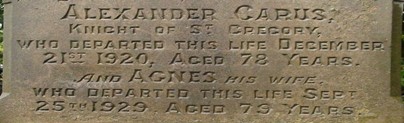 Headstone of Alexander Carus, Pleasington Priory
Compiled by Joyce Calder, June 2024
Sources:
“Cathy Carus Notes” and portrait - Darwen Local History Library
The Darwen News
findmypast. co.uk
ancestry. co. uk
Index to Wills and Administrations.gov.uk
Sir Charles Philip Huntington
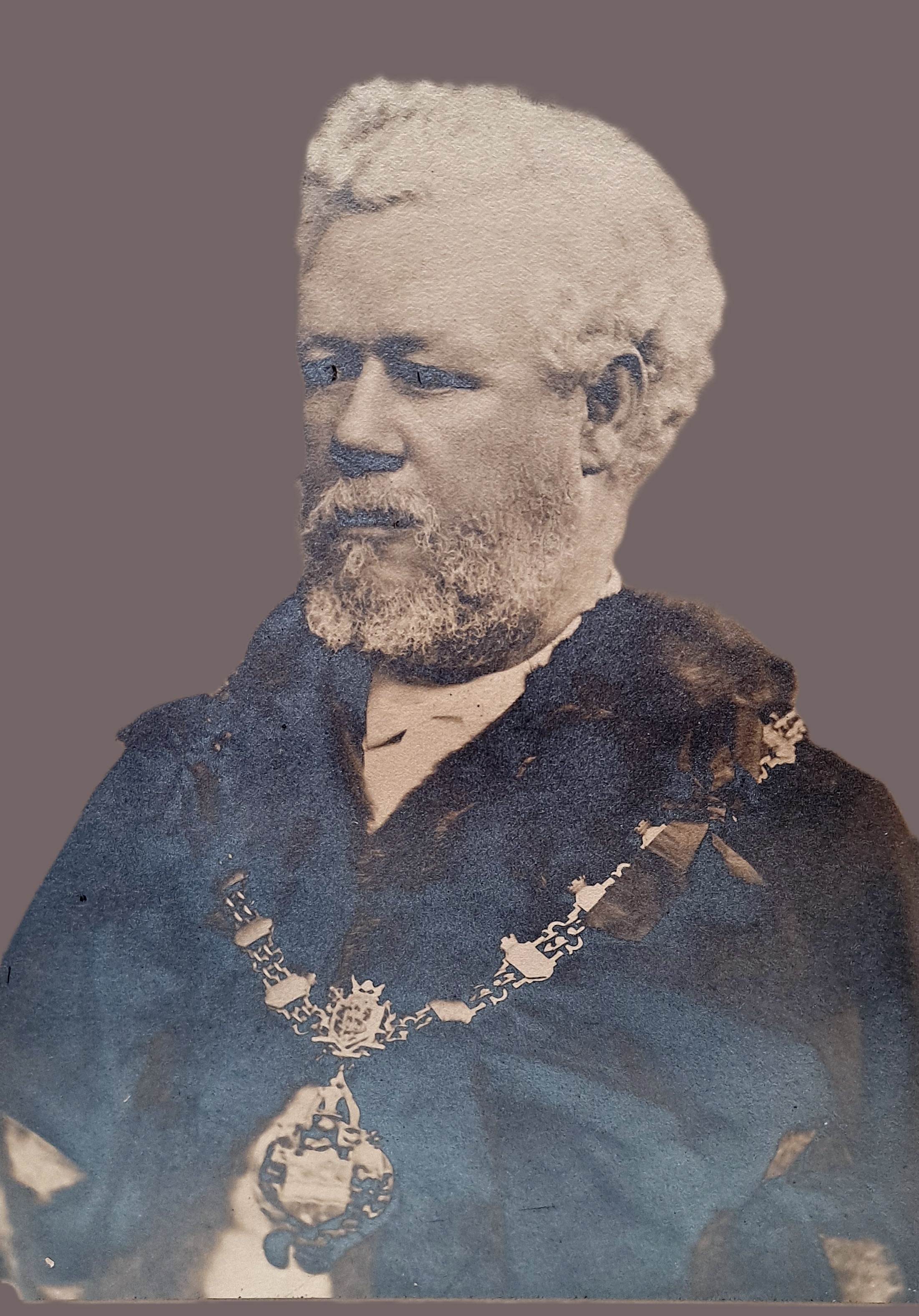
Mayor of Darwen 1897 - 1898
Charles Huntington was not a native of Darwen, having been born in 1833 at Mitcham, Surrey, the eldest child of James, an engraver, and his wife Harriet. Upon leaving school he learnt the art of designing at his father’s business in Mitcham, which was at that time the centre of a large calico printing industry. Afterwards he worked with his older brother, James Huntington, who was by then established in London in his design and silk printing business, but who came to Darwen as managing partner in the firm of Messrs. C. and J. G. Potter, wallpaper manufacturers, in 1864.
At the age of 21 Charles went to Paris and gained a high reputation for drawing and as a colourist, and after a few years his studio was one of the largest in the city. He then joined his younger brother, William Balle Huntington (trading as “Huntington Frères”) conducting a continental agency for Potter’s Paperhangings, and by their knowledge of markets and languages they were able to build up a large export trade for the firm.
In the meantime, James Huntington had so developed the wallpaper business of Messrs. Potter in Darwen that he invited his brothers to join him in that business, which they did – Charles to be in charge of the art department, and William as head of the commercial department.
In May 1876 Charles Huntington married Jane Hudson Sparkes at St. John the Evangelist church in Darwen. For a short period after their marriage they resided in a house overlooking Corporation Park in Blackburn, but on the death of Mr James Huntington in 1878 they moved to Astley Bank in Darwen, the house which had been owned and occupied by him.
Charles and Jane had eight children in total, Amy (born 1879), Sylvia (1880), Marguerite (1881), Henry (1885) and Charles (1888), plus three other sons who died in infancy.
They began to improve and expand Astley Bank House, building another storey to accommodate their many visitors, adding a ballroom, and the house was one of the first in the area to have electricity installed.
Politically Charles Huntington was a lifelong Liberal and in 1880 at a large demonstration at Darwen Theatre Royal he lent his support to the two Liberal candidates for North-East Lancashire. At the general election of 1885 he actively supported Mr J. G. Potter as Liberal candidate for Darwen division, but he was unfortunately defeated.
In 1888 Charles himself was selected as candidate, but it was not until the general election of 1892 that he was successful in his attempt to become Darwen’s Member of Parliament, when he defeated Lord Cranborne, who had been the Conservative Member for the previous six years. However, at the two following general elections in 1895 and 1900 he was defeated by Mr Rutherford, the Conservative candidate.
He was for some time a member of the Executive Committee of the National Liberal Federation and on a number of occasions contributed generously to the party funds. Locally he was president of Lancashire County Liberal Association and vice-president of Darwen Borough Liberal Association.
In addition to his political life, he was deeply interested in the welfare of his townspeople.
He was created Justice of the Peace for Lancashire in 1879, and for the Borough of Darwen in 1881. He also served the town of Darwen as Mayor from 1897 to 1898.
He was the first president of the Technical Schools, subscribing £1000 to the formation of the schools, and he set up the “Charles Huntington Scholarships”. His wife started and developed the Darwen and District Nursing Association.
.JPG)
The Clock House
In 1894 he bought Clock House, a large mansion on Chelsea Embankment, London and shared his time between there and his home at Astley Bank. In June 1906 he was created a Baronet, taking the title of Baronet Huntington of the Clock House, Chelsea. However, the honour was short-lived as he died in Chelsea in December 1906. He was succeeded in the baronetcy by two of his sons – Henry Leslie, who died soon after his father in 1907, and Charles Philip Jr., who died in 1928 - after which the baronetcy became extinct.
Sir Charles’ body was brought back for burial in Darwen cemetery, where he was interred in the same grave as his older brother, James. His will shows that his estate was valued at £222,781 and he bequeathed his two residences to his wife. He also left £500 to each of his executors, £1000 to each of the children of his sister, Harriet and everything else to his wife for life, and then to his children.
Compiled by Joyce Calder, July 2024
Sources:
A.V. Sugden & E.A. Entwisle, “Potters of Darwen 1839-1939 A Century of Wallpaper Printing by Machinery”, 1939
Darwen News
Darwen Library Local History Dept.
Findmypast.co.uk
Ancestry.co.uk
Dr. James Todd Ballantyne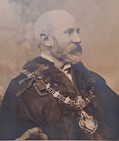
Mayor of Darwen 1898 –1899
James Todd Ballantyne was born in 1845 at Blantyre, Lanarkshire the eldest son of James Ballantyne, a mechanic, and his wife Elizabeth. He was sent to the local village school at the age of four and left there at the age of twelve to assist his father in his mechanics’ shop. After remaining there for a short while his father sent him back to school for another twelve months, by which time he had mastered all the learning available at the village school. His headmaster suggested that he should train for the teaching profession, but James had no wish to do so, preferring to be a joiner instead. His father agreed to this providing he would attend night school after his day’s work.
Therefore, when he was thirteen years old, he entered upon a 7 year’s apprenticeship to the trade of joiner in his home village and whilst learning his trade he also applied himself to the study of various branches of learning. His younger brother taught him the rudiments of Latin and once a fortnight he received private tuition from a headmaster. At the close of his apprenticeship, he left Blantyre and moved to Glasgow, where he studied at the Medical School and graduated from there as a Bachelor of Medicine and Master of Surgery.
In 1876 he married Miss Susannah Downie Shields, daughter of John Shields of Campsie, Stirlingshire and was living in Blackburn. The couple moved to Darwen shortly after their marriage and never had any children. In 1881 Dr Ballantyne entered into partnership with Dr Aspinall, who ran a surgery in Green Street in the town. Their association continued until the retirement of Dr Aspinall six years later, at which time the partnership was dissolved and Mr Ballantyne carried on the business as Surgeon, Physician and General Practitioner at the same address.
In 1888 he bought Holker House in Railway Road, Darwen which had previously been the home and surgery of Dr George Hindle until his death a year earlier. At one time Doctor Ballantyne ran his surgeries from three premises in the town, serving his patients for more than 30 years.
In politics he was a Liberal and in 1894 he entered the Town Council unopposed as one of the representatives of West Central Ward. Four years later he was unanimously elected Mayor of the Borough, an honour which he accepted with some misgivings, for he felt that owing to his professional engagements, he would not be able to devote the necessary time to the duties of Mayor.
During his time in office the council had purchased the tramways system, erected a refuse destructor and the electricity works, had altered and enlarged the hospital for infectious diseases, and passed through Parliament a Local Improvement Bill giving them increased powers.
When in 1899 war broke out in South Africa he started a fund which raised a considerable amount of money for the relief of wives and families of the reservists who were called up to serve in the war.
Upon his retirement from the Mayoralty he wished to leave behind some memento of his year in office. This took the form of a public clock with four dials which he caused to be erected in the turret of the Municipal Buildings in the centre of Darwen, and which remains to this day.
Away from politics he worshipped at the Belgrave Meeting House, was an active member of the Huntington Lectures Committee from its foundation and he was one of the earliest members of the Literary Society, becoming president in 1887.
He was a member of the Harmony and Industry Lodge of Freemasons, and an honorary member of the Newtonian Lodge of the Independent Order of Oddfellows, Manchester Unity. He taught ambulance classes for many years and was an active member of the Nursing Association.
He was also a member of Darwen Golf Club and of the Caledonian Curling Club based in Blackburn.
Throughout his life Dr Ballantyne had collected a large number of paintings and it had been his wish that most of these should be bequeathed to his adopted town upon his death. Whilst he was still Mayor,
Mr John Shields, a cousin of Mrs Ballantyne, painted a portrait showing Dr Ballantyne wearing court dress, and Dr Ballantyne set to designing a suitable frame for this. He spent many years carving the oak frame, which he did in a room at his Green Street surgery whenever his busy public and professional lives allowed.
After the doctor died his widow presented the portrait to Darwen Council, although a small part of the carved frame had not been finished.
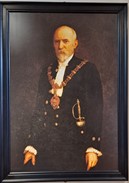 Copy of Mr Shields’ portrait at Darwen Heritage Centre
The Original painting is held at Blackburn Museum and Art Gallery
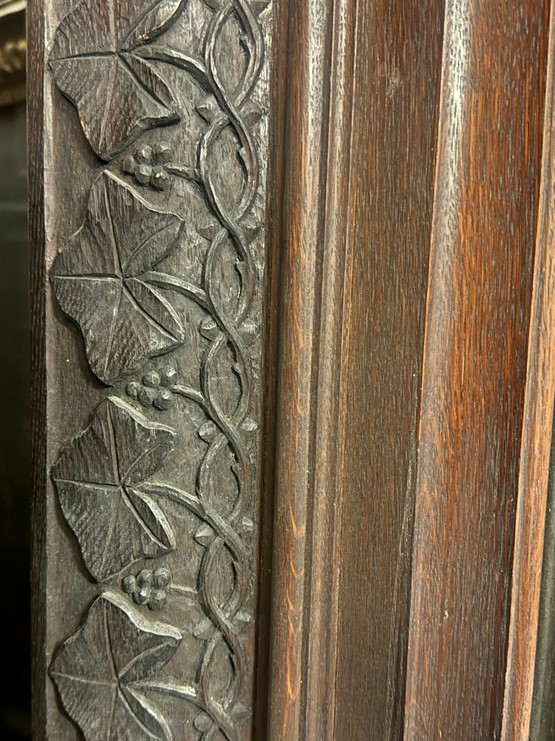
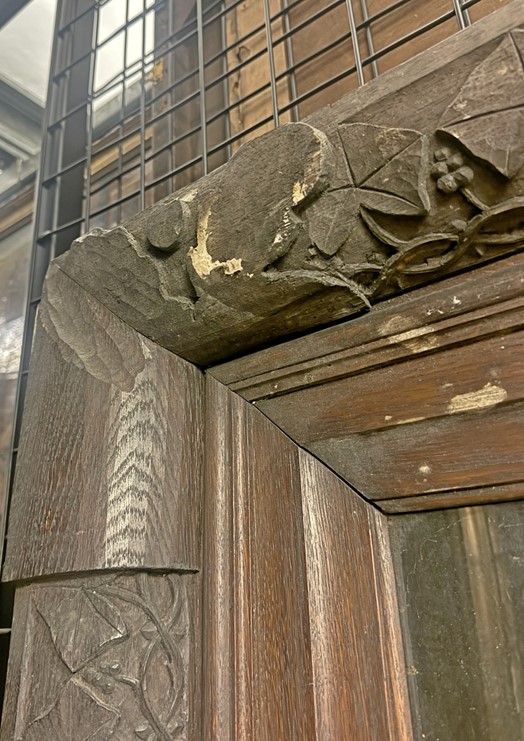
Details of carving on original painting
On the day of his funeral in June 1917 hundreds of townspeople assembled along the route of the cortege to pay tribute to the much-admired doctor. There was a private service at his home, Holker House and at the same time a public service was held at Belgrave Congregational Church, after which the public representatives formed a procession to precede the cortege to the cemetery.
Compiled by Joyce Calder November 2024
Sources:
Original painting images courtesy of Blackburn Museum and Art Gallery
Copy of painting courtesy of Darwen Heritage Centre
Darwen News
Darwen Gazette
findmypast.co.uk
ancestry.co.uk
John William Gillibrand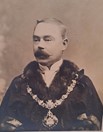
Mayor of Darwen 1899 - 1900
John William Gillibrand was born in Blackburn on 27th April 1854 the sixth of nine children of Thomas Gillibrand, a cotton manufacturer, and his wife, Ann. In about 1862 the family moved to Darwen, close to Hollins Grove Mill from where Thomas ran his successful business. John received his primary education at Mr. Singleton’s school at Spring Bank, after which he spent several terms at Whalley Grammar School before continuing his studies at Malvern College, Worcestershire. Upon leaving college aged 17 he went to assist his father in the mill, and on the death of the latter in 1878 he and his eldest brother Robert succeeded to the business.
The 1891 business directory for Darwen lists Hollins Grove Mill as a "Cotton Spinners and Manufacturers with 1270 looms producing handkerchiefs (coloured and plain bordered), brocades, brilliantes, fancy stripes and checks, jacconnettes, cambrics and shirtings."
In 1887 John W. Gillibrand was appointed a Justice of the Peace for Darwen, and in the following year he stood as the candidate for Darwen North-East Ward. He won the contest with a large majority thus becoming the first ever Conservative member of the town council and was returned unopposed at every succeeding election in the ward.
His principal work on the council was as chairman of the Parks and Recreation Committee, in which capacity he had a great deal to do with the development of Bold Venture and Whitehall Parks. On several occasions he covered the cost of musical performances by local bands in both parks.
He also presented a Meteorological Observatory to Bold Venture Park in commemoration of the Diamond Jubilee of Her Majesty Queen Victoria.
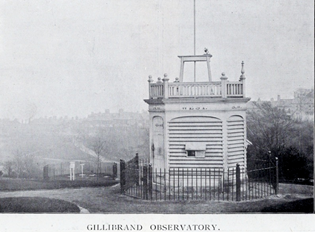
Observations took place twice daily, at 9am and 9pm, and a monthly report of the findings was published in a local newspaper.
As a councillor he played a prominent part in opposing the Corporation when they proposed to purchase additional watershed areas and reservoirs for the town. Together with his brother-in-law, Mr. F.G. Hindle he was instrumental in compelling the Corporation to drop the scheme, which would have placed a serious financial burden on the town.
Mr. Gillibrand was married in 1884 to Mary Agnes Senior, the daughter of Mr. James Senior of Beacon Grange, Sadberge, County Durham. The local newspaper noted that after the ceremony at St. Andrew’s Church the couple caught the 2.47pm train from Darlington en route to the Continent for their honeymoon.
There were two children from the marriage, Thomas Percival born in 1885, and Hilda Graham born in 1886, but she sadly died at the age of only 4 years.
Mr. Gillibrand was connected to St. Cuthbert’s Church at Hollins Grove from its beginning and was a generous supporter to the church and school. He was a church warden and one of the school managers for many years. By 1891 he and his family had moved to Earlsfield House on Blackburn Road, almost opposite St. Cuthbert’s Church.
Having continued his role as Councillor for the town, he was elected Mayor in 1899 by his peers in a unanimous vote, thus becoming the first Conservative Mayor for the Borough. It was noted that he carried out his duties in the most prompt, impartial, and affable manner possible, and during his tenure he completed several important schemes that were in hand prior to his becoming Mayor. He generously funded an Old Folks’ Christmas Treat at the Co-operative Hall and was considered a worthy and hospitable holder of the position.
Unfortunately, only a few months after the end of his mayoral year he suffered a sudden illness from which he could not recover, and on Christmas Day 1900 he passed away at his home, Earlsfield. His body was taken to St. Cuthbert’s Church for a private funeral, after which he was interred in the family vault at Darwen Cemetery. The cortege was witnessed by a large number of people, including many employees of his mill which had stopped for the day.
Probate was granted to his widow, Mary Agnes Gillibrand and his younger brother,
Frederick James Gillibrand M.D. and he left effects of almost £26,000. The business at Hollins Grove Mill was continued by his son, Thomas Percival Gillibrand.
Compiled by Joyce Calder March 2025
Sources:
findmypast.co.uk
Darwen Heritage Centre
Darwen News
Yorkshire Post newspaper
gov.uk Wills and Administrations
Published April 2025