© BwD - terms and conditions
The time at length came when the structure of this ancient Blackburn hostelry, having stood probably between 200 and 300 years without any very extensive alterations or reconstruction, must be taken down in order that a more imposing pile of building planned to suit modern ideas for a large town hotel might be reared upon its conspicuous and central site, Although the old premises occupied quite as much ground as the new ones, the principal rooms were of inadequate dimensions for the needs of a first-class house in a great town like Blackburn was growing into; and the passages were narrow, and the arrangements in the cooking department were deficient. But the circumstances which expedited the work of rebuilding was action of the Towns Improvement Commissioners, then newly constituted in laying out upon a better system , with altered levels, the streets at the “Cross” upon which the Old Bull Inn abuts. The old foot-pavements were irregular and narrow, and the north-east gable of the inn projected far into the street beside the upper Church-gates in Church-street. The owners of the inn therefore concluded that rebuilding had become imperative, and in the beginning of 1847 the work was resolved upon. Plans were promptly prepared, and submitted to the Improvement Commissioners in May of the year named. Minutes of the proceedings of the Commissioners respecting the building are given below.
“Old Bull—meeting of Commissioners held Friday May 7th 1847,—Mr. Walsh builder, attended with some plans for a new Inn on the site of the old Bull. It was proposed that several cellar openings in Darwen-street should be closed up; that the two projecting flights of stone steps should be removed; that the buildings should be rounded at the principal corner, and run in a straight line towards the Legs of Man Inn with the exception of one stone step at the Darwen street entrance to the new building. The step would project a foot on the pavement.”
“Meeting on Friday, June 4th, 1847,—Mr. Hopwood attended. The plan amended, the step abolished and no entrance to be in Darwen-street. The building to be thrown further back and a 7ft. path in Darwen-street.”
The Blackburn Standard for June 9th, 1847, reports that “the first ashlar stone in the front of the new building about to be erected on the site of the Old Bull Inn was laid on Friday at noon (June 4th) by Mr. Edward Sansom, after which there was an excellent collation.” A month later, on July 7th, the Standard remarks that “scarcely a fragment of the “Old Bull” now remains standing, but the new Inn is being rapidly raised in its place, and bids fair when completed to be quite an ornament to the town.” A serious accident happened during the process of erecting of the new building, which caused the death of one workman whilst two or three others had very narrow escapes. The whole of the massive cornice-stones fell together from the top of the wall facing Darwen-street. One stone fell upon a labourer named Thomas Green, and killed him. Mr Robert Ibbotson was the contractor for the building.
Both before and after its rebuilding the Old Bull Inn served as a commercial meeting-place or Exchange for the town, and at “high-change,” between 3 and 5 o’clock on a Wednesday afternoon, there used to be a large assemblage of gentlemen—Manchester yarn agents and Blackburn Cotton Spinners and Manufacturers—standing on the flags in front of the entrance to the inn discussing the markets, and giving and taking orders for yarns. The “Old Bull” on those days was thronged with customers and must have driven a splendid trade. This use of the house continued until, in 1857 an Exchange News Room was established, and at first occupied a large room on the Southside of the Town Hall, then newly erected, and then “Change” was shifted from the Old Bull flags to the Town Hall vestibule and steps.
Mr. Edward Sansom died in the beginning of June 1856, and intervening 34 years [until 1890] the Old Bull has passed through some vicissitudes, and has had a few successive Tenants. The inn was for some years in the hands of a company, but company-management did not altogether agree with it. Under the hostess, Mrs Mitchell, it maintains its ancient credit as an excellent house for comfort and entertainment, and is resorted to by a great proportion of the best townsfolk. Indeed Blackburn without its “Old Bull” would feel as bereft and incomplete as if its Town Hall or its Railway Station were taken away.
© BwD - terms and conditions
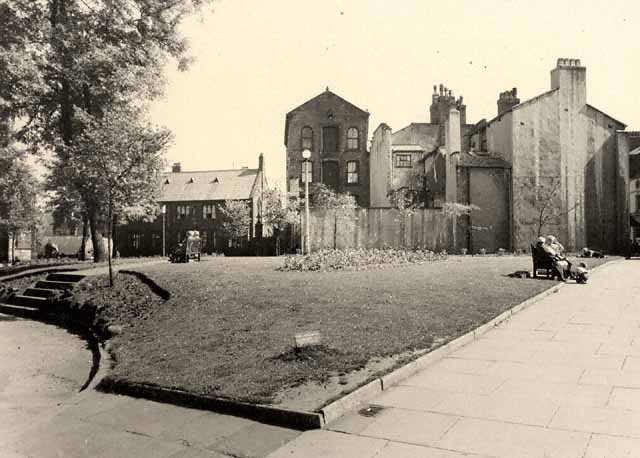
Site of the Old Bull Hotel
In 1901-02 Sir John Rutherford paid £30,000 to have the “Old Bull modernised. After the modernisation it was ranked as one of the foremost Hotels in Lancashire.
In 1937 a new road was proposed which would open up the way between Railway-road and King-street. It meant widening Church-street, Fleming Square, and King-street. The “Old Bull” was one of the casualties of this scheme, which never came about. After centauries of trading as an Inn and Hotel the “Old Bull” finally closed its doors as a licensed house April 9th 1938 and in September of that same year it became the property of the Corporation. Because of the War all improvement work in the town came to a halt. The “Old Bull” was temporarily reprieved, and was used to accommodate various local organisations concerned with the War effort. It was finally demolished in March 1950 and the site was landscaped and so it remains to this day.
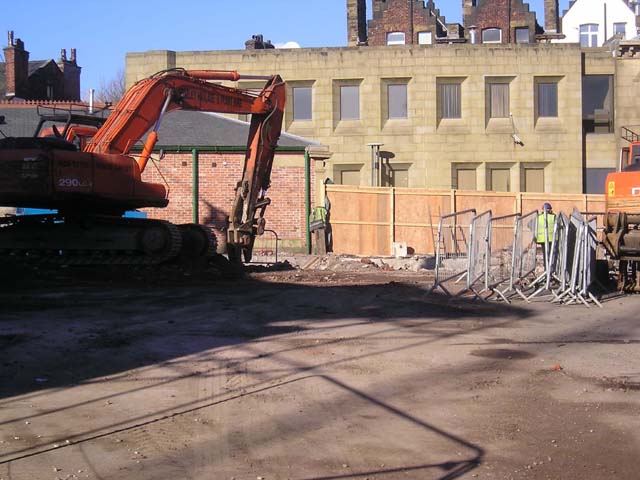
Another landmark Blackburn building has been laid low by the demolition men. The Castle Hotel in Market Street Lane is no more. It had been one of the town’s oldest inns, mentioned in August 23 1796 in connection with Mr Gornall’s dancing class and must have been at the heart of the town for the best part of three hundred years. The fact that it was rebuilt in 1810 suggest it had achieved some antiquity by that date. An item in the Blackburn Mail for August 8th of that year announced:
T Scott, late of the George Inn, Preston, being removed to the Castle, Inn, Market Place, Blackburn, begs to announce to gentlemen, travellers, his friends and the general public that the Castle Inn is now completely rebuilt, and all the alterations are finished in such a manner as to render it a house in every respect comfortable. The Travellers’ room is very spacious and all the bed and private rooms neatly fitted up, and the extensive stabling and coach house have gone through a complete repair. NB post horses and chaises as usual.
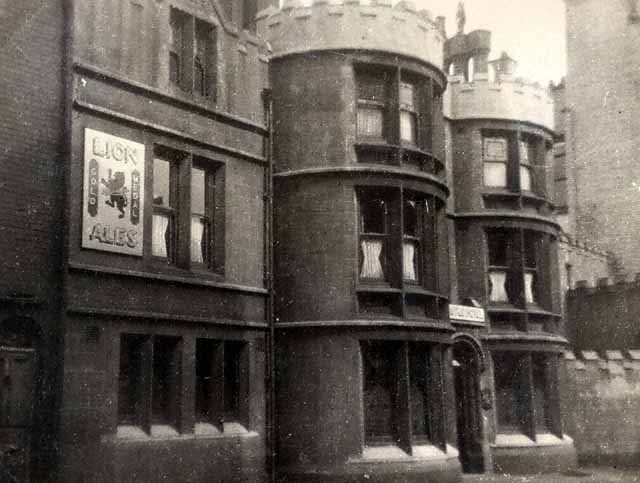
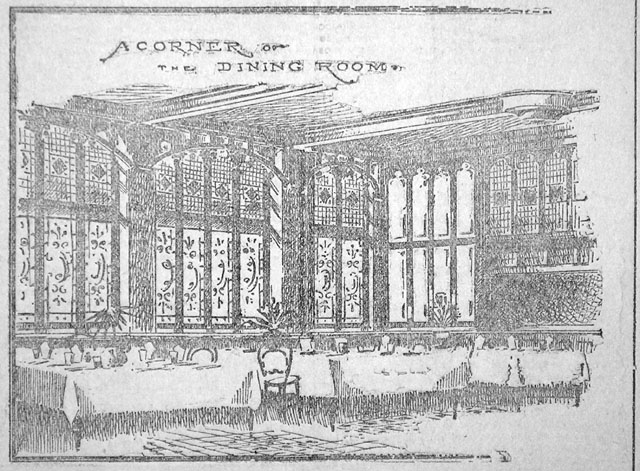
John Aspinall succeeded T Scott and was landlord until 1820 when John Chew took over. During the turbulent 1820s, the years of loom-breaking, when trade was bad throughout the town, there was a succession of landlords. James Riding, known as ‘Cock Robin’, former driver of the ‘High Flyer’ coach to Manchester took the Castle when he retired from the road in the 1850s. In the latter part of the 19th century the Castle became a meeting place for the town’s Tories. It was extensively refurbished in the 1890s with an imposing principal staircase and a dining hall 60 feet long by 20 wide, capable of seating 250. At the time John Cook of Spring Vale, Darwen was the owner.
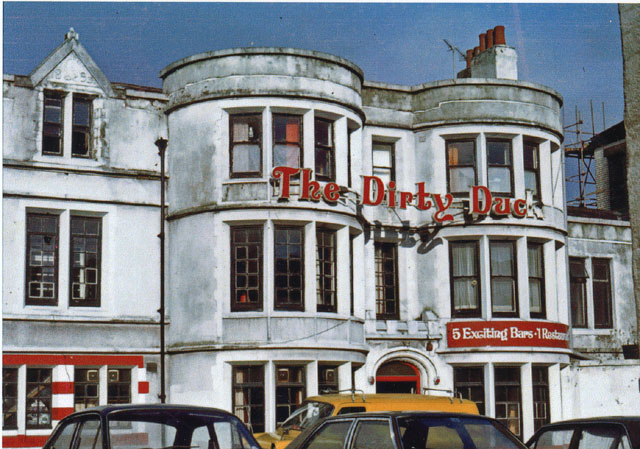
In 1972 the Castle suffered the ignominy of a name change, reopening after a refurbishment as the ‘Dirty Duck’. Andrew Stafford from Chesterfield was the new landlord. In 1975 when Alan and Sandie Bardsley were managing the pub, its first floor restaurant was turned into a night club. For many Blackburn people now in their fifties the Dirty Duck must have been the scene of their youthful Saturday nights out.
In 1980 Margaret Grimshaw took over, upgraded the premises and re-opened it under its original name. The main bar featured a disco, with another disco in the basement, where there were also facilities for live music. Ken Pilling was appointed manager and claimed he had the best bar staff in the town.
© BwD - terms and conditions
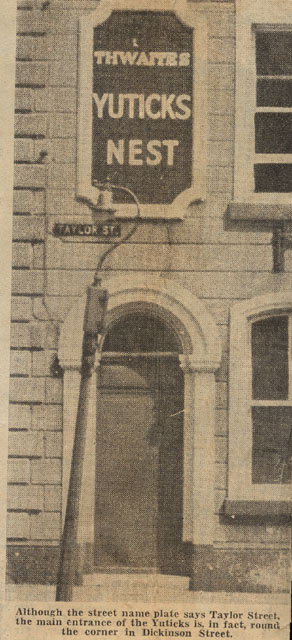
The older generation amongst you will, I have no doubt, remember the Yutick's Nest, a well known Blackburn public house on Dickinson Street. It had been built as an ordinary dwelling house in 1854, before being converted into a beer house in 1855 and called the Brick Makers Arms, or as some would have it, the Bricklayers Arms. A beer house was different from a fully licensed house; its licenses permitted it to sell only beer and not spirits, whereas a fully licensed house could sell both beer and spirits.
The earliest landlord I have found for the Yutick’s Nest was Thomas Perry, who ran the pub from 1866 to 1868. In 1874, according to Barretts Directory of Blackburn and District, a Mrs Nancy Fish was named as running it. John Fish is mentioned in the electors' list of the late 1868-69 as living at 81 Dickinson Street, which was the pub’s address. It seems they were husband and wife and Nancy ran the Pub, while John worked in the weaving shed as a drawer-in.
Some of the early landlords are given below, the dates of tenure are only rough approximates.
From when the beer house opened in 1855 until 1866 - unknown
1866 to 1867 - Thomas Perry.
1868 to 1879 - Nancy, John Fish.
1879 to 1889 - Eliss Bentley.
(In the first half of the 1880’s the house number of the pub changed from 81 to 41)
1889 to1895 - Charles Bentley.
1895 to 1900 - W.H. Keighley.
William Haworth was the longest serving landlord. He ran the pub from the 1920s right into the 1950s and in 1952 was the oldest Blackburn licensee for Daniel Thwaites.
In 1893 all the licensed houses in the County Borough of Blackburn, fully licensed houses, beer houses and off licenses, were inspected and a report made of their general condition and accommodation.
The report of the Yutick’s Nest was as given below:
Yutick’s Nest, 41 Dickenson Street, was classed as a beer house and was a tied house (that means it belonged to a particular brewery, in this case Daniel Thwaites.) There was no accommodation for travellers or persons requiring refreshment other than drink, and it had no stabling facilities. The vault was classed as small (the vault is the room with the bar in) and the cellar was fair.
The backyard was fair but the walls needed rising. The number of rooms on the ground floor, including kitchen and vault, was given as 4; the total number of suitable bedrooms was 3. Other rooms were clubroom and bathroom.
The two nearest licensed houses were both off-licenses, one 130 yards away (about 119Meters) and the other 180yards (164.5 Meters). The back entrance was regarded as suitable for police supervision. The report concludes that it was a fair premises in fair condition.
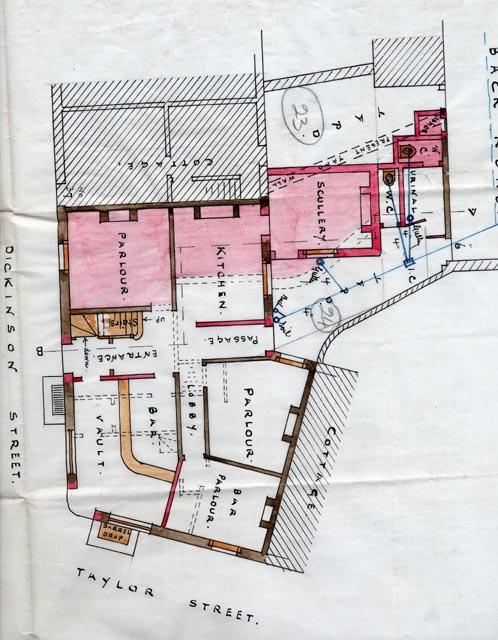
In 1903 plans were submitted by the brewery, for the pub to be extended and altered. From the plans, shown below, it seems as though the cottage next door (Number 39 Dickinson Street) was to be incorporated in the pub and alterations made to the parlour, scullery and W.C. The kitchen was to be extended and the yard wall moved. The plans were approved 27th April 1903.
In 1972 Dickinson Street was knocked down to make way for a new development and after 118 years the Yutick’s Nest was no more. However the name was not to be lost. In 1973 Daniel Thwaites had paid £13,000 pound for an acre of land at Pringle Street, part of the Queens Park redevelopment area, and in 1975 work started on a building that was to be the new Yutick’s Nest. The pub cost about £105,000 and took less than a year to build. Mr. Phillip Timson, who had recently retired from the post as production manager at Thwaites, opened it by drawing the first pint on Monday December the 7th 1976. The Blackburn Times reporting on the opening described it as a cosy and intimate pub with a games room, serving only matured draught beer, with various equipment from old cotton mills,including shuttles, healds and reeds, and a notice from 1851 from Waterfoot Mill, complete with various rules. The first landlord and lady were husband and wife Harry and Marion Roberts formerly of the Flying Dutchman at Padiham. Unfortunately the new Yutick's Nest was not destined to last long and was shut down in 1992. It was sold and reopened as a shop. It is now a community centre serving the Pringle Street area.
How The Pub Got its Name.
All the explanations as to how the pub got its name are basically the same and only differ in the telling. The Lancashire Evening Telegraph printed an article in 1972 giving this explanation;
“About 1875 the house was taken over by a man named John Fish who had three sons. All four of them were drawers in at a cotton mill. The old Lancashire name for a drawer-in was a Yutick… as the Brick Makers Arms was run by Yuticks, it was natural that many of the customers would be similarly employed and the change of name to the Yutick soon followed.” Another article in the Blackburn Times of the same year gives a similar story “ The landlord of the Yutick's Nest, a Thwaites house, was… away on holiday, [conveniently] but one of his staff had one suggestion.
He said, “ The name came about from one of the previous landlords who took the pub 30 or 40 years ago. Until then it was known as the Bricklayers Arms. This landlord used to work in a mill and the job he had was at the end of a loom that was shaped like a Yutick. I think it’s some sort of mythological bird. … When he took the pub he called it the Yutick’s Nest to remind him of the mill he worked in.” I can’t imagine what the shape of the loom would have been, or the shape of the mythological bird for that matter.
William Haworth who had been the landlord of the pub for over thirty years gives the Bricklayers Arms as the original name of the pub. He suggests a bird theme and is quoted in the Northern Daily Telegraph of 1952 as saying; “The original yutick…is a rare Australian bird that has lost the use of its wings.” Don’t all go entering “Yutick; Australian flightless bird” into your search engines, because you will not find it, neither is it found as a mythological bird or even drawer-in. There does however, seem to have been four people with the name Yutick in Allegheny, Pennsylvania in the late 19th century. So we come back to the question what is a Yutick? Well the people above who said it was a bird were not far from the truth. It is, in fact, the local (Lancashire) name for a bird. In his book “Blackburn’s Old Inns “ George Miller says, “ The original Utick was a bird called the stonechat.” However it is not the stonechat but a similar bird called the whinchat. In a book of birds printed in 1892 called “Birds of Lancashire” by H Saunders, under whinchat he gives the local names as “Eutick, Whin-check, Grass-check.” (There seems to be various ways of spelling the word, Utick, U-tick, Eutick.) In my own bird book it gives the voice of the whinchat as being Tic Tic Tu-Tic Tic which with some imagination can be heard as Yutick.
So why was the name Yutick given to the drawer-in, and what was his job (the name beamer, and loomer are also given whether they all do the same job I don’t know perhaps someone out there can tell me.)
Mr. J Whittaker in the Lancashire Evening Telegraph gave my favourite explanation of a Yutick in 1972 and explained what a beamer was (although I do not fully understand it). He said: “ Perhaps as an old-timer versed in the weaving shed lore of a past generation, I can throw some light on the subject in question. A Yutick has five legs and ejects tobacco juice with unbelievable accuracy at precisely determined intervals, according to weaving shed humour. Now for the explanation:
the name was humorously given to a loomer or beamer, whose task was to sit between a pair of weaver’s beams and piece the thousands of ends together.
To do this he would take between his fingers and thumb one end from each beam and twist them together. To assist and hold the twisted ends together he used a small can filled with China clay or size powder. He always sat between the two beams on a low three legged stool, head and shoulders at beam height and so surrounded was humorously given the nickname “Yutick’s nest.” To keep plenty of spittle in his mouth he resorted to and enjoyed a plug of twist tobacco [chewing tobacco.]”
The nest part of the name, as far as I can gather, referred to the name given by the mill workers to a three-legged stool.
The Assistant Keeper of the Queen Street Mill Textile Museum kindly gave me this explanation of a beamer:
"A beamer is a person (usually male), who is responsible for the transfer of warp yarn from bobbins or other 'packages' onto a beam. A beam is a large flanged tube around which the warp threads are evenly wrapped. The warp may then be sized (treated in a tape size machine to make it stronger), in which case a taper's beam is prepared. After being sized the warp is wound onto a weaver's beam, which is carried to the drawing-in area; the threads are passed through the healds and reed by a "drawer-in" before the assembly is taken to the loom to be "gaited up" for weaving."
A beamer could therefore either refer to the person who made up the taper's beam, or, in the case of unsized warps, the person making up a weaver's beam.
So there we have it; a Yutick is the Lancashire nickname given to a bird and, because of his actions and posture, also given to a drawer-in (beamer or loomer).
If any one has any memories, stories or any other suggestions, please feel free to contact CottonTown Web site at library@blackburn.go.uk
Remember enjoy your pints and always drink sensibly.
Cheers!
By Stephen Smith CottonTown Volunteer
Mr Alan Kay and Mrs Lynn Cooper-Kay visited the Community History Library in February 2024 to discover more about The Prince of Wales public house, 1 Grimshaw Park. Although there were other public houses in Blackburn by this name very few references to the Prince of Wales, Grimshaw Park could be found during an initial search. Lynn noted that her father, Frank Waddington, had been born in the pub and that her grandparents had been the last landlords.
With help and resources from Alan and Lynn, Community History Volunteer, Stephen Smith, has compiled the following information.
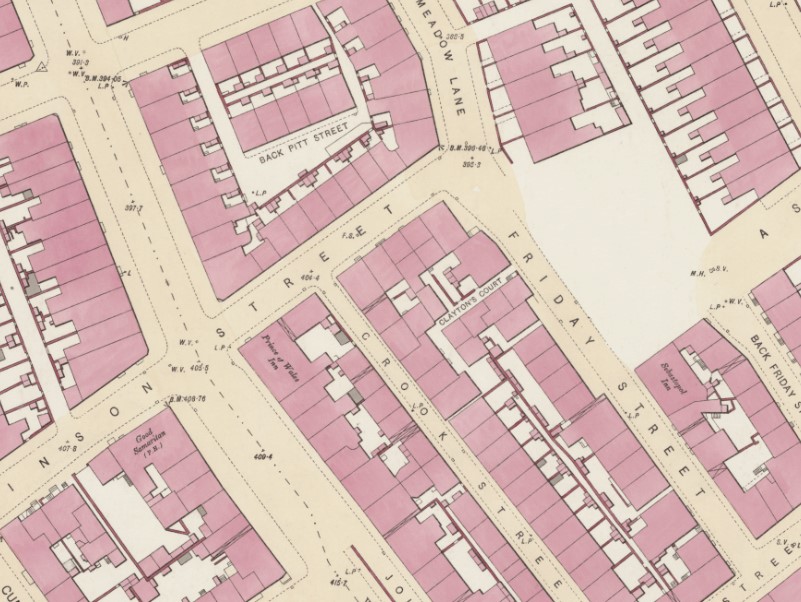
Map of Grimshaw Park, showing Friday Street where Harry was born,
Meadow Lane where he lived at age 16 and The Prince of Wales Public House
The Prince of Wales Hotel public house was situated at 1 Grimshaw Park. It was a tied house, owned by Thwaites but it is thought to have been with another brewery before Thwaites took possession of it. The landlord when it first opened its doors circa 1848 was Robert Booth. Other landlords and landladies were John Robinson (1852), Mary Duerden (1870), James Thompson (1885), William Holden (1903), Herbert Knowles (1912), Joseph Mercer (1925), Henry Waddington (1931 or 32 to 1947).
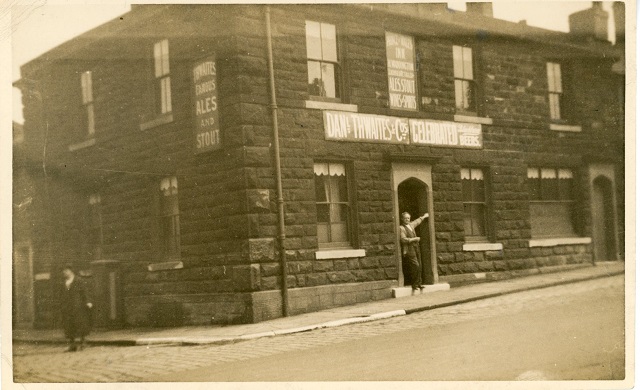
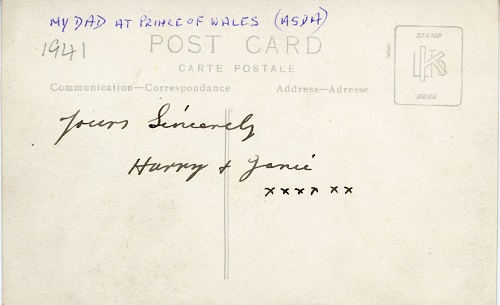
Post card showing The Prince of Wales, 1 Grimshaw Park in 1941, Harry is standing in the entrance
Henry (Harry) Waddington, the last landlord of the Prince of Wales, ran the public house until its closure in 1947. Harry then rented the property from Thwaites as a house from 1947 until his death on 14th September 1961. His wife, Jane (Janie), continued to live there until about 1963 or 1964 when the house was compulsory purchased by the Council for demolition and the regeneration of the area to make way for the Ice Arena and Asda. In 1965, Janie was living at 119 Higher Audley Street where she died on the 2nd November 1970.
Harry was the son of John Waddington (overlooker) and Elizabeth Waddington formerly Whittaker (weaver). He was born on the 14th May 1884 at 30 Friday Street, Blackburn. Harry was the second eldest of sixteen children, of which only eight survived. In the 1901 census, Harry was sixteen and he was recorded as a cotton weaver living with his parents at 24 Meadow Lane. Harry was married twice, first to Betsy Hindle in 1904 however Betsy died in 1926. Harry then married Janie Bilsborough, who had also been married before, her maiden name was Almond. Janie was born on the 15th February 1891 and she was the daughter of Matthew and Nancy of 14 Stopes Brow, Lower Darwen. Harry and Janie were married at Christ Church, Grimshaw Park on 3rd January 1931. At the time, they both lived on Rockcliffe Street and Harry was an overlooker.
%20and%20Jane%20(janie)%20Waddington%20021.jpg)
Harry and Janie behind the bar of the Prince of Wales
Their son, Frank, was born on 30th April 1932 when they were living at the Prince of Wales Inn, so, it was sometime between February 1931 and April 1932 when Harry became the Landlord of the pub.
A report compiled in 1893 on the Licensed Houses in the County Borough of Blackburn notes the following features regarding the Prince of Wales Inn, 1 Grimshaw Park:
Tied House (Thwaites).
Accommodation for Travellers and persons requiring food; None.
Stabling; None.
Vaults; Fair.
Cellars; Fair.
Back Yard; Fair but doorway leading into Crook Street Objectionable
Rooms on ground floor including kitchen and vault; 6.
Rooms suitable as Bedrooms; 2.
Other Rooms; Club Room
Distance from two nearest Licensed Houses; 22 yards Fully Licensed (Good Samaritan), 32 yards Beerhouse.
Number of tenants during last three years; 2.
Do back entrance and way to it afford adequate means of Police supervision; No.
General Remarks; Fair House.
Like many public houses in the nineteenth century the Prince of Wales was used to hold inquests. As inquests were usually in the vicinity of where the death took place, the local pub was very often the only suitable building for such purpose. They had space for the twelve jury men (no women at that time), and also, witnesses, coroner and other interested parties. In certain circumstances, the body could be stored and viewed there. The inquests were mostly accidental deaths but there were also a number of suicides and at least three manslaughters with the accused being committed to stand trial at the assizes. There were also more peaceful events. On 30th June 1859 at the Prince of Wales Mr. James Aspin, manager of Dewhurst Mill Clitheroe, was presented with a gold chain and silver pencil by the weavers.
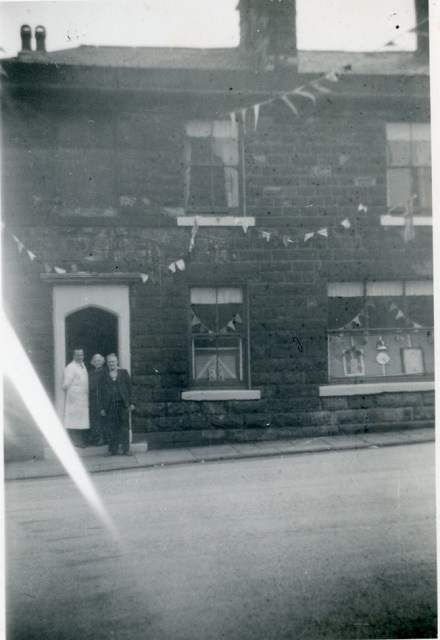
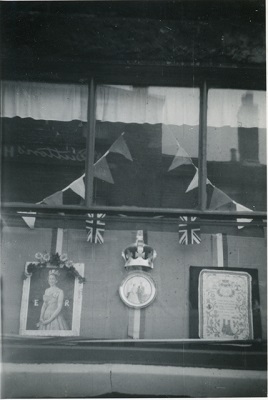
Left - Harry and Janie with a man in a white coat outside
1 Grimshaw Park decorated for the
Coronation of Queen Elizabeth II in 1953
It is no longer a pub having shut its doors in 1947
Right - A close up of the window of 1 Grimshaw Park at the Coronation of Queen Elizabeth II in 1953
Do you have any recollections, information or photographs relating to the Prince of Wales, Grimshaw Park? The Community History team at Blackburn Central Library would love to hear from you. Please contact library@blackburn.gov.uk
With grateful thanks to Lynn Cooper-Kay for sharing her story, memories and resources.
Bibliography & Resources
Barrett’s Directory of Blackburn & District, various years
General Report of the Justices of the County Borough of Blackburn on the Detailed Returns of Fully Licensed Houses & Beerhouses within the County Borough, submitted by the several Divisions of Justices who were appointed to visit all Licensed Houses within the County Borough aforesaid, together within the DETAILED RETURN of each Division, showing the General Condition and Accommodation, &c., of each Licensed House. Magistrates’ Clerk’s Office, July 1893. County Borough of Blackburn
‘Ancestry’ 1891,1901, 1911 Census,
Blackburn Standard, various dates
Old Maps National Library of Scotland
Published July 2024
This article written by Dave Whalley (Community History Volunteer) was published in the Lancashire Evening Telegraph, Wednesday May 16, 1984.
FOR CENTURIES pubs have been used by working men as meeting places in order to discuss ways and means of bettering their lot.
During the English Civil War, a network of pubs across the country served as centres of opposition for the Levellers, who were ordinary soldiers opposed to both Cromwell and the King. A bit closer to our own times, up until the 1890s, nearly all trade union meetings were held in pubs. The reason for this is simple. Many trade union societies were fairly small and could not afford their own premises.
In Blackburn, as elsewhere, during this decade pubs were playing an important role in enabling some trade unions to have their own branch meetings. The Weavers, with 10,000 members, had of course no need to use pubs. They had their own impressive headquarters in Clayton Street, and the breakaway Weavers Protection Society, with 2,500 members, also had their own premises on Princes Street. Some other smaller societies were also allowed to meet in the Clayton Street building, for example the local branch of the National Union of Life Assurance Agents, which had just thirty members.
But for many other societies, pubs provided the meeting places and often it was the one closest to the place of work. Thus, the local branch of the Amalgamated Society of Railway Servants (138 members) met every third week at the Star and Garter Hotel.
Workers who were members of the local branch of the National Union of Paper Mill workers (120 members) at Star Paper Mill met four times yearly at the Fielden Arms, Feniscowles.
Some of the pubs used in that way still survive, whilst others have not. The Dolphin Hotel, situated between Dutton's Brewery and the railway line was the meeting place of the Machine, Engine and Iron Grinders Society. The House and Ship Painters met at the Grosvenor Hotel; the Blackburn and District Coopers met at the Lord Nelson Hotel and the Iron and Steel Dressers met at the Nosegay Tavern on Leyland Street.

One of the meeting places for workers in East Lancashire was the Grosvenor Hotel, in Blackburn.
This particular pub was where the local branch of the House and Ship Painters used to get together.
It should be noted however, that one union at least seems to have been an exception to this pleasurable mixing of beer and trade union affairs. The two branches of the the Gasworkers and General Labourers Union met at the Central Temperance Hotel and the Spinners Institute, both on St. Peter Street.
Many of the small union societies in existence at the turn of the century were not, in fact, very old. But if we go back further generation or more, then a relationship can be traced between pubs and a much older form of trade unionism. Some such as the Journeymen. Cloggers' Society who met fortnightly at the Eagle and Child, Darwen Street, and the Tailors who met at the Swan Hotel, Astley Gate, represented trades going back to medieval times. Even by the middle of the nineteenth century, the prevailing form of trade unionism was different from its modern successor - the emerging textile unions, solidly based in single towns, were only in their infancy.
Tramping Unionism
The older form of organisation was known as tramping trade unionism. It was a system under which local craftsmen who were unemployed were sent "on the tramp" to other districts. An elaborate network of stopping places provided the "tramp" with a bed, food and help in finding work, if locally available. And the pub played a crucial role in the system. It became a place not only where the "tramp" would receive board and relief payment from his union based upon the number of miles he had to travel, but also a kind of informal labour exchange, a "house of call".
As one might expect, it was often a hard life. The tramp book of a brushmaker named Hall showed a record of years on the road, picking up work here and there, travelling from Preston to Halifax and Manchester to Birmingham. His book was first marked "sick", and then he ended his days, aged 40, in Blackburn, where the local secretary finally wrote "dead" across the pages of the book.
Durning the 1860s, some of our local pubs were a part of these national networks, under which working men might tramp thousands of miles in a lifetime seeking work, sometimes accompanied by their families, sometimes not. In 1862, the Holy Lamb, Northgate, was the Blackburn "house of call" for the brushmaker "on the tramp". For travelling from Bolton to Blackburn, a walking distance of 12 miles, the "tramp" received 1s/6d plus 1s for beer, and 6d for his bed, making a total of 3s (15p) in all.
He had to set off on the next leg of his round journey, this time to Preston, a distance of 10 miles. For the journey, he received a total of 2s/10d. The total number of miles tramped on the round journey from London and back was 1,178, which had to be completed within four months. After he had tramped the full circuit, he became entitled to relief at home for a while, although different trades had different rules.

The Vulcan Hotel, on the corner of Nab Lane and St. Paul's Avenue.
catered for tramping painters, tailors and also for brushmakers.
Not all trades had the same towns listed in the directories of "houses of call". Accrington and Burnley were not part of the brushmakers network. But in the 1860s, engineers called at the Bridge Inn, Church Street, Accrington and masons called at the Boot Inn, Burnley. In Blackburn, the Grapes Inn, Northgate, was the place where tramping carpenters received relief. The Vulcan Hotel, Nab Lane, must have been quite a busy place, too. It catered for tramping painters, tailors, and also, for brushmakers. Doubtless other pubs provided such facilities for other trades operating in the district.
Pubs, then, have always been much more than places to drink beer or be entertained. They have provided meeting places away from work, where workers could organise and try and meet employers on more equal terms. Earlier they were used for providing a reception for the tramping artisan, and often provided him with a bed and meal.
Bibliography
Leeson, R.A. 'Travelling Brothers: The six centuries' road from craft fellowship to trade unionism', Granada, 1980
Transcribed by Shazia Kasim. Published August 2024
Captain Nolan: His Association with Blackburn
The Charge of the Light Brigade was a disastrous British cavalry charge against Russian troops at the Battle of Balaklava that was carried out on October 25th 1854, during the Crimean War. The suicidal attack by the British Light Horse brigade led by the Earl of Cardigan charged with their sabres and lances which were useless against the Russian army who also had 30 or 40 canons. Some 110 cavalrymen were killed and160 wounded, 40 percent of the brigade. The order to charge was given by Brigadier Richard Airey and carried by Captain Louis Nolan who ordered them to attack the Russian guns immediately. When asked which guns Nolan indicated in a most disrespectful way with a sweep of his arm the guns at the end of the valley. His reasons for misdirection are unknown because he was killed in the ensuing battle. It was the most famous blunders in all military history. Nolan’s conduct has been the subject of debate ever since. Yet there has been no recent biography of Nolan. He remains an ambiguous and controversial figure to this day.
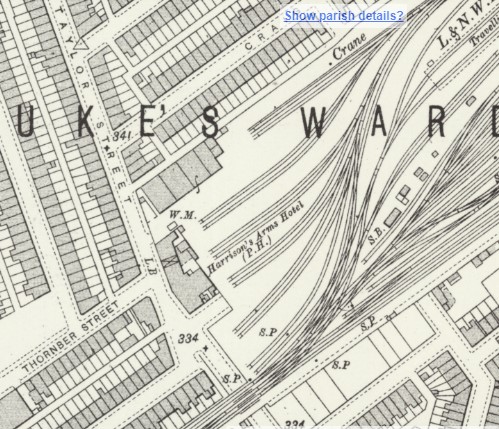
The Blackburn connection is very strange because he was certainly no hero, but Blackburn had a Thwaites pub called the Captain Nolan Inn on Captain Nolan Street. The street used to be called Harrisons Yard as the Harrison Arms pub was at the other end of the street. It was renamed in 1874 twenty years after the battle, yet four years later in 1878 the street was renamed Queen Elizabeth Street for some reason. Close to the Captain Nolan pub was the Harrison Level Railway Crossing, there had been a lot of fatalities on this crossing and the council wanted to demolish the crossing and make a bridge over the railway. The inquests on the accidents were held at the Captain Nolan Inn, the worst fatality was a five-year old boy called Richard Hindle who was sent to the Captain Nolan Inn by his babysitter for threepenny worth of whisky because she felt ill. He was hit and killed instantly.
The L.N.W.* Railway wanted to build a new Goods Yard in the area; Thwaites sold the Captain Nolan Inn which was due to be demolished in the clearance of the area for the new Goods Yard. A new bridge was finally finished in 1882. Taylor Street Goods Yard was demolished in 1980 and is now a housing estate. The Harrison Arms was demolished in 1991.
* London North Western Railway.
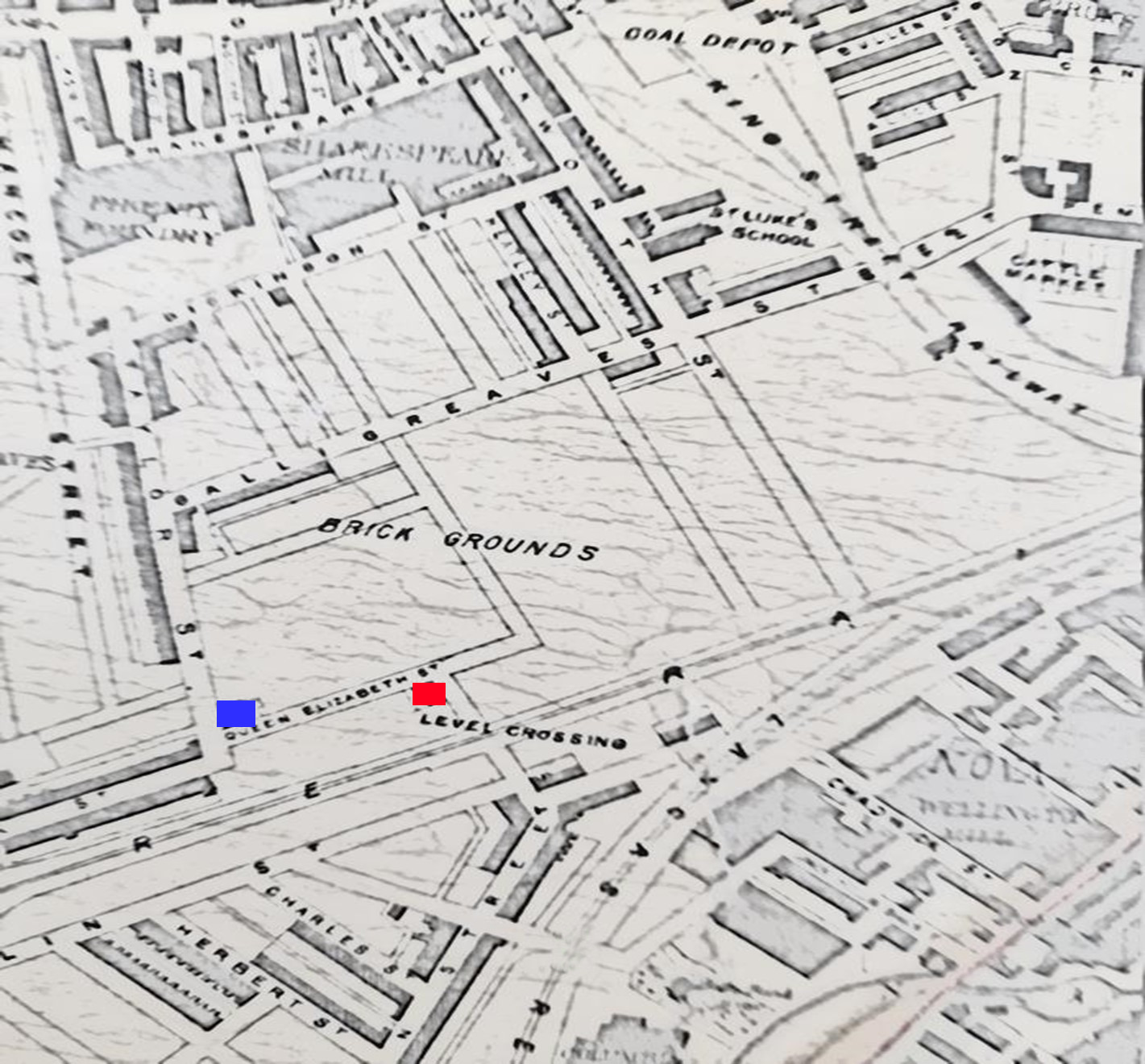
St Philips area of Blackburn 1878
The level crossing is close to the 'Captain Nolan Inn' which is coloured red.
The “Harrisons Arms” is coloured blue.
The area as changed dramatically from the 1878 map above.
The railway as expanded with new sidings and goods yards.
A bridge now replaces the level crossing. The Harrison Arms is still their but
the Captain Nolan Hotel as gone, with just a short section of
Elizabeth Street (Captain Nolan Street) remaining.
Written and researched by Jeffrey Booth (Library Volunteer)
Sources;
The Blackburn Standard various dates.
Published September 2024.

 Loading more