
 Loading more
Public Houses
Pubs and Inns of Blackburn and Darwen | Landlords of the Borough Arms | Pub Names
The Old (Black) Bull Inn | The Castle | The Yutick’s Nest | Prince of Wales Public House
Tramping Trade Unions | Captain Nolan: His Association with Blackburn
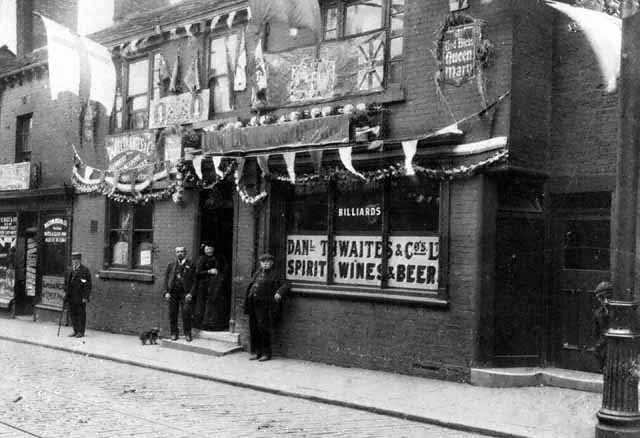
© LET - terms and conditions
The millworker did not have many escape routes from the drudgery of his life. There was so little time. The demands of the mill took up most of the day and the body’s need to recuperate much of the rest. In the evening, at the end of the day, there might be an hour or two, for the men at any rate and perhaps for younger women with no family responsibilities. For all other women there was no rest at all except in sleep and precious little of that.
There were some, those perhaps with aspirations to middle class status, who would spend time in the Mechanics’ Institute reading newspapers, borrowing books, attending lectures, but for the rest, for the vast majority, beershops, inns, hotels and taverns were their first and last resorts, their destinations and, in many cases, their destiny.
Drink was the quickest way out of town. Fatigue and anxieties would fade and be replaced by a rosy glow. Often there would be a roaring fire. There would be convivial companionship. Sometimes someone would sing or produce a fiddle. There would be games, gambling, tobacco and food in the better establishments. For a few brief hours the cotton worker would be as happy as the mill owner in his mansion with his port and cigars.
There were 207 beershops and 260 hotels, inns and taverns in Blackburn in 1881 when the population was 161,617. In Darwen there were 24 beershops and 53 hotels and inns for a population of 27,626. Most of these had traditional names: The Bull’s Head, Black Horse etc, but a few had rather more imaginative names, names that hint at the romance and poetry that pubs brought into people’s lives: The Friendship Tavern, The Sweet Willow, The Flowing Jug and The Last Rose of Summer.
In his definitive work ‘Blackburn’s Old Inns’, George Miller describes the importance of the public house.
‘We sometimes overlook the fact that these old hostelries played a far more important part in the social life of the community than do their modern counterparts. They were in a large measure self-contained units, each brewing its own ale, making its own bread, cheese and butter and often slaughtering its own cattle and pigs. In addition mine host usually kept a well-filled stable, supplying post-horses and post-chaises to travellers, draft horses to local carriers and often driving a stage or market coach himself.’
For most people the pub was far more comfortable than their homes were. Beer was the staple drink, long before tea became popular and was safer than water, which was often contaminated by drainage from sewers and privies. Business transactions could be carried out in pubs, friends could be entertained there, and there too life’s rites of passage, birth, marriage and death, could be celebrated.
By Alan Duckworth
Researched by Robert Monk
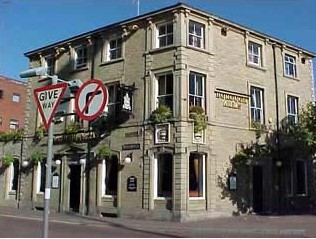
Robert Monk has been looking into the history of the Borough Arms Public House, Blackburn and has found out the following information relating to previous landlords of the building. Do you know any additional information which can be added to the information below? If so, email us at Cottontown@blackburn.gov.uk
The Borough Arms was built in the late 1850s in Market Square, Blackburn by a James CAUGHEY. From various trade directories, the landlords seem to have been:
1858 Maria Caughey
1861 Maria Caughey (the 1861 census shows that she has her nephew Robert Caughey MONK staying while 'learning cotton manufacturiing')
1865 - 1869 John Lund (who married Maria CAUGHEY)
1874 Mrs. Mary Caughey (presumably Mary GUEST b. 1814 (wife of James CAUGHEY) who was still alive in 1881 census)
1878 Amos Amistead
1881 to 1894 Mr. Richard Bradshaw
1900 to 1903 Miss F Burnett
1905 Robert Brownlee
1912 Walter Southcott
1915 John T Simpson
1925 Bertha McLure
1935 Eugenie Perry
1939 Stephen Howarth
1942 Harry Smith
1951 Annie Kitson
In the late 1950s Blackburn council took over the building to use as an annex for the town hall. The pub was used to house among other departments at various times, the Housing Dept, the Family and Community Project, the Cemeteries Dept, Rodent Control Operations and finally the Registrar of Deaths
How appropriate it was the Registrar of Deaths was last in the pub before it was decided that it should be sold back to a brewery.
The licensee was obtained in a exchange deal, which meant the end of The Legs O Man, one of Blackburn's older pubs (The pub was demolished and the site was landscaped to open up the view of the cathedral.)
The Borough Arms, as we know it today was reopened in December 1977. Mr Harry Deacon (a Yorkshire man) had the honour of being the licensee of Bass's first new pub in Blackburn town centre.
Any comments or additional information about the Arms would be appreciated. Thanks to Ian Miller for the post 1950s update.
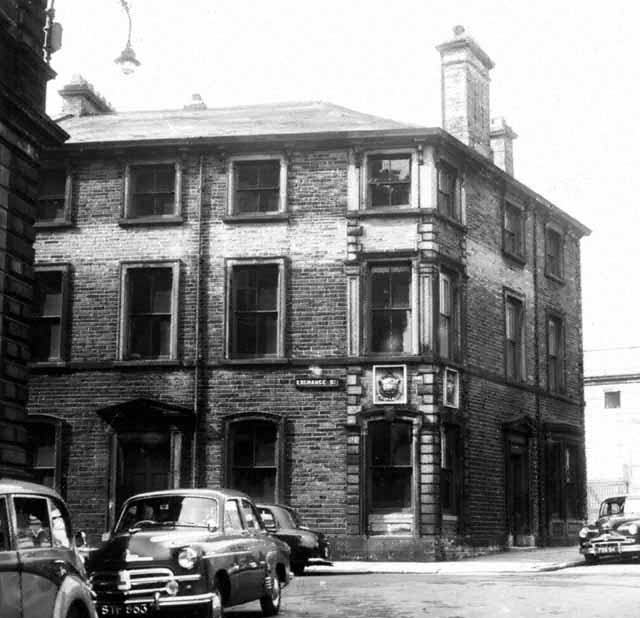
© LET - terms and conditions
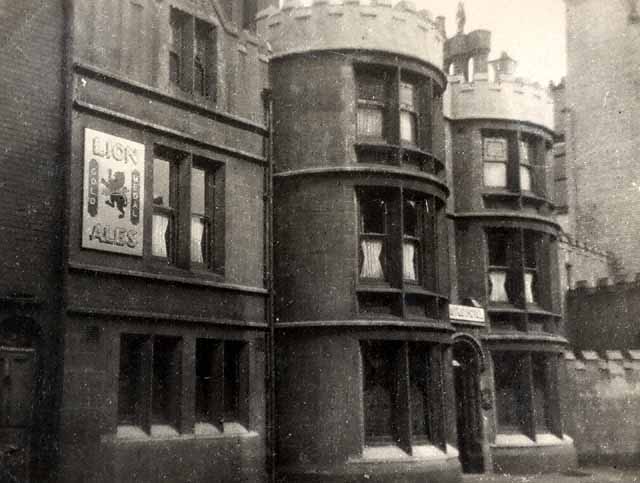
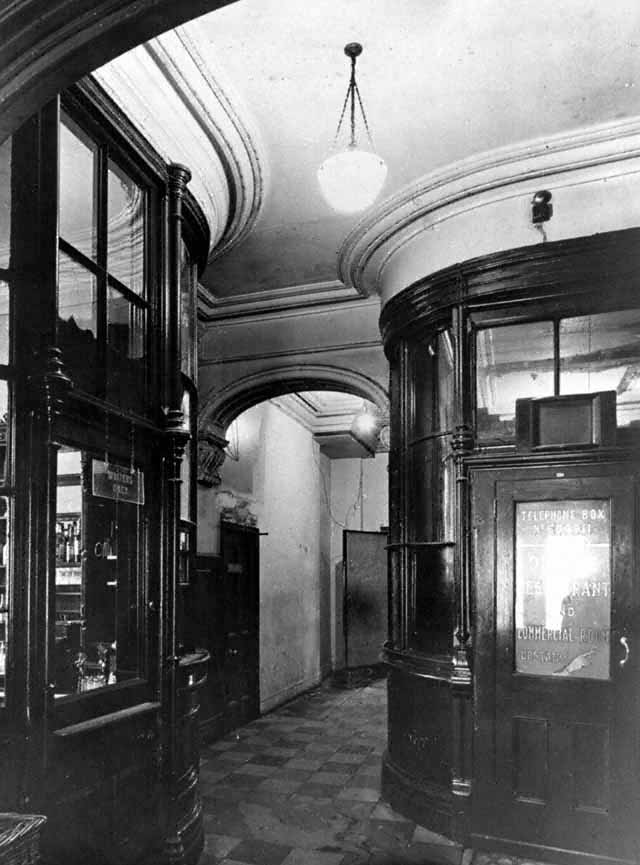
The Borough Arms on Exchange Street, Blackburn. Date unknown.
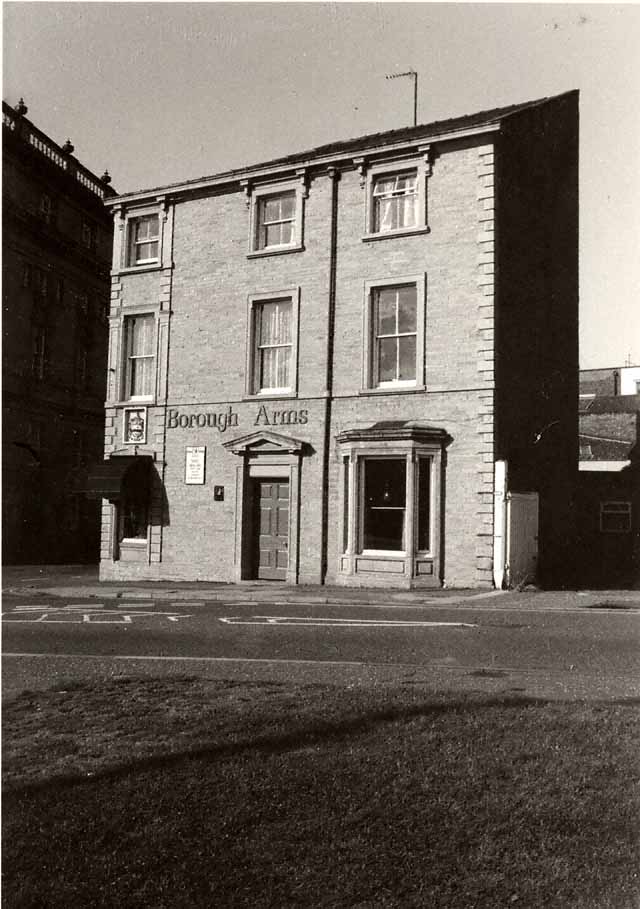
© BwD - terms and conditions
The Borough Arms on Exchange Street, Blackburn. Date unknown.
Pub Names
In Roman times pubs would identify themselves by hanging a holly or ivy bush outside the door. By the Middle Ages wooden signs depicting a local association began to appear. The Royal Oaks, Red Lions, Blue Boars, Crowns, and King's Arms proliferated. Early in the 19th century Blackburn had 77 such signs on display. Northgate had the most, followed by Darwen Street and then Church Street.
On one side of Northgate were the Joiner's Arms, the King's Arms, the Black Horse, the Jolly Sailor, the Red Lion, the Punch Bowl, the Boar's Head, and the General Wolf. On the other side were the Mason's Arms, the Nag's Head, the Holy Lamb, the Black Greyhound, and the Dog and Duck. There were three White Bulls in the town, two Red Lions, two Duke of Wellingtons and two Lord Nelsons.
Among the more unusual names were Mother Redcap, Dr Syntax, Who Could ha' thowt it, Utick's Nest, Stop and Rest, New Drop, and Hole i' th'Wall. Mother Redcap was the slang name for an old ale-wife. Dr Syntax was a famed 18th century character whose rhymed adventures were illustrated by Rowlandson. Uticks were birds and it was thought that the squatting position reachers-in adopted when at work at the mill was like the birds on their nests. New Drop referred to the gallows.
Some old inn names underwent a transformation over the years through misunderstanding and misinterpretation. The Bacchanals became the Bag o'Nails; the Infante of Castile became the Elephant and Castle; the God Encompasses became the Goat and Compasses and the Bologne Mouth became the Bull and Mouth. In Blackburn the Boleyn Butchered became the Bull and Butcher. With names like the Fruits of Industry, the Lancashire Lad, and the Labour in Vain folk were expressing themselves, proclaiming an individuality that had few other outlets.
BY W.A. Abram
Taken from the Blackburn Standard of 19th March 1890
PART ONE
Our paper will start with some notes respecting the Old Bull Inn (formerly the “Black Bull Inn”), at the “Cross,” in Blackburn, which there can be no doubt, is by much the most ancient inn of the town and district. This inn, indeed, has so long existed that its origin and early record are a blank, wrapt in the obscurity of a far-reaching antiquity. I could not pretend to say, even to a couple of centuries, when this hostelry was founded. If it were suggested that it stood where 500 years ago, we should be on the safe side, but it may well have endured, as a place of public accommodation, 700 years. With the exception of the Church of the parish of Blackburn, and the earliest abode of the De Blackburn’s, lords of the manor before and after the Conquest (which was more like a small castle or square tower than what we now call a house, and the very site of which is doubtful), with these two exceptions, no building can be thought of as being erected upon ground which is now covered with the thousands of buildings forming Blackburn, that might precede in the date of its foundation the first inn planted in the midst of the primitive settlement on the banks of the Blackbourne brook. The old water-mill of the lord of the Ville might be found a necessity earlier than the inn: and it is shown by charters that there was such a mill in the township of Blackburn more than 600 years ago, at which the corn of the lords tenants was to be ground, but the mill was not a part of the town at that period. It stood isolated at a point on the stream considerably below the cluster of tenements and the Church constituting the town. Blackburn Township then was what should be called now a rural one, and the farm tenants and labourers, spread over its superficies, were more numerous than the little colony of craftsmen whose domiciles were grouped in the centre of the township so as to form a sort of rudimentary-street. The water mill was for the hinds, the cultivators of the soil. The inn was for the service of persons who frequented the market and fairs which the lord of the manor was empowered to establish, and tolls whereof were the lord’s requisite.
But the original hostelry of the town had another reason for its existence, the recollection whereof leads to the conclusion that it must have been provided as early as been indicated. Going back to the times of the Plantagenet kings, say from A.D. 1200 to 1400, the Parish Church of Blackburn served a tract of country extending about ten miles from north to south (i.e., from the bank of the Ribble to the summits of the moors beyond Darwen), and some seven miles from east to west, from the boundary of Rishton to the boundary of Pleasington. There were no chapels-of-ease in Over Darwen, Tockholes, Billington, and Balderstone until long subsequently. The nearest parochial chapel was that of Great Harwood, five miles to the north-east, and Samlesbury chapel was six miles away on the north-west. The Parish Church at Blackburn was therefore the sole place of Christian worship for the inhabitants not only of Blackburn township but of the surrounding townships of Rishton, Little Harwood, Wilpshire-cum-Dinckley, Billington, Salesbury, Clayton-le-Dale, Osbaldeston, Balderstone, Mellor, Ramesgreave, Pleasington, Witton, Livesey-cum-Tockholes, Over Darwen, Eccleshill, Lower Darwen, and Yate-cum-Pickup Bank. The scattered dwellers in all these places, if they did not frequent their parish Church regularly, Sunday by Sunday, were expected to attend it several times a year, on special days in the calendar of the Church: and for christening of their infants, for the burial of their dead, and for the marriage rite, they were bound to come to Blackburn Church. It will therefore be understood that a christening party which had travelled several miles with a child for baptism, or those who brought from the outlying parts of the parish a corpse for burial, which had to be carried by bearers all the way, after the burial in the churchyard, or baptism in the church, were greatly in need of a public hostelry near at hand, to which they could repair for rest and refreshment, before starting on the homeward journey. Nor would a marriage party be likely to dispense with the hospitable inn, as soon as the wedding had been consummated. Those who travelled on horseback to church on such occasions, or to attend divine service on the Sunday, or at other times, would likewise require a house of call at which their horses could be baited. These circumstances I refer to in order to illustrate the different conditions of ancient church-going, which account for almost invariable proximity, in any old-time county town or village of the inn to the church. The requirement of the hostelry was so constant and urgent by all those who for any purpose came to the Parish Church from homesteads situated many miles apart from the Church, that since necessity causes supply of accommodation, the setting up of inns in the vicinity of Parish Churches is with certainty referred to a time not far post-dating the foundation of such Churches themselves.
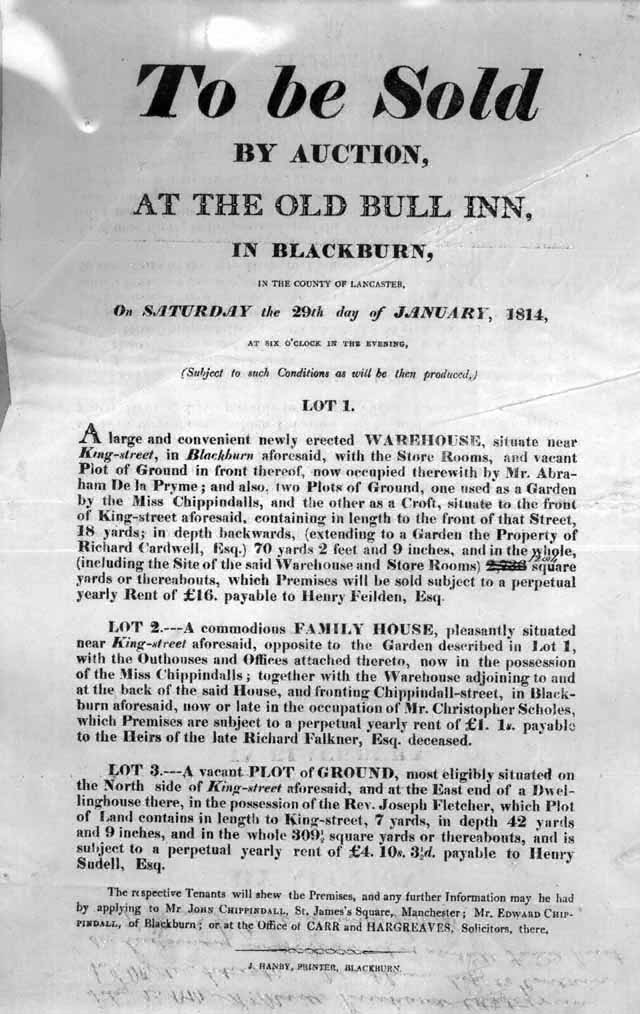
Now in the instance under are present notice, the original Inn of Blackburn, its very position renders assurance doubly sure that this hostelry is as ancient as the town, and was one of the first structures, after the Church, erected in the midst of the Ville. Its site lay between the churchyard and the site of the old Church on one side, and the ancient Gothic Market-Cross, in the old Market place, on the other side of it. The inn stood at the point of the junction of the two oldest streets of the town—Church-street and Darwen-street. It is not to be supposed that the owner of the ground would suffer a private tenement to be built on a site so eligible for an inn. The next fact to be adduced is that the site belonged to the Rectory estate which included a moiety of the manor of Blackburn. The early lords were also hereditary Rectors of the Church. It is about 730 years since that half of Blackburn manor, embracing the Church and advowson, was secured by Henry de Lacy and given as one of it richest endowments to the monastery of Stanlow, which was afterwards translated to Whalley. From that period, and for 250 years, the Abbot and Monks of Whalley owned the Rectory of Blackburn Church, with half the township of Blackburn as its Glebe, out of which a portion had been taken for a Vicar’s Glebe, and one of the monks henceforth was Vicar until the Abbey was suppressed. Unless the inn existed prior to the acquisition of the Rectory by the Monastery of Whalley, I take it that owes its origin to the Abbot and Monks of the fraternity, for I am satisfied that there was an inn upon the site long before the fall of the Monastery in 1537. The Abbots and Monks might be ascetics within the Abbey walls but we don’t believe they were so out of doors. They would have no scruples in opening a hostelry close by the gates of the Church for the entertainment of parishioners coming to mass and travellers. Nay, I suspect that the particular monks who officiated as Vicars of the Church must have dwelt at Whalley within the Abbey ordinarily, in order to live up to the rules of the order, and that they had no vicarage-house at Blackburn, but had a chamber at the inn set apart for their reception when they rode over to Blackburn. There is no proof that a Vicar’s house stood in the churchyard until after the Reformation. One appears to have been built in 1579. In the absence of a vicarage the inn was the inevitable quarters of the Monk-Vicars. The Chantry priests who were a sort of pre-Reformation curate, no doubt lodged in the town, and one of them was the schoolmaster under the Earl of Derby’s foundation (1514).
After the Rectory estate, along with the Church and Vicar’s endowment, were taken away from the Abbot and monks of Whalley, and exchanged by the Crown for another estate with the Archbishop of Canterbury, the Primates became Rectors of Blackburn. And now we reach the point at which conjecture and inference give place to positive knowledge. The hostelry from the middle of the 16th century has been part of the possessions in Blackburn of the See of Canterbury. The Primates have been ground-landlords of the inn. Indeed the old premises of the Inn pertained to the rectory, and the tenants paid a low rental for the house, which was increased later on. In the 18th century the Archbishop of Canterbury owned two inns in Blackburn, one being the “Black Bull,” and the other the “White Horse”.
At the close of Elizabeth’s reign, and the beginning of the seventeenth century, the town having increased sufficiently to support them, two or three other hostelries had been established besides the “Black Bull,” and by the end of the seventeenth century they may have numbered half a dozen.
Blackburn’s first inn had for its sign the “Black Bull” as far as it can be traced; whether it ever had a different sign before that is not known. The name of the “Black Bull” was changed to the “Old Black Bull” when a “New Black Bull” was started in rivalry; and eventually the sign was shortened to the “Old Bull”. The “Bull” must have entertained many travellers of note. The Justices of the district held their judicial inquires in the principal inn of a town, when no court-houses were provided. One such inquiry was held at a Blackburn inn, the house of Richard Sharples, in 1697; and that is likely to have been the “Bull” At the town or village inn, too, the lord of the manors held their annual courts to deal with disputes and complaints or defaults of tenants. In war time, the inns would be liable to fall by turns into the hands of the soldiers of one party or the other as their fortunes fluctuated, and the “Bull” at Blackburn, it may be imagined, was the scene of many a martial incident during the Civil Wars in the 15th, 16th, and 17th, centuries, when “the tide of battle rolled” in this direction. For instance, when in 1643 the Royalist and Roundhead troopers and militia occupied this town alternately, and drove each other out or were forced to evacuate the place, the church and church tower were garrisoned by the defenders; and on one occasion the school-house in the churchyard was converted into a barrack for the soldiers, who broke the glass of the windows and left the school-room in a dismantled condition when they decamped. The inn standing only a few yards from the church tower and the school-house, would share their fate. Its rooms would be crowded with roistering troopers and pike men, and the ale-barrels in its cellars would be emptied. The innkeeper would be thankful if his household goods were not reduced to a wreck during the military occupation, before he was suffered to resume possession and control of his own business. His losses through the injury to his trade, and the consumption of his liquor and victuals by armed partisans who had no idea of paying for them, would be inevitably serious. When the Civil War between King and Parliament was over, the country became more settled, and under the Protectorate of Cromwell, the appointment of quarters for detachments of the regular army posted in a town or district was the duty of the quartermaster, and Mr. William Yates, who was quartermaster in Blackburn, would billet the soldiers at the several inns, and the innkeepers would be entitled to fair payment for their rations. A civilian traveller in the first year of the reign of Queen Anne, passing through Blackburn, mentions in his journal that whilst his dinner was being got ready at the inn, he went out and viewed the church and town. No doubt the hostelry referred to was the “Black Bull” beside the Church.
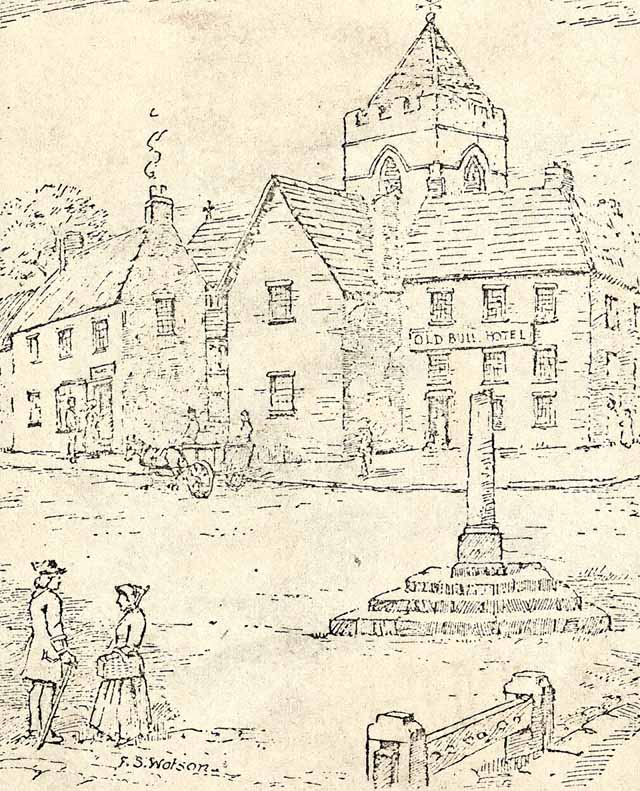
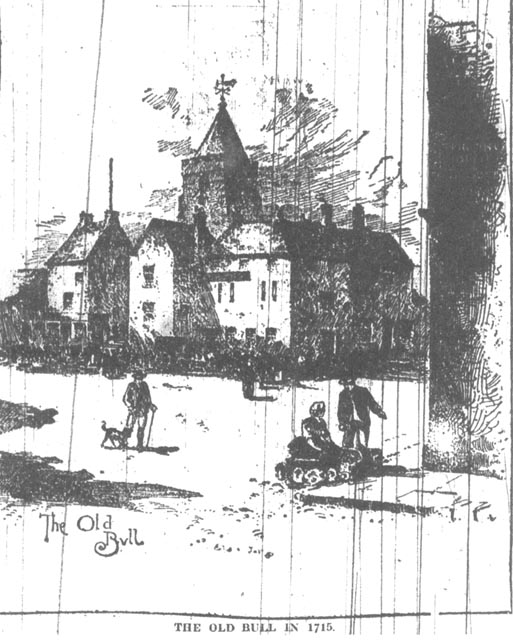
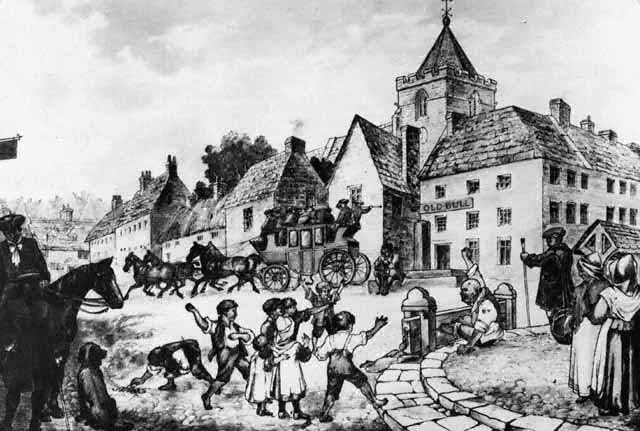
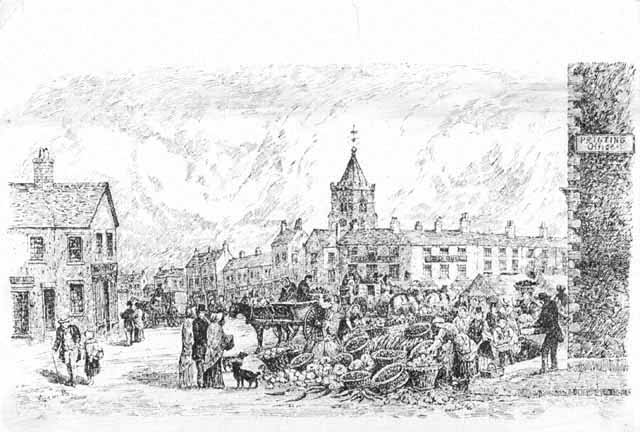
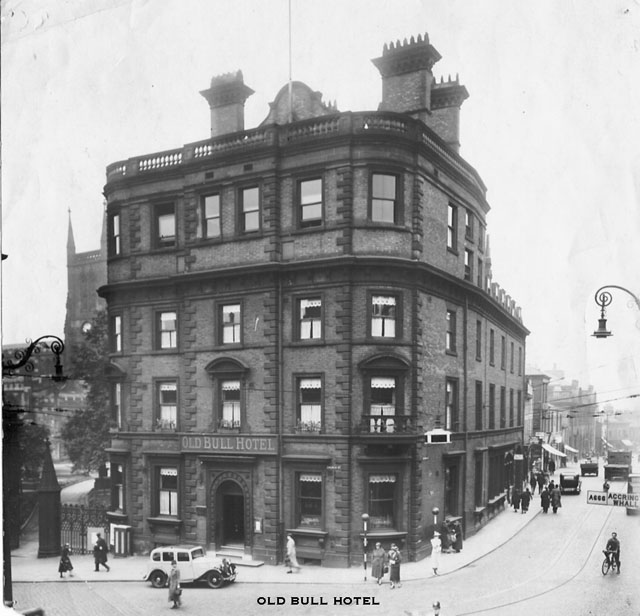
The interesting picture of “Old Blackburn” painted by Mr. Charles Cattermole for the Committee of Blackburn Free Library, which hangs in the large Museum Room of the institution, and after which the artist has executed an etching, was in its details of buildings, &c., in the centre of the old town, produced from data supplied by Mr. Thomas Ainsworth, Solicitor, who remembers the old Market-Place at the “Cross” as it was more that seventy years since, by Mr. McCallum, Borough Engineer, Mr. L.S. Walmsley, and myself. It represents a conception of the scene at the “Cross” in 1715, when the Jacobite Rebel army had reached Preston, and the townsmen and Yeomen of Blackburn and the neighbourhood were mustered by Captain Ainsworth and Vicar Holme to assist in resisting the progress of the Rebels. The old Church Tower and the Black Bull Inn in front of it, are the two most conspicuous buildings in the picture. The inn is depicted as it is known to have appeared about 100 years after the event, say, between 1815 and 1820, but it was then a very old house, and showed no indications of having been materially altered in its external features since it was erected (replacing certainly a much more ancient building). Therefore I think the view of this hostelry in Mr. Cattermole’s painting may be accepted as substantially an accurate presentment of the “Old Black Bull” of 1715, and of a lengthened period anterior to that date. Its aspect is antiquated enough. It resembles several of the oldest houses erected for inns which remain in the smaller towns and villages of Lancashire. So it stood with its plain doorways, small mullioned windows, gabled end projecting on the left, and steep roof, fronting to Church-street and to Darwen-street, with two passages into the churchyard and to the Church at either end of the house, in the times of the Stuarts, of Cromwell, of William the third, Anne, and of the four Georges, and until it was demolished and a larger and more convenient house was erected upon its site [this was in 1847]. The quaint picture of the “Old Bull Inn,” tower of the old Parish Church and old Market-Place, which is shown at the head of this article, was prepared by Messrs. Waterlow, of London, eminent Book illustrators. In it the hostelry is seen as it was in the early years of the nineteenth century.
Taken from the Blackburn Standard of 26th March 1890
Part 2
In the first article, last week, on the oldest of our Blackburn Inns, the Old (Black) Bull, illustrated by a view of the former antiquated structure of the house brought its memorials down to the beginning of the eighteenth century. From that period we now continue them. During most of the years between 1720 and 1740, the host of this inn was Mr. Thomas Johnson. There were two Thomas Johnsons, townsmen of respectability about then, father and son, one of whom was the landlord of the “Bull!” In1731, “Mr. Thomas Johnson of Bolton” was elected Governor of the Grammar School, and in 1737, “Mr Thomas Johnson, Junior,” was chosen to be Governor, if the elder Mr. Johnson had lived in Blackburn prior to 1731, and had then removed to Bolton the likelihood is that his son, the younger Mr. Thomas Johnson, was left in occupancy of the inn. At any rate, amongst the names of the tenants of the Rectory in Blackburn (70 in number) inscribed upon the curious map or plan of the rectory Estate made in 1739, now in possession of Lieut.-General Feilden, M.P., Lord of the Manor, the first tenement named is the “Black Bull Inn,” and the tenant was “Thomas Johnson,” who likewise held under the Archbishop of Canterbury as Rector a piece of ground, known as “Dixon’s” parcel of the rectorial glebe. It cannot have been much later than this (1739) that Mr. Thomas Johnson gave up the tenancy of the hostelry. He died in 1763. His successor in occupation before 1745 was John Yates.
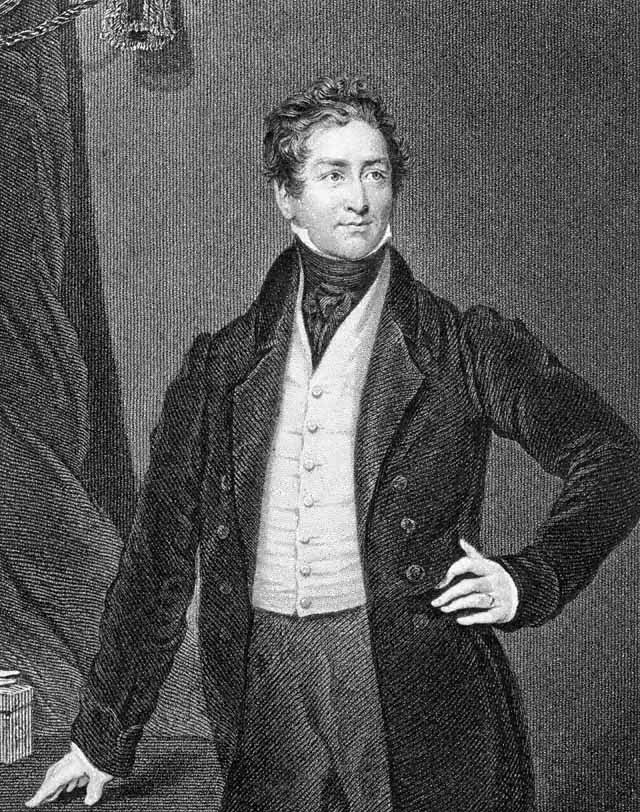
© BwD - terms and conditions
Mr. John Yates and his son, Mr. William Yates, are the most interesting persons associated with the keeping of Blackburn’s most important inn, on account of their personal relations with the Peels. The Yates’s (of the Blackburn branch of the numerous local clans) had for two or three generations at least been farmers and house holders on the Rectory estate in this township. John and William Yates occur as tenants of the Rectory in 1663, and the Christian names being the same suggest that they were progenitors of the John and William Yates who flourished nearly a century later; whilst that “William Yates innkeeper,” whom I mentioned [in part 1] as having died in 1660 would be one of an earlier generation of the family. Mr. John Yates was born about 1700-0, and he must have married about 1735. His eldest son, William, was born in 1739, and another son was Thomas Yates, born in 1741.
The “Black Bull” being, as I stated, the property of the Rectory, it was the custom of the lessee of the estate to hold his rent audit at this house: and found in the Book of the Accounts of the Rectory of Blackburn, kept after 1746 by Mr. John Bolton, entries of small payments to the to the innkeeper on these occasions for ale served to the tenants who came to pay their rents. Here is one instance: “1748. Paid John Yates for the Ale given to Tenants when they paid their Christmas Rent 3s 4d.
Mr John Yates was one of the original members of the Blackburn Subscription Bowling Green upon its establishment in 1753, and in 1772 after he had retired from business as an innkeeper, and had leisure to devote to the duties, he served the Green for one year as “Steward,” or Hon. Treasurer.
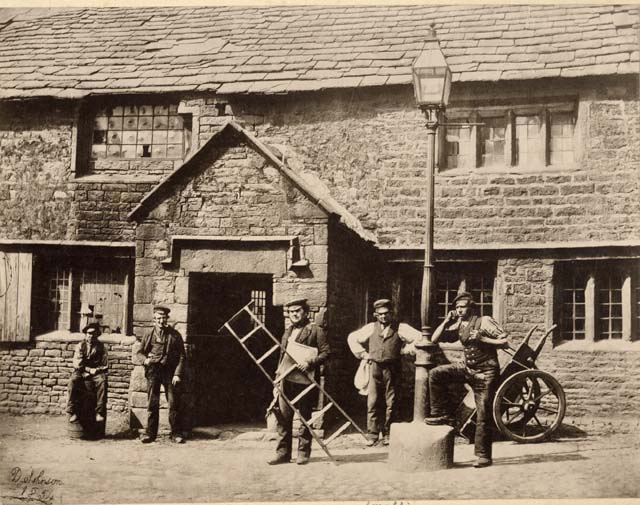
© BwD - terms and conditions
The “Black Bull” must have prospered exceptionally under the management of Mr. John Yates and his good wife, for within a period of perhaps a quarter of a century that he was tenant of it, he was to save what in those modest days was considered a comfortable competency. The inn was in repute with travellers in Mr. Yates’s time as a good posting house, and those were the days when, if any, not more than one or two occasional coaches ran upon the only practicable road for coaches which traversed Blackburn, namely, the turnpike from Preston (through Hoghton and Livesey), and from Blackburn to Burnley through Clayton-le-Moors and Padiham. People were obliged to travel distances too long to be accomplished on foot, and who did not keep their own horses, hired either a post-horse or a post-chaise, at the chief inn of a country-town, which carried them forward as far as the next town, and then returned. The “Black Bull” in this town was the best if not the only posting-house 130 to 150 years since, and the posting service of course brought much good custom to the houses.
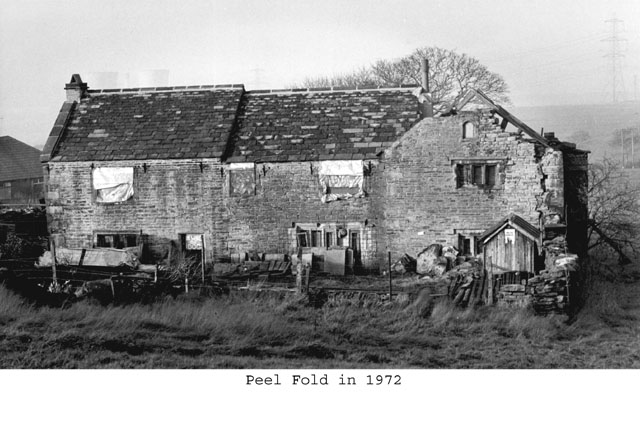
A neighbour who was on close terms of friendship with Mr. John Yates was Mr. Robert Peel, who, besides farming his own land at Peel fold, and a second farm under the Rectory at Hole House, on the easterly side of the township of Blackburn, had entered into the textile trade of Blackburn as a chapman, and had made some experiments in the new art of calico-printing by means of wooden blocks upon which a floral pattern was engraved. Mr. Peel had also helped another inventive neighbour, James Hargreaves, of Stanhill, to bring out his spinning frame, called the “Jenny,” and to produce a workable engine for the carding of cotton. Mr. Robert Peel had several vigorous sons who were growing to manhood, and whom it was his wish to start in a trade in which he saw possibilities of vast development. His friend, Mr. John Yates of the “Black Bull,” was similarly minded and circumstanced. His own two sons, William and Thomas, were both of age between 1762 and 1766, both had gone into trade as “chapmen,” and were as eager to push their way in life as M. Peel’s sons. The father, Mr. John Yates, had saved a few thousands, and had more capital at his command than Mr. Robert Peel. The two men often met and exchanged views on the subject of what they agreed was a grand opening for trading enterprise. Sir Lawrence Peel in his life of Sir Robert Peel the Statesman has related how the partnership of the Yates and Peel came about. Mr Robert Peel’s brother-in-law, Mr. Jonathan Haworth, had been in London for a year or two, learning all that he could of the art of printing calicoes there; and when he came home to Blackburn, he pressed Mr. Robert Peel to join him in commencing calico printing in this locality. They decided to join, but they wanted money. Sir Lawrence writes: “Mr. Peel raised money for the undertaking by the mortgage of his small paternal property. Mr Haworth had some money, but their united means did not furnish capital enough, and they therefore looked out for a partner with money. Mr. William Yates, or his parents, had kept a small inn at Blackburn, called, I believe, the Black Bull. In that line he or they had made or saved some money; he was willing to embark it in a scheme which promised well, and the three commenced business together under the name, style and firm of Haworth, Peel and Yates; they manufactures and printed their own cloth, and established a warehouse in Manchester for its sale.”
There is one mistake or misleading word in the above passage from Sir Lawrence Peel’s book. The inn kept by Mr. William Yates’s farther and mother is not correctly described a “small” one. It was a large inn for a town the size of Blackburn then, and the most important and well-frequented inn in the place. Mr Yates could not have put by the money he did within some twenty years in an insignificant public-house. Just before his son, Mr. William Yates went partner with Mr. Robert Peel and Mr. Haworth, he (the son) married at Blackburn Parish Church on February 22nd 1764—“William Yates of Blackburn, Gentleman, and Mary Bentley, Spinster, by License.” One of the witnesses was the bridegroom’s brother, “Thomas Yates,” who himself, the next year took a wife—1765, April 25. At Blackburn Parish Church, “Thomas Yates, of Blackburn, Gentleman, and Alice Bulcock, Spinster, by License.” Mr. William Yates witnessed the marriage.
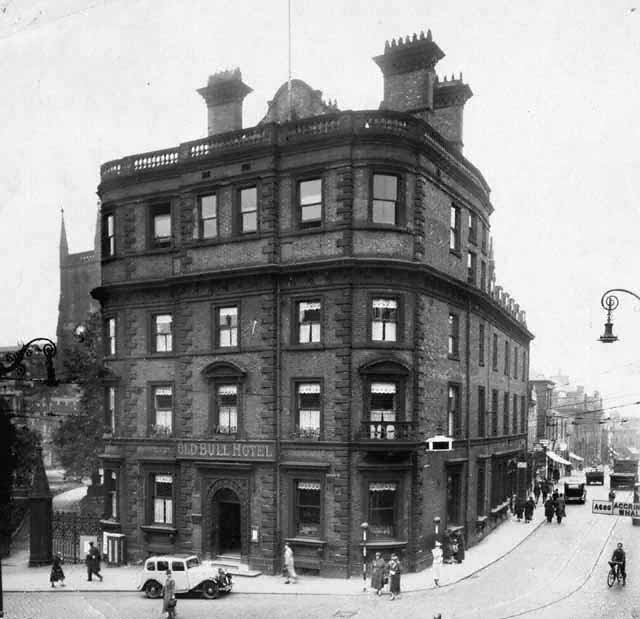
© BwD - terms and conditions
Blackburn’s first inn had for its sign the “Black Bull” as far as it can be traced; whether it ever had a different sign before that is not known. The name of the “Black Bull” was changed to the “Old Black Bull” when a “New Black Bull” was started in rivalry; and eventually the sign was shortened to the “Old Bull”. The “Bull” must have entertained many travellers of note. The Justices of the district held their judicial inquires in the principal inn of a town, when no court-houses were provided. One such inquiry was held at a Blackburn inn, the house of Richard Sharples, in 1697; and that is likely to have been the “Bull” At the town or village inn, too, the lord of the manors held their annual courts to deal with disputes and complaints or defaults of tenants. In war time, the inns would be liable to fall by turns into the hands of the soldiers of one party or the other as their fortunes fluctuated, and the “Bull” at Blackburn, it may be imagined, was the scene of many a martial incident during the Civil Wars in the 15th, 16th, and 17th, centuries, when “the tide of battle rolled” in this direction. For instance, when in 1643 the Royalist and Roundhead troopers and militia occupied this town alternately, and drove each other out or were forced to evacuate the place, the church and church tower were garrisoned by the defenders; and on one occasion the school-house in the churchyard was converted into a barrack for the soldiers, who broke the glass of the windows and left the school-room in a dismantled condition when they decamped. The inn standing only a few yards from the church tower and the school-house, would share their fate. Its rooms would be crowded with roistering troopers and pike men, and the ale-barrels in its cellars would be emptied. The innkeeper would be thankful if his household goods were not reduced to a wreck during the military occupation, before he was suffered to resume possession and control of his own business. His losses through the injury to his trade, and the consumption of his liquor and victuals by armed partisans who had no idea of paying for them, would be inevitably serious. When the Civil War between King and Parliament was over, the country became more settled, and under the Protectorate of Cromwell, the appointment of quarters for detachments of the regular army posted in a town or district was the duty of the quartermaster, and Mr. William Yates, who was quartermaster in Blackburn, would billet the soldiers at the several inns, and the innkeepers would be entitled to fair payment for their rations. A civilian traveller in the first year of the reign of Queen Anne, passing through Blackburn, mentions in his journal that whilst his dinner was being got ready at the inn, he went out and viewed the church and town. No doubt the hostelry referred to was the “Black Bull” beside the Church.
© LET - terms and conditions
The transfer of this inn was affected, towards the latter end of 1769, to Mr. Rixon, who will be noticed in the next article. In 1772, three years after his retirement from business, Mr. John Yates was elected a Governor of the Grammar School. He lived eleven years longer, and died in a good old age, in May, 1781. Buried in the family grave in the Parish Churchyard, May 13th, 1781, he is described in the Register of Burials as “John Yates, of Blackburn, yeoman.”
His wife outlived him, and died in her 85th year, in June, 1797, whilst on a visit to her son, Mr. William Yates, Calico Printer, at his mansion, Springside, near Bury.
Mr. Thomas Yates, of Blackburn, the younger son of John Yates, died aged 48 years, in November, 1789, buried November 27th.
Mr William Yates, the elder son of Mr. John Yates of the “Black Bull,” who had spent nearly thirty years of his life in the parental home, was an equally remarkable man for commercial enterprise and sagacity with his junior partner and son-in-law, Mr Robert Peel the younger. Jointly they developed the largest manufacturing business existing in England at the time. Before their deaths, Mr. Yates and Mr. Peel were millionaires, and being patriotic in their public spirit, they subscribed as a firm £10,000 to the National Patriotic Fund raised in 1798. It is well known that Mr. Robert Peel, father of the statesman received the honour of baronetcy as recognition of the noble gift of his firm, but it has not been published that Mr. William Yates also at the same time had the offer of a baronetcy, but declined it. This fact is stated on the excellent authority of Jonathan Peel, of Knowlmere, who in his private family memorial has recorded—“This munificent donation was subsequently acknowledged by the offer of a Baronetcy to each of the partners. One such honour was [by them] deemed sufficient. Mr. Peel accepted, but Mr. Yates declined the proffered dignity. Such the story told me by my father.” This incident occurred in the year 1800. In 1805, Mr. S. Pratt dedicated his book, “Gleanings in England, to Mr William Yates, and refers to him as a “gentleman who has so liberally and feelingly come forward as one of the most distinguished friends of the Seamen, Soldiers, Marines, and Volunteers wounded and of the Widows, Orphans, and other relatives of those killed in the immortal victory off Trafalgar.” William Yates, Esq., died on the 7th of January, 1813, aged 73 years.
Taken From the Blackburn Standard of 3rd May 1890
Part 3
Mr Samuel Rixon became the tenant of the Old “Black Bull” Inn, in Blackburn, as successor to Mr. John Yates, towards the end of the year 1769. He took it on lease from the Archbishop of Canterbury, as Rector of Blackburn, for a term of 18 years, being the residue of the term of Mr. Yates’s last lease. Mr. Rixon was a townsman of respectable position before taking the inn, and must have been a middle-aged man, of 45 to 50 years in 1769. In the Rectory Accounts, this innkeeper is occasional named in entries like these—“1770 August 3. Paid Mr Samuel Rixon for liquor had with Mr. John Feilden and Henry Heaton on account of the dispute with Abbott and others concerning a seat in the chancel [of Blackburn Church], 3s 4d.” “1778. Paid Samuel Rixon’s Bill and others for the expenses attending the letting of the Tithes of Blackburn Parish, £6 13s.” The inn itself is mentioned in the following item—“1785, November 11. Paid John Walkden for attending at the “Bull” when the Small Tithes were let.”
It must have been about the earlier years of Mr. Samuel Rixon’s occupancy of the “Black Bull” Inn that the ludicrous incident connected with this inn related in that amusing piece of native satire, the “History of Robin Foo,” happened, if it ever did occur. “Robin,” who is described as a simpleton dwelling at the top end of the township of Livesey, in the second half of the 18th century, was sent by his mother to Blackburn town, to procure some barm at the “Black Bull” Inn, in exchange for eggs. The directions given to the “gawmless” lad were—“Go streight to the markut Cross, and just o’er agenst id o’th’ ‘tother side o’ Wholly’s gret heos [Mr Whalley’s great house, on the site of the present Old Bank], tha’ll see a Black Bull o’th’ top uv a pow, obeawt suse yaerds fro’ th’ greawnd. Tha’ mun look for a heos wi’ a gret chimbley, bigged up to th’ gable end on’t, un to’art street. Tha mun gooa up an entry, an gi’ th’ landlady th’ eggs, un ax fur th’ canful o’ barm.” The point of the story is that “Robin” mistook his mother’s description of the old inn and its situation, with its “great chimney bult up to the gable-end,” for the Parish Church, which in those days, at its tower end, was within half-a-dozen yards of the back door of the inn, and that he accordingly entered the church 9instead of the inn), whilst a service was going on, and having been brought up in heathenish ignorance of churches and their uses, could not comprehend what was going on and interrupted the lesson by exclaiming that he had brought the eggs and wanted the barm. What interests us here is the allusion in the direction by Robin’s mother to the sign of the Old “Black Bull” in those days spoken of as “a black bull at the top of a pole.” Whether it was a rude wooden carved figure of a bull (such as we may see at Ribchester still), or a sign-board with a bull painted on it, swung at the end of a pole projected from the house-wall, is not certain. One or the other it must have been, if Robin Foo’s mother (or the writer who made up the story) described it correctly. Whether the inn has had either an image of a bull or a swinging sign is not known; but anciently it would have a sign which represented more than the name of the hostelry, in accordance with the all but universal feature of very old inns.
In December, 1773, the host of the “Black Bull,” Mr. Samuel Rixon, was one of the principal townsmen who signed the notification of the resolution to change the market-day at Blackburn from Monday to Wednesday. In November, 1780, Mr. Rixon had got into trouble with the local officer of excise, for having by inadvertence sent out post horses without the official certificate; and it was publicly advertised in the Manchester Mercury That “Mr. Samuel Rixon. Of Blackburn (Old Black Bull Inn), had paid to W. Pole, Esq., Collector of the Post Tax Duty, £5 for having his Horses to travel Post, not having a Post Ticket with them, neither was same posting Job entered to his accounts.”
Mr. Samuel Rixon had been married many years before we meet with him in the capacity of host at the “Black Bull.” Apparently he had no sons, but he had two daughters, each of whom married, and is connected with the social history of the town. The eldest, Mary Ann Rixon, born about 1775, was married from the Bull Inn, in 1778, to Peter Ellingthorpe, of Blackburn, Chapman, and had a son, who was the late Mr. Richard Ellingthorpe, of Shorrock Hey, in Pleasington township, and who was the father of the late Peter Ellingthorpe, the eccentric and well-known Clerk of the Board of Guardians of the Blackburn Union (died at Shorrock Hey, in April 1874), and of Mr. Rixon Ellingthorpe (died in 1865). This daughter of Mr. Samuel Rixon (Mrs. Mary Ellingthorpe) died aged 71 years, on April 26th, 1827. His second daughter, Miss Betty Rixon, became the wife of Mr. Ralph Latus, of Blackburn, coroner and attorney-at-law (married June 18th, 18790, and had a son, christened, after his grandfather’s name, Samuel Rixon Latus, at St. John’s Church, August 4th, 1800. Mrs Betty Latus survived her husband, and married, secondly, May 9th, 1811, Mr. James Sharples, of Northgate, Blackburn.
As innkeeper at the old “Black Bull,” Mr. Samuel Rixon must have done well, for he held the house more than twenty years, and until his death. In 1782 he became a member of the Subscription Bowling Green. He died about 1790-91. His widow “Mrs. Rixon of Blackburn, relict of the late Samuel Rixon” died on September 14th, 1803, aged 81 years.
Mr. James Forrest came after Mr. Rixon as tenant of our first Blackburn hostelry. He occurs in the Rectory Accounts in 1792—“July 26. Paid James Forrest his Bill for liquor allowed sundry persons at setting the Corn Tithes, £7 19s.” There must have been free drinking by many comers at this setting of the Tithes, at the Black Bull, to run up a bill of £7 19s. It was a period (1792) of heavy indulgence in the national alcoholic beverages by all classes.
On the 22nd of June, 1794, were married, at the Parish Church, “Mr. James Forrest of the old Black Bull Inn, to Miss Ellen Smith of Blackburn.” This was Mr. Forrest’s second marriage. Mr. and Mrs. Forrest kept the inn upwards of eleven years, at a period when the town was growing much more rapidly than it had previously done. The inn became a busy coaching-house after the construction of better roads to Manchester, Clitheroe, and Preston (Old Road reconstructed), permitted this town to have the benefit of a regular service of coaches on those routes, and also eastward to Burnley, Colne, and Skipton. The post-chase, however, had not yet been superseded by the coach. In July, 1797, James Hargreaves, of Darwen-street, Blackburn, advertised his chaises in connection with the “Black Bull.” He returns thanks “for encouragement in the Chaise line,” and mentions that he “has now a Carriage, two Chaises, and a Whisky, ready at an hour’s warning, with excellent Horses and careful drivers at 1s. a mile. All passengers who stop at Mr. Forrest’s the Black Bull, in Blackburn, may rest assured of being accommodated with Chaises, &c., immediately on their arrival, to any part of England.”
This hostelry was again in the market in the beginning of the year 1803, as the following notice attests, extracted from the Blackburn Mail for Feb. 23rd, 1803—“To be Let and entered upon in March next, the long established and well accustomed Inn, situate in the [Old] Market Place at Blackburn. Together with Out-offices, Stables, and convenience thereto belonging as now occupied by Mr. James Forrest. Particulars of Mr. Hamer, Blackburn Dec. 28th, 1802.” On Dec. 2nd, 1804, were married, Mr. Thomas Yates, to Miss Forrest, daughter of James Forrest, of the old Bull Inn. Mr Yates later on became landlord of the same inn. Mrs. Forrest died, aged 45, June 3rd, 1810. Mr Forrest was then still living in Blackburn.
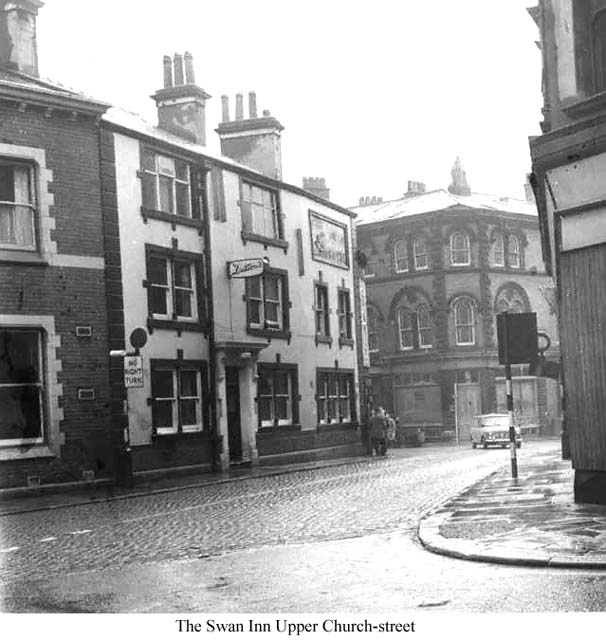
Mr. William Whalley, who had previously kept the Swan Inn, had succeeded Mr James Forrest at the Black Bull sometime before July, 1805, when he published the following circular to his patrons and the public—“W. Whalley, at the Old Bull Inn, Blackburn, respectfully returns his sincere thanks to the Public, for the patronage he received at the Swan Inn in this town and begs to inform the Gentry, Travellers, and the Public, that having lately entered on the Old Bull Inn, in the Market Place, he has furnished the same in a neat and comfortable manner; has also provided an excellent assortment of Wines and Spirituous Liquors, and flatters himself by paying a strict attention to his business, and to merit a continuance of the Public’s patronage.” Mr. Whalley was not a long stayer at the Bull, for he was out of it in little more than three years from the date of this notification, he had to meet his creditors in the latter end of 1807.
Mr. Thomas Yates of the “Dun Horse” and who married Miss Forrest in 1804 came to the Old Bull in the autumn of 1808. Here are his announcements in 1808 and again in 1809—“Old Bull Inn. T. Yates, from the Dun Horse, Market-street Lane, respectfully informs his Friends and Public that he has just entered upon the above Inn, which he is fitting up in the most commodious manner. Every accommodation will be afforded to Travellers, &c. Blackburn October 5th 1808.” Then in May, 1809—“T. Yates, Black Bull Inn, Market Place, Blackburn, returns his sincere thanks to his Friends the Public for the many favours he has received since he entered on the above Inn, and begs to inform them, that his House and Stables have undergone a complete repair, so that very genteel accommodation will be afforded to Gentlemen Travellers, &c. He will always have a stock of the best Wines, and his entire study will be to render his House worthy the patronage and recommendation of all who may honour him with their support. He has also to acquaint the Public that he has just commenced running very handsome and commodious Post Chaises, which will be got ready at a moment’s notice. Blackburn, May 31st, 1809.”
Somewhere about the end of 1814, Mr. Thomas Yates gave up the “Old Bull.” He subsequently removed to Manchester and took a respectable house there, namely, the Star Inn, in Deansgate. He died in 1831. his Obituary of April 7th 1831 says: “Died, Mr Thomas Yates of the Star Hotel, Manchester, formerly and the Old Bull Inn Blackburn.”
Mr Robert Yearsley, who had been butler to Mr. Starkie, of Huntroyd, entered as landlord of the Old Bull when Mr. Thomas Yates vacated. In March, 1815, he published his address to the public: “Black Bull, Blackburn. Robert Yearsley, late Butler to Le Gendre Starkie Esq., of Huntroyd, begs leave to acquaint the Public that he has taken that Ancient and Respectable Inn, the Black Bull, in Blackburn. He most humbly solicits the patronage of the Neighbourhood and County at large. He has provided himself with a choice stock of Wines and spirituous Liquors, and Post Chaises and able Horses will be always in readiness to accommodate the Public.” Mr Yearsley was a polite and attentive host, Highly esteemed by travellers and regular frequenters of the house, and the Old Bull was probably never in better reputation than during the ten years of his tenancy. He died in 1825. “July 17th, Mr. Robert Yearsley, of the Old Bull Inn, much regretted.”
Mr. Robert Johnson was successor of Mr. Yearsley. The new landlords advertisement was as follows: “Robert Johnson respectfully begs leave to return thanks to his friends and the public for the liberal patronage he experienced during his continuance in the Sprit Trade, and takes this opportunity of informing them that he has entered upon that ancient well-established, and respectable In, the Old Bull, in the Market-place Blackburn. He pledges himself to use his best endeavours to render his Establishment convenient, comfortable, and in every respect worthy the attention of Commercial Gentlemen. Its central situation, and the circumstances of its being the only Inn in the Town at which Post Chaises are regularly kept, are no mean advantages; and with a constant stock of choice Wines, and other Liquors, excellent Bedding, superior Stabling, and a steady and punctual attention to his Guests, will, he trusts, secure him the patronage and support of a discerning Public. He also begs to inform his friends that he has procured several new and neat Post Chaises, a Landaulet, and neat and commodious Gigs, together with excellent Horses, which he is licensed to let out upon moderate terms. Blackburn, August 30th 1825.”
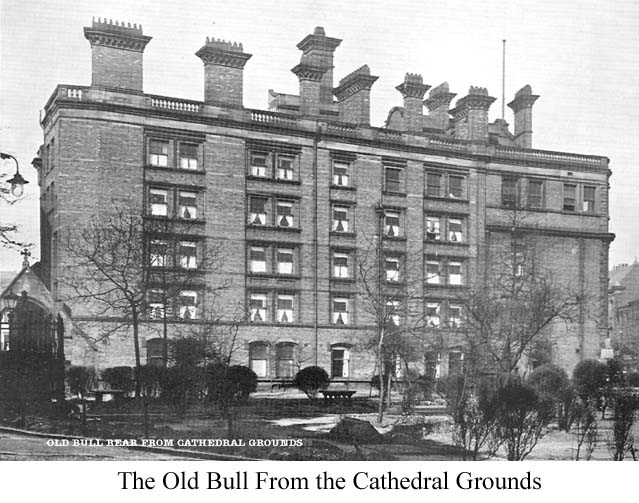
Mr Robert Johnson the new host of the “Old Bull,” had previously carried on a trade in the Sale of Spirits, in the premises in Back Lane, “opposite the Carriers’ Warehouse.” He was succeeded in that business by Mr. James Watson, who afterwards took the Old Bull Inn. Mr Johnson must have soon given up innkeeping, for in 1828 Mrs. Atkinson appears as landlady of this house. Then came Mr. James Watson, who kept the house in 1832 and for some time prior and subsequently to that date.
Of later tenants of the Old Bull there was Mr. James Blomley, who took it in 1837 or 1838 and kept it during a number of years until his death on the 6th of January, 1845. The obituary states that Mr. Blomley “was much esteemed for his excellent qualities as a host,” and his death had caused a painful sensation in the town. He had only taken possession of the “Hotel,” King-street, a few days previous to his death, and it was expected that his experience and superior management might have rendered the speculation a successful one. Mr. Blomley was forty years of age at his death. Mrs. Blomley notified that she had “given up all connexion with the Hotel, in King-street,” and that business would be conducted as usual at the “Old Bull Inn and Posting House, Market-place.” A few months subsequently, Mrs. Blomley retired from innkeeping, on her second marriage to Mr. James Forrest, whose son, the Late Mr. James P. Forrest, married her daughter, Miss Blomley. Mr. Edwards Sansom succeeded Mrs. Blomley at the Old Bull.
It was during the occupancy of Mr. Blomley, in the year 1841, that the Old Bull Inn was the scene of one of the most savage outbreaks of mob violence that has occurred in Blackburn, though in past time riots have not been uncommon in the town. At the Parliamentary Election in July, 1841, the Old Bull was head-quarters of the Conservative candidates and their Committee, and when, on the declaration of the poll, it was found that they had both been elected—Mr. John Hornby, the second candidate, by a majority of a single vote only over Mr. William Turner—the section of the populace that sided with Mr. Turner was so enraged, that the ringleaders declared the Old Bull Inn should be first captured and then demolished. As the late Mr. Tiplady, who was inside the inn, tells us in his diary—“An immense multitude rushed into the [Old] Market-place, and commenced throwing heavy paving stones and brick-bats at the Bull Inn windows which they speedily shattered. Then they proceeded to gut the interior, commencing with the old Travellers’ Room adjacent to the street, from which they tore tables, chairs, sofas, glasses, and every other description of furniture. Then they hurled large stones at the front door, which ultimately gave way and the mob rushed tumultuously inside,” They were expelled when the military were called out, but not until the interior of the inn had been wrecked. Mr. Tiplady records—“this is now the third time that the Old Bull Inn has been stormed after an election”, the previous instances being at the elections of 1832, and 1835. Again in April 1842, on the news arriving that the petition against the return of Mr. John Hornby had failed, the Turnerites organised a mob, and took their revenge by breaking the windows of the Bull Inn on the street fronts.