
 Loading more
Page 2
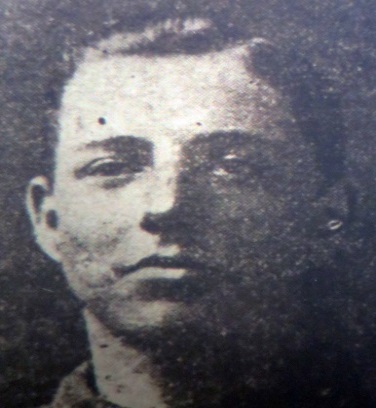
16th King’s Royal Rifle Corps, C/313
Samuel Baron, born in 1895, lived a 2 Peel Street, Darwen. He was the son of Edmund, a stonemason, and his wife, Mary. Samuel and his sister Alice would become weavers as soon as they finished school, and Samuel worked at Britannia Mill. He was also connected with St Barnabas’ Church.
Samuel enlisted in September 1914, joining the 16th Battalion of the King’s Royal Rifle Corps. It would be more than a year of training with them, at Perham Down, before Samuel would ship out to France, on 16th November 1915.
After fighting for many months at the early Battles of the Somme, the Battalion, as part of 100th Brigade, would go on to fight at the Boritska and Hazy Trenches. This was an attack by the 6th French Army, which the Brigade was supporting.
The War Diary reads:
16th K.R.R. and 1st Queens from front and 2nd Worcesters from right flank. Zero time 11.00am. Heavy artillery bombarded all localities in rear and BORITSKA and HAZY TRENCHES in front. Rolling barrage in front of flank attack lifted at 25 yds per min. Platoons went over in echelon as barrage lifted.
Battn. Headquarters remained in Sunken Road.
2nd Lt. Cholmondley was wounded leading his platoon. A huge gap occurred between our right flank and 2nd Worcesters owing to 1st Queens not attacking. Communication was, however, established with ‘A’ Company of the Worcesters under Capt. Bennett, and Capt. Hon. H. Lindsay took command of our line and consolidated the position. 2nd Lt. Sighton was wounded during consolidation. Casualties were comparatively few. 2nd Lt. Goody was severely wounded outside Battn. H.Q. Letters of congratulations and hearty thanks were received from Div. Gen and Bgr. Gen, special mention being made of Capt. E.P. Bennett of 2nd Worcestershire Regt. and Capt. Hon. L. Lindsay, 16th K.R.R. for their example of courage and resolution, and for the splendid behaviour of the troops under their command.
It was here, on 6th November 1916, that Samuel was killed.
The Darwen News Saturday Nov 18, 1916 reported Samuel’s death as follows:
Mr E Baron, an inspector on the Darwen Corporation trams, of 507 Bolton Road, has received an intimation that his only son, Acting-Sergeant Samuel Baron (27), of the King’s Royal Rifles has been killed in action. The sergeant of his company had fallen, and Corporal Baron was leading the men in an attack when he was shot down by a sniper. He enlisted in September, 1914, prior to which he was a weaver at Britannia Mill, and was connected with St Barnabas’ Church.
Samuel has no known grave, but is remembered on the Thiepval Memorial to the Missing on the Somme, Pier and Face 13a and 13b.
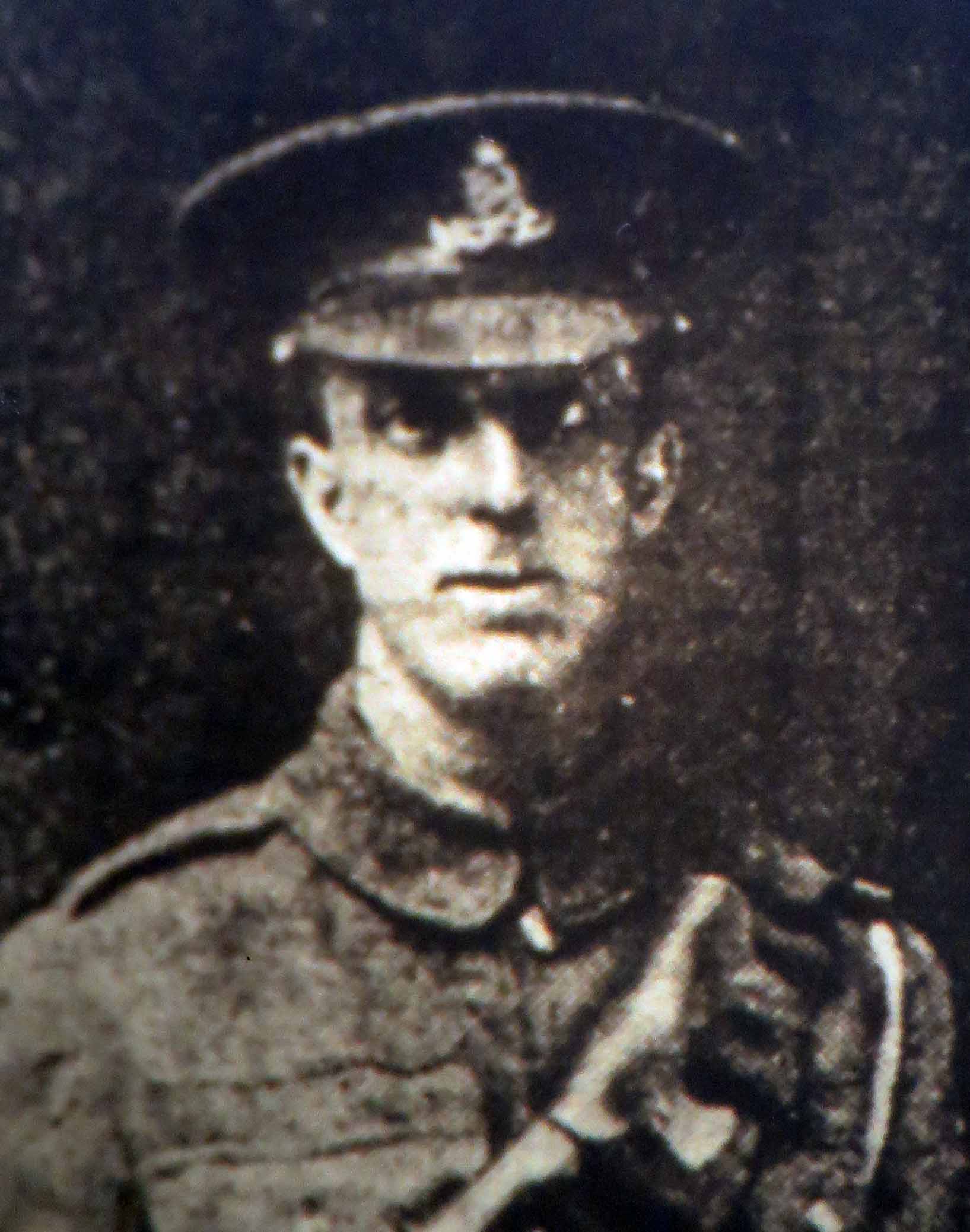
Royal Field Artillery L/9112
William Beal, born 1887, was the son of Armand and Ruth Beal, of 21 Lloyd Street, Darwen. The son of a clerk, William would become a warehouse packer in Darwen before the war broke out.
William enlisted into the 150th Brigade Royal Field Artillery 150th (Blackburn) Brigade of the County Palatine Royal Field Artillery which was part of 30th Division.
In most cases, after commencing training near home, the units were moved to concentrate near Grantham in April 1915. There were severe shortages of arms, ammunition and much equipment, for example, there was only one gun carriage available even by mid-July and even that was for funerals! It was not until October that the Artillery was in a position to commence firing practice, a few weeks after the Division had moved to the area of Larkhill on Salisbury Plain.
On 4th November the Division was inspected by Lord Derby, and entrainment began two days later. The Division sailed to Le Havre and Boulogne and all units concentrated near Ailly le Haut Clocher (near Amiens) by 12th November 1915. The 30th Division subsequently remained in France and Flanders and took part in the Battle of Albert in July 1916, and the Battle of the Transloy Ridges.
It was here, on 10th October 1916, that William was killed. From the war diaries, it appears that they suffered losses from a heavy enemy barrage. The war diary reads:
Heavy hostile barrage put up between Guadecourt and Les Boeufs which ceased on appearance of our aeroplanes – one British aeroplane fell in flames in the enemy’s lines.
William has no known grave, but is remembered on the Thiepval Memorial to the Missing on the Somme, Pier and Face 1a and 8a.
1st Border Regiment, 18303
Private John Bell of the 1st Border Regiment (No. 18303) was killed on 1st July 1916 at the Battle of Albert.
John was born on 17th August 1892 at 32 Pickles Row. Lower Darwen. He was the son of George Bell and Alice (nee Aspden). The couple had 14 children (six had died in infancy). By the time the 1901 census was taken the family had moved to 27 Bog Height Road, Darwen. He worked as a weaver.
When war broke out he enlisted at Darwen and joined the 1st Border Regiment. Following initial training he went to Gallipoli arrived at Cape Helles on 8th December 1915. He saw action at Krithia; Christmas Day was far from peaceful for him with the trenches being heavily shelled. On 8th January 1916, his Battalion received orders to withdraw and on 9th January he left Cape Helles for Egypt via Mudros. Whilst in Egypt, the Battalion was based in the Suez area and underwent further training. Orders were received on 25th February for a move to France. Embarking in March, they arrived at Marseilles and moved to concentrate in the area East of Pont Remy between 15th – 29th March 1916 where John saw action on the Somme.
In April 1916, the Battalion moved to Amplier Beauval and then the following month to Englebelmer (North of Albert) on the Somme. By 1st July 1916, the Battalion arrived at the frontline at Beaumont Hamel. At 7.30am the Regiment rushed the parapet and advanced from the support line. They made a right incline into No Man's Land at a slow walk as ordered. The advance continued until only small groups of men (6 or 7 in number) were left scattered; finding no reinforcements in sight, they took cover in shell holes. At 8am (in just 30 minutes of action) the advance was brought to a standstill. At the start of the day 23 Officers and 809 other ranks took part in the advance. By the end of the day 87% had been killed, wounded or missing.
Amongst the missing was John Bell. Towards the end of July his parents had been informed that he was missing but it would take almost another 12 months before they were officially informed that he had been killed in action. When the local newspaper reported his death it mentioned that four of John’s brothers had enlisted; two were still serving and two others had been discharged, one as the result of shell shock.
John Bell is remembered on the Thiepval Memorial to the Missing on the Somme and has no known grave.
At the end of the war he parents received his war medals - Victory & British War Medals; 1914-1915 Star.
Lance-Corporal Joseph Robert Briggs
8th East Lancashire Regiment, 26883
Joseph was the son of John Bury Briggs and Jane Ann Green. By the 1891 census, the family had moved to 8 William Street, Darwen. Ten years later they were living at 8 Exchange Street. The 1911 census shows that Joseph was working as a cotton weaver at Messrs. Harwood Brothers, Heyfold Mill, and he lived with his married sister, Susannah Parr at 239 Olive Lane. By 1914, he was married, and lived at 24 Hollins Grove Street, Darwen.
Joseph enlisted much later than his peers, on 12th October 1915. Joseph was transferred to 8th Battalion East Lancashire Regiment as a replacement, arriving early 1916, after only a short period of training.
In the early hours of 15 July 1916, Lieutenant-Colonel Mackay OC 8th East Lancashire received the specific orders that 112 Brigade would attack at 9.20am after an hour’s bombardment of the village of Pozieres, the key to the German 2nd line of defence. The Battalion lead the Brigade in the assault on the village - the men's first experience of going 'over the top'. They were to lose over 350 casualties including almost 100 killed outright. The Battalion would never be the same again
At 8.30am on 15 November 1916, after the preliminary bombardment of their objective Frankfurt Trench, the men advanced between Crater Lane and Lager Alley in two waves. In the fog they got to within 50 yards of Munich Trench, ‘A’ and ‘D’ Companies leading the way, followed by ‘B’ and ‘C’. Suddenly they were fired upon by machine guns and rifles at very short range. The men went to ground, before being forced to pull back. Ten of their officers were killed in this attack on the Redan Ridge between Serre and Beaumont Hamel. Allegations were made that many of the 150 casualties were caused by 'friendly-fire'. The battalion's second assault in the Somme battle had ended in failure.
It was here that Joseph went missing. He was listed as killed on 16th November 1916 but his wife was officially informed of his death in April 1917.
Joseph has no known grave, and is remembered on the Thiepval Memorial to the Missing on the Somme.
Private John Brindle
East Lancashire Regiment, 6353
John Lawrence Brindle, born 1877, was the son of Elizabeth Brindle, of 19 Bury Street, Darwen. He, like his brother and sister, was a cotton weaver in a local mill. He married Betsy Greenwood in 1903, and joined the Army in 1912.
John enlisted into the 1st Battalion East Lancashire Regiment, who he had served with during the Boer War. He joined the Battalion as it shipped out to France in 1914, and fought with them all the way to the Somme Region in 1916.
On the morning of July 1st the bombardment of the enemy trenches became intense, but German machine-guns continued to fire from Beaumont-Hamel throughout the bombardment.
At 7.26 a.m., the leading platoons of the assaulting companies moved out to a line taped-out in " no-man's-land," so as to be in line with the 1st Lancashire Fusiliers, of the 29th Division, who were to attack Beaumont-Hamel.
At 7.32 a.m. " D " Company and Battalion Headquarters followed the attacking companies and established themselves in shell-holes. A signaller accompanied the leading platoon of " A " Company, carrying a telephone and wire with orders to open communication from German front line, where Battalion Headquarters were to be established.
The personnel of the Headquarters followed up the wire and found the signaller in a large shell-hole just outside the German wire. Of course the wire was cut before it could be used, but the Headquarters remained in the shell-hole until 6 p.m.
Immediately the guns lifted from the German front-line trenches, heavy machine-gun fire was opened from the German front line; from Beaumont- Hamel and Ridge Redoubt, Lieut.-Colonel Green personally counted eight machine-guns firing on the battalion front. Simultaneously the German artillery barrage came down some 200-230 yards in front of the front line and on all assembly trenches.
In spite of this terrific fire, the Battalion advanced as steadily as if on manoeuvres until practically the whole battalion became casualties. Actually a few of the leading troops entered and passed the German front-line, but on the front of the right and centre companies the wire was found intact and no way through it could be found. Many men were killed on the wire while attempting to force a way through.
Many sought cover in the shell-holes close to the wire which they had vainly attempted to pass. The survivors of the battalion occupied shell-holes in "no-man's-land " until they were able to retire to our trenches at dusk. All wounded capable of crawling were sent back first, followed by a rear-guard of unwounded men.
About 7 p.m. the battalion was relieved by the 1st Royal Warwickshire Regiment of the 10th Brigade which, with the 12th Brigade, was relieving the 11th Brigade. On relief the Brigade went into billet at Mailly-Maillet. The strength of the battalion on July 1st was twenty-two officers and five hundred other ranks, of 41 officers and 950 other ranks.
John Brindle Lawrence was one of the men killed in this attack. He has no known grave, but is remembered on the Thiepval Memorial to the Missing on the Somme, Pier and Face 6c.
back to top
Sergeant Robert William Briggs
East Lancashire Regiment, 12319
Robert William Briggs was born on 2nd April 1896 at 13 Waterside Terrace, Eccleshill, Darwen. He was the son of John T. Briggs and Alice Gabbatt who, like many families in the area, were weavers. Robert also became a weaver when he was old enough.
Robert enlisted into 7th Battalion East Lancashire Regiment and immediately began intense training, first at Tidworth, and then, Andover, followed by a stint on Salisbury Plain. The Battalion was sent to France on 18th July 1915, where it would become accustomed to trench warfare. By November 1916, Robert and his comrades had seen action at Pietre, Albert, High Wood, Pozieries Ridge, and then the Ancre Heights. It was here, in November 1916, that Robert would be killed.
During the first twelve days of November the Battalion did two tours in Stuff trench and two in Brigade and Division reserve. The enemy made no more attacks, but shelled the back areas very heavily, causing many casualties during reliefs.
"This was our first experience of following a barrage. However, in a very few minutes we found that the difficulty lay in restraining the men from walking into it rather than in keeping them up to it. The barrage was timed to move forward very slowly, which no doubt was essential, for the troops on the left had very rough ground to cover and a considerable way to go, but it proved most irksome on the right. The fog which hid our advance proved a great hindrance in keeping direction and discovering objectives.
We walked into German trenches without realizing that we had reached them. The enemy were in no mood to fight and surrendered directly we arrived. D Company had gained all its objectives in the first ten minutes and was busy digging in before the others had reached theirs. B Company met with similar success on arrival at their line, but C Company became separated in the mist and was missing for some time. Colonel Torrie at once moved A Company, who had been held in reserve, into the gap C's disappearance created and was able to report that all objectives had been taken and the position consolidated by 7 a.m. Officers' patrols were sent out from B and D Companies to try and find out what had become of C Company and what was going on in the mist in front of us. It was most uncanny work, as it was impossible to distinguish friend or foe until within hands grip of one another.
By now the enemy were fully aroused and began sweeping the face of the hillside with machine-guns. It was most eerie the way these bullets came whispering through the mist. Wheal, in charge of the B Company patrol, stumbled right into a small party of the enemy in the Lucky Way. He was armed with a weighted pick-handle, which proved an ideal weapon for the occasion and in the hand-to-hand scuffle that followed did great execution. The officer with D Company met with another party of the enemy lining a small trench and facing the wrong way. He and the three men with him succeeded in killing two of the enemy and routing the others. While pursuing them through the mist they came across C Company.”
Robert William Briggs has no known grave, but is remembered on the Thiepval Memorial to the Missing on the Somme.
2nd East Lancashire Regiment, 12362
Lance Corporal John Burke, 2nd Battalion, East Lancashire Regiment, was killed on 5th April 1917. The son of Christiana Burke, John was a drawer in Messrs. Ashton’s Mill. He worked with his brothers, Henry and Ralph, whilst Thomas and Christopher were still too young for such work.
John enlisted into the 2nd Battalion East Lancashire Regiment on 27th August 1914, and following intensive training, joined with the Battalion in France on 5th January 1915.
Following bitter battles in 1916 during the Somme, in March 1917, the German armies on the Somme carried out a strategic withdrawal known as Operation Alberich. They destroyed everything on the ground that they left: flattening villages, poisoning wells, cutting down trees, blowing craters on roads and crossroads, booby-trapping ruins and dugouts. The withdrawal was to an immensely powerful and shorter line, positioned to take every tactical advantage of ground. The construction of this line - or rather, series of lines - had been spotted by British and French aviators in late 1916. British patrols began to detect the withdrawal of German infantry from the Somme in mid-February 1917 and a cautious pursuit began, halted only as the Hindenburg Line itself was approached.
Lance-Corporal John Burke was killed in action on the afternoon of the 5th instantly. He was going to an outpost with a sergeant when they were hit by a shell, their bodies being found in a shell hole. Lance-Corporal Burke who was in the Lewis Gun Section was 22 years of age.
Unfortunately, his body was never recovered, and John has no known grave. He is remembered on the Thiepval Memorial to the Missing on the Somme, Pier and Face 6c.
32nd Royal Fusiliers, 16497
Private James Burns of the 32nd Battalion the Royal Fusiliers (Number 16497) was killed on 4 October 1916, aged 19.
James was baptised 7 July 1897. He was the son of John Burns and Margaret Elizabeth Parkinson, who had married at the church during the previous year. By the time of the 1911 Census his father John is a widower and the family are living with the Parkinson grandparents at 13 Park Road. James is shown to be a Loomer at the cotton mill and has a younger brother and sister.
Private James Burns’ service record has not survived but the Medal Rolls indicate that he first went abroad with the 2nd Battalion the Royal Fusiliers as part of the Expeditionary Force to Gallipoli and the Aegean Islands, joining the 29th Division there on 23 September 1915.
He subsequently joined the 32nd Battalion (presumably after recovering from his injuries) under command of 124th Brigade, 41st Division arriving in France on 5 May 1916.
This Division was formed at Aldershot in September 1915. The majority of the units that comprised the Division were originally locally raised ones, primarily from the south of England. The Division was inspected by King George V and Field Marshal Lord French on 26 April 1916.
The units of 41st Division moved to France between 1 and 6 May 1916 and by 8 May had concentrated between Hazebrouck and Bailleul. The Division then remained on the Western Front until October 1917 and took part in the following engagements:
1916
The Battle of Flers-Courcelette
The Battle of the Transloy Ridges
James was probably taking part in the battle of Le Transloy (1 -18 October 1916) when he was killed. Like many, he has no known grave and is commemorated on the Thiepval Memorial.
In ‘Soldiers Effects’ his grandparents John W and Mary Parkinson are listed as sole legatees and would receive his 1914-1915 Star and British War and Victory Medals.
1st East Lancashire Regiment, 26355
Private Amos Bury of 1st Battalion East Lancashire Regiment (Number 26355) was killed on 18th October 1916, aged 32.
He was the son of Moses and Mary Bury of Carr Street, born 5th March 1884 and baptised at St Paul’s, Hoddlesden, 24th August 1884. On the 1911 census Amos is recorded as living at Carr Street, with his sister, Rachael Bury. Amos is shown as a weaver.
Amos joined the 1st Battalion in France, after spending some nine months in training. Following some of the earlier battles of the Somme, Amos was killed in bitter fighting at Le Transloy.
The War Diary shows:
18 October 1916
“At zero hour (3.40 am) the weather conditions were appalling – pitch black, extremely cold and pouring with rain. The three waves advanced up the line under cover of the barrage. The advance was begun on the left. ‘C’ Company on the left had the LES BOEUF – LE TRANSLOY road to guide it. The right company (‘A’ Company) in the darkness went too much to the right and got somewhat mixed up with the 1st Rifle Brigade. Machine gun fire was opened by the enemy immediately the first wave advanced and severe losses were incurred. Owing to the tremendous shell fire concentrated on the enemy’s trenches for some days past, it was extremely difficult to tell where RAINY and DEWDROP trenches were but from the distance traversed the first two waves must have got past these trenches.
No organised lines held by the enemy were met, but heavy machine gun and rifle fire was directed on our lines from front and flanks and owing to the absolute darkness, it must have been impossible for any Officer or N.C.O. to organise the digging of any advanced posts at the limit of the advance.
The few remaining men withdrew to RAINY where ‘D’ Company had arrived having suffered fairly heavy casualties in getting there. O.C. ‘D’ Company seeing that two first waves were practically non-existent, and that the enemy had Machine Guns trained on RAINY, decided to withdraw to our original front line trenches, and hold that line. The situation in front was always obscure. No Officers or senior N.C.Os. of ‘A’ and ‘C’ Companies came back and no messages were received back. I think that no rifles of the men who went forward could have been in working order 10 minutes after they left our lines. The ground was terribly torn up by shellfire, and as slippery as ice. The men kept on slipping and falling into the holes in the dark. The few who returned were one mass of mud from head to foot, and completely exhausted. I consider that a considerable portion of the missing (8 Officers and 53 O.R.) are in all probability prisoners.”
Amos Bury has no known grave and is commemorated on the Thiepval Memorial. His sister Rachael would receive His British War and Victory Medals.
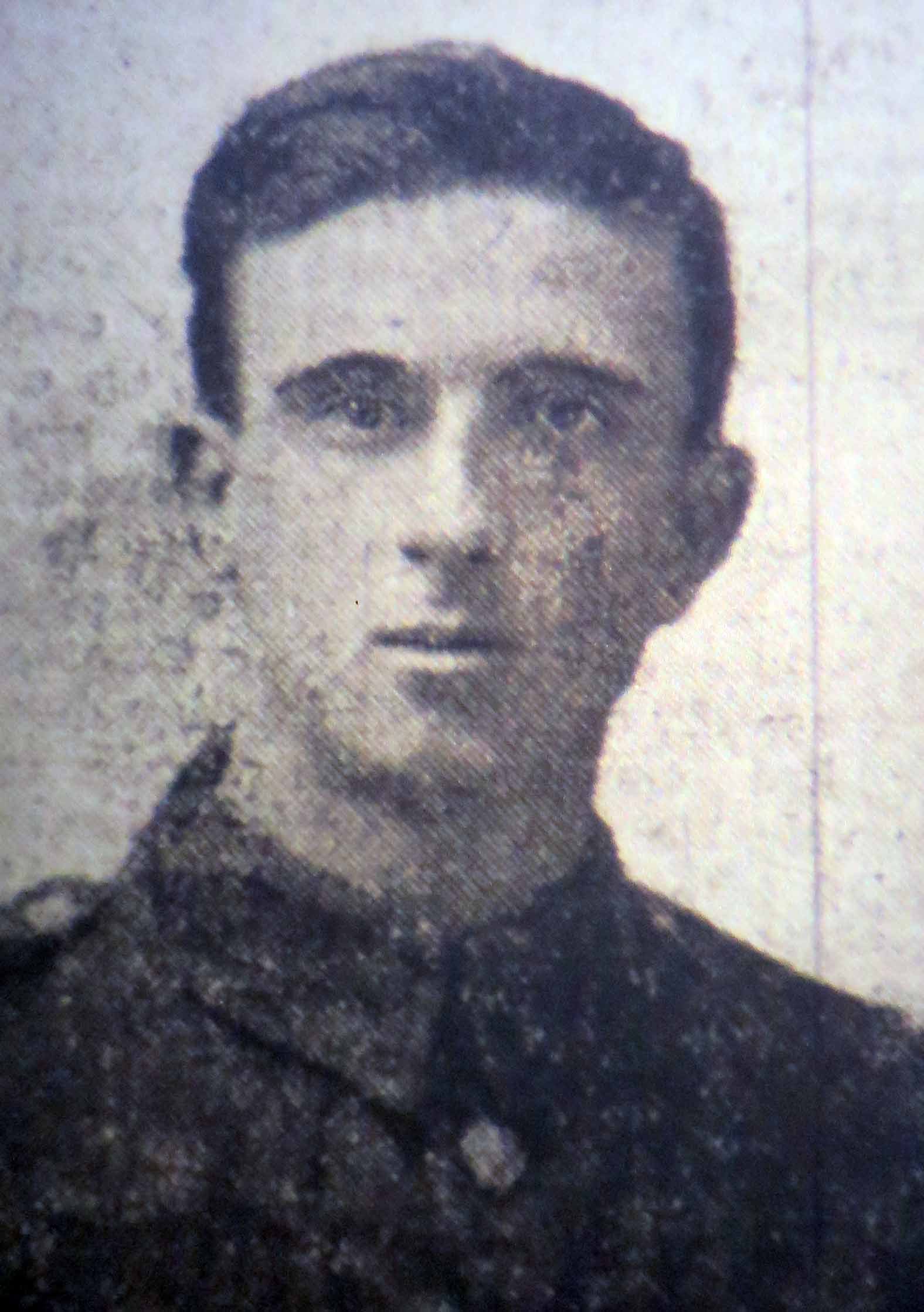
East Lancashire Regiment, 26255
Balfour Butterworth, born 1890, was the son of Annie Butterworth. Like many Darwen families, Balfour, his Brother and two sisters, were cotton weavers before war broke out in 1914.
Balfour enlisted into the 1st Battalion East Lancashire Regiment in 1915, and undertook intensive training before being sent to France in early 1916 as a replacement.
Balfour survived the first day of the Battle of the Somme, one of only 150 unscathed (of 1000 in a battalion). It would be October 18th when Balfour was finally killed, at the Battle of Le Transloy.
The Battalion history reads:
The ground was in the most appalling condition; heavy rain had fallen for weeks and continued throughout the attack, with the result that the terrain was a vast lake of mud, pitted with shell-holes. The night was pitch black and the enemy's line was extremely vague; German trench maps had been issued, but they were of little use for the German line really consisted of detached machine-guns in shell-holes. At zero hour a barrage was put down on Dewdrop trench which lasted for 4i minutes. At the same time the battalion and the 1st Rifle Brigade floundered into the mud of "no-man's land."
The men, wearing full equipment and carrying extra bombs, made slow progress; some were utterly exhausted and scarcely mobile, only to be shot down, drowned in shell-holes or rounded up at daybreak.
The advance was by the left. "C" Company on the left had the Les Boeufs—Le Transloy road to guide it. " A " Company on the right, in the darkness went too far to the right and got somewhat mixed up with the Rifle Brigade. Directly the first wave advanced it was met with heavy machinegun fire and casualties were numerous. Moreover, it was difficult to find Dewdrop and Rainy trenches, which had been heavily shelled by our artillery.
However, from the distance traversed by the two leading waves, the two trenches must have been passed.
No organized German line was found, but heavy rifle and machine-gun fire was directed on our waves from front and flanks, and owing to the darkness it was impossible for any officer, or non-commissioned officer, to organize the digging of advanced posts at the limit of the advance. The few remaining men who had reached Dewdrop, and beyond, withdrew to Rainy trench where "D" Company had arrived, having had many casualties. The Company Commander, then seeing that his two leading waves were practically wiped out, and that German machine-guns were trained on the trench, withdrew to the original front-line trenches.
The situation now, in the front trenches was very obscure. No officers or senior N.C.O.'s of "A" and "C" Companies had come back and the few men who did come back were clothed in mud from head to foot and completely exhausted.
There was no counter-attack by the enemy, though the front trenches were heavily shelled and swept with machine-gun fire until dawn.
The day (18th) was quiet, and after dark "B" Company relieved "D" Company. "A," "C" and "D" Companies then went into support in Shamrock. Patrols were sent out who were met by hot rifle-fire as they approached Rainy and Dewdrop. Wounded men were sought for and a few brought in, also wounded men in the trenches, unable to walk, were evacuated by special stretcher parties after dark.
The casualties of the action were heavy and included all the officers in the two leading companies. In "A" Company Lieutenants R. A. C. Matthews, W. F. Curran, T. A. Ritchie were killed, and the O.C. Company Captain A. N. Scott made prisoner of war. In "C" Company 2nd-Lieutenant E. W. Graham was killed and Captain C. Waddington (O.C. Company), 2nd-Lieutenants M. Quayle and J. M. Wilks were captured. C.S.M.s W. Ashcroft and J. Cunliffe were killed, C.S.M. W. Vaughan made prisoner, and the total casualties in the other ranks were killed 12, wounded 58, missing 292.
Balfour Butterworth has no known grave, but is remembered on the Thiepval Memorial to the Missing on the Somme, Pier and Face 6c.
Royal Scots Fusiliers, 15643
The son of a Corporation labourer, James Chappell, was born in 1893 to George and Hannah Chappell, of 63 Hindle Street, Darwen.
James was a cotton weaver, along with his brothers and sisters: Sarah Alice, Annie, Ethel, Mary, Victoria and George.
On the outbreak of war, James signed up, and joined the 1st Battalion Royal Scots Fusiliers. Following nine months of training, in April 1915, James was finally sent to France. James would see actions at Hooge and Bellewarde in Belgium in 1915, before moving to the Somme Region in June 1916 for the major offensive.
The 3rd Division, of which the Battalion was a part of, was selected to attack Bazentin le Grand, on 14th July 1916. On the right, attacking between Bazentin le Grand and Longueval were the two XIII Corps Divisions, left to right, the 3rd Division and the 9th (Scottish) Division. The 9th Division, which also contained the South African Infantry Brigade (in reserve near Carnoy), took Longueval and reached the fringe of Delville Wood which flanked the village but were unable to take the German redoubt at Waterlot Farm.
In the centre, things did not go well for the 3rd Division attacking from Montauban towards Bazentin le Grand. The German wire was uncut and the defenders alert. The German defensive barrage laid down in no man's land missed the assaulting battalions but caught the supporting waves.
In this attack, James, aged 23 years was killed, 14thJuly 1916. He has no known grave, but is remembered on the Thiepval Memorial to the Missing on the Somme, Pier and Face 3c.
East Lancashire Regiment, 24829
William Cooper was born 1887 to James and Jane Ellen Cooper of 12 Primrose Street, Darwen. Like most Lancashire families, William, his brothers Samuel, Joseph and Albert, and his parents, worked in the Cotton industry. William was, in fact, one of eight children.
William had joined the army prior to the First World War, and he was on the Reserve list. He was immediately recalled, and posted into the 1st East Lancashire Regiment. William would be one of the first British soldiers to fight in the war, as the Battalion landed on 22nd August 1914.
William would spend the next two years fighting with the Battalion, across Flanders and France, before finally arriving at the Somme. On July 1st, the Battalion took part in the Battle of Albert, and suffered horrific casualties. After that, the Battalion was sent for rest and refit, returning in the October to fight in the Battle of Le Transloy.
“On the 15th orders were issued from XIVth Corps Headquarters for the 4th and 6th Divisions to make another attack, on the 18th, on the trenches of the Le Transloy line.
The ground was in the most appalling condition; heavy rain had fallen for weeks and continued throughout the attack, with the result that the terrain was a vast lake of mud, pitted with shell-holes. The night was pitch black and the enemy's line was extremely vague ; German trench maps had been issued, but they were of little use for the German line really consisted of detached machine-guns in shell-holes. At zero hour a barrage was put down on Dewdrop trench which lasted for 4 ½ minutes. At the same time the battalion and the 1st Rifle Brigade floundered into the mud of "no-man's land."
The men, wearing full equipment and carrying extra bombs, made slow progress ; some were utterly exhausted and scarcely mobile, only to be shot down, drowned in shell-holes or rounded up at daybreak.
The day (18th) was quiet, and after dark " B " Company relieved " D " Company. " A," " C " and " D " Companies then went into support in Shamrock. Patrols were sent out who were met by hot rifle-fire as they approached Rainy and Dewdrop. Wounded men were sought for and a few brought in, also wounded men in the trenches, unable to walk, were evacuated by special stretcher parties after dark.
The casualties of the action were heavy - other ranks were killed 12, wounded 58, missing 292.”
William was one of the missing from that day. His body was never found. He is remembered on the Thiepval Memorial to the Missing on the Somme, Pier and Face 6c.
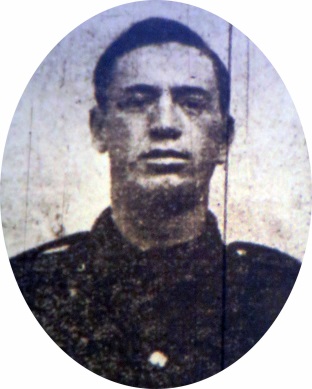
3rd King’s Royal Rifle Corps, 9107
Acting Corporal Herbert Cox of the 3rd King’s Royal Rifle Corps (No. 9107) was killed 25th September 1915 at Frise on the Somme.
Herbert was born 17th March 1888 at 63 Kay Street, Darwen. He was the son of Walter William Cox and Elizabeth Ann (nee Bottrell) and Herbert was baptised at Holy Trinity (now St Peter’s) on 20th May 1888. The family had moved to Darwen from Oxfordshire during the early1880s and had settled in India Street and later Kay Street. At the time of the 1901 census, Herbert was aged 13 years and he was working as a cotton weaver.
Herbert was an all-round athlete and around 1908 he won the first prize at the Darwen Sports Day. Shortly after winning the sports prize, he enlisted in the Army and joined the 3rd King’s Royal Rifle Corps. Prior to the Great War, he saw service in England, India and Malta where he continued with his running and carried off various prizes. On the outbreak of War, his unit was recalled to England and then to France where they arrived 26th September 1914.
In France, his unit was concentrated in the area between Aire and Arques where Herbert saw action at St Eloi (14-15 March 1915), and, at the Second Battle of Ypres (22 April – 25 May 1915). During quiet moments Herbert found time to take part in races which his Battalion organised and, in August 1915, he won the 100 yards and 400 yards races. Prince Hiram Sing also gave him a prize for the best all-round athlete.
By mid-September, the Battalion had moved to Frise on the Somme and on the night of 19th/20th September had taken over the trenches from the French 414th Regiment (6th Corps). The Battalion’s War Diary for 25th September 1915 reads “Frise: In the trenches. Rained almost all day but cleared at sunset. Germans shelled us killing one of our machine gunners. In the afternoon and evening we shelled the Germans. Battalion relieved in the evening by 4th KRR relief was complete by 10.15 p.m. and Battn marched to the huts at Frosissy reaching them by 1 a.m. (last companies)." The man killed referred to in the above entry was Herbert Cox.
Herbert Cox is remembered on the Thiepval Memorial to the Missing on the Somme, and has no known grave.