
 Loading more
G to L
Men from the Blackburn area commemorated on the Thiepval Memorial
G H I J K L
Letter G
Garrett David | Gaskell Harold | Geddes Robert | Gerrard Arthur | Gleave Thomas
Greaves Robert W | GreenHalgh Fred | Greenwood Fred | Gregson John
Gregson Robert | Griffiths Thomas Henry
Private David Garrett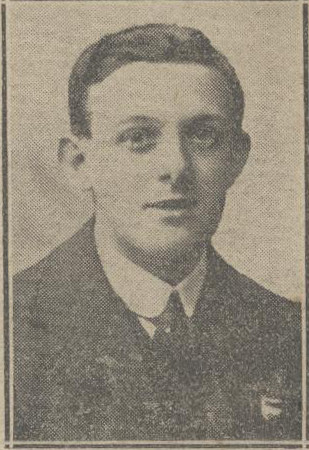 2nd/5th, Lancashire Fusilier’s, 7640
David Garrett was born in 1892, the second son of Thomas and Rebecca Garrett. His elder brother was Thomas and he had a younger sister, Sarah, and a younger brother, Hugh. The 1911 shows him to be living with his parents at 23 Wellington-road, Witton and that he was employed as a Cloth Machinist. His obituary card notes that he worked at Bank Top Foundry, so it is likely he had changed his job.
It is not known when he enlisted into the army but his first Regiment was the East Lancashire's No. 4180. He was later transferred to the Lancashire Fusiliers 2nd/5th Battalion, No. 7640. He married Margaret Harrison at St. Luke with St. Philip, on March 11th 1916; it was more than likely that he was in khaki at the time.
He was a member of St. Luke's Conservative Club and attended St. Luke's Church and Sunday school. Again, there is no information as to when he first went to France.
In 1916, the 2nd/5th Battalion were part of 164th Brigade 51st (Highland) Division.
The 33rd Division attacked High Wood at dusk on the 19th of July. Two Battalions of the 19th Brigade crept forward on 20th of July, during a bombardment and attacked when it lifted at 3:25 a.m. During the afternoon of the 21st July, another Battalion went forward and managed to reach the northern fringe of the wood.
Due to the number of British casualties, two more Battalions were sent forward as reinforcements but as dark fell a German bombardment forced the British from the north end of the wood, which was retaken by German troops and both sides dug in.
After the attacks on the 20th July ended the Germans reoccupied most of High Wood, until only the southern corner remained in British hands. They also dug a new defensive position, known as Intermediate trench, ahead of the Switch Line to the west of the wood. This meant that taking the wood, became an even harder for the British.
On the night of the 22nd/23rd of July, the 4th Gordon Highlanders attacked the eastern corner of the wood, whilst the 1st Royal West Kent’s attacked the south-eastern part of the wood and Wood Lane, there with the 14th Royal Warwickshire’s at their side.
There had been a preliminary bombardment, but this had not inflicted sufficient loss on the defenders, and they were able to hold High Wood. No significant gains were made, although the Royal West Kent’s suffered 420 casualties. The other battalions also suffered losses.
Units from the 51st Division fought here on the 23rd of July. The attacks On High Wood went on until the 15th of September.
David Garrett was killed on the 9th of September during this battle, he was just 24 years old. He has no known grave and is commemorated on the Memorial at Thiepval, Pier and Face 3 C 3 D.
It is thought that at least 8,000 British and German soldiers died in the wood in 1916.
David is also commemorated on a family grave in Blackburn Old Cemetery (information supplied by Maurice FFelan, Friends of Blackburn Old Cemetery).
Gunner Harold Gaskell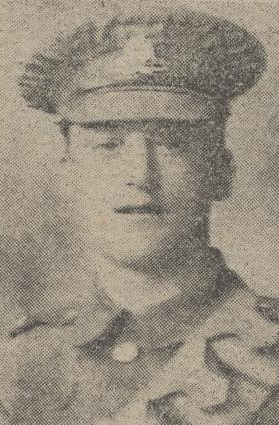 B Battery, 15th Brigade Royal Field Artillery, L/8342
Harold Gaskell’s mother, Elizabeth, was a self-employed confectioner at 145 Penny-street, Blackburn, where Harold was born, in 1895.
By 1911, aged 15, Harold was an apprentice cake maker in the business. He went on to serve his apprenticeship with his uncle, Thomas Crossley, (Weighing Machine Makers) of Regent Works, Old Chapel-street, Blackburn. His mother was a widow, and Harold was an only son, a sibling having died in infancy.
He took a keen interest in cycling, of which he was an ardent devotee. He was a member of Holy Trinity Church and a special Memorial Service was held in his memory, 5th November 1916.
Harold enlisted in February 1915 into the 15th Brigade of the Royal Field Artillery. He embarked in December, having trained as a Gunner.
March 1916 saw the Brigade move with 5th Division taking over a section of front line between St Laurent Blangy and the southern edge of Vimy Ridge, in front of Arras. This was a lively time, with many trench raids, sniping and mining activities in the front lines. When the Franco-British offensive opened on the Somme on 1st July 1916, the 5th Division was enjoying a period of rest and re-fit and was in GHQ Reserve. However, this restful time was not destined to last, and the division fought at High Wood, Guillemont, Flers-Courcelette, Morval and then Le Transloy.
It was here, at Le Transloy, that Harold would be killed, on 10th October 1916. Harold has no known grave, and is remembered on the Thiepval Memorial to the Missing on the Somme, Pier and Face 1 A and 8 A.
Private Robert Geddes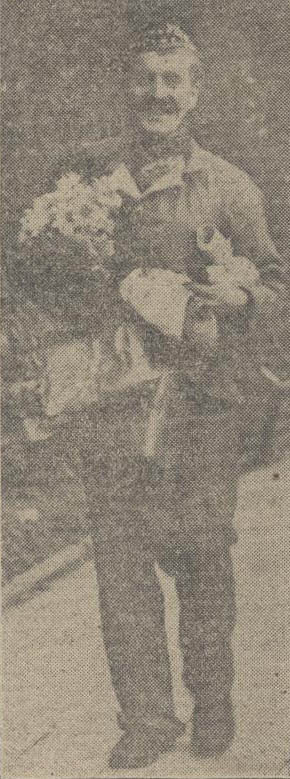
8th Seaforth Highlanders, 8004
Robert Geddes was from a family of seven and from Scottish descent. His parents were both born in Creetown, Kirkcudbrightshire, Scotland, near Dumfries.
At the time of the 1911 census his father was a self-employed master tailor and his mother was a tailoress. The family lived in Lancaster Street, Blackburn. Robert was a tram conductor on the Cherry Tree section of the Corporation Tramways for over 3 years prior to enlisting.
Robert married Martha in 1908 and resided at Granville St, Cherry Tree. Their only son, Robert Walton McKenzie Geddes, was born 15th January 1909 making him just over seven years of age when his father was killed.
Private Geddes, whose Regiment, the Seaforth Highlanders, fought the war in its regimental Scottish kilts, received serious injuries during the Retreat from Mons in September 1914. Robert was hit by shrapnel in his left leg, with another piece piercing his jacket, and another – his water bottle. He struggled on with the rest of the troops, but fell behind. Badly injured, but determined to fight on, he charged his rifle and fixed his bayonet, when he was challenged by a sentry at an encampment he stumbled across. He mistakenly thought he was in German hands, but then recognized the blue uniform of the sentry, signifying a French encampment. They too recognized his kilt. He was carried to their quarters where they tended his wounds, before despatching him to Paris, the next day on an ambulance train.
From there, he was transferred to England where he spent many months in various hospitals being treated for the painful wound in his leg. As he recovered from his injuries at home in Granville Street, Robert gave a graphic account of his experiences during the first few weeks of fighting to the local newspaper in October 1914.
His recovery took until the summer of 1916 when his time as a Reservist had expired and he was requested by the War Office to re-enlist. Two months later, he returned to the front and was killed just four weeks later, September 19th, 1916. He was 30 years old.
His wife, Martha, received a letter from his Officer telling her that Robert had been hit by a shell and that he suffered no pain. He expressed his hopes that Robert’s long service to his country would be of some comfort to her as it was to his comrades. He went on to say that the brave soldier was buried near where he fell and that she would be informed, in due course, by the War Office, of the exact spot.
Geddes Street (now demolished) in Cherry Tree was named after him and his family.
Robert was described as “One of the heroes of Mons” and he was a very brave man indeed and an absolute hero in the face of adversity. It is believed he was killed while tending an injured soldier.
It is an unfortunate aspect of war that although he was properly buried, his grave has been lost. The heavy bombardments often caused this across the Somme. Robert is, however, still remembered on the Thiepval Memorial to the Missing on the Somme, Pier and Face15 C and also on the memorial at St Francis’ Church, Feniscowles.
Rifleman Arthur Gerard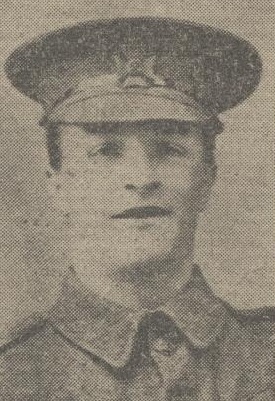
10th King’s Royal Rifle Corps, R/3124
Arthur Gerard, son of Mr and Mrs J Gerard of 114 Roman-road, enlisted on September 2nd 1914 into the 10th Battalion King’s Royal Rifle Corps. He had previously been employed as a weaver, but left for the front line in June 1915. It was around this time that his brother, Ralph, was killed at the Battle of Loos.
Arthur would go on to fight in the Battle of the Somme, where he would be killed near Guillemont on 3rd September 1916.
The Battle of Guillemont (3rd-6th September 1916) was an attack by the Fourth Army on the village of Guillemont.
The Fourth Army had advanced close to Guillemont during the Battle of Bazentin Ridge (14th-17th July) and the capture of the village was the culmination of British attacks which began on 22nd-23rd July to advance on the right flank of the Fourth Army, to eliminate a salient further north at Delville Wood. German defences ringed the wood and had observation over the French Sixth Army area to the south towards the Somme.
His commanding officer wrote:
“It is with the deepest regret that I have to inform you of the death of your son, Arthur, of this Battalion, who was killed in an attack on Guillemont on Sunday, September 3rd. In the midst of your sorrow, in which we must sympathise with you very sincerely, we trust that the knowledge that your son died a hero’s death fighting, and fearlessly, in an attack which has, without doubt, brought great success to our army, will console you in your grief.”
A memorial service was held at St James Church, Lower Darwen for Arthur. His younger brother Harry survived, fighting with the Rifle Brigade.
Arthur died aged twenty-four, and is remembered on the Thiepval Memorial Pier and Face 13 A 13 B. He has no known grave.
*The CWGC spells his surname Gerrard
Thomas Gleave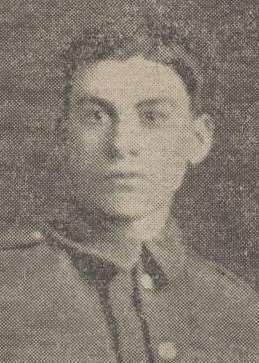
1st/4th East Lancashire Regiment, 201467
Thomas Gleave, born 18th April 1896, was the son of Elizabeth and Thomas Gleave of 51 Mill-street, Blackburn. Thomas, like his father, would go on to become a cotton weaver, at Britannia Mill. His father died in 1908, leaving Thomas alone with his mother. They would spend time at Furthergate Comp Church.
Thomas enlisted into the 1st/4th East Lancashire Regiment in July 1915, and following only a few weeks training was sent to the Dardanelles as part of the reinforcements as part of the 42nd Division. Through battle casualties and sickness, it was down to little more than one third of its normal establishment.
It received reinforcement in the shape of men of the Yeomanry, fighting dismounted. The Division, along with all other units in the Helles bridgehead, made a successful withdrawal from Gallipoli by 8th January 1916.
After a short stay on Mudros while sufficient shipping was made available and the army administration got on top of the flood of units coming to Egypt from Gallipoli, the Division returned to Alexandria.
Further work was undertaken on the Suez Canal defences throughout the spring and summer of 1916. In early August 1916, the Lancashire Fusiliers and Manchester Brigades made a very long march under blazing sun, towards Romani where a short engagement took place in which the Turkish units were pushed back with heavy loss. The Brigades (of the by now retitled 42nd (East Lancashire) Division) had to wade and struggle through loose sand, and the physical effort was extreme. Many men collapsed.
Romani was an important victory, because from there the British force pushed a railway and water line across the Sinai desert that would enable an assault with the intention of clearing Palestine. The East Lancs were involved as advance guards as the building moved forward as far as El Arish. However, a decision had been taken to restructure the force in Palestine, and in consequence the Division was ordered for the first time to the Western Front. All units embarked at Alexandria by the end of February 1917.
The 1st/4th East Lancashire Regiment was in Equicourt near Cambrai in July 1917, when Thomas was killed, only 2 days before a month long furlong.
The Lieutenant of Private Gleave’s Company, in a letter to the mother says:
“A party of Germans has been observed coming towards our trenches, when they suddenly disappeared. Your son along with a sergeant volunteered to go out, with the idea of ascertaining the German positions etc. After a short interval an explosion was heard, evidently a British bomb, also the report of a rifle. The sergeant was seen to run a short distance, and then disappear. A search party was sent put at dusk, but failed to find any trace of either man. I have every reason he adds “to believe that he is a prisoner in enemy hands. I regret his loss, as he was a plucky lad and a brave soldier.”
Thomas was never found. He is remembered on the Thiepval Memorial to the Missing on the Somme, Pier and Face 6 C.
Private Robert W Greaves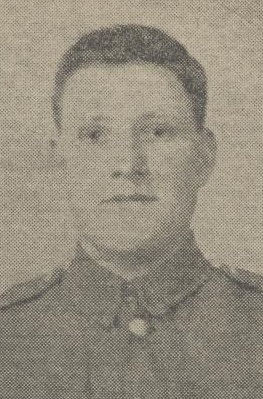
1st Border Regiment, 5056
Robert W. Greaves was born in 1896, one of eleven children (nine boys and two girls) born to John Thomas and Nancy Greaves of 2 Thompson-street, Blackburn.
He had attended St. Phillips Sunday School. His eldest brother Josiah worked for the Lancs &York's Railway Co. as a fireman which is perhaps how Robert came to work at the Lower Darwen engine shed. His father had been a coal cart driver and a foundry labourer with the rest of the family working in the cotton industry.
Robert had enlisted in the special reserve before the outbreak of war. He had one brother also in France and another brother had returned home in January 1916 from the army as a time expired man. As war broke out, Robert was ordered to report for duty, in the 1st Border Regiment.
In August 1914 the 1st Borders were in Maymyo, Burma. They returned to England, landing at Avonmouth on 10 January 1915, when Robert would join them, having spent the last 5 months in training.
On 17th March 1915 the Battalion, as part of 29th Division, sailed for Gallipoli, going via Egypt and Mudros. They landed at Cape Helleson 25thApril 1915. Following the terrible campaign, in January 1916 they were evacuated via Mudros to Egypt. They then moved to France in March 1916, to prepare for the Battle of the Somme.
In this opening phase, the British assault broke into and gradually moved beyond the first of the German defensive complexes on the Somme. Success on the first day in the area between Montauban and Mametz led to a redirection of effort to that area, for the initial attack was defeated with huge losses north of Mametz. There was a stiff fight for Trones Wood and costly, hastily planned and piecemeal attacks that eventually took La Boisselle, Contalmaison and Mametz Wood.
Robert died aged twenty in the first battle Somme on the 1st July 1916.
He is remembered on the Thiepval Memorial to the Missing on the Somme, Pier and Face 6 A and 7 C He has no known grave.
Fred Greenhalgh
15th Lancashire Fusiliers, 39768
Private Fred Greenhalgh of the 15th Lancashire Fusiliers, son of Thomas and Ellen Greenhalgh of 14 Stanley Street, Blackburn Lancashire, was killed on 20th November 1916, shortly after the Battle of Ancre Heights. Fred, born 1885, originally worked at a cotton mill before the war, as a stoker for the boilers.
Fred was formally part of the East Lancashire Regiment before joining the 15th Battalion Lancashire Fusiliers, the first ‘Salford’ Pals Battalion.
The Battle of Ancre Heights was the continuation of British attacks after the Battle of Thiepval Ridge from 26th–28th September, by the Reserve Army (renamed Fifth Army on 29th October) from Courcelette near the Albert–Bapaume road, west to Thiepval on Bazentin Ridge.
British possession of the heights would deprive the German 1st Army of observation towards Albert to the south-west and give the British observation north over the Ancre valley to the German positions around Beaumont Hamel, Serre and Beaucourt.
A brigade of the 31st Division attacked north of Serre forming the northern flank guard, before being withdrawn in the evening after the 3rd Division to the south was stopped in no man's land by the Serre garrison, which was not taken by surprise, having heard the British infantry advancing through the fog. South of Serre most of the objectives were taken; the 51st Division took Beaumont Hamel and the 63rd Division captured Beaucourt-sur-l'Ancre.
South of the Ancre, II Corps captured St Pierre Divion and reached the outskirts of Grandcourt, while the Canadian 4th Division capturedRegina Trench north of Courcelette. Desire Support Trench 400 yards (370 m) beyond Regina Trench was consolidated on 18th November. Large operations ended, until the renewal of pressure by the Fifth Army as soon as weather permitted, in January 1917.
The British advanced 5 miles (8.0 km) on a 4 mile (6.4 km) front up the Ancre valley and caused the Germans to begin the withdrawal to the Hindenburg Line prematurely, in the area north of the Somme. Fred Greenhalgh was killed manning the line in the aftermath of the battle on 20th November 1916. Casualties in the 32nd Division from 18th–24th November, were 2,524, more than 50 percent being "missing".
Private Fred Greenhalgh is remembered on the Thiepval Memorial to the Missing on the Somme, Pier and Face 3 C and 3 D and has no known grave.
Private Fred Greenwood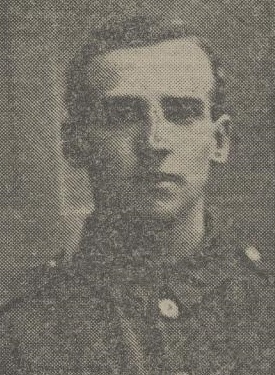
11th East Lancashire Regiment, 24523
Private Fred Greenwood, 11th East Lancashire Regiment, was born in July 1891 into a weaving and boot-making family. His father, John, was a Boot-Maker Master, whilst his mother was a weaver. His brother and sister would follow similar family trades, as would Fred himself, becoming a weaver.
As a child he attended St. Matthews Church and Sunday school, but soon joined the family trades. When war broke out, his brother John joined up, whilst Fred initially continued to work. But with the creation of the Accrington Pals, Fred joined with a flurry of others in 1915.
The 11th Battalion East Lancashire Regiment, more commonly known as The Accrington Pals, was raised in September 1914 in Accrington, Lancashire.
At the end of February 1916, the 31st Division was ordered to France, to prepare for the attack on the Somme. They were to fight at Serre, on the very edge of The Battle of The Somme.
At 6.30a.m., 1st July 1916, the British artillery commenced its final furious bombardment of the German front line. At 7.20am, Captain Tough led the first of the battalion's four waves 100 yrds into No Man's Land under the cover of artillery and mortar fire. A few minutes later, the second wave followed led by Captain Livesey. As shells continued to burst on the German front trench, the men of the 3rd and 4th Companies R169 scrambled from their underground shelters bringing machine guns, rifles and grenades to bear on the attacking troops.
At 7.30a.m., the bombardment was lifted from the German front line and the leading waves rose and walked in line towards the German positions. Machine gun and rifle fire immediately tore into the advancing lines of infantry. One British observer likened the lines of dead to "swathes of cut corn at harvest time". Incredible as it now seems, groups of Pals defied the machine gun fire, threaded their way through the barbed wire and dropped into the German front line. The remaining survivors in the German front line - bereft of reinforcements - were forced to withdraw. By 8am, the battle for Serre was effectively over.
Records indicate that out of some 720 Accrington Pals who took part in the attack, 584 were killed, wounded or missing. Fred Greenwood was listed as missing that day, and his body was never found. He is remembered on the Thiepval Memorial to the Missing on the Somme, Pier and Face 6 A and 7 C, and also, in Blackburn Old Cemetery, C of E. S 4728/9.
Private John Gregson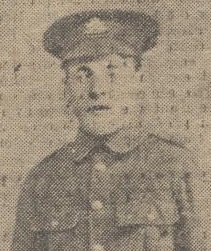 2nd East Lancashire Regiment, 5242
Born in Blackburn in 1894 to Richard and Elizabeth Gregson, John Gregson enlisted in his hometown of Blackburn with the 2nd Battalion East Lancashire Regiment.
Before the war, John was a reacher at Wood’s Brick Works, whilst his father was a Limewasher and his mother a cardroom hand. His two sisters were still at school when the war began.
As part of the 2nd Battalion, Private Gregson came under the command of the 24th Brigade in the 8th Division. Having arrived in France in February 1915, John would fight at the Battle of Neuve Chapellein March 1915 and the Battle of Aubers in May 1915.
Between October 1915 and June 1916, John served with the 23rd Division in the action of Bois Grenier. On 5th September the 23rd Division was attached to III Corps and moved to the Merris-Vieux Berquin area, where trench familiarisation began under the tutelage of the 20th (Light) and 27th Divisions. The Division took responsibility for a front line sector for the first time nine days later, taking over between Ferme Grande Flamengrie to the Armentieres-WezMacquart road.
The 2nd Battalion were again thrust into battle in the opening phases of the Somme, around Albert. It was here, on 10th July 1916, that John was killed. He was reported as missing for over a year, although his officer wrote to the family to express his sorrow at losing a fine soldier.
John died aged twenty-three, and is remembered on the Thiepval Memorial to the Missing on the Somme, Pier and Face 6 C. He has no known grave.
Private Robert Gregson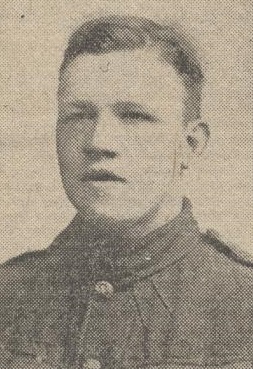
1st East Lancashire Regiment, 20005
Robert Gregson was born in 1894 into a cotton weaving family. When he was old enough, he would go on to work with 2 of his sisters, whilst his father was employed as a lorry driver at the same works.
Robert and his father were dedicated to the armed forces, having both signed up for Territorial service before the war. John Gregson, Robert’s father, would join the Loyal North Lancashire Regiment, whilst Robert joined the 4th East Lancashire Regiment, after being recruited in Southport in September 1913. He left before the war began, but was immediately recalled and placed into 1st Battalion.
The 1st East Lancashire Regiment faced a wealth of tough battles, but it was the Battle of Le Transloy where Robert would lose his life.
The failure to secure original battle objectives led to a renewed major assault on the afternoon of 12th October when infantry on 4th army’s right foundered towards German trench lines in front of Le Transloy while formations on the left slogged towards the butte de Warlencourt. Despite the slightest of gains the operation was not successful.
Orders for a fresh attack, issued late on 13th October ignored the desperate conditions and physical state of the attacking troops. The subsequent early morning assault on 18th October witnessed heroic efforts but minimal gains were made against resolute defenders well supported by accurate artillery fire.
The inauspicious beginnings of the 18th October attack were described with grim and brutal reality by the official historian:
"In almost every brigade, forming-up positions had been taped out in front and careful compass bearings taken of the direction of the advance. When the moment of the assault arrived the British front positions and the approaches thereto were a maze of water-logged shell-holes and flooded trenches.
As the troops struggled forward through the darkness (the moon being obscured by heavy rain clouds) officers and men stumbled and fell in the slippery ooze; rifles and Lewis guns became clogged with it so that bomb and bayonet were soon the only weapons."
On the 18th October the 1st East Lancashire’s, who had only recently returned to the Somme, attacked at Le Transloy through “a vast lake of mud, pitted with shell-holes”, losing all the officers, warrant officers and senior NCO’s of the assaulting companies and a total of 362 other ranks.
Private Gregson is remembered on the Thiepval Memorial in France, Pier and Face 6 C.
Private Thomas Henry Griffiths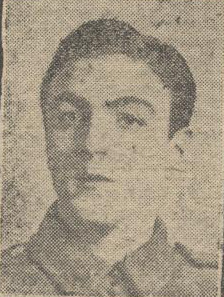
2nd/5thLancashire Fusiliers, 7595
Thomas was born in Blackburn to an Irish-born Labourer, Thomas Ludden, and his wife Sarah.
In February 1915, Thomas Griffiths, joined the 2nd/5th Battalion of the Lancashire Fusiliers, was sent to join the 66th Division, on its way to France.
However, it was only a few short months before his battalion was transferred again to the 3rd Highland Brigade, Highland Division, where less than one month later the formation became 154th Brigade of the 51st (Highland) Division. In early May 1915, the Highland Division was hurried to the defence of Ypres. The enemy had attacked on 22nd April 1915, using poison gas for the first time. All available reserves were deployed to stop the Germans taking advantage of the initial surprise. The Division remained in action until moved to the area of Estaires on the River Lys, on 19th May.
The Division then remained in France and Flanders and took part in the following engagements: The Battle of Festubert, the Highlanders were still "practically untrained and very green in all field duties" before Festubert, according to First Army commander, Sir Douglas Haig; The Second Action of Givenchy, shortly after thus unsuccessful action the Division moved south to the area north of the River Somme. They relieved a French Division near Hamel. At this time, the Highland Division now being considered experienced, various New Army units were attached to it for instruction. Indeed, it had also begun to build a reputation as a hard, fighting formation.
In 1916 came the attacks on High Wood and The Battle of the Ancre – both phases of the Battles of the Somme. During The Battle of the Ancre, the Division captured Beaumont Hamel and took more than 2,000 prisoners. By the end of the Somme and believing it could not face another sustained assault such as this; the German Army was preparing to make a strategic withdrawal to the prepared Hindenburg Line many miles east.
Private Griffiths was killed in action on 9th September 1916, as the Battle of the Ancre began. He is remembered on the Thiepval Memorial to the Missing on the Somme, Pier and Face 3 C and 3 D.
Letter H
Halewood George | Halton David | Hargreaves Edwin | Hargreaves Thomas
Hargreaves Wilfred Henry | Hartley Joseph | Hartley William | Haworth Absalom
Haworth Philip | Haworth Robert William | Haworth William | Haydock Arthur
Haydock Edgar Brindle | Hayhurst William | Hesketh William | Hindle James William
Hindle John Crook | Hindle Robert | Hodgson Reginald | Hodson John | Holden Joseph
Hook William Henry | Howard George | Howarth John | Hull Jesse
Private George Lewis Halewood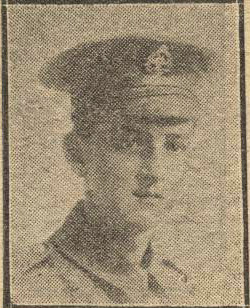
11th East Lancashire Regiment, 15690
Private George Lewis of the 11th Battalion, East Lancashire Regiment, the Accrington Pals, was killed on 1st July 1916. He was 20 years of age.
He was a single man, one of several brothers and sisters born to William Houghton Halewood and Harriet Halewood. He was living with his parents at 31 Flemming Square, Blackburn, when he died.
The obituary which appeared in the Blackburn weekly telegraph of 29th July 1916 gave his address as 31 Flemming square and said he was a member of Blackburn YMCA. The obituary also said that one of his comrades, Private J. Sharples had written to his parents and told them that "Lewis (by which name he was best known) went into the trenches in very good spirits to do his duty."
Private Halewood has no known grave and is remembered on the Thiepval Memorial to the missing on the Somme, Pier and Face 6 C.
George was killed at the battle of albert which is the official name given to the British efforts during the first two weeks of the first battle of the Somme. As such it includes the first day of the Somme, the most costly in British history.
Private David Halton
1st East Lancashire Regiment, 22807
David Halton was born in the year 1880 and baptised 5th December 1880. He was the son of David, a house painter, and Ellen Halton, with 5 siblings. Born in Blackburn – where he would later enlist in the East Lancashire Regiment – he married Ann (née Lupton), a cotton warper, also from Blackburn. Their marriage was registered in the summer of 1907 and they went on to have a son, Arthur.
As part of the 4th Division, Private Halton would have joined the action in The Battle of Le Cateau (26th August – 1st September 1914). This tactical victory is said to have been short but sharp with the total British casualties amounting to 7,812 of all ranks, killed, wounded and missing; 38 field guns were lost. Heavy casualties were inflicted on the Germans and another delay imposed on their Schlieffen timetable.
Followed by this were The Battle of Marne (7th-10th September 1914) and The Battle of Aisne (12th – 15th September 1914). The Battle of Armentieres (13th October – 2nd November 1914) included the tactical incident of the capture of Meteren by 4th Division. The Division also faced The Battles of Ypres 1915 ("Second Ypres") (22nd April – 25th May 1915).
The Battle of Albert (1st-13th July 1916): In this opening phase, the British assault broke into and gradually moved beyond the first of the German defensive complexes on the Somme. Success on the first day in the area between Montauban and Mametz led to a redirection of effort to that area, for the initial attack was defeated with huge losses north of Mametz. There was a stiff fight for Trones Wood and costly, hastily planned and piecemeal attacks that eventually took La Boisselle, Contalmaison and Mametz Wood.
Private Halton was killed in action in France on 1st July 1916. He has no known grave, and is remembered on the Thiepval Memorial to the Missing on the Somme, Pier and Face 6 C.
Private Edwin Hargreaves
2nd/5th Lancashire Fusiliers, 204062
Private Edwin Hargreaves was reported missing on 9th September, 1916 but his mother had to wait until March 1917 before the army confirmed Edwin had died.
Edwin was a single man. He was born on 15th May, 1888 and records show he was baptised on 17th June, 1888 at St. Pauls, Blackburn.
Census records show that he was one of seven children born to John and Betsy Hargreaves. Sadly, no obituary or photograph of him appeared in the local papers.
Edwin was a member of the 2nd/5th Battalion Lancashire Fusiliers and would, most likely, have been killed in the Battle of Ginchy. The narrative below of the Battle of Ginchy is taken from the Commonwealth War Graves website.
"Ginchy village, a mass of shattered masonry and shell holes by late summer 1916, had been a key objective for 7th division in the important attack of 3rd September. It was not taken and in the days immediately following repeatedly defied British assaults. A further concerted attempt on Ginchy was planned for the afternoon of Saturday 9th September as the 4th Army sought to support French attacks beyond Combles ( to the south east ) and secure a stable line of attack for a large-scale breakthrough offensive intended for mid- September.
The task of clearing the village was given to the depleted 16th (Irish) Division. Its two attacking Brigades (47th and 48th) were supported on the right by 56th Division’s operations in Leuze and Bouleaux woods.
Precisely at 4.45pm on 9th September, the 48th Brigade rushed towards Ginchy from the south-west but was instantly halted by a ferocious German barrage. Two minutes later, 47th Brigade’s attack (from the south) was immediately cut down by close- range machine gun fire.
In wet conditions, bad light and the confusion of the assault, elements of the 1st Royal Munster Fusiliers veered to the flank and, there confronted by the enemy, resolutely drove the Germans back. Pressing on, 48th Brigade’s troops were in the village by 5.30pm and consolidated. The attack was characterised by dash, turmoil and heavy casualties.
During the evening the Germans made several attempts to re-enter the village and fighting continued as the 1st Welsh Guards relieved the exhausted 48th Brigade later that night.
The capture of Ginchy forced the remaining German defenders out from the eastern edge of Delville Wood, but the new British line formed a salient vulnerable to German counter attacks.
Edwin has no known grave and is remembered on the Thiepval Memorial to the Missing on the Somme, Pier and Face 3 C and 3 D.
Private Thomas Hargreaves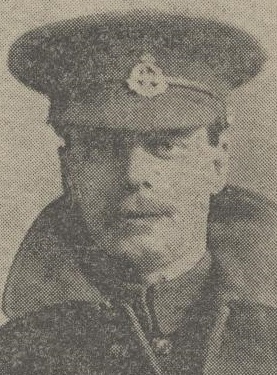
1st East Lancashire Regiment, 20041
Private Hargreaves was a married man, aged 31. He was the son of Edward and Isabella Hargreaves and the husband of Bessie Hargreaves who he married in 1906. Thomas had previously been employed as a weaver at Prospect Mill, Wharf-street Blackburn.
He and Bessie were living at 95 Harwood-street, Blackburn at the time of his death.
“The Blackburn Times”, 29th July 1916, reported that Private Thomas Hargreaves had been killed on 1st July, 1916.
The 1st Battalion took part in the Battle of Albert from 1st July 1916 to 13th July 1916. The Battle of Albert is the official name for the British efforts during the first two weeks of the first Battle of the Somme. As such, it includes the first day of the Somme, the most costly day in British Military history.
The report of his death stated that Thomas had joined the Territorials soon after the outbreak of war. He was transferred to the 1st Battalion East Lancashire Regiment and, once at the front, he immediately volunteered for scout work. His name is on the Roll of Honour for Holy Trinity Church.
The Blackburn Times report noted that before going to France Thomas had acted as an orderly to Lieutenant Ormerod. Additionally, the article mentioned that two of Thomas’s brothers were also serving in the Army, one in France and one in training in England.
Private Hargreaves has no known grave and is remembered on the Thiepval Memorial to the Missing on the Somme, Pier and Face 6 C.