
 Loading more
Darwen Mayors
William Snape | Henry Green | William Entwistle | Timothy Lightbown | Thomas Grime | Alexander Thomas Eccles
Ernest Morgan Davies | Moses Duxbury| James Cocker| William Pickup| Alexander Carus | Sir Charles Philip Huntington
Dr. James Todd Ballantyne | John William Gillibrand | Robert Shorrock | George Pickup Holden | John Tomlinson | Ralph Yates
James Tomlinson | Thomas Pearce Davies | Ralph Shorrock
William Snape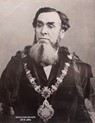
Mayor of Darwen, 1878 -1881
Alderman William Snape, J.P., was elected the first Mayor of the newly incorporated Borough of Darwen in July 1878, and was subsequently re-elected to the office in November 1878, 1879 and 1880. He had been a member of the Darwen Local Board since 1859 and after a short break from these duties sought re-election to the Board, following a fever epidemic in 1875, and was then appointed chairman.
At a ratepayers meeting held in the Co-operative Hall on 20th March 1877 he presided over the meeting which adopted a resolution in favour of applying for a Charter of Incorporation for the town. Over the course of ten days a petition to the Queen was signed by 670 ratepayers, and as a result of this, one of the inspectors of the Local Government Board held a public enquiry on the proposed incorporation. On 10th November 1877 a letter was received by the clerk to the local board stating that a charter would be granted.
The receipt of the Charter of Incorporation on 25th March 1878 prompted celebrations in the town. It was announced that Mr Snape would arrive on the train from Manchester, bringing the important document with him. The platform was crowded and outside the station a procession soon formed to escort Mr Snape to the Free Library, which was filled to overflowing. Mr Snape expressed his pleasure at having the privilege of bringing the charter to Darwen and the Town Clerk, Mr Costeker unfolded and read the charter to the assembly.
The first meeting of the Town Council was held in the library on 9th July 1878.
Councillor William Snape was elected Mayor; councillors William Snape, William Pickup, Henry Green, William Entwistle, John Walmsley and Ralph Pearson were elected Aldermen.
Although Mr Snape spent much of his adult life working towards the improvement of Darwen and its residents, he was not a native of the town. He was born on 1st April 1819 in Walton-le-Dale, and was the youngest of a family of eight children. His father, Henry worked as a builder and carpenter there. William received his elementary education in the national school, and afterwards spent a few years in a Moravian school in the county of Chester. Upon leaving school he took up an apprenticeship in the design department of a calico printing works, working there for several years.
On 1st Jul 1840 he married Ann Eccles in Manchester, and their first child Samuel Henry was born in 1841, followed by Emma in 1846, and Gerald in 1851. The family moved to Darwen in 1846 and William took up the position of chief designer in the wallpaper business of C. E. and J. G. Potter. Nine years later he set up business on his own account at Livesey Fold, developing a paper staining business which flourished for several years until it was taken over by the Potters, when William became a partner in that firm.
Sadly his wife, Ann died in 1857 at the young age of 37 years. Later that same year William married Lydia Southam at the Weighhouse Congregational Chapel in the City of London, and their daughter, Elizabeth was born two years later. The family continued to live in Darwen and by 1871 had moved into Lynwood House, where the census entry shows William as a paper manufacturer employing 350 men.
After leaving the firm of Potters he engaged in several other business enterprises, setting up as a cotton manufacturer at Dove Mill, entering into partnership with his son Gerald B. Snape at Woodford Mill, and holding a large interest in a chemical works at Widnes. He was one of the promoters of the India Mill Company, becoming a large shareholder and later chairman of the company.
He retired from business in 1875, having made a substantial fortune, and sought re-election to the Local Board, soon becoming its chairman. During his tenure he devoted his attentions to improvements to the sanitation in the town, extensions to the gas and waterworks, improvements to the river, highways and streets, and encouraged the idea of the building of a new market hall. He continued to serve Darwen in many areas, culminating in his election as the first Mayor of the Borough of Darwen.
At around this time a number of business ventures proved unsuccessful and he put his house, Lynwood, up for sale and moved into the smaller adjacent cottage.
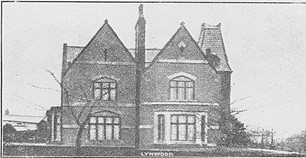 Lynwood House
The advertised sale in 1889 describes the house as:
“ An eligible Mansion House, Land, Stables, Greenhouses and Offices, lately the residence of Alderman William Snape J. P. The land contains more than four acres, and is laid out in ornamental grounds, well planted with forest trees, shrubs, flower beds, kitchen garden, lawn tennis grounds , lawn and meadow land. The mansion is gothic, brick built with stone carvings, contains four receptions and seven bedrooms, two nurseries, bathroom and lavatories. Most of the interior woodwork is of polished oak with handsome tiled vestibule and corridors. Hot and cold water is laid on throughout the premises. Within easy distance of a railway station, from which Manchester is reached within forty minutes.”
Throughout his time a public servant he was a strong advocate for raising the educational status of the local people. He took a very great interest in the Darwen Mechanics' Institution, of which he was first secretary and then president, and he assisted in promoting the adoption of the Free Libraries Act by the ratepayers. When the Act was adopted he became its chairman, and one of their earliest transactions was to take over the library of the Mechanics' Institute, which consisted of about 4000 volumes. He continued to take an active part in the purchase of new books, and in the management of the Free Library.
In politics Mr Snape was a Liberal, gaining the highest reputation not only in Darwen but in the county generally. He was one of the founders of the William Street Reform Club, of the Market Street Liberal Club, and of the Hollins Grove Liberal Club.
In order to further the interests of the Liberal party he purchased the “Darwen News” in March 1876. In the first editorial of the newly acquired newspaper Mr Snape stated his intentions to provide a more readable and useful publication, to increase its circulation thereby encouraging more advertising, and thus making it overall a family newspaper. He promised to collect every item of worthy local news and report it in the best manner - the political principles adopted in commenting upon public affairs would be those lying at the basis of true Liberalism, whilst endeavouring to express broad, charitable and generous sentiments in the editorials. He only owned the newspaper until March 1881 when it was bought by Mr John Joseph Riley, a publisher and printer in the town.
In religious matters William Snape was a Baptist, but when he first came to Darwen there was no Baptist church in the town. He therefore attended the services of the Rev. S. T. Porter in the old Ebenezer Chapel, which in 1849 was superseded by the Belgrave Meeting House. There then came a request from members of the Lancashire and Cheshire Association of Baptist Churches to invite a number of gentlemen to a meeting to discuss the possibility of forming a church in Darwen. After several further meetings a small band of them determined to carry the idea forward, and they firstly formed a Sunday School.
The school in William Street was vacant at the time, so it was immediately taken and on the first Sunday of April 1858 the first Baptist Sunday School commenced with just 20 scholars, although that number rapidly increased. Preaching services were also conducted morning and evening, and in the following December a church was formed. Mr Snape was elected one of the first deacons of the church, a position which he continued to hold for many years.
The congregation continued to worship in William Street school and to increase so rapidly that the accommodation became too limited, and they therefore decided to have a chapel of their own. A building committee was formed, with Mr Snape acting as secretary and the new building was erected on Bolton Road at an initial cost of £3,300.
Mr Snape's services to the church continued, and at various times he acted as superintendent, secretary and treasurer to both the church and the Sunday school. He represented the church at the annual meetings of the Lancashire and Cheshire Association of Baptist churches, and at the twice-yearly meetings of the Baptist Union of England and Wales. He was regularly invited to lay corner-stones of new schools and chapels, to open bazaars, to preside at tea meetings and missionary meetings, all of which duties he performed in a pleasant and cheerful manner.
After he retired he and his family spent much of their time at Grange-over-Sands, a place for which he held a great fondness. However his health began to deteriorate and he became almost blind during his final years. He passed away on 31st March 1888, and his body was brought by rail from Grange to Darwen and taken to the Baptist Chapel. Flags on all the prominent buildings in the town were flown at half-mast, and on the day of the funeral a procession was formed in front of the new market buildings, with members of the Lancashire Constabulary, Fire Brigade, gentlemen representing the various Liberal clubs and other religious denominations of the area attending in large numbers, all watched by a crowd of the local townspeople.
A service was conducted at the chapel and his coffin was carried from there by the borough surveyor, the borough treasurer, gas manager and sanitary inspector. Afterwards the procession, which included some 200 members of the church and school, proceeded to the cemetery where his remains were interred in the family vault.
His will was proved at Lancaster later in 1888 and probate granted to his executors :- his
son, Gerald Birch Snape, of Dalston Middlesex, a factory inspector, his nephew Thomas Snape of Liverpool, a chemical manufacturer and Timothy Lightbown of Darwen, a linen and cotton manufacturer. His effects totalled £5,364.
Compiled by Joyce Calder, Janaury 2024
Online resources:
findmypast.co.uk
ancestry.co.uk
Index to Wills and Administrations-gov.uk
Newspapers:
The Darwen Times
Blackburn Standard
With thanks to Darwen Heritage Centre
Henry Green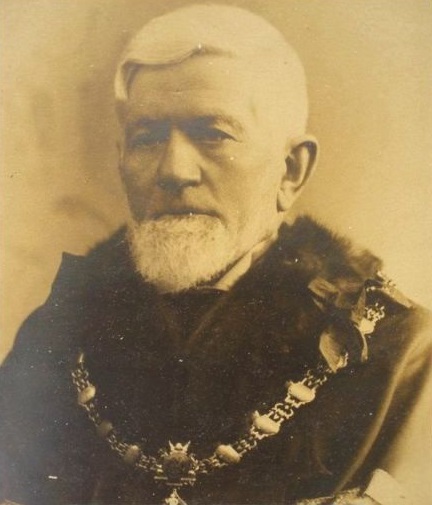
Mayor of Darwen 1881- 1882
Henry was the son of Thomas Green a weaver from Darwen, and his wife, Mary. He was baptised at Darwen St James's Church on 2nd September 1813, as was his older sister, Betty in 1810. Unfortunately, his father, Thomas, died soon afterwards, and was buried at St Mary the Virgin Church in Blackburn, aged only 30 years on 21st December 1815.
The Darwen News notes that Henry was sent to the mill to earn his own living at the age of only six years, which was a common occurrence in those days. The Short Time Act had not yet been passed, so that there were no half-timers, nor was there any legislation in force regulating the hours in factories. Under these circumstances Henry cannot have had any great educational advantages, and it is believed that the only formal education he received was through his attendance at Sunday School.
In 1833 Henry married Ellen Entwistle at St Mary the Virgin, Blackburn, and, by 1841, they were living on Duckworth Street in Darwen with their four young children. The 1851 census shows the family still on Duckworth Street, and Henry gives his occupation as Power Loom Manager.
However by 1861 they had moved to Wood Street, Darwen, now with two more young daughters and 1 servant, and Henry is a Cotton Manufacturer employing 300 people.
He had formed a partnership with Mr Doctor Graham, Mr Thomas Fish, and Mr John Kay, working at Woodside Mills for many years.
In 1886, this partnership was dissolved and a new partnership formed by Mr Green and Mr Graham at Culvert Mill, Watery Lane, Darwen. He later went into partnership with his two sons, Thomas and James, owning a couple of mills in Blackburn.
Mr Green was for many years the chairman of Cotton Hall Spinning and Manufacturing Company, and also of Darwen Manufacturing Company at Carr's Mill.
Henry Green was a member of the Darwen Local Board for many years, and when the town was incorporated as a municipal borough in 1878, he was returned as a member of the Town Council and at the first meeting of that body he was elected an alderman.
During the early part of his career he took an active part in educational matters and was a prominent member of the Mechanic's Institute, which in those days was the principal educational institution in the town. He was a firm believer in compulsory education and was heard to state “ The forced attendance of children at school would be of great value to the rising generation, and would place within the reach of everyone facilities whereby they may, if they think proper, prepare themselves for the better fulfilling of their duties as citizens.”
He was an ardent Non-Conformist and strenuous advocate of civil and religious liberty,
being a member, and for many years a deacon of Belgrave Congregational Church, where his interest in popular education lead him to act as School Manager. When later the new schools were erected he was a liberal subscriber to the building fund, and along with others, exercised a general supervision of the works.
But it was as a temperance reformer that he was most widely known. He was one of the earliest members of the Darwen Temperance Society, which was formed in the summer of 1834, and he was one of a number of local veterans to address a public meeting held on the celebration of the Society's jubilee.
In politics he was a Liberal, and a frequent attender at Market Street Liberal Club in the town, where he also liked to indulge his favourite pastime of chess.
On 9th November 1881 he was unanimously elected Mayor of the Borough. Following his election he drew a picture of what Darwen was like when he was younger, saying “I can remember the time when there were no flagged parapets, no water for domestic use but what had to be carried for long distances, no lamps to light the streets, no gas for household consumption, no removal of night-soil, no sweeping or watering of streets, no collection of refuse, and no control over new buildings or the laying out of streets.”
He was a diligent reader and had considerable literary taste and judgement so that when the Literary Society was started during his mayoralty, its earliest meetings were held in the mayor's parlour. He was rarely absent from its monthly meetings and regularly took part in the debates.
During his mayoralty the new Market Hall was opened on 21st June 1882. Local mills and businesses had been encouraged to allow their workers time off for the afternoon, so the streets were filled with onlookers when the M. P. Mr Frederick Grafton arrived at noon. He was welcomed by the Mayor, members of the Town Council and borough officials, after which there a public procession through the town. On returning to the Market Hall, Mr Grafton was presented with a golden key by Alderman Green, and asked to perform the opening ceremony. Later in the day there was a banquet at the Co-operative Hall and a ball at the Market Hall, the latter being attended by about 1200 people.
For more than twenty years Henry and his family lived at Woodbine House at the junction of Tockholes Road and Vale Street, and it was there that he passed away after a short illness on 8th March 1897 aged 83. His wife, Ellen had died before him in 1890, and they were buried together in Darwen Cemetery.
Probate was granted to his two surviving sons, Thomas and James, both Cotton Manufacturers, and, to his son-in-law Joshua Williamson, a retired Grocer (the husband of his daughter, Ann Jane). His effects totalled £1448 1s.
The funeral service was held at Belgrave Congregational Chapel, attended by the Town Clerk on behalf of the Mayor, and invited council members.
Compiled by Joyce Calder, December 2022
Sources:
The Darwen News
Darwen Heritage Centre
lan-opc.org.uk
ancestry.co.uk
Index to Wills and Administrations-gov.uk
William Entwistle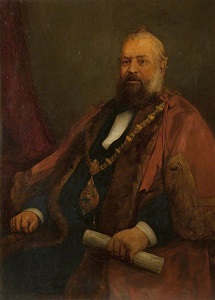
Mayor Of Darwen 1882-1884
© Blackburn Museum and Art Gallery
William Entwistle was the grandson of Ralph Entwistle of Sough, who was one of the principal founders of Wesleyan Methodism in Darwen. When John Wesley visited Darwen in 1785 to found a mission, Ralph Entwistle had the honour of welcoming him to stay at his home. Ralph's son William, a yeoman and colliery proprietor married Betty Smalley, who was the daughter of Robert Smalley of Heyfold and the granddaughter of Reverend Robert Smalley, the pastor at Lower Chapel Congregational Church for 40 years.
William Jr. was born on 7th October 1827 in a house overlooking Belgrave Square in the centre of Darwen, one of seven children of William and Betty, and he was baptised at Darwen Methodist Chapel the following year. He received his early education at the school conducted by Mr Joseph Kershaw in a small room in Bank Lane and he then attended Blackburn Grammar School for several years.
The 1841 census shows William living with his mother, who gave her occupation as farmer, and three of his sisters at Brick House, Sough Road, Darwen, his father having died the previous year. In 1851 he was living nearby at Rosehill House with three siblings and described himself as a farmer's son, but by 1861 he was again living with his mother in Rosehill Cottage. At about this time he went into business with his oldest brother, Robert Smalley Entwistle trading as stone and flag merchants from Rosehill Quarry. Darwen had become famous for the production of stone flags, which were considered superior to others due to their being able to withstand any climate. Messrs. Entwistle continued to grow their business, gaining a reputation as good businessmen who were courteous and obliging to their customers.
On 28th September 1876 William married Sarah Heyworth, daughter of John Heyworth of Strawberry Bank at St. Paul's Church Blackburn and they continued to live at Rosehill Cottage.
William had, by this time, been elected a member of the Local Board in Darwen, and was soon appointed Chairman of the Highways Committee, a position which he held for 18 years. Upon the incorporation of the Borough in 1878 he was elected Councillor for Darwen South East Ward, and at the first meeting of the Town Council he was made an Alderman, a position to which he was re-elected twice more in 1883 and 1889.
On 9th October 1882 William was elected Mayor by a unanimous vote, and at the end of his year of office was invited to accept the position for a further year. In 1885 he was appointed Chief Magistrate for the area, a position in which he gained respect and admiration for the way in which he conducted his duties.
During his time as mayor the Mayoral Sunday processions accompanying him to the service at Railway Road Wesleyan Chapel were impressive. He was also a hospitable host at the banquets which he held for county and borough magistrates, corporation and borough officials, and to which he also invited many of his friends.
On a personal level his interests centred on assisting religious, educational and philanthropic movements, irrespective of any denominational prejudice. He was a member of the Harmony and Industry Lodge of Freemasons, and at the time of his death was the oldest member of the lodges within the Darwen area. He also took a keen interest in Oddfellowship and was a member of the Newtonian Lodge, Manchester Unity. The volunteer movement appealed strongly to his patriotic instincts and he was a generous subscriber to the funds of the local corps.
The Blackburn Standard Newspaper of 29th May 1886 reported:
“Alderman William Entwistle J P, Councillor Robert Arkwright and Mr William Henry Marsden journeyed to Belfast last Monday evening to purchase some additional horses for the new steam fire engine. They arrived back safely in Darwen on Thursday morning with five handsome horses which they have purchased for the town”.
After his period as mayor ended he continued to serve as Alderman until 1891 when he retired from the council. In his resignation letter he explained the reason for his retirement. This was that having by a family arrangement become interested in the flag pits of his nephew, Mr. James Pickup Entwistle in addition to his interests in the firm of Messrs. R.S. & W. Entwistle, and especially because the former firm had business relations with the Town Council, he felt that it would not be in the best interests of the ratepayers to continue his membership of the council.
William died on 23rd February 1898 and probate was granted to his widow, Sarah and to Joseph Greenwood Thomas, bookkeeper, and cashier. His effects totalled £14,772.
Compiled by Joyce Calder March 2024
Sources:
ancestry.co.uk
findmypast.co.uk
Index to Wills and Administrations – gov.uk
Newspapers:
Darwen News
Blackburn Standard
Timothy Lightbown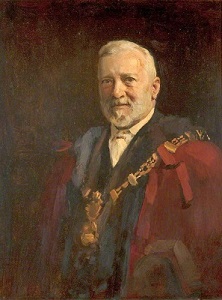
Mayor of Darwen 1884 to 1886
Portrait by unamed artist in Blackburn Museum & Art Gallery, Art UK
Timothy was born in Darwen in 1838 to John and Phoebe Lightbown (nee Holden). By 1841 he had emigrated to America with his parents and older sister, Mary Alice; the 1850, 1855, and 1860 censuses show the family living in Paris, Oneida, New York State. In 1861, Timothy married Mary Elizabeth Pritchard, a Canadian by birth, and they returned to England before 1871. The 1871 Census shows Timothy and Mary living at 39 Hindle Street, Over Darwen with their son, William Ellis (born 1862 in Pennsylvania), and sister-in-law, Agnes Pritchard. Mary Elizabeth died in 1871, aged 34 years, and, in the following year, Timothy remarried, as detailed in the Blackburn Standard Newspaper:
“9 October 1872 at United Methodist Free Church, Darwen, by Reverend R. Lyon,
Timothy Lightbown Esq., Manufacturer, of Over Darwen to Miss Alice Kay, Falcon House, Hollin Grove, Lower Darwen”.
Timothy and Alice then continued to live at Falcon House for the rest of their lives. In 1862, Dove Cottage Mill was leased to Timothy and his half-brothers, Henry & Roger, and, in 1882, Brookside Mill was sold to Timothy & Roger who formed the Brookside Weaving Co. Ltd.
Timothy was elected Mayor of Darwen in 1884 and served for two years.
On 14th February 1885, Timothy Lightbown of Falcon House, Darwen became Commissioner of the Peace for the Borough of Darwen.
On 19th March 1892, he and others were elected to serve as Aldermen of the Borough for a period of 6 years.
On 3rd December 1906, Alderman Timothy Lightbown was made Honorary Freeman of Darwen.
A report in the Manchester Evening News notes that on 4th March 1885 the Mayor of Darwen, Mr Timothy Lightbown J. P. gave a donation of £100 to the Darwen Free Library to be spent in books.
Information from Darwen Heritage Centre notes that on October 14th 1886 a much admired fountain was erected at a cost of £200 in Whitehall Park, Darwen, the donor being the then Mayoress (Mrs. Alderman T. Lightbown).
Timothy Lightbown died at Falcon House on 7th September 1910 and probate was granted to his son, William Ellis Lightbown, Salesman, Walmsley Preston Kay, Solicitor, and Moses Ellison, director of a Limited Company. Effects totalled £39,240 15s.
There is an ornate gravestone for him and his wife in Darwen Cemetery with the inscription:
“In Loving Memory Of Alice Lightbown, The Beloved Wife Of Timothy Lightbown Of Falcon House Darwen
Who Died May 30th 1909 Aged 76 Years.
Also of Timothy Lightbown, For 22 Years Alderman of This Borough
Who Died 7th Sept 1910 Aged 72 Years”
After his death, Falcon House (on the corner of Falcon Avenue and Blackburn Road) became Darwen Masonic Lodge, then Darwen Liberal Club, but later fell into disrepair and was demolished c. 2015
Compiled by Joyce Calder February 2022
Sources
Shaw, J.G. 'History and Traditions of Darwen and Its People'
ancestry.co.uk
familysearch.co.uk
findmypast. co.uk
Index to Wills and Administrations – gov.uk
Thomas Grime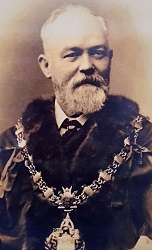
Mayor of Darwen 1886 to 1887
Thomas Grime was born 28th January 1826, the son of John Grime, a weaver of Darwen and his wife Mary (nee Harwood), and was baptised at the Ebenezer Chapel in Darwen on 16th July 1826. He was one of 8 children and the family lived at Green Street Darwen, before moving to Wellington Street, where the 1851 census shows Thomas as a Railway Clerk.
He went to work in the mill at 12 years of age, and eight years later became head cloth-looker at Newfield Mills, Lower Darwen. In 1848 he was appointed station master at Sough, and in 1853 he became cashier at the Hollins paper mill of Messrs. C & J G Potter.
On 14th August 1851 he married Mary Webster (daughter of George Webster of Over Darwen) at Blackburn St. Mary the Virgin church as witnessed by John Carlisle and John Sanderson.
By 1861 Thomas and Mary were living at Top o'th Croft Lower Darwen, and he was clerk to a Paper Manufacturer.
In 1865 he and Doctor Aspinall commenced business as paper manufacturers at Knott Mill Paper Works, which was situated on the land between the present Darwen Library and Darwen Railway Station.
In 1871 he was living at Shorey Bank, Over Darwen.
He and Mary did not have any children, but adopted Albert Carlisle, who was the youngest son of Mary's sister, Jane and her husband, John Carlisle of Clitheroe.
The 1881 and 1891 censuses show Thomas, Mary, Albert and servants living at Heatherby House off Bolton Road in Darwen.
Their adopted son Albert Carlisle Grime married Evelyn Otway Dray in Brixton, London in 1893 but he then died in Darwen on 15th February 1898 aged 34 years, having suffered a fall at his mother's house on Bolton Road.
In January 1867, Thomas was elected to the Local Board of Health with three other local businessmen, and in the following year was appointed chairman of the finance committee, a position he retained until he was appointed Chairman of the Board in 1872.
In February 1869 he was initiated into the Darwen Harmony and Industry Masonic Lodge where he remained a member until his death.
The Preston Herald newspaper reported details of the laying of the Foundation Stone of the Jollie Memorial Church in Barrow on 15th April 1876:-
“The foundation stone of the Jollie Memorial Church, Barrow which is to be erected as a memorial of the Reverend Thomas Jollie, one of the founders of the Lancashire Independency, and first Pastor of the first Congregational Church in North East Lancashire was laid by Mr. Thomas Grime of Darwen.
Mr. H. Harrison, in an appropriate speech, presented a silver trowel, which bore a suitable inscription, and a mallet made of curled oak, to Mr. Grime for the purpose of laying the stone. He then in a workmanlike manner adjusted the stone, and declared it well and truly laid.”
December 1886 saw the opening of a new Temperance Club in Duckworth Street Darwen, as mentioned in the Preston Herald:-
“The new premises of the No.1 Working Men's Temperance Club, the erection of which will involve an outlay of upwards of £1000, were formally opened by Mr. Graham Fish.
Among those who took part in the proceedings were the Mayor (Councillor Grime) and Councillor Timothy Lightbown J. P. (ex Mayor).
After the ceremony a tea meeting took place at which upwards of 400 sat down. The club can now boast of a membership of over 230. A bazaar will be held early next year to clear off the debt.”
The same newspaper had given details of a meeting of shareholders of Knott Mill (Darwen) Paper Company Ltd in November 1877 at which a balance sheet was submitted, showing a considerable loss, which was attributed to the continued depression of trade. It was stated that the market price of paper had declined during the last two years by about 25%, while the price of paper-making materials had very largely increased, so that it was now almost impossible to carry on the trade to a profit. After considerable discussion a resolution was supported by several gentlemen present expressing their entire confidence in the chairman, Mr. Thomas Grime, asking him to accept the position of Managing Director.
However, presumably the paper trade remained difficult and Mr. Grime's bankruptcy hearing took place on 15th May 1889:-
“At the Count Court Blackburn Mr L. Broadbent made application to his Honour Judge Coventry for the discharge in bankruptcy of Mr. Thomas Grime, trading as Thomas Grime & Co. of Knott Mill Paper Works. Mr. T. Edelston, the official receiver, stated that the liabilties were £6,174, whilst the assets had already realised £1,140.”
His death was reported in the Darwen News:-
“We regret to announce the death of Mr Thomas Grime of Bolton Road, which took place between 8 and 9 o'clock in the morning of Wednesday, 22nd May. He had been in a critical condition for a time, and his death was due to congestion of the liver.”
and his funeral in the Preston Herald:-
“The remains of the late Mr. Thomas Grime, an ex-Mayor of the borough were interred at the cemetery. The service was conducted at the residence of the deceased gentleman by Reverend Henry Irving. A large number of prominent gentlemen in the town, principally members of the Harmony & Industry Masonic Lodge formed in procession. The coffin was of polished oak, had brass fittings and was completely covered with a very large number of beautiful wreaths, one of which was formed from forget-me-nots in the shape of a masonic emblem.”
He was buried in Darwen Cemetery, and in 1904 his wife was also interred there.
Compiled by Joyce Calder, September 2022
Online Resources:ancestry.co.uk
familysearch.co.uk
findmypast. co.uk
lan-opc.org.uk
Newspapers:
Darwen News
Preston Herald
With thanks to Darwen Heritage Centre
Alexander Thomas Eccles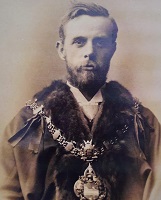 Mayor of Darwen 1887 to 1889 and 1908 to 1909
Alexander Thomas Eccles was born in 1851, the son of Joseph and Betty Eccles of Darwen. Joseph was a member of a firm of Cotton Spinners and Manufacturers which ran Ellenshaw and New Bridge Mills, and he later commenced business on his own account, building Bottomcroft Mill on Blackburn Road, before acquiring other mills in Preston.
The 1851 census shows Joseph and Betty living on Union Street, Darwen with their children Joseph (born 1846), and Alexander Thomas. By 1861 they lived at 33 Railway Road, Darwen with their two sons and their daughter, Betsy (born 1855).
Alexander received his preliminary education at a private school in Darwen before attending Blackburn Grammar School. He remained at the Grammar School until he was fifteen years old and then proceeded to Cranfield College at Maidenhead for a further two years. His education completed, he entered his father's mills to gain an insight into the cotton business, but was encouraged by his father to travel and visited many parts of the British Isles, also Canada, the United States of America and several European countries.
The 1871 census shows Alexander living at High Lawn, Blackburn Road, Darwen with his parents and siblings, but by 1881 he and his widowed father were at the same address with two servants.
In 1876 Alexander was the secretary of the newly founded Congregationalist Church
at Hollins Grove, being one of those who established a Sunday School there. For thirty years after the church was established he was the choirmaster.
In 1883 Mr Eccles became a member of the Borough Council, as one of the representatives for North West Ward, succeeding his uncle, Mr Thomas Eccles J. P. in that position.
His first appointment was as vice-chairman of the Finance Committee and not long afterwards he succeeded Councillor Grime as chairman. In September 1889 he was made a Justice of the Peace for the borough, and in the following year was made an Alderman.
In 1887 Mr Eccles was invited to the position of Mayor. He accepted the offer and served the office for two years. During the first year of his mayoralty his eldest son Joseph was born and he and Mrs Eccles were the recipients of a silver cradle, suscribed for by the members of the council.
In 1895 he was invited by the Liberal group in Chorley to stand as the Liberal candidate in the forthcoming contest to become Member of Parliament for Chorley, but he declined the invitation, leaving the only other candidate, the Conservative member Lord Balcarres to receive the nomination.
In 1905 he was the first Borough Magistrate to be added to the Commission of the Peace for Lancashire, and was later invited to become Mayor again for the 1908 – 1909 period.
He remained a member of the council until 1920, during which time he was associated with every committee, serving as chairman on most of them, and at the time of his retirement was its oldest member.
He had married Helena Mills who was the daughter of Abraham Mills, a cotton manufacturer of Middleton, Lancashire at the West End Church in Southport on 24th November 1886.
Alexander and Helena had 5 children – Joseph Louis (born1888), Muriel (1889),
Ethel Mary (1890), Hubert Ballantyne (1891) and Bessie (1895).
The family regularly visited Grange-over-Sands in Cumbria, and the 1891 census shows the three eldest children and their parents at Oneglia Lodging House, The Esplanade.
By 1901 their two sons Joseph and Hubert were boarders at Bilton Grange, Dunchurch near Rugby, which was a school originally set up by Reverend Walter Earle in 1887. Their three sisters were at that time living in Grange-over-Sands with 2 governesses and other servants, but their parents do not appear in the census.
In 1911 Alexander, Helena and their 4 eldest children were resident at “The Grange” in Hawkshaw Avenue with five servants. Their youngest child Bessie had died in 1904.
Having been one of the founders of Hollins Grove Congregational Church in 1876, Mr. Eccles was closely involved in the planning and fundraising for a new chapel which was to be built nearby, which meant that the original building could be used as a Day and Sunday School providing accommodation for 518 scholars. The estimated cost for the new chapel and organ, plus alterations to the old building was £8,000 to £9,000.
A special subscription tea party was held in February 1905 and promises to the Chapel Building Fund were shown to be already over £1,300. Fundraising continued throughout the following year by way of a Carnival, Garden Party, Sale of Work etc so that the total reached over £3,000. It was noted that Mr Eccles made a contribution of £1,000 and in addition promised to subscribe £2 for every £1 contributed, up to a total of £500.
February 1907 saw the laying of the foundation stone by Mrs Alexander Eccles, and in December of the same year the new Chapel was opened by Miss Eccles, by which time the funds raised had increased to £6,115.
Alexander and his wife spent their summers in Anglesey, and in 1914 The London Gazette reports that “Alexander Thomas Eccles Esq. of Uwchydon, Treaddur Bay, Holyhead and The Grange, Darwen Lancashire is to be nominated for Sheriff of Anglesey for 1915.”
In 1920 he was one of three Aldermen who had the Freedom of the Borough of Darwen conferred upon them in recognition of their services, the others being Alderman Carus of Hoddlesden Hall and Alderman Cocker of Inglewood.
In 1925 he moved to Grange-over-Sands, Cumbria and shortly afterwards the congregation of Hollins Grove Chapel held a large assembly in the school at which a specially commissioned oil portrait of Mr Eccles was presented to him in recognition of his many years' service to the Chapel.
He continued to visit Darwen to meet his friends and acquaintances until his death in Grange in May 1934. His wife Helena had died there only a few months earlier.
Probate was granted on 10 July 1934 to his sons Joseph Louis Eccles, nurseryman, and Hubert Ballantyne Eccles, poultry farmer, and to his son in law Robert Brian Bickerdike, chemical manufacturer. His effects amounted to £86,755 17s.
Compiled by Joyce Calder, November 2022
Sources:
The Darwen News
Hollins Grove Congregational Church, Souvenir of Opening – Darwen Library
Hollins Grove Congregational Church, Diamond Jubilee brochure – Darwen Library
Darwen Heritage Centre
ancestry.co.uk
findmypast.co.uk
Index to Wills and Administrations – gov.uk
Earnest Morgan Davies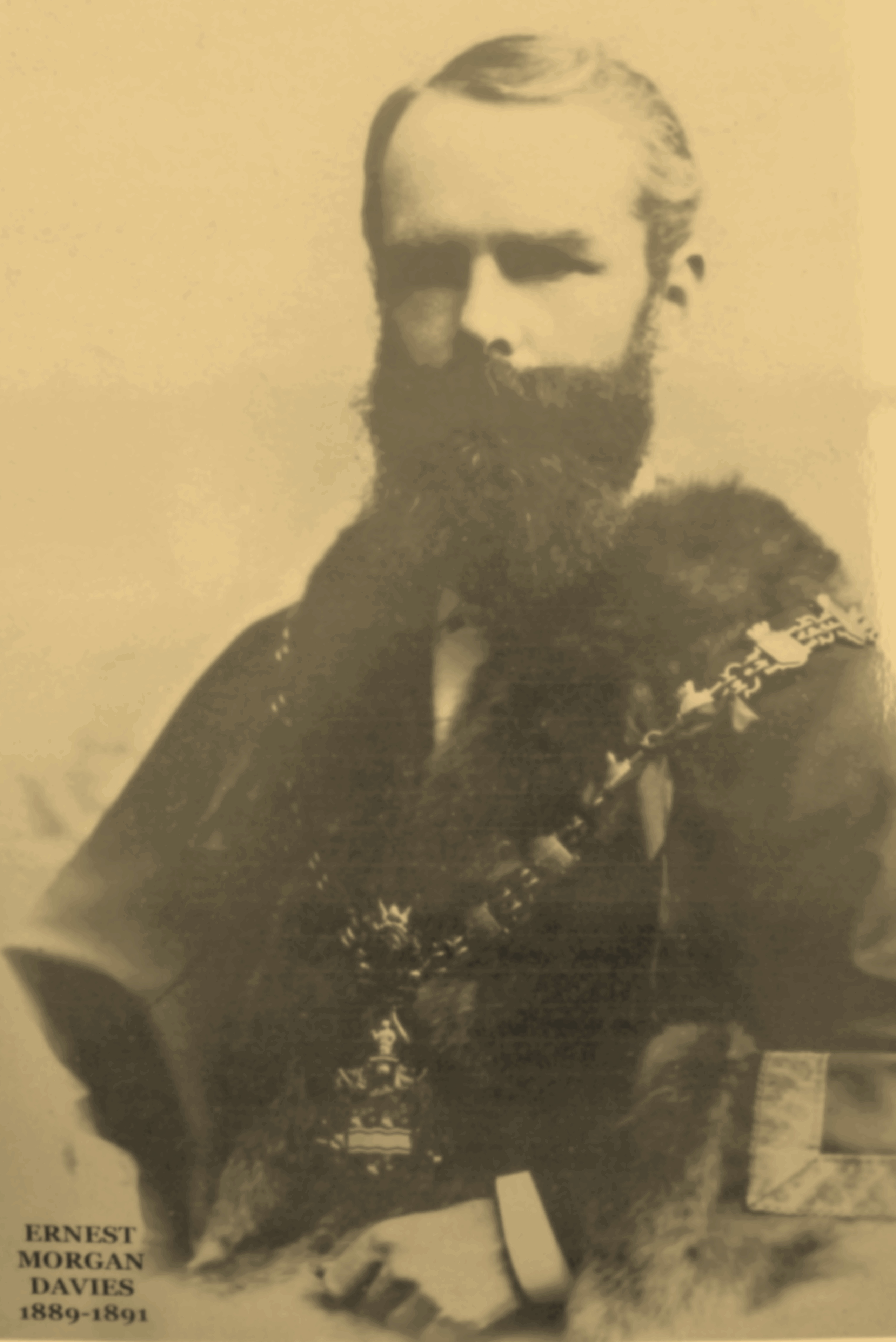
Mayor of Darwen 1889 to 1891
Mr. Ernest Morgan Davies became Mayor of Darwen in 1889 and served two years in the office. Although not a native of Darwen, he had been closely connected with the borough for the greater part of his life, his father Rev. Thomas Davies being the pastor of Duckworth Street Congregational Church for twenty years.
Mr. Ernest Davies was born in Maidenhead Berkshire in 1848 where he attended a boarding school, distinguishing himself in his studies. He then came to Darwen when he was 13 years old with his parents and six younger siblings. He spent two years at the Blackburn Grammar School, followed by one year at Preston Grammar School after which time he attended his uncle's school, Cranford College in Maidenhead for a further three years.
Whilst a pupil at Blackburn Grammar School he and three of his classmates were put forward for the Oxford University Local Examinations held throughout England. All candidates were required to satisfy the examiners in arithmetic, spelling, composition, good handwriting, the analysis and parsing of Paradise Lost (book 1), geography, english and history. In addition to this preliminary examination every candidate was required to choose between one and four further papers, of which Davies chose Latin, Greek and Mathematics. All three boys passed the examinations, and they and all the other pupils at the school were given one day's holiday to celebrate their success
Ernest Davies' father wished him to pursue a business career and so sent him, upon finishing school, to learn the business of cotton manufacturing with Mr. John Goodier at Peel Mills in Preston.
In May 1869 Mr. Davies set up business as a cotton manufacturer in Darwen, his father having purchased and completed the unfinished mill at Greenfield, running 246 looms there. His younger brother Mr. Thomas Pearce Davies later joined him in the concern and the business greatly expanded, eventually running 1100 looms and associated preparatory machinery, providing employment for 450 men, women and children. This partnership continued until 1908 when it was dissolved by mutual consent, and the business was continued by Mr. Thomas Davies' two sons.
Although Mr. Ernest Davies was a member of the Town Council for a number of years, it had been largely in religious circles that he was best known in the town and district. He had been prominently associated with Congregationalism from the time he came to Darwen, and became a teacher at Duckworth Street Sunday School. When a branch Sunday School was established at Hollins Grove some years later he became superintendent there until the new chapel was erected in 1882, at which time he returned to the parent church at Duckworth Street. There he became superintendent, manager of the day school and member of the Chapel Committee.
Duckworth Street Chapel had been opened in 1853 and in 1906 a new larger organ was installed, necessitating structural changes to the building. At the same time a new oak pulpit was added to match the existing organ case, both of which had been paid for by Mr. Davies as a memorial to his father, the late Rev. Thomas Davies at a cost of about £1,500.
He also won a place in the Councils of the Congregational Union of England and Wales and in 1910 was elected chairman of the Lancashire Congregational Union. He was a director of the London Missionary Society and in his later years devoted a great deal of time to the welfare of the blind, becoming honorary secretary of the Darwen Blind Society.
In August 1872 Ernest Davies married Mary Ann Tweedie, daughter of John Tweedie of Rerrick, Kirkudbrightshire and they set up home at Cranberry Cottages, Over Darwen, close to Greenfield Mill. They went on to have two children, Constance born in 1873 and Charles Ernest two years later.
It was in 1884 that Mr. Davies was elected to the Town Council as the Liberal member for South East Ward, a position to which he was re-elected unopposed in 1887. This latter year also saw him appointed Justice of the Peace, and he became an Alderman in 1895.
During his long service to the council he was chairman of many of the important committees, including gas and water, the health, highways and finance departments.
In 1889 Mr. Davies was chosen to be Mayor of the Borough, an honour which was repeated twelve months later.
The 1911 census shows that Mr. Davies had moved to Moorthorpe, Park Street, Darwen having been recently widowed, and he continued to live there, with two servants, until his death in January 1929. His will showed his estate was worth in excess of £39,000 and probate was granted to his two grandsons, Robert S. Halliwell and Charles D. Halliwell. He bequeathed £300 each to his domestic servants, Sarah Kirkup and Jane Newbigging, and £100 to his gardener, Aaron Cronshaw.
The interment took place on Friday, 11th January at Darwen Cemetery preceded by a service at Duckworth Street Congregational Church.
Compiled by Joyce Calder, March 2023
Sources:
ancestry.co.uk
findmypast.co.uk
Index to Wills and Administrations – gov.uk
Newspapers:
Blackburn Times
Blackburn Standard
Moses Duxbury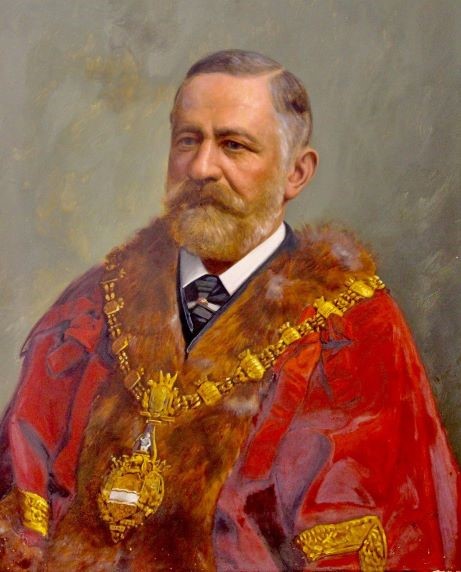
Mayor of Darwen 1891 to 1892
Moses Duxbury was born December 10th 1835 at Bury's Yard, Bolton Road, Darwen, one of thirteen children of Mr. Andrew Duxbury, who sadly died when Moses was only four years of age. He was first schooled by Mr. Thos. Kershaw in Bridge Street, and subsequently went to Belgrave Schools until the age of sixteen.
On leaving school he went to learn paper making, being apprenticed with Messrs James Wrigley and Son, Bridge Street Mill, Bury. On the completion of his apprenticeship, he went to Messrs Chadwick and Taylor's Broughton Grove Mill, Manchester, as machineman. There he was promoted to manager, and after holding the position for a few years, he went to South Wales as manager of the Ely Paper Mills near Cardiff.
In 1867 at the Gravel Lane Wesleyan Chapel, Salford he married Mary Ellen Rogers, daughter of Mr James Rogers of Higher Broughton, and the 1871 census shows Moses, Mary Ellen and their first child Joseph Andrew living at Paperwork House, Llandaff, Cardiff. After a stay of five years in Wales the family moved to Bury where Moses took up the position of manager at Messrs Newbold Bros' mill.
He remained there for four years before returning to Darwen as manager of Spring Vale Mills for the Darwen Paper Mill Co. Ltd., which had been formed in 1871 by a co-operative of working men. The Company originally worked the Lower Darwen Mill and having gained considerable success there they were able to purchase the Spring Vale estate and commenced the manufacture of newspaper. Prior to Mr Duxbury taking the management of the news mill, Spring Vale Mill had never paid a dividend, but after two year's service from him the company was able to show a profit – a success which continued for many years.
By 1881 Moses and Mary Ellen were living at Valemont House, Causeway Street, Darwen with their children Joseph Andrew (born 1870), Frederick William (1872), Lydia (1874) and Harry (1878). Their youngest daughter, Beatrice was born in 1872.
Mr Duxbury was evidently held in high regard for the way in which he continued to manage the Darwen Paper Mill Company, and when he was approached to accept the Mayoralty of the Borough in 1891 he placed the invitation of the Town Council before his board of management for their consideration, pointing out that whatever they decided upon he would willingly carry out. Without hesitation, however, a full meeting of the board unanimously decided that their manager should accept the honour conferred upon him.
In the following year he was created a Justice of the Peace for Darwen. Perhaps his chief public duties were those associated with Darwen Town Council. He was elected unopposed as a representative of the South West Ward in the year 1881, and up to the time of his retirement in August 1903 he had never had his seat contested.
In 1891 Mr Duxbury was created an Alderman and was also made chairman of the Cemetery Committee and the Waterworks Committee, the latter post being retained by him until his retirement in 1903.
He was a Liberal in politics, and although at one period he was president of the Bolton Road Reform Club, he was not regarded as a very active politician. He was also a member of the Harmony and Industry Lodge of Freemasons.
In later life he regularly spent weekends at his second home in Station Road, Blackpool, very close to Victoria Pier (now South Pier), and was Chairman of the Pier Company for many years. It was here that he suddenly became ill with Brights disease, and he passed away a few days later on 5th April 1906, surrounded by the members of his family. His body was returned to his Darwen residence to await burial in Darwen Cemetery, after a private service conducted by Reverend Bramwell Brown, Wesleyan minister.
Probate was granted to his widow, Mary Ellen and his son Harry, paper mill manager.
His effects totalled £15,200 12s 10d. Mrs Duxbury continued to live in Blackpool until her death there in 1926 at the age of 81.
Compiled by Joyce Calder, August 2023
Sources:
Image courtesy of Darwen Heritage Centre
The Darwen News
findmypast .co.uk
Index to Wills and Administrations-gov.uk
Published September 2023.