Old Darwen Memories
These “Old Darwen Memories” were taken from "The Blackburn Weekly Telegraph", between the 17th of March 1906 and the 4th of August 1906.
Transcribed by Shazia Kasim.
Henry Hargreaves | Thomas Harwood Marsden | David Ainsworth | James Thomlinson | Mrs Watson
George Yates | John Duxbury | John Whalley | Mrs Sanderson | William Taylor | Nancy Hindle
John Chadwick | Thomas Pickersgill | Mrs Bury | Amos Waddicor | Mrs Scholes | Nicholas Fish
Blackburn Weekly Telegraph 17 March 1906
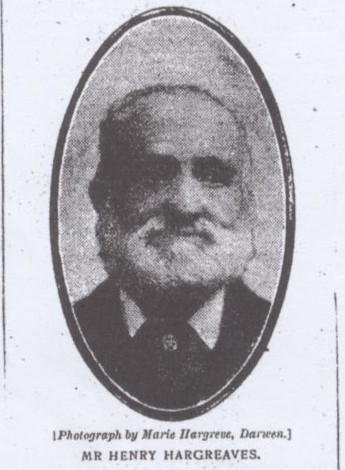
A lady to whom I inquired the whereabouts of the residence of Mr. Henry Hargreaves first condensed that gentleman’s name to “Harry Hargreaves” and then informed me that no one bearing it lived in Cranberry Lane. I persevered. “He is fond of music and plays a fiddle…….”
“A fiddle”, her brow contracted in thought.
“Harry – oh, id’s Owd Harry fiddler yow wast. Ye’ should speyk English.”
Having delivered that crushing retort she gave me directions to go as far “as ever yo’ con see, then past a pub, through a gate, an’ there’s a well, isn’t there?”
I didn’t know, but admitted that probably there was.
“Well yo’ll find him at th’ fost o’ three beanses forther. They stand l’th bottoms in a field by theirsels”.
The road was rugged, but at the end of my journey in a commodious, comfortable cot, with a trim garden frontage, I found Mr. Hargreaves, a sturdy veteran, whose years exceed by one the allotted span, the remnant of Hargreaves’s fiddling hand, a quartette composed of father and three sons, who in the bygone days were in great demand at social functions.
“I’ve a fiddle there yet”, and he pointed to the chimney nook where it was hanging. “Many is the good time we had, my father, my brothers and I fiddling at dances and all sorts of do’s. I’ve played in all sorts of places. Once I was sent for by James Shorrock, grandfather of the late Alderman Christopher Shorrock, to fiddle for his Irish haymakers in a barn at Astley Bank, and I remember how he roared with laughter as the men jigged away to the music. And I fiddled at Johnson’s Theatre, too.”
“Johnson’s Theatre,” I remarked, “where was that?”
“It’s been a long while since then. They to come to Darwen for three months at a time, and they acted plays. They were plays about things that had happened, not makeups.
Nowadays plays are made, and things are done on the stage that never have been. It was different then, and when we had a murder or things like that it was acted to us. We had ‘The Factory Girl’, ‘The murder of Maria Martin, ‘Red Riding Hood’…
“The pantomime?”
“Oh no, a play. It was something that had happened. Old Joe Hall was the comic and he could sing.”
“Do you remember any of the old songs?”
“Well not the words. There was ‘Old Ann Tucker’, ‘John Brown’s Wife’, ‘Rock the Cradle, Lucy’ and a lot of others. But I can’t remember the words. There was plenty of singing in those days, especially on beef nights – when the farmers had their do’s.
For a period of something like eight and twenty years Mr. Hargreaves was card master at Top Factory, and this fact led us to chat of the changed conditions in the cotton trade.
“Factory folk are a lot better off than they were then”. Mr Hargreaves continued. “Why, when I was a lad the hours were long and the work hard. A big lad for his age would be started when he was seven years old, and I went it at eight.”
“As a half-timer?”
“Half-timer! No! There were no half-timers then. If you went into the factory you had to work all the day. I worked from six in the morning till half-past seven at night, and four o’clock on a Saturday afternoon”.
“And your wages were?”
“Two shillings a week. When I was going home with the first money I ever earned I was bobbing at a duck on a lodge bank, and I bobbed my two shillings into the lodge. We hadn’t to get a certificate to pass the doctor. When he came to pass us it was a case of looking as well as you could, and if you looked well you passed. My spinner got hold of me and rubbed my face with a cloth to make it look rosy and then he made me put two waistcoats on to look plump. And when the doctor saw me he opened my mouth and looked at my teeth, and said I’d do. They don’t do it like that nowadays. We worked at night by candlelight, for we had no gas, and the piecers would go round with the box snuffers when we were leaving off. They were not particular about running overtime or cribbing at meal times, for there was no inspector, to matter anything. Women are better off now than they were then...”
“In what way?”
“They need to work down in the coal pits about here, with breeches on, short skirts and caps on their heads. Some worked as drawers and some as thrutchers. The drawers had lumps of clay on their heads, and in this a candle would be stuck so that they could see where they were going. They had chains round their bodies, and these were fastened to the waggons they had to pull. The thrutchers had their caps padded, and they had to put their heads against the wagons behind and push for all they were worth. That was the work they were doing the day through in the pits – dragging and pushing the wagons.
“There was a lot of drinking in the old days, and men used to boast about how much they could sup, and make matches. There was one at a public-house and the man had to drink a gallon of ale, then so much water and then…..”
“And then what happened?”
“Then he died through it. But there were a lot of drinking matches of one sort or another. There was more ale sold then after twelve o’clock at night than is sold at many a public-house the day through. Beer-houses closed at eleven, but when they were shut the men used to turn it at the publics. You don’t see the same drinking now.”
We joined a veteran of 81 years “by the book”, Mr. Thomas Heys, and these two gentlemen chatted away about the times when they were boys. “Peace eggs” were mentioned and Mr. Heys joined in with a recollection of the old “pace-eggers.”
“They used to go round the district singing” he said “and two would be dressed in ribbons, another being the basket carrier. They had tinsel aprons on, and their hats, dressed with ribbons used to cost a good deal. Bill Smith and their Tom would start off through Darwen, Tockholes, Chorley and round Bolton back to Darwen again. They sang songs they had made up and practised for months.”
Mr. Hargreaves in the course of his memories told me an incident about the Egerton Band, with which he was connected when a young man.
“One of our players had bow-legs,” he said “and another was knock-kneed. When we were marching along playing the children used to lie down in the streets to find out what band was coming. When they looked under the instruments and saw the bow-legs and the knock-knees they would shout out ‘Egerton band’s coming!’”
Mr Thomas Harwood Marsden
Blackburn Weekly Telegraph 24 March 1906
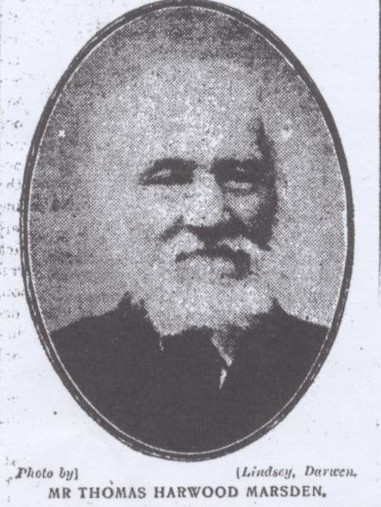
In political and religious movements at Darwen during the past half-century Mr Thomas Harwood Marsden of Lynwood Avenue has played a considerable part. A keen fighter and hard hitter, he is an interesting figure on any platform, for he is representative of that type of man who have raised Darwen from the position of a village to that of a fairly important town within the limits of the past century. Mr. Marsden may claim to be one of Darwen’s ‘pure-breds’. When the inhabitants of Darwen were few, and the houses were widely separated and far from numerous his ancestors lived in the district, and the combination of the names Harwood and Marsden is the 18-carat stamp of local antiquity, for representatives of the families bearing them lived about the hillside several centuries ago.
Mr. Marsden can tell interesting stories of Darwen as it was in the days of his boyhood, and he is the possessor of a rich store of anecdotes of the men who, at different periods, have played their proper part in Darwen’s life. He has laboured under many religious guides and political leaders and taken part in many exciting battles. When he was beaten, many years ago, for a seat on the Town Council, a local poet, accustomed to issuing broadsheets on the events of the moment, hit off several features of Mr. Marsden’s character in “a moving ditty” and invested his poem with the atmosphere of the man. He wrote:
"I’m a sworn foe to jobbery, trickery cant
A teetotaller, too, what more can you want?
And hate like poison all bluster and rant
Which nobody can deny."
Much water has run under the bridge since the days when that song was sung to the old tune of “The Roundheads are Rogues” and Mr. Marsden is now able to survey the happenings of his long life and compare the times present with those past.
“Some folks think that the world on the down grade”, he remarked to me, “and that the people are going to the dogs. But I don’t believe it. And why?
Because my experience proves to the contrary. When I was a lad my parents always saw that I attended the Sunday school at Lower Chapel. The chief business at Chapels then was mining, and when I was going to school on a Sunday morning, I have seen colliers who had been drinking all night, stripped naked, wearing nothing but a pair of clogs, fighting and kicking away at each other. We don’t have that sort of thing now. The public-houses are closed earlier, and there is not the brutal fighting there was when I was a lad. It was a common thing for a man to be so injured in a fight that he died, and with my own eyes I have seen men come from public-houses and go on the Lee, where they fought until one was killed on the spot. No, the world is getting better, not worse”.
We conversed about the drinking habits in the old days for some time, and in the course of our talk Mr. Marsden mentioned a notorious old-time “Hush Shop” which existed at Hill o’m Hoyle.
“A hush shop was a place where beer was sold without a license,” he said, “and this one was kept by an old man who went by the name of Jem Guy. He pretended to be a handloom-weaver, but he did not do much weaving, and had his loom in the house more as a blind than anything else. I drew in for Jem at one time when I was a lad. One day some men went to Jem’s for some fun, and to get cheap beer. Jem was weaving bandanas then. Well they got the beer they asked for, and just as Jem was expecting to be paid they shouted ‘Constable! Constable!’ as loud as they could, and pretending that the officer was coming and they would all be caught, they made a dash right through Jem’s warp, smashing it down, and through the window, just as if the Old Lad was after them. Jem dared not say a word, and he had to put up with it. He never had a successor in the game, but he was well to do, and made a lot of money, all with selling beer illicitly. I don’t know how it was he was never caught, for the brewery cart would come and stop before his house with barrels as it might have been a public-house. There used to be a lot of whiskey making about the moors, and it was brought down and sold to Jem. There was also a lot made about Pickup Bank, and it was brought over in farmers’ carts, and all sorts of secret ways.”
Mr. Marsden then told me the long story of how Lancashire starved in the cotton famine of the early sixties.
“Things were awful then,” he said, “no materials could be got to keep the looms going, the mills were locked up, and the operatives were thrown out of work. Misery and privation was suffered by the people and much of the keenest suffering was amongst those who said nothing but bore it quietly. Lancashire was starving. Soup kitchens were opened, and soup and bread were given out to the famished folks, and one of those kitchens was in the premises now occupied by the Independent Labour Party in Bury Street as a club. Relief came from many parts of the kingdom and even from America: I shall never forget flour coming from America. Three thousand pounds were given out in Darwen and Blackburn in clothing and kind. We were then in an awful state, for the folks had sold what they could. Outdoor work was organised to find the men a bit of something to do. The footpath down the side of the station, by the Albion, was made by the relief workers, and some of the footpaths on the moors were also improved. In order to keep the operatives out of the streets a day school was also organised in William Street, and sewing classes were started for the women. Well, the Relief Committee advertised for a school master, but none of the applicants suited and the Rev. Thomas Davies told them that he thought he knew a man who would do. The result was that I was appointed school master, along with Emanuel Gibson, who emigrated to America when the American war was at an end. We did not teach the abstruse sciences, for our students were carters, colliers and all sorts of people. A register was kept of the attendance of the adults, and if they did not turn up at school when they were not working they got no relief, for it depended on their attendance. We taught writing, reading and arithmetic – anything to get the dull times over.”
Mr. Marsden then told me the story of the important part which he, Elijah Holt, Hartley Ingham, watchmaker of Blackburn, at one time chapel keeper at the Park Road Congregational Chapel; Jacob Wearing, Richard Hedson, and others played in bringing about an improvement by interviewing Sir Charles Wood in London. But that is a long story and my space is full.
Blackburn Weekly Telegraph 31st March 1906
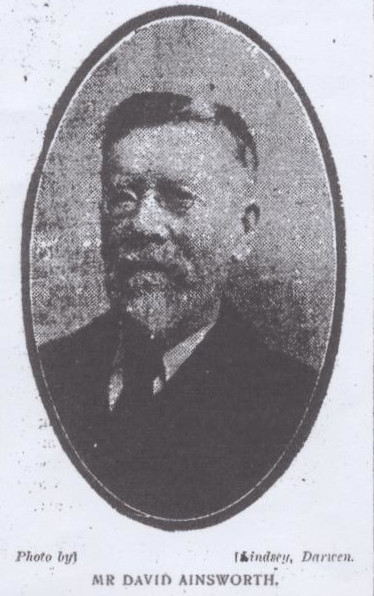
The hungry forties, and the thirties, too, come within survey in the period covered by the recollections of Mr. David Ainsworth, an interesting stalwart, who lives a link connecting today with the bygone yesterday. It does one good to creep into the confidences of a man who was born 79 years ago, who carries his great years with ease, and whose memory over all that great space of time remains fresh and clear. As Mrs. Acton Tindal wrote, in the days when he was a lad:
Before him stand ungarnished
The realities of life
My chat with Mr. Ainsworth naturally led him to talk of the hardships of the poor and working classes in the early thirties, and it was an incident, illustrating what was then endured, that he concluded by remarking, "I never had a halfpenny spent on my schooling in all my life, for my folks were too poor when I was a lad to lay out the very little money they had in that way. Old John Nuttall used to come over from Waterside with a wallet teaching reading and writing and he would say, "Now lad, don't open that book so wide, it'll want binding afresh."
Mr. Ainsworth then told me how learnt to knit healds under George Kay, and went to work at Bowling Green Mill, under the first Eccles Shorrock. When George Kay went with his family to America, Mr. Ainsworth was promoted to the position of being master heald-knitter at the factory.
"I was ten years old, and wore petticoats when I got that post, and I had 3s 6d a week for being the master heald knitter and for teaching others how to do the work. I was at Bowling Green Mill on procession through the town to the new mill in Union Street and we had dinner in the shed. That was a great day in Darwen. In our procession we had a lad named Walsh-he's dead now-and he walked wearing a frock, bonnet and shawl. He wanted to be a lass, and he walked with them. And he called himself Alice.
"Our folks were as poor as church mice, and all-round the standard of life for the working classes were very low. Flour was sixpence a pound, and everything else accordingly. It was porridge in the morning, porridge for dinner and porridge again at night and when the porridge-pot was put on the table it was helter-skelter with us children for the last spoonful, and sometimes we had words as to whose turn it was to scrape the pan out. We never had tea except on a Sunday and we had it then made from mint and sweetened with treacle. Two quarts of milk could be got for 1 1/2d, but we couldn't spare that money for luxury.
"We had a spell of hard times in 1843, when Hilton's failed. They had a paper mill where the India Mill and Dimmock's Mill is now, and when it stopped there was much suffering. No work could be got in the town. It was at that time the authorities to relieve the folk got them to cutting the old Dole Road. Where is that? It is what is called Police Street now, and the earth stood as high as the wall on the left-hand side. It was all cut out. The men were not paid in money. My stepfather worked all week for a score of potatoes and eight pounds of meat. There was some distress in those days.
"I was between ten and eleven years old when I got my first pair of breeches. My suit had brass buttons on, and trousers, and jacket were buttoned together. I worked on at heald-knitting until I started weaving. It was all work and bed for workers in those days. We were in the factory till half past seven every night, and till five o'clock on a Saturday afternoon.
Drifting in our conversation from the conditions of industry, Mr. Ainsworth said, " we had no policemen in the town then. There were constables in the daytime and watchmen at night. Old Bill Foo was one- his name was Fowler- and he had a curious way of expressing himself and was a great fighter. There was a dungeon in Back Duckworth Street; then there was one in Arch Street and another in the cellar of the Angel Inn. Eccles Shorrock was chief magistrate, and often when Bill had any prisoners to be tried he would march them down to the office at New Factory, where they would get their sentences. If it had not been for the watchmen a lot more folk would have been drowned when Bold Venture lodge burst on August 23rd. I don't think the lodge burst, but that it was a rain cloud which flooded us. It happened in the night-time and there were twelve drowned. I was living in the little houses at the Circus then, and when I came downstairs I splashed into water three or four steps from the bottom, and the hardware my mother-in-law sold was swimming about the kitchen. Two or three were drowned in a cellar under the Angel Inn, houses were carried away bodily from about Lumb Street, and a young lass named Nixon was carried away by the flood. There was a tremendous torrent, a regular flood, and the river running under the Circus lifted the roadway clean up and left a great gulf. That was an awful night for Darwen.
"I was one of the singers at the old Association Chapel, under George Hindle, who got his living by paving the streets. One Sunday we had a minister called Worrell. He was the superintendent minister, but only came to Blackburn about once in three months. Well, on this Sunday he gave George a very solemn tune. In those days the parson gave out the hymn two lines at a time, because the folks were too poor to buy hymnbooks. While we were singing the parson leaned over the pulpit to George and said, "will you go a bit quicker!" George replied, "Nowe". The parson said, "Will you try?" and "Nowe", said George. But while we were singing the next few lines George found is a fresh tune, and we finished the hymn to it, so that we sung it two tunes. The first time was "Richmond" and the second "St. Helens". The second had a rollicking movement. After the service the parson asked what the tune was changed for, and if we could not have sung a bit quicker, without getting a fresh tune, and George said, "Nowe; ah look here, if tha'll mind thy preyching an'll leave eaur singing aloane, tha'll hav enough to do".
Mr. Ainsworth then mentioned to me the names of some of the original members of the old Choral Society of which Joshua Baron was conductor. "There was John Grime, James Hargreaves, Simeon Cocker, Jeremy Hunt, John Hunt, George Hindle, Joseph Walmsley, John Briggs, James Briggs, Richard Crompton , Andrew Bury, John Fish, Thomas Fish, David Fish, John Fish Senior, Michael Jepson, William Jepson, Ephraim Eccles, Richard Entwistle, Arthur Kay, Robert Jackson, James Jackson, James Hindle, Betty Jepson, Sarah Fish, Sebulah Entwistle, John Thompson, and the two sisters named Law. I think they are all dead now but Ibean remember their names. And that is not bad for a man 79 years old". I agreed.
Blackburn Weekly Telegraph 7 April 1906
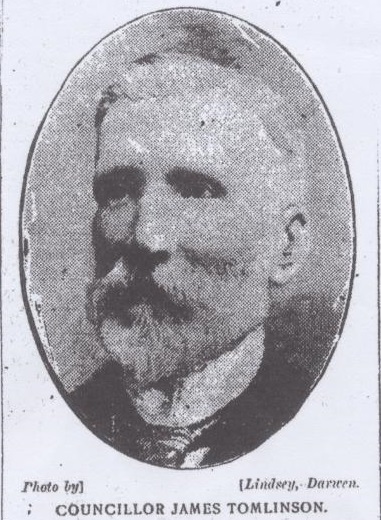
The romance of Lancashire Industry is a story yet untold. It deals with men of grit and purpose, who from the humblest circumstances raised themselves and their families to positions of affluence and influence. The late Mr. Joseph Eccles was a cotton weaver, today his sons stand amongst the most respected and influential cotton princes in the County Palatine. Dr. Ballantyne worked as an ordinary carpenter the time he was attending lectures; he has been Mayor of the town in which he now resides. And amongst others, Mr. James Tomlinson, with whom I had an interesting chat a few days ago on life in the old days, is one who for his personal worth was honoured by his townsmen with the highest honour it was within their power to bestow- that of chief magistrate.
Mr. Tomlinson was born in the bad old days, 68 years ago, when child labour was exploited by manufacturers and by parents for what it would bring in. It was not unusual seventy years ago for children of the tender age of six years to be called into the workshop at the Livesey Fold Printshop at five o'clock in the morning and be kept working there until seven or eight o'clock at night for a miserable pittance of 3s. Times were hard, food was scarce and work anything but plentiful. The poor working classes were thankful for anything that was offered them and were glad to live.
Between 1830 and 1838 there was a slight improvement in working class conditions, and it was in 1838 that Darwen's deputy mayor was born. "Chapels was passing from the condition of an important district and was being overshadowed by the rapidly developing Darwen when I was born there on January 4, 1838" Mr Tomlinson told me. "Several collieries about Chapels were worked by the Brandwood's, who owned the Turncroft Estate. When I was eight I went to Dob Meadows to work. We were up at five o'clock, and in the winter time we were often at work until ten and eleven o'clock at night. Little attention was paid to education, but when the Factory Act was altered, Eccles Shorrock opened a half-timers school at William Street where the Reform Club is now. Thomas Holden was the schoolmaster and the education he gave us was of a very elementary character. We were very unfortunate in our school days because we had to adapt our attendance according to the calls of our work. We might go to school half-time for one week, and then for three or four weeks never see the place. When we missed like this all we did was to take the attendance book to the schoolmaster, and he would mark it up for the inspector just as though we had been regularly present. Things are not done like that nowadays."
Mention of the approaching Eastertide reminded Mr. Tomlinson of the "pace-egging" of the old days.
"About now", he said, "the pace-egg poets would be busy producing their doggerel rhymes for the men who, gaudily dressed, went about the district singing. The rhymes were generally somewhat vulgar in character, but at times, fairly good poems were written. One excellent song was written about Walsh's mill. At the time there was a big strike, and we had the plug-drawing riots. It was a long tussle, and the people were very riotous. One man was shot and five were wounded by the military, thirty-three of the rioters being imprisoned. I was quite a child when these occurred. All the windows at the George Inn were smashed one night because a relation of the Walsh's was staying there, and the people took revenge on anyone connected with the master. Dicky Catlow, at Chapels had his windows smashed. The weavers who were knobsticking were accompanied home by crowds, who hooted and pelted them. The soldiers came, and the Riot Act was read in front of what is now the Greenway's Arms, which was then kept by a man whose nickname was Billy-go-Deeper. There was a big hole at the bottom of Hacking Street, filled with pebble-pavers, and on one occasion while rioting was going on the hole was emptied. Long Bill, who was then Police inspector, had his head split with a stone. They were rough times, and when anyone's windows were broken in the nighttime the blame was placed on the shoulders of old Calico Jack. He was a recluse who lived for a long time at Red Delph. The gorse on the moors he cut to make besoms, and he brought these down into the town to sell".
The beginning of Darwen Fair was mentioned, and Mr. Tomlinson told me that it had its origin, he had been told, in the rejoicings attending the coronation of Queen Victoria. "All the clubs and friendly societies had dinner at their clubhouses, and it became known as dinnering day. The day was afterwards kept up, and stalls and hobby-horses established themselves in what came to be known as the fair. There has been some talk of changing the date of the fair, but that would be a mistake, because the fair as it is now held really marks an historical event".
"When a young man I was a member of the Temperance Band, which was in existence nearly a hundred years ago, and the 50's we went to London to play at the Crystal Palace in a contest. We were supplied with a form to say what prizes the band had won and was put down that it had gained a first prize, but it was not stated that occurred forty years before. The band is of very great age. Old Jeremy Leach played the bass trombone in it when a young man, the late Joseph Eccles, father of Alderman Eccles, was a member, and so was Richard Eccles, father of of Mr. James Eccles, the organisor of subscription concerts. We didn't win a prize but we took part in a concert in which 2,000 brass instruments were conducted by the late Enderby Jackson. We were supplemented by 24 military side drummers, and there was a gong drum which stood seven feet high. Two men stood, one on each side, and they were without coats. In the forte passages them men drummed away as hard as ever they could. Although our band did not win we created a very good impression."
Mrs. Joshua Watson
Blackburn Weekly Telegraph 14 April 1906
The tales of the people are voices of power,
That echo in many a land:
They lighten the heart in the sorrowful hour,
And quicken the labour of hand.
When Christopher Welsh and his family, more than a hundred years ago, came to Darwen from Wales, the history of the Valley was in its infancy. Where houses, and mills, tradesmen's establishments, and workshops now exist in great numbers, there were then verdant meadows, and the dwellings were few. The history of Darwen as a town of much importance can almost be ascertained from the lips of men and women who are amongst the living today.
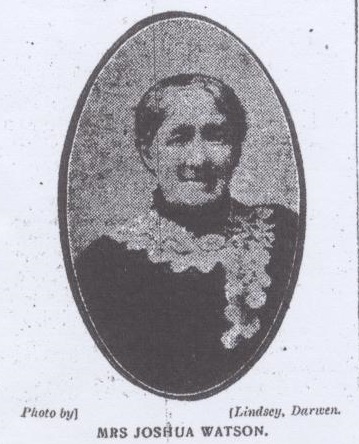
"There were fields in the centre of Darwen", I was told by Mrs. Joshua Watson, who lives in Livesey Fold, and who is a granddaughter of Welsh, "and along the east side of the town when I was a child; indeed, I could have counted all the houses in the town in three hours. But there have been great changes since then, and I have seen town grow larger and larger. It is now nothing like what it used to be."
Mrs. Watson has passed the allotted span of years by three, but she still possesses a vivid recollection of incidents in the long past, of men and women who left the impression of their character and their work upon the history of the times in which they lived, and who had something to do in making Darwen what it has since become. Her father was Robert Greenwood, a well-known man, who occupied a little shop next to the "Association Chapel" in Duckworth Street and was the only shoemaker in Darwen nearly eighty years ago. Although now hemmed in the heart of the town today, it was then almost on the fringe.
"There were open fields almost all about when I was a child," Mrs. Watson said, "just a few cottages and a shop in Duckworth Street and a house and shop at the top of Union Street. Darwen was little more than a good-sized village, and there was also the smaller cluster of dwellings at Chapels.
"I remember well enough the first Eccles Shorrock, who was the pioneer of manufacturing by steam power. He was very tall, rather stout, and exceedingly good looking. Few men have had so much influence upon Darwen's progress. He had the first cotton mill in the town, the Top Factory, and I also remember his second, the New Mill, being built in Union Street, where he had erected a number of cottages in which his work people lived. He also opened the first proper day school in the town, the half-timers' school at William Street, and I was one of the scholars under Thomas Holden, uncle to Councillor John Holden, the cotton manufacturer."
Before the railway line was laid between Blackburn and Bolton, Darwen had to depend upon the old stage-coach services, and Mrs. Watson well remembers how these passed through the town.
"They were like omnibuses", she said, "and sometimes they would be drawn by four horses, but more often by two only. When there were letters to deliver, or passengers to put down, they would stop at what is now Gregg's Hotel. There was no cheap tripping then, and it was looked upon as a great thing to go away. Folks would save up their money to have a few days at Blackpool, and they travelled there in carts, sitting on chairs. It was an all-night journey, and they kept themselves waken by telling tales as they travelled along the road. When they went on chairs, they always reckoned to stay a week, for it was a great event, but Blackpool was not what it is now, there were only very few houses, and folks didn't spend much.
"The people lived poorly-porridge two or three times a day, and occasionally boiled carrots and turnips. There was a lot of drinking indulged in, and fighting was common amongst the men. Behind the old Grey Horse, where Police Street is now, there was a style at the top of Bury Street, and it led to a meadow. It was a common occurrence for men to come out of the Grey Horse and go out into the meadow to fight. I saw two men kicked to death during fights of this sort, and the men who did it were transported.
"You will have heard of old Aggie's. It is a name given to an old house at Stepback now, but it was really that of an old woman who, with her husband, lived for years at that lonely spot. I never heard their surname, and they were always known as Old Aggie and Old Aggie's husband. One night, when the old folks had gone to bed, three men-one of them lived in Hacking Street-went out to Stepback to rob them. They crept into the house through a back window and wore masks over their faces so that they would not be recognised. One of them struck a match, but the noise of this and the light wakened Old Aggie, and she roused her husband, who said to the men, "what is your will, tonight?" "Where is your money?" one of the men replied; and Old Aggie said, "we have none". But she and her husband were obliged to tell where their money was, and when they had secured it, the men stunned the old folks by striking them behind the head.
"Next day the men were somewhat easily caught, and they were tried and transported for 21 years. About twenty years afterwards one of them sent a letter home saying that he should never return to Darwen. He was courting the daughter of the Governor and was about to be married."
Mrs. Watson told me how the elder Greenway, uncle to the Revd. Charles Greenway, bargained for the removal of the bell from the old Methodist Chapel, because he did not like its sound, and she also related a story of an early tea-party at the school.
"It was a tea-party for old folks", she said, "and there were cockles and mussels, toasted buts and mechody cream."
"What was that?"
"Rum and tea-and that was the only party at the school at which it was served."
Mrs. Watson was one of four young ladies who had the first ride in a truck on the railway when it was opened between Spring Vale and Darwen in 1848.
Blackburn Weekly Telegraph 21 April 1906
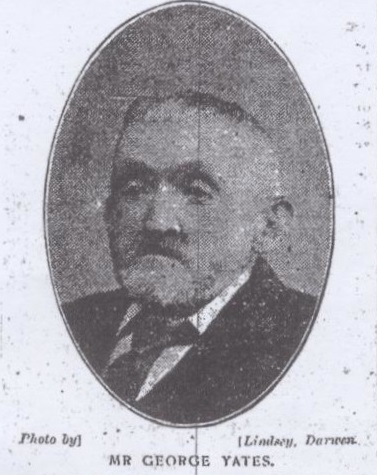
In the year 1830, which may be said to mark the beginning of Darwen's great development as a cotton manufacturing centre, there was born on the hill-top at Belthorn, George Yates, the youngest member of a large family, all of whom were handloom weavers. Seventy-five years have passed and another is running its course, and in that span of time Mr. Yates, who now lives in Stanfield Street, has seen many changes in the customs and conditions of the people amongst whom his life has been entirely passed. To the heights of Belthorn, isolated as that district was from the growing towns, the new methods came slowly to the people, and in the boyhood of Mr. Yates the handloom weaver continued to pick the shuttle.
"There were eleven in our family", Mr. Yates told me "and we had eight handlooms, six in the shop and two in the rooms above. Nearly every house was provided with its weaving shop. The warp had to be sized. Some sorts had to be woven from the cop and others from the bobbins. The bobbins we had to wind. I have woven bandanas, or silk on the handloom. How did we dispose of our cloth? To the chapman or merchant. There was one in Blackburn of the name James Bolton, and we had to carry our cloth in sacks on our backs from Belthorn to his place and bring back, our warps and weft from Blackburn in the same fashion. The cloth was always taken on Saturdays and before we were paid the cloth was examined. If there was anything wrong with it then we were baited, that is we had something stopped. Sometimes work ran short, and we could not get either warp or weft, and when this happened we had to walk to Blackburn again and again until we were lucky enough to get some.
"There was a lot of famishing in those days. Food was dear, and I have been two months at a time and never seen either sugar or tea—nothing but gruel. We had flour puddings, too and folks kneaded meal balls. They would roll it up, move a coal to one side, and then drop the ball on the hot cinders. When one of its sides was cooked, they would turn it over, and then when the whole was cooked, they would get hold of it with both hands and eat it just like horses. They would not do it now, if they did they would want a doctor fetching, thinking they were poisoned. I took a paper in and paid 9d a copy for it. I was the only one in that part of the country who got a paper. Folk would come seven or eight miles across the country to look at it, and to get the news.
"They did not start work in those days at Belthorn until about Thursday morning. On Mondays they played football matches, with Guide and Pickup Bank, and it was not like what it is now. There were generally a lot hurt, and when Bill o' George's had had a lot of ribs, and legs, and fingers to doctors, well, there had been a grand match. When Thursday came round everybody had to set to, for the cloth had to be in by Saturday or there was no money. They often worked all night on Thursdays to fetch up for their lost time".
With the decay of the handloom industry came hard times for those hill-top weavers. Mr. Yates told me of his own weary trampling about Blackburn and Darwen in search of work. One of his sisters walked to and from a mill in King Street, Blackburn, from Belthorn, night and morning, a total distance of about eight miles, and for her work at two looms she received 9s a week. Hard times for cotton operatives! Mr. Yates himself was amongst the crowds of deposed handloom weavers who besieged the power-loom mills seeking work. These old weavers went anywhere to learn the work, and then they sought employment. Once he obtained work at a mill in Furthergate, and night and morning he travelled the road between Belthorn and that district: often he was up to the middle in snow, and arrived at the factory, with clothes saturated, and had to change before he could go to his looms. And the food he had carried in a handkerchief was in a state of pudding. The plug-drawing riots at Lower Darwen he saw, as well as other serious disturbances, brought about by the great industrial revolutions which were taking place, but which people did not understand. Sad although those old days were, and hard, they had some redeeming features. Each district had some special trait of which it was proud. Belthorn was proud of its "Messiah singer".
"My father was a great 'Messiah' singer", Mr. Yates continued, "and there were nine or ten others. They were all self-educated men, who succeeded by their unceasing perseverance. Night after night they would spend practicing the 'Messiah' and 'Job's Anthem', that is in the seventh chapter of Job. There was one man at Belthorn named Ward, who wanted badly to be one of the 'Messiah' singers, but he was told that his voice was not good enough. Well, he went every morning away into an old delph, and there, alone he prayed that God would give him a bass voice. He did that for twelve months, and then his voice came to him, and it was as good as the voices of any of the others.
"Ward and his wife were bandana weavers and one week they were so placed that they could not finish their piece to take it to the merchant at Blackburn. He did shaving a halfpenny a time. In this particular week they had nothing to eat for about three days, and with the prospect of not being able to take their pieces in they were in a bad way. 'Never mind' she said, 'let us sing Dr. Wyatt's hymn, "The Lord will provide" and they set to. A few minutes later there was a knock on the door, and a man said he had brought a gentleman from London who wanted a shave. Ward set to, and when he had finished the shaving the gentleman asked him what he wanted. 'A halfpenny', replied Ward, and the gentleman put his hand in his pocket and gave him, not a halfpenny but a soverign. 'I can't change this', said Ward looking at the coin, 'for I don't think there is so much money in all Belthorn'. 'Never mind', replied the Londoner, 'I do not want any change'. When his wife took her basket and went to the grocer's, she had to explain to him where she got the money from before he would change it, and then he said, 'I don't believe you."
Mr. Yates lived at Belthorn when Protection was oppressing the people and making existence for them most difficult. He also lived there when the great fight was taking place in Parliament for the abolition of the Corn Laws. A man was sent every morning from Belthorn to Blackburn to get to know the news of how the fight was going on. And one day he came back with the glorious tidings that the Corn Laws were abolished. He carried a big loaf on a pole, and it was a signal to those poor handloom weavers who had suffered under the system of Protection and they turned out and rejoiced.
An interesting incident in Mr. Yates's life is the fact that he walked to Macclesfield, 47 miles away, afterwards taking the train into Staffordshire, to witness the public execution of Palmer, the notorious poisoner.
Blackburn Weekly Telegraph 28 April 1906
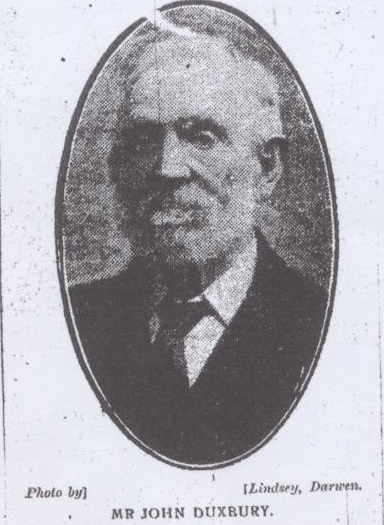
It is almost incredible that a man whose personal recollections embrace the whole local history of cotton manufacturing by steam power is still to be found employed at a Darwen mill. Nevertheless, it is true. Mr. John Duxbury- whom I saw at his cosy cottage in Blackburn Road-is more than 84 years old, yet six o' clock each morning sees him at Brookside Mill, where he is employed. Until he was 76 years of age he was a tackler, there, and accustomed to carrying on his shoulder beams weighing 12 score, and sometimes more, but today his occupation is of a lighter type.
"Our folks," Mr. Duxbury told me, "were handloom weavers and lived in the cottages just below Bank Terrace in Bolton Road. That was in the country for them, for there were fields all round. They had six handlooms, and I was the bobbin winder. That was in the [18]20s, when George IV was on the throne. When William IV was crowned we all went to the Top Factory, with our pots and coffee was served to us. Top Factory had just been built before 1822, when I was born. Carr, Hatton and Co. were fitting it up. There was to be weaving on the bottom floor, the room above was the cardroom, and throstle spinning was carried on in the next room. I was only a lad when the loom smashing riots took place. The hand loom weavers thought they were to be done out of their living by the steam power looms—work being very scarce—and a great mob came from Blackburn and were joined by our own handloom weavers. Eighteen power looms were smashed, and one woman who stole a shuttle was transported.
The shuttles were less than those of the handlooms. The folks were very bitter against the power looms and there were a lot transported over the riots. My eldest brother was one of the loom smashers, and when the soldiers came he took his hook. Hounds were turned out to hunt the rioters, and when he was coming home again he had to run into a sewer to hide. He heard the soldiers tramping over his hiding place, and the hounds came some way up the sewer sniffing, but they did not come far enough. That night he stayed inside that sewer and until the following night. The soldiers having left by that time he came home. He was an apprentice to William Livesey, who had a loom shop at th'Hill o'm' Hoyle. Livesey had several apprentices, lads and lasses, and they were verbally bound to serve him for two years.
"A lot of work was taken to Blackburn by the weavers, who carried it in sacks on their backs, and brought back in their warps and weft in the same way, but work was also put out by John Walmsley for a man I only knew as Old Jack. Neddy Gregson also put out work at Knott Mill. He had twenty-four looms there and they were worked by a water wheel. I think those would be about the first power-driven looms in Darwen.
"Darwen was little more than a hamlet then. Folks did pretty much as they liked, and there was a lot of drinking and carrying-on. The public houses were open night and day- from twelve o'clock on Sundays till midnight on Saturdays. They opened again at six o'clock on Sunday morning till serving time. Then they closed, but as soon as the service was over they opened again. I often saw drunken folks turning into church. The hand loom weavers never reckoned to work on Mondays, and sometimes they took Tuesdays and Wednesdays as well.
"I was about eight years old when Eccles Shorrock came. He had been running Dandy or Boggart Factory, at Blackburn. It stood where the Palace Theatre is now, and was Boggart Factory, because the weavers said they could see boggarts in the old churchyard through the windows. They said they saw them every night. Top Factory was empty, for I played in one of the rooms. I was about seven when I went to work as a full-timer at Livesey Fold as a teir boy, and we worked twelve hours a day at the least. Regularly we started at six o'clock in the morning, and if we got away by seven or eight at night, we were let off soon. Well, Eccles Shorrock took Top Factory, and I was one of his first workmen, starting with him about a month after he bought the place, in 1830. There were a few throstle spinning frames, a winding machine, and a warping mill, and he sold warps to the handloom weavers. I was a throstle spinner. That was really the beginning of manufacturing by steam power in Darwen. Steam power looms were put in the mill four or five months later."
We talked of the growth of the cotton industry, and Mr. Duxbury traced it step by step, and in his story the handloom weavers receded from the picture as the power loom weavers came into prominence. He told me of the plug-drawing riots, and how the prisoners were taken on coaches to Blackburn to be tried, many of them being transported and never again seeing their home district.
"Eccles Shorrock was always keen on education, and he got a man named Mr. Wells to come to the mill and give us lessons," said Mr. Duxbury. "When we were at liberty from our work we could go up to him for a lesson. Education was looked upon as a luxury, and working folk were too poor to pay for it".
Mr. Duxbury learnt to weave on the power looms at Belgrave Mill, where cotton manufacturing was carried on by Mr. Edwin Potter, uncle, to Mr. John Gerald Potter, who had 100 looms. There was only one tackler, a man named Thomas Turner. Work was often started at half past five in the morning and it went on till about eight o'clock at night.
An interesting remembrance of Mr. Duxbury's was of the old racecourse. "The races were held on the site where the Duckworth Street Chapel is now, and folks came for miles to attend them. The jockeys used to ride coloured costumes, and there was always a lot of betting. They were abolished, and the last of the races we had at Darwen were at Bob th' Knowles's Farm, on the Moor head.
Mr. Duxbury remembered the old head constable, portly Tom Greem and his powerful assistant, Bill Foo, whose eccentric method of dispensing justice is the subject of many good stories. Then came the police force.
"After we got the police", said Mr. Duxbury, "there were some robberies committed in the night-time, and the shopkeepers got frightened, and thought they were being done by the officers themselves. So they organised a fund and engaged two watchmen, who went round during the night watching the police and anybody else. Every hour those men shouted out the time and told the characters of the weather."
Blackburn Weekly Telegraph 05 May 1906
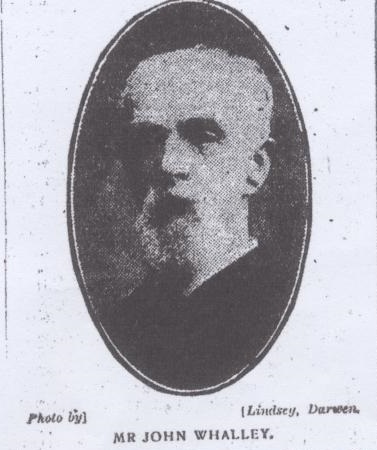
On a Christmas Day four and sixty years ago, when Darwen was developing from its village state, in which it had remained from the days when it was no more than a hamlet, a wayside cluster of dwellings, when the cotton industry was assuming those great strides with which it traversed the whole district, there was born at a little house in Arch Street, a house still standing, John Whalley. The son of an ardent temperance advocate, he followed in his father's footsteps, and as a politician he trod where his father had walked. The father was the most eloquent speaker who, from the ranks of the toilers, ever advocated the principles of Liberalism and progress: the son has taken part in many a strenuous political fight; at election after election has pleaded for the cause, and on behalf of the party whose banner he has upheld has been inspired to write many stirring songs and rhymes. It is as a politician that Mr. John Whalley is best known. In that character he has greater fame and popularity than many of those who have been merely observers of changing customs and conditions in the life of an earnestly industrious people whose progress is common history.
Temperance came slowly into the lives of a people in the days when it was fashionable to be a drunkard, and when a man who could sit the night through consuming liquor was a fine gentleman and good citizen. Yet there were men who saw the evils of those early times, and who joined hands with those who were making for total abstinence. Mr. John Whalley's father was one of the men who withstood the temptations of the age in which he lived. His excellent example was followed by his son John, who 56 years ago joined with the Temperence Society, and is today one of its members.
In the course of these recollections of Darwen's old inhabitants, the name Hill-o'm-Hoyle has cropped up more than once, and naturally so. It was one of the oldest districts and has now disappeared. Mr. John Whalley, with whom I had a chat a few days ago, remembers well its character, and its receptacles for 'the bottom dogs'. Some of the houses within its area were of interest because they were in earlier times the homes of the original men of Darwen, but at a later period many of them became the resorts of the illicit whiskey distillers, of preachers, and others whose lives were not of the higher type. In early days illicit distillers existed in fair number, and Mr. Whalley has recollections of one whose popular name was 'Wigan Bob' and who was a notorious offender. This man suffered imprisonment on more than one occasion, but continued his manufacturing, nevertheless, selling the concoction to people of the district in which he lived, and even allowing some to drink it upon his premises. "There was also a lot of whiskey made on the moors, in secret places," Mr. Whalley told me.
"Poaching was very common, too, amongst the rougher characters, who took game from the moor, and also from Sunnyhurst Woods, which were then preserved. They covered the hills right away through Stanhill Woods and knew every trick. One of them whom I knew had a black dog which went about its work just like a human being.
"It was Hill-o'm-Hoyle which experienced the full force of the flood of 1848. That was a terrible night. I was then living in Arch Street. Even more terrible still it might have been had not the fact that the embankment of the Bold Venture Lodge was giving way been discovered just when it was. The policemen and the town watchmen were about the streets, but the people were sleeping, many of them in the cellar dwellings with which the district abounded. It happened that some of the workmen of Mr. Eccles Shorrock, employed at New Mill, went out to see how the pipes were through which the water came from Bold Venture Lodge. When they arrived, they saw the danger, and realised the possible consequences. The water was tearing down the embankment and was descending upon the heart of town in great volumes- in a flood. They fled down to the dwellings, roused the people- as many as they could- and alarmed the town. The majority escaped, but nine were drowned. Two died in the water in the cellar beneath the shop of Mr. Roan, saddler, in Green Street. My father saved two lives that night, and those were the only people in grave peril who were rescued. Two dwellings were washed away."
It is, however, as an ardent politician that Mr. Whalley is best known. He was interested in politics even in those days when Darwen was struggling, and in an electoral sense was considered to be of small account. Previous to that of 1868 he remembers no election to have taken place at Darwen, or the people to have been keenly alert on the question of their local representation. But Mr. Whalley was not alone, he told me, in those who went down to Blackburn and saw the old hustings on the wrangling.
"There were lively doings", he said. "The candidate and their supporters occupied platforms within barricades, and after the notices were read and the appeal made for a show of hands the fun began. The Tories generally secured the verdict of the chairman on the show of hands, and the Liberals would then demand a poll. Then it was that the proceedings became lively: indeed, there were riots on a small scale. Stones were thrown about, and often people were injured.
"It was in 1868 that Darwen Liberals, as part of the North-East Lancashire Division, had the present Duke of Devonshire and Mr. Grafton for their candidates, and the Tories Messrs. Starkie and Holt, and at that election we saw the last open hustings."
Following that election was established William Street Reform Club, a home of political stalwarts. Amongst the founders was Mr. Whalley, and others were Mr. Thomas Harwood Marsden, Mr. Benjamin Fish, a cloth looker for Mr. Graham Fish, Mr. Fish Fish, and Mr. Ralph Hindle, a winding master. Mr. (now Alderman) John Tomlinson was its first secretary. From its commencement to the present time Mr. John Whalley has been connected with it and during four years occupied the position of president. His life story embraces the history of many great movements, and "as a debater, a speaker, and a reciter," it is recorded in an illuminated address presented to him by the club in 1892 that he has done his duty.

 Loading more