
 Loading more
Page 3
Blackburn Weekly Telegraph 28 July 1906
Tis sweet to pause, as on we creep,
Up life's precipitous ascent,
And sure to view from summit steep,
A new race, go where once we went,
In youths' glad days.
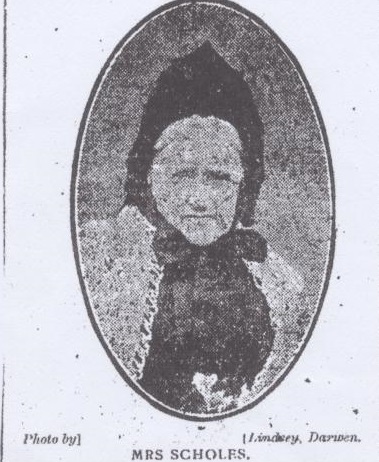
'Tis interesting to travel with an old inhabitant through memory's space back to the days of the long ago, to revive in them recollections of old-time happenings and of people now numbered amongst the great majority, and to learn something of the conditions under which people lived who have left their impress on the history of a district. Mrs Ann Scholes, who now resides with her son-in-law in Buff Street, is rich in the possession of a rare stock of the folklore of Blacksnape and Hoddlesden, about which she spent the days of her girlhood; and notwithstanding that 84 winters have passed over her head, she can tell stories of the life of men and women who long since passed away. Her pictures of life in the days when she was in her childhood-the early days of the century now closed-possess no sombre tints. Memory has retained for her only that which is bright and cheerful, and as she entrusted me with her recollections she mentioned to me a garden- a garden by a brook-a garden where flowers she grew when she was young.
"I can almost see the flowers now", she said, and her eyes glistened with the joy’s remembrance brought to her. "There was a brook close by, and the water from it kept the roots of the plants moist, so that the bloom came on them in abundance. They were the bonniest flowers in all the world, I think, and the garden was full of them".
It is difficult to associate the beautiful in nature with the bleak height and slopes of Blacksnape and the surrounding area, yet this feat Mrs. Scholes accomplished in a few eloquent sentences. She loves her native area, and despite all that we call improvements that have come into modern life to make it easier and better she clings to her idea that there were "no days like those old days."
Her life was not tinged with that unremitting strife associated with the struggle for existence so many of the people of eighty and a hundred years ago had to endure. Thomas Watson, her father, was for his times in a fairly comfortable position. No fewer than half a dozen handlooms were his own and fitted in the loom-house at Far Scotland Farm in 1821, when Ann was added to his numerous family. A man of steady habits, an Independent, and a worshipper at the old Pole Lane Chapel, he had none of the unstable habits so prevalent amongst many in Blacksnape and Chapels, and his family had to endure none of the hardships which attended other households. He got his work from James Shorrock, the father of the late Alderman Christopher Shorrock, who then lived at Prince's and was doing a rare business amongst the old handloom weavers, and when he had manufactured it into cloth he took it, along the old Roman road or across the fields on his back, and returned with its equivalent in food or coin. All the family were put to the handlooms, and this, with the little the farm produced, kept the family.
It was not much that the farm could add to the income of the family, for-and here Mrs. Scholes made confession of the state in which others were 80 years ago-the buttery of the farm had to be taken to Bolton to be sold. "We could not afford to eat it", she told me, "and there was nobody about to buy it, so my father had to walk to Bolton with it in a basket, and he would stand at the cross where the Earl of Derby was beheaded, offering it for sale at 3d a lb".
Porridge formed a staple food, but there were also other types admitted to the Watson household, and to some of the others about the district. Now and again a beast was killed, and on that "beef night" there was rejoicing and merriment. The butcher had no share in that rough-and-ready slaughtering: he got none of the profit and chunks of desh were carried away to the different farms. Often there was more than could be eaten at the moment, and this was put to pickle in salt. It lay in brine come two or three weeks and then a hole was bored and a string passed through, by which the beef was suspended from the roof of the house, where it dried and hardened, and it was used as needed.
"Handlooms were very common at all the farmhouses about Hoddlesden and Blacksnape," Mrs. Scholes told me, "And the majority of the loom houses still stand. I never went to school because there was not one at Hoddlesden. There was some teaching at Blacksnape by Mr. James Nuttall, who also went round selling the folks books and pamphlets, which told them what they had to do to get in Heaven. I got my learning at the knee of my mother, and a little in the Sunday school, and now I can read anything almost."
Mrs, Scholes then proceeded to recall to me some of the old Blacksnape families, who were, she said, mostly Independents, the heads being men whose descendants are a part of the backbone of Darwen in these times. There was James Briggs, set down as a "cotton manufacturer" in a directory of the time, because he had about half a dozen handlooms which the members of his family worked. Mrs. Scholes herself went into the loom-shop of her own father directly she was tall enough to wind bobbins for weaving. Tom Sanderson, the father of either eleven or twelve children, and an attender at Pole Lane and Lower Chapel, lived in the top house at Blacksnape. John Fish was well known and of importance because he was one who put out work to the handloom weavers and dealt with the merchants. John Holden, too, had handlooms. One of his daughters became the wife of Joseph Baron. At Pinnacle Nook, James Cooper lived. He worked for James Shorrock and was killed whilst taking cloth to Manchester. Fish Fish was a farmer, shopkeeper and handloom weaver and he had a big family. At Drummer Stoops lived Thomas Waddicor, who frequently preached at Lower Chapel. The grandfather of Mrs. Scholes lived at Th' Hillock Farm, and there was also Bob o' Briggs. John o' Bob's lived at Cockerman's Nook, was a handloom weaver, a Primitive Methodist and a decent chap. Andrew, the father of Staveley Bury, the organist for a number of years at Trinity Church, lived at Near Scotland, and Oliver Duxbury, the grandfather of Thomas Harwood, the tinsmith, was also a farmer. John o' t' Slack (John Leach) lived opposite the brook and it was in his gardens that the "most beautiful flowers grew." Coming up Slack Brow there was old Kester Hindle, brother to old John o' t' Sunnyfield's ancestors of the late Dr. Hindle and Mr. F. G. Hindle. At Layrock Hall lived old Timothy Holden, grandfather to Alderman T. Lightbown. He was a farmer and handloom weaver. John Kirkham had his house at th' Top o' th' Meadow, Thurston Briggs at Stanhill and William Fish at Stand Farm. William was a great singer and for many years was singing master at Mount Street Chapel, Blackburn.
Amongst Mrs. Scholes' recollections is one of an excursion she made to Blackpool in a shandry, more than seventy years ago with her uncle George and several others. The rain was pouring down when Preston was reached, and so it continued until beyond Kirkham. The start had been made in the early morning and it was nearly dark when the party arrived at Blackpool, which then had few houses and none of the attractions with which it is crowded today.
Blackburn Weekly Telegraph 04 August 1906
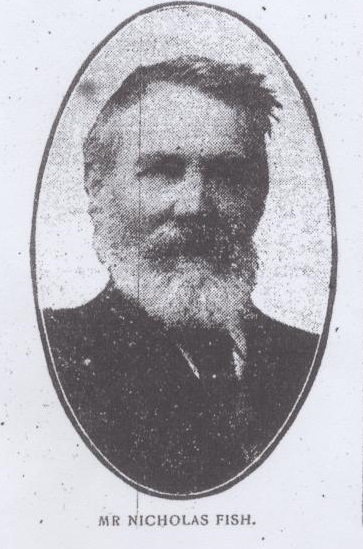
Amongst Darwen families extending back over centuries is that of Fish, a family Mr. Nicholas Fish is connected with. The Fish family is indeed one of the most ancient in the district. Members of it lived in Darwen centuries ago, farmed along its hillsides and worked their handlooms. The father of Mr. Nicholas Fish was Thomas Fish of Bent Hall. His grandfather was also Thomas Fish, and his great-grandfather was Nicholas Fish. Both now lie in the Pole Lane burial ground. It was on the little farm at Bent Hall, situated on the left-hand side of Bolton Road, near the Bull Hill Hospital, that Mr. Nicholas Fish was born. Coaches were running between Blackburn and Manchester in the days of his boyhood. Handloom weaving helped many a little farmer to make a living pittance, and conditions were much different for the people to what they are today. Many of the changes that have taken place, Mr. Fish has observed, for he is now on the border line of three score years and ten.
"My grandfather was a notability in his time", Mr. Fish mentioned to me during our conversation. "He had a little farm at Harwood Fold, and he was also the assistant Poor Law officer for many years. The leader of the choir at the old Pole Lane Chapel, and at the old Ebenezer Chapel, he sang alto when he was 70 years of age. My grandfather on my mother's side was called Briggs-another old local family-and he was called John o' Henry's. He lived at Cranberry Fold and was an old freeholder. At the time when the common land was being stolen from the people all over the country, a statute acre was given to him so that he would not grumble, and the fencing is round it yet.
"My earliest recollection is that of the handloom industry, and of getting up very soon in the morning, when I was no more than three or four years of age, to wind bobbins. In our loom-house at Bent Hall we had four handlooms and there were three of us bobbin winders.
"May poling was very common when I was a boy, and it was the custom to decorate or plant farmsteads with the branches of young trees. Different trees had different significance. The holly was a symbol of contempt and it was an insult to place it over the door or in the chimney stack. The mountain ash had a different meaning because its common name of wicken rhymed with 'my dear chicken'. By using different kinds of branches at Maypole time one person could convey what regard he held another in. I remember that my father used to keep a hayfork, the prongs beautifully burnished by his bedside, and we never knew why. But one night, when we were all in bed, the May polers came. They climbed the low slanting roof and were decorating the chimney stack when one of them knocked a loose stone down the chimney. Out of bed my father jumped, picked up the hayfork he had handy, and downstairs he went. As we children crowded to the window we saw him with nothing on but his shirt, and with his hayfork in his hand, chasing the terrified May polers across the meadow.
"Old Black John, who lived in Cranberry Fold was a Fish, but I never knew to what branch of our family he belonged. He was one of those who got an acre of land when the common was enclosed, and he had to do what he liked with it so long as he lived, but afterwards it had to pass to the lord of the manor. He fenced it round and worked at it. The centre he mowed, and round the side he grew vegetables and he converted it into worthy capital land. He had only one pair of clogs in his lifetime that anyone knew of. If he found nails on the road he would drive them into his clogs and any pieces of iron he came across he would fasten to them also. When he was walking down the road his footstep sounded like that of a horse. Some-time after his death, many years ago-it must be nearly half a century-one of his clogs was found in the river and it weighed 15lbs
"James Briggs, a distant relative of my mother was known as Gentleman James, because although he was really no better than anyone else, he always appeared to be superior. He wore neat knee breeches, white stockings in the summer-time and low shoes. He also had a top hat, and it was something to have a top hat in those days.
"Old Timothy's farm was a little one, and also at Bull Hill. His name was Timothy Holden and he was one of the old Darwen stock of Holdens. He never got any other name but Old Timothy and was a peculiar character. His word was as good as a warranty as to the quality of a cow. Once my father sent for him to look at a calf, and after Old Tim had examined it most carefully he was going away, when my father said, "Yo've sed nowt, Tim!" Old Timothy turned and replied, "Id'll be a cow if i'd lives". Tim was a handloom weaver as well as a farmer.
"Jem o' Ayster's- his surname was Harwood- had not a farm really, but there was an old building on the roadside which had been used to put in relays of horses required for the coaches, and in this he kept a cow or a donkey. He had one cow which had toes turned up five or six inches like the end of a chinese shoe, and this animal was known as "old long toes". Jem eked out a living by combining several occupations, and amongst them was that of drawing teeth. He had one of the horrible old screw machines, a wrench really, and it had a short lever which he pressed against the tooth. Really the tooth was drawn out on the principle of drawing a nail out of the floor by leverage. It was a terrorising and sickening operation.
"Down at Graining's Brook old Davy Holden lived. A man over six feet high he was, with a great massive head, and a remarkable figure altogether. He had an old-fashioned garden in which he grew the old flowers and the old herbs.
"One of the Kay family was Alick, a joiner, who was very eccentric. He made coffins, and it was said that he made his own, and that one day he got into it and persuaded his wife to put on a black bonnet, just to see how it would look.
"We got our groceries at Pall Mall (it is called Bowling Green now) at the shop of Timothy Fish, who was one of the pioneers of the railway between Bolton and Blackburn and lost £4000 in it. Timothy was a very religious man and as honest a man as could be found. He had always a pleasant word for the customers to his shop, knew everybody by name, and could attend a half-dozen almost at one time, serving them very rapidly.
"John o' t' Knew kept the White Lion in my early days, and before becoming a publican he was governor of the old Darwen workhouse. He always made potato pies for the country people who came to attend services on Sundays. They would go to church or chapel in the morning, then to the White Lion, where they would have potato pie, a drink and a smoke, and in the afternoon they would go to service again.
Mr. Fish told me of many other old Darweners, of the conditions of life of the people generations ago, and many interesting anecdotes, but, unfortunately, my allotted space has run out.