
 Loading more
Page 2
Blackburn Weekly Telegraph 12 May 1906
Let’s fondly cherish old memories true,
Deep in affection’s shrine
And we gladly turn aye for them years
To the friends of Auld Lang Syne
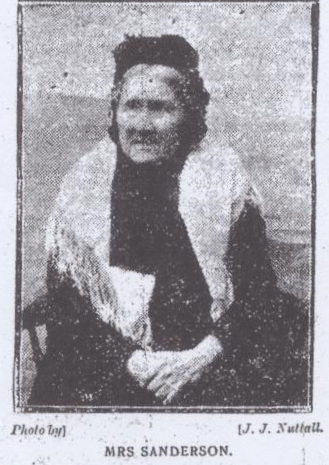
Luddism, the movement against the use of machinery, which obtained such vogue in Lancashire and Yorkshire, had been stamped out by the execution of eighteen persons and the imprisonment of seventeen more when Mrs. Mary Sanderson, better known as “Old Mary Whittaker”, who now lives in Peabody Street, was born in the almost district of Harwood Fold, Eccleshill, but she came soon enough into the world to witness stirring scenes and great industrial development. Then the great cotton industry of today was in its swaddling clothes, and the population of the district below 6,000. It was in 1819 that Mrs. Sanderson was born and at that time Darwen was in its primitive state.
“There were not many houses when I was a girl,” she told me during our conversation. “There were some at Chapels, and then there were fields all the way down to Darwen. We had to go by Robin Bank, and at the bottom of Union Street, near, where the Higher Grade School is now, there was the river, and we had to cross on stepping stones to get to Darwen. Chapels was a little village of itself, and there was Blacksnape and Darwen, the three being separated by fields.”
Mrs. Sanderson lost her parents when she was quite a little mite, and, in consequence she came into association with ancestors, who link her with the early part of the eighteenth century. Her grandfather, William Duckworth, with whom she went as a child to live, had occupied the house at Harwood Fold for more than sixty years, and in that time had combined the occupation of a farmer with that of a handloom weaver, then the staple industry of the district.
“Thomas Kenyon had a school at Hey Fold- it was called an academy- and I was lucky enough to be sent there when I was a little girl,” Mrs Sanderson told me “but education was not much thought of then. Folk were poor and times were hard, and it was a case of everyone getting to work as soon as they could. I could only have been six or seven when I started working as a bobbin winder. My grandfather had seven pairs of handlooms in the loom house, and boys and girls used to come to him to be taught to weave. I don’t know that they were apprentices to him- a thing that was common- or that he paid them wages while they were learning. I went on bobbin winding until I could reach the treadles with my feet, and then I became a handloom weaver, and have woven both cotton and silk.
“There were a number of handloom weavers about Chapels,” said Mrs. Sanderson, and history supports her, for, in addition to J. Pickup of Chapels, Old Eccles, and others mentioned in a record of the time, there is proof to be found in some old Icon houses still standing but decreasing in number, “and they had to work hard to get a living. But on Mondays they never worked. It was the day on which they had what they called the ‘uppings’ that was their football match. It wasn’t football like what we have now. There were two walls, and the players who punched the ball most often over their opponents’ wall won the game and took the stakes. They played for money- that is, the players would put a shilling apiece down, and the winners would take the lot, and after the match go off to the alehouse to spend it. The teams came from Tarton and Guide and other parts, and once when Chapels went to play Guide there was a song I remember, which ran:
There was Charlie, and George Harwood
And Nathaniel Hunt beside
The three best footba players
That ever went to Guide
Mrs. Sanderson has a vivid recollection of the old racecourse to which reference has on more than one occasion been made. When a child, she remembers having accompanied her grandfather to the races, and, with all the crowds of people who had come from all parts, they sat on the hillside at the Top o’ th’ Robin.
“There were always great doings at Darwen races,” she said, “and along with the club walks they were the events of the year. The publicans had wooden huts round the racecourse, in which they sold drink, and there were a few stalls where food was sold. The course stretched right away from Union Street down below Peabody Street, the horses would race round, and round until it was over. They started and finished at the Union Street end of the course. The jockeys wore red, blue, yellow and other coloured jackets, and there was plenty of excitement.”
In her early days Mrs. Sanderson was in the singing pew at Lower Chapel- “th’ Higher Chapel,” she called it, and it is by that familiar name the historic sanctuary is known amongst old Darweners. Richard Eccles, a son of Nathaniel Eccles, of Dandy Row, was the singing master. There was a bass fiddle at Lower Chapel, and on it, the accompaniments were played. After the split, she said, “the fiddle was taken down to Duckworth Street and Will Jepson played.”
It was when she had married and gone to live at Hoddlesden that Mrs. Sanderson, at that time Mrs. Whittaker, came to know Jeremy Hunt. The Congregationalists of Pickup Bank were then worshipping in an old cottage, and it was Jeremy who taught them how to sing and also perhaps, inoculated the district with that keen love for music which is such a prominent feature at the present time. Jeremy urged the building of a schoolhouse, and a builder was got to do the work. The people themselves provided him with the material. Men and women and children went out with sacks and different things, and they gathered stones from the beds of the hillside streams and any place where they could be found, and took then across the bleak rough country to the site where being brought into existence a building in which so much good work was afterwards to be done. Mrs. Sanderson herself carried stone there in her apron and was proud of her burden.
Mrs. Sanderson’s life has been one of strenuous worthy effort. She has passed through interesting times, and witnessed great changes in customs and methods in the 67 years she has lived. As a woman of the people, she has played her part worthily, and it must indeed be for her a proud reflection that she lived to see one of her daughters, her eldest – Mrs James Tomlinson- in the high position of Mayoress of Darwen.
William Taylor
Blackburn Weekly Telegraph, 19 May 1906
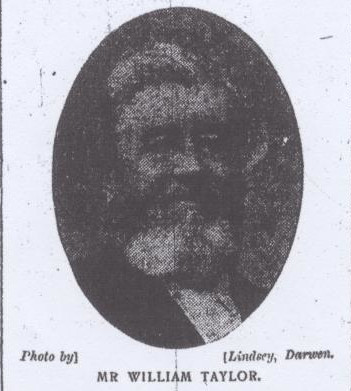
The Leaches, who at the beginning of the last century, and still nearer to our own times, had associations with Holden Fold, are amongst the oldest families of Darwen. Their history stretches back over centuries, and their lives as farmers, coal-getters, and handloom weavers is incorporated in the annals of the district. It is through his grandfather on his mother’s side—Mr. Joshua Leach—that Mr. William Taylor, now of Rosehill Terrace, has kinship with the family.
Much of the property at Holden Fold was owned by Joshua Leach, and, as proving the antiquity of the family, it may be mentioned that it been sold on lease extending over seven lives. Joshua was the last of the seven Leaches who had held the houses under the lease, and before his death, he purchased the property out, so that it passed on to be divided amongst the members of his family who survived him. Those houses he had in the Dole times, and the fact that he had to pay rates and taxes at a time when his tenants were unable to pay him rent owing to their poverty placed him in a very unfortunate position. He was not only a handloom weaver, but also a manufacturer of the looms until the time when there was no demand for them owing to the advent of the power looms.
Mr. William Taylor, with whom I talked at his home a few nights ago, gave me a graphic picture of those olden times when “it was all work.” Himself three years beyond the span allotted man, he was set to work 68 years ago at the loom house of his grandfather, winding bobbins for the handloom weavers. He was five years of age at that time. His grandfather had seven pairs of looms in the Holden Fold loom house, and amongst the weavers who worked for him were Nathaniel and Andrew Hunt James Lightbown. Education was not thought of in those early days, and bread-winning was the chief thing to which even a child of most tender years should supply its hands. It was in those hard times for children that Mr. Taylor received his industrial education.
“I was bobbin winding till I was nine, and then I went drawing at old Engine Pit at the closes near Harwood Fold,” he told me, “I was working for my uncle, Thomas Hutchinson--Tum o’ Ned he was called, because his father’s name was Ned. There were girls and young women working in the pits. They wore breeches, like lads, and with a chain fastened round their waists and passed between their legs they would draw the sledge—not tubs, but sledges—in a bent position just like dogs. My aunt was a drawer. Their way was lighted by a candle fixed in clay and stuck on the end of a sledge. Very young lads were employed in the pits, some when only seven or eight years of age, and that was because men’s prices would not be paid. We went into the pit about six o’clock in the morning, and we had no fixed time for coming out. We were let loose when the work was done, and that was very often late at night. The colliers had no fixed time for starting, and we were never sure of them, owing to their rough drunken habits. They came in just when they liked, but we had to there at six o’clock. There was a lot of drinking then. Men did not think they were men unless they could drink a lot, and I remember that a stranger came into the house we kept then—the Oddfellows’ Arms—and treated the colliers to beer. When he left they pretended that they would lead him to Darwen, but instead of doing that they led him to the Top o’ th’ Rough and nearly murdered him. They left him for dead, but he climbed a fence, crossed a field, and lay hidden until next day. The men were caught at Tythebarn—one was called Little Harry o’ Roger’s, and the others were named Taylor. They got fifteen years each and were transported. They never came home again.
Mr. Taylor then told me how Bold Venture, the title of one of the town’s lovely parks, obtained the name. “It was through my grandfather, George Taylor, on my father’s side,” he said. “He had been a journeyman calico printer for Greenway’s printing ‘rainbows’ and he decided to start in business for himself. He took a little hut, right away in the corner at the top end of the lake, and the people called it a ‘bold venture’ on his part. The description stuck and the place is called Bold Venture to this day. He had a garden at High Lumb Hoyle, and grew very big gooseberries. I don’t know whether his speculation was a good or a bad venture, but they worked on their hut for some time, and then gave up. He died about 60 years since.
“There was a lot of handloom weaving done about Blacksnape and although many of the loom houses have been altered, they can be picked out very easily to this day. The weavers were very badly paid when I was a lad, although they had been paid better in earlier times. We had to work a week for 3s 9d, that is, we could weave three pieces and we got 15d a piece for them. These had to be carried to King Street, Blackburn, to a place called “the old woman’s” because it was managed by a woman. She ran the warehouse, received the pieces and put out the work.
“I went to work for John and Joseph Place as a weaver when I was ten years old. We were supposed to be there at half past five in the morning, but that meant a quarter past, and we were there till about eight o’clock at night, and nearly six o’clock on Saturdays. My wage was three shillings a week. The wages for workmen on the Brandwood estate, either on the brow or in the Delph, were 12s a week, and carters, with two horses to look after, got 13s. The average wage of handloom weavers about us would not be above 5s a week. I remember that old Turner had silk in and he only made 10s”.
Mr. Taylor gave me some very interesting particulars about many old coal pits. In particular, of that at Heyfold, a yard mine, where the St. James’s Vicarage now stands, the old Hollins pit, which was opposite the present Industry Mill, and others. “There were a lot of little mines” he said, “all about – indeed there was almost one in every field for miles. Coal was sold 1½ cwt for 2½ d at some pits, and at Eli Walsh’s they were 11d a tub, which was more than 3cwt. The original road to Hey Fold was across the bridge which now leads into Woodfold Mill yard, and Ralph Sharples had a house at the end of the bridge. There were only fields about there, and I can remember when there was only one between Shorrock Fold (at the top of Police Street) and Sunnyhurst, and that was Nick Holden’s Farm, which was pulled down when St. George’s Church was built”.
Blackburn Weekly Telegraph 26 May 1906
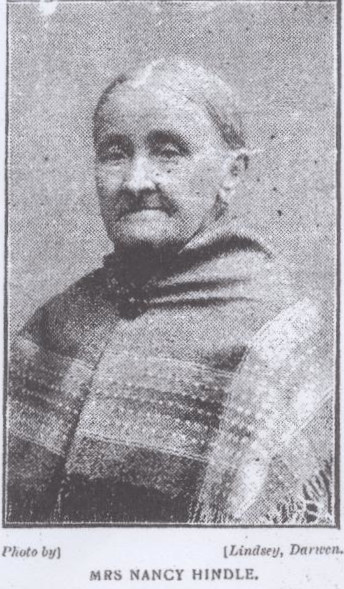
The Shorrocks are amongst the most ancient of Darwen families. Centuries ago, so far back as the early part of the sixteenth century, representatives were living about the district, in particular at Eccleshill, and the name is to be found recorded at an even earlier period. The name, probably derived from sher rock or steep rock, as the late Mr. Abram believed, is one which goes back into the earlier life of Darwen – to the days when it was not even a village, and when dwellings were scattered here and there, great distances apart, over a verdant area. Mrs. Nancy Hindle, who now lives in Bolton Road, is a present-day representative of this ancient local family. She is a link which serves to connect the family chain of the Shorrocks, who are it is believed largely all of one stock. Before her marriage she was Nancy Shorrock, and by that name she was better known to old inhabitants than by the name she obtained upon her marriage. She was born at Darwen seven and seventy years ago, at the time when the district was just entering upon the prosperity which the introduction of steam power and new inventions had to produce from the cotton manufacturing industry. The days of her childhood were those which divided old conditions from the new. In her life she saw Darwen thrive in its infancy, cover vacant spaces with factories and with dwellings for the workers. She has witnessed the passing of many worthy and quaint characters from the district, and the unfortunate disappearances of many old and even historical landmarks. When I talked with her at the residence of her son, Mr. James Hindle, jeweller, she told me many interesting things of old Darwen places and faces.
It was at Dob Meadows Mrs. Hindle was born, and her father, Ralph Shorrock – a man well known to many of Darwen’s older inhabitants- was engineer at the print works which have been frequently mentioned in the course of this series of articles. At Dob Meadows Works it was that children were sweated and overworked in those days. They were deprived of the opportunities for obtaining education so that they could ‘addle’ two or three shillings by labouring over a number of hours adult men will not work in these better times. Early in the morning these dots of six and seven and eight years of age were called to work, and they were kept at it until seven, eight and even later hours at night. Fortunately, Mrs. Hindle was a girl and saw little of this system of child slavery.
James Shorrock, her grandfather, was uncle to the first Mr. Eccles Shorrock, a man who had more than a little to do with setting Darwen upon its feet, but it was not with that branch of the family that Mrs. Hindle came most closely in touch in her girlhood days. She knew James Shorrock, the father of the late Alderman Christopher Shorrock, best, and although he was a man of middle age when she was a child, then living in Union Street, she remembers him well and many of his characteristics. Mr. Shorrock was at that time living at Shorey Bank and was a partner with Mr. Eccles Shorrock. He was a man who enjoyed a good joke. “One day,” Mrs. Hindle said, “Mrs. Shorrock asked me to go across to Mrs. Eccles Shorrock’s house with a packet and leave it along with her best respects. Well, I had often wondered what ‘best respects’ were, and the packet not being properly fastened I thought I would peep inside and find out. When I saw the contents I danced about and shouted to my mother, ‘I know what best respects are’. ‘What are they?’ she asked, and I replied ‘Grey yure wi’green ribbon teed to id’. This came to Mr. Shorrock’s ears and when he had company he would send for me and ask me what best respects were”.
Mrs. Hindle went to a school conducted by old Mary Beckett, near Joe Bentley’s wood yard down Croft Street—now the marketplace—and afterwards to the school at Belgrave, of which Mr. White was master. She was living in Union Street when New Mill was being built, and she remembers William Walmsley, brother to the late Mr. John Walmsley, cotton manufacturer, being killed whilst the operations were going on. William’s wife was called Isabella, and she was a baker of famous oatcakes. At the present time there is in the possession of Mrs. Hindle’s son the bowl from which punch was ladled in the New Mill shed during the festivities occasioned when the late Queen Victoria was crowned.
Mrs. Hindle went to a school conducted by old Mary Beckett, near Joe Bentley’s wood yard down Croft Street—now the marketplace—and afterwards to the school at Belgrave, of which Mr. White was master. She was living in Union Street when New Mill was being built, and she remembers William Walmsley, brother to the late Mr. John Walmsley, cotton manufacturer, being killed whilst the operations were going on. William’s wife was called Isabella, and she was a baker of famous oatcakes. At the present time there is in the possession of Mrs. Hindle’s son the bowl from which punch was ladled in the New Mill shed during the festivities occasioned when the late Queen Victoria was crowned.
In those days, there was no water laid to the houses, it had to be fetched in buckets from the wells, and generally, the conditions of life for the people were not distinguished by features of convenience. Handloom weaving was disappearing, but here and there were people who clung to the old industry and tried to drag a livelihood from it. One of them was a woman known by the nickname of “Old Blackbonnet”- Mrs. Hindle never knew her by any other name- and she was a woman of very eccentric habits. Another quaint character was old Nancy “Caddick”- probably Chadwick – who had a donkey and cart, and fetched coals from the pit at the bottom of Turncroft Lane. Mrs. Hindle frequently saw her when she was living at ‘Brick House’ then a public house, but now known to the present generation as Barton Cottage and standing at the Redearth Road end Turncroft Lane. Old Mary had a peculiar way of getting her donkey along the road, for to tempt it on she would walk before it with a wisp of hay in her hand and allow it to catch the scent. Redearth Road district was then very barren. The old Black Horse used by the Catholics as a church, was standing, and in addition there was the house of old Henry Mather, with his loom house at Cross Barn, which was pulled down when St. John’s Church was built; and the old Bent House, nearer Sough. Behind the “Last Rose of Summer” public house there was a farm, which was occupied by Mr. George Hindle, grandfather of Mr. F. G. Hindle, Liberal candidate at the last general election. From all the way up to Blacksnape there was little but fields. At Dangerbus Corner, at the bottom of Turncroft Lane, there was a row of houses and a calico-sizing place, which was worked by a man known as ‘Old Dick Sizer’. In the course of our talk, Mrs. Hindle mentioned Bobbin Hill, where power looms were first fitted up, and where they were broken by gangs of loom smashers, some of whom came from Blackburn and from Guide. It has disappeared in order to make way for the rebuilding of the premises of the Victoria Buildings in Bolton Road.
Blackburn Weekly Telegraph 2nd June 1906
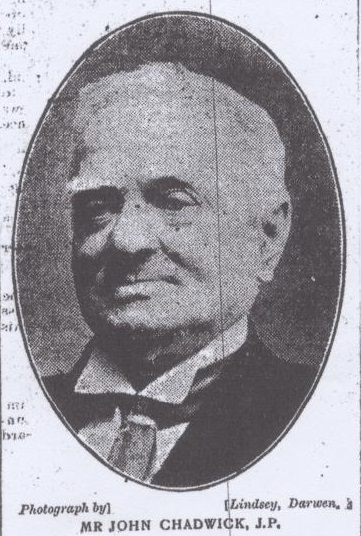
Mr. John Chadwick, J.P, is the link connecting the present with the past generation of Darwen tradesmen, and of Darwen as it appeared, and of people who moved in it nearly three quarters of a century ago, he has a lively and kindly recollection. We talked of those bygone days and people at Highfield House, Mr. Chadwick’s residence on the eve of his birthday. Six and seventy years ago on the 29th of May, he was born at a shop in Market Street.
“There were only two other butchers in the town when I was a lad,” Mr. Chadwick told me, “and one of them was Roberts, who first had a shop in Union Street and afterwards moved to the top of School Street where his son is now. The other was George Matthews, who had a shop in Market Street where Catlow is. There was no early closing in those days, and the few tradesmen there were kept open very late, often till twelve o’clock. Darwen was a very small place at that time, but although the people worked long hours and there was only candlelights at night, they did not go early to bed. They were off to the factories at five o’clock in the morning, and it was very common for them not to finish till nine o’clock- sometimes half past nine—at night. There were some rough doings—drinking in the public houses through the night, and some brutal scenes occurred in the streets. I remember a woman named Hutchinson—a very big and very strong woman who had worked as a drawer in one of the coal pits. She and her husband came out of a public house, and she encouraged him to fight with another man, saying, “Give me thi close an’ give him a hiding”. As the men fought on the ground she went on encouraging her husband by patting his back, and she held out the promise “If tha doesn’t beot him aw’ll beot thee!”
“Some of the leaders didn’t set a very good example and there was one minister who was found lying in a ditch bottom drunk. The constable lifted him up, looked at his face, and then put his back, saying, ‘It’s only own _____; he’ll noane be wanted till next Sunday’.
Football was played against Bury and other districts, and other sport was dog fighting, cock fighting, bull baiting and bear baiting. Men travelled about with bears, and at Blacksnape they would allow them to be baited by dogs, charging a fee per dog. If the bear happened to get hold of the dog with his paws he would squeeze it. Bull baiting was very common, and it was defended because it was said that the beef was made more tender when the bull had been baited by dogs before being killed. We had a dog which had its legs broken twice over in bull baiting contests.
“Darwen was paved as far down Market Street as the New Inn, up Bolton Road as far as Wraith Street and to Redearth Road, 65 or 70 years ago, and the rest were indicated roads formed of broken stones. All round about that area were fields. There was no Railway Road and the road to Trinity Church was up Church Bank Street. The building now occupied by Mr. Costeker as an office was then the Holy Trinity Vicarage, and there were gardens on both sides of it. There were arches in what is now known as Arch Street and they still exist there, but have been covered up. I played under them, and old George Whittaker had a blacksmith’s shop beneath them. Then there was a hollow where a row of shops stands now, Old Swallow and others, who went round with their barns, playing ‘The Murder of Maria Martin’ and some of Shakespeare’s plays, made their stand at that place. On Saturdays stalls lined the street from the Angel Inn down to the Commercial Inn, and beyond that there was nothing except very small shops. These stalls were illuminated by candles, and when the storms came—and we had some storms in those days—and the stalls went over and there were some lively scenes.
“The streets were not swept, but were tidied up by Long Jimmy with a rake. He got all the rubbish together, and then threw it into the river, which was open. When the river was in flood all the stuff was swept away. Jimmy was a sort of town clerk, borough surveyor, and Lord High Everybody—all rolled into one. And his wages were 10s a week. For water for domestic purposes we had sometimes to go at least a mile. There were fish in the Darwen 65 years ago, and I have seen the water quite clear. The river was open from Spring Vale to Scotshaw Brook, Lower Darwen and here and there were a few wooden bridges. On the right-hand side of the river looking towards Blackburn there was scarcely anything but fields. One of the bridges existed at the Circus and simply led to Potter and Co.’s bleach works on what is now the Market ground. There was another at the bottom of Union Street and there was also one which led to Darwen Mills. There were two tollbars on the old highway between Darwen and Blackburn, and four between Astley Street and Bolton. One of the bars was where St. Edward’s School is, and another 200 yards this side of the Aqueduct Inn. Foot passengers went through free, but horses and conveyances had to be paid for. There was always a lot of traffic on the roads, which were very rough, and the mail coach ‘Red Rover’ which started from Blackburn at five o’clock in the morning, came through Darwen and picked up passengers on its way to Manchester. There were other coaches besides. The roads were dangerous then, owing to the footpads and highwaymen who robbed travellers. I used to go to Skipton Market on horseback, and we always waited for the butchers from Bolton, so that we could travel together in safety. Fifteen or sixteen would come riding down the road, and then we would join in. It was an all-night journey, and on one of my journeys my clothing was frozen to the middle. Belthorn was a lawless place and a lot of the footpads came from about there. Either fifteen or sixteen Belthorn men were transported for thieving at one time, and a lot of stolen property was found in a pit in that district. There were a lot of illicit whiskey distillers all round the outskirts and sheep stealing—which was a hanging matter—was also common.
Nicknames were very common in the old days, and I remember Jim o’ Jack’s o’ Harry, Dick o’ Tums o’ Rutchets, a member of an old Darwen family, Rutchett’s o’ Dicky’s, Joan o’ William’s, and old Calico Jack. Old Jack was a queer character and lived in a Delph on the moors. There were some very curious characters about High Lumb Hall district, and Bill Foo, whose mother Ailse Foo had a shop in Market Street, had tussles with some of them. Bill was a big, stout, powerful fellow, and he was not gentle with his prisoners.
Roger Aspinall, father of the late Dr. Aspinall, had a grocer’s shop on the Green, where the Provident Store is now, and a relative of his, James Aspinall, had a shop in Green Street where Dr. Ballantyre has his surgery. Roger was a very feeble, nervous old man and dare not go out at night. There was also Old Molly Bury, who said she could do better selling wet stuff than dry stuff and gave up her little grocery shop to manage the Black Bull which she owned. She built the houses behind the Bull. She was a wealthy woman, and had two brothers who were doctors”.
Blackburn Weekly Telegraph 16th June 1906
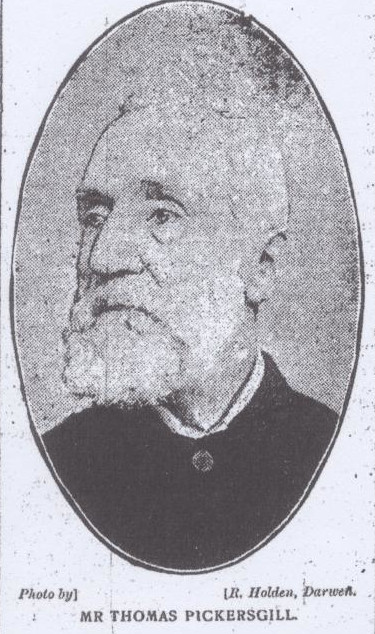
Much water has gone under the bridge since the day when Mr. Thomas Pickersgill first saw light at the Weasel in Tockholes over four and eighty years ago. His father and his mother belonged to Yorkshire, and after they had migrated to the little hill-top village, their son, who is now Darwen’s oldest veteran, was born. “There were seven stone steps up to the bedroom at the Weasel”.
“When I was a lad,” Mr. Pickersgill said, “there were not many folks in Darwen, and I knew the names of nearly everybody in the centre of the town and in the main street from one end of Darwen to the other, but I cannot remember them all now—I seem to forget.
“I was not more than three years old when I used to go to Dob Meadows watching the tier boys who worked there tiering, and some of those youngsters were not much bigger than myself.
“Names! It was rather unusual to call folks by their proper name. The folks used to christen their neighbours themselves and gave them nicknames which would stick to them through life. There were lots of old folks whom I knew well enough by their nicknames, but whose real names I never knew at any time.
“Old Joe Brass Girl will be known to many very old Darweners. He was a man when I was a child, and went about the town selling toffee and doing odd jobs. I think he was an old printer, and took to going about when he got too old and weak to work at the calico printing works.
“More than seventy years ago old Mike o’ Cicely’s had a garden in Wellington Fold, at the top. “That was before the Dole Lane was cut. We old people call it Dole Lane to this day, because it was cut in the dole days by men who were paid a shilling a day for their work, but many of the younger generation only know the lane as Police Street.
“Old Nancy Chadwick lived in what we called the Alley, which was near the Grey Horse, and she was a curious character. She had a donkey, and carried coals to the houses of folks who didn’t want to give orders for a load. The donkey had a pannier on each side, and when she had got her order Nancy would trot her donkey off to the brow of some pit where the owner was not very particular. There she would gather the coal, and when the panniers were filled, deliver it to her customers.
“I knew old Jimmy Greenway, the uncle to the late Charles Greenway, very well. He was a pottering old man when I was a lad. Moderately tall he was and walked rather sharply. I remember that he rode a mule, because a donkey was too small, and he dare not get astride a horse. One day he was riding up Dove Lane, and the mule spotted some nice grass beyond the hedge. It wanted that grass and to reach it marched right through the hedge and dragged old Greenway along with it. The entrance to old Jimmy’s grounds was where Bottom Croft Mill now stands.
“At the top of what is now called the Tip were a few very old houses, and Bill o’ Davy’s lived in one of these. He was the old bellman before Old Tom Bam. Bill was reckoned to be a very good-living fellow, but he was rather vulgar in his speech. “I knew old Tom well and often saw him out in his uniform—with his red knee-breeches and vest and his green coat. He wore a tall black hat, and it had a thick band round it. I think there was some trimming round the brim. Tom was a little fellow, and he had a remarkably good voice for his job. Whatever had to be announced he was called upon to do it, and often several announcements would follow each other. Between each Tom would ring his bell once. Every week a cartload of potatoes was emptied on the Green, and when this occurred, he had to go round with his bell telling the folks that the potatoes had arrived and their price.
“I never knew any constables at Darwen before Bill Baker and Bill Foo. Baker was the head constable and the gentleman, whilst Foo was the assistant and the runner. Bill Foo got all the rough work to do, for Baker took the top end of town, and I have seen Foo about eleven o’ clock at night taking drunken men to the dungeon under the Red Lion in Arch Street. There were steps down to the dungeon and these were covered by a big door. Foo would open the doors, push his prisoners in, then lock the dungeon door, throw down the door on the top of the steps, and fasten it. And there his prisoners had to stop until he released them—in pitch darkness.
“There were a few handloom weavers in the centre of the town, but not so many when I was a lad. All up Market Street there were cellar dwellings under the shops. I remember that a man named Ainsworth lived in one, and another man was old Henry O’ Harry’s—that was his proper name. Ainsworth was a carter, and had about three or four horses. Old Tup’ny Pies had his shop in a cellar, and got his name from the fact that he sold pies at two pence each. I never knew him by any other name.
“Jim o’ th’ For End was a handloom weaver, and lived in the houses in the hollow now filled in at The Tip. Other handloom weavers were Bill ‘o’ Davy’s and old Mike o’ Cicely’s. There were two or three old weavers in Gregg’s Gardens. Little Singing Dicky was one of them, and he had a place with several looms, on which he allowed weavers to work for sixpence a week.
“Jack o’ Lodney-Don’s was a convict, and had been transported. He was not allowed to go into anyone’s house, but he went about the streets singing out about the matches he sold. They had brimstone at both ends, were a little longer than other folks, and were thick. He sold a lot. Tum o’ Queen Dicky’s was a barber and had a shop near the entrance to the old Market House. I also knew Jos o’ Theston’s.
“There were three night watchmen. Bill o Davys’s was one, Jem o’ Nick’s was another, and the third was a tall man, whose name I forget. These men would go about the streets during the night shouting out the time and the weather”.
Blackburn Weekly Telegraph 23rd June 1906
Why dost thou search? Why urge my memory
To conjure up old times to life again?
To think on all times backwards, like a space,
Idle and void, where nothing e’er had being.
And thou has peopled it again:
O thou hast set my busy brain at work!
Travelling back into the period of a departed past by the agency of memory of an old inhabitant, in her recollections living with the people of a long gone by but still not forgotten generation, we are brought into touch with the beginnings of the great commercial enterprise which give Lancashire its present-day prosperity. Customs strange to our modern ideas, methods alien to the new thoughts, come into the old-time picture and we view the primitive stages of our vast industries. Habits and operations that are in themselves singular are revealed, yet in all we can trace the foundation of our developed state in these early days of the century. And as the opening of the present century appears to us, so may our days, our ways, and our businesses appear to those who attempt to recall a century hence all that we enjoy and are proud of today. The customs and the thoughts of one generation are distinct from those of succeeding generations- the habits of ours are not those of the other, nor are the ambitions of the two alike.
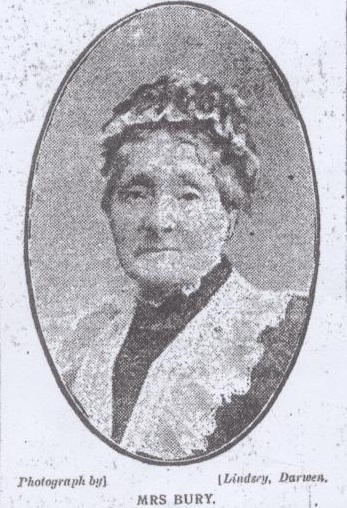
All this is well realised when I revive the recollections of an old lady like Mrs. Bury, with whom I had a chat at her residence in Heys Lane a few days ago. She is in her 86th year, but time has rolled gently above her head and touched it lightly. She is not one of an old Darwen stock – not any of those families Darweners claim as the foundation stones of their town, but the greatest number of the years of her life have been spent in the district. “Darwen was only a village when I came to it,” she told me. “The town which a century ago had less than 4,000 inhabitants in all its area had a population increased in numbers by some 7,000 people. Some of the old village industries were dying, or had disappeared, new employments were coming into existence. It was the period of the growth of a new commerce and fresh enterprise. Protection, the bane of the day, when Mrs. Bury was in her girlhood, was doomed: the application of steam to manufacturing purposes was working out a natural revolution in methods.
Mrs. Bury, I have said, was not born in Darwen. It was in the neighbouring borough of Bolton that she first saw light and where she first experienced the factory system of her time. There is much contained in her assertion that “there were no inspectors when I was a lass”. It reveals how much the work people were at the mercy of those who cared to inflict hardships upon their employees. The days of her girlhood were those in which child and female labour was unduly and often improperly exploited in the cause of making families rich. The child was particularly exploited because its labour was cheapest to the employer, though dearest to the nation. Mrs. Bury was favoured in her day. It was not her lot, as it was the lot of some, to be sent into the mill before she had reached the age of eight years, to have her face scrubbed with a cloth just before being sent in to see the certifying surgeon in the mill office, so that the inflamed flesh might be mistaken for the rosy tint of health, or to undergo many of the cruelties often inflicted upon the very young in the early days of the factory system. These were common in the cotton manufacturing districts, not only in the district in which she lived, but also in Darwen and other parts where it existed. It seems strange today to say that a little girl should go into the spinning room – to act the role of piecer- work which is now done by boys- yet this was the work which Mrs. Bury had to do when she was a child, labouring through the long hours over which work then continued.
Mrs. Bury was one of the first women to travel on the railway, which, when she was young, extended only between Manchester and Bolton. It had not been carried on to Darwen and other parts of East Lancashire, which could be reached only by travelling on the coaches or on foot. She had the prevailing fear of the new conveyance and told me how on an occasion when she had been on a visit to Stockport, and had walked thence to Manchester, she and a companion continued their walk to Bolton, because “we were too frightened of the train to ride".
Then she came to live at Egerton, and there saw more of the primitive methods available to East Lancashire for travelling. “We saw the coaches coming through from Blackburn and Bolton, and also the conveyances bringing people from Bolton, who were going by road through Darwen, Blackburn, and Preston to Blackpool, for that was the way they travelled. “They often called out to us as they went past, telling where they were going", she said. “The road was not fairly straight as it is in these days", she continued, “but was zigzag and the surface was rough." How different the conditions for trippers then to what they are nowadays, when excursions go so far a field as Paris for a day's outing!
The attractions of Darwen drew Mrs. Bury and her husband to it from the wayside village of Egerton a little more than half a century ago. Egerton was small, but Darwen itself was larger, although a village. The river was open, running through the district. Green fields and meadows existed where now stand rows and rows of houses and mills in which the multitude find occupation. “At the lower end of Heys Lane there was a nursery, or a small wood", said Mrs. Bury, “and the children would cross the river to play amongst the trees. There was a little bridge by which they could get across, and a cottage beside it. All was open, nothing but fields down to where Percival Street is now. At that time we went to live in a house with one room up and one down. And there were plenty like that in the town. The rents were about 5s a week. On the Lee side of Blackburn Road there were very few houses. Near where Orchard Street is there was an orchard, and that is how the street got its name. Lower down, where a block of shop property stands, were the gates entering the grounds of Mr. Walsh, who afterwards moved up the hill a little to live in the house formerly the home of his brother. It is now known as the Alexandra Hotel. The Walsh's were a family of great influence in Darwen in those days."
So Mrs. Bury went on, speaking of people and places that have now disappeared, filling one with astonishment at her wonderfully preserved recollection, as we:
Open memory’s book again-
Turn o’er the lovely pages now
And find that balm for present ills
Which past enjoyment can bestow.
Blackburn Weekly Telegraph 07 July 1906
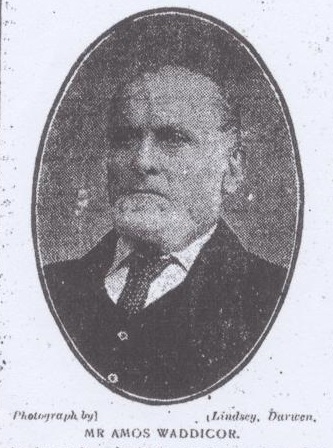
The Blacksnapes ridge and slopes, forming the eastern boundary of the Darwen valley, and the people who lived there have a history and characteristics distinct from those of the town, which is today in a more highly developed state. The road which runs through the heart of that little outlying hilltop village exists as a reminder of the Roman occupation of Britain, for it was formed by one of the most renowned regiments of the Roman army, who furnished the garrisons of Lancashire, and some of whom encamped at Ribchester. Blacksnape in later time came to be fairly populous and thriving village, the home of industrious handloom weavers and of colliers, whence wrestlers and football players went forth to battle for their district against the men of other villages. A quaint village, hard in some of its features, yet interesting. Blacksnape today had not upon it the stamp of progress, it is regarded as a place to some extent decaying by those who know it only in the modern aspect, but men and women who where acquainted with it in the early part of the past century realise that even Blacksnape has moved onward and made some progress. This I gathered in the course of my conversation with Mr. Amos Waddicor at his home in Philip Street the other morning.
Mr. Waddicor has been described to me as one of an old Darwen family, but it was not at Blacksnape, but at Drummer’s Stoops that he was born. In his boyhood the handloom weaving industry was struggling against the competition of the steam power loom, established in the town. Born in 1836, Mr. Waddicor was sent into the pit at a very early age, and at 13 he went to the mill, subsequently entering the business of a coal merchant. At Blacksnape Fold John Fish lived, and he was known as a manufacturer of handlooms. To those who wove in the loom shops attached to the houses he supplied work, and he was one of the few important enough to travel by coach to Manchester to do business with its merchants. It was usual for him to join it at the top of Bolton Road. Some of the oldest loom shops still remain, although they are now put to uses other than those for which they were originally intended. Those who gained a hardly-won pittance from the soil by farming often swelled their incomes by earnings on the loom.
The men who possessed a few looms were known as cotton manufacturers, but Briggs and Harwood and others who had flourished there, had passed away, and the old-time academy of James Nuttall, who taught a little reading, writing and arithmetic was closed when Mr. Waddicor in his boyhood’s stage came to be an observer of the customs and the people of his time. He just knew his great grandmother, who died at the age of 80 years, and his great grandfather, who died in 1841, and was 88. Today they lie at rest in the burial ground at Lower Chapel. It was Mr. Waddicor’s father, Thomas, who carried on the services in the vestry after the secession from Lower Chapel which culminated in the establishment of the Duckworth Street Congregational Church. All the Waddicors were handloom weavers and that was almost the staple industry of the Blacksnape area.
John Cook was then one of a leading Blacksnape family, and it was a Miss Cook, one of its members, that George Pickup, father of the late William Pickup, an ex-Mayor of Darwen married. John was a very well-known man. Another of the leading families was that of John Riley, who was a farmer, grocer and publican. The Kershaw’s also originated at Blacksnape and were chiefly colliers. Then there was old John Holden, who was a coal proprietor and got a lot of coal out of the land he farmed.
John Fish o’ Baron’s, whose family is still living, was a man of much intelligence and was the politician of the district, paying great attention to the progress of public affairs. How slowly news came to that little village in the old days will be gathered from the fact that John was the only man in Blacksnape who took in a newspaper, and even he, so Mr. Waddicor told me, “joined at it with William Chew, of Dewhurst’s, who was a farmer and coal proprietor.” John was a cripple.
“Amongst those who were weavers were Richard Waddicor, William Waddicor, who lately died, and my brother John. The Yates’s of Far Hillocks were very old handloom weavers, and at Near Hillock was James Briggs. The Yates’s have left Blacksnape, and I believe the family is now principally scattered about Edgworth and Bolton, although one member, Yates Yates, kept the Griffin Inn at Hoddlesden. Old John Holden had a farm on the wayside between Drummer Stoops and Grimehills, and he never married. His brother Edmund had a farm just below.
“The Dixon’s farmed at Whittlestonehead for a long number of years and owned the farm. Two of Dixon’s daughters married George Pickup’s sons, James and Robert, who were both farmers. Robert is a farmer near Sleeper Hills and James is dead. At Drummer Stoops lived William Fish, who came from Lower Darwen after he had given up work and bought a few cottages. William was an intelligent man and was an old Calvinist. He attended the old Lower Chapel for a time, and then left and started a new place of worship in a room behind where Mr. Entwistle had his druggist shop in Market Street. In his younger days William was a first-class violinist and afterwards a leading singer, possessing a splendid voice and a thorough knowledge of music. He was in great demand for more than 20 miles around.
“John Entwistle, who lived down at Grimehills, was an old handloom weaver and very eccentric. Himself, William Aspden and a few more formed a party, who always had a ‘grand-day’ when Turton fair came round. They would go there on a fighting expedition, and I have heard how they knocked the stalls over. In the latter part of his life John became a leading spirit of the Primitive Methodist body, then in its infancy, and did good work as open-air preacher. Both himself and his wife were interred at the Redearth Road burial ground. About Blacksnape there was a lot of fighting, and nothing was thought about going into the open and stripping naked for a fight. When not fighting themselves, they would have dog fighting or cock fighting. There are one or two of the old cockpits about the district yet. The birds were trained for the fray, and were fitted with metal spurs, the battles being for money stakes. The Townsends were famous fighters, as were John Rostron, Thurston Cooper and others.
Mr. Waddicor then told me of the coal getting industry. The pits were small ones, ranging from 18 to 30 yards deep and were shown as turnpits.