
 Loading more
Law and Order
The William Gourlay Embezzlement | The Murder of June Anne Devaney
Crime and Punishment in 1920’s Blackburn | Specifications for Police Uniforms
Juvenile Delinquent | The Brewery Street Siege | The Murder of Emily Holland
Blackburn Tragedy, The Murder of Alice Beetham
| Special Constable Richard Burke | Memories of Robert Eastwood
The William Gourlay Embezzlement
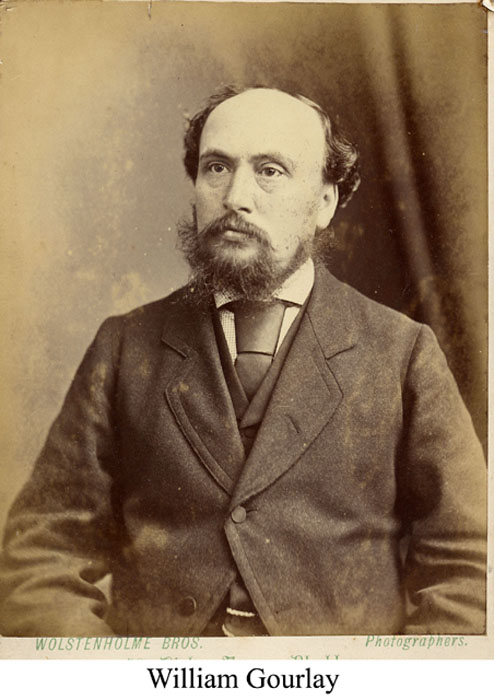
HIS ARREST AND FIRST COURT APPEARANCE
On Wednesday the 18th of June 1879, William Gourlay was taken the short distance from his cell in Accrington Police Station to the court where, before Mr Gatty he was charged with embezzlement from the Oswaldtwistle Local Board. It came as a shock to the people of Blackburn and the surrounding district to learn that such a highly respected man should find himself in such a position.
Dozens of people were gathered outside court as he was brought in, and the court room itself was full to over flowing. Three other prisoners were also on trial that morning. These three were led to the prisoner’s box while Mr. Gourlay was led to the box usually occupied by reporters; there he hid himself behind a pillar out of the gaze of the spectators, held his head low and looked very dejected. When his name was called he walked firmly to the dock. Mr. Backhouse who appeared for the prosecution, told the court that the prosecutors were the Oswaldtwistle Local Board and “The prisoner stands charged upon the warrant with embezzlement of monies belonging to that Board to the amount of £500.” The charge was that on the 12th of April, 1878 Gourlay received from Edmund Pearson, of Marsden-street, Church, the sum of £500 as a loan to the Local Board, for which he was given a receipt. On the 13th of May, Pearson handed in the receipt and got a certificate for the money. Pearson said that he had twice received interest on the money from Gourlay, in cash, but the £500 was still owing to him. The account however was never passed through the books. After this was found out the books were examined and Mr. Backhouse said, “From the investigation that has taken place it is evident and clear that defalcations will be found out to a very considerable amount.” A request to remand the prisoner until Saturday the 21st was made to which Mr. Gourlay had no objections. He was then led away back to the cells.
On Tuesday the 17th of June 1879, just before 3.30 pm two plain clothes police officers made their way up Shear Bank-road. Then, as now, it was a highly desirable place to live and had some of the most expensive housing in the town. The two detectives were making their way to a house called “The Woodlands,” the home of William Gourlay and his wife Margaret. The officers were Detective P.D. Beattie of the Accrington police, and an unnamed sergeant from Blackburn Police Force. At the house Beattie knocked on the door and after a short wait it was answered by the Gourlays' maid. Having identified themselves they told the girl that they needed to see Mr. Gourlay on an urgent matter. Leaving the detectives in the hall, the maid went into the drawing room where Mr and Mrs. Gourlay were entertaining a friend, she informed Mr. Gourlay about the visitors. The police officers were shown into the drawing room, then waiting until the maid had gone, Beattie informed Gourlay that he was there to arrest him on a charge of embezzlement. For a moment Mr. Gourlay seemed confused, he rose from his chair trying to speak but was unable to get any words out. He quickly composed himself, and then calmly asked the officer if he had a warrant. The detective produced one from his inside jacket pocket and immediately began to read it out. The charge was “That on the 12 April 1878 Mr. William Gourlay embezzled the sum of £500, the property of the Local Board of Oswaldtwistle.” Gourlay made no immediate reply to the charge. His wife, who up to this point had been sitting quietly, now became hysterical and began to scream and cry out. Mr. Gourlay’s friend took hold of her and asked if he could take her out of the room, the sergeant nodded and he led her away. Gourlay then asked if he could prepare himself and was allowed to do so. When he was ready they all made their way to the front door. Without a word to anybody Gourlay took his hat and coat from the hall stand and left the house with the two officers. Outside the Blackburn sergeant said he would walk some distance behind so as not to rouse any suspicion as to what was happening. They made their way back down Shear Bank-road. Beattie told the prisoner that they were going to Accrington Police Station and that they could either go by rail or cab, Gourlay said that he would rather go by cab. Reaching the bottom of Shear Bank-road they turned onto Preston New-road and at Sudell Cross found a cab. They arrived at Accrington Police Station at about 4.30 pm where William Gourlay was formally charged. He was led away to the cells where he spent the night, awaiting his court appearance the following day.
© BwD - terms and conditions
LIFE IN BLACKBURN
William Gourlay was born in 1828 into a middle class Glasgow family. He had a good education and he claimed himself to be an “intelligent, well educated and well read man.” Nothing more is known about his early life in Scotland and it is not mentioned at his trial. On leaving school he took a position with a local newspaper and by all accounts, became a very able reporter. He married Margaret in the late 1840’s and they were very happy in their relationship, although they never had any children. The Gourlays came to Blackburn in 1859 and bought their first house which was at Lower Bank, Preston New-road. Not long after this they moved to a house on the same road called Bank Villas where they remained until the spring of 1879 when William paid £4000—which for the day, was a considerable amount of money for a man in his position—for a semi-detached house on Shear Bank named “The Woodlands”.
His first situation on arriving in Blackburn was as editor of the Blackburn Standard newspaper, a position he was to hold for the next six years. The Blackburn Standard was and always had been a staunch supporter of the Tory party and Gourlay, who wrote all the paper’s political articles soon began to impress the party with his opinions. For a number of years the Conservatives had been having a hard time in the town, but Gourlay's editorship soon saw its popularity began to improve, and it wasn’t long before he became a significant member of the party.
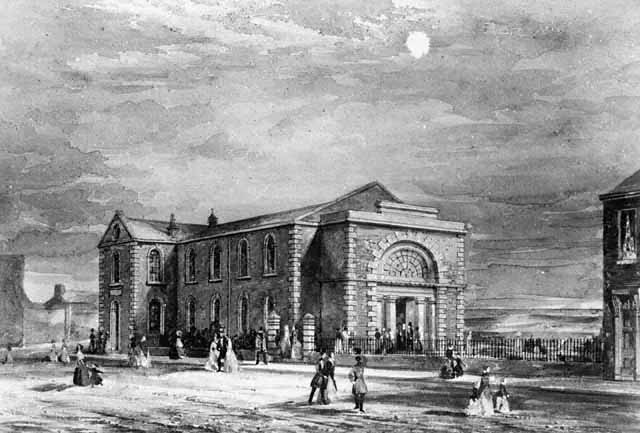
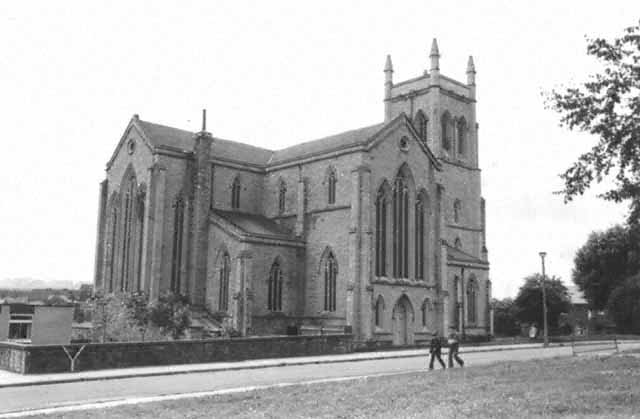
By religion the Gourlays were Presbyterian, both he and his wife were members of Mount-street Presbyterian Chapel. It was not long however before he started to cause some ill-feeling among the congregation. Using his position as editor of the Standard he had written some articles which criticised certain aspects of Nonconformity; this of course soon began to anger a large part of the congregation and the incumbent, the Rev. Skinner in particular. His position within the church soon became untenable, and he decided that it would be best for all concerned if he found another place to worship. After quitting Mount-street Chapel he gave his devotions over to the Church of England, which fitted in far better with his Conservative views than the Nonconformist ever could. He now began to attend Holy Trinity Church, Mount Pleasant in the Larkhill district. Once again he took a prominent role in Church affairs and was soon elected to the position of Churchwarden.
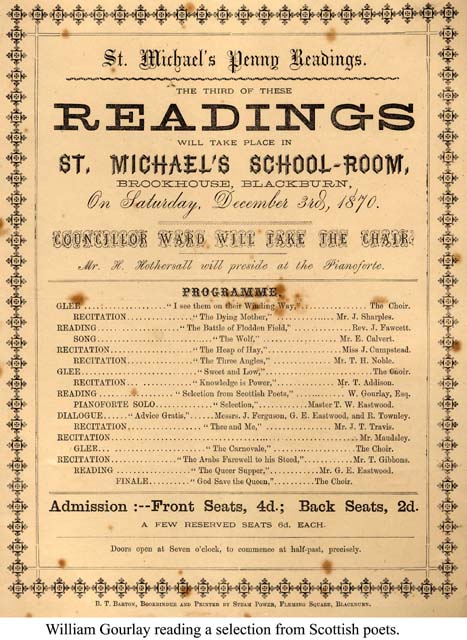
In 1861 Robert Hopwood Hutchinson became Mayor of Blackburn, that same year was also the start of the American civil war which was to bring so much hardship to the people of Blackburn. It was to become known in Lancashire as the “Cotton Famine”. Mills all over the County were shutting down or were put on short time. Thousands of people had no other choice but to rely on handouts. Hutchinson as Mayor was also chairman of the relief committee, and as such he opened a soup kitchen in Cleaver-street which at its height was distributing about 2,400 quarts of soup a day to the needy. As Hutchinson’s Mayoralty came to an end William Gourlay thought it appropriate to write a short account of the events which had occurred during that year. It was to be published for circulation amongst the close friends and allies of the ex-Mayor. The American Civil War finally ended in 1865, and Gourlay began to write another book, this time for general distribution, called a “History of the Distress in Blackburn 1861-65.” He dedicated it to “Robert Hopwood Hutchinson Mayor and Chairman of the relief committee 1861-62 and James Barlow Stewardson Sturdy, Mayor, 1862-63, and chairman of the relief committee, 1862-65.” The book was a history of the: “Distress and the means adopted for its relief…both of those who were themselves sufferers from the effects of the Cotton Famine, and those who, by personal exertion and pecuniary contributions, helped to mitigate its severity.” It gave facts and figures about how the town had coped with the distress. It paid tribute to the people who had given donations to the town, including the mill owners and ordinary people from all over the country; mention was made of the Royal Family who also donated funds. The book told of how the unemployed men of Blackburn had been given employment by the Corporation, how knitting and sewing circles were started for the women. It was said at the time that the book was an “accurate and well written piece of work.”
© LET - terms and conditions
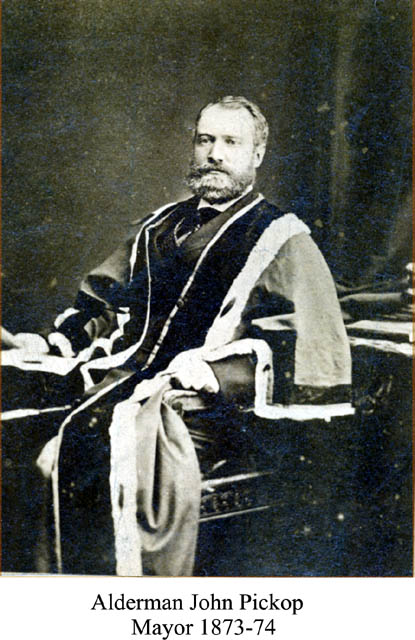
After six years as editor of the Blackburn Standard, Gourlay decided to end his connection with the newspaper. He next took on the position as confidential clerk to Alderman John Pickop who ran a firm of conveyances and solicitors in Blackburn. He worked there for two years and in that time took his “articles”. It was also about this time (1866-67) that he became connected with the Oswaldtwistle Local Board where he acted as clerk under John Pickop. On leaving Pickops he accepted a full time position with Oswaldtwistle Local Board as clerk to the Board at a wage of £150 per year, which was soon increased to £200. This together with £25 he earned as Clerk to the School Attendance Committee made his salary £225 per year .From this money however he was expected to pay the wage of an assistant. In 1871 he applied for but failed to get the position of Clerk to the School Board at Blackburn.
In the autumn of 1875 Blackburn Corporation decided to change the way in which they audited their books, as they felt the old system was open to misappropriation. The Corporation considered it necessary that an independent audit should be carried out immediately and as William Gourlay was regarded as a man whose integrity was beyond reproach, the Council appointed him as Borough Auditor at a salary of £100 per year. As well as all these posts he was also an agent for “Scottish Widows” the life insurance company and held shares in the London And Yorkshire Bank Limited and Manchester County Bank. He also became involved in many limited liability companies which included; Church Paper Company, where, with seven others he held fifty £5 shares, White Ash Paper Company, Brookside Paper Company, Moulden Water Paper Company, Commercial Mill Company, all of these, by the time of Gourlay’s trial had been wound up either voluntarily or by compulsion. Others were Madder Clough, Hippings Vale Hybrake Spinning, Vine Spinning, Excelsior Washing Machine Company, Accrington; Anstey Paper Company, Earby Cotton Manufacturing Company, Ashton, Frost and Company, Hollinwood Commercial Company, Lezayre Corn Mill Company, Isle of Man.
In July 1879 an action had been brought by W.A. Heaton, and Thomas Aspin, against the seven directors of the Whiteash Paper Company, these were William Gourlay, Benjamin Wilkinson, Hugh Catlow, Edmund Richmond, Thomas Alexander Aspden, Robert Reddish and R.D. Farnworth. They were accused of fraudulently issuing a false prospectus and misrepresentation in the forming of the Whiteash Paper Company. The plaintiffs were claiming damages for the amounts that they had paid in as shares. A settlement was finally reached with the defendants agreeing to pay the plaintiffs 12s 6d (62 ½ p) in the pound on their claims, and the claims of the other share holders who were acting with them, together with costs.
Gourlay had a great interest in books and was an avid collector; by 1880 he had acquired a very substantial and valuable library. He was a member of the Free Library Committee from1861 until 1878 and served on the sub-committee for the purchase of books.
THE SLIPPERY SLOPE
It was not until January 1878 that any suspicion began to fall on Gourlay,— it was later suggested that it could have been as early as 1868, soon after his appointment as clerk for the Board, that he began embezzling. One reason for this suspicion was his conduct in and involvement with so many limited liability companies; certain local officials had started to wonder how a man in his position and with his salary could be making so many investments.
Further suspicions were aroused when, at a meeting of the Finances Committee at Oswaldtwistle, a committee member made a complaint, stating that there were certain people who were dissatisfied with the receipts given to them for money they had loaned the Board and, that no bonds had ever been issued for these loans. In fact some months before this meeting took place the Board had been having doubts about the loan system they used and a resolution was adopted to the effect: “That the books should be obtained so that an improved system may be introduced,” but unfortunately the resolution was never carried through. The Board did press Gourlay to get suitable loans books printed and at a meeting of the Finance Committee which he attended on Thursday the 5th of June the chairman asked Gourlay if these books were ready. He was told they were still with the printer and not yet ready. When asked the name of the printer Gourlay would not give a direct answer. Another member of that Committee told the meeting that he had given Mr. Gourlay £50 to invest with the Local Board, this money was the balance of the cotton famine relief fund; he had received no bond for it. When he was asked about this Gourlay gave an evasive answer. When Gourlay was asked who needed to sign the bonds he replied that under the old Act the signatures of five members of the Board to each loan certificate was required but now with the present Act the signature of the Chairman of the Board was sufficient. When asked about the bonds Gourlay gave the Board an assurance that they were ready and could be collected at any time from the office, but when a man had called to get his bond, Gourlay told him that his particular bond was not yet ready. The man had immediately informed the Board of this.
On Monday afternoon the 9th of June William Metcalf, the Chairman of the Board, went to Gourlay’s office with the intention of looking at the loans books and lists. On arriving he found that Gourlay had earlier gone home claiming to be sick. He therefore went into the office where he noticed that a great amount of paper had been burnt in the fire grate; Metcalf noted that far more paper had been burnt than if it had been mere waste. He called for the office boy and sent him to Blackburn in order to ascertain whether Gourlay had gone home. When the boy returned he informed Metcalf that Gourlay was indeed at home. From then on Gourlay was closely watched. He went to the office for a few hours on the Tuesday but was absent on Wednesday. On Thursday he attended for a few hours before returning home. On the Friday Mr. Metcalf, finding Gourlay in the office, once again asked about the bonds. Gourlay said that he did not remember any applications being made for them. Metcalf asked if they were ready Gourlay replied that they needed the signature of the Chairman. On Monday the 16th of June Gourlay went to see Mr. Metcalf and said to him: “You want to know about the accounts. They are wrong, and I am going to give myself up.” They agreed that they would meet later at Accrington but Gourlay did not turn up. Later Mr. Metcalf with another member of the Board and Superintendent Brying visited Gourlay at his house. He was asked to give some indication as to what he had done, to which he gave no answer. He did ask who would be the prosecutors. Mr. Metcalf answered: “the Board,” Gourlay’s reply was “the Law of Local Boards is rather peculiar.”
Meanwhile at Oswaldtwistle, the accountant of Church, Mr Sandeman, was temporarily appointed clerk to the Oswaldtwistle Board. His first task was to look through the accounts to ascertain their state, he found among other things, that Gourlay had forged bonds under the old Loan Act when five members were needed to sign the certificate. It also came out that the Treasurer to the Oswaldtwistle Board, Mr. Porritt, of the Manchester and County Bank, had not received any payment from Gourlay on account of the Board since the 9th of May It had been expected that at least £2,000 should have been handed to the Treasurer since that date.
THE CASE BEFORE THE COURT
On Thursday the 19th of June, the day after his first court appearance over 50 people who had advanced money to Gourlay on behalf of the Oswaldtwistle Board gathered at Accrington Town Hall with their receipts. Mr. Metcalf brought Richard Sharples, Accrington’s solicitor to examine their documents. The names of the people and the amounts advanced were taken. These amounts varied from £20 to £500. About 20 of the bonds were printed and signed by both William Metcalf, chairman and William Gourlay, clerk. William Metcalf said he had only signed four of the bonds, the rest were found to be forgeries. The remainder were just receipts signed by Gourlay; these receipts acknowledged that the money received would be invested at 4% interest per year. Some of these receipts were printed on the Board’s headed note paper, others on plain paper; all had penny receipt stamps on. The value of the receipts was between £8,000 and £10,000. One Great Harwood man told the solicitor that he had bought a farm from Gourlay but had never been given the deeds.
Gourlay’s second court appearance at Accrington was on Saturday the 21st of June before W.H. Pilkington, John Mercer and W. Wilkinson, the prosecutor was again H. Backhouse and J.H. Tattersall was to defend him. The court was again full, with many outside who could not gain entrance. At 10 o’clock, Gourlay was taken to the dock, he looked pale and disorientated. Mr. Tattersall asked the members of the Bench if the prisoner could sit by him to which they agreed. For the rest of the trial he sat with his head in his hands shading his eyes. Mr Backhouse read the charge, which was embezzlement and forgery, the defalcations amounting to £38,000. The number of embezzlements were somewhere in the region of 167 with 7 or 8 forgeries. He told the court that he would only be going into three charges of embezzlement and two or three charges of forgery. He went on to say that the loans ranged from £100 to £500 and in some instances more. Mr. Backhouse then said that when the keys to Gourlay’s office were obtained and a search made, a number of forged documents were found, also a ledger which Gourlay admitted to be false. The fact that there were entries for 1873 in the book and the water mark on the paper was found to be for 1874 proved beyond any doubt the ledger was false.
He told the court that the three charges of embezzlement would be: £500 paid by Edmund Pearson on the 12th of April; £69 16s paid by George Taylor on the 22nd of May 1878, and £100 paid by William Haworth on the 1st of August 1878.
Mr. Backhouse then called Edmund Pearson to the stand who gave his evidence as in the first hearing. Mr. Sandeman was called next to give his evidence. He told the court that after the arrest of Gourlay, he had been employed by the Local Board to go through the books. He added that he knew Gourlay well and also knew his handwriting. He had been through the books and couldn’t find any entry to the sum of £500 received from Mr. Pearson for the 12th of April 1879, he had searched from April 1869 to the present day without success. Neither could he find any entry of money from the other two men. Mr. Sandeman said that he had found another book containing entries of sums of money lent by a great number of people to the board. The book gave the names of the people from whom the money was received. The sums purported to be received amounted to £38,695 18s 5d. The entries were all in the hand of Mr. Gourlay. There were entries of interest paid in respect to those sums in the same book. None of the names or the sums were to be found in the loan accounts or cash books of the Board. All the Boards books were audited annually by the Government Auditor and signed to that affect, the ledger containing £38,000 did not bear any mark of having been audited. He added that he had found the name of Edmund Pearson in the false ledger. Mr. Sandeman went on to say that he had visited William Gourlay on Thursday the 26th of June saying that he wished to make some enquires, but he did not want to entrap him. He said that he had found that the loans in the ledgers amounted to about £96,000 while the loan accounts in the other ledger showed about £60,000, making a difference of £36,000. Gourlay replied “Aye that will be the amount.” He then stated that there were two ledgers, one false and the other is correct.
Other witnesses were called and they verified what had already been said. Mr Backhouse said that he would now proceed to the case of forgery. He told the court that on the 8th of July 1878, Lawrence Walsh had got a mortgage deed for £300 purporting to be signed by Mr. William Metcalf; Chairman of the Board, Mr. Backhouse said he would show that the signature on the deed purporting to be that of William Metcalf was in fact a forgery.
Lawrence Walsh, a farmer from Bumper Hall Oswaldtwistle was called to the stand. He said that he had lent the Oswaldtwistle board £300. He had received a document from Mr. Gourlay which had been signed by William Metcalf and also William Gourlay with the seal of the Board on it. He told the court that he had given the document to Mr. Sandeman the previous day. Mr Sandeman was called back to the stand where he told the court that he was well acquainted with the handwriting of Mr. Metcalf and the signature on the document in question was definitely not his. He went on to say that the general appearance of the signature was wrong, that he had compared it with 33 authentic copies of Mr. Metcalf’s signature in his letter book and found a considerable difference. He explained that he could see marked differences between the real and the forged signature, that he had studied each letter and found them to differ greatly. William Metcalf was recalled, he said he had examined the documents and the signature on them was not his.
At 1.15pm the magistrates retired to consider their verdict, returning after 35 minutes of deliberation. The Chairman of the magistrates addressed the prisoner saying: “William Gourlay, you will be committed to the Assizes at Manchester to stand your trial for embezzlement and forgery.” Gourlay was taken back to the cells from where he was taken to Baxenden station and on by train to Manchester.
THE SENTENCE OF THIS COURT...
On Saturday the 19th of July 1879 William Gourlay was brought up at Manchester Crown Court before Mr. Justice Bowen. For the prosecution were Mr. Leresche and Mr. Addison, instructed by Mr. Backhouse, and for the defence were Mr. Higgin, Q.C., and Mr. Addison, instructed by Mr. Tattersall. William Gourlay was charged with three counts of embezzlement to which he pleaded guilty. He also pleaded guilty to two counts of forgery. The Judge told the court that he did not propose to pass sentence yet as council wished to say something on the matter.
Mr. Higgin for the defence said: “My lord, I have been instructed on behalf of this man to consider this case, and from my experience to offer to your lordship such observations as in my judgement I think ought to be offered to a learned judge before coming to a conclusion as to the sentence which ought to be passed…There can be no doubt whatever that during the time that he was assistant clerk, and for the many years during which he was principal clerk he conducted the affairs of the Local Board with perfect honesty and integrity…The Public Health Act of 1875 [says] it is absolutely unlawful for a person to execute the office of clerk and treasurer of a local Board…I tell your lordship that the members of the Board voluntarily—although they had a nominal treasurer—still permitted the prisoner, as their clerk to receive…large sums of money from time to time from persons who were willing to advance their money by way of mortgage to the local Board…with reference to the Act of Parliament…the local Board, and the individual members of the local Board, actually with their eyes open contravened it, not only in spirit, but in the letter, by allowing the clerk to receive large sums of money and hardly upon any occasion asking him for any account…Well what has been done with it? [The money.] Every penny has been invested in shares in public companies to the number of 25, and of the whole of those companies there is only one that has returned anything in the shape of profit or dividend. I might say a great deal more with reference to the members of the Local Board, but I forbear to do so. I wish to mention no names, I wish to make no accusations, but a time will come… when it will be found that some of the members at least of this particular Local Board have been shareholders with this man in some of those companies; in other words, that his very masters, or some of them must have known that whilst he was in receipt of £200 a year as their clerk,he was expending thousands upon thousands of pounds in calls upon shares in some of those very companies in which they themselves were concerned.” Mr Higgin finished by saying: “If it be true that this man has been subjected to severe temptation, who can tell how much temptation has been successfully resisted? No one but this man can tell what amount of temptation he has resisted… My lord I have nothing more to say, except to ask your lordship to be as lenient with this man as the justice of the case will permit. The Judge told the court that sentence was to be deferred until Monday and ordered the prisoner to “stand down for the present” Gourlay, very much dejected, was led out of the dock back to his cell. On Monday morning Gourlay was led back to into court and the Clerk of the Assizes asked him if he had anything to say before the Court proceeded to pass sentence upon him, Gourlay replied: “Nothing.” The Judge addressing him said: “William Gourlay, you occupied a place of trust and a comparative honour, but you abused your position by a series of frauds reaching over years. I have sought in vain for mitigating circumstances in your case. The sentence of this Court upon you is that you be sent to penal servitude for ten years.” Gourlay, who showed no signs of surprise or emotion was led away to begin his sentence at H.M. Convict Prison Chatham in Kent.
There is little else to say about this story; I cannot find any information as to what happened to him after he had served his sentence. I know that soon after his conviction his wife returned to Scotland and so I assume, after being released he did too.
One other question which must be answered is did the people who lost money get anything back? On September 30th 1880 about 200 notices were issued by separate bond holders and served on members of the Oswaldtwistle Board. It affected 20 members of the Board including the newly elected clerk Mr. Sandeman. The notice stated the failure of the members of the board and said that they had: “Negligently permitted William Gourlay to borrow the moneys, and by assigning and authorising the seal of the Board to be affixed to securities for moneys so borrowed without due investigation, and by their negligence in permitting Mr. Gourlay to have exclusive possession of the seal, [which] enabled him fraudulently to obtain the moneys.” The bond holders wanted to recover from each of the members named the sums paid to Mr. Gourlay and “such damages as the Law allows.”
The case was eventually heard at the Assizes Court Strangeways Manchester before J.B Aspinall Q.C. the recorder of Liverpool. The amount embezzled by William Gourlay was put at £40,000, it was finally agreed by all concerned that the sum of £15,000 should be paid to the bond holders
HERE WE GO AGAIN!
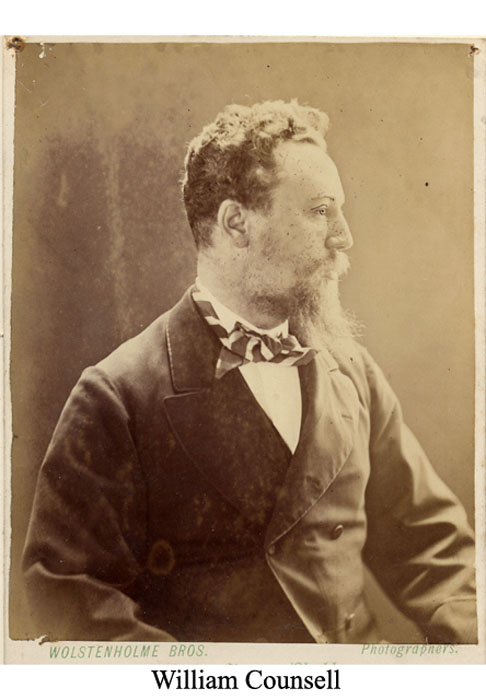
Less than ten days after the arrest of William Gourlay, another case of embezzlement came to light. This time it was the “Borough Treasurer” of Blackburn Mr. William Counsell. He was arrested on the 26th of June on the charge of embezzling £410 5s 5d. It was entirely due to the Gourlay embezzlement that this case came to light, the Corporation had ordered a special audit of the books because of the Gourlay fraud, which resulted in the discovery. The Blackburn Times said: “Owing to the fact that the last holder of the office (Borough Treasurer) was a defaulter to a considerable extent, when Mr. Counsell was appointed, the system of cheques signed by the treasurer and counter signed by the Town Clerk was introduced thus it was thought all danger of defalcation was removed. But the result seems to show that this is not the case.” The total amount that Counsell embezzled came to about £1070. Just prior to his arrest Mr. Counsell is said to have offered to pay back double the amount that he had embezzled but this offer was refused.
William Counsell was 37 years old, married with six children, and lived on Duke’s Brow. He had worked as a bookkeeper for ten years and as Borough Treasurer for six year at a salary of £250 per year.
Counsell was taken before the Magistrates on Friday the 27th of June. On the bench were E. Wharton, W. Hopwood, T. Higson and Dr. Patchett. The charge was read out that: “Being a servant of the mayor, alderman and burgesses of the Borough of Blackburn did, on the 23rd of June, 1879, feloniously and fraudulently embezzle and steal the sum of £410 5s 5d, money received by him on account of his said masters.” The case having been laid out by the prosecution, the magistrate remanded the case until the following Friday, bail was refused.
The following Friday he was brought from the prison at Preston to Blackburn and after a short examination he was committed to stand trial at the next Preston sessions. After being allowed to see his family he was once again removed to Preston prison. The trial took place on August 22nd 1879 where Counsell pleaded guilty to two charges of embezzlement. He was sentenced to nine months’ with hard labour.
Note
Using the National Archive Currency Converter an approximation can be made between the value of £40,000, the amount William Gourlay embezzled in 1880, and today, when that value would be in the region of £1,932,400.00.
William Gourlay paid £4,000 for his house The Woodlands, today that would be £193,240.
William Counsell embezzled about £1000 which today would be about £48,500.
The salary of £250 would be about £12,000.
by Stephen Smith
Using the National Archive Currency Converter an approximation can be made between the value of £40,000, the amount William Gourlay embezzled in 1880, and today, when that value would be in the region of £1,932,400.00.
William Gourlay paid £4,000 for his house The Woodlands, today that would be £193,240.
William Counsell embezzled about £1000 which today would be about £48,500.
The salary of £250 would be about £12,000.
by Stephen Smith
The Murder of June Anne Devaney
Before 1948, Blackburn was only recognised on a small scale for being an industrial town in the North West. However, on the 15th May 1948, the reputation of Blackburn was tainted with something much more disturbing, making it a household name not only around the UK, but stretching to the rest of the world.
This is the story of a murder with no motive, a ‘most dreadful case’, so horrific it struck the emotions of the entire nation. June Anne Devaney was a girl of only 3 years and 11 months, yet her life was snatched away from her in a spontaneous act of brutality. The scene of the crime was Ward C.H.3 of Queens Park Hospital, in the children’s department, where June had been admitted on the 5th May complaining of pneumonia. She was due for release on 15th May, but regrettably she did not live long enough to see this day.
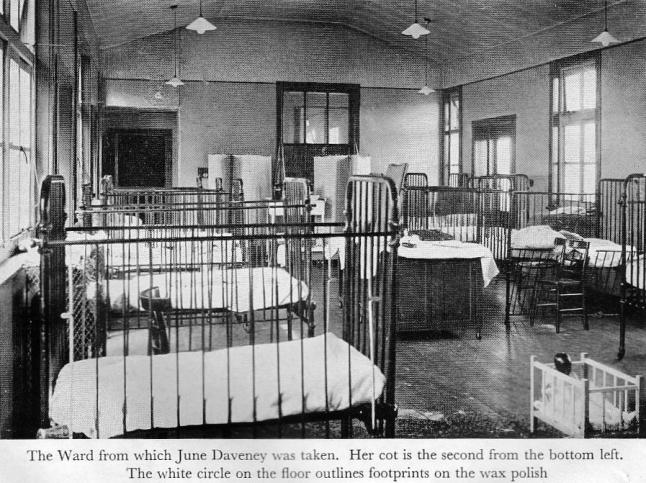
The night nurse on duty was named Gwendolyn Humphreys, she had been tending to the children in the ward of which June was the eldest, when she moved into the adjoining kitchen to begin preparations for breakfast in the morning. At 12:20am she heard a cry coming from one of the cots so she returned to the room to make sure all was well. She noticed nothing unusual so she resumed her work. Then, at 1:20am she felt a draft coming from the veranda door. At the time she simply closed the door and did not regard it as suspicious, that was until she noticed an empty cot, which belonged to June Anne. Nurse Gwendolyn noticed a Winchester bottle had moved from the trolley which she placed underneath the child’s cot, along with a trail of vague footprints. In panic, she raised the alarm and the police raced to the scene arriving promptly at 1:55am. They began a systematic search of the grounds and at approximately 3:16am, June’s beaten body was found lying next to the boundary wall of the hospital, 283 feet from her ward. The emergency services were baffled; they had no explanation as to what had driven someone to carry out an act so inhumane against a girl so small. A police officer in the Blackburn Times dated Friday 21st May 1948 stated ‘there is no motive, no sense in it at all’.
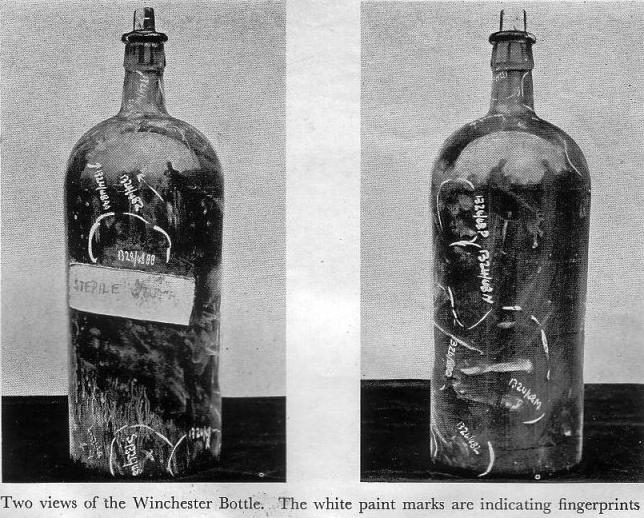
The police acted quickly, they gathered all of the evidence they could find and dusted it for fibres and fingerprints. Although the evidence was minimal, it included only prints from the Winchester bottle along with fibres and markings from the footprints on the floor. As a result, they had no immediate leads except reports of a ‘peeping tom’ lurking around the hospital earlier in the night, who when questioned by the nurses as to what he was doing replied; ‘Hush, don’t tell anyone’. This man was found, fingerprinted and ruled out as a possible suspect. Naturally, the next step for the investigators was to rule out the possibility of any of the hospital staff being involved in the murder. Their marks were analysed by the Finger Print Bureau in Hutton, who confirmed that none of these prints matched those located on the Winchester bottle, and that the extent of the search would have to be widened. Research was also carried out into the staffing of the hospital on that fateful day, but the sub-committee later announced that they were ‘completely satisfied that no blame is attached to any member of the staff’
The police also received a statement from a taxi driver who claimed to have picked up a gentleman on Queens Park Road with a ‘local accent’. The police realised that they would be searching for a man with local roots, who had an extensive knowledge of the hospital as it would be almost impossible to negotiate it in the dead of night.
A task of gigantic proportions’ lay ahead of Chief Inspector Capstick and his team as they were ordered to fingerprint every single male person over the age of 16 having known to have been around the Blackburn perimeter between the 14th and 15th of May. Only three of the fingerprints obtained from the Winchester bottle were prominent enough to make comparisons with so a card was developed to record the left forefinger, middle and ring fingerprints. These cards would also demand the name, address and National Registration Number of all persons collected. A squad of 20 Blackburn officers led by Inspector W. Barton swarmed the pre-determined districts recording those over the age of 16, but keeping a suspicious eye on those under it. The records were checked thoroughly against the electoral register and stamped as ‘cancelled’ then filed if they did not prove a match, making sure that nobody slipped through the net.
Eventually, on the 12th August, a card was found that bore prints of an exact match to those found in evidence which led the search to a 22 year old ex-serviceman Peter Griffiths, living at 31 Birley Street Blackburn. The inspectors and police arrested Mr Griffiths at 9:15pm on the 13th August on Moss Street and he was taken to Blackburn police headquarters. Here he released a lengthy statement admitting his legal guilt and yet he displayed no remorse for his actions, so he was immediately charged with the murder of poor June Anne. The police then raided Griffiths’ house and found several items also carrying his fingerprints, including a ticket from the pawnbrokers where he had sold the blood stained suit that he wore as he killed Miss Devaney. All of the evidence was conclusive and pointed directly at Griffiths, which came as no surprise as he admitted his responsibility almost immediately.
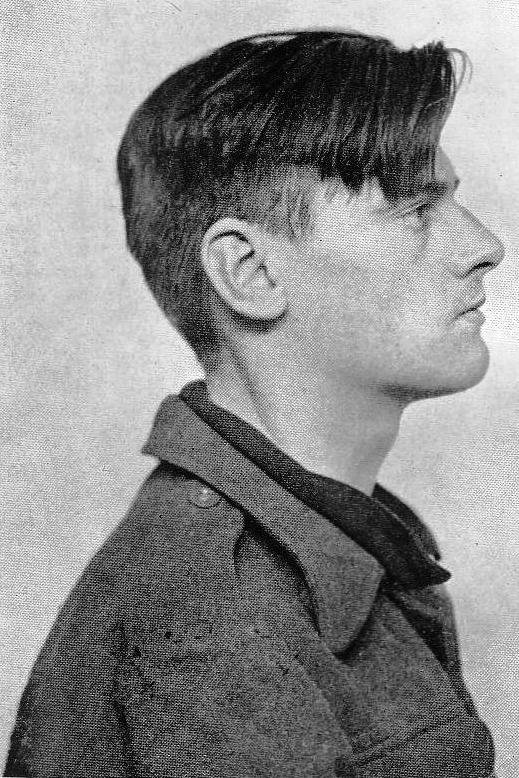
The trial began in October, under the judgement of Mr Justice Oliver, in which Griffiths pleaded guilty. Peter explained to the court how he had carefully removed his shoes before entering the hospital and crept cautiously through the halls. He had picked up the Winchester bottle and grasped it in such a way as to use it for a weapon if required, and continued into June’s ward. In his statement to the court he recalled; ‘I carried her under my right arm and she put her arms round my neck and I walked with her down to the hospital field’. He also identified how reading of the murder in the Blackburn Times had little effect on him, ‘It didn’t shake me’. Mrs Griffiths gave a statement in which she referred to her son as a ‘queer’ child who had locked himself in his room for hours on end, playing with matches.
The evidence against Griffiths was of a monumental magnitude and his defence had little choice but to appeal to the court in sheer desperation, ‘I cannot ask for this man’s liberty, but I do plead for his life’. Yet, when the court adjourned and re-opened on Monday the 18th October, the defence had made an addition to the plea of Griffiths and began to use the legal doctrine of insanity to claim that he was suffering from a ‘split mind’, or schizophrenia as he was committing his offence. Doctor Alastair Robertson Grant who had worked for seventeen years at Whittingham Mental Hospital examined Peter Griffiths, and concluded that he had displayed early signs of schizophrenia passed down from his father who had been a patient at a mental institution for 6 months in 1918-1919. The doctor claimed that the defendant was aware of what he was doing, but did not fully appreciate that what he was doing was wrong. However, Grant later admitted that after hearing Griffiths’ account of events, he was of sound mind. This claim was further rebutted by Doctor F.H. Brisby, a medical officer from Liverpool prison who had observed the accused since his admission on the 14th August, and concluded that he was sane when he committed the crime.
Following a two day trial and a mere 23 minute discussion from the jury, the verdict was released as guilty of murder of a ‘brutal ferocity’, and Peter Griffiths was sentenced to death by hanging. Mr Justice Oliver followed with his closing statement; ‘the sentence of the court is that you be taken from here to a place of execution to suffer death by hanging, and may the Lord have mercy on your soul’. When asked if he had any final declarations to make, Griffiths simply answered in a sharp tone ‘No, Sir’. So, on Friday the 19th November 1948 at Liverpool Prison, Mr Peter Griffiths was hung for committing a murder that would be remembered not only for the evil circumstances and dramatic effect it had on the population at the time, but also the lasting impact it would have on the procedures taken by police in cases similar to this.
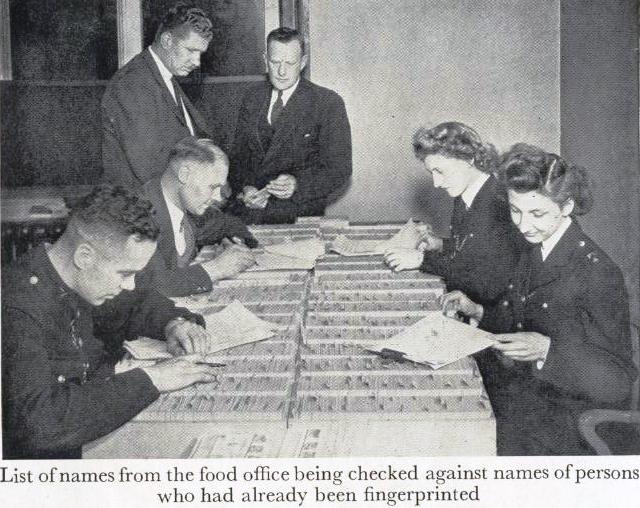
This incident triggered the most extensive finger print probe ever known, and established the true capabilities of modern scientific criminal investigation. 46,500 prints were taken, recorded and later destroyed under the supervision of the Blackburn police force, who displayed the thoroughness of forensic research. Griffiths took a chance when he volunteered his fingerprints to be taken, but he lost against the iron will of the Blackburn Police investigators.
Crime and Punishment in 1920’s Blackburn
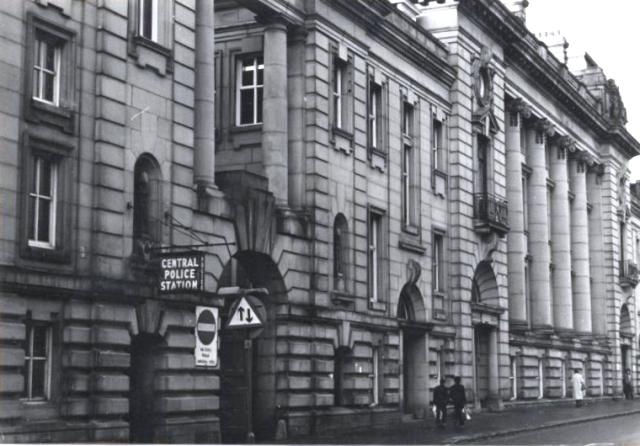
Central Police Station Northgate Blackburn
Many of the crimes committed in Blackburn in 1929 seem to have been minor offences linked to the new motor cars, buses and lorries on the streets. The fines for these offences ranged from five shillings for having an inefficient silencer on a motorcycle or paying costs for driving on the footpath to a fine of ten pounds for the mill manager who was found drunk in charge of a motorcar. This fine is significantly higher than the fine a man received for being drunk in charge of an older means of transport- the horse. Fines for the same offence could vary widely: Fines for driving a motor vehicle without a licence could be anything from five shillings to five pounds. Nobody received a prison sentence for a driving offence- not even the man convicted of driving in a manner dangerous to the public after his van collided with a motorcycle, killing the rider. The van driver received a fine of 40 shillings. One man was fined £1 for not having proper control of his motorcycle, and his passenger was fined the usual ten shillings for aiding and abetting a criminal.
Unfortunately there appear to be a fairly large number of dishonest traders in the Blackburn area, selling bread, coal, and sugar in smaller quantities than required. These people incurred fines of between ten and twenty shillings for their crimes. A fine of one pound was given to one particularly dishonest coal seller for carrying unjust weights to enable him to sell short measures without people paying anything less for them. There seems to be an issue with the selling of milk- fines were handed out to people selling milk not of the required substance, nature or quality, selling milk not sealed on premises registered for the purpose, and selling milk without the sellers’ name and address clearly marked. One tradesman was banned from selling milk, in addition to a fine of forty shillings after it was found that he had failed to thoroughly clean the milk receptacles before delivering them.
Unfortunately there appear to be a fairly large number of dishonest traders in the Blackburn area, selling bread, coal, and sugar in smaller quantities than required. These people incurred fines of between ten and twenty shillings for their crimes. A fine of one pound was given to one particularly dishonest coal seller for carrying unjust weights to enable him to sell short measures without people paying anything less for them. There seems to be an issue with the selling of milk- fines were handed out to people selling milk not of the required substance, nature or quality, selling milk not sealed on premises registered for the purpose, and selling milk without the sellers’ name and address clearly marked. One tradesman was banned from selling milk, in addition to a fine of forty shillings after it was found that he had failed to thoroughly clean the milk receptacles before delivering them.
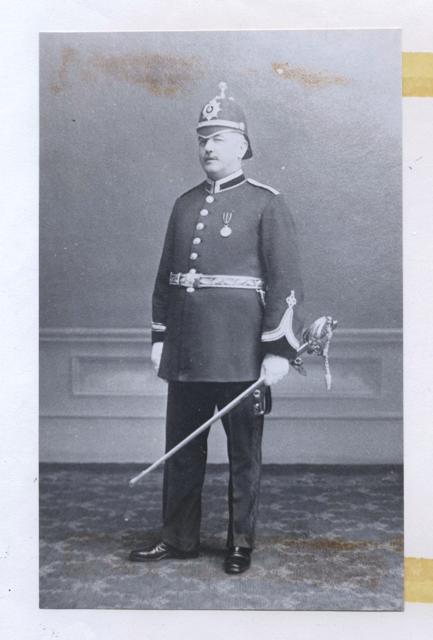
Christopher Hodson, Chief Constable 1914-1931
Blackburn also had a number of people who ignored the strict laws on ownership of dogs, for example the people who were fined for keeping dogs without licences, without a name and address on the collar, or keeping dangerous dogs- fines- 5 shillings. Certain people were also ignorant of the rules preventing dogs from entering Corporation Park- fine: 5 shillings. Other crimes connected to animals were allowing sheep to stray into a road (fine- 5 shillings), and cruelty to a horse (fine- 20 shillings).
There appears to have been relatively little violent crime in Blackburn in 1929. Just one man was sentenced for unlawful wounding (of his brother) and went to prison for only one month. There was just one case of indecent assault (6 months in prison), and one case of disorderly conduct (fine: 5 shillings). However, there were many cases of assault, for which a fine of ten to forty shillings was payable, or two months in prison for the man who attacked a debt collector with a poker. Some of the men convicted of these crimes were also drunk; particularly those who were charged with assault or disorderly conduct. The usual fine for drunkenness was twenty shillings, although one man was fined forty shillings for being drunk outside the permitted hours for drinking alcohol.
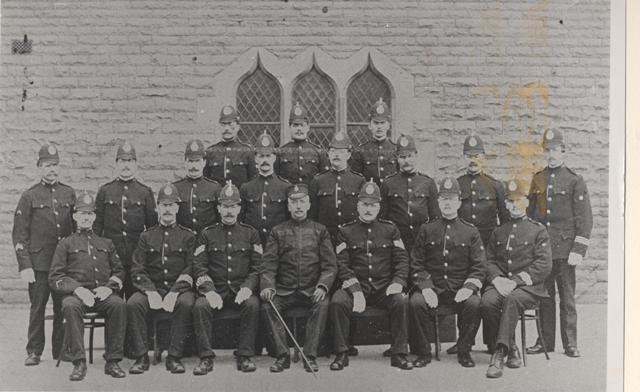
Blackburn Borough Detective Department c1921
Many cases of theft and criminal damage were recorded. Fines of between one and fourteen shillings were handed out for causing damage to doors, windows, and crockery. One man was fined £10 for setting fire to 30 acres of moorland near Sabden. Another was only ordered to pay damages to two householders after altering a water supply pipe and cutting off their supply. There was also the very common fine of five shillings for permitting a chimney to be on fire. Theft often resulted in a prison sentence: three months for stealing £3; one month for stealing a pair of trousers, a padlock, and six shillings; one week for stealing a pair of boots. Two men stole three cars and four tins of paint between them, however received different sentences- one got a fine of £3, the other two months in prison. Few fines were imposed for theft; those who didn’t receive a prison sentence were likely to be released on condition of their good behaviour. A very harsh sentence in comparison was the three years penal servitude imposed on one man for breaking and entering and stealing six stockings, which was his twentieth conviction.
Not all of the poor and desperate people of Blackburn who turned to crime decided to steal to get a little bit more- several people were accused of making false representations to claim unemployment benefit or relief from the rates: Fines of between twenty shillings and £5 were imposed and one woman went to prison for a month. However, another woman was let off for claiming unemployment benefit whilst making a coat, which she then sold for twenty-five shillings.
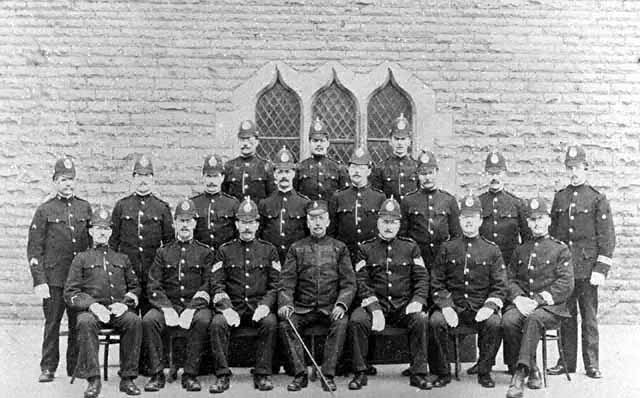
Blackburn Borough Police, Duckworth Street Section c1912
Other people resorted to begging on the streets- this was not welcome, and one woman who was caught begging was ordered to leave the town. Some of the poor people of Blackburn sent their children out to earn money instead of going to school- a woman who, the court heard, had not left her house for several years, was fined twenty shillings for failing to comply with a school attendance order, made after her daughter had attended school on 7 of a possible 241 occasions. One man was sent to prison for a month for seriously neglecting his seven children in a manner likely to cause them unnecessary suffering or injury, his wife was also charged but got a divorce in the time that passed between their first court appearance and the sentencing, so was considered not to be involved in their continuing suffering.
Two slightly odd crimes committed were conveying the carcass of a dog through a street- forty shillings plus costs, and discharging a toy pistol in the street- also ordered to pay costs.
Overall, the vast majority of crimes were judged to only necessitate a fine rather than a prison sentence, and some criminals received sentences we would view as lenient today, such as the one month in prison for unlawful wounding with a knife, and other sentences seem very harsh, such as five or ten shillings fine for allowing a chimney to be on fire, or twenty shillings’ fine for failing to display the unladen weight on a trailer.
This article was researched by Jonathan, a pupil at St. Christopher’s C E High School, Accrington, whilst on work experience at Blackburn Museum.
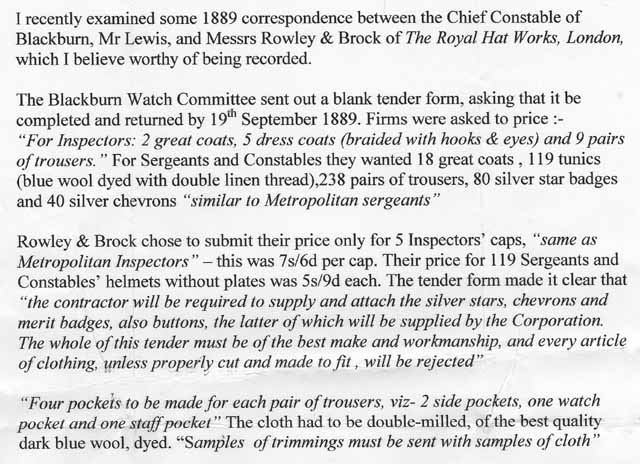
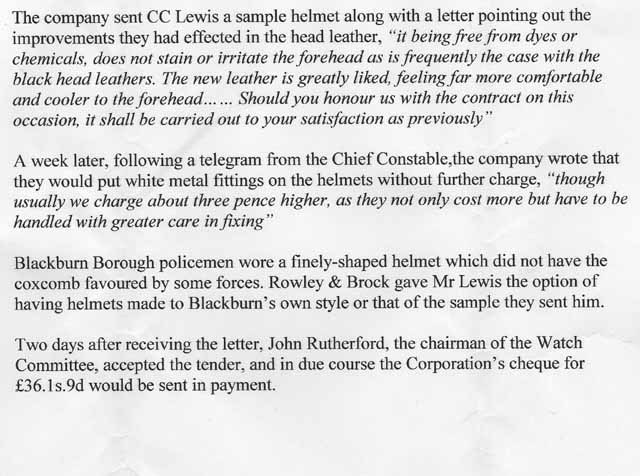
Specifications for Police Uniforms
Juvenile Delinquent
This story from the Blackburn Mail of July 18th 1827 could have been taken straight from a Dickens novel. The young lad seems not to have been neglected or misused. The family do not seem to be destitute; he was just an habitual criminal.
Among the felons transported for life, at the Preston sessions there is a boy only seven years of age*. This unusual circumstance will be best explained by a succinct history of the child’s short, but extraordinary career. His name is Taylor**, and he is the son of a small farmer in the neighbourhood of this town. The boy had scarcely attained his fourth year when he evinced a propensity to steal, by converting to his own use the money he was in the habit of receiving from his father’s customers for milk, which he (the boy) was employed to bring to town every morning. On this being discovered, the urchin was sent to school, but on more than one occasion he pocketed the school money sent by [his father] to the master, and finally he was dismissed from the school in consequence of purloining a case of mathematical instruments. He was next despatched to Manchester, where it was intended he should be bound apprentice, but there he employed himself in picking pockets, and the father was obliged to make up the loss to the plundered individuals. Soon after this, the young rogue sold his clothes, and returned to Blackburn, where he remained several days before his father knew he had left Manchester. The next feat was an attempt at shop robbery, he having been found concealed under the counter of Mr. Boardman’s shop, in Church-street [William Boardman, linen draper] just as the premises were about to be closed for the night. The crime for which he received sentence in the sessions was perpetrated…in the town, where, in open day he dexterously picked a man’s pocket [the man was Samuel Strong] of a tobacco-pouch, ink-horn, and nine pence in money. He was taken into custody, but the magistrate before whom he was sent, hesitated to commit so youthful an offender, and suggested parental correction as the best remedy. The father, however, positively said he could do no more with him, and preferred that the law should take its course, as the only alternative. He was accordingly committed, but his tricks were not at an end for all that. Mr Kay [Blackburn’s constable] compassionating the boy’s youth would not confine him in the lock-up but recommended him to the care of an assistant, who took him home to his own residence for the night. The young thief was stripped and put to bed. In the morning, the assistant who had slept in another room, missed two shillings from his pockets, and sure enough, on searching, the stolen money was found in the lining of the boy's cap. In order he might not grow worse, by herding with old offenders, the little rogue was quartered in the hospital of the House of Correction at Preston, and slept in an apartment with three invalid prisoners. In the course of the night, whilst two of them lay awake but apparently asleep, they observed the boy get up, and steal over to the clothes of the third, and pick the pockets of the only penny they contained, and that penny was found in the thief’s stocking on the succeeding day. And the subject of this lamentable statement has just passed his seventh year!
*The England and Wales Criminal Register of 1791-1892 gives his age as 8.
**The boy was called William Loxam and used Taylor as an alias. It seems strange that such a young boy should have an alias!
I can find nothing about his short life in Blackburn nor any information about his transportation other than the sentence, which is shown in the “England and Wales Criminal Registers of 1791-1892.” Whether he made it to Australia and if he did what happened to him there remains a mystery; unless someone out there knows something!
FOOT NOTE
Nicola Jackson, formally of Darwen, Lancashire and now living in Sydney Australia, sent this to Cotton Town.
“I did a quick search of historical documents and found the following:
UK, Prison Hulk Registers and Letter Books, 1802-1849
William Lomax – Died at Hospital 8th July 1831 whilst on the prison
hulk Euryalus which was moored at Chatham (ship for juveniles until
they reached 15yrs then could be transported)
Sorry to be the bearer of bad news.”
UK, Prison Hulk Registers and Letter Books, 1802-1849
William Lomax – Died at Hospital 8th July 1831 whilst on the prison
hulk Euryalus which was moored at Chatham (ship for juveniles until
they reached 15yrs then could be transported)
Sorry to be the bearer of bad news.”
Thank you Nicola, William would have been about 12 when he died. It gives a sad ending to a sad story.
The Brewery Street Siege
On the night of Friday the 12th of December 1958 at about 11.04pm a man ran into the police station on Northgate shouting that someone with a gun was holding a family hostage.