"The girl had been for some weft. I saw her returning front the weft shop. She came through the weaving shed door with a can full of weft. Birkett immediately followed and I saw him seize hold of her from behind. They had their backs to me, and I could not tell that he had anything in his hand, but he seemed to draw it across her neck. She immediately fell to the floor, and I rushed towards them. I was about three yards away I grasped him and threw him to the floor, and then saw a pool of blood on the ground coming from the girl’s body. I immediately ran for the manager."
"When I rushed to the scene everybody was greatly excited. I immediately went to the girl, who was quite dead, her head having been nearly severed from her trunk. I next went to Birkett who was lying on the floor. I found him bleeding profusely from his throat. He had two cuts on his neck - one either side - but he had missed the front of it. I bandaged his neck and immediately sent for the police from Copy Nook Station. I then went back into the weft shop and by the rails, on the floor, I found a razor.” The manager found it utterly impossible to continue working so upset were the operatives, and eventually the factory was closed. Many of the women weavers fainted outright.
"When I went in Beetham and Birkett were standing there close together, Birkett was saying something to the girl, who did not appear to want to bother. She got her weft and was just opening the mill door, when Birkett put his arms around her neck. With them having kept company, we thought he was trying to kiss her, and we laughed. But then I saw blood on her clothing and they both fell to the ground. Edith Rimmer and myself tried to pull him away, but he resisted and we ran for the manager. I never saw a razor at any time."
"I was standing in the weft place, when I saw Birkett rush to the girl. The next thing I knew was that both Birkett and Beetham were on the floor. The girl struggled for a second, seeing blood and hearing someone shout "He's cut her throat". Tattersall and myself got hold of Birkett. We pulled at his shoulders, but could not get him back until he seemed to faint and fall back. Dewhurst was hold of him, so we went to inform the manager and to fetch a doctor."
"I saw Beetham push open the door, then I saw her drop in the doorway. She kicked her legs up: two or three times, and I rushed to her. I was excited because I knew something of the relations of the couple. Alice was an intimate friend of mine. I was horrified to find her in a pool of blood, with her head nearly off. I rushed to the interior of the shed and screamed and people rushed to the door. I swooned and was carried out and sent home. I am told many people fainted.”
The Inquest
Alice's body was taken to Copy Nook Police Station and Arthur was taken to the Infirmary. His injuries were not life threatening.
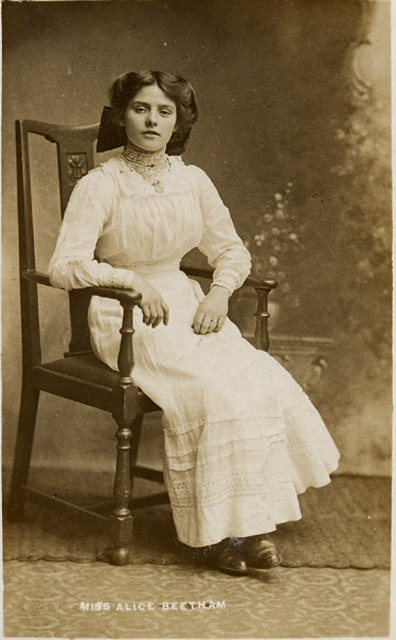
The Coroner, Mr. H. J. Robinson, opened the inquest on Alice Beetham, on Tuesday 21 May 1912. He said “it was an inquiry into the death of a girl, aged 18 years, a weaver, who was killed by having her throat cut at a mill on Monday morning. On the first day only evidence of identification was given, and the inquest was adjourned. Thomas Edward Beetham, the father of the Alice, said his daughter was 18 years old on the 23 August last. She was a cotton weaver, and had worked at Gate-street Mill ever since she began to work. She was in perfect health. He told the hearing that he did not see her before she went to work on Monday morning, as on Mondays she went to the mill before he got up.
The Coroner asked if he knew Birkett. Mr Beetham said he had only seen him once, about fortnight ago at the bottom of the street when I was coming home. He had been courting with Alice for about 5 weeks.
The Coroner said that was as far as he could carry the inquiry that morning. The inquest was then adjourned to 9.30 on Friday the 31st May at the Town Hall. The proceedings had lasted a quarter of an hour.
The Resumed inquest
Mr. H. G. Robinson resumed his inquiry into the death of Alice Beetham on the Friday morning at the Town Hall. No members of the public were allowed into the court. Those in attendance were Mr. I. G. Lewis, Chief Constable, Superintendent C. Hodson, and Inspector Pomfret. Arthur Birkett sat in the dock, looking pale and ill. The police surgeon, Doctor Bannister gave his evidence saying “I found a deep incised wound 2½ inches behind left ear to 2½ inches behind right ear, all the way around the neck apart from about four inches at the back. This could all have been done in one stroke, using a considerable force to inflict the wound.” Birkett suffered two self-inflicted wounds to the neck. The one on the right was about five to six inches long and about half an inch deep, severing one of the muscles. The one on the left was merely superficial.
Mrs. Lily Wagg, of Laurel-street, a weaver at Jubilee Mill, told the inquest that she had been a friend of the deceased's for two years. Birkett and Alice had had tea at her house. The couple had been together for about six weeks. Three weeks before the tragedy they had spent the afternoon and part of the evening at her house, and a week prior to Alice’s death she, her husband, Alice and Arthur had gone to the pictures. At that time they were all very good friends. Three days before the tragedy – Alice had told her "I can't take to Birkett and will have to give over going with him." When the mills closed in the afternoon they left work together. They saw Birkett outside, and all three went down the street. That night Birkett called on Mrs. Lily who had friends in the house, so she went out to him. He said "Alice has chucked me", he asked if Alice had told her it. She answered "No". Her husband who had joined them said to Birkett "There are plenty of women beside her" to which the young fellow replied, "But none like Alice to me".
The Coroner asked if Birkett made any threat. Mrs. Lily told him he said he would cut her head off.
She told the inquest that on the Monday of the tragedy, Birkett and the girl met in the mill about 7 a.m., but although he was quite close to her, Alice did not speak to him, but walked past him. At breakfast the girl told her that Birkett had stared at her, and she had not spoken to him. At about 8.45am Mrs Lily saw Alice go to the weft warehouse carrying a weft can. Birkett followed behind her, also carrying a can. They both went through the door. From her looms she could see into the warehouse. She saw Alice pushing the door open with her can in order to return to her looms, and then noticed that she was pulled back. The girl next dropped on the floor with her feet in the doorway. She did not see who pulled Alice back. She went towards the girl; found that she was streaming with blood, and on bending over her saw that her throat had been cut. Birkett was lying on the floor near her. Mrs Lily fainted from the shock.
The Coroner briefly summed up, after which the jury, without retiring, returned a verdict of "Wilful Murder" against Arthur Birkett, who was committed in the coroner's warrant to take his trial at the next Manchester Assizes. Birkett was in a state of collapse, and had to be carried down the dock steps.
On June 4th Birkett appeared before Blackburn Magistrates and was remanded until the June 5th whilst notes of the evidence could be transcribed. He fainted as he was leaving the dock. On his next appearance he was more composed. The verdict was that he "feloniously, wilfully and of malice aforethought killed and murdered Alice Beetham". He was then committed for trial in Manchester.
The Funeral of Alice Beetham
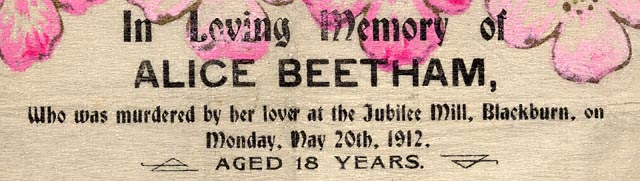
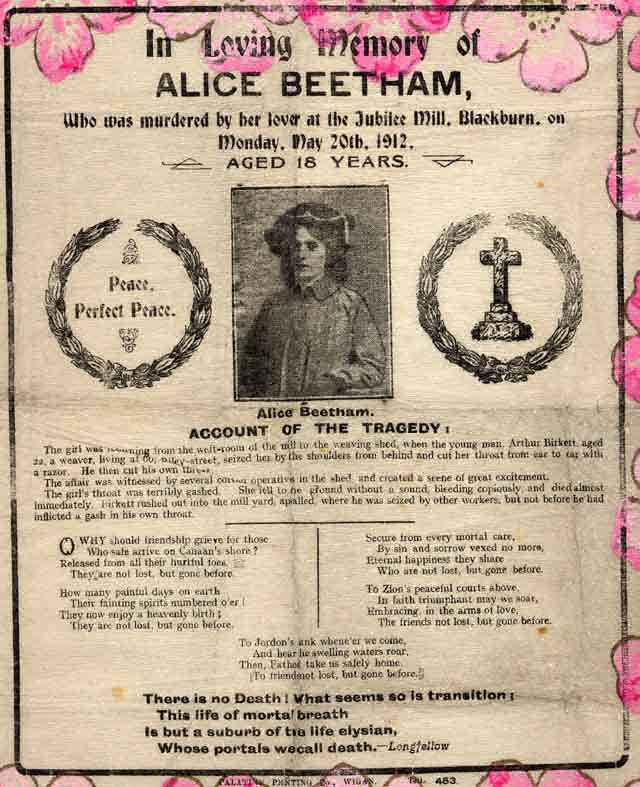
Alice's funeral took place the following Saturday the 25 May. A collection was taken at the mill, with some of the money going to her family and the rest to provide a beautiful floral tribute. Young girls held bunches of flowers, which were added to the other wreaths and flowers around her coffin in the kitchen of her home. There was a large wreath sent by the workers at the Jubilee Mill. On the accompanying card was written 'With deepest sympathy from the workpeople of Jubilee Mill'. Hundreds of people called at the house to view the body, and crowds lined the route of her funeral cortege. She was buried in the Roman Catholic portion of Blackburn Cemetery.
The coffin was of polished oak, with silver plated fittings and covered with a purple velvet pall, on which was embroidered a golden cross. On the plate of the coffin lid was the simple inscription:
“Alice Beetham Died May 20 1912. Aged 18 years. R.I.P.”
The Trial
Arthur Birkett was tried at the Manchester Assizes on the 5th July 1912, before Mr. Justice Bucknill having recovered from the injuries sustained when he attempted to cut his own throat. Mr. Gordon Hewart and Mr. A. R. Kennedy, prosecuted, While Mr. Lindon Riley defended him. When asked by the judge Birkett, who appeared calm and collected, pleaded "Not guilty"
Mr. Gordon Hewart said “the facts of the case were comparatively few and quite free from complexity. It was difficult to see, if the evidence for the prosecution was accepted, how the jury could escape the conclusion that this was a deliberate and premeditated murder.”
“It was”, he continued, "A painful but a plain case". On the defences, indication, that the prisoner was not responsible for his own actions, he said that “one or two things would have to be proved, first that by reason of infirmity of mind, due to mental disease, he did not know the quality or nature of the act, or that, if he did know, he did not know that the act he was doing was wrong.”
Mr. Riley for the defence called no evidence, but proceeded to address the jury.
He said the jury had two alternatives to the verdict of wilful murder, and on those two alternatives he based his defence. One was that at the moment of the committal of the act that the murderer was insane, and the other was that the circumstances of the case entitled the jury to regard it as a case of manslaughter. Were there not elements which would entitle them to reduce the charge to one of manslaughter? If the crime was something else, then he submitted that it was due in a moment when the prisoner was not in full possession of his reasoning faculties.
After the judge had summed up the jury retired at 2.45 returning after only sixteen minutes with a verdict of "Guilty of wilful murder".
The Judge donned the customary black cap and said “Arthur Birkett you have been found guilty upon the clearest evidence of a very, very cruel murder - the murder of your sweetheart - a murder premeditated and determined and cruel... you have forfeited your life. Make your peace with your maker, I implore you". Birkett passed out and was supported by two warders. Loud sobs came from the gallery as Birkett was led away.
Birkett Writes to His Family
Arthur Birkett's family tried to get him a reprieve, his mother wrote to the Queen asking for clemency for her son, as she was widowed and depended on him as he was the "breadwinner". Just as there was great sympathy for Alice's family, equally there was much sympathy for Arthur's mother and family. Indeed the Beetham and Birkett families had made their peace with each other, as they had both suffered terrible bereavements. The petition failed and no reprieve was given. While Birkett appreciated the endeavour to secure a reprieve, he was not sorry that the petition failed.
A letter was sent by the prisoner from Strangeways prison, Manchester to his Family, It read;
“My dear mother, brother, sister, and grandmother,
I know you must have been, like me, awfully upset. It breaks my heart to think of the suffering I have caused, not only to myself, but you all. But, my dear mother, I am beginning to think there is such a thing as Fate and what has to be will be. I can never explain how much I love you all, and would give up the world to make you all happy; but none of us know what we have to go through, and how we have to end up in this world. I hope and pray, however, God will forgive me all my sins.
I shall be waiting for you all in Heaven and I hope I shall meet Alice God bless her. I am wishing she likes me as much as I more than like her. I have not taken to anyone like her; but to think it should come to this!
I am looking forward to seeing you all, because I know you will be waiting to see me. It breaks my heart to think how we have to meet, and know what is in store. But God says, "The Sea shall give up the dead", and we shall be together for evermore. It is an awful and hard end, but think we shall be together in the next world, and it will not be like this weary world of trouble.
You must let me know if any of my dear relations in Preston want to come, but anyway, I will write to them. I would like you to send me, as soon as you can, George, that photograph of Alice, and I would like you, George, to send me a photograph of yourself; you know I am more than proud of you.
I will now conclude with my best love and wishes to you all.
You’re unfortunate and ever-loving
Arthur.
P.S. Good night. God guard and bless you all.
The Execution
On Tuesday morning the 23rd of July 19112, at Strangeways Prison, Manchester, Arthur Birkett, was led from his cell to the place of his execution. Outside the prison over 700, people had collected, which was one of the biggest crowds that has gathered at an execution in Manchester for many years. It was a quiet and orderly gathering. The one topic discussed was the subject that had drawn the people together. The Newspapers reported that “Birkett rose at an early hour on Tuesday morning. He was thoroughly resigned to his fate. He was dressed in the dark blue serge suit that he wore at the trial. Pale but composed, he chatted with the warders, thanking them for their uniform kindness to him. Then he concentrated his attention on the photograph of his dead sweetheart, and the group portraying his mother, grandmother, brother, and sister, and Mrs. Beetham. It was only on Monday that he received this group, which had been specially taken, and he was overjoyed in getting it. Of breakfast prisoner partook sparingly. Since his incarceration he had welcomed the visits of the chaplain, to whom he had become attached. When the officials entered the cell shortly before eight o'clock Birkett rose to meet them, and though he could not repress all signs of emotion he bore himself with fortitude. He quietly submitted to the pinioning process. Then the final procession was marshalled, the chaplain (the Rev. R. D. Cruikshank) leading the way, reciting the burial service, followed by Birkett, with warders in close attendance, after whom came the Under-Sheriff (Mr. Arthur Ratcliffe-Ellis, of Wigan), representing the High Sheriff of Lancashire; the governor of the prison (Major J. O. Nelson); the prison medical officer (Dr. Edwards); visiting justices; and the chief warder, with Lamb, the assistant executioner, who had previously bound the condemned man's arms. A few short strides led to the gallows, and when the condemned man was placed on the trap Ellis, who officiated as executioner, rapidly completed the necessary adjustments. Immediately afterwards Arthur Birkett passed into eternity. Just after eight o'clock the solemn tolling of the prison bell intimated to the public that the sentence had been carried out. Subsequently the Under-Sheriff (Mr. Arthur Ratcliffe-Ellis) informed a reporter that the execution had been expeditiously and satisfactorily performed. Subsequently the following notice was posted on the prison door: Declaration of Sheriff and others. We, the undersigned, hereby declare that judgement of death was this day executed on Arthur Birkett in H.M. Prison, Manchester, in our presence. Dated this 23rd day of July, 1912. ARTHUR RATCLIFFE-ELLIS (Under-Sheriff of Lancashire) R. A. ARMITAGE (Justice of the Peace for Lancashire) J. O. NELSON (Governor of the said prison) R. D. CRUIKSHANK (Chaplain of the said prison). Another notice from the surgeon, Dr. John Edwards, certified that on making an examination of the body he found that Birkett was dead.”
The Newspapers also reported what was occurring in Blackburn on the morning of the execution;
“The early morning scenes in the vicinity of Mrs. Birkett's house in Riley-street, Blackburn, were of such an impressive character that they are not likely to be soon forgotten by those who witnessed them. Long before seven o'clock relatives and friends had assembled in the house and among those who arrived later were Mrs. Beetham and the Rev. F. G. Chevassut, vicar of St. Thomas' parish. The table in the centre of the room was literally covered with wreaths and floral tributes from all quarters, and the whole company, for the most part attired in sombre black, were overcome with grief. The Vicar opened the proceedings by reading two appropriate hymns, followed by portions of Scripture, and afterwards he went through part of the Church of England burial service. As the fatal hour of eight o'clock, the time fixed for the execution, drew nigh, the family party, now numbering between 30 and 40, went on their knees, and were engaged in silent prayer for several minutes. Outside, several hundred people had collected, including a large number of mill operatives clad in factory garb, and on the stroke of eight, when almost every blind in the street was drawn they joined in singing such well-known hymns as "Jesu, Lover of my soul," "Nearer, my God, to Thee," and other pieces which were favourites with the condemned man. The vicar offered words of solace and comfort to the bereaved mother and her family. George Birkett was so overcome with grief that he had to be assisted into a rear room, where he received the attention of a nurse who was present. As Mr. Chevassut left the house the mourners joined in singing, "God be with you till we meet again," and several hundred voices outside took up the refrain. Afterwards the service was continued by one of the women present until the arrival of a Salvation Army captain, and he stood on a chair outside the house door and offered prayers and words of counsel to the large concourse of people. Men reverently bared their heads, and many were moved to tears, whilst the women and girls were very much affected. Mrs. Birkett announced that Mr. Chevassut had very considerately placed 12 pews in St. Thomas's church at the disposal of the mourners for a special memorial service on Sunday morning, whilst there would be a second service at Furthergate Congregational Chapel (Where Birkett was brought up) in the evening. She extended an invitation to neighbours and friends to attend. In the midst of the services a telegraph messenger arrived with messages of sympathy from well-wishers, and he was closely followed by the postman with one of Birkett's last letters home. Among those present were Mr. Thomas Bibby, Mr. Harry Reynolds, and Mr. Mathias Rogerson, representing St. Thomas' Conservative Club, and the latter told a Pressman that the club members had subscribed a beautiful miniature monument as a gift to Mrs. Birkett to place in her house. It would be enclosed in a glass case, would stand 18 inches high and would bear the inscription: "In loving memory of Arthur Birkett, Born July 27th, 1889; died July 23rd, 1912. On the other side would be the words: "Son, thy sins are forgiven thee."

 Loading more