
 Loading more
Page 2
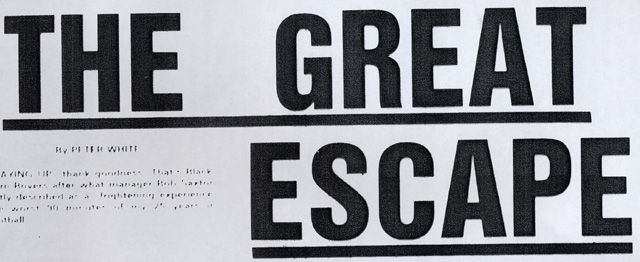
……….The atmosphere before the match was full of tension but Rovers got away to another flying start, this time it took 42 seconds to break the deadlock with a goal almost identical to the opener against Sheffield, only this time Garner’s header from Miller’s cross was saved this time but he managed to prod home the rebound and score his 100th League Goal for the club. The relief was evident all around the ground but unlike Sheffield, Grimsby were made of sterner stuff and fought back to equalise only four minutes later. A corner from the left has headed home by an un-marked Kevin Moore to get the nerves jangling again. As the first half went on the news came through that Carlisle had taken the lead at Oldham and a draw would now send Rovers down. They fought back and regained the lead after 32 minutes when Simon Garner got clear and sent over a cross to Chris Thompson who then set up David Hamilton to smack it home and Rovers reached half time in front.
Carlisle were still leading at Oldham but if Rovers could hang on they would be safe. They then suffered a horrible attack of the jitters and were nearly made to pay for it when a mix-up between Glenn Keeley and goalkeeper Vince O’Keefe let in Gordon Hobson who should have put the Mariners level but didn’t and Rovers breathed again.
With just over fifteen minutes to ago Hamilton sent Garner away into the penalty box and Phil Bonnyman brought him down to give Rovers a penalty. Simon Barker stuck the spot kick away to give Rovers some breathing space. Almost at the same time the news came through that Oldham had equalised against Cardiff. The celebrations really started when Oldham grabbed a late winner to condemn Carlisle to relegation and Rovers were safe.
At the final whistle the roars around Ewood Park were not only of celebration, but also simply of sheer relief. Even though Rovers had not been in the relegation places at any time during the season, it had been too close a call. If it hadn’t been for two early goals against Sheffield and Grimsby, combined with the weather and Carlisle losing their last two matches after leading in both of them, the Rovers may well have been relegated and in their precarious financial position at the time, could well have ended up in the wilderness for years and the glory days of Jack Walker and Premiership may never have happened. It’s also interesting to note that Carlisle themselves never recovered from the relegation and as I write have still never regained their status in the second tier of the football league 23 years on.
By Roger Booth
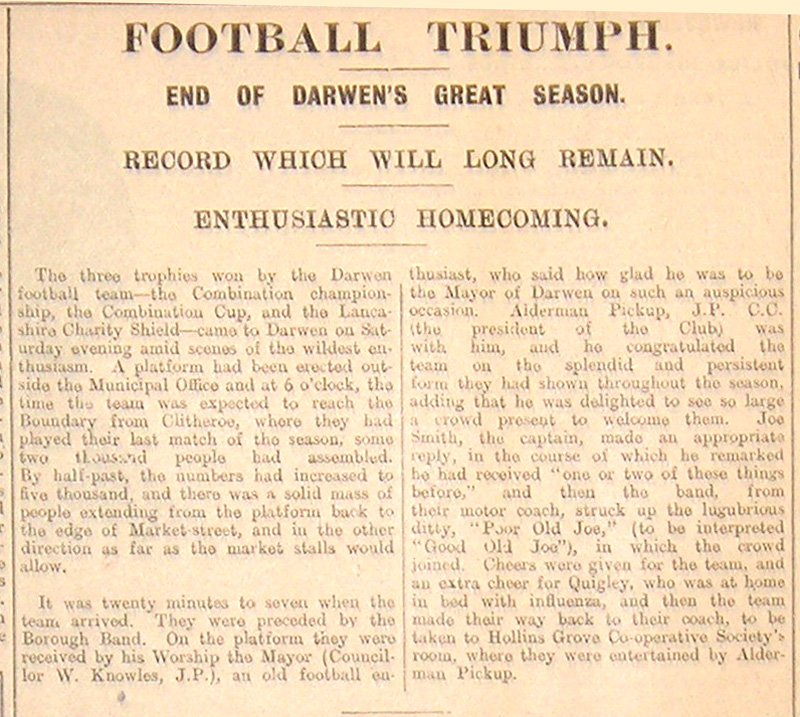
Darwen's Treble Triumph
In the 1930/31 football season Darwen achieved the treble of the Combination Championship, Combination Cup and Charity Shield.
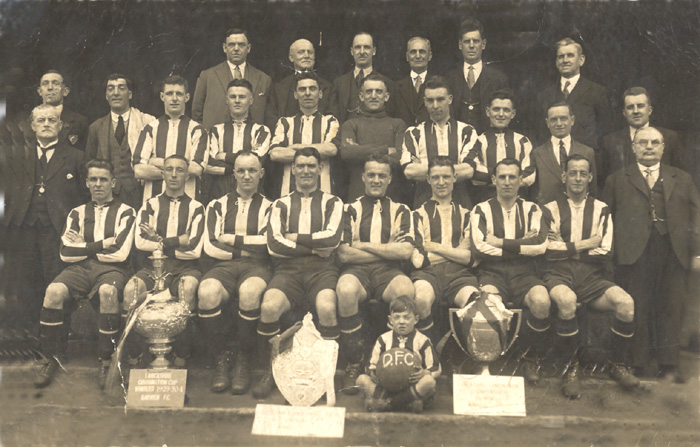
Back Row: W Duxbury (Director), G Pickup (President), H Harwood (Chairman), J Woods (Director), H Hacking (Director), H Ainsworth (Director).
Second Row: J Woods (Director), B Proos (Assistant Trainer), J Slater, J Bennett, A Amith, J Burke, F Dawson, A Leeming, J Bishop, (Trainer), A Hornby (Director).
Front row: J Briggs (Director), T Williamson, A Robinson, P Quigley, Joe Smith, R Preedy, B Dale, G Shaw, R Jenkinson, J S Entwistle (Director)
Mascot: B Proos.
A CENTURY OF A FOOTBALLING FAMILY
Everybody who knows anything about football knows about the Allen family who had EIGHT members of their family who played professional football at one time or another. Well, we have a footballing family in our community; the Byrom’s who can beat that! It all started with Tommy Byrom who was an inside right (midfielder) who played for the Rovers four times and scored two goals during the 1914/15 season. Tommy also played one game in the 1916/17 season while he was still in the army. He also played three times in the 1918/19 season scoring one goal, and, in the 1919/20 season he played nine times, scoring one goal.
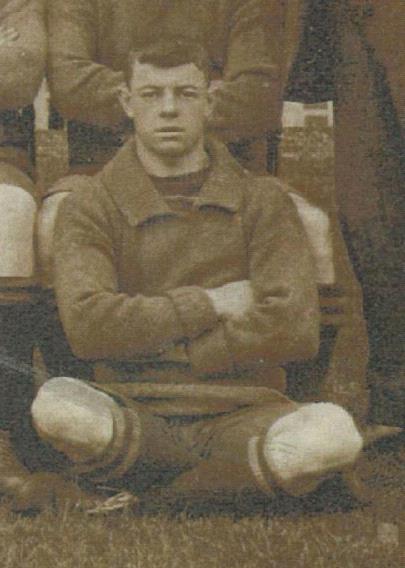
Tommy Byrom, Blackburn Rovers 1912/13
Tommy’s brothers, Albert and Robert, played for the Rovers during the 1916/17 season. Albert, a right winger, played eleven times in all competitions, scoring one goal. Robert, a left winger, played for the Rovers once, scoring one goal in the 1916/17 season and he played twice scoring one goal during the 1918/19 season.
William Byrom, a full back, played thirty times for Rochdale during the 1946/47 season. William was also on the books as a professional at Burnley and Queen's Park Rangers. Raymond Byrom, a winger, played for Accrington Stanley nine times, scoring one goal during the 1957/58 season . He also played for Bradford Park Avenue seventy times, scoring fourteen goals throughout seasons 1958/60. Raymond’s son, Alan, was a professional at Preston North End but he was released by the then manager, Nobby Stiles, without making a first team appearance during the 1977/78 season. David John Byrom, a full back, played at Stockport County three times in the 1984 season; he is the great gandson of Robert, who played for the Rovers.
The most famous footballer in the Byrom family is, of course, John Byrom, who played for the Rovers 106 times plus 2 substitute appearances. John scored 45 goals before he was transferred to Bolton Wanderers for ten years. John returned to the Rovers in 1976, making 15 appearances and 1 sub appearance. He scored 5 goals before he retired in 1976. John was also an England Youth International.
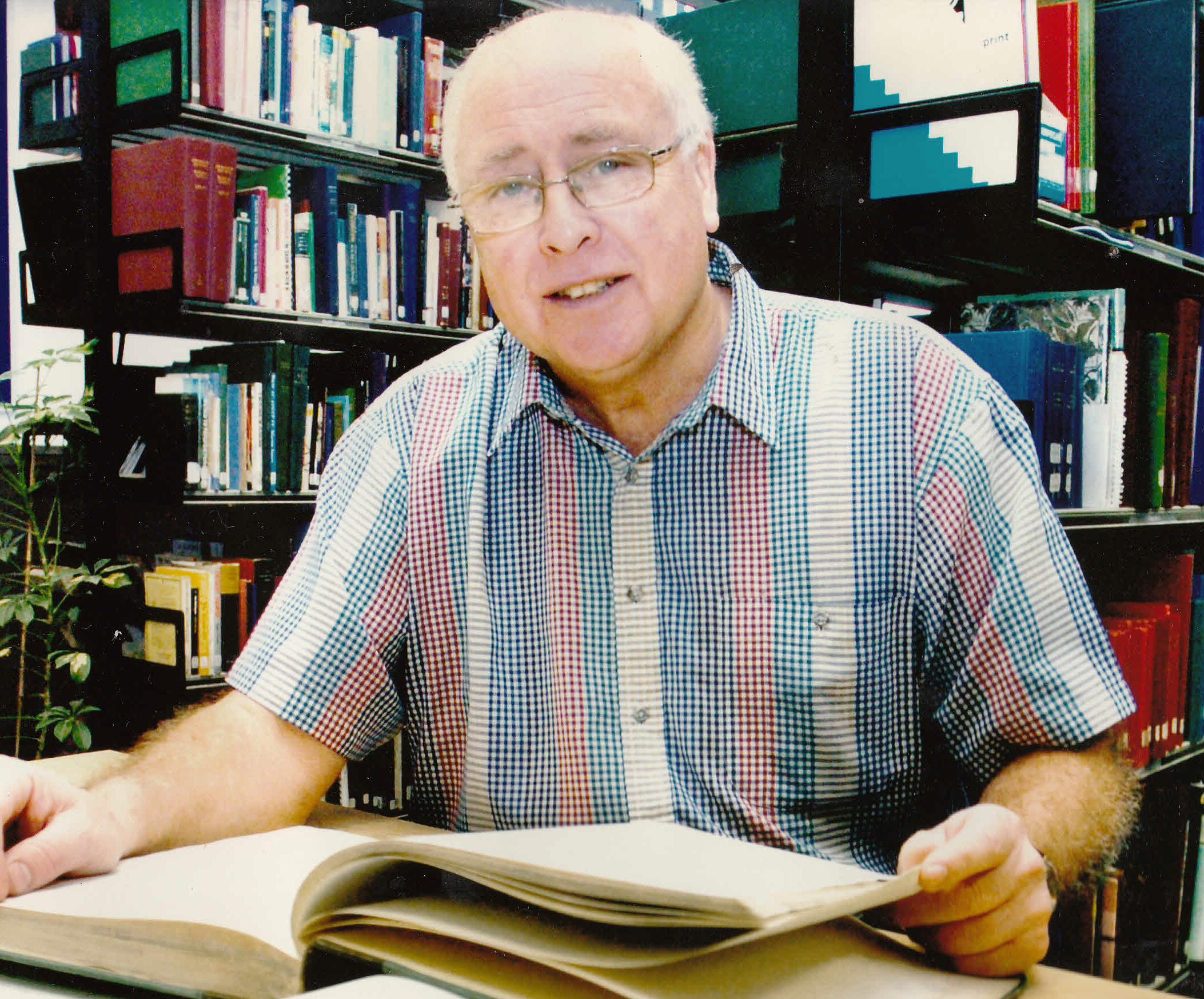
© BwD - terms and conditions
John Byrom
As a footnote, John Byrom was the first substitute to be used by Blackburn Rovers when substitutes were first introduced to the game in 1965/66. John came on for Mick McGrath at Old Trafford in a 2-2 draw with Manchester United. The following week at Ewood Park, coming on for Mike Harrison, John became the first goalscoring substitute for the Rovers in a 4-2 win over Newcastle United.
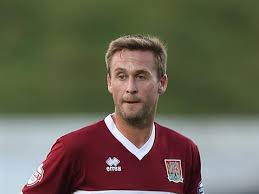
Alan’s son Joel who is currently playing for Northampton Town completes this footballing family tree. Joel started his career aged 14 years at Blackburn Rovers, and spent four and a half years on the club's books, progressing from their centre of excellence to the reserve team. He did not, however, make any first-team appearances for the club and was subsequently released in summer 2006.
Joel Byrom
n
n
Joel joined League Two outfit Accrington Stanley before the start of the 2006/07 season, but only managed a total of two appearances. He was released by the club in January 2007, and opted to join local side Clitheroe on a short-term basis. Byrom then joined Southport, scoring twice in two appearances for the side, before rejoining Clitheroe in August 2007; captaining the side at the age of 20.
Joel then attracted the interest of Northwich Victoria, who subsequently signed him for a small four-figure fee in January 2008. Byrom spent a year and a half at the Cheshire club, before joining Stevenage for a fee of £15,000 in May 2009; helping them achieve promotion to the Football League for the first time in the club's history. Byrom was also part of the Stevenage side that earned back-to-back promotions to League One during the 2010/11 season. He has also played for the England C team and earned his solitary cap in a game against the Belgium U21 team.
| Year | Team | Appearances | Goals |
|---|---|---|---|
| 2005/06 | Blackburn Rovers | 0 | 0 |
| 2006/07 | Accrington Stanley | 2 | 0 |
| 2007 | Clitheroe | 21 | 11 |
| 2007 | Southport | 2 | 2 |
| 2007/08 | Clitheroe | 18 | 3 |
| 2008/09 | Northwich Victoria | 49 | 9 |
| 2009/12 | Stevenage | 77 | 9 |
| 2012/15 | Preston North End | 33 | 4 |
| 2015 | Northampton Town | 40 | 4 |
Over a hundred year period from Tommy Byrom, nine members of the Byrom family have played professional football; a record to be proud of!
This local footballing family also had a relative who fought at the Battle of Waterloo: Henry Byrom: Waterloo Veteran
Researched by Jeffrey Booth (Community History Volunteer) from an idea by Roger Booth and with considerable help given by John Byrom.
Verdi Godwin
Verdi Godwin, B.E.M., from Professional Footballer to Professional Lifeguard
Verdi Godwin was born in Blackburn on 11th February 1926; his parents were obviously opera fans as he was named after the Italian Opera Composer Giuseppe Verdi. He lived in Moss Street and attended Bangor Street School. When he was seventeen he worked as a Bevan Boy and he used to cycle every day to work at Bank Hall Colliery in Burnley.
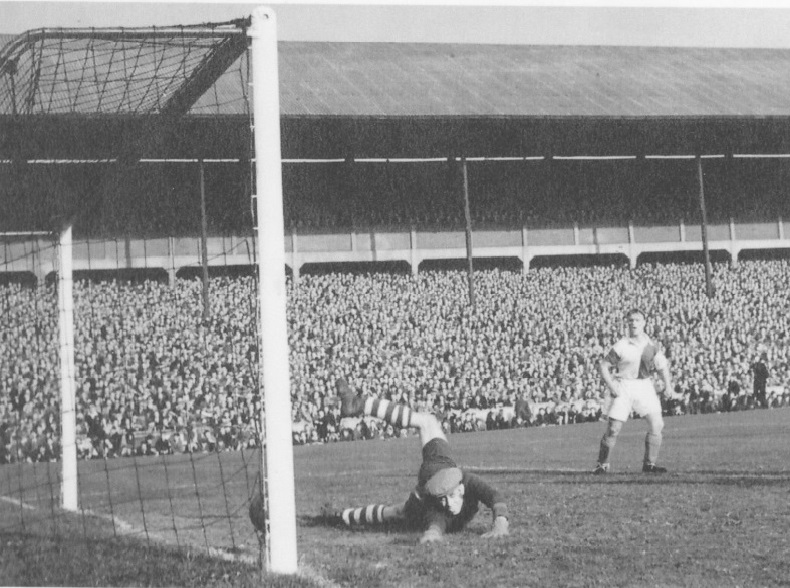
Verdi playing for Blackburn Rovers at Ewood Park Against Preston North End
1947/48 season as Rovers Score the first goal in a 2-3 defeat.
The gate was 47,000.
After the Second World War he was signed up by his local side Blackburn Rovers, who were then in the old first division (the top division). Verdi scored six goals in two seasons at Ewood Park, he then joined Manchester City in the summer of 1948. He scored three goals in eight matches for Manchester City before joining Stoke City whose manager Bob McGrory saw Verdi as the answer to Stoke's goal scoring problem in 1949-50. However, despite scoring on his debut he only scored one more goal in the next 20 matches and, by January, he was used as a part exchange with Third Division Mansfield Town for Harry Oscroft. He then became a journeyman striker spending short spells at Grimsby Town, Brentford, Southport, Barrow, and finally, Tranmere Rovers.
After the Second World War he was signed up by his local side Blackburn Rovers, who were then in the old first division (the top division). Verdi scored six goals in two seasons at Ewood Park, he then joined Manchester City in the summer of 1948. He scored three goals in eight matches for Manchester City before joining Stoke City whose manager Bob McGrory saw Verdi as the answer to Stoke's goal scoring problem in 1949-50. However, despite scoring on his debut he only scored one more goal in the next 20 matches and, by January, he was used as a part exchange with Third Division Mansfield Town for Harry Oscroft. He then became a journeyman striker spending short spells at Grimsby Town, Brentford, Southport, Barrow, and finally, Tranmere Rovers.
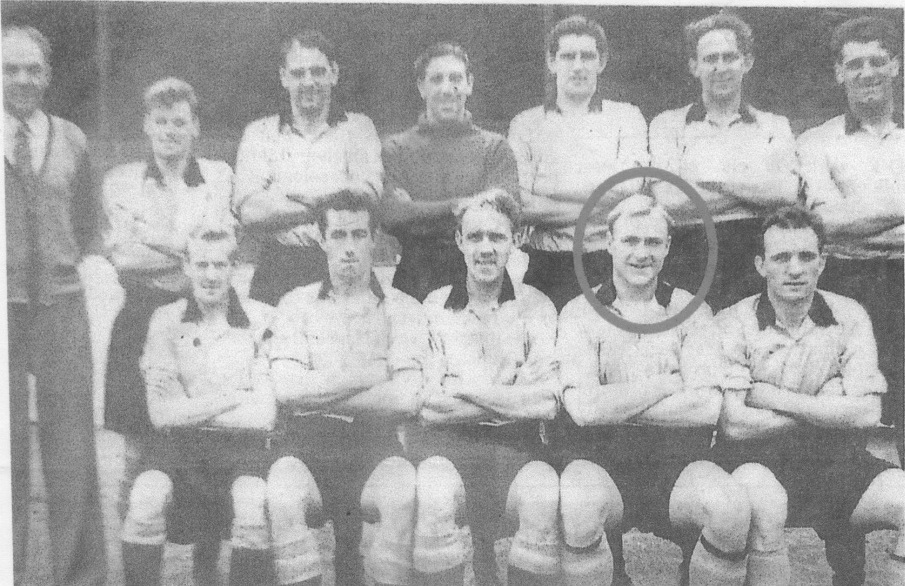
Verdi Godwin playing for Southport 1954 and 1955 season's.
When Verdi stopped playing he became a scout for Blackpool, Liverpool, Plymouth and Vancouver Whitecaps; he worked at Liverpool with the great Bill Shankley and when he was scouting for Plymouth Argyle he discovered Paul Mariner playing for Chorley who eventually became an England player. He and his wife Daphne lived in Southport and his wife worked at the sea boating lake; one day her boss said that they needed Life Guards on the beach, Verdi applied and got the job. He eventually finished up as Chief Lifeguard; he had a book which recorded over 800 rescues and not a single fatality in all the time he worked there (36 years).
In the 1980s Verdi was mentioned in the Southport Visitor paper because he found the wreckage of a ship called the Atlantic which was wrecked off Ainsdale beach in January 1883, it was on its way from Liverpool to North America with a cargo of salt. Verdi took the trouble to draw a map of where the wreck was and to deposit a copy of both the map and the photo in the Botanic Garden Museum . The actual nameboard is deposited in the Merseyside Maritime Museum. Verdi was awarded the British Empire Medal in 1987 in recognition of his service. Verdi died on December 1st, 2013 aged 87 years.
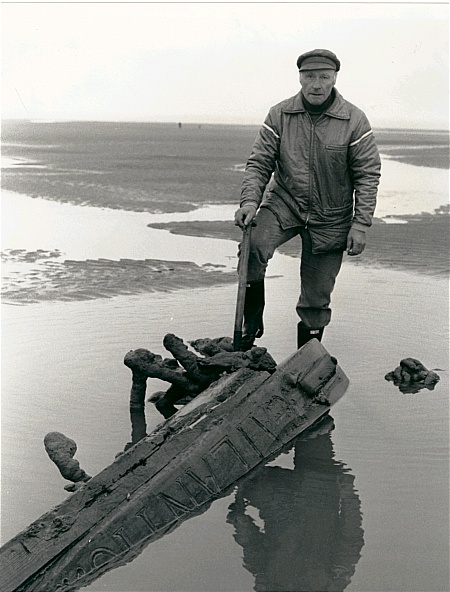
Verdi on Ainsdale beach showing part of the wreck of the Atlantic
Article by Jeffrey Booth, Community History Volunteer with help from Mr Butterworth, Verdi's cousin, March, 2017.
Bob Crompton
The Greatest Rover of Them all
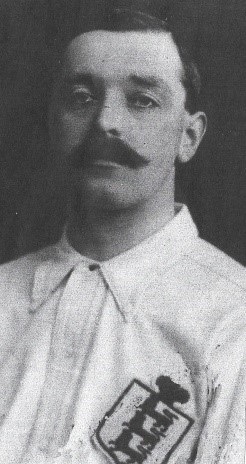
Photo from Mike Jackman’s Official Encyclopaedia of Blackburn Rovers
By the end of the twentieth century’s first decade Blackburn was emerging as a force in English football, and their defence was particularly strong. Along with Crompton, Arthur Cowell, George Chapman and the keeper Alf Robinson formed the basis of the side that Crompton was to captain twice to the League title, winning it for the first time in 1912 and again in 1914.
Blackburn Rovers 1911-12
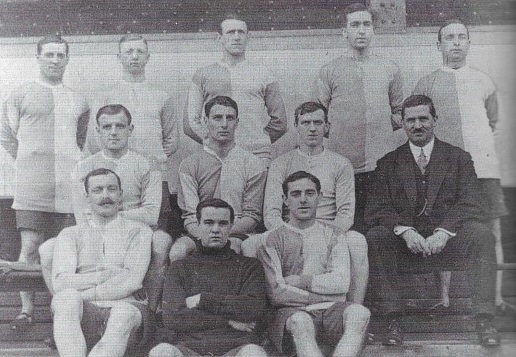
From left to right.
Back row;
Back row;
J. Simpson E. Latheron, G. Chapman, W. Aitkenhead,
W. Anthony,
Middle row; A. Walmsley, P.J. Smith, B. Bradshaw,
R.B. Middleton
Front row B. Crompton, A. Robinson, A. Cowell
Photo copyright: Howard Talbot
In 1902 he made his debut for England against Wales at Wrexham. During his 41 appearances for his country, Crompton became the first professional to captain England and he also established a new appearance record at international level, this was to stand for38 years until Billy Wright finally surpassed it. He was his country’s first choice full back for 12 years. He was appointed England captain in 1903 and went on to captain his country 22 times. Although he is now only 74th on the list of most capped players for England it as to be recognised that when Crompton was playing the number of international caps was severely limited. England was restricted to playing just Home International Championship games with only the occasional sojourn against a foreign side. Some have estimated that by today’s standards he would have achieved at least 120 caps. The outbreak of the First World War meant that Crompton was never able to add to his list of honours as a player after 1914. He played on for a short while after the war but injuries meant he retired in 1920 aged 40. On the 15th of June 1911 the FA, in recognition of his achievement of becoming England’s most capped player, presented Crompton with a portrait of himself. He achieved the feat two years previously when he won his 24th cap playing for England against Scotland on the 3rd of April 1909.
After his playing career was over he went on to become a director of Blackburn. Following the departure of Jack Carr from the secretary/managership at Blackburn he was invited to become the club’s ‘honorary manager’. It was a decision which enabled Crompton to embark on another successful career at Ewood Park. He managed the team between 1926 and 1930 and immediately lifted them out of the regulation zone as the team won four of his first six games in charge and finished the season comfortably in mid-table. He then lead the team to a hugely surprising win in the FA Cup Final of 1928 over the much fancied Huddersfield, a feat even more rewarding as this was the one honour he never collected as a player having been on the losing side in the 1912 final. In 1931 struggling to get his ageing squad of players to adapt to new demands of a game that was developing tactically he was fired. In 1935-1936 he had a spell managing Bournemouth but returned to a struggling Blackburn in 1938.When he arrived Blackburn found themselves looking at relegation to the Third Division (North), but Crompton again proved the saviour for the club and managed to keep them up. Originally just returning for that one season, he was persuaded to stay on and guided them to the Second Division championship the next season. Back again in the First Division hopes were high with Crompton at the helm, but the next season was to be suspended after just three games due to the outbreak of the Second World War.
On the 15th of March 1941, and still manager, Crompton suffered a heart attack while watching Blackburn beat Burnley 3-2 in a war time game and he died that evening. Perhaps it was fitting that he should end his days at the club that he loved and where fans still consider him to be one of the greatest ever figures in the clubs history.
On the 16th of October 2015 Crompton was one of two special posthumous awards handed out as he joined nine legends to be inducted into the National Football Museum Hall of Fame at a prestigious awards ceremony, receiving the award alongside Bob Crompton’s grandson and family was Blackburn Rovers President Keith Lee. He said “It is a great honour for the club and his family to be here to receive his award”. He also became the first player and Manager to be entered into the Blackburn Rovers Football Club Hall of Fame on the 8th of February 2019. With respect to one club players Brian Douglas and Ronnie Clayton and Alan Shearer I think Bob Crompton was THE GREATEST ROVER OF THEM ALL.
Researched and written by Jeffrey Booth (Library Volunteer) with thanks to Mike Jackman. Published January 2022.