
 Loading more
Page 2
The Blackburn Rovers team of 1889-90 faced Sheffield Wednesday in the 1890 Cup Final. Played at the Kensington Oval, now more famous as a cricketing venue, they won by the narrow margin of 6-1! Billy Townley scored the FA Cup's first ever hat-trick.
© BwD - terms and conditions
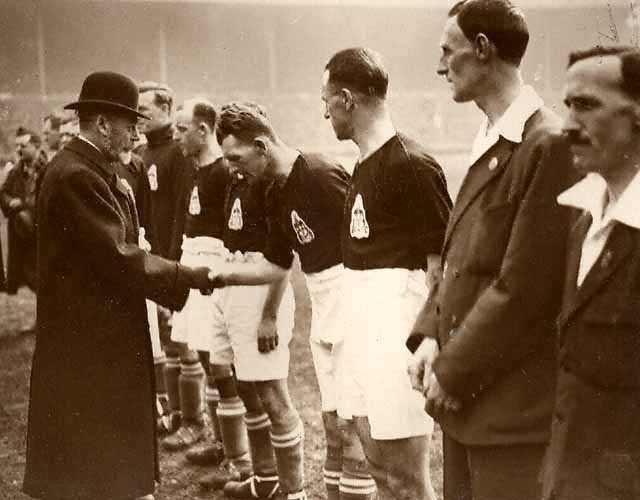
Presentation of players to H. M. the King. 1928 FA Cup Final.
The Rovers players and officials meeting King George V, prior to the start of the 1928 FA Cup Final. My claim to fame is that my Great Grandfather, John A. Ormerod was Mayor of Blackburn at this time and sat next to the King!
Sadly the Rovers have never managed to achieve greatness in the Cup Final since 1928. Their only other appearance being in 1960 when they lost 3-0 to Wolverhampton Wanderers.
© BwD - terms and conditions
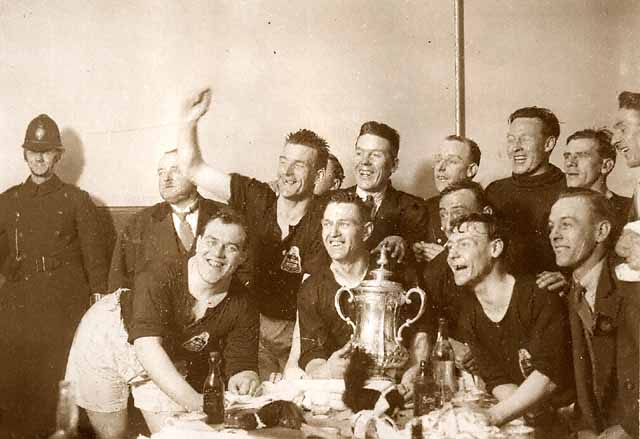
Jubilation in the dressing room as Rovers beat Huddersfield Town 3-1 in the 1928 FA Cup Final.
Jubilant players celebrate their triumph in the FA Cup Final of 1928 against Huddersfield Town.The Rovers were very much the underdogs as Huddersfield's team included several internationals and they were at the top end of the League, whilst Rovers were nearer the bottom.
The final score was 3-1, with Roscamp scoring twice. The other goal was scored by McLean.
The players in the shot are:
Front (l-r) Jock Hutton, Harry Healless(captain with the Cup), George Thornewell, Arthur Rigby, Peter Holland.
Back Bill Rankin, Tommy Mitchell,Herbert Jones, Jock Crawford, Tommy McLean.
Front (l-r) Jock Hutton, Harry Healless(captain with the Cup), George Thornewell, Arthur Rigby, Peter Holland.
Back Bill Rankin, Tommy Mitchell,Herbert Jones, Jock Crawford, Tommy McLean.
© BwD - terms and conditions
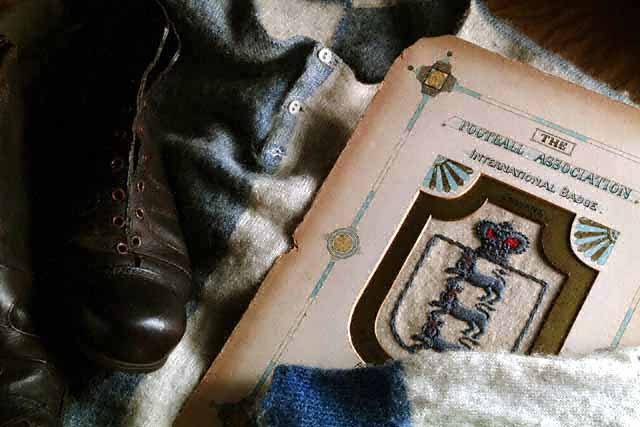
Early 1900s Football Memorabilia
Modern football prima donnas would not be seen on the field in anything other than ‘Play Dry’ technology shirts, golden boots and jewellery with a market value higher than most of us earn in a year.
Step back a century or so however and the Versace play wear of yesteryear consisted of heavy woollen shirts (imagine what they would have been like to wear in the wet), hob nail boots and anyone sporting body piercing would have been abused by the crowd and shouted from the field. How things have changed!
© LET - terms and conditions
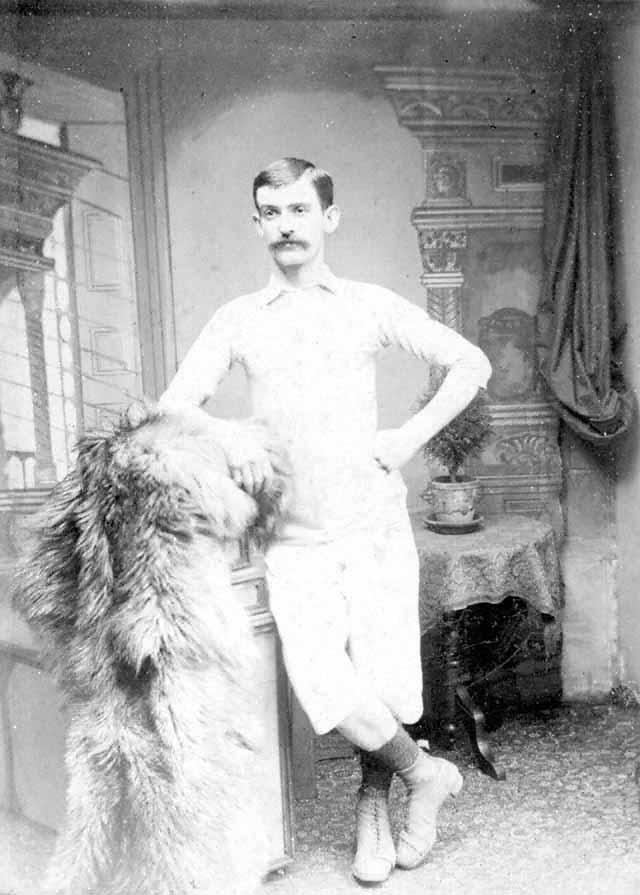
Fergus Suter
Fergus or Fergie as he was known, is famous as the Rovers first professional player.
Born in Glasgow, he was a stonemason by trade. He played for Partick Thistle and Glasgow Rangers before coming to Lancashire. He began his career "south of the border" at Turton in 1878, moving on to Darwen the following year.
He gave up his career as a stonemason claiming that English stone was to hard to work with! Rumour has it that Darwen were paying for his services. Moving on to Blackburn Rovers in 1880 he was to remain with the club until 1889.Whilst playing for the Rovers he was employed as a tape sizer at a cotton mill.He appeared in four FA Cup Finals whilst with the Rovers.
© LET - terms and conditions
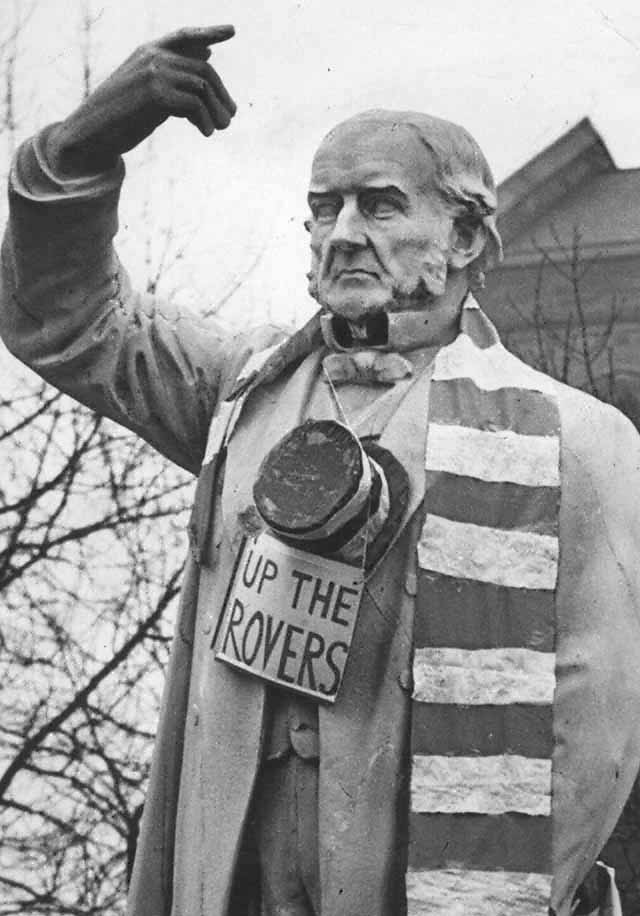
William Gladstone: Rovers Supporter!
In the hours of darkness, high spirited Rovers fans adorn the statue of William Ewart Gladstone with a scarf and hat.
The 3 ton statue was originally unveiled on Blackburn Boulevard by the Earl of Aberdeen on the 4th November 1899 with a crowd of 30,000 onlookers. The statue was the first statue erected in Great Britain to commemorate the life of the great statesman and now resides outside King George's Hall after being removed from the boulevard in 1955.
The Forgotten Football Disaster – Bury v Blackburn Rovers 1952
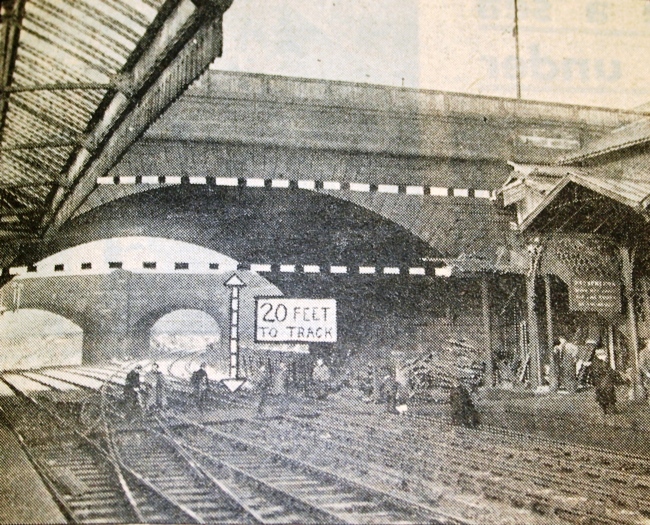
When the subject of football disasters is brought up, many people immediately start talking about Hillsborough, Hysel, Ibrox, maybe even Bradford but there is one disaster which is never mentioned, probably because it didn’t occur at a football ground but the people who were there will never forget it. I am talking about the railway bridge collapse at Bury in January 1952.
© BwD - terms and conditions
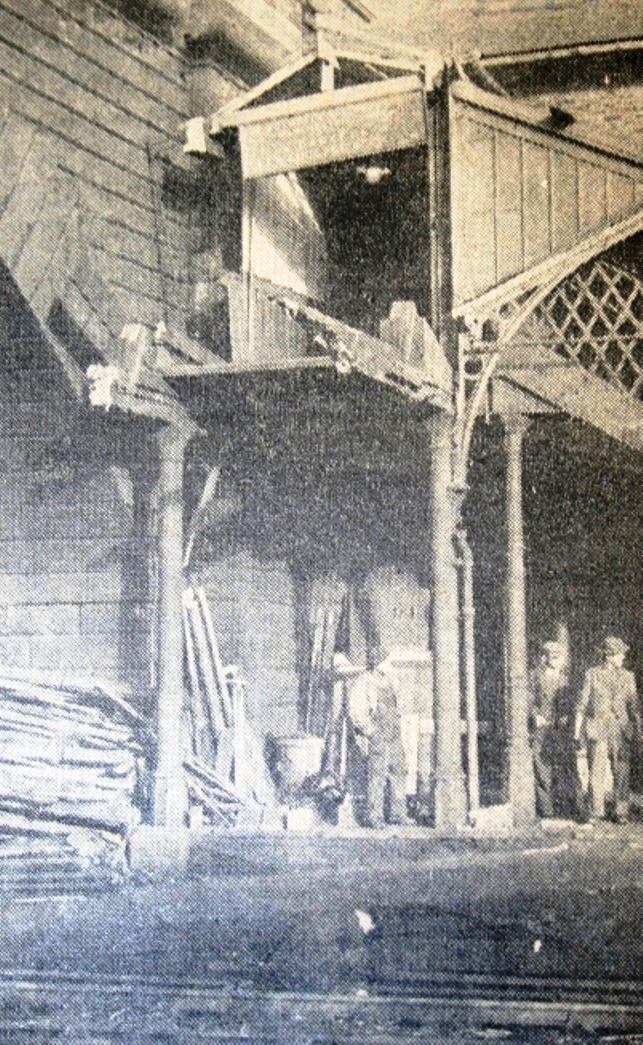
It was the 19th January 1952 and thousands of Blackburn Rovers fans had just enjoyed a 2-0 over Bury at Gigg Lane and were due to head back home on the train and were waiting for four special trains to arrive at Knowsley Street station. One train had already filled up and left the station and more than 200 supporters were waiting on a wooden bridge ‘packed like sardines’ for the second train to arrive when they heard a creaking, then a crack. Suddenly the bridge collapsed and the supporters fell 20 feet on to the track along with debris from the fallen bridge. Some people who had escaped the bridge collapse actually fell through the gap left by the bridge as the crush of people was so great. The leading porter, David Foulkes, saw what had happened and immediately sent out an ‘obstruction danger’ signal in all directions. His swift action saved many lives as one train stopped just 200 yards from the injured.
Men, women and children were scattered along the track along which a train could pass at any moment. There was no lack of volunteers to go to the assistance of the injured. Some Rovers fans, including a young Jack Walker, scrambled down on to the tracks to help pull the injured people free. Jack recalled the event in an interview in 1992. “I was on the bridge with my brother Fred, but we didn’t go down. We were at the other end. There were thousands of people trying to get on the bridge, then suddenly it started vibrating, rumbling and shaking and then the middle just dropped out. It was frightening. We went down on to the railway line and Fred and me helped get helped get people off the tracks – including the mascot.”
© BwD - terms and conditions
Other supporters also described their experiences, Mr James Smith, a lathe operator at the R.O.F. talked of ‘a sudden crack and the whole floor went down beneath our feet’, one of the youngest victims, 14 year old Blackburn Grammar schoolboy George Haworth, described how his friends only escaped the crash because he had lost his return ticket home. Jack Squires, aged 23, fell along with his father Raymond and afterwards grinned ruefully after telling reporters how he had only just recovered from hurting his back in a fall through a garage room a few weeks before. Another man, Harry Steele, a shop foreman for Foster, Yates & Thom, was also a witness of the disaster at Bolton in 1946. Mr George Kay from Furness Street remarked laconically ‘The Rovers picked up points at Bury and we dropped on some’.
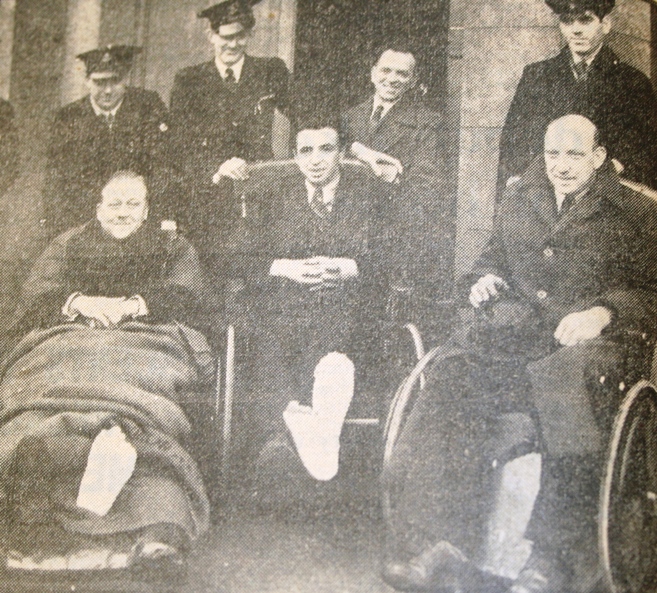
The Fire Brigade arrived just six minutes after the incident and the Police arrived 5 minutes after that. Waiting rooms became casualty clearing stations and 30 ambulances and a number of buses arrived from Bury to act as a makeshift shuttle service conveying the injured to hospital. The last casualty was removed from the scene at 6.15pm. As the victims were brought into the hospital, faces blackened with dust and soot, local clergymen, hearing of the disaster, were there to help comfort the injured and offered cigarettes and tea. Operating theatres worked through the night and some of the injured were sent to the Royal Infirmary and Queen’s Park Hospitals in Blackburn.
© BwD - terms and conditions
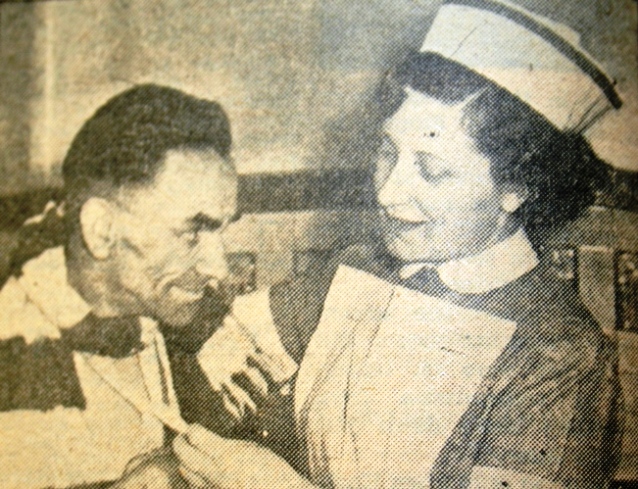
Relatives waited outside Blackburn station on Saturday night and about 9.30pm two Rochdale double-decker buses arrived containing about 30 of the injured. They were transferred to Blackburn Corporation buses, manned by personnel who had finished their normal duties and volunteered to help with the emergency. Some of the others were taken straight home by ambulance. On the Sunday afternoon the Town Clerk, Mr C.S. Robinson, at the request of the Borough Police, authorised the provision of a special bus to convey relatives to Bury Hospital to visit their loved ones.
© BwD - terms and conditions
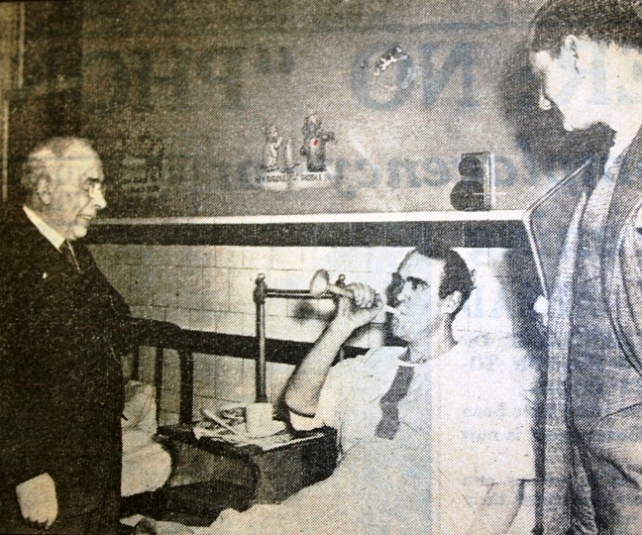
One person, William M Hargreaves, died in the tragedy and 175 people were injured, 56 of which had to be detained in hospital. They were visited by the Mayor Alderman William Hare and the Town Clerk, Mr C. S. Robinson. Officials and players from the Rovers, including Captain Bill Eckersley also visited the injured. Blackburn Rovers also arranged collections to be taken at the following home game against Luton Town in order that the injured might be provided with ‘additional comforts’.
© BwD - terms and conditions
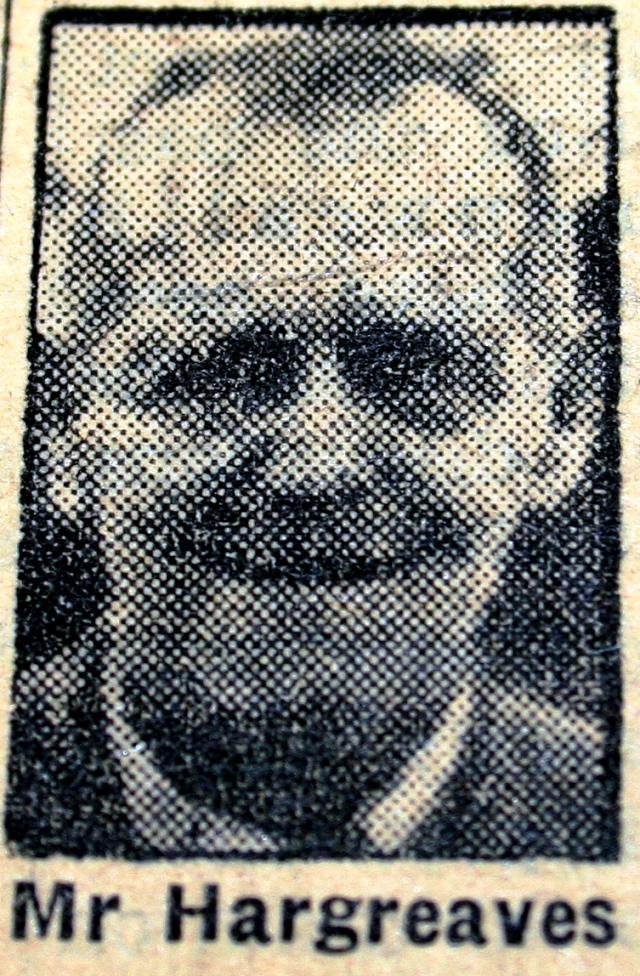
William M Hargreaves, a widower and a retired weaver, aged 66, died in the tragedy and 175 people were injured. William was with three other friends at the time, he received injuries to his chest and back. He was described as a keen Rovers supporter, a season-ticket holder and always travelled to away matches. He lived with his son-in-law and his wife in Havelock Street. His wife passed away four years previously when he was living in Princess Street. Witnesses reported seeing Mr Hargreaves lying under another injured man with a heavy wooden beam pinning them both to the rails. He was rushed to hospital and he described the accident as “a nasty mess” but could not give a full account of what happened to him. He passed away at Bury General Hospital on the Monday night. Mr Hargreaves officially died from lobar pneumonia following chronic bronchitis and shock after rib fractures.Among the floral tributes was a wreath from the Directors, Officials and Players of Blackburn Rovers, in the blue and white colours of the team he supported with such enthusiasm for many years. Other wreaths were from the Green Park Veteran Bowler’s Association of which Mr Hargreaves was a member. Only members of the family attended the funeral service and the internment was at Pleasington Cemetery.
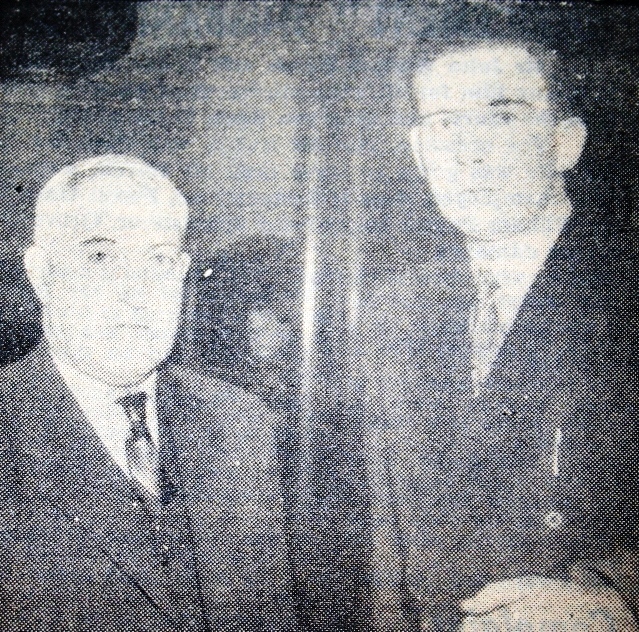
There was an immediate outcry for an investigation into the tragedy and Bury Town Council held a special meeting on the Monday to discuss the matter and formulated a request to the Ministry of Transport for a public inquiry. On the Tuesday senior officials from British Railways conducted an on-the-spot inquiry and it was announced that Brigadier C. A Langley would conduct the public inquiry which took place on the Tuesday 30th January at the Divisional Offices of the Midland Region of British Railways at Hunt’s Bank in Manchester.
© BwD - terms and conditions
At the inquiry, it was discovered that the bridge on which the tragedy occurred was about 70 years old with a span of 60 feet 9 inches long, 7 feet 4 inches wide and although it was described as ‘an unusual construction’ it had passed inspections in 1944, 1946 & 1948. The Brigadier congratulated all concerned who helped with the injured on site and the Bury Hospital staff on the way they dealt with the emergency. A consultant engineer, Mr Arthur Cresswell, blamed the collapse on the lack of proper maintenance saying that “I would be surprised if the bottom boom of the bridge has been inspected in the last 25 years. Mr A Tims, a Blackburn contract engineer, said that the bridge was inspected in 1944 by a joiner, a man who had since died but from his report there was no immediate indication that the bridge was in a dangerous condition. He had taken the boards of the inside of the bridge but not off the outside. He did not take off the outside boarding because it was wartime and there were staff difficulties. The inspection in 1946 was carried out by a Mr Halewood during a time when the bridge was being repaired. It was having a new roof put on to the bridge, and the outside and inside boards were taken up, along with the floorboards. Mr Halewood looked at the straps at the bottom of the bridge by climbing up a ladder with a hammer and said that they were all right. It was also inspected in 1948 by another man, also since deceased, and his report requested that the outside boarding be replaced as well as outside down spouts and facing boards. None of these recommendations were believed to have been carried out. It was revealed that the man who carried out the inspection in 1948 was in fact a bricklayer, but it was agreed that he should have noticed any corrosion on the bridge.
© BwD - terms and conditions
Mr F Turton, bridge and steel work engineering assistant, said he had examined the bridge work since the accident and had made calculations as to its strength. It would have capable of holding a full load if it had been in good condition. He reckoned that the corrosion of the straps had taken approximately 10-15 years to develop. It was believed that the straps would have been covered with soot and unless they were thoroughly cleaned it may have been difficult to see just how corroded they were. Brigadier Langley told Mr Turton that he wanted further tests on the straps to ascertain their condition.
After the 9 hour hearing, the inquest jury reached their verdict of ‘misadventure’ and in their opinion there had been no adequate inspection of the bridge for a number of years. It was found that the failure of the wrought iron straps at the bottom of the bridge had caused the collapse. All similar bridges were inspected and eventually replaced. It was a tragedy that most people outside Bury & Blackburn have never heard of, and even in those towns it is spoke of very little when people recall football tragedies, but any loss of life should not be forgotten, whether they support Liverpool, Juventus, Bradford or Blackburn Rovers, especially when all that person was doing was following his favourite football team.
by Roger Booth
1987 Rovers Victory Parade
Blackburn Rovers Full Members Cup Victory Parade (Radio Lancashire, 30th March 1987).
A three coach convoy, led by the players’ open top bus, travelled from Ewood Park, where fans had already gathered, along Bolton Road to attend a civic reception at the Town Hall. The convoy stopped outside Blackburn Royal Infirmary, where the players alighted and showed off the Trophy. Patients waved from the windows, and nurses lined up along the grassy bank to cheer the team. Some fans ran alongside the coaches on the journey into town.
Various voices can be heard, including Glenn Keeley, Terry Gennoe, Don Mackay, Tony Diamond, Chris Sulley, Alan Ainscow, John Haworth (Club Secretary), Mike Madigan (Mayor), Simon Garner, Paul Mckinnon, William Fox (Chairman), Colin Hendry, Jim Furnell, Scott Sellars, William Bancroft (President), Ken Beamish, Keith Hill, Ronnie Clayton, Bryan Douglas, Jim Branagan, Noel Brotherston, Chris Price and Mike Rathbone.
Outside Blackburn Town Hall, fans scaled every vantage point to see their heroes.
Coverage of this triumphant occasion was given a sense of perspective with an interruption by a newsflash, naming a Preston soldier killed in Ireland while serving in the Queen’s Lancashire Regiment.
A three coach convoy, led by the players’ open top bus, travelled from Ewood Park, where fans had already gathered, along Bolton Road to attend a civic reception at the Town Hall. The convoy stopped outside Blackburn Royal Infirmary, where the players alighted and showed off the Trophy. Patients waved from the windows, and nurses lined up along the grassy bank to cheer the team. Some fans ran alongside the coaches on the journey into town.
Various voices can be heard, including Glenn Keeley, Terry Gennoe, Don Mackay, Tony Diamond, Chris Sulley, Alan Ainscow, John Haworth (Club Secretary), Mike Madigan (Mayor), Simon Garner, Paul Mckinnon, William Fox (Chairman), Colin Hendry, Jim Furnell, Scott Sellars, William Bancroft (President), Ken Beamish, Keith Hill, Ronnie Clayton, Bryan Douglas, Jim Branagan, Noel Brotherston, Chris Price and Mike Rathbone.
Outside Blackburn Town Hall, fans scaled every vantage point to see their heroes.
Coverage of this triumphant occasion was given a sense of perspective with an interruption by a newsflash, naming a Preston soldier killed in Ireland while serving in the Queen’s Lancashire Regiment.
53 mins 14 secs.

By Kind permission of Radio Lancashire.
DW 2017