
 Loading more
Page 2
On the side of a great, green hill, nestling among the oaks, stood a tiny white cottage. It was low and had only one window on either side of the door. No other dwelling was near it – it was alone on the mountain. A little child was in the gay garden of the cottage, playing among the sunflowers and bright, sweet peas, and her bare, brown legs twinkled in and out among the tall stems of the sunflowers as she ran from one flower to another burying her little brown face among the masses of sweet peas.
“Morva! Morva!” cried a shrill voice in Welsh. “Come, child- take these flowers to the town; they are lovely today and will fetch a big price.” And a woman came into the garden with a basket of flowers, which she gave to the little girl. Morva, after saying goodbye to her mother, set off along the narrow, stony path, singing as she went.
In a little while she entered a huge fir forest. Everything was grey and still, the sunlight seemed shut out, and Morva felt just a tiny bit frightened as she walked among the tall, straight trees. She looked up and down – no one was in sight. Generally she met some old Welsh women on their way to the big town, but today she was alone in the dark, weird forest. She grew more and more frightened as she got deeper into the forest and fancied she saw the “little people” peeping out at her from behind the trees. She began to sing, but the sound of her own voice frightened her, so she ceased. The little girl went on and on till suddenly she heard a soft, sweet sound, like the call of a bird. Again and again, she heard the low, clear call, but no bird was to be seen. She followed the sound till it seemed quite close to her and suddenly there stepped from behind the trunks of the grey trees, a little, old woman, in a red cloak and tall black hat. “So, you have come,” she said in Welsh. Morva did not speak. “I have waited a long, long time for you.” “For me?” said Morva in surprise. “For you!” said the old woman. “Now, come with me,” and she put out a long bony hand and took the child’s little brown one. “But” said Morva, “I am going to the town to sell flowers and mother ____”. “Mother will understand,” interrupted the old dame as she led the way along a still darker path.
It was late in the afternoon when Morva had started for the town and now night began to steal through the trees. Morva caught a glimpse of the stars as they twinkled in the dark blue sky, when all at once the old woman stopped, and gave the low call that had brought Morva to her. Three times she called and as the last call died away lights began to twinkle far away among the trees. Nearer and nearer, they came, lights of every shade and colour, all looking as if they shone through gauze. So near they came that Morva saw that little beings dressed in the colours of the lights, bore them on willow wands. Morva clapped her hands with delight as they ranged themselves in a ring before the old woman and herself. But imagine her delight when the tiny fairies began to dance, swaying the beautiful lights gently to and fro, to the time of the sweet, low songs they sang meanwhile. For a long time they danced, till, with a sign from the little woman, they withdrew to a grassy mound. Again the old woman called and Morva waited to see what happened.
There came a rustling, a swaying of branches and a crackling of twigs and in a minute thousands and thousands of tiny elves stood before them. “Bring the cushion,” cried the old woman. They disappeared but reappeared instantly with a large cushion of rose leaves and thistle-down. “Come,” said the fairy (for indeed she was one), and taking Morva’s hand she and the wandering little girl lay down on the cushion. “Ready!” and immediately the cushion soared into the air over the tops of the fir trees. “Look!” said the fairy and pointed to the world below. Morva peeped over the edge of the cushion and saw far, far below her the dusky fir forest, the twinkling lights of the town, and above all, the one tiny light in the cottage on the side of the hill. They drew near the stars now and Morva noticed one particularly bright, larger than the other and wished she could enter it. The cushion came nearer and nearer to it, till it stopped right in front of it. The star seemed to be made of silver, so bright that the little girl had to shade her eyes to look at it. The old fairy pushed open a small silver door and they entered.
Never had Morva imagined anything could be so beautiful. Everything seemed to be of a soft silvery-blue colour. There were tiny silver-blue houses, with lovely gardens and a blue river flowing peacefully along, dotted over with silver boats. The fairy called softly, and she was answered by merry cries and out of every house came children eagerly running to greet her. “You have come at last,” they cried as they crowded round her. They were beautiful children; all dressed in dainty silvery-blue. “These,” she said, turning to Morva after she had greeted them, “are the star children.”
“So, this is Morva of the Hills,” said a star child; “I have often peeped down at her playing in her garden. “Now,” said the old woman, “we will go in a boat.” And as she spoke a silver boat drew near. The children crowded in after the fairy and the boat glided through the clear water. “Sing- do sing!” cried the children and so the old woman sang. Her voice, clear and sweet as a bell, rang over the water. She sang of fairies, hills and children; wonderful songs of the sea and of mermaids; and at last, when her voice died away, not one child moved. “Morva,” she said, “we must go, the dawn is coming.” They bade goodbye to the children and went out of the star and lay down on the cushion. In a very short time Morva found herself standing in front of the cottage. She ran into the house. “Morva! Morva! Back!” cried her mother. “Where have you been? I thought you were lost, though something told me you were safe.” Morva told her all about the old woman. “That,” said her mother, “was the good fairy of the fir forest.” “Oh! Mother!” cried Morva, “look!” and she showed her a little silver coin suspended round her neck. “A lucky penny,” cried the mother; “nothing will ever harm you while you wear that.” Morva was delighted, but never again did she see the “Fairy of the Fir forest”.
Transcribed by Shazia Kasim
The Blackburn Weekly Telegraph, Saturday September 21st 1907
All was dark and still, except for the sound of red ashes falling through the bars of the fire-grate. Master Mouse popped his little grey head out of his snug hole and looked about. Yes! all was safe; he must get some food for they – that is his tiny brothers and sisters – had fed on a corner of carpet for a week and never a scrap of cheese or candle for desert! It was awful! Oh! it was quite plain that Master Mouse must go in search of food. So with a sigh (for Master Mouse was lazy) he crept out and stole across the hall. He was getting on finely, when, to his great fear, he spied Miss Tabby Cat stretched comfortably in front of the dying fire. She was fast asleep, never dreaming of the plump little mouse so near to her. Master Mouse waited a little, to see if she moved; it would never do to go back without anything. Miss Tabby Cat slept on, so he scurried down the passage and made for the pantry door.
Here was another difficulty. The space between the pantry door and the floor was far too small for Master Mouse to squeeze through, and he crept disconsolately down the passage, his dreams of cheese and candle shattered, and his long tail (of which he was very proud) draggling along behind him, when he saw a little hole in the side of the panelling. “Perhaps,” he thought “it leads to the pantry.” And his hopes revived again, as he popped into the hole. He found himself in a very, very narrow passage. So narrow that he could hardly squeeze along. But he struggled bravely, borne up by the visions of a feast. After wending his way, very painfully for a good while, he heard the far-off sounds of squeals and squeaks. Perhaps they were some friends, enjoying themselves, and he would be able to get something after all without working for it. You see Master Mouse was lazy.
The sounds grew louder and louder, and Master Mouse hurried along, till at last he turned a sharp corner, and came full upon a crowd of mice, gathered round little heaps of meal, bits of candle, lumps of cheese, and anything else that a mouse delights in. Master Mouse’s mouth watered as he eyed the luxuries, and at once he advanced to a solitary piece of candle and began nibbling. After he had eaten half a candle he started on the cheese, and it was not until he was halfway through a heap of this that the other mice noticed him. Then there was an uproar. They rushed on him, squealing, squeaking and uttering all the noises possible for angry mice to make. They bit him, and scratched him, tore his whiskers out, pulled his fine tail, and when at last they stopped for a second to refresh themselves for a fresh onslaught, it was a wreck of Master Mouse who squeezed up the narrow way with a dozen or more of his enemies at his heels. On and on he struggled, tired out, aching all over and, he was glad to find a wider passage where he could run with ease. After a little while the sounds off his pursuers died away, and Master Mouse took a rest in the passage and looked round him. He had not the faintest idea where he was; he had only been out food hunting once before and had never got into narrow passages under the floor before. How was he to get out? Wherever was he to get food for the others from? Well! they would just have to live on carpet a little bit longer. He had had a good feast, and so he was satisfied.
He got up and trudged wearily along, when a faint odour of toasted cheese met him. He hurried on as fast as he could and soon came out of the hole, and there right in front of him, was a little box with shining bars across and oh! what good luck! a big piece of toasted cheese hung temptingly near. Master Mouse jumped on the top of the box and tried his very best to reach the luxury. But in vain; he could not touch it; he pawed the bars fiercely, but it was no use.
His tail dangled near the cheese, through the bars; he stuck his fore-paws through trying as hard as he could to reach the cheese. All at once there was a snap. With a squeak Master Mouse tumbled off the box and fell with a thud on the ground, without his tail.
Poor Master Mouse! His tail was the pride of his life. Was it not the longest, finest tail in the neighbourhood? At least, so he thought. With one terrified glance at his fine long tail lying in the box, he scurried heedlessly down the corridor.
Master Mouse seemed bound to meet misfortune on this night, for, there in front of him, was the huge bristling shape of Mistress Tabby Cat. She was hungry, and she licked her lips as she eyed the plump little mouse cowering before her, and thought how nice he would taste, but, as Master Mouse had done, Miss Tabby Cat “counted her mouse before he was caught”. For Master Mouse, alive to his danger, warily slipped past her and rushed on, with the angry cat after him. She did not run her fastest, for she was sure of catching him. How dare the little creature try and escape? She would punish him for this; she would keep him in fear of his life longer before she made a meal of him.
But Master Mouse was a fleet little thing, and he dashed across the hall, with the cat, anxious now, bounding after him. She made one blind spring at him only to bound against the wall and then found that Master Mouse had disappeared into his snug hole. Fancy, beaten by a mouse! She lay down outside the hole, but he never made an appearance. Nor was Master Mouse fit for a long time to again go food hunting, and when he did, he was a wiser and sadder little animal, and took great care to keep away from the house where the cheese was hung, and also other people’s feasts.
The Blackburn Weekly Telegraph, 12th October 1907
Transcribed by Philip Crompton
Transcribed by Philip Crompton
The ground and hedges were all covered with snow, hardly a dot of green was to be seen anywhere, but flaunting its scarlet head over the dazzling snow, waved a Hip, and by its side hung a crimson Haw. They quarrelled the whole day long about their brightness of colour.
“Why, I am far away more beautiful than you, little stunted Haw,” sneered the Hip.
“Oh, you may think so,” replied the Haw, “but opinions differ. Now just look at my perfect shape, my glorious colour, my nice black hat.” “You have not a long green stem like I have,” said the Hip; and so, they went on day after day.
One day there came an invitation for them both to a dance held at moonlight underneath the oak tree. “Now,” said the Haw, “this will be a good chance of showing off my bright red coat.” And he called the caterpillar out of his snug bed and had him polish his coat until he could see himself in it. So the sleepy caterpillar rubbed and rubbed, and the coat grew brighter and brighter, until the caterpillar caught sight of an ugly black head and two great sleepy eyes “Goodness gracious! What’s that?” he cried. “Oh, that’s you,” said the Haw. “Go on rubbing.” But the caterpillar was lying in the snow panting and struggling to crawl away in case the strange creature he had seen should come after him, so the Haw had to be satisfied.
The Hip looked quite dull beside him, and he racked his brains to think of a way to make himself shine. At last, he had an idea. He would stick his head in the snow, and so he would get bright. So he stuck his pretty head into a heap of snow. It was very cold, but he thought of the brilliant Haw, and bore it bravely. Then he admired himself in a drop of water. “Oh!” he thought, “the Haw looks pale beside me. How I shine! Won’t he be jealous? I shall be the handsomest at the ball!”
“Why, I am far away more beautiful than you, little stunted Haw,” sneered the Hip.
“Oh, you may think so,” replied the Haw, “but opinions differ. Now just look at my perfect shape, my glorious colour, my nice black hat.” “You have not a long green stem like I have,” said the Hip; and so, they went on day after day.
One day there came an invitation for them both to a dance held at moonlight underneath the oak tree. “Now,” said the Haw, “this will be a good chance of showing off my bright red coat.” And he called the caterpillar out of his snug bed and had him polish his coat until he could see himself in it. So the sleepy caterpillar rubbed and rubbed, and the coat grew brighter and brighter, until the caterpillar caught sight of an ugly black head and two great sleepy eyes “Goodness gracious! What’s that?” he cried. “Oh, that’s you,” said the Haw. “Go on rubbing.” But the caterpillar was lying in the snow panting and struggling to crawl away in case the strange creature he had seen should come after him, so the Haw had to be satisfied.
The Hip looked quite dull beside him, and he racked his brains to think of a way to make himself shine. At last, he had an idea. He would stick his head in the snow, and so he would get bright. So he stuck his pretty head into a heap of snow. It was very cold, but he thought of the brilliant Haw, and bore it bravely. Then he admired himself in a drop of water. “Oh!” he thought, “the Haw looks pale beside me. How I shine! Won’t he be jealous? I shall be the handsomest at the ball!”
All the time the Haw was admiring himself in another drop of water, when suddenly a shadow fell across the snow, and looking up, they both saw a little Robin, eyeing them hungrily. “Chirp!” he said, “I’ll have the brightest first.”
The Hip glanced triumphantly at the Haw, who returned it with interest. Now they would know who was the brightest: they did not think of the danger. Robin drove his sharp little beak into the Haw and pecked away all the lovely red coat and left only one tiny bit clinging to a bare, brown stone. Then he advanced to the Hip and took a good bite until the Hip had shared the same fate as the Haw.
“Chirrup!” he sang after he had finished. “I should never have seen them but for their bright red coats and because they waved so high trying to get above each other.” And the bits of Haw and Hip shook mournfully in the wind.
Published in The Blackburn Weekly Telegraph, Saturday October 19th, 1907
Transcribed by Shazia Kasim
1908
The Marigold and the Violet
Rosebud & Pukaboy
For the King
The Two Dragon Flies
Robin Redbreast
The Orchid was the Queen of Society then, and the Pink Rose, her relations, and all the other flowers were members of society. The Spotted Orchid, being the queen, was the only flower that had a maid to wait on her. Her maid was the little Purple Violet, who had no desire to be in “society,” and had offered herself to the Orchid for a maid.
Purple Violet was very humble, and whenever she was not curling the Orchid’s handsome leaves or gathering honey for her, she ran away to hide herself by the cool, green moss, and just sing happily to the water beetles as they darted over the top of the water.
One of the most important members of society was handsome Sir Marsh Marigold, and, as the Bee had whispered to the Violet, it was hoped that some day he and the orchid would lead society together.
One day the Dragon-fly, who, as I suppose you know, is the flower’s messenger, brought invitations from Sir Marsh Marigold to a moonlight ball to be held under the weeping willow that night.
“Quick!” cried the Orchid, sharply, to Purple Violet Curl up my leaves! Draw me some dew! Go and get some paint and fresh up my spots! Quick! Oh! how slow you are. I shall never be ready in time.” Poor Purple Violet rushed hither and thither, trying to do all that her mistress told her at once.
She could not find any paint, then there was not enough dew for the queen to bathe in, and then the Orchid’s leaves persisted in curling up the wrong way. At last the Orchid got so angry that her spots really blazed, and she cried out in a terrible voice, “You shall not go to the ball to-night, you are too slow and stupid for anything; you shall stay at home, and come at the end of the ball only, to bring my cloak.”
At this poor Violet’s tears fell, because she did so love to see all the gay flowers, with their beautiful dresses, dancing in the moonlight.
After a little while Orchid was dressed in all her best, and she set off on the butterfly’s back for the ball. Soon the sound of music and dancing came creeping to the little Violet as she hid in the moss. It was really too tempting. Violet could not resist one little peep. So she crept up to the weeping willow and peered through the branches. There was Queen Orchid and Sir Marigold talking together not far from her, and there, at the other side, was My Lady Rose, eating honey with Duke Hyacinth, and there ____ Oh! the Orchid had seen her! She and Sir Marsh Marigold were coming towards her! Whatever could she do?
“How dare you!” cried the Orchid, trembling with rage. “How dare you come to the ball when I forbade you to come? I shall report you to Judge Beetle for disobedience.
The poor Violet could not say a word. She was so terrified. Then Sir Marigold stepped forward. “Madam! Madam!” he said. “Don’t be so angry with your little maid. Don’t ____”
“Sir Marigold,” interrupted the Queen,” “it is really too bad of her. I was obliged to forbid her to come to-night, much against my will. She is so disobedient and aggravating. I really cannot help-p it, Sir Mari-g-il-“ and the Orchid fell in a fainting fit right into Sir March’s arms.
Purple Violet was very much distressed at the effect her conduct had had on her mistress, and did all she possible could to bring her round. At last she revived, and was on the point of sending Violet home, when Sir Marigold interfered and said that as long as she was here she might as well stay, and he led her away to dance with him.
The Spotted Orchid curled her leaves contemptuously and tried not to look angry. Sir Marsh stayed with Violet all the evening, and gave her a personal invitation to a dance he was giving in a few nights, and of course little Violet was delighted and went home very happy.
The Orchid after all this was very unkind to her little maid, and when she heard of the dance, she said that on no account could Violet go, and the poor little flower crept away to the friendly moss to cry.
Days went by. On the night of the dance the Orchid went off to the ball, leaving Violet at home. Violet sat swinging on a long stalk, crying to herself and gazing at the moon, for she dare not go again without permission, Orchid would be sure to dismiss her, so she sadly swung to and fro on her stalk beside the river, and by-and-by she fell asleep.
“Violet, Violet,” someone called, and the flower woke up hastily to find Sir Marigold standing before her. “Come quickly,” he said, “to the ball; we are waiting for you,” and before she knew what was happening, she leading to the ball with Sir Marigold, and the Orchid was dancing fiercely behind her, all her spots flaring with anger.
When all the leaves were resting on toad stools, about the middle of the ball, Sir Marigold led Violet up to the Queen and told her that she was going to marry him, and gave her and all the flowers an invitation to the wedding. Then the Orchid jumped from her seat and angrily that she would never come to their wedding, and that if Sir Marsh Marigold chose to marry a waiting-maid, he should have his title taken away from him and should no longer be a member of the select Society. After this speech the Queen of Society haughtily withdrew, and the rest of the flowers went with her, stepping past Sir Marigold and Violet with their heads in the air.
That morning at dawn Sir Marigold, with his wife, the little Violet, wandered out of the garden of Society into the common fields and meadows, and they settled by the riverside, and were as happy as could be living alone, far away from Society. And that is the story of how the Marigold and the Violet became field flowers.
The Blackburn Weekly Telegraph, Saturday 21st March 1908
Transcribed by Philip Crompton
The Blackburn Weekly Telegraph, Saturday 21st March 1908
Transcribed by Philip Crompton
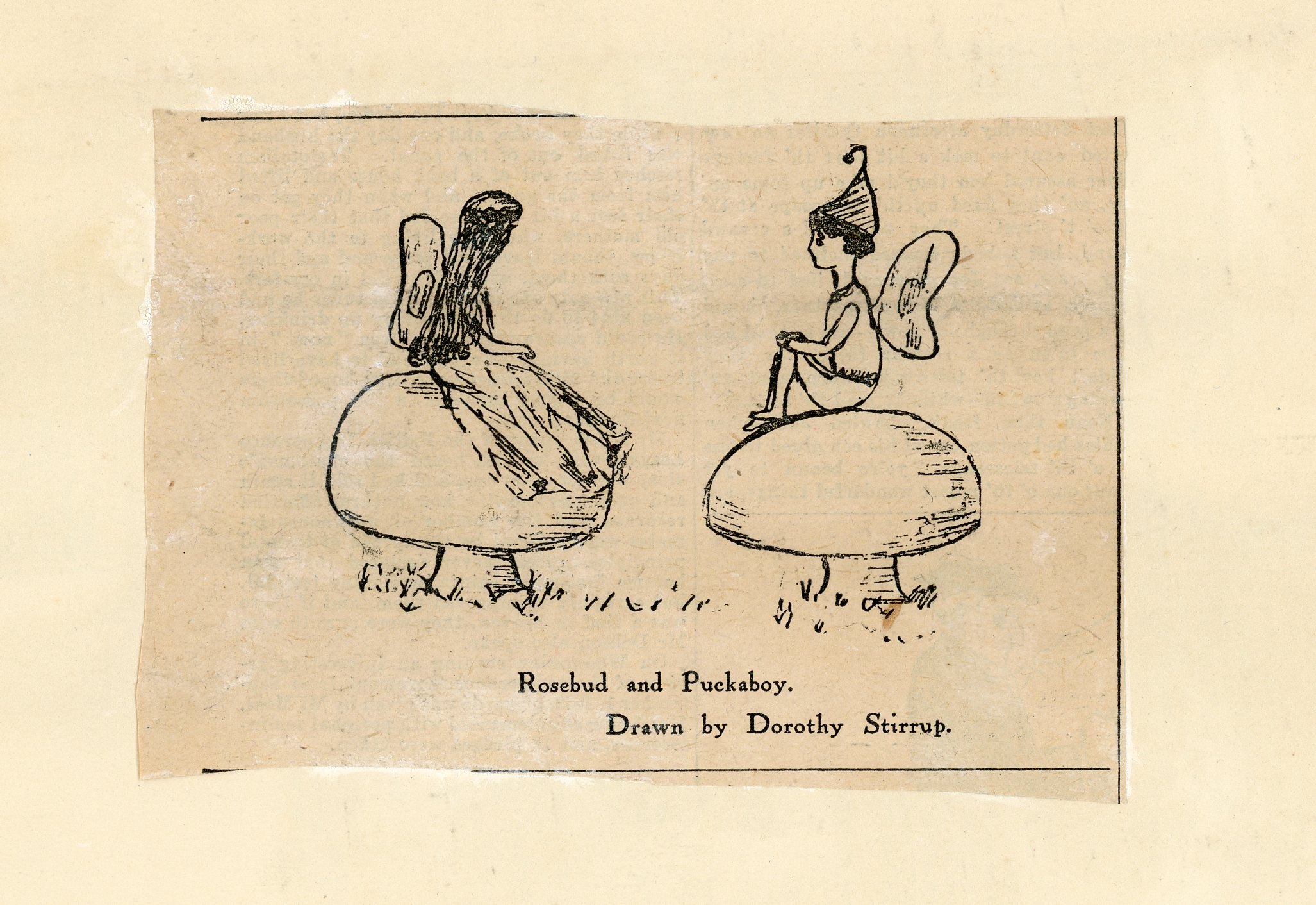 Two little mushrooms grew side by side on a bank by a stream. Under these little ‘buttons’ lived two little fairies, Rosebud in one and Puckaboy in the other. They were great friends, these two, and every day they went together to draw water to play by the brook and were as happy as the day was long. One day, while they were sitting on top of the smooth, white mushroom, each under the shade of a lady’s mantle leaf, chatting pleasantly, the old grasshopper came up. “Good morning,” said Rosebud politely, “I hope your gout is better.” “Getting on nicely, very nicely, thank you,” clicked the grasshopper.
“And how are you young stay-at-homes getting on?” he inquired. “Still as contented as ever? Why at your age, I was always on the jump, always going somewhere new, and looking out for something fresh. Why, I went to see the world, I did, at your age.”
Both fairies tried to look very interested. “Yes!” he went on, “the world’s a very wonderful place, full of beauty and green grass. This,” he waved his leg contemptuously round. “This is nothing to the world. Go out, both of you, and see it. I would if I had the chance, and believe me, you won’t be sorry for it,” and the old grasshopper went off.
The two were very quiet for a little while, then Rosebud said, with a sigh, “suppose we try it. I’m rather tired of this place.” Puckaboy shook his head.
“No, Rosebud,” he said, “I don’t think we’d better; you don’t know what other things there are in the world besides green grass. Let’s stay at home.”
“Well,” said Rosebud decidedly, jumping off the mushroom, “if you are not coming with me, I am going by myself.”
That would never do. Puckaboy could not let her go alone.
“Of course I’ll come with you,” he said. “When are you going?”
“Tomorrow,” she answered. “Get something for us to ride on, Puckaboy, dear, for I suppose the world is big.”
The next morning, just as the sun rose, Puckaboy was waiting outside Rosebud’s mushroom with a pappus of a dandelion (one of the piece’s of a dandelion ‘clock’).
Rosebud and he were very soon mounted. Puckaboy in front and Rosebud clinging on behind. There was a little breeze, so all went well for a time. And all that sunny day the two skimmed merrily over the heads of the gay summer flowers, as happy as could be. Just when it was growing dusk, the wind came roaring up from the east. Puffing and up and down. A great crash came, and then a lull. Another flash, and then the same awful
noise. Rosebud flew from one flower to another, crying, terror-stricken, to let her in. But all the flowers were fast asleep, their heads drooping almost to the ground. The storm raged on. The poor fairy threw herself down on the ground and buried her face in the grass. By-and-by the thunder stopped, then the rain came down in torrents, but Rosebud did not feel it, for worn out by fear and excitement, she was fast asleep.
Next day the sun came up as rosy and jolly as ever. He saw the poor little fairy lying on the damp grass and being a kind old sun, he put out all his strength to warm her and dry her wet wings. Very soon a little fairy came wandering through the grass. He looked very sad and disconsolate, and he searched very carefully about him as he walked. Suddenly he rushed forward. “Rosebud! Rosebud.” The little fairy woke up. “Oh, Puckaboy, are you here. I’m so glad to see you again.” And indeed, they were delighted to see each other.
“Oh, do let us go home again,” said Rosebud. “The world is a horrid place, Puckaboy. Let’s start out now.” And home they went, and they reached their own little mushrooms just before dusk. “After all,” said Puckaboy, when they were comfortably settled that night, “after all, there’s no place like home.”
And Rosebud heartily agreed.
The Blackburn Weekly Telegraph, Saturday September 5th, 1908.
Transcribed by Shazia Kasim
Over the great brown hill went little Mistress Margery, down by the stream into the cool woods, under the golden brown shade of the trees; over the rustling leaves, on and on she went, for it was a long journey from the church to her father’s house.
And to-day she had to make it alone, for Charity Prane, her old companion had stayed with Friend Kirken to dine. So it happened that she was alone, waist high in the yellow bracken, this bright September Sabbath.
She made a pretty picture as she stood there in her simple grey gown and white folded kerchief; her soft curls peeping out from her stiff white bonnet, surrounded by all the glories and harmonies of early autumn.
But Mistress Margery was not thinking of the beauty around her. Something seemed to trouble her as she walked slowly along; for there was a wistfulness in her blue eyes, a sadness lurking round her mouth which did not usually belong to this happy little Puritan maid.
She was thinking of the King - King Charles. Thinking of his haunted life, of his imprisonment, and of his poor young children. Why did men harass him so? Why was it her father and Friend Hubert spoke so often in whispers? Why did they look so grim and stern when she spoke of the King? That brave King, so handsome and gallant, whom she had seen once, long ago, as he rode laughing and jesting through the little village.
Did they mean some harm against him? She had seen them giving orders to a band of Puritan soldiers the other day. She knew they were going to fight. But for, or against the King. Oh! surely, not against him!
Little Margery in her secluded home knew hardly anything of the war raging in the country. Her father, a stern Puritan, would not speak of it to her. Charity Pane did nothing but mumble, “Lord, save us!” and shake her old head in reply to her questions. Yet, from the little she had heard Margery had grown to love this King, and all her girlish sympathies and sorrows were for him.
Margery had reached the little glade now, and had stopped to lean over the well. How beautiful the world was! How golden the bracken! How lovely the red brown trees! And the King was shut away from all this. Poor, poor King. Margery’s eyes were filled with tears. Hush! What was that? A footfall surely. The leaves rustled, a twig cracked, and a man leapt out from the bracken, his hands raised as if to implore silence. She choked back a cry and waited.
“Your pardon,” he said softly, “I am sorry I startled you so.”
She noticed his dress, rich and flashing with jewels, his great sword and scarlet sash of the cavaliers – “The King?” she cried. “Nay, nay sweet maid, but one of his most loyal servants,” and he bent low to the ground. “I beg you,” he continued hurriedly, “for the love of God show me a safe hiding place. The guards are after me! I do not know this country! God knows I do not ask it for myself, but for the King.”
“For the King,” she whispered. “But my father, my father, what will he say? He does not love the King as thou and I.” Alarm crept over her face.
“You love the King?” then help me to save him! I tell you they will kill him. Yes, kill him-oh! but there is not time to tell it now."
“I will help thee,” she answered, “and the King.”
Quickly she led him to a hiding place, a place of which she alone knew, which she had found long ago in her wanderings. It was a small undergound passage, small and ruinous. The entrance was hidden by boulders, overgrown with bracken and brambles. “Canst thou move them?” she whispered anxiously. He did not reply, but fought with the stones. At last he forced a passage and leapt down.
“You cannot replace it,” he said with a look of despair. And indeed she could not.
Suddenly terror crept into her eyes, “Some one comes,” she cried. The despair deepened on his face. “The King,” he muttered aloud he said “Go! Go quickly. You must not be seen with me!”
“No,” she said firmly. It is too late.” Seizing the nearest bracken she tossed it over the aperture, more and more she threw on, until it seemed like a heap of dead fern so often seen in the woods. “I shall stay with thee,” she said as she sat on the misplaced stone and carefully spread her gown over it to hide the new earth which clung to it. In vain he implored her to go.
“Hush,” she answered, “it is for the King.”
Steel helmets began to shine among the trees, and in a few moments a band of guards were pressing up the hill towards her. Margery’s heart throbbed violently, and only by great effort she controlled herself and strove to appear calm. “Hast thou seen a King’s man pass this way?” shouted one in a hoarse voice. “No, sir,” she answered steadily.
“If thou’st telling me a lie I’ll knock that-
“Leave her alone, Dick,” interrupted one, good naturedly, “Cant not thou see how thou’rt frightening the child.”
“Aye, forward, lads forward; ‘tis but waste of time to question babies!” shouted another.
“Once more, lass, hast thou seen anyone pass this way?”
“No, sir”
“Are there any hiding places near?” “There is one – the hollow at the end of the wood.” She directed them quickly; they went at last, stealing away among the bracken. For a long time neither moved. Margery’s conscience was pricking her now. She had not spoken the truth. She had told a lie, as that soldier said. Her soul shrank from it. An untruth seemed the blackest of sins. What should she do?”
“Is it safe,” came an anxious whisper.
“Yes,” she answered.
In a few moments the cavalier was kneeling at her side. “How can I thank you?” he said, pressing her hand to his lips. “My maid, this day you have saved his Majesty’s life and mine. I cannot find words to thank-you, my heart is too full of joy and hope. But for you little maiden, I should be dead now, and the King in deadly peril. But you have saved us, my King and I.”
Margery’s face was covered with confusion. “Sir,” she said softly, “I do not even know thy name.”
“Rupert.” He answered.
“Prince Rupert, the robber?” she cried.
“Aye, so they call me. Nay, rise,” as she fell on her knees, “and tell me, my brave maiden what is your name?”
“Margery Maine,” she said, simply.
“Then, sweet Margery, take this is remembrance of the King and I.” He unfastened a great jewel from his laces. “Nay, do not refuse, it is for the King. Adieu, my little saviour.” After kissing her hand many times he dropped among the bracken and was gone.
“Fare thee well,” she called and stood there with happy tears in her eyes and the jewel flashing in her hand. She had served her king.
Years afterwards, when Mistress Margery grew older, she thought happily of the jewel as she showed it to her little ones, but that untruth lay heavy on her innocent soul, and gave her many unhappy twinges of conscience.
The Blackburn Weekly Telegraph, Saturday October 24th, 1908
Away down at the bottom of the pond two queer-looking little objects were wallowing together in the thick mud. They really were the ugliest, funniest little creatures imaginable. Both had think dark bodies, heavy heads, and great sleepy eyes which seemed to be too big for their bodies. They crawled slowly and lazily along.
‘I say,’ said the gentleman grub, ‘Don’t you think we’d better be getting married soon?’
‘I suppose so!’ answered the lady grub, blinking her great eyes.
‘Well suppose we get married the day after to-morrow,’ said he.
‘All right,’ said she, and all at once she went to sleep. ‘She really is getting very queer,’ said he to himself. ‘I do hope that she is all right before the wedding-day,’ and away he went to arrange matters. The Black beetle said he would marry them on the appointed day, and all the bull-heads, water-beetles, sticklebacks, and other grubs promised to come to the ceremony.
Mr Wobblyboy (the bridgegroom) was very excited, and actually ran across the pond. But the bride could not be aroused. She lay in the mud, half asleep, and took no interest at all in the preparations for the great day. Mr Wobblybob grew alarmed, she was so changed. What could be the matter with her? He grew desperate, the eve of his wedding had come, his bride had only opened her eyes once and seemed to have forgotten all about the wedding and him.
Poor Mr Wobblyboy went to bed very unhappy. In vain his friends tried to cheer him and tell him that it would be all right. He did not sleep at all that night, but just as dawn began to break the weary grub fell asleep. All at once he was awakened; someone was poking him with a stick. A great grub stood by him, his heavy head and fat body shaking all over with excitement.
‘There,’ he said quickly. ‘She’s gone off.
‘She’s off- she’s---'’Where? Where? cried poor Wobblyboy.
‘Off! Off! Half-way up the lilyroot! Come on! Come on!’ Away went the two at full speed, poor Mr Wobblyboy wringing his hands (or rather his legs) in agony.
‘I knew something would happen. I knew it would,’ he kept moaning, as he went along.
A crowd of grubs had gathered round the lilyroot, and were watching with great interest the progress of another grub, as it slowly but surely clambered up the slender root. ‘Yes, yes, it is she,’ cried miserable Mr Wobblyboy, as he gazedupwards. ‘Oh! What shall I do? What shall I do? To think that she should go off and leave me like this. To think – ‘her his emotion became so great that he over-balanced himself and flopped on his back in the mud.
All his friends rushed to him, and by a great deal of pushing and struggling they at kast managed to set him firmly on his legs again. ‘Poor fellow,’ they said, ‘Poor fellow.’
Wobblyboy could only lie there and stare; it had been too much for him. Suddenly he felt an overpowering desire to go to sleep . Vainly he upbraided himself for forgetting his sorrows so much. He simply could not help himself. He shut his great eyes and dropped into a deep sleep. By-and-bye he awoke, feeling very queer and sick. What could be the matter with him? Something seemed to be compelling him to get out of the pond. The lilyroot swayed near him, he crawled trembling towards it. And in a few moments much to his own surprise, he was a good way up it.
On and on he climbed, very slowly and painfully. The desire to get out of the water became stronger and stronger. At last he poked his great head over the surface of the water, and in a little while he was clinging to a read a few inches from the water. An awful feeling came over him, then he remembered no more.
Two pale, frail creatures were clinging to one reed. They hung there thin, colourless and apparently lifeless. At last one opened her great eyes and saw the other above her. She nearly fell into the pond again, such a horrid ugly creature it was.
She drew a long breath and stretched her wings. There was a glorious creature with a brilliant body and lovely wings. She longed to fly away over the gay green fields, but curiosity made her wait a little and see what was going to happen to that other miserable looking object by her, so she watched with wondering eyes.
By-and by he woke too, and the same thing happened to him.in a few seconds another glorious dragon fly fluttered by her. He was even more beautiful than she was.
They were astonished when they saw each other; it took them a long time to get over it. At last the gentleman spoke.
‘How glorious everything is! Suppose we fly around together and look about this beautiful place, shall we?’
‘Oh, yes, said the lady fly. ‘I should like to very much.’
So they flew away together over the beautiful, gay world. They had forgotten about their old life in the mud at the bottom of the pond. And as to him being the ugly Mr Wobblyboy and she his future bride – why! They never dreamt of it.
In a little while they got married, this time without the bride going off, and I am sure were the happiest little dragon-flies under the sun.
The Blackburn Weekly Telegraph, Saturday 14th November 1908
On the bare branches of the old hawthorn tree stood a little robin redbreast. He looked very dejected and lonely, his little head drooping on his red bosom, and his bright black eyes looking very unhappy. He was not chirruping gaily, as he generally did, on the fine, frosty mornings,
“Hullo, Rob,” shouted a cheeky little sparrow, “what’s the matter? Had no breakfast?”
“Oh, yes,” said Robin, “plenty.”
“Well, if you’ve had plenty, what’s the matter.” Food was all the sparrow cared about.
“It’s a great deal worse than having no breakfast, “said Robin, sadly. “I’ve lost my brother!”
“Oh, cheer up,” said the sparrow, not in the least concerned. “He’ll turn up soon.”
But Robin couldn’t cheer up. His little brother had been away two days now, and Robin had searched high and low. He was just wondering where to look for him next. He determined to look for him until he found him.
How frightened his poor brother would be, out in the wide world by himself. Just as Robin was going to set out, Miss Jenny Wren flew by.
“Good morning,” she called. “I’m just hurrying home. I’ve heard there’s going to be a fearful storm!”
“A storm,” said Robin to himself. “That’s worse and worse. Bobbie will be more frightened than ever. I must away.” He spread his wings, and away he flew over the fields. The sky grew greyer and greyer, the air was bitterly cold. “I don’t care about anything,” said the brave little bird, “if only I can find Bobbie. But, oh, if the wind begins to blow, what shall I do?”
The snow began to fall. Robin hurried on. All at once there was a great rumbling, then a fearful whistle.
“Oh!” cried Robin, “the wind! the wind!”
The great wind came rushing up from the north, whistling and screaming as it came. The trees creaked and bent before it. The snowflakes whirled round furiously. “Ha! Ha! Ha!” he roared louder than ever as he caught up the poor helpless Robin and hurled him before him on his way. “Hee! Hee! Hee!” he screamed, tossing him away up high, and throwing him down in the snow again.
Poor Robin lay there, with hardly any breath left in his body, and his little heart fluttering painfully.
But the thought of Bobbie helped him on. He got up and flew on; but, alas! Back came the tyrant wind, howling fiercely. He seized the little bird, whirled him round and round, tossed him up against a tree, then, with one awful scream, flung him again on the piled up snow and rushed by.
Robin's wing lay broken, his heart beat feebly, the snow fell thick upon him. “Bobbie! Bobbie!” he cried, tremblingly. Then his eyes closed, and the fluttering grew fainter.
“Robin Redbreast!” said a little voice. “Robin Redbreast! Come with me.”
Slowly, very slowly, Robin opened his eyes. A tiny fairy stood by him, but his eyes closed again. Then he remembered nothing more. When he awoke he was lying in a cosy little nest. Little brown elves were flying hither and thither, binding up his broken wings.
He also felt so comfortable and happy, but, best of all, there on a twig above his head chirped Bobbie!
Oh, how delighted they were to see each other again! How they did enjoy talking over their adventures! Bobbie told Robin how he had been lost, and how the kind fairies had taken care of him and kept him there to wait for his brother.
The elves home turned out to be the sweetest little place, and when Robin was better he and Bobbie were very sorry to leave it.
But they went home to a warm welcome. All the birds came out to greet them. Old Lord Owl solemnly knighted the brave Robin, and the cheery sparrow brought him a fine fat worm to show his admiration.
The Blackburn Weekly Telegraph, 12th December 1908
Transcribed by Philip Crompton
1909
A Tale of Cheepy Sparrow
The Adventures of the Little Silver Elephant
The Wilful Crocus
Jeremiah Bobtail
The Baby's Adventures
The Youngest Peggy White-throat
The Further Misfortunes of Tommie Tomkins
Dewdrop and Daddy Longlegs
Billy Blun
The other day, when Mr Cheepy Sparrow was sitting leisurely over his breakfast, the postman brought him a letter. Cheepy lazily opened it, and read to his great joy and surprise-
‘Mr Sunny Starling requests the pleasure of Mr Cheepy Sparrow’s company a dinner party on Tuesday.’
‘Well, I never!’ he exclaimed. ‘Fancy, me being invited to a dinner-party – and to Sammy Starling’s, too! Dear me! Dear me! All the woodland society will be there. How important I am! I must go off and order my new dress suit immediately.’
And away he bustled to the tailor’s -W. Woodpecker. There he ordered the finest dress suit that could be made, and then bustled off home again. He called in at all his friends’ houses on the way to tell of his invitation.
He was the only one that had one.
He was the only one that had one.
‘I’ve heard,’ he said to one, ‘that Duchess Dove and Lady Pamela Pigeon are going. I’m sure it will be a very grand affair. What a pity you aren’t asked, isn’t it?’
He said this with such a condescending air that his friends felt as if they would have liked to kick him out of the nest.
How the time did drag! At last Tuesday arrived, and Cheepy Sparrow woke in a perfect flutter of excitement. All that day he did nothing but gaze at his dress suit and try on his new tie and light gloves.
Just as the blackbird, who stood for a clock in the woodland, called half-past seven, Mr Cheepy Sparrow stepped out of his nest, carefully dressed in his new suit, his white tie beautifully tied, and his claws tightly packed into his new kid gloves. He strutted up and down a little before his friends’ houses in order to give them a chance of admiring him, then set off for Sammy Starling’s in a whirl of excitement. In a little while he arrived, and was ushered in by Billie Bluebottle, who looked very uncomfortable in a new livery.
Cheepy bowed on every side as he advanced up the room.
‘Who is this officious person,’ said Countess Harriet Henpartridge, eyeing him all over disdainfully. Then, when told, she cried out loud and angrily, ‘I did not know, Mr Starling, that when I cam to this party I was expected to mix with sparrows!’
Poor Cheepy Sparrow felt very embarrassed, and slunk away to a seat in a corner. There the great people forgot all about him, and it was not until dinner-time that somebody spied him.
‘The idea’, cried the Countess again, ‘of coming toa dinner-party and sulking away in a corner. But, alas! I fear it’s the way with all these vulgar people – they have no manners.’ Mr Cheepy Sparrow felt very much inclined to retort that she had none, but thought it best to say nothing.
When they went into dinner, Sammy Starling discovered there was no room for Cheepy at the table. ‘Hope you don’t mind.’ He said, ‘awfully sorry. You can dine after with Bluebottle the butler.’
Cheepy Sparrow almost cried with mortification, and was just going to ask Starling if that was the way he treated his guests when the Countess broke out again:
‘Indeed, it’s a very good thing, for I should never have suffered myself to eat at the same table with such a vulgar person.’
Poor Cheepy tried to stammer out something, but the words stuck in his throat, and he was obliged to go out of the room to hide his grief and vexation.
In the hall he met Billie Bluebottle, ‘Get me my hat,’ he cried. ‘I won’t stay in this house another minute.’ ‘Cheer up, cheer up, old man,’ said the Butler. I know what it is – I know what it is. Haven’t I had to stand it for four weeks. I’d escape if I could, but, bless you, he’d find me out – he’d find me out,’ and with this he went into the dining room. Cheepy Sparrow set out for home, wishing over and over again he’d never come.
‘It will get out all over town,’ he said, bitterly, ‘and everybody will crow over me and despise me.’
He went on thinking over what had happened, when suddenly he heard somebody calling for help. A minute later after a great bird flew by with a small bird in its mouth. The little prisoner fluttered and struggled. It must have seen Cheepy, for it called, ‘Mr Sparrow, Mr Sparrow! Help me, save me.’ Now Cheepy, though so conceited and proud, was very brave. He darted after the bird, which he found to be the Hawk, a dangerous enemy of his.
Cheepy was determined to make him drop his prey. He pecked at him with all his might, and fluttered before his eyes so that the Hawk could not see where he was going. He annoyed him is every possible way. At last the angry Hawk dropped his prey and swooped down on Cheepy, Cheepy calling to the other bird to make off as quickly as it could, darted away in the darkness.
On and on he flew. He could hear the swish of the Hawk’s wings behind him. His little heart beat violently, his wings began to lose their strength. All at once he remembered an old trick he had once heard of. He made a wild dart forward, then dropped noiselessly and suddenly to the found. To his intense relief he heard the Hawk fly on above him.
A little while after a weary and ragged little sparrow arrived in the wood. To his surprise a great crowd of birds were anxiously awaiting him.
‘Three cheers for Cheepy Sparrow,’ they shouted, and he was quickly surrounded by a noisy crowd, who praised him altogether.
‘I say, Cheepy, cried Robin Redbreast, ‘do you know who you’ve rescued?’
‘No’ said Cheepy rather wearily.
There was a murmur of excitement.
‘Why, you lucky fellow, its little Princess Dolly Dove, and here is the queen coming to thank-you.’ And so it was. Cheepy Sparrow was overwhelmed with tears and thanks and gifts of the queen and her daughter. He was taken to court at once, and raised to the office of Lor High Chancellor. His heart was nearly bursting with joy. Now he could afford to smile at the insults of Countess Harriet Hen Partridge and her set.
And I must not forget to tell you that Cheepy Sparrow soon found a pretty little wife, and they live very happily next door to the palace itself!
The Blackburn Weekly Telegraph, Saturday 23rd January 1909