
 Loading more
Page 2
He continued there until after his wife's death in 1905. He died at his daughter-in-law's house in Blackpool in 1914. No evidence exists of Kisielowski having involvement with anything related to the Polish cause, after his arrival in Britain, and after being active in Liberal politics in Burnley during the 1860s (he was a Liberal committee member for Lowerhouse in the 1868 general election, listed in the Burnley Gazette on 14 November 1868) he ceased to be politically active. He appears to have settled down to running a business and raising a family with his wife. After moving to Blackburn his eldest son, Felix, became a grocer in his own right, his only daughter, Eleanora, married Henry Woods, a coal agent, his next son, John Thaddeus, was an agent and local sportsman, playing football for Blackburn Olympic and Witton before doing what his father resisted fifty years earlier, emigrating to the United States in 1907, and his youngest son, Victor Menotti, was a Blackburn school inspector and popular comedian in the North West of England. Kisielowski had a quiet and respectable life, not that of a dangerous, revolutionary firebrand as feared by the respectable classes of Liverpool in 1851. Kisielowski's only claim to fame was that he introduced cigarette smoking to industrial Lancashire.
Kisielowski's story has resonance today. Kisielowski, the son of a landowner, arrived in Britain as a refugee from revolutions and wars in Central Europe. He, and his fellow refugees, were abandoned by the government and represented as dangerous republicans and a threat to British values. They were also portrayed as enemies of our allies after fighting Russia and Prussia. But, through the support of a network of tradespeople and the working-classes, Kisielowski, and some of the other refugees, settled in Britain and became part of British society with the fears that they would undermining British society being found groundless. Kisielowski's only threat was that of introducing cigarette smoking to the industrial north!
Addendum
Further research has revealed that Kisielowski was from an old and noble family, not from Warsaw, nor Galicia but Silesia. The family's origins place them at the heart of geopolitical, cultural and religious complexities affecting Central Europe. Some details regarding two of Kisielowski's brothers provides evidence of how this myriad of complexities extended into the family; both brothers served the Austrian empire which Carl, on the other hand, had fought against as a young man.
In its obituary, the Blackburn Times claimed that Kisielowski's father was Count Carl von Kisielowski, and, that the family had a crest that was still in existence at the beginning of the twentieth century. Siebermacher's book of German heraldry, Grosses und Allgemeines Wappenbuch, published in Nuremburg in 1883, showed that the family had not one crest but two. These are shown below.
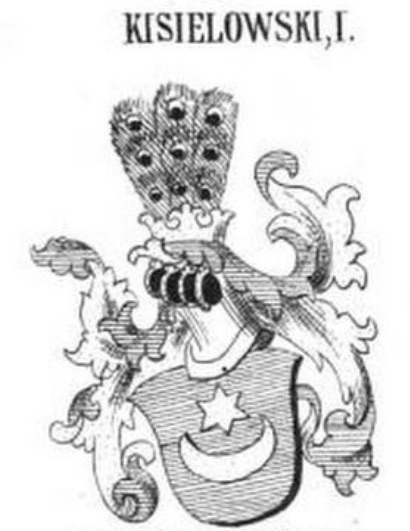
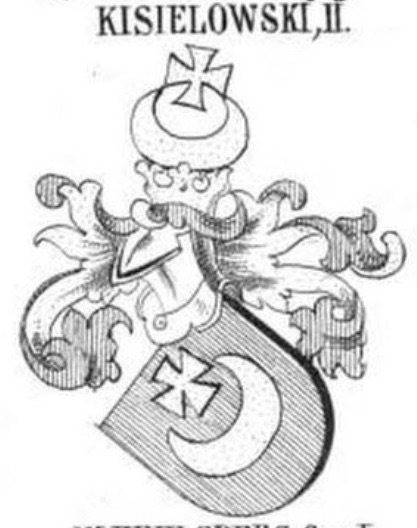
The crests are from J. Siebermacher, Grosses und Allgemeines Wappenbuch (Nürnberg, 1883), table 17
Siebermacher's book and Gottlieb Biermann's history of the Duchy of Teschen, Geschichte des Herzogthums Teschen, published in Teschen (modern day Ciesyn) in 1894, provided some genealogical background. During the fifteenth century a Johann, or Jan, was granted by the Duke of Teschen the right to bear the name of the village of Kisielow as the family name. The Duchy of Teschen was in Upper Silesia and, in the fifteenth century, was a fiefdom of Bohemia but, as Teschen had been part of the medieval Kingdom of Poland, it retained the Polish forms of coat of arms, szeliga and leliwa, the latter form of which remains in use by some Polish families today. Kisielow is located about six miles due east of Ciesyn and about 30 miles from Ostrava in the Czech Republic and 90 miles from the Polish city of Krakow (see maps below).
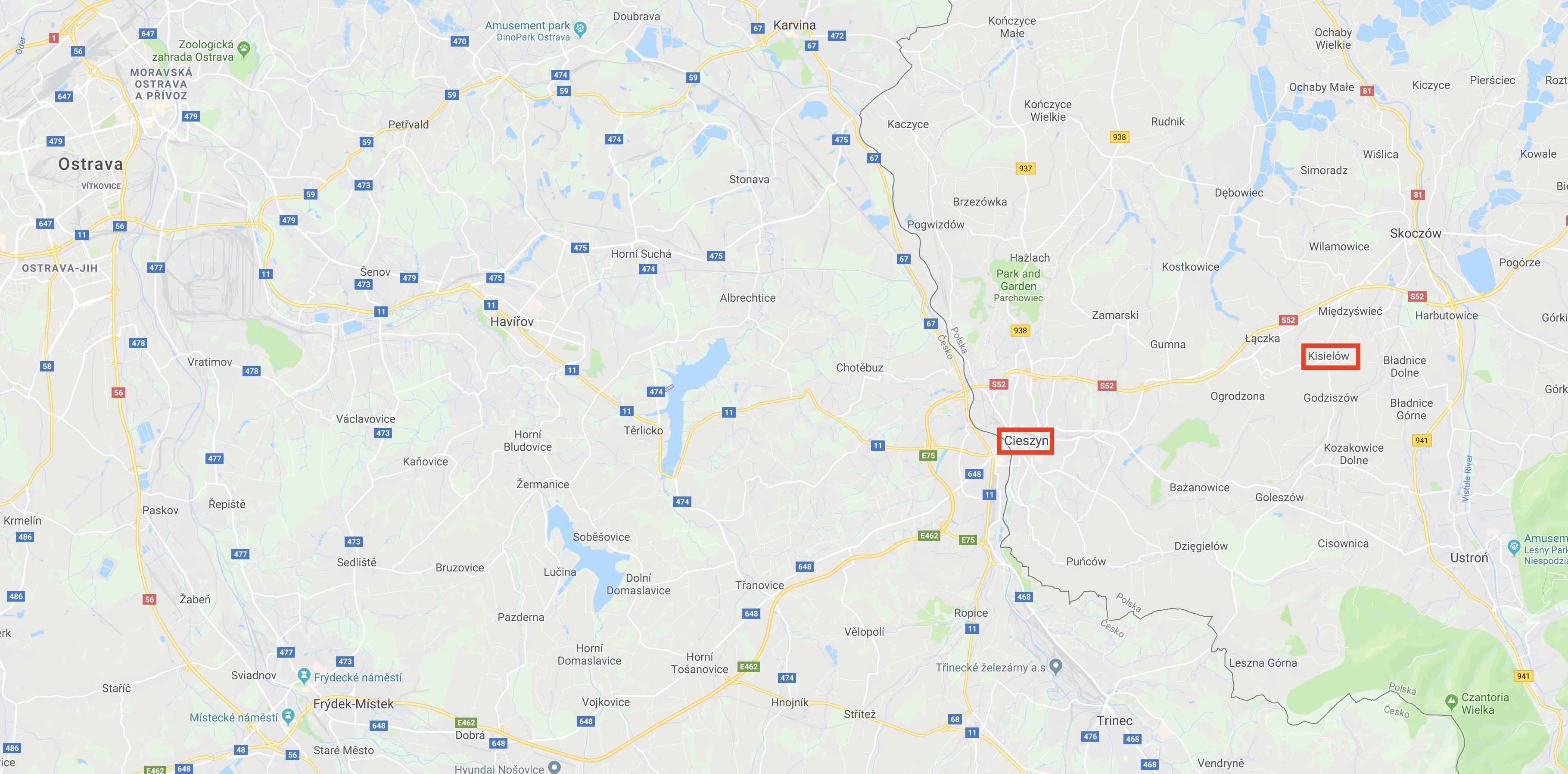
Map (above) of Czech Republic and Poland showing the location of Kisielow is from Google Maps.
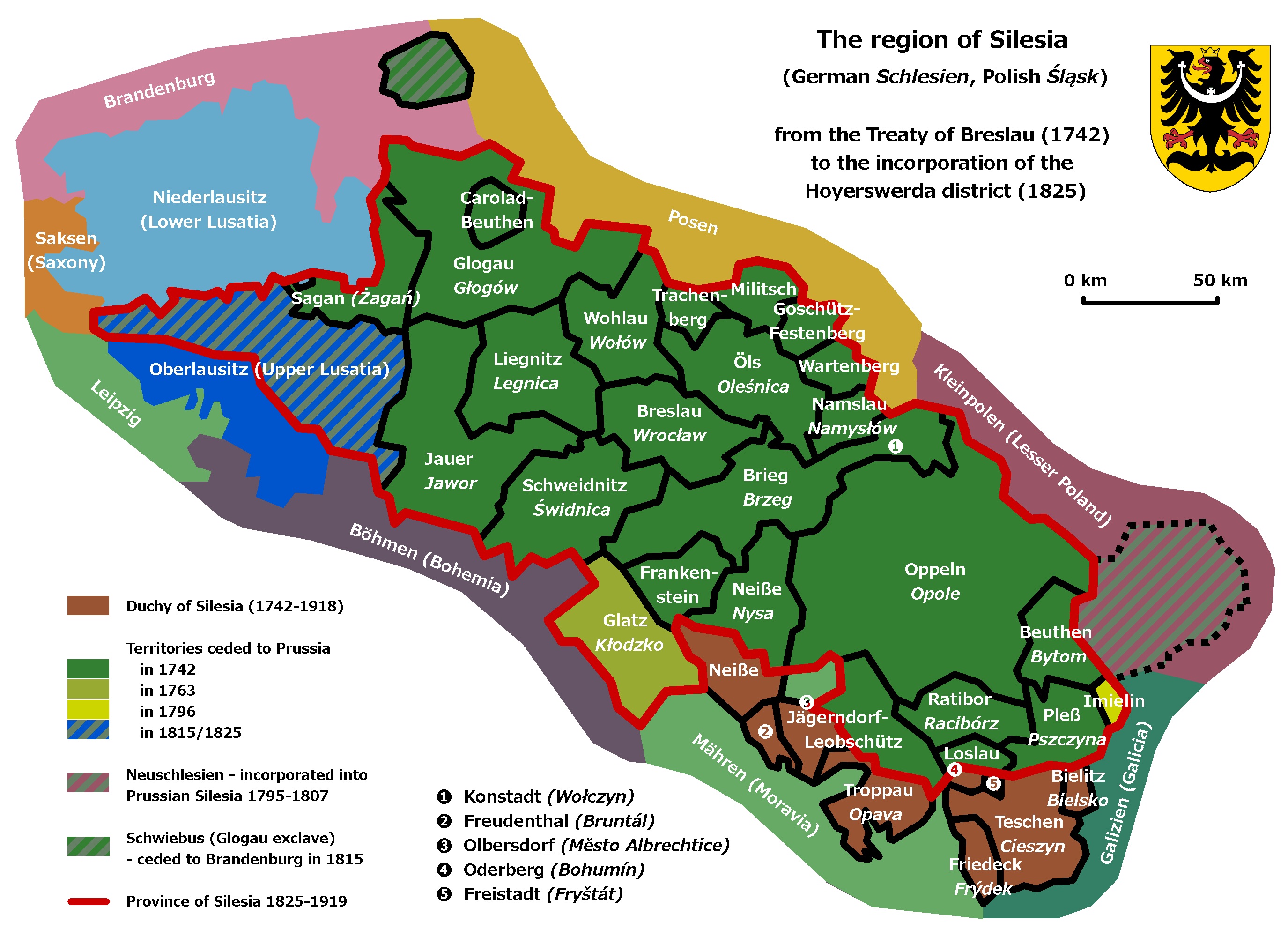
Map of Silesia: Wim Bosmans - Own work, CC BY-SA 3.0
When the Duchy of Teschen granted the family the right to attach the suffix 'ski' (the equivalent of the German 'von' or the French 'de') they became feudal lords with rights to land, and the serfs who worked the land, in return for service to the duchy. The family was granted one coat of arms in 1539 when it held lands in Kisielow and the nearby village of Nierodzim. In 1661 the Kisielowski estate was recorded as one of the Protestant estates of the Duchy of Teschen but, by 1718, it was listed as a Catholic estate; therefore, it is not clear whether the family was Protestant or Catholic. In 1718 the head of the Kisielowski family, along with others, was granted the position of 'Herren Landstände', which placed the family in the rank of the high nobility. In the eighteenth century 'herr', or lord, was one of the three ranks of the senior nobility, the others being ritter, or knight, and prelate, a representative of the church. The Kisielowskis had possessions in Kisielow, Nierodzim and Seibersdorf, the latter of which has not been identified. 1718 might have been the height of the Kisielowski status because Siebermacher noted that in 1760 the family was no longer recorded as holding these estates and that they no longer retained one of the coats of arms. Although the Kisielowski family was of an established noble line, with three villages under its control, it began to suffer a decline in fortunes in the middle of the eighteenth century. Kisilowski's father may have continued to hold some land when Kisielowski was born and may still have had a title but the family's importance and influence had declined.
If Kisielowski was born in Galicia, as recorded in the British census of 1911, the family had moved from its possessions in Silesia. However, Kisielowski was born in the Austrian empire because, although most of Silesia had been incorporated into Prussia in 1825, the Duchy of Teschen remained part of the Austrian empire, eventually becoming part of the Duchy of Silesia in 1842. If the family had moved the few miles from Teschen in Silesia to Galicia, they would have moved from a predominantly German area to the mainly Polish Kingdom of Galicia and Lodomeria. This mix of cultures, along with the different religious identities, as identified in the Kisielowski family history, are representative of the cultural clashes in the region.
The Kisielowski brothers provide evidence of the different responses to the political and social upheavals in Central Europe in the middle of the nineteenth century. The Blackburn Times referred to Carl as having two brothers, Henry and Joseph. According to the Blackburn Time's account, Henry had joined his brother in exile, working in a printworks in Padiham but left to join Joseph working in the Austrian Foreign Office in Vienna. Research confirms this account to be largely true but there are significant differences. Henry, more correctly Heinrich, was much younger than Carl. In the British Census of 1871, Heinrich's age was recorded as 28, which meant he was born around 1843, whereas Carl was born in 1827. Heinrich was a child during the uprisings between 1846 and 1848 and would only have been five or six when Carl was fighting for an independent Poland. Being so much younger could have meant he had a different sense of national identity from his older brother. Why Heinrich came to England is unknown, as is how long he lived here. In 1871, he was employed as a pattern drawer to a calico printer in Padiham. This was when Carl was still a grocer in Lowerhouse. By 1875, Heinrich had left England and moved to Vienna where he worked with his brother, Joseph, more correctly Josef. Josef's age is not known so it is impossible to speculate about the effect of the revolutions of 1846 to 1848 on him. However, unlike Carl, there is no evidence of him fighting the Austrians, the only evidence is that he served in the Austrian army. If Josef was of a similar age to Carl, he could have fought for Polish independence but, after the revolution was quelled, he could have chosen to join the Austrian army rather than become a refugee like Carl. The only evidence is that Militär-Beitung reported that Josef had been promoted to unterlieutenant in the infantry on 8 August 1863. He served in the infantry until 1866 when the Gemeinde-Zeitung reported Lieutenant Josef Kisielowski had been seriously wounded on 22 July at what was then referred to as the Battle of Pressburg (Bratislava). Later, this became known as the Battle of Blumeau, the final action of the Austro-Prussian war of the summer of 1866. By 1871, Josef was listed in the Kaiserlich-Konigliches Armee-Verornungsblatt as a finance official in the Austrian Reichs-Kriegs-Ministerium, or Ministry of War, in Vienna. By May 1875, Heinrich had joined his brother in the same department in Vienna, according to the Militar-Zeituing. So, by the mid-1870s, two of Carl's brothers had not only not chosen exile but had also chosen to serve the enemy Carl had fought in the late 1840s. In microcosm, this shows how a family, whose cultural origins were Polish, responded differently when national identity became a political issue in the middle of the nineteenth century. Carl had chosen exile and a new life in a new country whereas two of his brothers chose to serve at the heart of the Austrian military empire, the very thing that Carl had fought. The Kisielowski family warrants further study but that would mean accessing records held in Austria and Poland.
Sources
Books and Articles
John Belchem, 'Britishness, Asylum-seekers and the Northern Working Class: 1851', Northern History, Vol. 39 No. 1 (2002), pp. 59-74.
Milosz K. Cybowski, The Polish Question in Briotish Politics and Beyond, 1830-1847, University of Southampton, Faculty of Humanities, PhD Thesis (May 2016).
W. J. Linton, Memories (London, 1895).
Krzysztof Marchlewicz, 'Continuities and Innovations: Polish Emigration after 1849', Exiles from European Revolutions: Refugees in Mid-Victorian England, Sabine Freitag (ed.) (Oxford, 2003), pp. 103-120.
Bernard Porter, The Refugee Question in Mid-Victorian Politics (Cambridge, 1979).
Newspapers
Blackburn Standard.
Burnley Gazette.
Leeds Times.
Liverpool Mail.
Liverpool Mercury.
Manchester Times.
Northern Star.
Preston Chronicle.
Yorkshire Evening Post.
Online Resources
Birth, Marriage and Death records, Census Records and Travel and Migration Records accessed via www.findmypast.co.uk.
OnLine Parish Clerks for the County of Lancashire, www.lan-opc.org.uk.
Lancashire BMD, www.lancashirebmd.org.uk.
Researched and written by David Hughes, January 2019.
Further information can be found on the following link: Meeting to welcome Polish and Hugarian Refugees in 1851
Tommy was born in Blackburn in 1925. He started work as a striker for a blacksmith - Little Peel Engineering on Old Leyland Street and also helped his father on a market stall. Tommy joined the Kings Liverpool Regiment during the second World War and on leaving went to work as a milk delivery man for the old city dairy. He then began rag tatting with an old pram. Tommy's career spanned forty years and had started with a five pound note and a pile of clothes. He had hoped to get a stall on Blackburn outside market in 1954 but initially was unsuccessful however later he was granted an allocation. Eventually he had realised that there was money to be made from the rags and waited outside the rag shops to buy the best stuff from the tatters which he then sold on the market. Tommy had married Mary who washed and mended the clothes whilst he repaired the shoes - they lived on Boxwood Street.. It became his trademark to stitch the shoes together in order to stop the pairs being separated. After a while he opened factories in Clifton Street and Salisbury Street making his own shoes but this failed and he went broke. Another venture was a factory making hair stimulant "Wilgrow" but this business also folded.
Tommy went back to the rag trade selling his goods from two shops one on Whalley Range and one at Larkhill before taking a shop next to the Salvation Army and then taking over the derelict premises on Hart Street which then sold new shoes and the shop at the bottom of Ciceley sold re-conditioned shoes. He opened a shop in Chorley and a warehouse on Stanley Street. His motto was "never to sell cheap shoes but to sell good shoes cheap".
Tommy became a pioneer of Sunday trading and in 1982 was prepared to go to jail for opening on Easter Sunday. To get round the law he started opening as a private club charging a fee of twenty pence to enter and used this money and his own amounting to over £18,000 to purchase a kidney dialysis machine in memory of his mother. Tommy even became a Seventh Day Adventist calling Saturday his Sabboth and then opening on Sunday. Tommy was a Blackburn supporter through and through despite his battles with the council and even saved the pot fair after the site at Ewood had been ruled out. Eventually he had to admit defeat over the high court battle with the council over Sunday trading or risk going bankrupt.
Tommy was a generous man well known for buying drinks in the pubs whih he called cheap advertising. He hosted a huge party at his home for two thousand friends and colleagues who had helped him to get to the top in business - all he asked was for them to buy raffle tickets for charity. The business had proved to be a top attraction in Lancashire with an estimated 1.25 million visitors in 1988. Unfortunately Tommy suffered from poor health from the seventies and in 1977 was rushed to hospital after a heart attack at home so that on doctor's orders in 1986 he sold the business for an undisclosed sum. The warehouse was handed over to his two former managing directors Graham Threlfall and Joan Piper. After selling the shoe business he sold bargain clothes and was given permission to open a night club further down Ciceley. After his wife Mary died he held an auction of the contents of their home which caused a dispute with three of his children.
Tommy retired to the Isle of Man at the age of sixty five with his new wife Linda and he died at the age of eighty three on the 30th. of March 2008.
Most of the above is from articles in the Lancashire Evening Telegraph dated 16th. of October 1972, 30th. of October 1981, 20th. of February 1982, 7th. of September 1983 and 2nd. of April 2008. The Citizen supplement of the 24th. of September 1981 and the Blackburn Mail dated the 18th. of August 1983.
Article compiled by Community History Volunteer, Janet Burke, November 2021
A Local Waterloo Hero Recalled to Mind William Whitaker of Long Row, Blackburn
Transcribed From the Blackburn Standard of 24th January 1891
Walking on Darwen Moor, one Sunday afternoon early in November last, in company with my dear old friend, Mr William Thomas Ashton, it was suggested by Mr. Ashton that we should look in upon old Lawrence Kenyon, a singular character known to many of our Darwen readers, who occupies a small tenement, with about half a dozen acres of rough land, at Duckshaw, where a small clough skirted by a foot-road, opens near the summit of the moor on its eastern edge. The house stands in the hollow on the steep bank of the mountain stream, which falls in a picturesque cascade. But Nature’s endearing beauty at this spot is not matched by what remains of construction by the hand of man. Lawrence Kenyon’s solitary abode has a desolate and dilapidated look on its exterior, but that is tidy and decent contrasted with the interior, which is about the most squalid specimen of a “home” I have ever seen in a rural situation in Lancashire. My friend had prepared me to expect to find a particularly filthy and unwholesome sort of den or I might perhaps have recoiled at the threshold. The one living room down stairs looks and smells like a hen-roost, which, in point of fact it is for its human inmate shares it with his poultry, of which he keeps a numerous stock. Floor walls and ceiling are black with dirt. In a rusted tumble-down grate, a small fire is burning, and on the hearth-stone the ashes lie in heaps, the accumulation of weeks. There is no furniture except a couple of stools, a tub, an old box, and some sacking. Some potatoes scattered on the floor in one corner were the only articles of food I noticed. Old “Lol” Kenyon, the tenant is a real hermit, and this wretched hovel is his cell. He has lived by himself for years. He has a wife who however, left him long ago, and never comes near him. They were parted because they couldn’t agree. Incompatible of temper is not confined to married people of a superior grade. It occurs in the lowest stratum of society. “Lol” couldn’t adapt his habits and his humours to the ideas of any female living so he dwells alone and avoids domestic rows. He and his fowl little shanty reminded me of Dicken’s description of “Tommy Tiddlers Ground.” Hermits are not admirable when encountered at close quarters. “Distance lends enchantments.” However, Lawrence Kenyon had manners enough to rise from his stool when Mr. Ashton and I appeared at the open doorway, and to offer the seat to one visitor, and of two men who were “camping” him one vacated the other stool, so that we both were seated during the interview; “Lol” and his mates standing propped against the wall opposite the fire. The Sunday clothes of Lawrence were no variation on his work day garb. They were a suit of corduroys, of considerable age and the worse for wear. His frame is broad set but his garments hung very loose. His trousers, especially, were “a world to wide for his (stout) shanks.” His tailor must have miscalculated the amount of further development “Lol’s” person was capable of at the date when he had his last rig out. Lawrence’s face is the freshest and most healthy-looking feature of his outward semblance; it is full and ruddy; and his blue eyes twinkle at times with native humour. Neglected and lost in dirt though he be, Lawrence is not stupid or stolid. His [face] does not scowl upon you but has an open expression of countenance and an agreeable smile as he answers our questions about his marital father. Lawrence Kenyon was the son of the old Peninsular and Waterloo campaigner whose career I am going to notice, though he bears another surname, having been born out of wedlock. His father subsequently married his mother.
William Whittaker was born, as near as I can calculate, about the year 1788 of 1780. His father then lived at Altham, but removed to Blackburn when William was a child. William Whittaker in his latter days, when the town had become more populous, told his children how he used to “whip crows” (whatever that phase may mean) under Darwen Street Bridge in Blackburn. At the age of sixteen, being a strong well-grown lad, and recruits being much in demand at this time, William Whittaker was taken for a soldier. That would be the year 1895 or there abouts. The war with the French Republic was then proceeding, and the Blackburn lad was speedily sent on Foreign Service. He was in a regiment of Horse Artillery. Information is lacking as to the campaigns he served in for the first ten years or so of his soldiering, but at one period he was on active service in America, and he went through the whole war in Spain and Portugal, under Sir Arthur Wellesley afterwards the Duke of Wellington. That “Peninsular War” as it is designated in British military history commenced in 1808, and ended in 1814. William Whittaker had plenty of Experience of desperate fighting in those years. He was [present with his regiment at many great battles and severe engagements. At the peace in 1814, a number of regiments in Lord Wellington’s army were conveyed to America, the country being at war with the United States. Other regiments were brought to England, and these were shipped to Belgium in the spring of 1815, on Bonaparte’s return from Elba. William Whittaker’s regiment of Horse Artillery was ordered to go and fight again the old enemy, the French. He accompanied it and fought and he fought in the final battle and crowning victory of Waterloo. He saw some bloody work in that tremendous struggle, and whilst defending the guns of his battery repeatedly crossed swords with the French cavalry charging the British lines. Himself a tall, massive, powerful man, Whitaker had not a very high opinion of the physique of the French soldiers. They were, he said, mainly less men than the English, and could not fight so stubbornly because they were not fed as well. I am not certain whether this Blackburn warrior was wounded at Waterloo, but in the course of his long service in the army he was wounded several times, but lost no limbs in consequence of wounds. He used to tell that badly wounded soldiers often thought so little of their legs and arms when set against the prospect of a pension, that they would ask the surgeon who was to amputate a shattered limb to saw it off above the knee or elbow joint because they would thereby be entitled to an additional twopence or threepence a day on their pensions. William Whittaker, after Waterloo marched on with his regiment to Paris. A few months later, the army returned to England and was disbanded. Whittaker was discharged with a pension, having served (his son recollected) 20 years and about 145 days. He came back to Blackburn, and settled in the town where he had been brought up for the remainder of his life. That would be towards the end of 1815 or early 1816.
Whitaker was still a single man when he left the army, being of the age of 36 or 37 years, and I suppose would live in lodgings in Blackburn until he married. He made the acquaintance of a towns-woman, named Betty Kenyon, who lived in Nova Scotia. A soldier’s code of morals, after twenty years campaigning abroad, were none too strict in matters connected with love, courtship and marriage. So, it befell that Betty Kenyon became a mother before she was a lawful wife. She had a male child, who was christened Lawrence, and took his mother’s surname. Lawrence Kenyon of Duckshaw, Darwen, the hermit whose personality and environment I have attempted to describe, is identical with that illegitimate son of Betty Kenyon. He is now within a year or two of seventy years of age. His age he doesn’t seem to be sure of. As to his paternity, there appears to be no question that William Whittaker the pensioned soldier was his father. He owned him by soon after marrying his mother. She subsequently bore five other children. William and Betty Whittaker lived together as man and wife seven or eight years, I think, until the husband’s death. They resided in one of the old cottages at Long Row, near Billinge End. Whittaker did not obtain his Waterloo Medal on his discharge, but the Vicar of Blackburn, The Rev. J. W. Whittaker, who was acquainted with the veteran, wrote to the military authorities on his behalf, and in response to his application the medal was forwarded.
Among William Whitaker’s comrades-in-arms who had survived the wars, there were many, pensioners like himself, who kept up the acquaintance; and some of them occasionally travelled long distances to come and see him. Not so lucky as he had been, a number of these fellows had lost arms or legs from wounds in battle, and his wife, Betty, who no doubt knew that the spending of his scanty stock of money on drink would follow, when she saw one of these maimed heroes approaching the house, would remark “Another owd wingy coming.” Whittaker’s prolonged service in the Horse Artillery had given him an extensive knowledge of horses. He was both an excellent judge of the points of as horse, and a competent farrier. He was frequently sent for to the stables of the Feildens, of Feniscowles, the Hornbys and other neighbouring gentry who kept horses, to pronounce his opinion upon a horse offered for sale before a purchase was decided upon. On one occasion at Feniscowles, Mr. William Feilden (afterwards Sir William) wished old Whittaker to say what he thought of a stylish-looking horse which had been sent on approval. The pensioner suspected that the animal had been fettled for the occasion and directed the man in charge of it to run it backwards and forwards on the carriage-drive. He did so, and Whittaker noticed the horse pulled hard at the halter while running, as if it was trying to get its feet off the drive, and onto the grass at the side of it. He then looked at the horse’s feet, sent for the smith to take off its shoes and took from beneath a quantity of soft material with which the hoof had been padded. This is one of several stories about his father told by old “Lol.” By his neighbours and townsfolk William Whittaker in his later years was generally spoken of as “the Old Pensioner.” He lived to no great age, dying aged 51 about 1830, and was buried in the parish Churchyard.
It is a proof of the fact that few families in this district, containing several sons, did not contribute one or more recruiting to the British Army or navy, during the wars which lasted almost without intermission from 1793 to 1815, that both of the men residents in Darwen, who happened to be in Lawrence Kenyon’s house when Mr. Ashton and I called, and who listened to our questions and his replies had relatives who fought at Waterloo. One of then stated that his uncle Thomas Duckworth, served as a soldier in the army under Wellington and retired with a pension. He returned to Darwen, and died some twenty-five years since aged 70. The other man said that three of his uncles were soldiers. Their names were, respectively, John, James and Joseph Walsh. John Walsh (his height was 5ft 11½ inches) and James Walsh (his height was 6ft 3 inches) were both in the Life Guards, and were killed in battle. The other brother was not so tall in stature his height was 5ft 8 inches, and he was drafted into an infantry regiment. He was not killed, but came home on his discharge, with a pension, and also lived in Darwen. He was either father of grandfather of a man named Walsh who is living at present in Carr Road, Darwen and who works for Mr. Ashton.
W. A, Abram
Biography of William Whittaker and Lawrence Kenyon
If, as Abram says, William Whittaker was born at Altham between 1870 and 1880 then the only birth with that name is as shown below.
Baptism: 18 Jan 1777 St James, Altham, Lancashire, England.
William Whittaker - Son of Betty Whittaker
Abode: Altham
Notes: Base Child
Baptised by: R. Longford Curate
Register: Baptisms 1749 - 1788, Page 71, Entry 11
Source: LDS Film 1278856
I found the discharge papers for a William Whittaker, the dates on these are as follows:
Length of Service, 8th May 1809 to 24th January 1816.
He was about 40 years old on Discharge, so using that information, his birth, would agree with that given above, 1776 or 1777. Abram suggests that Whittaker died aged 51 about the year 1830, this again gives a birth date of around 1779, which fits in with the above, and so, William Whitaker could well have been the illegitimate child of Betty Whittaker.
However, I am not convinced that this is the William Whitaker we are looking for. Searching the 1841 census I came across a record giving the information shown below;
William Whittaker 50 hand-loom Weaver
Betty Whittaker 30 Hand-loom Weaver
Lawrence Whittaker 12 Hand-loom Weaver
Robert Whittaker 9
Sophia Whittaker 7
Henry Whittaker 3
The 1841 Census only gives the county a person was born in and not the town, but what makes this census record enticing is the address. Abram says; “They [the Whittaker’s] resided in one of the old cottages at Long Row, near Billinge End” The census record gives the address as “Long Row Ouzehead” which is in the Billinge area.
Lawrence Whittaker is given as the oldest child (there is no difficulty posed by Lawrence being called Whittaker and not Kenyon at this time). On this record, William is 50 years old. It should be noted that 1841 census enumerators were instructed to give the exact ages of children under 15 years of age and to round down those over 15 years, a multiple of 5 years so, someone aged 54 would be given the age 50. However, it is known that some enumerators gave the correct age of a person while others would round up the age. This means that William’s age could have been anywhere between 46 and 54. In that case William could have been born between 1787 and 1795.
There is a birth at Altham for a William Whittaker in 1790;
Baptism: 18 Apr 1790 St James, Altham, Lancs.
William. Whitaker - Son of Robert Whitaker & Sally
Born: 2 Mar 1790
Abode: Altham
Register: Baptisms 1788 - 1793, Page 15, Entry 1
Source: LDS Film 1278856.
If March 2nd 1790 is his date of birth then, in 1841, William would be about 51 years old.
If this is the case, then the army discharge papers above cannot refer to the William Whittaker we are looking for.
Having searched the Napoleonic War records I found another William Whittaker who would fit the person we are after.
Enlistment Age: 18
Discharge Age: 40
Birth Date: abt 1790
Birth Place: Blackburn, Lancaster
Enlistment Year: 1808
Discharge Year: 1830
Regiment: Royal Horse Artillery.
Unfortunately it is only a transcript of the actual record, with no other information included.
We do know, from Abrams article that William was in the Royal Artillery.
Again, Abram tells us that William married Betty Kenyon at Blackburn Parish Church the record reads;
Marriage: 9 Oct 1831 St Mary the Virgin, Blackburn, Lancashire, England
William Whitaker – [X his mark], Weaver, Bachelor, this parish
Betty Kenyon – [X her mark], widow, this parish
Witness: Joseph Fairbrother; William Riley, (X)
Married by Banns by: Richard Burnet
Register: Marriages 1829 - 1831, Page 270, Entry 808
Source: LDS Film 1278807
This marriage was in 1831, in the article Abram gives that year as the approximate year of William’s death. On this record Betty Kenyon is said to be a Widow. I believe this to be the marriage record of the William Whitaker we are looking for and together with the 1841 census we can presume that Abram was given the wrong information.
William Whittaker died in 1844 aged 55 years as the entry below shows.
Burial: 17 Jan 1844 St Mary the Virgin, Blackburn, Lancashire, England
Wiliam. Whittaker -
Age: 55 years
Abode: Blackburn
Buried by: Wm. Walker
Register: Burials 1843 - 1851, Page 37
Source: LDS Film 1278820 - PR3073/1/87
I have found two records for the birth and baptism of a Lawrence Kenyon, both around the same time. The first, at St. Pauls Church, shows Lawrence to be the illegitimate son of Betty Kenyon. The second is at the parish church and shows Lawrence to be the son of Lawrence and Betty Kenyon. If Betty was a widow as shown at her wedding, then the second record could be the correct one. However, regarding the second record, having searched, I cannot find a death for Lawrence Kenyon, Betty’s husband, between 1829 and 1831 which would have made her a widow on her marriage to William Whitaker.
Name: Lawrence Kenyon
Birth Date: 8 Dec 1828
Baptism Date: 4 Jan 1829
Parish: Blackburn, St Paul, Lancashire, England
Mother: Betty Kenyon
Register Type: Parish Registers
Reference Number: PR 3340/1/2
And;
Baptism: 25 Dec 1828 St Mary the Virgin, Blackburn, Lancashire, England
Lawrence Kenyon - Son of Lawrence Kenyon & Betty
Abode: Blackburn
Occupation: Weaver
Baptised by: J. W. Whittaker, Vicar
Register: Baptisms 1828 - 1832, Page 62, Entry 494
Source: LDS Film 1278804.
The 1841 census gives his surname as Whittaker and his age as 12 years old, he was a hand-loom weaver so he probably worked at home helping his mother and father who were both hand-loom weavers.
He married, I think, Rachael Hamer at Ainsworth parish church in 1851;
Marriage: 1 Dec 1851 Christ Church, Ainsworth, Lancs.
Lawrence Kenyon - (X), Full, Weaver, Bachelor, Ainsworth
Rachael Hamer - (X), Full, Weaver, Spinster, Ainsworth
Groom's Father: Lawrence Kenyon
Bride's Father: Peter Hamer, Weaver
Witness: Jonathan Fielding, (X); Margaret Hamer, (X)
Married by Banns by: G. Ridley Carr
Register: Marriages 1843 - 1894, Page 71, Entry 141
Source: LDS Film 93655
Lawrence Kenyon is given here as his father’s name. We can infer from this that either, William Whittaker was not his father and the second record showing his birth is correct or that he wanted a father’s name on his wedding certificate and chose Lawrence Kenyon rather than William Whitaker.
Lawrence left Blackburn and moved to Darwen before 1871. That census says he lived at 25 Sandhill, Over Darwen, Sandhill was more or less opposite to where the Cemetery.
His family was:
Lawrance Kenyon 41 Head, Cotton, Weaver Born Blackburn
Rachel Kenyon 40 Wife, Born, Near Bolton
John Kenyon 15 Son Cotton Weaver, Born Bury
Thomas Kenyon 11 Son, Born Over Darwen
James Kenyon 9 Son, Born Over Darwen
Sarah Kenyon 7 Daughter, Born Over Darwen
Mary Kenyon 5 Daughter, Born Over Darwen
Rachel Kenyon 1 Daughter, Born Over Darwen
In 1881 Lawrence is living apart from his wife and family at 4 Lower fold. By the 1891 Census, taken not long after his interview with Abram, Lawrence Kenyon was a farmer, living alone at Overshaw Farm Darwen. He died June 1898 at the age of 68.
An article appeared in The Blackburn Times dated the 16th June 1978, and also, in the Lancashire Evening Telegraph dated June 1978 regarding the above lady. Sometime that year a farmer, Richard Smith, from Carleton near Skipton had found one hundred and twenty letters from Lizzie to a Yorkshire Dales farmer called Tom Anderson - it seems they had been walled up in his barn for over seventy years. The BBC had become interested in the story and appealed to Blackburn people for any information about Lizzie. A Mr. Simon Bromley of Beaumaris Avenue managed to locate Lizzie's unmarked grave, plot J11687 in Blackburn Cemetery but there was no other information apart from the contents of the letters.
After searching on Ancestry it seems likely that Lizzie, or rather, Elizabeth, was born in 1850, the daughter of Joseph, a grocer, and his wife Nancy who lived in Burnley. By 1861, Joseph had died and Mrs Sutcliffe and her three children - Anne Maria, aged fifteen, Elizabeth, aged eleven and Mary, aged six along with a cousin and a boarder, still lived in Burnley. It then seems that Elizabeth went to live with her grandmother who also had a lodger, and, in 1881, aged thirty, she returned to Burnley with her mother and various other family members. It looks as though the family survived by taking in lodgers, however, in 1891, Elizabeth was living in Blackburn at 28, Oswald Street with her sister Mary Broughton, a widow, known as Polly, and a dressmaker, her niece Annie, aged nine, and a boarder, James S. Parke, a marine engineer. This is about the time that Elizabeth met Tom Anderson, a farmer, and fell madly in love with him. Tom was born in 1855, so he was a little younger than Lizzie, and, in 1881, he lived with his family at Glen House Carleton, near Skipton. How Lizzie met him is not clear but her grandmother had lived at Rough Lee and there may have been relatives in that area.
Lizzie wrote to Tom between 1889 and 1893, posting her letters at the Old Post Office at Sudell Cross.
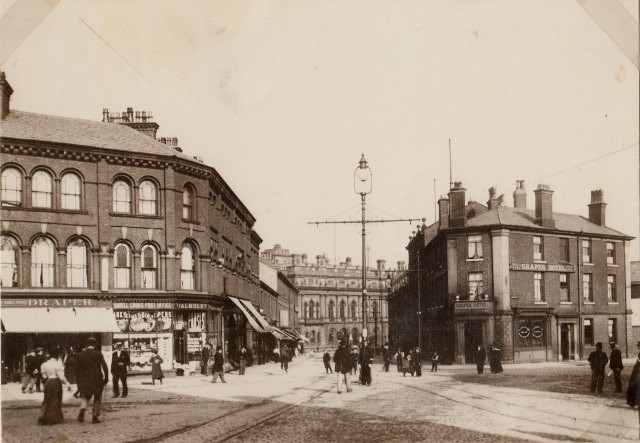
Sudell Cross, circa 1906, Post Office in the middle of the shops on the left hand side
Tom did reply to Lizzie but it appears he was not quite so enamoured, and, at one stage, he got his brother to write to Lizzie informing her of his sudden death! Lizzie accepted this but when talking to mutual friends she discovered the truth; that he was fit and well still working in the fields. She recommenced her letters to Tom and was hoping that he would marry her in spite of the fact she knew that he saw other women.
Patrick Hargreaves, a film editor at the BBC, and his staff who examined the letters stated that in 1889/90 Lizzie was living at 26, London Road with a Miss or Mrs. Lewis who enclosed notes to be sent to Tom. In Lizzie's letters, apart from her romantic thoughts, she also complained about her sister and a shortage of money which led Tom to send her a pound. This was quite a substantial amount in those days and it enabled her to pay the rent on her lodging at 28, Oswald Street as she had spent the rent money on coal. Lizzie recorded witnessing in Blackburn the terrible explosion of the 30th. of November 1891 when five people were killed and six badly injured in a gas explosion at the Crown Hotel in the market place adjoining the "sixpenny bazaar" and she sent Tom a press cutting. Lizzie apparently got by running a lodging house and had connections to St. George's Presbyterian Church and St John's Blackburn. Tom eventually deserted Lizzie and in her last letter she wrote of her disappointment. In 1901, Lizzie was living on Butler Street with three lodgers but seven years later at 24, Henry Street she died aged fifty eight. The proceeds at probate were £106-16s.-9d. granted to a William John Barbour, a fancy goods dealer.
The census of 1911 records that Tom was aged fifty-eight and had been married for twelve years but was living on the date of the census with his three brothers and sister at Carleton. There is also a record of banns being read at St. Mary's, Carleton in Craven two times but not the third reading and an entry at the side reads "(u hoax)". This entry was dated November 1885 and the intended's name was Eleanor Georgina Clifford from Manchester. There is no evidence that this proposed marriage took place and it could add to the rumours of his doubtful character suggested in the letters.
A dramatised version of Lizzie's story "Paper Kisses" was aired on BBC 2, December 24th, 1987,
A talk by Patrick Hargreaves, Director and Producer of the film "Paper Kisses" which was dramatised by Brian Thompson was given in Carleton Village Hall in 2011: Carleton in Craven:Paper Kisses
A full list of the cast and credits of "Paper Kisses" is available by searching the British Film Institute website.
Compiled by Community History Volunteer, Janet Burke, January 2022.
Margo was born in Blackburn to Alfred and Agnes Womack. Alfred worked at the Star Paper Mill and the family lived on East Street, Feniscowles before moving to the new council estate on Green Lane. Margo went to Cherry Tree Primary School and then on to St. Hilda's Secondary School.
Margo had a couple of jobs before starting at Mullards where her husband to be, John Nevil Grimshaw, also worked. They married in December 1950 and their first son Andrew was born the following October. John had then been working at the fuse factory but lost his job so they took a stall on the market which Margo ran selling material. John got another job and as Margo was pregnant again they sold the stall and stock and applied for a council house. Non was forth coming so Margo put an advert in the paper for a house or shop to rent. This resulted in a property on Bolton Road where she ran a dry-cleaning business and then a hairdressing salon. After that they thought of emigrating but with the current economic climate and two young children they stayed in Blackburn and their next venture was to take a pub. This was
the Jubilee on Blakey Moor and having no experience they learnt very quickly the ins and outs of the trade, It proved to be very successful and in the ten years they were there, the publicity stunt of the "topless bar staff" occurred - being males as opposed to females! and it was also the first pub in Blackburn to have a juke box. With the profits from their time at the Jubilee Margot and John bought the derelict Clarion Cycle Club near Ribchester.
After objections from local people it took two years before Margo gained a licence and she named the venue the Lodestar. When the breathalyser was introduced Margo sold up for £75,000 in 1972 but bought it back for less, three years later. She built her first night club - the Brickyard next to the pub and invited pop groups unknown at the time including the Boom Town Rats and the Sex Pistols, there were male strip shows every Tuesday and a competition to find Mr. and Miss Lodestar. She got rid of conventional glasses replaced by throw aways and created an open air dance arena - this however had to close due to local objections. There was a Sunday market which started with only a few stalls but ended with over a hundred. There were a lot of complaints and Margo sold out to Newton Leisure for £250,000. Margo and John had separated but were getting together again only for him to die suddenly in May 1978. Margo and her three sons went on to own several pubs and night clubs in Blackburn and other towns. When Jack Straw was reviewing the licencing laws Margo felt this would be the end for pubs as people of all ages would no longer gather together at the same time.
Margo appeared on television and in a film about real life gangsters. She was invited by David Trippier MP to be a small business advisor working for the Department of Employment. She had her own column in the Lancashire Evening Telegraph and travelled far and wide speaking to a variety of people. Always a supporter of Blackburn she had a project to build seventy flats in the centre of the town which was started at a difficult time in economic terms and the building remained empty for some time. In spite of this Margo has been a generous person both in time and money and supported many people who have gone on to become well known personalities.
Much of the above information is from an article in the Blackburn Times dated 18th. of July 1980, articles in the Lancashire Evening Telegraph dated the 14th. of December 1999, the 24th. of March and 22nd. of June 2001 and the 19th. of July 2004. Also from information contained in her published autobiography.
Compiled by Community History Volunteer, Janet Burke. Published January 2022.
My Cousin George
Liaqat Mahmood
23/02/1958-19/08/2023
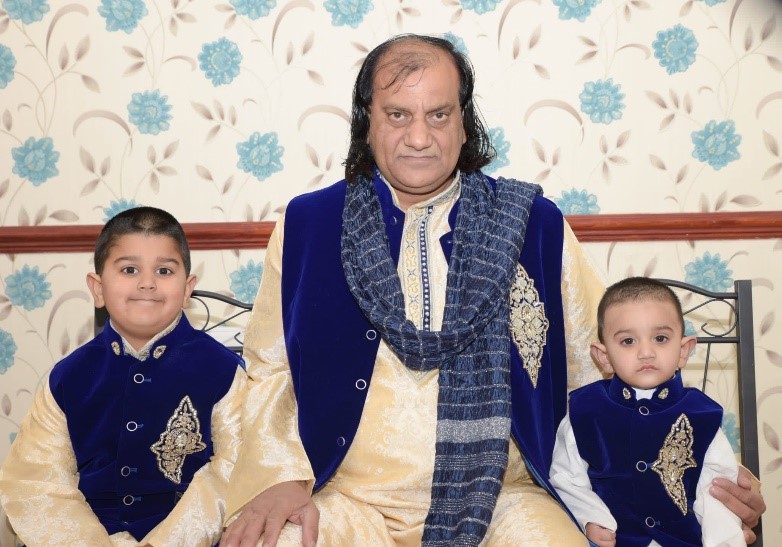
Lala George Patel with two of his grandchildren
George became a legend within his community in Blackburn ever since opening his barber’s shop in the Bastwell area, following his redundancy from the cotton mills. More on his later life later, but first let me take you back to the time when we were children.
There were only a couple of years between us, with George the younger of the two. George was one of four children; me being the only child – I guess that was one reason why he had taken a shine to me. We were born in a rural village in Pakistan, Kala Gujran, in the 1950s.
From a very early age he had developed his father’s strong work ethic, as a child he would tend to the animals – feeding and watering them. He loved to wash some of the cows on our farm, even though he was only five years old.
He had no fear of animals, he had even managed to encourage me to get on the family donkey with him to ride it to our farm from our home in the village. He was a natural with all of the animals, whereas I always felt the animals sensed my fear, which in turn would make me hesitant towards them.
His lack of fear pulled me towards him, and we became very close – if we were not on the farm, we would be together playing marbles or hide and seek.
In 1962 my father came to work in England, three years later, along with my mother, I also moved here, leaving all my extended family, including George behind. I began to miss him in those early months after our arrival here.
I was over the moon, when two years later, he came to live with us in England. By then we had moved from Oxford to Bradford, West Yorkshire.
We both went to school in Bradford, finishing off our schooling in Blackburn, Lancashire, when my father moved our family to Blackburn – he was made redundant by the cotton mill in Bradford as the industry there began to close.
Whilst in Bradford we had both got hooked on football and played it whenever we could. However, it was in Blackburn where he got his nickname, ‘George’, after the legendary George Best of Manchester United and Northern Ireland. Ever since those days of playing football on the grassland near St Alban’s Church, on Whalley New Road, he had become known as ‘George’, following his mazy runs with the ball, evading tackle after tackle.
George never really enjoyed school much, I was the ‘pen pusher’, he would rather be doing something with his hands. After leaving school, George followed my father into the cotton mills. He became a weaver and a loomer, not sure which came first. He very quickly got himself a reputation for being a very hard worker. He went onto work in different cotton mills in the Blackburn area, including Waterfall, India mill and Vale mill. He was never off sick or late for work, a discipline he took very seriously, whatever job he did.
Sadly, the cotton industry began to decline and very quickly shut down in England. This, however, did not present a problem for George, he looked to a completely new direction.
In 1982 he opened one of the first Asian barber’s shops in Blackburn, having never worked in hairdressing before – going to college to learn his skills and developing them further at his shop. His first shop was on Palm Street, just off Whalley New Road. It was in this new role, as the local barber, that he made his mark on the local community, becoming hugely popular. People would come from near and far, as his reputation grew, to have their hair cut at his shop, usually because he was open seven days a week, up to twelve hours a day, but also because he was cheaper than most other barbers. However, people also came to his shop because of his friendly welcome, a cup of ‘chai’ and a much-needed natter.
He had always got on well with people from all different backgrounds, his clients reflected the makeup of the local area and included indigenous whites, Indians and Pakistanis, young and old. It was his love of people from different backgrounds that, I believe, led to him changing his name to ‘Lala George Patel’, (unofficially that is). In his unique way he wanted to demonstrate he was proud of his Pakistani roots, being called ‘Lala’, meaning uncle, as he was seen as an uncle to all the youngsters that came into his shop; by calling himself ‘George’ and ‘Patel’, it made him feel close to people from different backgrounds.
Ask people about George using his real name, Liaqat, and the usual response will be … who? Mention George or Lala George Patel and more often than not the response will be … ‘ah yes Lala George Patel, I know him well’, or … ‘ah yes he has a barber’s shop, let me direct you to his shop’.
After being forced to sell his shop on Palm Street, due to the properties being knocked down, George moved his barber’s shop to Plane Street. With bigger premises, he attracted even larger number of clients.
Whenever I visited him in his shop, he would always have a smile on his face, talk about the Queen and how wonderful she was and his love for Elvis Presley, which he had had since the 1970s. If the shop was quiet, he would often give me his rendition of some of the King’s biggest hits … ‘Are You Lonesome Tonight’, ‘I’m All Shook Up’, ‘Suspicious Minds’, ‘In the Ghetto’ … and so on. He knew so many and did such a good impression of Elvis, he could certainly shake a leg, just like the king.
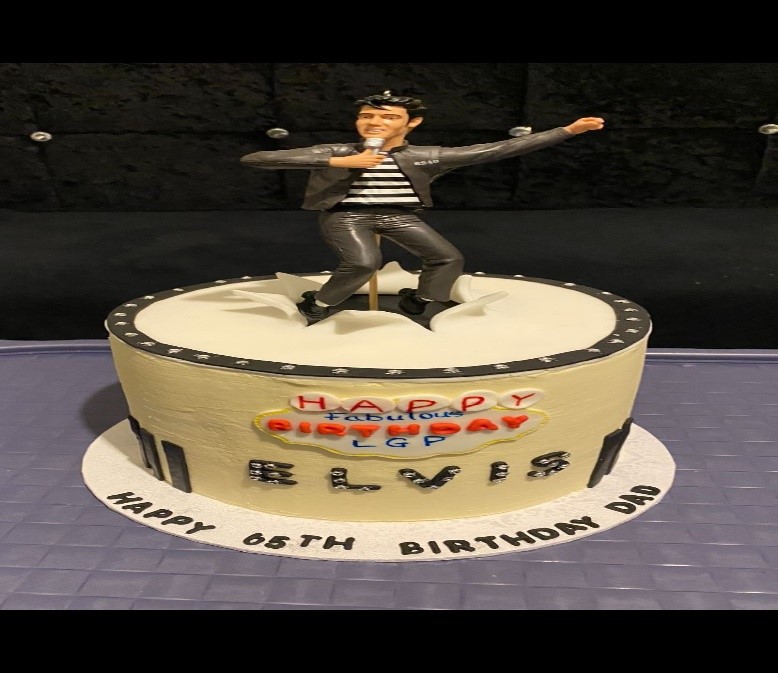
The cake specially made by his family and daughter Najma on his 65th birthday,
a fitting tribute for his love of Elvis Presley.
In his early 60s his health started to deteriorate but not enough for him to slow down and he continued to put the hours in.
Sadly, in his mid-60s, my cousin George passed away in the early hours of Saturday the 19th of August 2023, after losing his battle with cancer. Leaving behind a devoted wife, Nasreen and four loving children – who provided much comfort when he needed it the most.
George will be remembered for bringing such joy to customers and family members alike, anyone who walked into his shop, whether they wanted a haircut or not, they always walked out with a smile on their faces. He was above all a character and a people’s person.
My dear cousin George, you have enriched the lives of so many of us, you will always retain a very special place in our hearts. Rest in peace, you have certainly earned it.
May the almighty grant you Janat.
Article by Mahmood ‘Mebs’ Ahmed
Published August 2023