
 Loading more
Murder on the Heath
MURDER IN THE HEATHER:
The Winter Hill Murder of 1838
David Holding
ACKNOWLEDGEMENTS.
INTRODUCTION.
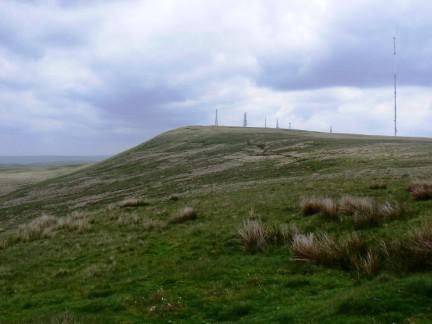
Winter Hill and nearby Rivington Moor are familiar landmarks to the inhabitants of the neighbouring townships of Horwich and Bolton, lying in the valley below. They present a challenge to the adventurous hiker who, after a struggle to the summit of Winter Hill some 1,475 feet above sea level, will have his or her efforts amply rewarded by the view it affords on a clear day. To the north-east can be seen the slopes of Pendle Hill and further still, the outline of the Yorkshire Dales.
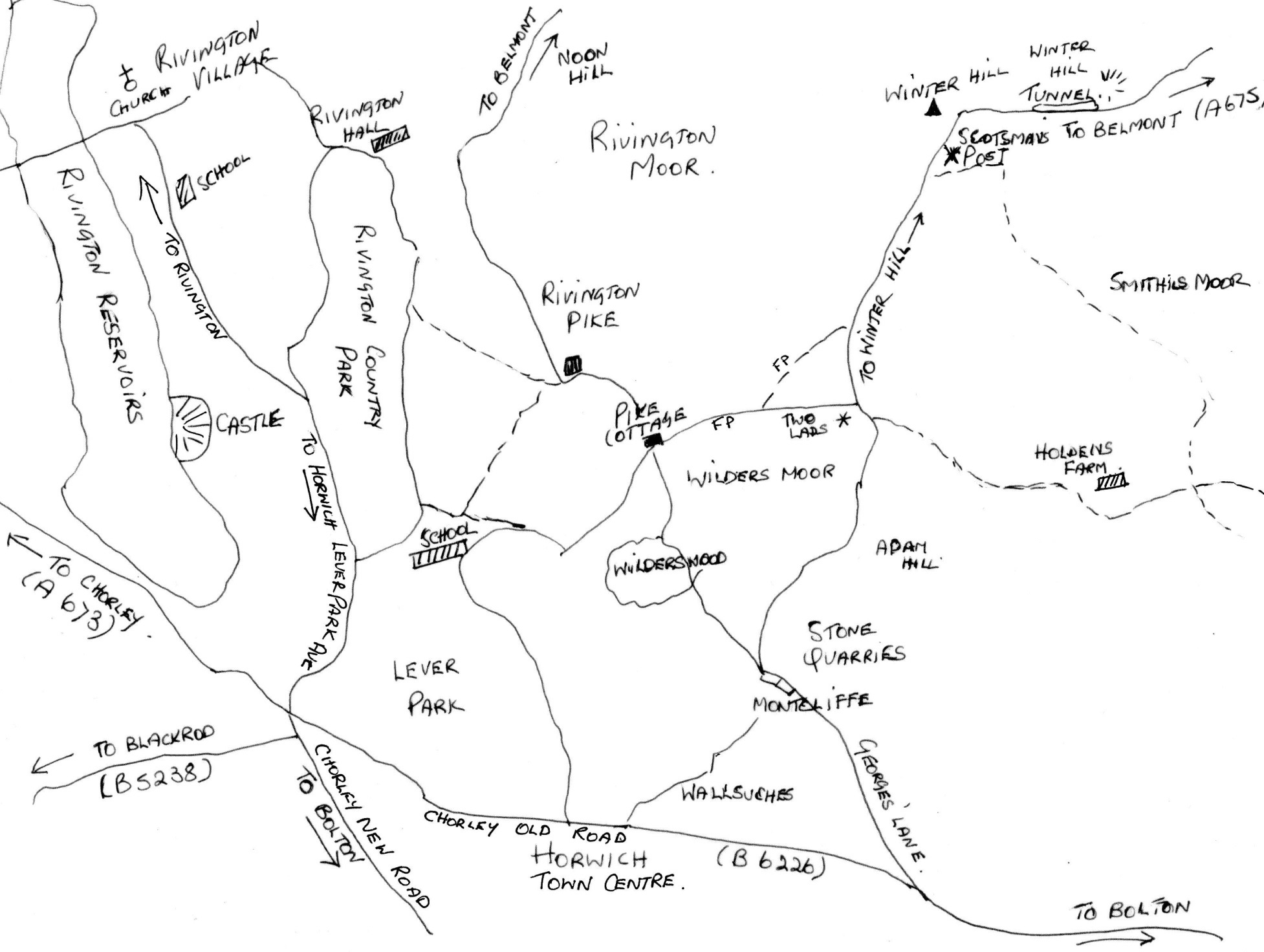
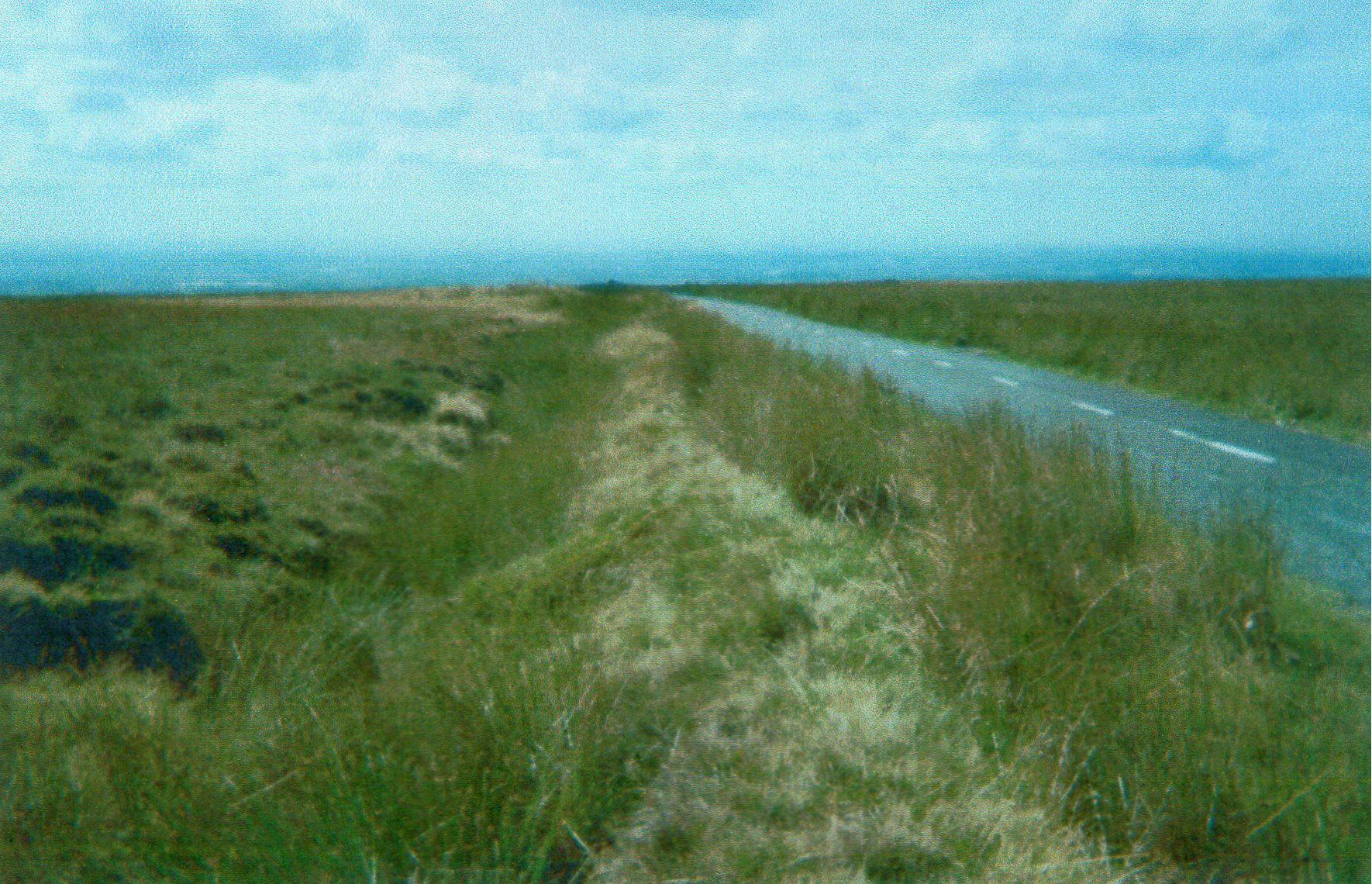
The most direct route covering the area of our case is from Bolton along the B6226 Chorley Old Road, which was formerly the old Turnpike Road from Bolton to Chorley. Just before the road drops down towards Horwich, there is on the left-hand side the 'Jolly Crofters' Inn, and almost directly opposite is Georges Lane. This lane runs along the moor's edge towards Rivington Pike passing several stone quarries. The main working quarry today is at Montcliffe, which was a small hamlet with a colliery and miner's cottages. Bearing right past Montcliffe Quarry, there is a modern road constructed for access to the TV station and radio masts on Winter Hill. This road follows the original pack route over the summit of Winter Hill towards the village of Belmont, and then on to Blackburn.
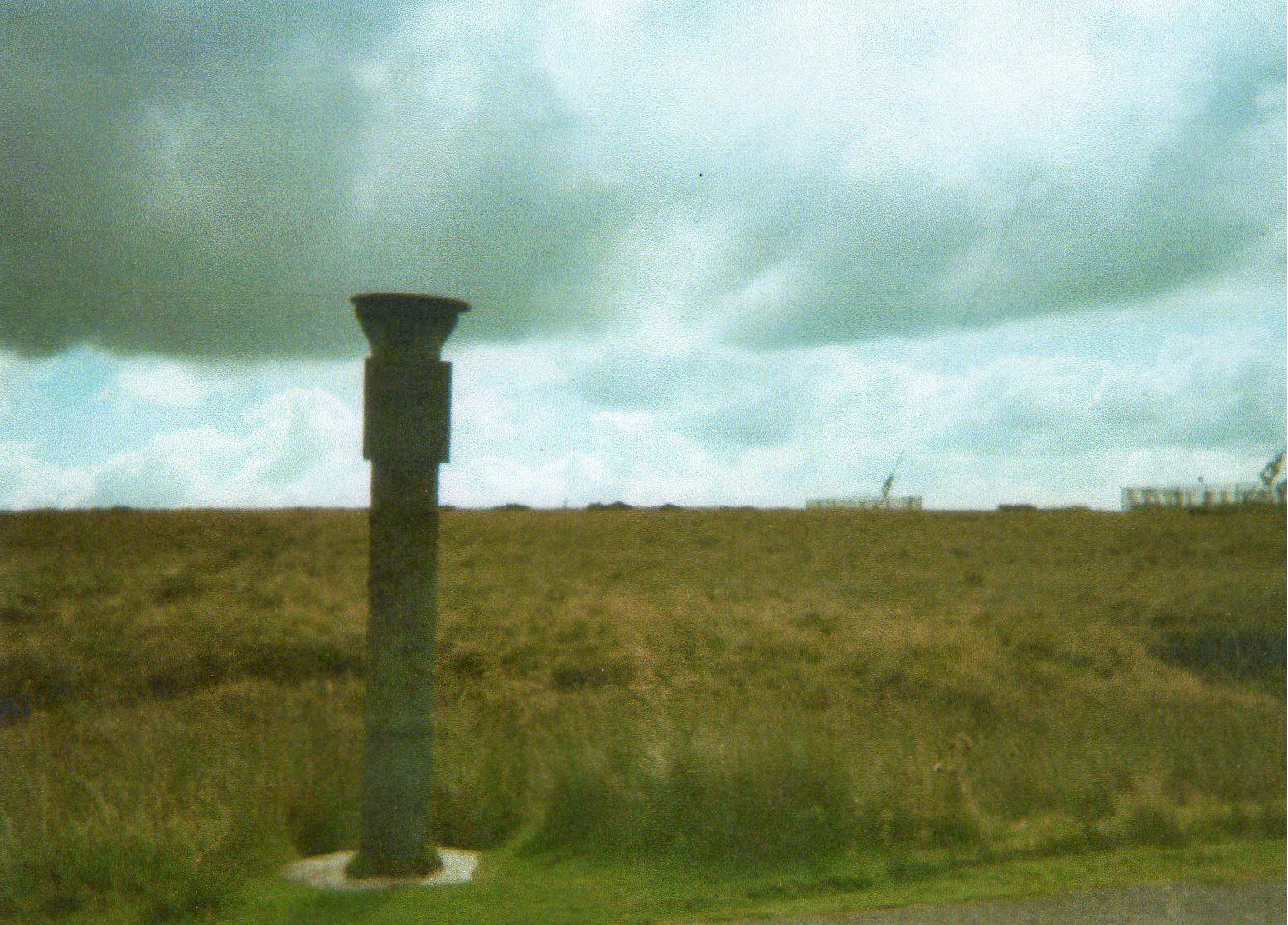
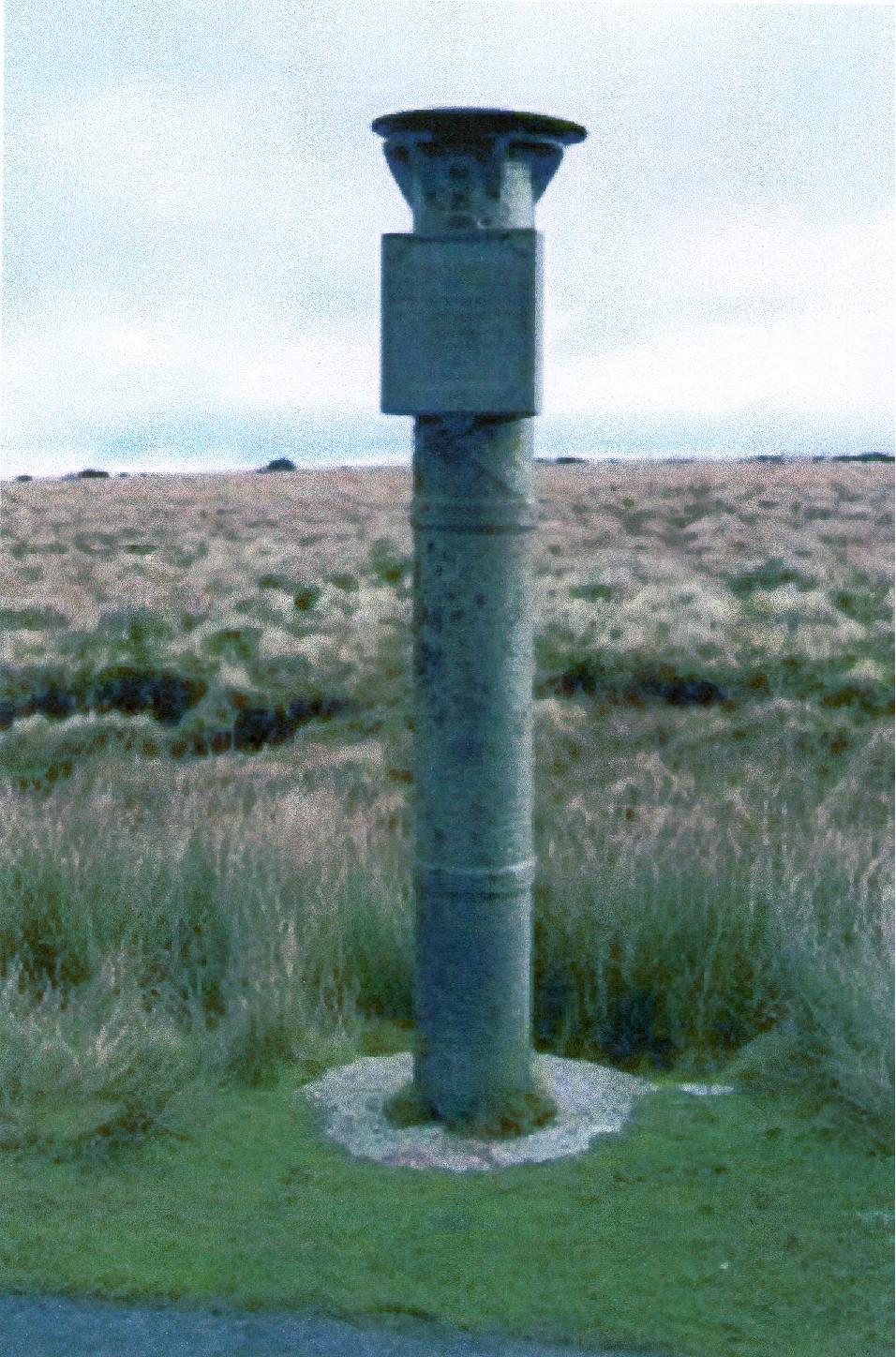
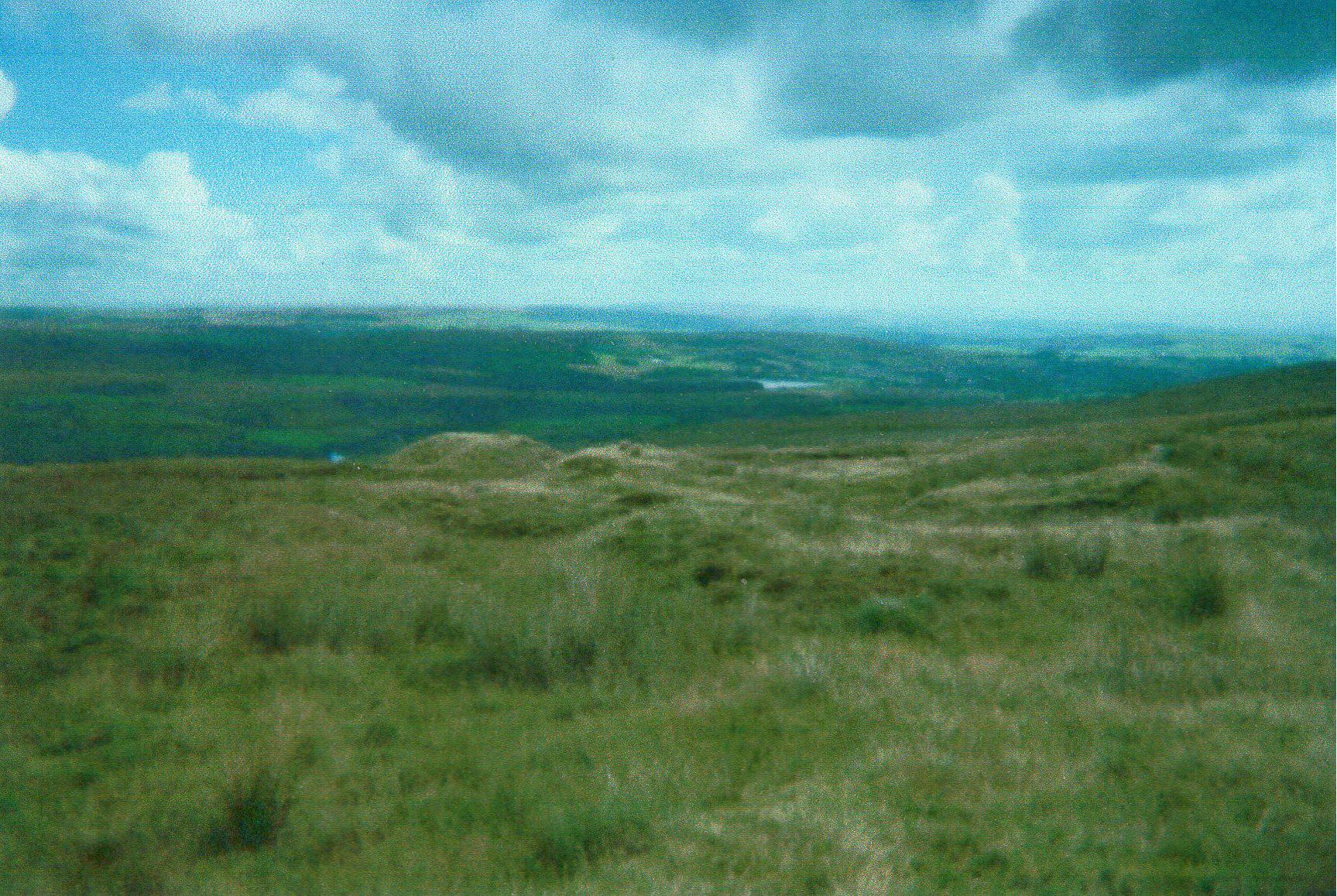
In the early nineteenth century, there were several dwellings situated along the route over Winter Hill such as 'Five Houses', a group of terraced cottages, the Winter Hill Brick and Tile Works, and several small working coal pits, all owned by William Garbutt who resided at Five Houses. When excavations were being undertaken for the present television mast in 1959, old coal workings were discovered at a depth of some 50 feet. There were part of the Wildersmoor Colliery which was worked from the early nineteenth century until its eventual closure in 1961. At a distance of some 700 yards past the television mast, there is the site known locally as “Scotsman's Stump", where a simple memorial was erected to mark the spot where the victim of our case was discovered in 1838. It bears the following inscription:
“ In memory of George Henderson, native of Annan, Dumfriesshire, who was brutally murdered on Rivington Moor at noonday 9th November 1838, in the 20th year of his age".
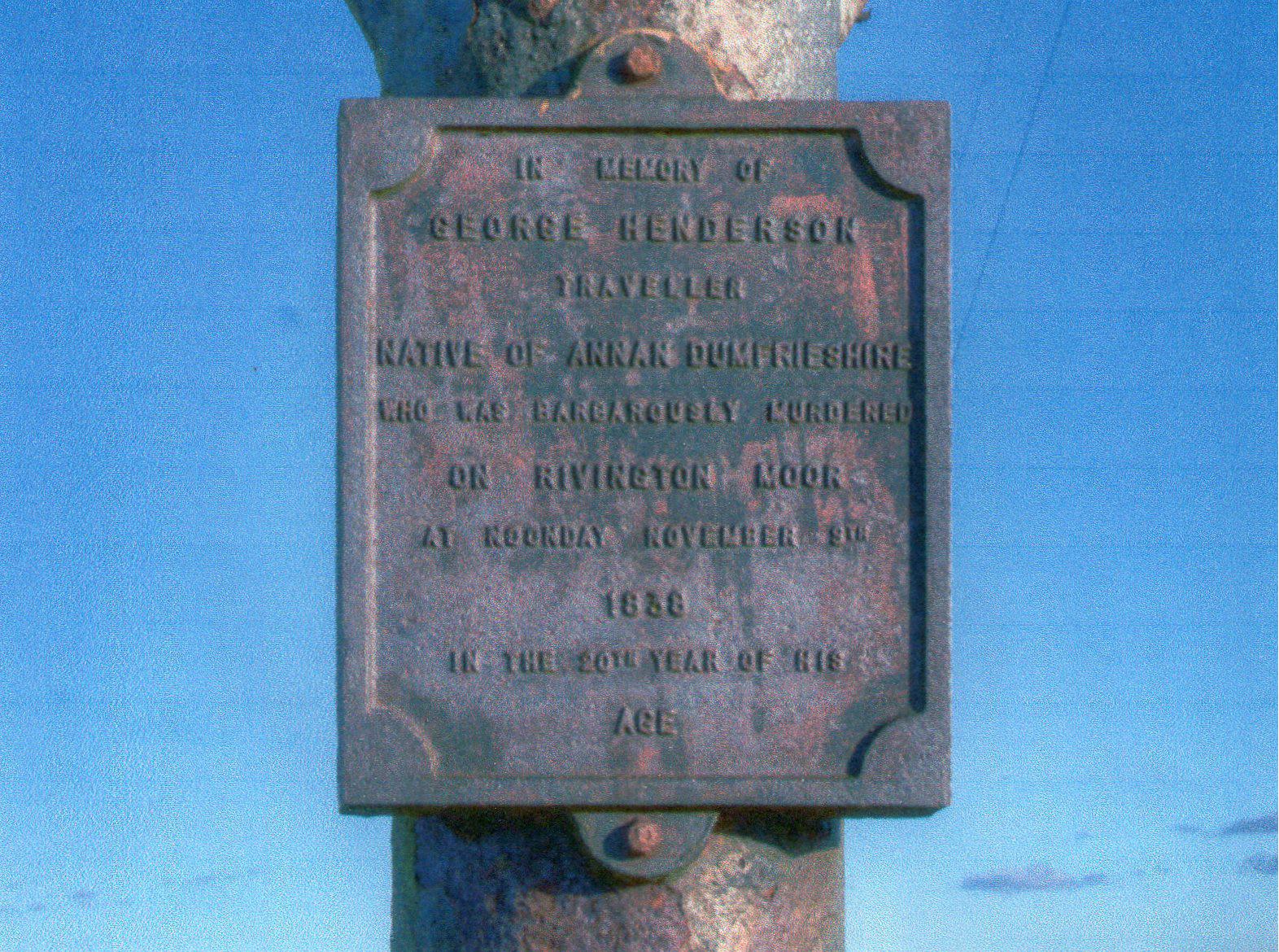
Our account of the Winter Hill murder of November 1838, commences with the movements of one George Henderson, a twenty year old Scotch traveller, a native of Annan, Dumfriesshire. He was employed by a Mr John Jardine, a draper with a business in Blackburn as his traveller. Henderson moved around the neighbourhood stretching from Blackburn to the outskirts of Bolton, including surrounding small villages, selling goods, taking orders and collecting payment in return. It was his usual custom to make his way every other Friday back to Blackburn to report to his employer. This would take him on a regular route over Horwich Moor and Winter Hill to the village of Belmont.
He is known to have stayed overnight at the Old Cock Inn, in Manchester Road in the village of Blackrod on Thursday 8th November 1838. The following morning from the high vantage point of Blackrod, thick cloud could be seen smothering the nearby moors at Horwich and Winter Hill. It was in this general direction that the regular travellers' route to Blackburn ran, climbing up the moor and passing over the summit of Winter Hill, before descending to join the Bolton to Preston road near Belmont. About half a mile distance from the summit of Winter Hill and along the left-hand side of the road, stood a group of terraced cottages known locally as “Five Houses" or Garbutt's, after the owner of the cottages, brick and tile works and several local coal pits. Garbutt's own cottage also doubled as a beer-house which became a regular meeting place for both travellers and the local inhabitants of the area.
PRESS REPORTS OF THE INCIDENT.
“HORRIBLE MURDER AT BELMONT."
“ Yesterday about one of the clock, one of the most dreadful and atrocious murders was committed in our neighbourhood which has now fallen our lot to report. It was with no common feeling of regret that we now take down to make public the gross act of great turpitude. Up to this time, the deed is wrapped in mystery. By the kindness of two medical gentlemen we have heard the particulars of the event and we are grieved to be compelled to make this public. All who know this country known that there are parts which are secluded and wild. Imagination pictures deeds of violence as we pass such tracks, and it was on one of these bare and barren spots that the murder was perpetrated. A poor itinerant Scotsman is the victim. With another of his countrymen, he was in the habit of travelling the county. The deceased was going by appointment to meet a friend at Five Houses near Two Lads, crossing from Horwich to Belmont. The non-appearance of the deceased induced the other Scotsman to go in search of him. The unhappy man discovered him by the roadside in a dying state, a shot having passed through his head, found its vent through the left eye. The face was terribly blackened. When found, he uttered, “I'm robbed, I'm killed".
“ His friend having to meet him, went back to the Black Dog at Belmont, where they ought to have dined, the dinner was ordered, but finding he did not come, he went in search of him. He states that while on his road, he met a tall man in shooting coat with a gun. He states that the stranger immediately lowered his gun and he saw him no more. He sought his friend and never heard of him until he heard of his death. No suspicion being attached to the man who gave evidence, he was allowed to go on his way and wept as he went to Blackburn. The body of the man presented a fearful spectacle. Mr Wright of Belmont was active in ascertaining as far as possible, the circumstances of the case immediately it was known. We are anxious as far as possible to give publicity to the murder that the circumstances being known, someone may perhaps be able to throw some light on the matter. The part of the country described is well-known. It was daylight when the murder was committed. The victim is dead and may be, we hope, identified, and we feel that no better way of getting information regarding this barbarous act, can be obtained than through the press, and hope the inhabitants of Blackburn will assist in the discovery and apprehending of the person who knew, and is likely to give some information regarding the individual in question."Bolton Chronicle, Saturday November 10, 1838.
HORRID MURDER AT HORWICH MOOR NEAR BOLTON.
“We have of late observed with feelings of the utmost horror, the frequent recital in the public journals of the perpetration of barbarous and inhuman murders in the Sister Isle, but little did we think that we should be called upon to relate one of those dreadful instances of desperate depravity which reflects disgrace not merely on the age in which we live, but on human nature as occurring within the confines of our own country. It is our painful duty to give the particulars of a most horrid assassination which took place on Friday last at noon day on Horwich Moor about two miles from Belmont. On diverting from the Bolton Road to Belmont by the print works of Messrs Spencer and Winder, the traveller from Blackburn proceeds about half a mile up the New Preston Road to a gate 220 yards distant from the Wright's Arms.On going through the gate he proceeds along the base of a long chain of hills on his left, having a fine view to the right of Hill Top, the mansion of Thomas Wright Esq, and on the left a modern ruin called the Sheep Folds. On arriving at the top of Winter Hill, elevation 1,500 feet above sea level, we enter Horwich Moor the scene of the dreadful event. About half a mile from the nearest house by the side of the road, the victim of this deadly attack was shot in open day and thrown into the ditch. The bed of the ditch was covered with a small quantity of water. The deceased who was a traveller in the employ of Mr. John Jardine in this town, had travelled from Blackrod early in the morning and was proceeding on his road homewards through the moor when his further progress was arrested by the deadly hand of the assassin."
Blackburn Standard, Wednesday, November 14, 1838.
“Yesterday an Inquest was held before William Smalley Rutter, Gentleman, Coroner, at the Moorgate Inn, in the parish of Horwich, on the body of George Henderson who was found on Friday morning last, lying in a ditch in a wounded state. The Jury assembled precisely at eleven o'clock having viewed the body of the deceased previously which had laid at a beer-shop at Five Houses about two miles distant. The following were sworn onto the Jury:
Mr. Richard France , Foreman.
Mr. Titus Barlow.
Mr. John Pendlebury.
Mr. William Longworth.
Mr. John Hopwood.
Mr. Thomas Markland.
Mr. Hugh Grundy.
Mr. Richard Crankshaw.
Mr. Robert Barlow.
Mr. John Knowles.
Mr. Richard Booth.
Mr. Robert Orrell.
Mr. Joseph Winter.
Mr. James Spencer.
Mr. William Longworth.
“Thomas Whowell stated that he resided at Holden's Farm on Smithills Moor with his grandfather Thomas Walsh. On the Friday morning he was going with his brother's dinner to the coal-pit on Winter Hill. He saw a Scotsman pass by carrying a bundle at the end of his stick. He passed him about 100 yards. As he was going straight along the road from Five Houses to the Winter Hill Tunnel, he heard a moan and looking up the road, he discovered several spots of blood. He was terrified and set off running immediately to the Tunnel to get some help. James Fletcher who was getting his dinner, came back with him to the spot where he heard the moaning. On going to the ditch he observed the Scotsman who he had seen passing that morning lying on his back in the water. There was blood then flowing from his head. Fletcher and he could not lift him and so he sent for further assistance. The blood in the road was about three yards from where the victim lay. There were no marks as if the body had been drawn across the road. From the place to the Tunnel was about 400 yards. The bundle and the stick were lying at the edge of his feet, He spoke only once when he and Fletcher got to him. He said," Oh Jamie, Jamie, they have robbed me". From the time he heard the moaning to the time he got to the coal pit he saw no other person about the moor. It was terribly misty. He could see no more than a yard or so before him. Fletcher was the very first man who saw him after he got to the coal pit. He did not hear a gun going off. When he saw the Scotsman pass, he was perfectly sober. The breeches pockets of the deceased were turned out. There was not sufficient water in the ditch to cover the body. He could not tell who he meant when he said ,"Jamie". He heard no report of a gun on the moor at this time. When he got to the Tunnel, he found Fletcher's daughter there. There was no one else. The daughter had brought her father's dinner from Horwich."
“James Fletcher stated that he lived at Horwich and was a banksman. The pit where the boy came from was the pit at which he was employed. It was distant from the Tunnel 400 to 500 yards. On Friday last he was opening a delph at the side of Winter Hill gate, a short distance from the Tunnel. His daughter had brought his dinner to the pit and, as it was rather wet, they went to the Tunnel. On going towards the 'Stumps,' he heard the noise of a gun being fired. He said to his daughter that it was rather rare game for the poachers that day, for the keepers couldn't see them. From the delph to the Tunnel was about 160 yards, and from the Tunnel to the pit was about the same distance. When the boy came to the Tunnel he had been there about ten minutes. The boy came running to the Cabin door. He said he had seen some blood and thought a man had been killed for he heard a moaning noise. He went back with him and discovered the deceased lying in a gutter by the side of the road. The body was in some water. He could not lift him out so he sent his daughter to Garbutt's for assistance. He lifted the victim on the side of the bank and he gave a deep sigh. He observed that he had a parcel to send off on Monday and then he said, “Damn them", after which he put his hand to his nose and in an attempt to blow it, the blood rushed out of the socket of the left eye, the other eye had obtruded itself from the socket more than two or three inches.
He had been shot and the mass of the shot had passed just under the right ear. Thomas Ratcliffe came and assisted him to get the deceased out of the ditch. When they got him out, they found the waistband of the breeches undone, except one button, and the right-hand breeches pocket was turned out. He laid the body on the ground and rested the head on his knee until a chair was brought. They then carried him down to his master's, where the body now lies. He remained with him until he died which was about half-past two the same afternoon. The brains came through the eye which was blown out. The cheek and under the ear was stained with powder marks, and the roots of the ear or eye were projecting out. The wound at the ear seemed as if it had been made by the muzzle of a gun put against it. The brains were lying scattered about the road. There was no damage done to any other part of his dress. After he heard the report of the gun he saw no person about. There had been a tramp in the Cabin in the morning. The report of the gun was not distant, and it came from the direction in which the boy ran from. It was the report of a gun, not a pistol, such a fire as might come from a sportsman. He had never seen anyone with a gun that morning, and that was the only report he had heard that day. It was not such a day as a sportsman would select for shooting because it was so misty."
“James Ratcliffe stated that he lived at Horwich and was one of Mr Garbutt's banksmen. The first that he heard of this was from Fletcher's daughter who came running down the road to the coal pit. She told him that her father had sent her for him to help get a man out of the ditch. He went and assisted him. His master and Whittle's father came up, and Mr Garbutt sent Whittle's father for the doctor and a constable. We then carried the deceased down to Five Houses, and he saw the wound on the Scotsman's ear which was blackened with powder. He did not hear the report of any gun. He was working at the pit about 600 or 700 yards from the spot where the deceased lay. When the boy Whowell came he was in the Cabin eating his dinner. He had not seen anyone with a gun that day. He had seen the first Scotsman passing an hour before in the direction of Belmont. He saw him afterwards that day, when he was sent for from Belmont by Mr Garbutt. He said to him on hearing the particulars of the murder, “It might have been me". The coal pit where he worked is near the road. He did not know the Scotsman."
“Mary Entwistle was the daughter of James Fletcher and was at the Tunnel with her father when the boy came in. She lived in Horwich and took her father's dinner to the stone pit on Friday. She went the road the Scotsman did. It was about 12.30p.m. when she arrived. She knew the boy Whowell but she had not seen him before he came to the Tunnel. She heard the gun fired but saw no other person about. After the boy came they went with him to where the deceased lay. She went to the pit to Ratcliffe for assistance and afterwards to Garbutt's for the same reason. Mr. Garbutt was at home and accompanied her and John Whittle (the prisoner's father) back to where the body was lying. She then went home. At about 8.30a.m. that morning she saw Whittle with a gun shooting near her house. She thought he had the same clothes on then as he had now. She was sure that it was him for she knew him well. She never saw anyone with a gun besides him that day. He was firing upon the moor at some moor game but he missed them. Her house is in the hollow near to Five Houses. She did not go into Garbutt's house to give the alarm but shouted out, and told him that a man was lying in a ditch. Both Mr Garbutt and his wife came out. Whittle's house is a door or two from Garbutt's and the prisoner lives with his father and mother there. She lives about 200 yards away in what they called Quaker John's House. She did not see the prisoner again until 5.00p.m when he was standing by Garbutt's."
“William Garbutt stated that he knew the deceased by sight, in consequence of his regularly passing his home, but he never frequented his home during his travels. About noon on Friday last, he came in for the last time. He was alone when he came in, and he called for a glass of ale and drank it off twice. When he came in, the two carters were already in the house. This was about 20 minutes before the girl came in to give the alarm. He had seen Whittle before that day in the forenoon. At daylight he heard someone firing on the moor. The prisoner's father was that morning getting in some potatoes for him. He said, 'there is a great deal of shooting going on this morning'. He replied,' yes, I have seen some smoke twice'. While talking to his father, he saw some person which he believed was the prisoner, come through the hedge bottom with a gun in his hand, just before he had heard three reports of a gun. This was about 9 or 10a.m. He was never seen at his home after the dead body was brought in, but his wife told him that she had seen the prisoner look into the window on the Friday morning whilst the deceased Scotsman was still inside. “ Robert Makin, Constable of Halliwell stated that he informed the prisoner of the charge on which he was being arrested. He had asked, 'Have you seen the Scotsman?' Whittle had replied 'Yes, I have seen him and spoken to him'. The constable then asked him how he knew it was the man. He replied,' From the description that had been given afterwards'. He then asked him what kind person he was and what dress he wore. The prisoner replied that he could not tell. He afterwards said in the lockup, on being asked by the constable what had killed the deceased, that it was not a bullet but slugs. He then stated that he had been on the moors that morning but with no gun on him."
“An adjourned Inquest was held on Friday 16th November 1838. Thomas Rutterworth, residing at Blackrod, stated that he knew the deceased. He was in the same way of business as the deceased. He was in business on his own account and had seen Henderson on the Thursday night and had stayed with him at the Cock Inn at Blackrod. He saw him start on his road homeward at 8.00a.m. He had no opportunity of knowing what money he had about him. He heard him call for some port wine at the Inn which he paid for in silver. The Coroner addressed the prisoner, “Whittle, the evidence is now closed. Now is the time for you to say anything in your defence or to call any witness to prove where you were at the time when this horrid transaction took place". Whittle protested his innocence and said that he hadn't anything further to say than that he was at home at the time when the alarm was given, and also at Five Houses at 12.00 noon, adding that his father could prove this. A proclamation for witnesses for the defence was announced, but not a single person offered to come forward. The prisoner was about 22 years of age, six feet tall, possessing a dark, morose, unpleasant countenance, but strong and athletic form. He has of late been a lawless, dissolute and reckless character, known for poaching. His habits of indolence had been latterly more confirmed, having formed an illicit connection with a young woman in the area to whom it is said, he was to have been married in the week previous to the murder."
Blackburn Standard, Saturday 17 November, 1838.
“Several witnesses were examined who proved the prisoner was at Five Houses on the day in question at 12.00 noon, and that at the time the deceased passed Five Houses, the prisoner was seen to leave his father's house and go in the direction of where the deceased's body was found afterwards. The prisoner was committed to Kirkdale for trial at the Liverpool Assizes."
The Manchester Times, Saturday 17 November, 1838.
“George Henderson was shot through the head by some villain and his pockets rifled after which the body was thrown into a ditch by the road side. He ( the accused) had a single barrelled gun which was a percussion piece. The Coroner asked the prisoner if he had any witnesses to prove where he was at the time of the murder. The prisoner's father John Whittle appeared very much agitated and stated that his son was at home when the murder was committed."
Wheeler's Manchester Chronicle, Saturday 17 November, 1838.
“About 10.00 a.m. in the morning, Mr Benjamin Burrell, the friend referred to, arrived at Five Houses and went into the beer-shop kept by Mr. W. Garbutt, where he waited for half an hour. We have to add that Roger Horrocks, who was found in a turf-cess with a gun at his side, was at one time supposed to be the guilty party, but closer evidence fixed upon a man names James Whittle, the former was liberated and the latter arrested. On Tuesday, November 13th, the Inquest was held and in consequence of the reports that were current on Friday and Saturday, Thomas Wright Esquire and Peter Ainsworth had thought it right to direct the arrest of a collier named James Whittle who was in the employ of the latter. William Garbutt, beer-seller and master collier, said he lived at Five Houses, Horwich. There are no other houses on the road but those between Horwich and Belmont. A girl informed him in the forenoon of that day. He recollected seeing him fire a gun at the bottom of his garden on Friday morning. He saw Whittle pass by his house while the Scotsman was inside. There was no other company. Many people came in to see the body but he did not see Whittle amongst them. Burrell, the surviving Scotsman, said he was going to Belmont and saw a man near the place where Henderson was found, above the hill, and he had a gun. A verdict of Wilful Murder was returned against Whittle. The trial took place at Liverpool Crown Court on Tuesday, April 2nd, 1839."
Horwich, its History, Legends and Church, Thomas Hampson, 1883.
“Adjourned Inquest – Yesterday morning at 10.00 a.m. the adjourned Inquest was held. Daniel Cook, Constable of Sharples, was called in. He said that he had been sent for by Mr Wright to apprehend at the coal-pit, Whittle who worked there. The Constable of Halliwell took him into custody. The prisoner said he had no gun with him on Friday afternoon, and that he was out with Mr. Matthew Lambert. He said that he had shot a bird that day but couldn't remember what kind. Henderson had made an appointment with another Scotsman, Benjamin Burrell, to meet on the road over the moor and dine at Belmont. Burrell arrived at Five Houses about 10.00 a.m. and he waited at Mr. Garbutt's beer-house. He waited about one and a half hours, and then left a message that he would meet Henderson at dinner in Belmont. At approximately 12. noon, the deceased arrived at Garbutt's and was told that Burrell had gone on, so he hastened on. At about 12.15p.m. the body was found, and there was a coal-pit about 300 yards from the spot. One of the banksmen took Henderson by the hand and said, “I think you are hurt, sir". The deceased replied, “I am robbed, Jamie, and I should have sent a parcel off on Monday". He was immediately removed to Garbutt's who, on hearing the news, got all the workpeople out of the pits, and the moors were scoured in all directions. From various circumstances which came to light, it was deemed necessary to apprehend James Whittle, a young man of 22, who resides next door to Garbutt's and is employed as a collier at Mr. Ainsworth's pit in Halliwell. “
“ Garbutt immediately sent men on horseback to Belmont for Mr. Burrell. On his return, he stated that when he arrived near the spot, a tall white looking young man dressed in blue clothes with a gun in his hand asked him, “ Is there any game about here?" Burrell replied, “ I believe there is “. Whittle then said, “If you go with me a bit, you shall have the first that I kill". Burrell declined the offer saying that he had business to attend to. After walking a few yards, he turned to see the man with the gun levelled as if to shoot him. He pretended to have been aiming at birds. Burrell proceeded but kept an eye on the man as he went. When this was related, suspicion fell immediately on Whittle who was exactly the sort of person described in both dress and appearance. Whittle was also seen opposite Mr. Garbutt's house without a gun at the time the alarm was given. He made off without redering any assistance, and did not return until night. He also led a dissolute life of late. Mr Jardine, the deceased's employer, had met Henderson on Tuesday night at Preston, and received all the money he had collected upon his journey. Mr Jardine conjectures that he could not have had more than £15 about him at the time of the murder. According to a witness, Thomas Whowell, Henderson passed him about 12.30p.m. carrying a bundle on the end of a stick. He heard moaning about half a mile from the pit, and a further 10 yards, he saw blood on the road."“
Mr. W. Jardine, Mr .J. Jardine, Mr. P. Johnson and Mr. G. Brown rode in the procession. The cavalcade passed the spot where the murder was perpetrated and continued to course over Winter Hill to the New Preston Road whence diverging to the left, it proceeded to Belmont and then fell into Bolton Road. It reached the village of Over Darwen about 3.30p.m. The streets were lined with spectators from the Bowling Green Inn at Livesey Fold. On arriving at the Crown Inn at Nova Scotia, the cortege was met by Rev. Francis Skinner, Minister to the Scottish Church, and twenty-five of his countrymen attended. The procession moved towards Blackburn, and passed through Darwen Street, Church Street and Salford Street, reaching the Presbyterian Church in Mount Street at 5.00p.m. The chapel was crowded to excess with not less than 1,000 present. The following Sunday afternoon, the Rev. Skinner in his funeral discourse, used the text, “ In the day of adversity, consider."
Bolton Chronicle, Saturday 24 November, 1838.
CHAPTER TWO.
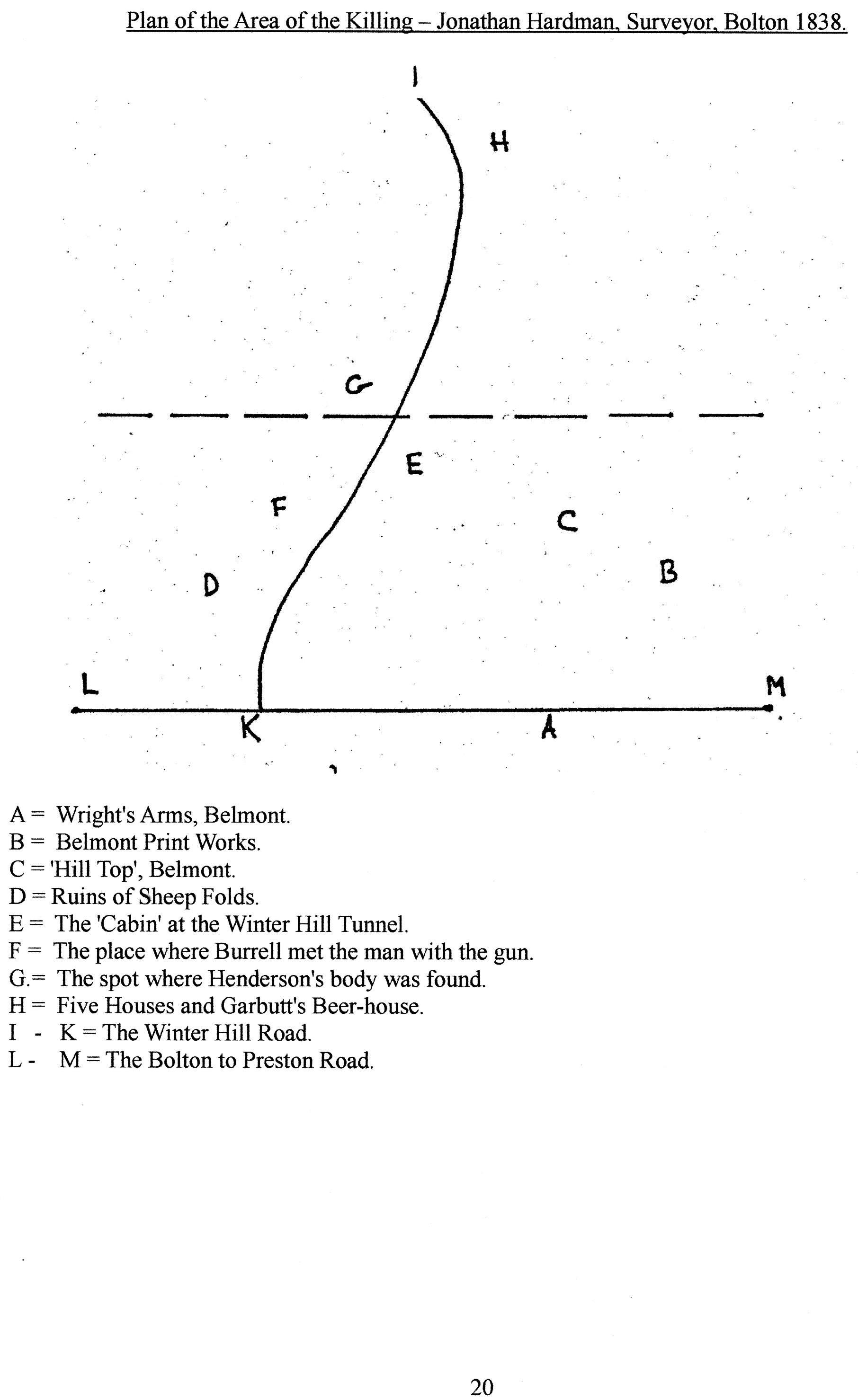
Jonathan Hardman.
Jonathan Hardman, a surveyor from Bolton, produced a plan of the area of the killing, which showed Five Houses as a group of cottages on Winter Hill. They were known locally as 'Garbutt's' after the owner William Garbutt, whose cottage was used as a beer-house for the use of miners, packmen and travellers. He indicated that the distance from Garbutt's to the spot where Henderson's body was discovered was 972 yards. Nearby was the entrance to one of the coal mines called the Tunnel. The distance from the spot to the Stumps which was a boundary wall five feet in height, was 212 yards. The distance from the Stumps to the Tunnel was 137 yards. The Moorgate Inn at Horwich was approximately 2 miles distance from Garbutt's. There was no footpath between Horwich Moorgate and Five Houses, so people crossed over the moor. On the moor were numerous ditches cut for drainage. Lying between the spot where Henderson's body was found, and the Winter Hill road was a deep ditch approximately 3 feet wide, which was extended on the right side of the road from Five Houses to the Stumps.
Thomas Whowell.
Thomas Whowell, a boy of 14, worked for Thomas Walsh of Horwich, and was riding on the morning of the 9th November near to Adam Hill which was about half a mile from Garbutt's. He was on his way to see his brother who worked in one of the mines on Winter Hill. Whilst he was on Adam Hill, he heard the midday bell ring from Ridgeway's Works in Horwich. When he arrived at Garbutt's, he saw the Scotsman come out and go up the road. Thomas's horse was making heavy going up the hill so he swore at it. When he came to the pit he stopped to take his brother's dinner. The Scotsman was walking with a stick and bundle on his back, and came up to him and reproved him for swearing. It was custom to call any packman Scotsman, because many travelling packmen originated from Scotland. The pit was approximately 400 yards from Garbutt's.
He stopped with his brother for about ten minutes and then began his journey down the road. After going about 300 yards from the pit, he heard a moaning noise coming from the ditch on the side of the road. A bit further on, he noticed blood on the ground. He was afraid and did not look into the ditch but went forward to the Tunnel where he saw James Fletcher together with his daughter Mary Entwistle. He told them what he had heard and they went with him to the place where they found the Scotsman lying in the ditch. It was the same man he had seen going up the road. Fletcher tried to lift him but he could not. Thomas went for assistance and met Garbutt and John Whittle ( the prisoner's father) coming up the road. He had known the prisoner for about two years, and he was in the habit of shooting. The day was very misty and he could not see far before him. He heard the moaning about 12.30 to 12.45p.m. The deceased appeared to be in great agony and struggled much with his hands. He did not notice any footmarks near the place where he lay. He did not see a gun or a pistol near the spot, or see the body when he passed it first time. The bundle was lying beside the deceased in the ditch, and did not appear to have been opened. He did not observe that the pockets were turned out.
James Fletcher
James Fletcher, a banksman at the coal pit near to Five Houses, stated that on the 9th November, he was working in a stone delph on Horwich Moor near the Tunnel. About 12.30p.m. his daughter came with his dinner and he went with her to the Cabin to eat it. This was used by used by quarry worker and miners to eat their food. When near to the Stumps, he heard the report of a gun from the right of Five Houses. Whilst getting his dinner in the Cabin, Thomas Whowell came in, and in consequence of what he had stated, he went with him to the place where the body lay. Whowell pointed out the spot and when he went back to it, he discovered the deceased lying on his back. One of the eyes was entirely blown out.
When Thomas Ratcliffe another banksman came up, they lifted the body out of the ditch. When they looked, they saw that the right-hand pocket hung over the trousers on the outside, and they were torn down from the pocket. He did not observe that the left pocket was turned out in the same way. They carried the deceased to Mr. Garbutt's as soon as possible, where he died about 2.30p.m. His right ear was much discoloured and black with powder. They were assisted by William Garbutt, James Heaton, James Bamford and a man named Lomax. He was placed on a table, the body being washed and the eye replaced in its socket. He did not see any firearms near the site, but many blood stains on the ground close to it. In the left waistcoat pocket, Fletcher and his friends found one shilling and eleven pence. In Fletcher's opinion, the trousers appeared to have been unbuttoned by force. When asked if it would have been possible for a person firing the fatal shot to have reached the Cabin without being seen on the road, Fletcher said it was impossible. The person firing the shot would have to cross the moor and get to the Cabin without Fletcher seeing him. Fletcher had about 130 yards to go after hearing the shot, whereas the man would have to go about 300 yards. On his return to the Cabin, there was a man about fifty years of age asleep there. He was a stranger to the neighbourhood, and he thought that he was a 'navvy'. He had a stick and a bundle attached to it. He was dressed in fustian trousers and had a blue waistcoat, and on awakening he left the Cabin.
Thomas Ratcliffe had been working in the coal pit next to Five Houses. Mary Entwistle had come to him and after hearing the story, he went to the site where the victim lay. The ditch was about half a yard deep and of a similar width. He heard the gun fired below Five Houses on the other side of the pit about 10.00a.m. in the morning. He had not heard a shot about 12.00 noon because the wind was blowing towards the Stumps. He had never known Whittle to do any harm to anyone, and described him as good-tempered and well-behaved.
William Stott.
William Stott was aged 13 years and was examined by Mr. James Cross, partner in the firm of Cross and Kay, Attorneys, Bolton. He worked in the Tunnel where he had been on the day in question. He had seen Whittle inside the Cabin at about 11.00a.m. in the morning. When he had seen Whittle, he had asked him the time and had been told 11.00a.m. Whittle had been dressed in the clothes he was now wearing. With Whittle in the Cabin had been William Simms and an old tramp, but he could not remember how Simms was dressed. Asked why, he replied that Whittle had been closer to him and it was dark in the Cabin. He went to the Tunnel and was there about ten minutes, and when he next looked in the Cabin, Simms had gone but Whittle was still inside with the tramp. He then made a rather strange statement saying that he had been approached privately, and told to keep to the same story. He had also been informed that there was a £100 reward to be had, and had been instructed to say what colour Whittle's clothes were. On reflection, he was sure Simm's jacket had been dark, and he had gone into the Cabin to shelter from the rain.
William Fletcher was the son of James Fletcher and had been working at Garbutt's on the day in question, in place of James Heaton. He left work about 11.00a.m. and on his way home he had seen Whittle in an old road near to a 'turf-cess' which was between the pit and Garbutt's house. He had a gun in his hand. Whittle asked if he had a 'play-day', a day off, and he replied he had from that time for the rest of the day. They then walked together until they were about three fields away from his home. It was about 11.45am. when he arrived home. Whittle had left him between Five Houses and the pit.
Sarah Lomax lived at Five Houses between Whittle's and Garbutt's, and she was at home when the killing took place. Before she had heard the news of the killing, she had seen Whittle coming from the direction of the spot where the body was found. This would be about 12.00 noon. Whittle was standing in the cart road near the house.
Anne Garbutt.
Anne Garbutt lived next door to Sarah Lomax and was also at home on the 9th November. From her window she had seen Whittle go past about 12.00 noon and Henderson was still in her house. Immediately Whittle passed, Henderson went out. Twenty minutes later, she saw Whittle again through her window, this time he was coming from the direction of Horwich a little before the murder. The first time he was going towards Belmont and the second time he was coming from his own door and was not wearing a hat. She definitely saw Whittle pass her window around 12.10p.m. A stranger on a grey pony called at about 2.30p.m.