
 Loading more
Page 2
William Heaton.
William Heaton was a carrier for Garbutt and between 10.00 and 11.00a.m. on the 9th November, he was going up Winter Hill from the Belmont side with a horse and cart. At the bottom of the hill he met William Simms going in the direction of Belmont.. Late he met Burrell going in the same direction. He stopped to load his cart at the delph where James Fletcher was working. He then went on to Garbutt's reaching it about 12.00 noon, where he found Bamford inside. He had been in about twenty minutes when Whittle came in and asked about a horse being ill. Two or three minutes later, Mary Entwistle came down the road shouting, and by then, Whittle was on his way out.
Benjamin Burrell.
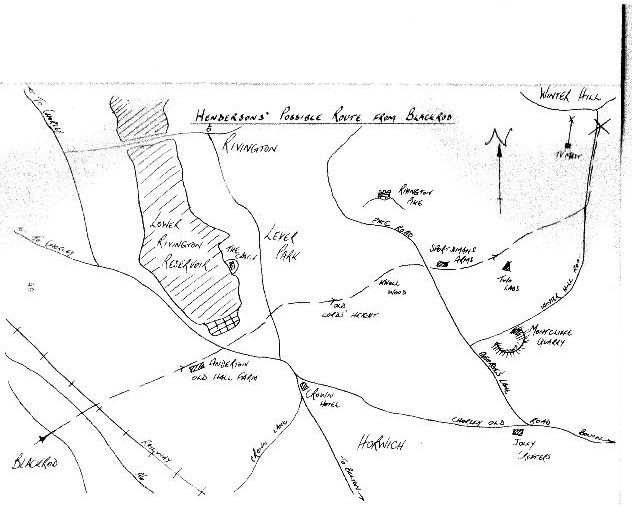
Benjamin Burrell stated that in the month of November, he was living in Blackburn, and was in the service of a Mr. John Foster as his traveller. He knew George Henderson who, last November was also in the service of Mr. John Jardine of Blackburn. He was about twenty years of age and was a fellow Scotsman. It was their practice to go certain routes to sell goods, take orders and collect money, and this was one of the duties of the deceased. Both their rounds took them over Horwich Moor to Belmont. They went across the moor every other Friday, and the 9th November was one such day. When they got home in Blackburn, they accounted for the fortnight's proceeds. He knew Garbutt's beer-house and on the 9th November they appointed to meet there a little after 11.00a.m. He went to Garbutt's according to his arrangement and reached there about 10.00a.m He remained there till about 11.00a.m.and since Henderson had not arrived, he left word that he had gone on to Belmont. When he left Garbutt's house, he went in the direction of a place called the 'Stumps', and he had seen the place where the body was found, and had passed it alone on the 9th November. As he was going up the hill, one of the colliers called to him, 'Are you going up?'. Near to the place where the body was found, he saw a man about 50 yards off, and he had a gun in his hand.
He came towards him as he went on and came off the moor onto the road behind him. There is a ditch between the road and the moor. When in the road, the man would be about 10 to 12 yards away. He asked him if he had seen two men as he expected two to come off the moor. He was told that none had been seen. When he spoke, Burrell was near enough to see that he was a tall man dressed in dark clothes. The gun he had with him was a single-barrelled one. Burrell walked up the hill and the man walked behind him. After proceeding a few yards, he happened to look behind him and saw the man pointing the gun towards him about 10 yards off. When he turned round, the man asked him if he saw some birds but there were no birds in the direction in which the gun was pointed. The man came nearer and Burrell asked him if he could shoot birds flying. He said he could and that if he would go with him on the moor, he would give him or kill him a bird and show him a good path to Belmont. Burrell told him that he was going to Belmont because the man had enquired. After the conversations which took place as they were walking, he told Burell that the path was against the wall and through the 'Stumps' and turn to the right.
He went through the 'Stumps' and the man came close to him. He observed his clothes, his trousers were blue and very much worn about the knees, a patch was upon one of them and they were very short. He had a blue coat and a dark waistcoat. He wore his hat very much over the eyes. He had the opportunity of noticing his gun, which had a single barrel and a percussion cap. He couldn't swear that the man he saw was the prisoner, but he had the same general appearance, was wearing the same kind of clothes, and was about the same height. He heard Whittle speak at the Inquest, and the voice was very similar to that of the man on the moor. Not seeing the appearance of a footpath, Burrell told the man that he had business to attend to and turned back. He did not observe the man following him. He then went down the road to Belmont and met two carters with three carts and three horses. Their names were Heaton and Bamford. They were about 200 yards from the Belmont side of the Tunnel. He reached Belmont just before noon, and was sent for to Garbutt's, and reached there about 2.00p.m. He saw the deceased there who died about two minutes later.
Joseph Halliwell, when examined by Mr. Dundas, stated that he was a corn-dealer carrying on a business in Skipton. In November last, he was in the service of Mr. Gerrard, another cattle-dealer from Bolton. On the 9th November, he had directions to call for a heifer at Walsh's Farm. He called at the place where he worked and by his directions went to the farm on Smithills Moor called Gilligant's. He saw Mrs Hood there and arrived at the farm at 12.25p.m. by her clock. He was not able to get the heifer and remained at the farm for no more than ten minutes. It was very foggy at the time. He was on his way to Belmont, and asked Mrs Hood to direct him. She told him that the road went to a place known as Holden's Farm. The road by which he went led towards a brow, and turning off to the right, this brought him onto Smithills Moor. When he got some distance he heard the report of a gun. By then, he had lost his directions and insisted that he was sober and had only three glasses of ale on that day. He went in the direction of the sound of the shooting thinking some gentleman might be shooting and would tell him the road to Belmont. He met the prisoner within a quarter of an hour. When he first saw him, he was about 30 yards off and it was very foggy indeed. The prisoner was running towards him and had a gun in his right hand. He got within a few yards of him when he spoke to him and asked directions, but got no answer. He was dressed in a blue surcoat, blue trousers and a blue waistcoat with a yellow spot.
He thought it was the same waistcoat he had on now. He was running in the direction away from the sound which he had heard. After going about 320 yards from the spot where he met the prisoner, he came to a road. There was a ditch between him and the road. He saw a man lying in the ditch, the righ hand pocket of his trousers was torn down. He got off his horse to look at him and saw blood on his cheek which turned him very sick. He attempted to get off the moor and onto the road. He was riding a grey pony but could not get it over the ditch. He tried two or three times in different places and went down the ditch 40 or 40 yards. He then remounted and then tried to go back again, but he could not tell in which direction he was going. When the mist cleared away, he found himself close to Holden's Farm where he had originally started off. He knew Garbutt's and got there between 2 and 3p.m. and had a glass of ale on his horse. He did not know at the time, that the body of the deceased was lying in the beer-house. He said nothing about the body in the ditch as he did not know anybody in that part and was apprehensive. He had on him £304.16s. 6d. of his own money. In going along the road to Garbutt's, he saw a man and his wife about twenty yards from the place where the body was found.
Cross-Examination of Halliwell by Mr. Wilkins ( Defence Counsel).
He did not know at what time he got up that morning. He swapped a cow with a Mr Webster of Footed Brook that very morning. He let him have a beast of his that he got from him a week before and another one. They had a glass of ale over their swop. They went back to Mr. Gerrard's, then to a beer-house and had only one glass of ale. He paid for one for another man there. They had a six-weeks reckoning and settled their accounts at Mr. Gerrard's. He paid him seven shillings and sixpence or fifteen shillings and sixpence, he couldn't say exactly which. He left Gerrard's at 10.00a.m. and the horse he rode was Mr. Gerrard's. The first place he stopped at after passing St. George's Church in Little Bolton was Mr. Ainsworth's pits. Whilst he stooped at the first pit he did not see John Entwistle eating his dinner. He saw another man at the first pit but he did not get off his horse. He would swear that he did not ask the way to the Green's Arms. The man directed him to Ainsworth's pits and he met up with John Walsh there. He asked him to drive his heifer for him which his master had bought from Walsh's master. He did not ask the way to Gilligant's Farm. He asked him if he could cross two fields but he said he could not, although he went across them anyway. It was between 11.00 and 12.00 noon when he got to the pit. He met Walsh's wife within 20 yards of the pit with his dinner.
He did not know Richard Nuttall. He offered a man 1s.6d to help him with the heifer over the moor. He may have called him Dick. At this time he had not yet seen the dead man. When he got to Gilligant's, he saw a clock and asked who was the maker, and it was not 1.25p.m. by that clock. He was not drunk and did not fall off his horse. He did not remember losing his whip and he did not tell Grace Whowell that he was so drunk he could not drive the heifer. He did not know the country there at all, nor did he know Garbutt's House or Quaker John's. It was a little after 2.00p.m. when he arrived at Five Houses and it was about two hours since he had last seen the body. He could not swear to the dress of the wounded man. His pack was laid upon the opposite side of the road in the ditch. He did not jump over the ditch himself. He asked his road to the Wright's Arms and he did not know whether he had told anyone what he had seen. He got to Proctor's at half-past three. John Proctor was landlord of the Duckworth Arms at Over Darwen on the main turnpike road between Bolton and Blackburn. He told him that he believed it was a Scotsman shot that day. He supposed it was a Scotsman from his pack. He told Mr. Proctor that he had seen the body and a person running from that direction with a gun on Horwich Moor. An Irishman and his wife whom he overtook on the road, told him a man had been murdered. He was fetched from Yorkshire to give evidence a week afterwards.
Re-Examination by Mr. Dundas ( Counsel for the Prosecution)
Mr. Proctor lives at Over Darwen and it was 3.30p.m. when he told him what he had seen. He showed him a piece of the man's skull which the Irishman, whom he met with his wife, gave him, and which he said he had picked up on the opposite side of the road to where the man was lying. He couldn't say whether he gave an account of it to the people whom he saw at the Wright's Arms at Belmont. He knew the man very well when he saw him at the Inquest, and had no doubt that he was the same he had met on the moor with a gun.
William Garbutt.
He stated that he kept a beer-house at Five Houses and knew Henderson quite well, and was at home on the Friday. The other Scotsman called every other Friday on business between Horwich and Blackburn, and often changed silver and sovereigns for notes. Henderson was not a regular caller at the beer-house. At the time Mary Entwistle came with the news, Whittle was standing close to his right side, but he had no gun with him, and this would be about 1.00p.m. He had seen Whittle that morning about 8.00a.m. with a gun. He had also seen a person of about his height and dress similarly fire a gun on three separate occasions. About 10.00am he again saw Whittle, and then finally about 1.00p.m. leaving his house. He did not see him again that day. Many people came to see the body, but he did not see Whittle amongst them. The early part of the morning had been clear but it became foggy about noon. It cleared in the afternoon, so that men could be seen on the moors at a considerable distance. These proved to be a shooting party. Burrell had exchanged some money when he called at the beer-house, but not Henderson.
She lived at the Moorgate Inn, Horwich, and stated that she had been at home on the 9th November, and had seen Whittle about 1.30p.m. She had spoken to him and asked about her husband's gun, one which had been lost sometime before. Whittle had told her that he knew nothing at all about it. He was still at the Moorgate at 3.00pm. A servant came in and said that there had been a man shot on the moor, a Scotsman. Whittle then remarked that many of them went that way on Friday on their way home. He then stated that two or three of them made appointments to meet there on Friday and go home together. He then said that he had brought back the gun he had borrowed, and would never have another one in his house while he lived. She said that Whittle had left the house about 4.00p.m. She also stated that she heard of Mr. Orrell, steward of Mr. Wright's estate had called at Whittle's house to complain to his father about Whittle poaching on the moor. Whittle stated that he had not shot fowl as he came through Brownlow's Close, which lay between Five Houses and the Moorgate Inn.
Mr. Matthew Lambert.
He was the landlord of the Horwich Moorgate Inn, and he agreed that he had lent the prisoner a single barrel fowling piece with a percussion cap, on Thursday 8th November. He made an appointment to meet him on the Friday in Brownlow's Close, about 1 ½ miles from the Moorgate. Whittle had stayed at the inn until about 4.00p.m. on the Friday. Before leaving the inn, Lambert asked Whittle about the shooting of the packman, was it accidental or was it a wilful act? Whittle had replied that he did not know any details about it, but if it had been done deliberately, whoever had fired the shot, deserved to suffer for it. He stated that he thought it was not quite 1.30p.m. when Whittle arrived at the Moorgate. The foreman of the Jury asked what size of shot was in the shot bag, and Lambert stated that it was No 2 shot, and had been taken away in the shot bag by John Whittle, the Chief Constable of Wigan. The gun which had not been loaded when it was brought back, was handed over to a Mr. Peter Heron, a gun expert. The charge in the gun was not withdrawn. The weapon had been handed over at the Coroner's request to Constable Burrows. On the Friday, Whittle came to the Moorgate and brought a pair of grouse still warm. He reared the gun against the wall of the brew-house and went inside. We both left at 4.00p.m. and went in search of a hare up to the north of Brownlow's Close. He walked back with Whittle for about 600-700 yards, and then came back home again. Before leaving, Whittle explained he had brought the gun back and everything belonging to it.
He was Constable of Sharples, and stated that on the Saturday following the killing, he went to arrest the prisoner. Whittle was brought out to him by Mr. Steward, Manager of the colliery, and he told Whittle that he was their prisoner. Whittle asked why this was happening, but Cook did not reply but brought out his handcuffs, but Whittle said he would go without them. Mr. Peter Ainsworth who was a magistrate, accompanied Cook to make the arrest, and Whittle was cautioned and told that he had no need to make a statement, but if he did, it could be used in evidence. Whittle said that he had not had a gun in the house since Sunday last. The whole party then set off to go to the Horwich constable. Cook and the prisoner walked together to Horwich and Robert Makin, Constable of Halliwell walked behind them. Whilst walking, Whittle told Cook that he was innocent of this crime. Cook replied, “ Jem, hadn't thee a gun in thy hands all yesterday?" Whittle replied, “No, not until the afternoon when I was with Matthew Lambert, and I shot a blue-beak, and I told him that the fellow that shot the Scotsman ought to suffer".
Robert Makin.
He was Constable of Halliwell, and stated that Whittle had told him that he had seen the Scotsman, and had in fact spoken to him at Garbutt's stable door. Whittle had also told him that the dead man was not the first Scotsman who had gone up the road that day. There had been another and he had seen them both. Measurements were taken at the scene of the killing. The distance from Garbutt's house to the first coal pit at which James Fletcher worked was 420 yards, and the second pit was 55 yards from that. The distance from the furthest pit to where the body was found was 507 yards. The distance from where the body was found to the Cabin of the Tunnel was 309 yards. It was 220 yards from the stone delph to the Stumps through which the road went. The distance from the Stumps to the Tunnel was 137 yards, and it was 112 yards from the place where Fletcher heard the report of a gun.
James Corless.
He was gamekeeper employed by Mr. Peter Ainsworth of Smithills Hall. He had been out on Horwich Moor with a shooting party consisting of Messrs Wright, Crompton, Ryding, Ireland, Horrocks and Ince. They were not local men but shooting guests of Mr. Ainsworth. He heard a gun fired on Smithills Moor about ½ mile from where the body was found. About five minutes later from a different direction, he heard another shot. The first shot was heard about 11.55a.m. and the second about noon. He was sure of the time because he heard a factory bell ringing. The shots were not fired from his party because all the guns were close together the whole day because of the mist.
ADDRESS FOR THE DEFENCE – MR. WILKINS.
“Members of the Jury, had it been made clear in your minds that the unfortunate man had in fact been murdered? After a good deal of investigation, I see good grounds for doubting this. Generally speaking, vindictiveness or a desire for gain are the incentives for murder. Was there any proof of vindictiveness on the part of my client towards the victim? Was there in fact, anything to warrant such a surmise? Was there any proof of a desire for gain? When the man was found, no money had been taken from him. His pack had not been disturbed, his stick and umbrella left untouched. The weather was very foggy and it was such a time that poachers would carry out their operations. It seems possible and probable from the state of the deceased's dress that he had ventured to the roadside for some particular purpose, to answer a call of nature, and had been shot by some poacher ignorant to this day of the accident or knowing it, concealing that knowledge through fear of the consequences. Would this be a natural or forced surmise?
You have been asked to infer from the flesh near the wound, that the gun was near when the shot was fired, but anyone would know that discolouration would be produced around a wound by the blow of a gunshot from whatever distance the gun might have been fired. It was the custom of parties of Scotsmen in the neighbourhood to get their silver changed into notes at the beer-house. The victim Henderson called there and had paid for a glass of ale from his waistcoat pocket in which money was found after he had been discovered in the ditch. He did not ask for change, the presumption being that he had been unsuccessful in his collection on that day. There are reasonable doubts and they must be given to the accused. Suppose it was murder, then the question is who had committed the murder? The indictment points to the prisoner but what was the evidence? The testimony of Halliwell is utterly unworthy of belief and it is totally improbable that he had, by any honest means, become the owner of the property he stated he had in his possession on the day of the murder. This is borne out by his wholly unacceptable manner in which he has given his evidence, and as such, it should be regarded as defective. There is no continuity in the events he recalls, and there are gaps in his evidence which are unaccounted for. Elsewhere, there is not a point in the case which is not accounted for.
The prisoner was out shooting all day, but was this an uncommon circumstance? It was nothing more than usual or ordinary. From the coal-pit to Belmont there was not another single dwelling but one solitary Cabin. Knowing the area as he did and the habits of the Scotsmen, was not the circumstances that the man was killed so near his own home, rather an argument in favour of my client's innocence than guilt? It was given in evidence that he was a young man of mild temper with no blemishes on his character. This must also weigh well in his favour. I would ask you to consider whether or not there is sufficient evidence to support the view that there is proneness to fit and fashion facts to a particular set of circumstances? Looking at the testimony of Benjamin Burrell, it is quite clear that he had no apprehension when he turned round and saw the gun pointing at him, then the prisoner dropped it to his hip. He had no suspicion that he intended to fire at him. If indeed, he intended to murder him, he could have done so without having his back to him. Would not any person preparing to shoot at game, have dropped his gun to the rest on being spoken to? In fact, there is nothing more common than carrying a gun pointing, on shooting at moor game on a foggy day. I would ask you to consider if there was anything suspicious about the manner of the prisoner? He was without excitement when he came from his dinner and spoke to the carrier about the horse being ill. Mr. Garbutt had considered it rather extraordinary that he should have asked had he a horse ill. Why should this be so?
It was an ordinary circumstance because he had a horse ill very often. He had one ill that day and the prisoner was a near neighbour. He was in no agitation, no trouble, no apprehension, and yet he walked about with an instrument of death in his hand. You have heard the testimony that my client did say at Matthew Lambert's, that he would have no more to do with shooting, but that arose from the annoyance from which he had been subjected by complaints from his father. Consider, if you will, the very important fact that the shots found in the brain of the deceased, were of uniform weight, while those in the shot bags and those in the box taken from the loaded gun were of different sizes. Those found in the gun and bag did not tally with those from the brain of the deceased. Members of the Jury, it is dangerous to lay too much emphasis on statements made by a person when apprehended, especially in a sudden manner. I therefore respectfully suggest that when my client had been questioned by the constable in the presence of his employer and local magistrate Mr. Ainsworth, and Mr. Wright, both of them owners of parts of the moor, he did in fact suspect that they intended to arrest him for poaching, and therefore made false statements to avoid being charged with that offence."
No witnesses being called for the Defence, Mr. Wilkins concluded his address to the Jury. The learned judge emphatically recapitulated all the leading points in the case, directing the Jury to give the prisoner the benefit of any doubts they might entertain. His Lordship dwelt particularly on the fact of all the shot found in the head of the deceased being of one size, whilst those which the prisoner had used proved to be of different sizes. The Jury retired at 9.00p.m. to consider the evidence and returned at 11.00p.m. with a verdict of NOT GUILTY. The Foreman of the Jury remarked that the decision had been arrived at in consequence of the defective evidence of Joseph Halliwell. James Whittle was immediately discharged.
The trial opened at 9.00a.m. in Liverpool Crown Court on Tuesday 2nd April, 1839, and continued until 7.00p.m. Wilkins had succeeded in weakening the evidence of two or three material witnesses through stringent cross-examination. There was an adjournment of the court for thirty minutes for the defence to decide whether to call witnesses or proceed straight away to addressing the Jury. The latter course of action was taken with Mr. Wilkins surpassing himself by his speech to the Jury. He opened with his cool, quiet, deep sonorous voice, low but impressive and solemn, gaining the calm attention of the Jury to his remarks, proceeding step by step to unravel the facts, and urge upon the Jury such points as he considered important to the prisoner's case. He appealed so to the feelings and consciences of the Jury that the whole court was hushed, and paleness, stillness seemed to paralyse the whole audience there.
The cattle-dealer Halliwell, overstated his evidence to the extent that Mr. Wilkins was able to shake his testimony and raise a doubt in the minds of the Jury, which lead them to believe that Halliwell was lying on oath. He also dwelt on other circumstances, the unimpeachable character of the prisoner's previous life, the uncertainty and doubtfulness of relying solely on circumstantial evidence. Mr. Wilkins also raised the possibility that some sportsmen on the moor may have fired in the mist a chance shot without seeing or intending to harm anyone. The Jury returned a verdict at 11.00p.m. When Whittle's father now aged between 60 and 70 went into the dock, they could be seen embracing each other. A rare, personal account of the Trial proceedings is recorded in the autobiography of John Taylor, Attorney-at- Law of Bolton , which was published by the Daily Chronicle in 1883. Taylor opens his account by stating that during February and March of 1839, he was engaged in preparing the defence papers of James Whittle who had been charged with 'Wilful Murder', the case causing great excitement in the local neighbourhood. He makes the very important observation that the evidence for the prosecution was entirely circumstantial!
The defendant is described as a collier employed by Peter Ainsworth of Smithill Hall, Bolton. Whittle had an irreproachable character up to the time of the event. It appears that Whittle's friends who had promised him their support and help with the costs of the defence, failed to respond at the last minute. Ironically but perhaps, not surprising, the Prosecution case was conducted regardless of cost. Taylor retained as Whittle's Counsel, Charles Wilkins, later Sergeant Wilkins, a young barrister on the Northern Circuit who was regarded as one of the most eloquent counsel in England at the time. There is evidence that Taylor was undecided whether to abandon or proceed with the defence, the sum of £50 being necessary for legal costs but was not forthcoming. However, an arrangement was made between Taylor and Mr. Wilkins, whereby he was to be paid £5 to hold the brief, with the promise of further fees should they become available. It appears that for a period of twelve months, Mr. Taylor had no contact with the Whittle family, but on sending a promissory note for the outstanding fee of £50 for defence costs, the note was duly returned signed by Whittle and his father. It was agreed to pay the amount by monthly instalments, bearing in mind that the two parties were only labourers. Taylor concludes his account by stating that he was thankful to recover the costs within five years of the trial, receiving the total sum of £48. This result was proof that the Whittle family had a lasting remembrance of the services of their young attorney.
Whittle's Known Movements.
8.30. a.m. | Between Garbutt's and Entwistle Lane with gun. |
| 9.10. a.m. | In the vicinity of Garbutt's with gun. |
| 10.30. a.m. | Between the Stumps and Winter Hill Tunnel with gun |
| 11.00. a.m. | In the Cabin at Winter Hill Tunnel with gun. |
| 11.30. a.m. | Between a coal-pit and Five Houses with gun. |
| oon. | . |
| 12.20. p.m. | Seen coming from the direction of Horwich. |
| 1. 30. p.m. | Arrived at Horwich Moorgate Inn with gun and |
| 4.00. p.m. | Left Moorgate Inn with Matthew Lambert. |
| 5.00. p.m. | Seen outside Garbutt's without a gun. |
The most obvious factor emerging from the known movements of Whittle, is his presence on the moors with a gun on the Friday morning. He was seen by witnesses on no less than five occasions. These occasions, viewed independently, would not arouse much interest, but taken collectively, provide sufficient evidence for Whittle to be considered a prime suspect for the shooting. Living in a scientific age as we do, it is easy to forget just how far scientific knowledge has progressed, particularly in the field of forensic science. It is difficult to fully appreciate the limitations imposed on those responsible for the investigation and detection of crime in the nineteenth century. At the time of the incident ( 1838), forensic medicine and the specialist field of ballistics were virtually unknown sciences. With the exception of the most obvious causes of death from crime, medical opinion rested on assumptions and hypotheses, rather than hard facts. In reviewing the aspects of this case, it would seem a fitting tribute to the progress of forensic detection to consider the various strands of our case, by utilising well-established and proven principles of forensic science as they apply to deaths due to firearms. Many of the sporting guns of the eighteenth and nineteenth centuries were of the flintlock type which, although popular with sportsmen, had the disadvantage of being slow in firing. When they were fired, the flash and smoke from the priming pan often temporarily obscured the target. There was also a perceptible time lag between the ignition of the primer and the explosion of the main charge.
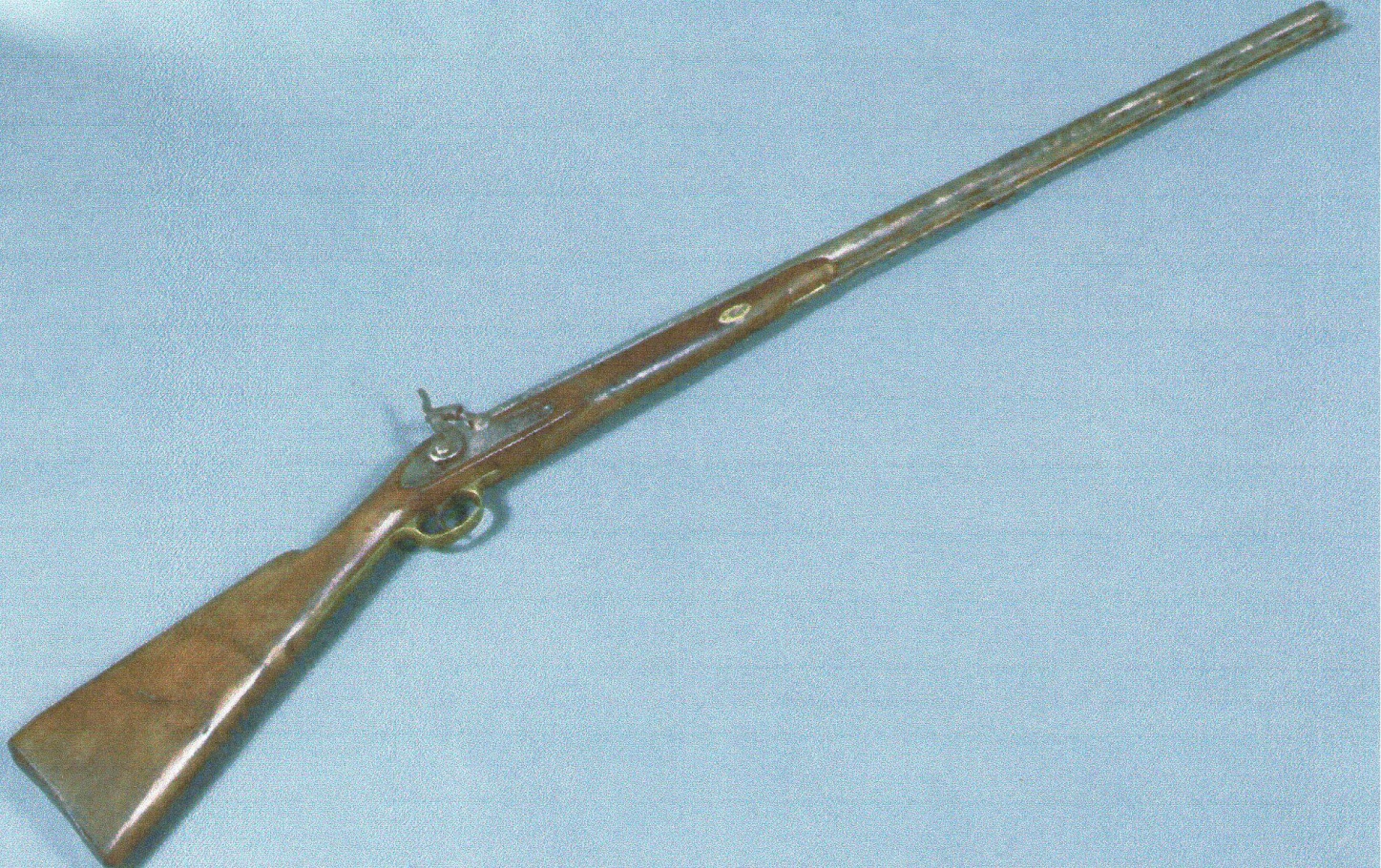
19th Century Percussion Lock Fowling Piece.
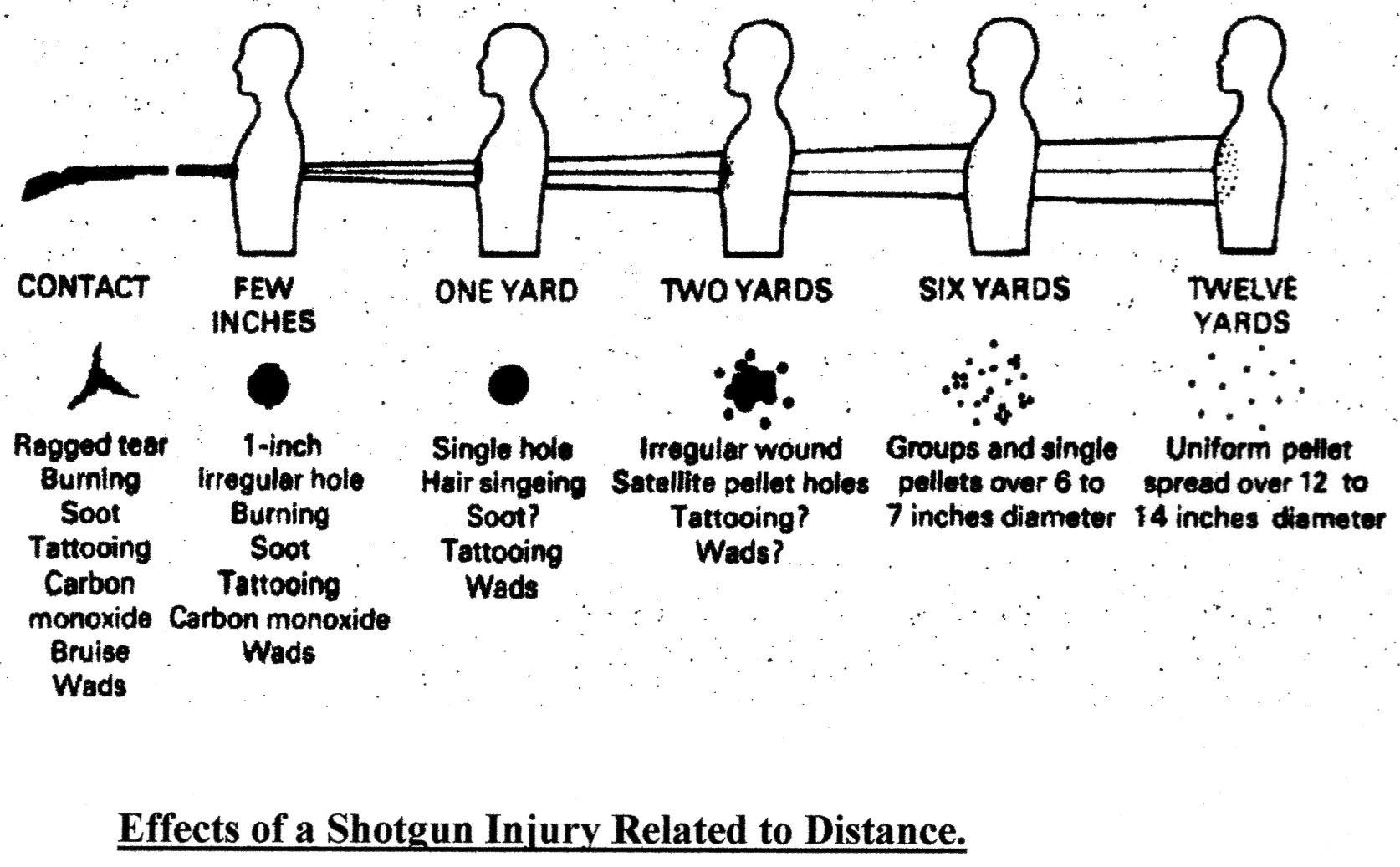
The direction of fire of a shotgun can only be determined from the entrance wound in close-range injuries, shot spread over 20 inches will have been fired from a range of about 20 yards. When a shotgun is fired, the pellets begin to disperse soon after leaving the weapon. At close range ( up to 3 feet), the shot will enter the body in a single mass, with the resultant large lacerated wound, accompanied by burning and blackening. If a shot is fired at close range through the head, the skull will disintegrate with the shot exiting via openings such as the orbits or eye sockets.
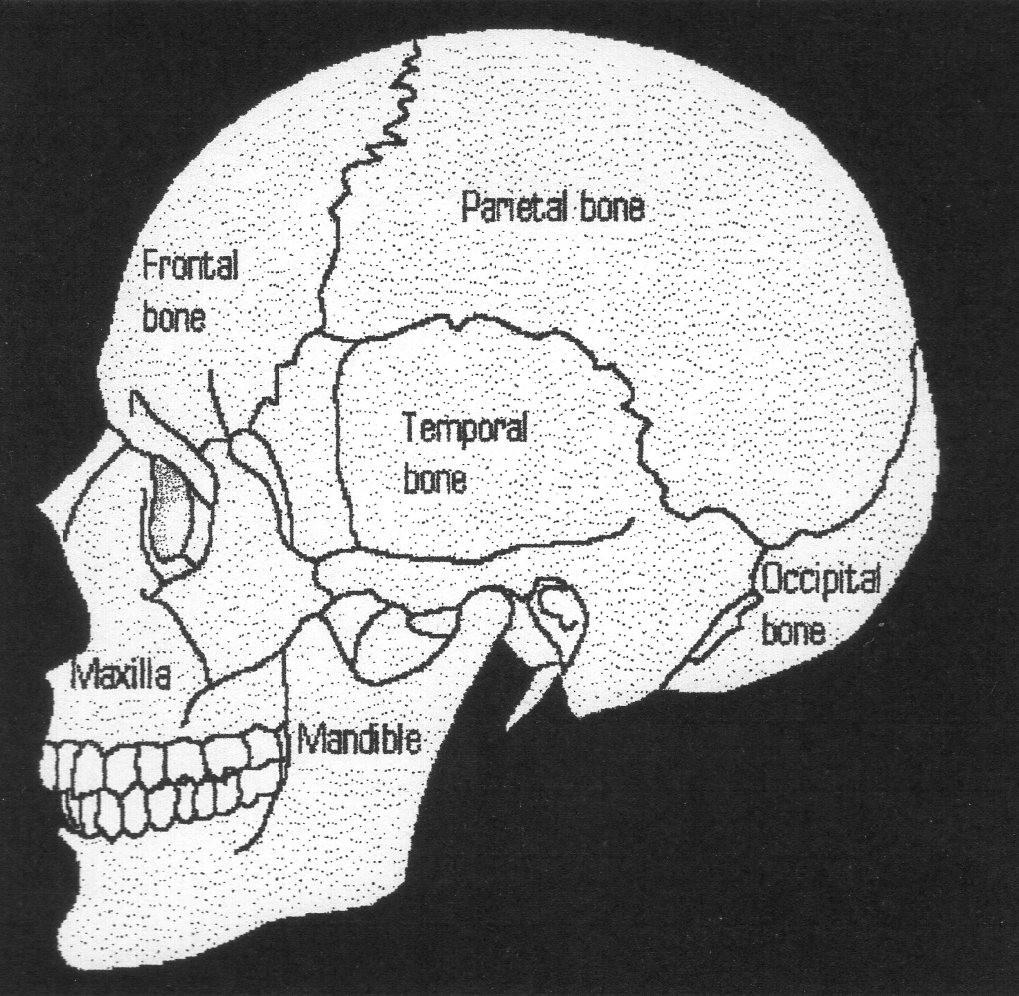
There were no obvious signs to indicate this, or marks to suggest that the body had been dragged from the road to the ditch. This medical evidence rules out the possibility that the victim had strayed into the line of fire from either poachers or other sportsmen shooting on the moor. The only conclusion to be drawn from the medical evidence is that Henderson was the victim of a deliberate shooting. Looking back at the movements of the prime suspect James Whittle, these timings if taken to be accurate, certainly place Whittle in the vicinity of the shooting at the material time. However, careful analysis of these timings does cast sufficient doubt that Whittle was , in fact, the perpetrator of the crime. The critical time frame on the day in question was between 12.00 noon and 12.30pm. We are told that Whittle was seen passing Garbutt's beer-house at approximately 12.00 noon, going in the general direction of Winter Hill summit. However, this contradicts the statement of William Fletcher who had in fact accompanied Whittle back down the road on his way home at around 11.15a.m. This raises the obvious question, why would Whittle be going back up the road having already just come down it not less than three-quarters of an hour earlier?
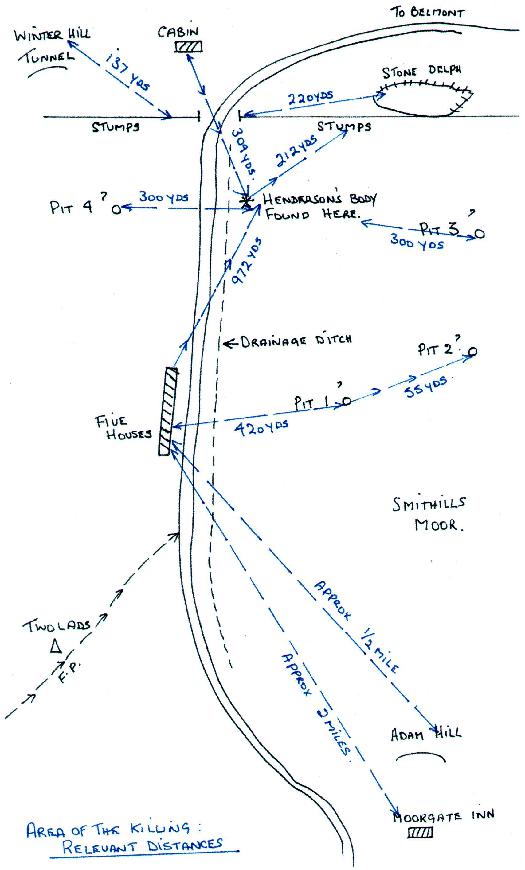
At this stage in our re-assessment of the case, let us endeavour to place ourselves in the position of the potential killer, and consider the various options open to him or her. Given that the motive for the killing was considered to be robbery, this would presuppose that the killer or killers had prior knowledge of their victim and his movements. This would rule out the possibility of it being a chance or opportunist attack, and would suggests a planned attack on a known victim presumed to have been carrying the objects of the attack, namely money and goods. The route of the potential victim being known in advance, the perpetrator or perpetrators would ensure that they were in the area ahead of the victim. The weather was misty and ideal for such an attack, and those responsible could avoid the possibility of being observed both before and after the attack. It would not be beyond the realms of possibility for such a plan to be carried out by persons living in the immediate area, whose chances of success far outweighed the risks of being apprehended in the act. The victim's movements for that particular Friday were well-known in the area, and an isolated spot was chosen for minimal disturbance, and an escape route out onto the mist-covered moorlands. Having created for our purpose an hypothetical scenario, let us place the prime suspect Whittle into it, and see if any patterns emerge.
Whittle did have knowledge of the movements of the packmen, and of their purpose in calling at Garbutt's beer-house on their way home over Winter Hill, although he was not alone in this. However, unlike a well-planned robbery, Whittle appears to have made no attempt to disguise the fact that he was out shooting on the moors for most of the morning in question. He lived in the immediate area of the shooting, was well-known by neighbours and local mine workers for his habit of poaching, and appears to have been completely indifferent as to whether he was observed or not. These are hardly the actions of someone intent on carrying out an armed robbery. On reviewing the available evidence, one cannot help but conclude that Whittle's eventual arrest and charge was based entirely upon circumstantial evidence. Such evidence allows a conclusion to be drawn from a set of circumstances or information. In our case, several witnesses had testified to having seen Whittle with a gun at the material time. It may well be that these circumstances when viewed separately were insufficient to raise reasonable suspicion of Whittle' involvement, but when taken together, they quite likely created a strong suggestion of guilt.
In effect, this means that even though there may be only circumstantial evidence available, if there is enough of it taken as a whole, it may be sufficient to form the basis of a prosecution, which does appear to have happened in our case. His presence on the moor with a gun at the material time, provided those circumstances which lead the authorities to an inference of guilt, there being no direct evidence to link Whittle with either the victim or the crime scene itself. The traditional approach to circumstantial evidence has tended to be for the defence to underplay its significance, and for the prosecution to overplay it. However, no Jury should convict unless it can be sure that the standard of proof, “guilt beyond reasonable doubt" has been fully satisfied. So far as circumstantial evidence is concerned, any inference of guilt must be unequivocal and inexorable. The circumstances must point in one direction only. In effect, most of the evidence in criminal cases tends to be circumstantial, rarely is there direct evidence of a criminal act. Having said this, it is sometimes regarded as of higher probative value that direct evidence, which does appear to have occurred in our specific case.
The prosecution suffered a serious setback with the defective evidence of the cattle-dealer Joseph Halliwell. It is surprising that his testimony was even considered admissible, and today he would certainly be considered an 'hostile witness'. His testimony was so inconsistent and lacked clarity or comprehension, it could not be taken as reliable in any sense, and even borders on perjury. What is more remarkable is the statement of William Stott, which does appear to have gone unchallenged by either the defence counsel or the Judge. The very fact that he had been approached by a certain party and urged to keep to his description of Whittle's clothing should have set alarm bells ringing very loudly. This is entirely consistent with a conspiracy to implicate Whittle, especially in view of the fact that there was a £100 reward on offer. It does appear to have been an abuse of process that Stott was not compelled on oath, to furnish details of this approach and to identify the individual.Whittle does make an incriminating statement to the constable on his being arrested, in which he describes the method by which Henderson had met his death, when he stated that he was shot with slugs or shot rather than with a bullet. This raises the question of how Whittle knew the cause of death not having viewed the body lying at Garbutt's. However, Whittle, being an experienced sportsman would be well aware that the usual method of shooting game was with shots or slugs and not bullets. Whittle did not own a gun and appears to have borrowed one from the landlord of the Moorgate Inn, Mr Lambert. His wife stated that her husband had lost a gun some time previous to the incident, and when this was mentioned to Whittle, he denied any knowledge of this gun. One could speculate that it was possible that Whittle had in fact, two guns in his possession on the day in question, one borrowed from Lambert, the other being the 'lost' gun. Whittle could then, have committed the crime with the lost gun, disposed of it, leaving him with just the one borrowed gun in his possession. This would ensure that when Henderson's post-mortem was carried out, the shot discovered in the victim's head did not correspond with that used in the borrowed gun.
Regarding a possible motive for the shooting, everything points towards robbery. We have the evidence of the victim's own words, “They have robbed me". Henderson's pockets were turned inside out, and very little money was found on the body. However, the pack he was carrying had not been disturbed and the contents still intact. It would be expected if robbery was the motive, then a search of the victim's belongings would have occurred for anything of value. There is also the fact that Henderson's employer, Mr. Jardine, surmised that he would not have had in his possession more than about £15 in money on that Friday.