DARWEN STREET SHOPS, PUBLIC HOUSES AND BUSINESS SITES OF YESTERYEAR
By
Mike Sumner
Darwen Street has always been an important thoroughfare during Blackburn’s history of development especially because of its close connection to Blackburn’s original market place. The street starts at its junction with the top end of Church Street and the start of King William Street which was developed much later. Today, the Old Bank marks the central spot from where the old market place extended outwards along the western side of Darwen Street as far down as Market Street Lane and Jubilee Street on busy days. At the start of Darwen Street there was also the old stone Market Cross which was probably erected by John de Lacy during the reign of Henry I which stood on three stone steps from its base which contained a recess holding a statue of the Virgin Mary. In 1535, the cross was updated by Abbot John Paslew from Whalley Abbey, with new inscriptions and the Abbey coat of arms, three fish and semi- croziers (staff with crook or cross on it) issuing from their mouths and a Latin inscription. In the same location there was also a draw-well for water which had a circular stone wall round it, and stocks where people who broke the law could be held in public. The Old Bank Site is where an early paper was printed called the "Blackburn Alfred" which was a Conservative newspaper produced by Wood and Morrice in 1832 although it only had a brief existence.
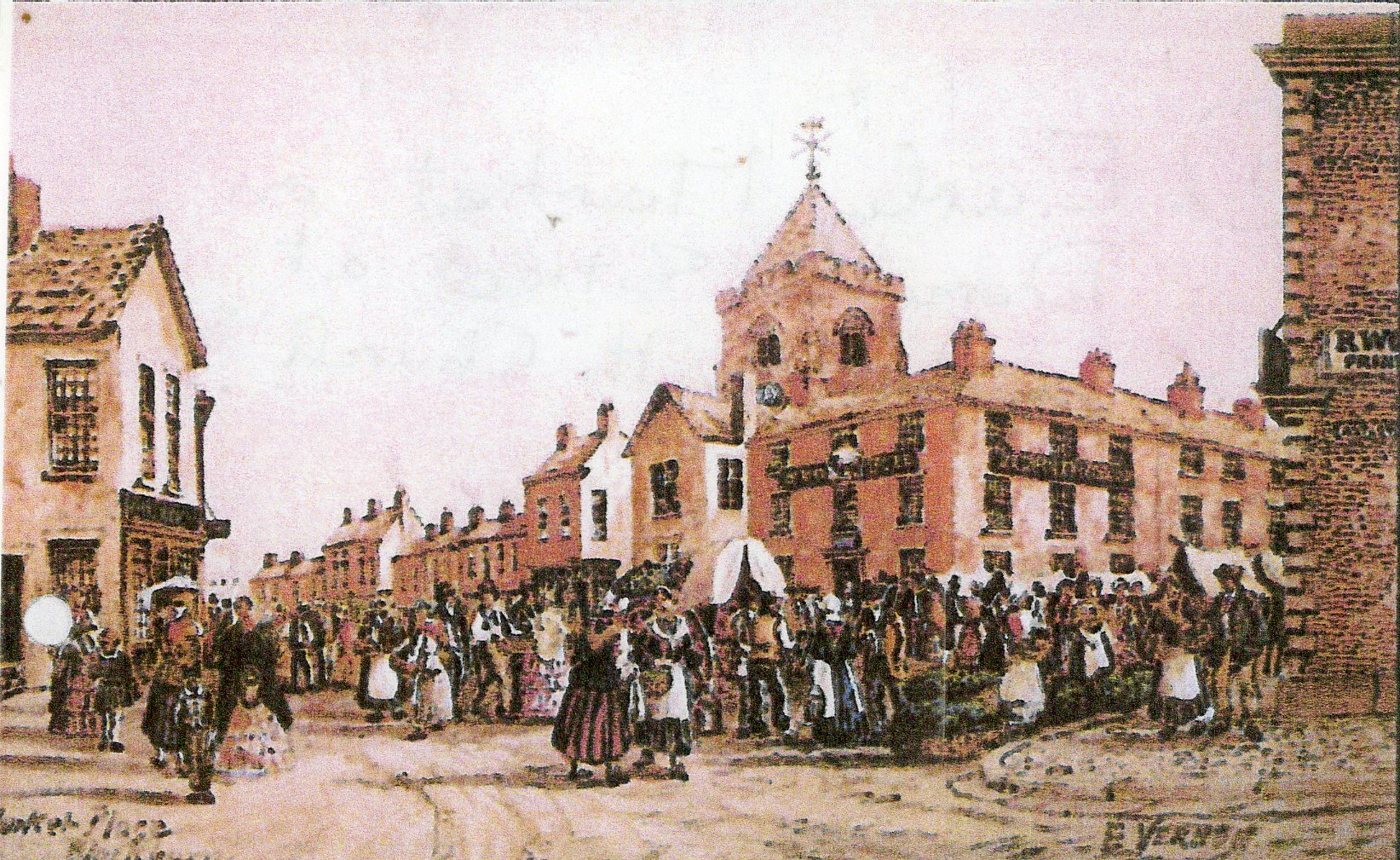
Early Market Site on Darwen Street at its junction with Church Street.
The footpath on the Old Bank side of Darwen Street from the market cross down the street was extra wide to take the stalls of local farmers and others selling a variety of local goods and produce on market days when the street was very busy with people drawn from a wide area who came to shop and sample the wares on offer. At the same time, these people would also be able to visit existing shops on the street which extended down to Darwen Street Bridge and its junction with Park Road, Great Bolton Street and Canterbury Street. Due to the high footfall on this street especially at its market place end there were a number of public houses close by and others from the Old Bull down to the Duke of York at Darwen Street Bridge which took the Preston railway line into Blackburn Station. Before this bridge on lower Darwen Street there is another older bridge taking the River Blakewater under the street called the House of Correction Bridge as the original House of Correction (first mentioned in the Quarter Sessions in 1663) was sited close to it where Neville’s Emporium later stood. The bridge also marked the limit of the town's built up area and beyond this, before the railway bridge was built, was Towns Moor with the isolated hamlets of Nova Scotia, Grimshaw Park and Islington with their own independent character and inhabitants. The original shops along Darwen Street were mostly small low two-storey buildings with mullioned windows and their own awnings whilst those on the west side of the street with the wider pavements could display their goods on the pavements on non- market days before the market moved to its purpose built Market Hall, Fish Market and market squares off King William Street in the late 1800’s. A number of the streets and alleys off the top end of Darwen Street on its western side close to the main market area had stalls extending into them or areas where goods could be stored and some held specific trades associated with the market e.g. butchers and fish stalls on Fleming Square with Market Street Lane (aptly named) another important street. Darwen Street took its name from the fact it ran on to Great Bolton Street then Bolton Road on its way to Darwen via Ewood.
NOTABLE HOSTELRIES ON DARWEN STREET
1. THE OLD BULL INN – sited at the top of Church Street at number 18 and along the top of Darwen Street, this old inn was a familiar landmark in Blackburn for a number of centuries. The original fabric was a low half-timbered building with wide gables and mullioned windows and had an arched entrance from Darwen Street to its rear courtyard as it was a coaching inn. This structure remained until 1847 when it was replaced with a more substantial three storey building which had 36 beds for travellers and accommodation to supply 60 people with refreshments and had 12 rooms on the ground floor and 40 bedrooms. This first class hotel had three sitting rooms, two club rooms, a dining room, a billiard room and two bath rooms but no stabling. The inn was a focal point for business meetings and political groups and used during the hustings for local elections. The inn was used during the Second World War as a civil defence centre but was demolished in 1950 to open up the cathedral and its grounds.
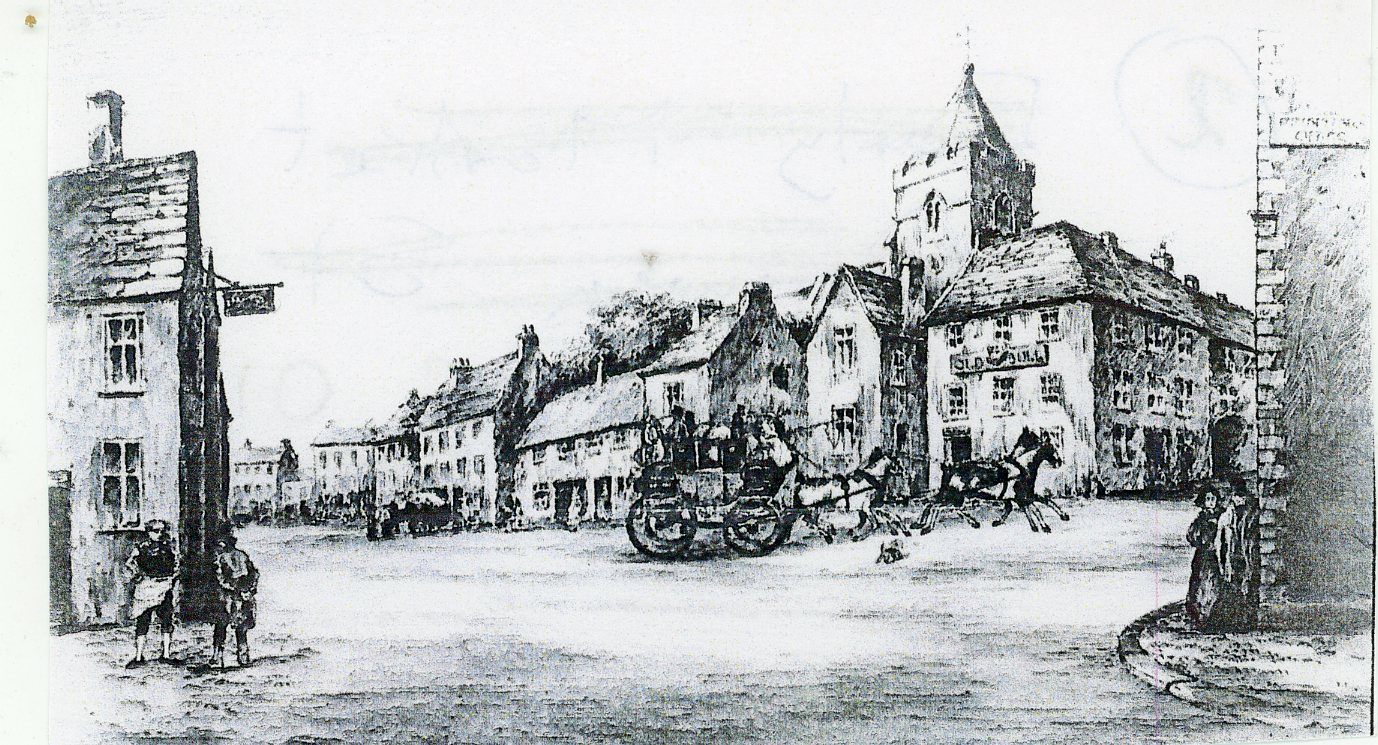
Early 1800s view of the original Old Bull Hotel.
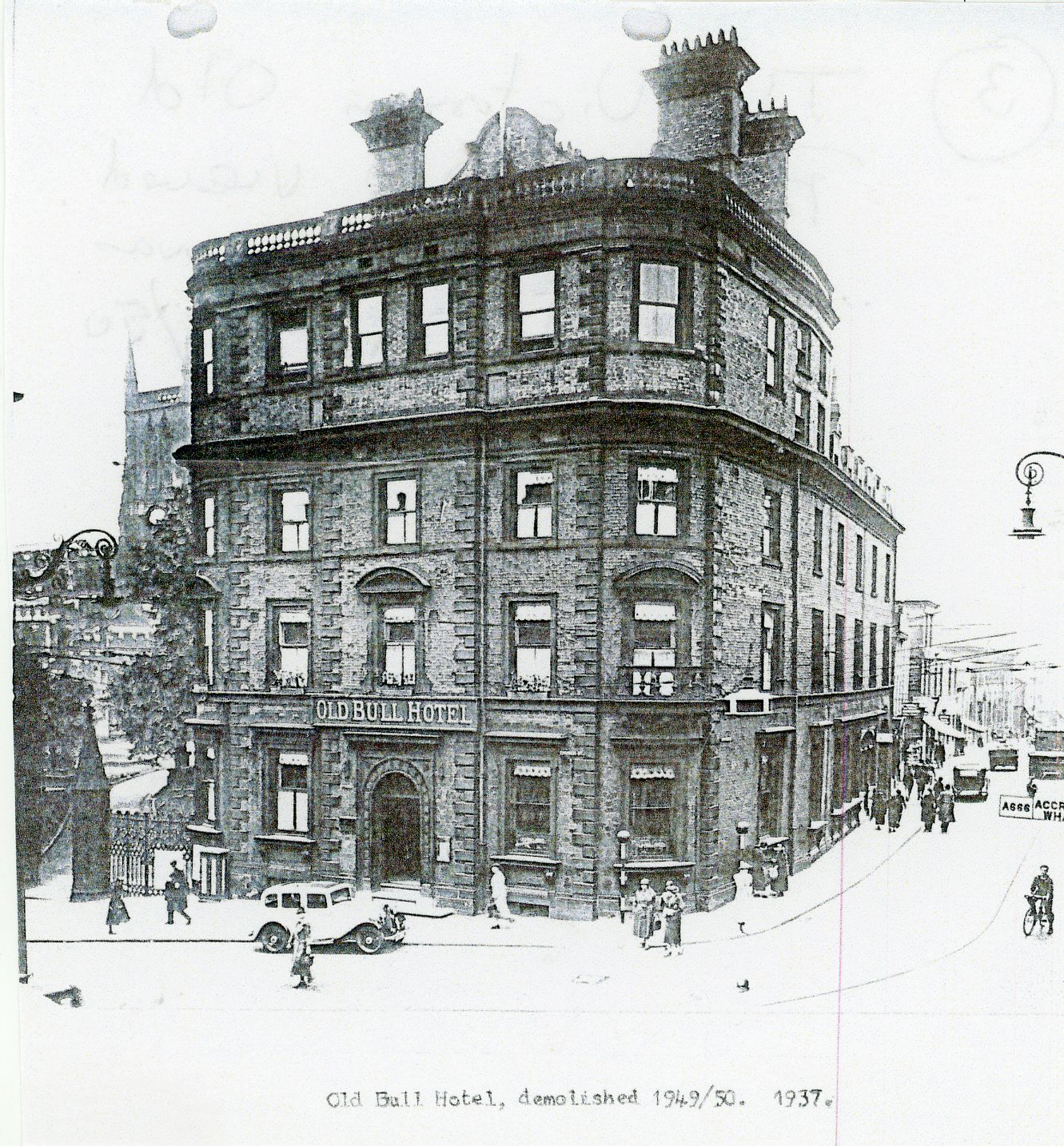
The Victorian Old Bull Hotel viewed in 1937 which was demolished in 1949/50.
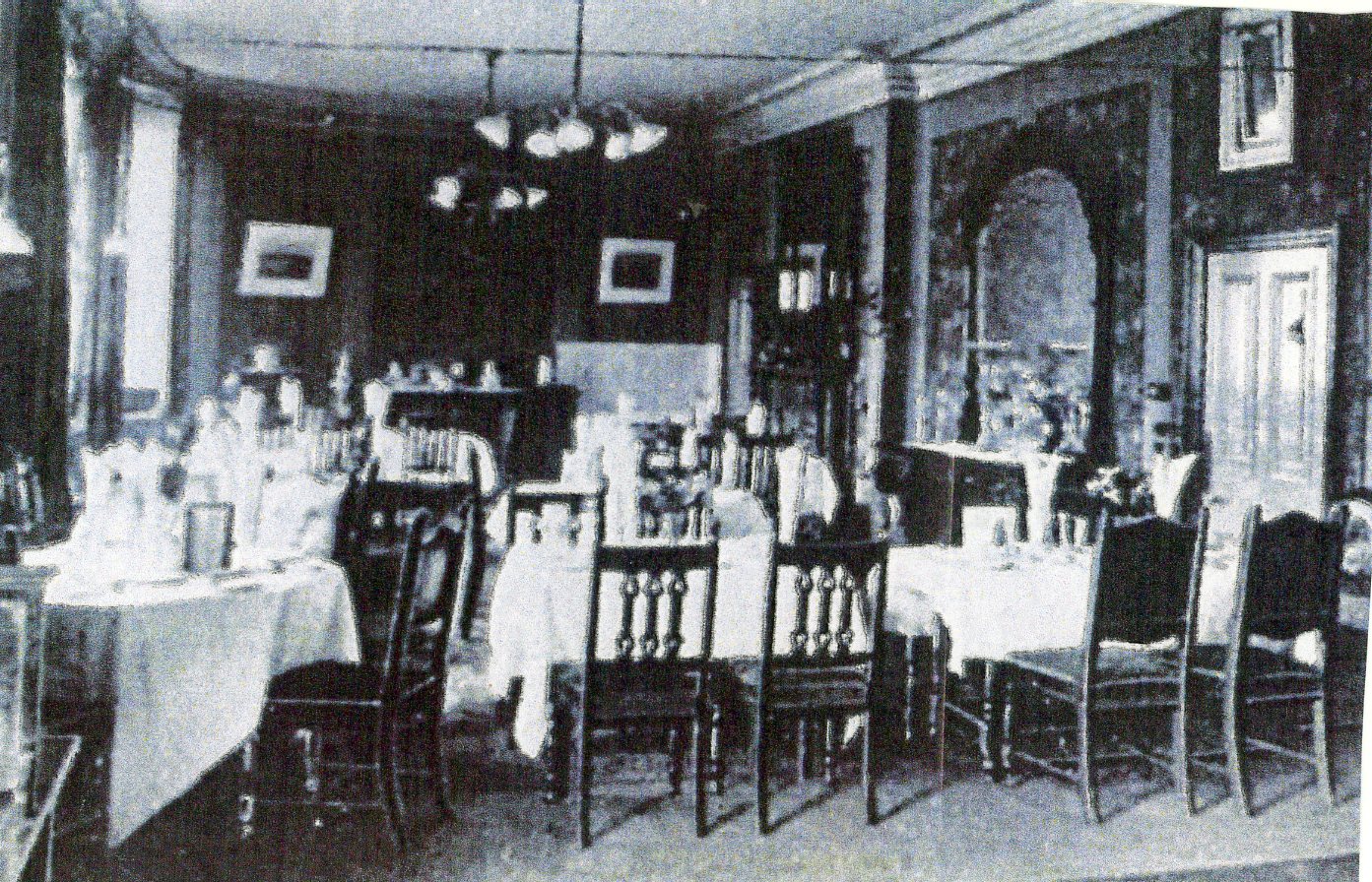
View of the Dining Room in the Victorian Old Bull Hotel.
2. THE LEGS OF MAN INN – this was formerly the Paslew Arms with links to the abbots of Whalley Abbey including John Paslew who at one time had a house on Church Street. It was one of the oldest inns in Blackburn being the stop over for pilgrims in the 14th century as it was close to All-Hallows well and St. Marie’s chantry in the parish church. By 1833, it had become a coaching inn with coaches leaving on Thursday and Sunday mornings for Blackpool. The Legs of Man are linked to the Earls of Derby who were formerly lords of the Isle of Man and ruled there up until the time of the Civil War who also owned land in the Blackburn area and had influence there. Its original fabric would have been similar to the Old Bull Inn i.e. a half- timbered structure with over-hanging gables. This was replaced with a Georgian structure but remaining was a huge vault that extended under Darwen Street, a good example of barrel-vaulting. By 1892, the Inn covered numbers 1, 3 and 5 Darwen Street, had 4 rooms on the ground floor and 6 bedrooms but no room for travellers with the accommodation used mainly as vaults and a retail shop.
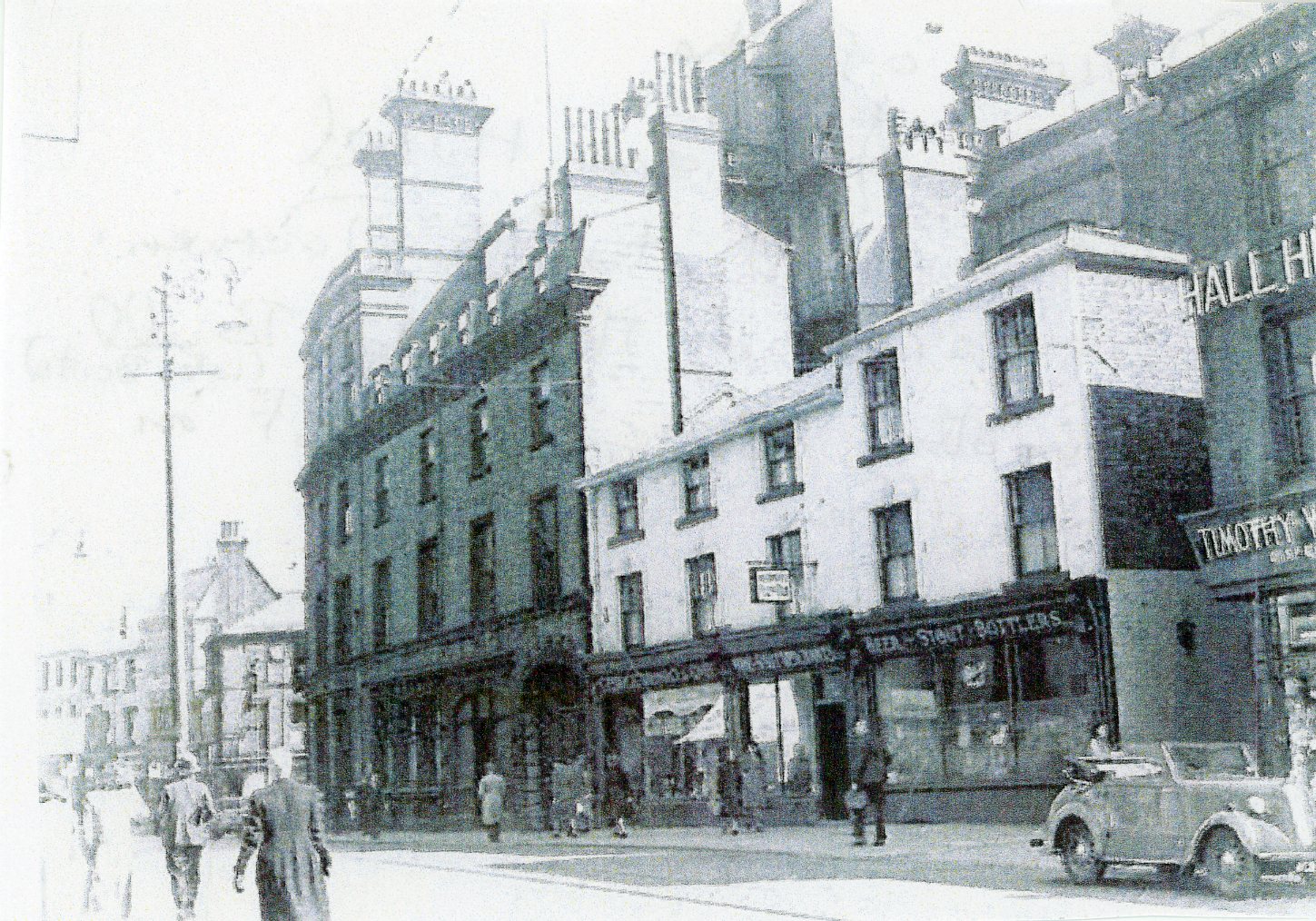
View of the Legs of Man Hotel sited below the Darwen Street side of the Old Bull
Hotel with Timothy Whites Chemist (later Boots) on the other side.
3. THE BIRD-IN-THE-HAND INN – this was just beyond the Legs of Man Inn separated by a couple of shops at number 11, Darwen Street. Records exist of this Inn from the 1790’s and, like the earlier two inns, it was well positioned to receive a high footfall from the original market. Its name is clearly borrowed from the popular saying “a bird in the hand is worth two in the bush”. In 1892, the outside was painted and alterations made internally to improve the facilities and renamed “The Darwen and County Arms” and, more recently, just the "County Arms". At this time, it had no beds for travellers and could supply refreshments to 6 persons with 6 ground floor rooms, 5 bedrooms and no stabling. By 1825 the inn was a depot for the Bury and Haslingden carriers whose wagon left on a Wednesday evening returning on Friday. For many years the inn was a meeting place of Blackburn Shoemakers who, in 1827, celebrated the anniversary of St Crispin there. At the time when Henry Whalley was the landlord there he established a coach service to Bolton driven personally but in time lost out to the new railway to Manchester although his was the last coach to run from Blackburn, closing the service in 1847.
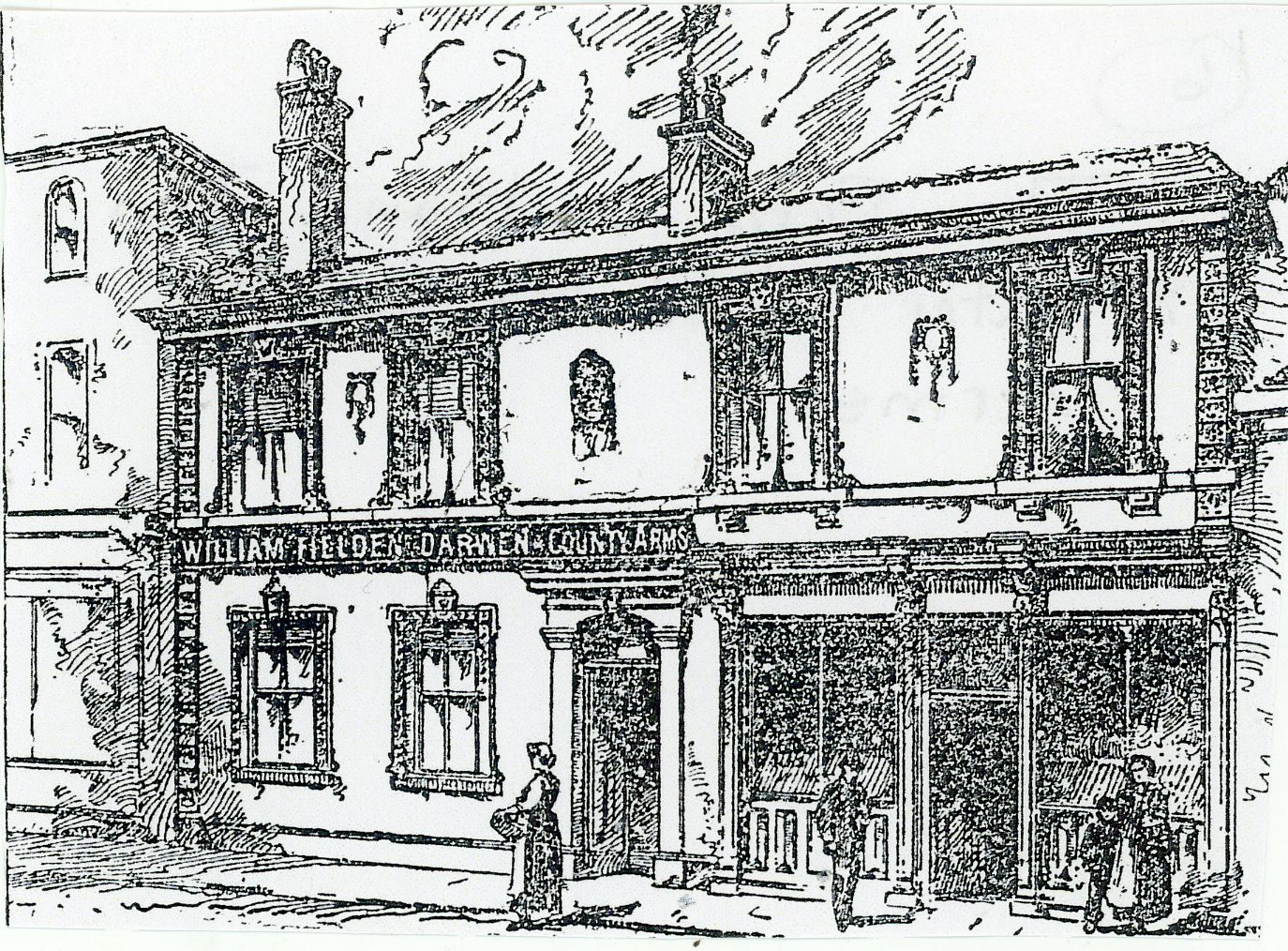
The Bird-In-Hand Inn 1891 which later became the County Arms on Darwen Street.
4. QUEENS HEAD INN – this was situated at 17, Darwen Street next to the last house before Dandy Walk that leads to the Boulevard and probably dates from the late 1700’s. The inn had accommodation for supplying refreshments to 12 people but no accommodation for travellers. It also had stabling for three horses and 5 ground floor rooms and 3 bedrooms in 1892. By the late 1920s the Inn was converted into a wholesale and retail fruit merchants.
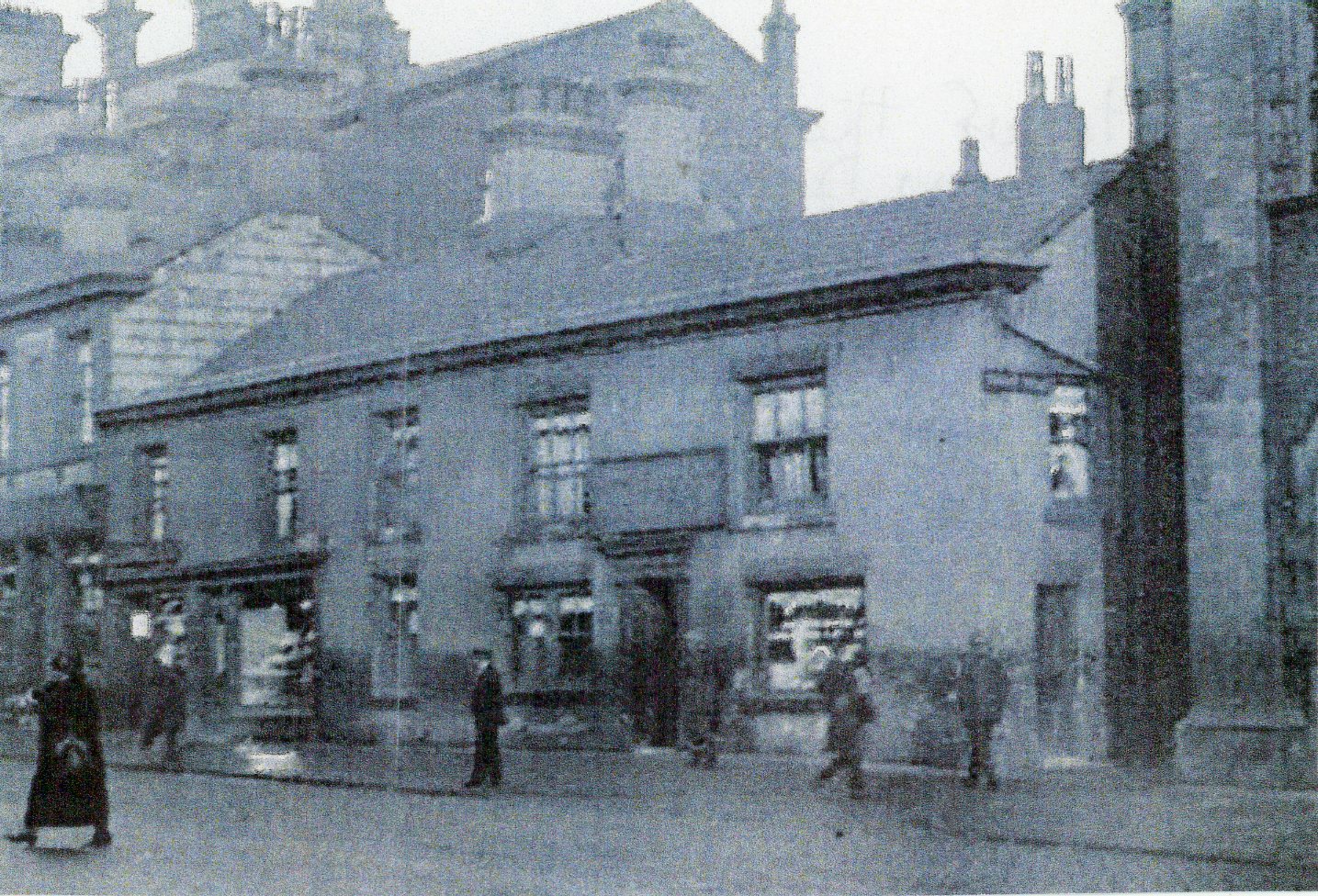
The site of the old Queen’s Head Hotel at 17, Darwen Street next to Dandy Walk,
in the 1920s it later became a wholesale fruit merchants.
The shop on the left was where Henry Harrison was born in 1834 who became a Textile Magnate.
5. EAGLE AND CHILD INN – this was situated at the top end of Darwen Street, at number 18, beyond the Old Bank and opposite the Legs of Man and dated back to the late 1700s. The Inn was owned by the owner of the Wheatsheaf, sited below opposite The Bird in the Hand. At this time the Inn had two beds for travellers, accommodation for 20 people to have refreshments, a warehouse, brewhouse and stables, so clearly made its own beer. The Inn was an old building with low rooms which were dark and much of the inn needed repairs in 1892. Its site on the main side of Darwen Street’s market stalls meant it was a popular inn. In 1803, both the Eagle and Child and Wheatsheaf Inns were sold together to James Walmsley who let them out to tenants. In 1815, a meeting of Blackburn Publicans was held at this inn to consider the licensing laws when a petition to Parliament was adopted. During the loom breaking riots at the Jubilee Mill (Dandy Factory) sited across the road, so when the military were called in and fired on the crowd the shutters of the Eagle and Child were riddled with bullets and one man severely wounded sheltering in the doorway with four others also wounded and 33 arrested. Between 1840 and 1845, Bland’s coach started for Manchester from this Inn and was regarded as an “opposition” coach to that of Henry Whalley at the Bird-in-Hand across the way! This inn either gave its name to the nearby Eagle Court off Darwen Street or took it from the same?
6. ANCHOR INN – This picturesque old hostelry formerly called the Hope and Anchor when Darwen Street was called Church Street, was originally a Jacobean structure with mullioned windows surmounted by dripstones and was still standing as late as 1890 before its demolition to make way for more shops. The landlord in 1851 was a woman called Alice Ainsworth. It stood on the west side of Darwen Street above the entrance to Mill Lane opposite the shops below the Post Office. Mill Lane at this time was a winding track leading down to the town’s corn mill and then known as Mill Gate. In 1822, the landlord was a James Broadley.
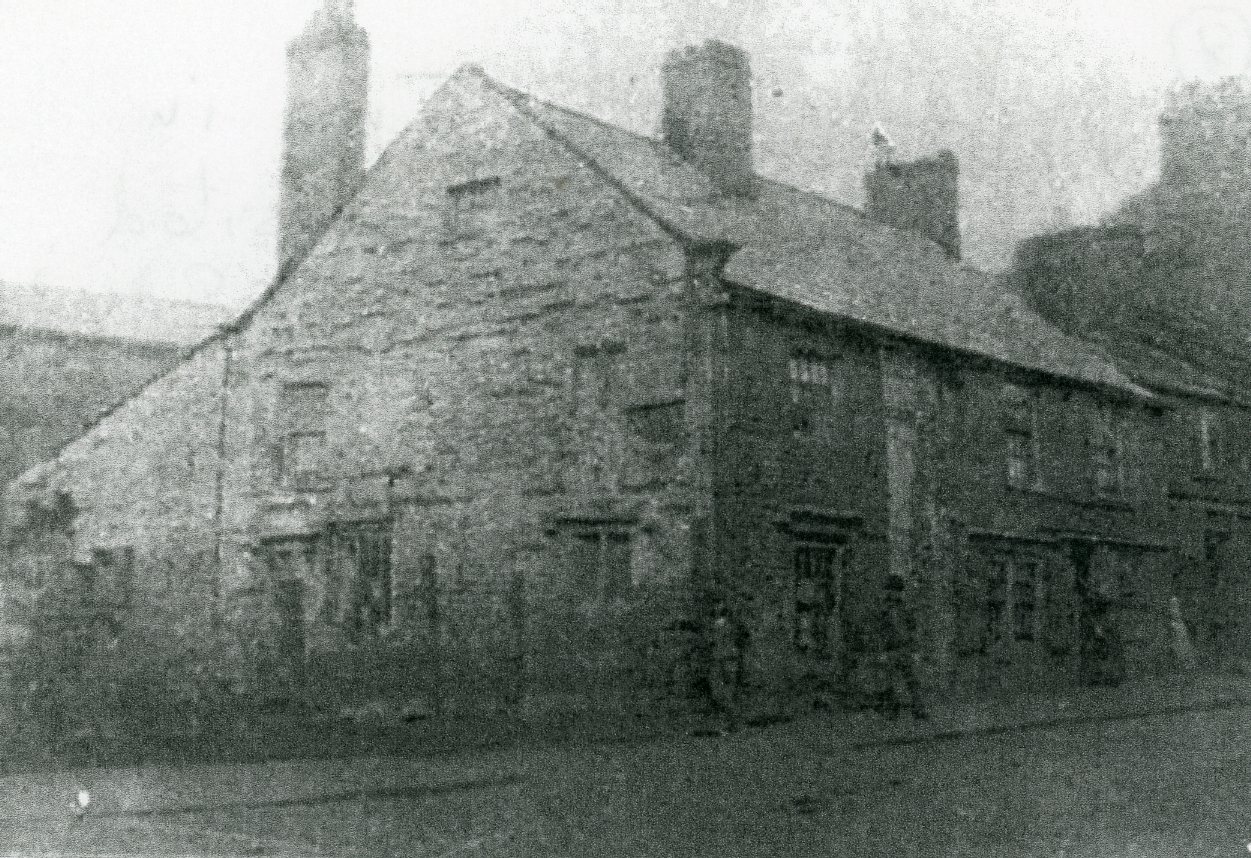 The Anchor Inn in the early 1900’s sited between St. Peter Street and Mill Lane on Darwen Street.
7. DUN HORSE INN – Originally an ancient hostelry situated at the Darwen street end of Market Street Lane and had been in existence in 1715. This was proved by an extract from the 1st. Jacobite rebellion when a Captain Douglas from the rebel army based in Preston came to Blackburn in disguise as a traveller looking for arms and horses. The local townsfolk were on alert and armed, therefore, when he entered the Dun Horse hoping to learn about the movements of the Hanoverian forces he was recognised and only just managed to escape. In 1802, the landlord was Robin Wood followed by a Stephen Parker. The Inn had stabling for 16 horses and other out-buildings but was hemmed in by narrow streets although a carrier waggon left its yard every Tuesday in 1824 for Preston and Kirkham and others went to Manchester and Chorley. When the old market on Darwen Street left for its new home, trade dropped off and the Inn was rebuilt at the Mincing Lane end of Market Street where it still is.
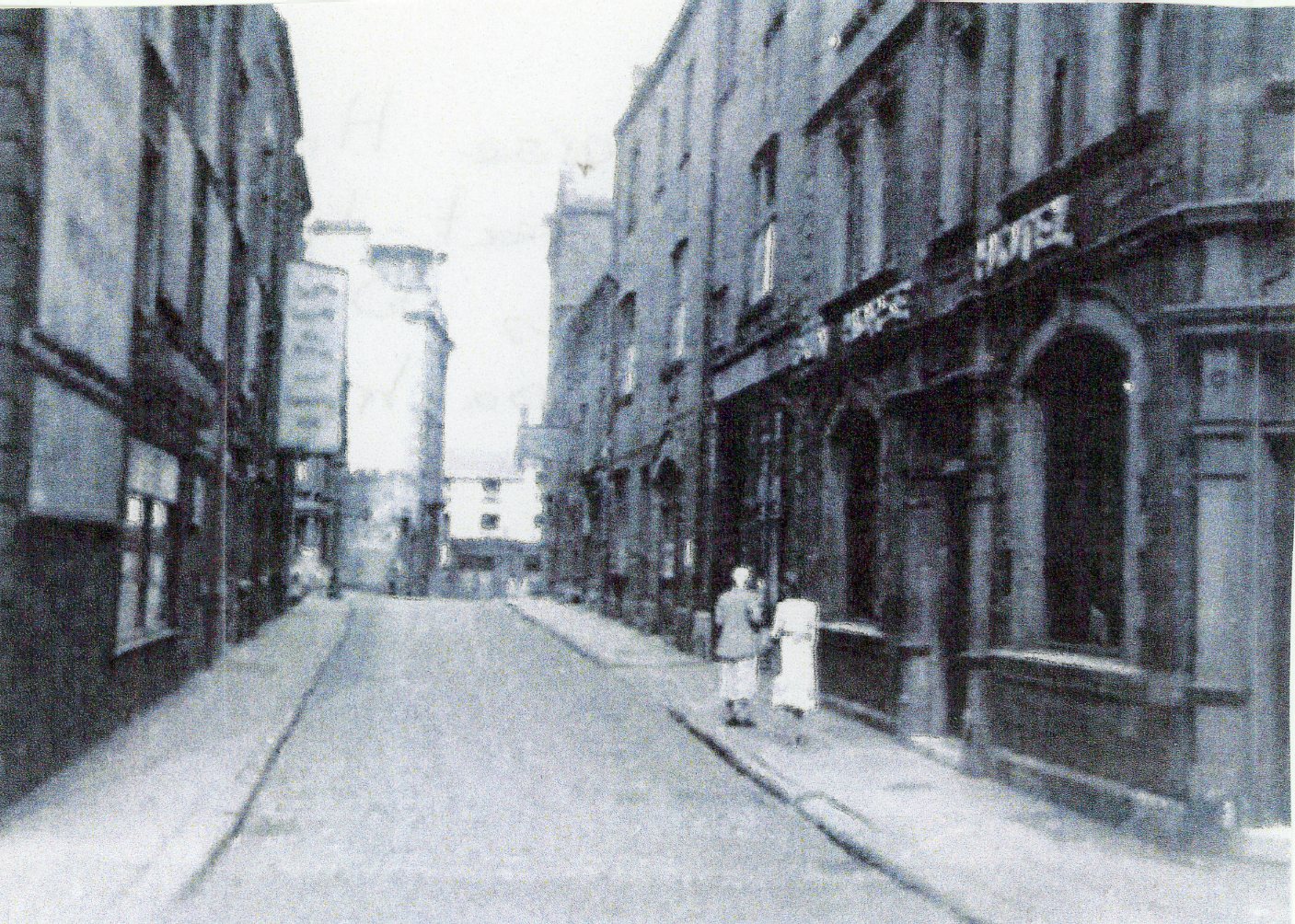
The Dun Horse Hotel on Market Street Lane looking towards
Darwen Street in the background. 1960s.
8. MERCHANTS HOTEL – This was situated on the corner of Jubilee Street which, originally, was a cul-de-sac off Darwen Street before it was upgraded to a Street leading to the Boulevard and railway station. The site was formerly taken by the OLD WHITE BULL INN but little is known of this quaint old hostelry other than it had a large room reserved for the sitting of an impromptu magistrate court, as it was reasonably near the former town lock-up just beyond Darwen Street bridge. The Merchants Hotel built on its site at 43/45 Darwen Street was a tied house in 1892 and had two beds for travellers and room to supply refreshments to 20 people with stabling for 6 horses and good vaults. The hotel had 7 ground floor rooms including a billiard room and ten rooms available for bedrooms and a band room.
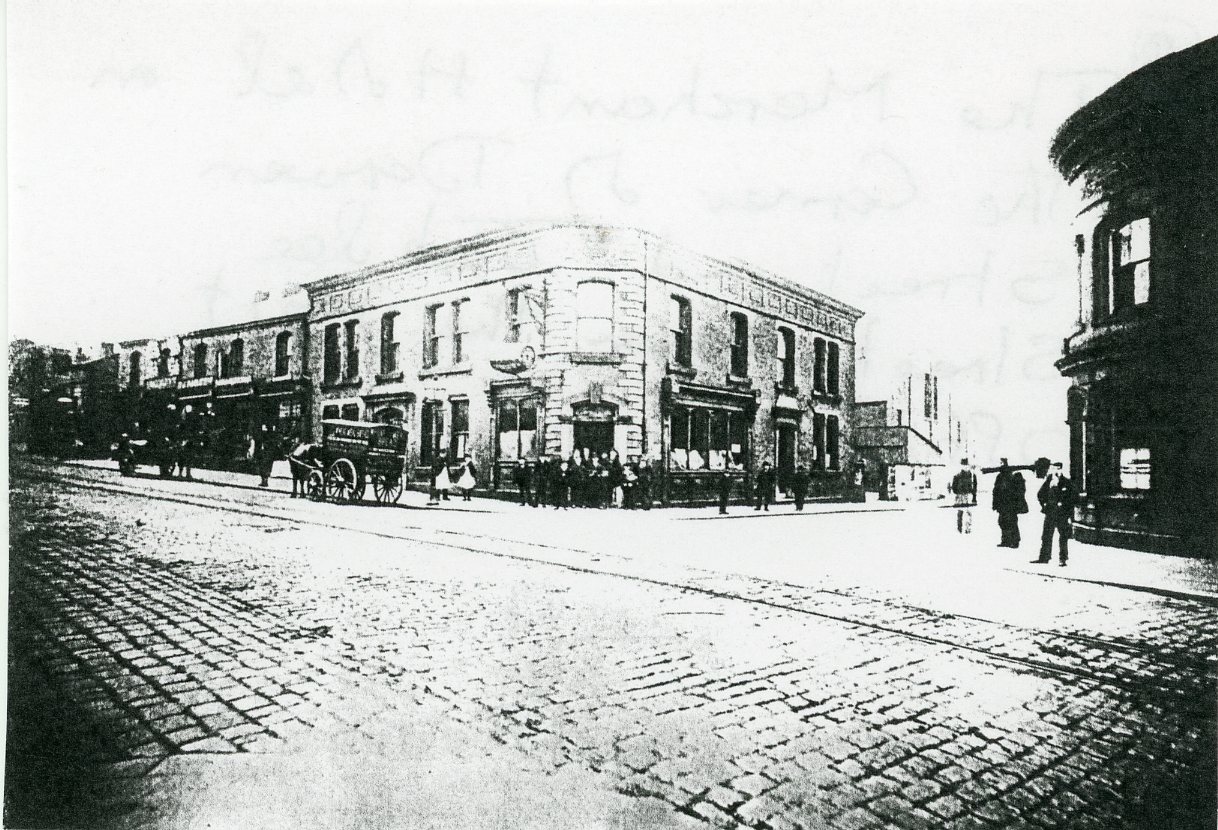
The Merchant Hotel on the corner of Darwen Street and Jubilee Street below the Post Office.
9. STOKERS ARMS – This was situated below Darwen Street’s junction with Jubilee Street and Mill Lane at 73, Darwen Street on the Post Office/Edmondson’s side and in 1892 was a Tied House with no accommodation as it was a small inn. It had four ground floor rooms and three upstairs, a beer-house and was licenced before 1869. Its name would indicate a connection with the steam age industry/railways?
10. GEORGE INN – This was situated on the opposite side of Darwen Street to the Stokers Arms just below its junction with Back Lane (Mincing Lane) on the corner of Weir Street at 82, Darwen Street. The name could have been derived from King George or, from George Clayton, who also gave his name to Clayton Street off Back Lane (Mincing Lane) and who was the town constable in 1800. It was a fairly large Hostelry and, in 1892, had two beds for travellers, five rooms on the ground floor, six bedrooms, a sitting room, club room and a ball-room. The Inn also had 21 stalls for stabling in 1892 which is a link to a past landlord there called John Dixon who was formerly the landlord at the Golden Lion on Church Street before he set up as a hay and straw dealer on Bolton Road where he started a coach business. After establishing the coaching business he transferred it to the George Inn where he remained till 1890 also running the hostelry. For many years he ran the Post Office Mail Coach between Blackburn, Bury, Preston and East Lancashire. At the same time he also established a funeral service after adapting a coach brought into use by George Shillbeer in 1829 into a funeral carriage drawn by two horses. It was glazed all-round with a long narrow chamber in the middle for the coffin and above were two rows of seats for the mourners who sat back to back. The entrance was from the back by means of a drop flight of steps and it had large black plumes at each corner of the coach as an extra (See illustration below). In 1866 the Blackburn Times reported that he was pulled up at the Shackerly Toll Bar on Preston New Road for not paying the toll although undertakers travelling to burials and church services were exempt but when his hearse was examined there was no body!
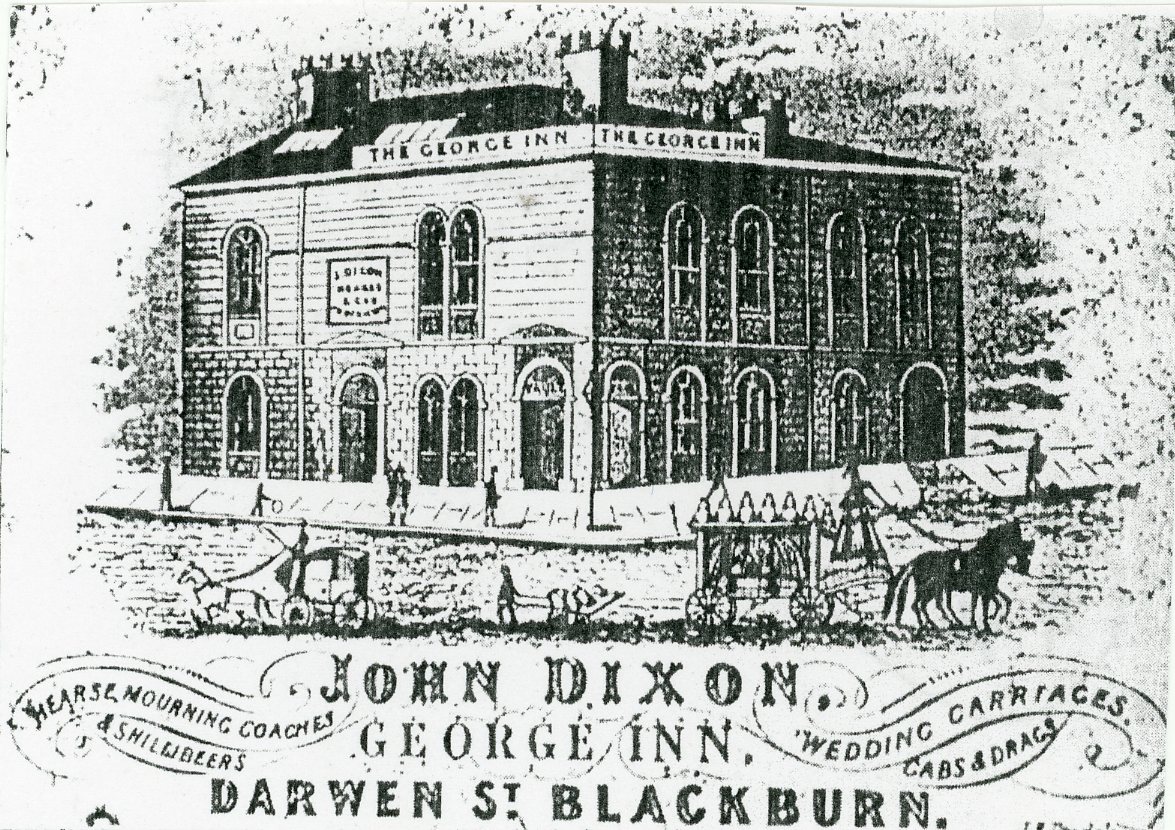
1870s sketch of the George Inn on Darwen Street where Weir Street
and Mincing Lane converge alongside it.
11. THE SHIP INN – The old “Ship Inn” stood at the bottom end of Darwen Street where the street began to rise to surmount the ancient stone bridge over the River Blakewater which was later replaced by the present level bridge. An ancient hostelry that can be traced back to a tenant in 1784, sited on the same side of lower Darwen Street as the George Inn and was slightly set back from the main street line being a place of call for the farmers of Livesey, Mill Hill and Tockholes who would enter/leave town by this area. The Inn was demolished when it was affected by street improvements creating a new entrance which opened up Darwen Street into Back Lane (Mincing Lane) which ran behind and parallel to it. The landlord in 1821 was James Aspden who had lived there for 37 years and was the oldest publican in Blackburn.
12. THE DUKE OF YORK INN – This was situated at the end of Darwen Street where it goes under Darwen Street Railway Bridge on the corner of Canterbury Street; the Inn was established some time about 1790, with its formal brick facade fronting on Darwen Street. The rear of the building, seen from Canterbury Street, is possibly older and built of large well-cut blocks of freestone. Part of the rear section of the Inn was used as a shoeing-forge and its well-worn stone mounting block for the use of farmers’ wives riding pillion is still in position. The Inn’s isolated position on the edge of the Towns Moor beyond the bridge, as shown by Gillies Map of 1822, must have made it a welcome sight to travellers descending the lonely, highwayman infested moorland roads from Haslingden and Bolton. Evidence of the amount of highwaymen about in these early days was the fact that it was the custom of local manufacturers and merchants to gather at a set rendezvous at the edge of town and travel over the moors in company with an armed escort riding ahead! As the nearby Town Moor was also reserved, by decree, for the training of military levies since the days of Elizabeth 1st; the area was in constant use, especially during the Napoleonic Wars, with drill sergeants organising events so the Inn would have been close enough to be a constant attraction when drills ended. Thomas Holden was the landlord in 1810 followed by Christopher Gibson in 1828, and, during his early tenancy of that year a ringleader called Thomas Bury (a weaver) was taken prisoner by the military and confined to the cellar of the inn following loom-breaking riots. However, when the military later returned to their local barracks on King Street, the rioters launched an attack on the Inn and battered down the front door and rescued Thomas Bury but, the following day, Blackburn’s Constable forced his way into Bury’s home and re-arrested him from his bed. The Inn’s name is taken from the royal Duke who was a popular figure during the second half of the 18th. Century; he was the son of George 111 who created the Duke of York and Albany in 1789 and held the office of commander-in-chief of the British Armies until his death in 1827. In 1892, the Inn had a barn, shippon, stables, brewhouse and other out buildings with two rooms for travellers, 15 stalls for horses and six rooms on its ground floor and five bedrooms together with a sitting room and club room.

 Loading more