
 Loading more
20th Century 1950 1970
John Beardsworth | William Hare | John Shorrock | Robert Weir | John Stirrup| Houghton Johnson
William Alfred Henshall MC | Herbert Vaughan Dowdall | George Haworth | John Makinson Lomax | James Whitehead
George Gillibrand Margaret McNamee | Frank Wilkinson | Francis W. Bramwell | Lawrence Edwards
Edith Railton| Florence E. Lewis | Arthur Rigby | Edmond Gregson
John Beardsworth
Mayor of Blackburn 1950-51
John was born in Blackburn on the 4th of September 1899 to James and Emily who had a family of eight children. James worked for the railways and his sons John and George followed him to become railway clerks. John married Florence Kenyon Sarsfield in January 1909 and by the census of 1911 they were living at 13, Woodbine Road with their two daughters, Ethel two and Dorothy five months - they went on to have another daughter and three sons. In 1939 they were living at 195, Brownhill Drive. John was interested in all sports particularly cricket and had been an official of the Railway Clerks Cricket Club.
John was a British Railways Railway Service Representative retiring in 1950 after more than forty six years in railway service. At the age of fourteen he had started as a junior clerk with the Lancashire and Yorkshire Railway Company at Blackburn and spent the whole of his career at Blackburn Goods occupying several positions. He was appointed Commercial Representative in May 1938 but was withdrawn in consequence of the WW2. At the close of war he again took up duties in the town making contact with the various firms and traders being appointed to his final position of Railway Service Representative in October 1945. For twenty one years he was secretary of the Blackburn Railway Clerks Association and afterwards became their Chairman. John began his council service in 1928 when he was elected as Labour Councillor for St. Paul's Ward which he continued to represent until he was made an Alderman in 1945. He was deputy leader of the Labour Group and had been Chairman of the Waterworks Committee since 1929. John was appointed a Justice of the Peace in 1938 and was also a member of the Management Committee of the Blackburn Co-Operative Society. He was the Chairman of the Finance and General Purposes Committee of the Lancashire and Western Sea Fisheries Committee where he represented Blackburn for many years. After the passing of the Rent Act he set up an information bureau to give advice to tenants which eventually resulted in the reduction of rents for twenty thousand householders in the town. John's brother Fred also served on the council and another brother George had been the Mayor of Bebington and awarded the OBE.
Florence died aged 89 in 1974 and John died at the age of ninety in 1980.
Janet Burke.
William Hare
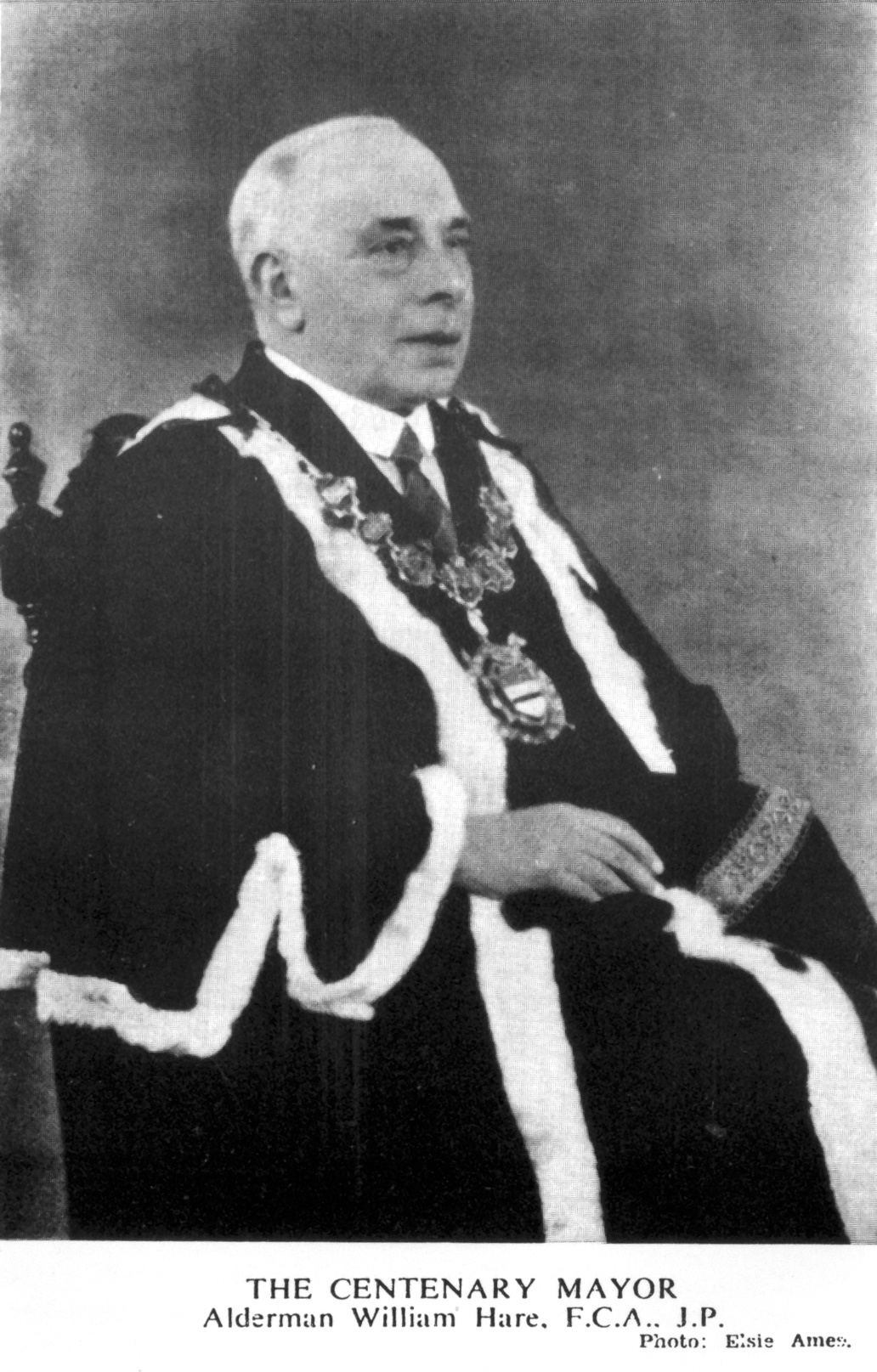
William Hare Mayor of Blackburn 1951-52
The Centenary Mayor
William was born on the 23rd of July 1879 to William and Hannah. The family lived on Queens Road in 1901Zand William at the age of twenty one was an accountant's clerk. His younger brother Charles Henry was a stockbroker's clerk and father William was described as a book-keeper. William had an elder sister Amelia, a weaver and a younger brother Arthur still at school. William's father was from Leicestershire and educated at Manchester Grammar School. He worked at Coddington's Mill as cashier for fifty nine years and was very involved at St. Thomas's church being the Sunday School Superintendant. In 1907 William married Sarah Jane Hart. On the census of 1911 they lived at 215, Revidge Road and had a son William aged three months. William served his articles with a Mr. J. Rudd J.P. and on passing his final exam in 1911 was elected an Associate of Chartered Accountants and immediately became a partner in the firm of Waterworth, Rudd and Hare. William divided his service to the Church between St. Thomas's and St. Silas's holding many positions including being a representative to the Diocesan and Decanal conferences and also being the Sunday School Superintendent like his father. At the special Diocesan Conference meeting of the 16th. of June 1922 it was said that William was largely responsible for Blackburn being selected as the See Town.
William became the Mayor in the town council's centenary year. He had been the Conservative member for St. John's Ward since 1931 and continued until he was made an Alderman in 1941. He was an old boy of the Grammar School and a governor since 1932, he was the Chairman of the Finance Committee, Treasurer of the local Conservative Party and Hon.Treasurer to the Council of Cathedral Builders. William was very concerned with the extension to the cathedral and disappointed that it was not sufficiently advanced to permit an official opening in his year of office. The costs had risen threefold due largely to the suspension of work during the war and William announced his intention to open a subscription list for Blackburn Cathedral Building Fund, £176,000 had already been contributed but it was thought another £200,000 would be needed. He regretted that the celebrations for the centenary year would be somewhat restrained in view of the aftermath of the second world war and the war in Korea. Many improvements to the town had been achieved but there was still a lot to do and William also appealed for a return to the Church and that people might attend at least on a Sunday - congregations had greatly diminished.
William's final address was 77, Alexandra Road where his wife Sarah Jane died in January 1931 William was married again in September 1932 to Ellen Kenyon the daughter of an Estate Agent - the ceremony took place in Chipping. William died on the 14th. of May 1961 and probate was granted to Ellen and his son William, also a chartered accountant, the proceeds being
£20,422-6s.
Janet Burke.
John Shorrock
Mayor of Blackburn 1952-53
John was born in 1882 to James Edward and Mary Ann Shorrock. There had been twelve children in the family and John was the eldest, however three had sadly died. When John was nine years old, they lived at 15, Whitebirk Road and he went to a small school run by one master and his wife. Whitebirk pit was across the road from the school, and it was common for people to borrow a barrow and take a hundredweight of coal for sixpence. John was living at 58, Cherry Street with his parents and siblings at the age of 19. At that time he was working in the cotton industry and started as a half-timer on two shillings and sixpence a week and then became an overlooker. He studied at Blackburn Technical College and eventually became a director of F. Mercer & Co. Pioneer Mill, Kelly Street, Mill Hill. He was also a director of another concern and John latterly had an interest in his father's furniture and bedding business on Copy nook and the Bottomgate Billiard Hall. He became company director of the billiard hall after the death of his father in July 1940. He met his wife to be, Alice Smith, at a dance held in the Co-Op Rooms on Belper Street and they married in 1907, living on Cherry Street.
John was a member of the Labour Party for over fifty years and was elected a councillor for St. Matthews ward - a position he held for thirty-five years. He was Chairman of the Public Assistance and Finance Committees, Chairman of the Watch Committee and Chairman of Brockhall Institution. John was also on various hospital boards including Manchester Regional Hospital Board, Prestwick Hospital, Moor Hospital Lancaster and Blackburn and District Hospital Management Committee. He was the House Chairman of Queens Park Hospital where he had been involved for twenty-seven years. During the trade depression from 1931-39 John helped with social work for the unemployed of the town and he paid several visits to the United States where he studied the problems of unemployment. One of his special memories during this period was the visit of Gandhi to the local area. During his mayoralty nearly £15000 was raised for various local funds including the relief of Lynthorpe and the East Coast Flood Relief Funds. In 1946 John was appointed to the Magisterial Bench where he served until reaching the compulsory retirement age of seventy-five. John was also an Alderman and respected by all parties.
John and Alice celebrated their golden wedding in 1957. However, in April 1964 John died at his home 840, Whalley New Road aged eighty-two - the funeral was held at Furthergate Congregational Church and the interment was at Pleasington Cemetery. Probate was granted to Alice and the proceeds were £5,132. Alice only lived for two more years and died in Queens Park Hospital.
Most of the above information was contained in the obituary published by the Blackburn Times on the 10th. of April 1964, articles from the Evening Telegraph of 1957 and information related to his father’s billiard hall which is held in the Local History collection at Blackburn Library.
Janet Burke.
Robert Weir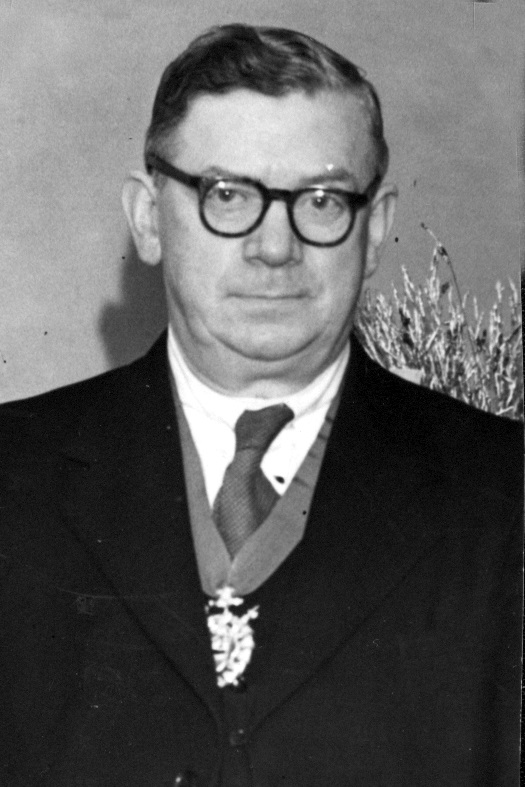
Mayor of Blackburn 1953-54
Robert was born on the 17th of June 1893 in Glenluce, Scotland but his family came to Blackburn and in the census of 1901 they lived at 49, Ingham Street. By 1911 Robert, aged eighteen, was working as a Blacksmith's striker, and was married to Nellie aged twenty - they lived at 139, Alker Street. In 1939 Robert worked as a Railway Signalman and lived with Ellen and their son John Robert aged sixteen at 80, Old Bank Lane. Robert worked on the Railways for forty two years and had been a special grade signalman for thirty one of those years.
Robert became the Mayor in the year of the coronation. He was elected an Alderman only three months after his mayoralty although he had been a councillor for twenty five years. Robert was the longest serving socialist councillor and for eight years had been Chairman of the Transport Committee, Chairman elect of the Municipal Transport Association and a member for the National Joint Industrial Council for Passenger Transport. Robert was Chairman of the N. E. Lancashire Town and Country Planning Advisory Committee and had led several deputations to the President of the Board of Trade. In 1938 he was appointed a magistrate and in 1957 he was awarded the BEM for his role in Blackburn's public life, Trade Union affairs and national transport work.
Ellen died in 1972 aged eighty and in 1981 Robert died in Queens Park Hospital aged eighty eight. He had lived on Bradda Road at the time of his death and left a son and a daughter.
Janet Burke.
John Stirrup
Mayor of Blackburn 1954-55
John was born on the 24th of July 1891 to John William and Eliza Jane. John William was a boot maker and there had been eight children in the family but one had died. At the census of 1911 they lived at 143, London Road, John junior was nineteen and described as a mill furnishers clerk. He married Eliza A. Morris in October 1917 and they had a son Kenneth on the 31st of May 1922. John was the Sunday School Superintendent at St. James's Church and before he enlisted in the army in 1917 he had been presented with a bible which he read every day and later kept in the Town Hall. In 1939 John and Eliza were living at 64, East Park Road and John's occupation was described as a Textile Machinery Merchant and Mill Furnisher. He was keenly interested in music and as Chairman of Blackburn Music Society was largely responsible for the promotions of the big concerts of recent years and visits of famous orchestras like the London Philharmonic, London Symphony and the Halle and also artists such as Gigli and Gracie Fields. He formed and trained a men's choir who performed for the Duke of Kent on his visit of the 7th of July 1934 and was presented as the conductor. In 1937 he took a choir of unemployed men to London for a concert which was broadcasted. John was the musical advisor to Blakey Moor Girls’ Choir which was very successful and he became choirmaster at St. Silas's on the death of Dr. Herman Brierley. John was invited to be the Hon. Director of Competitions for the national competitions of the Festival of Britain in 1951. In 1960 John received the OBE for his work in the field of music.
John was elected a Conservative councillor for St. Andrew's Ward in 1941 and his interests were the unemployed and education. He was responsible for the formation of the Mayor's entertainment committee and subsequently the Garrison Entertainments. During the war John was the Chairman of the first ENSA (The Entertainments National Service Association) music club for workers. John was a co-opted member of the Public Assistance Committee and also involved in the push for a new telephone exchange as had been agreed by the Postmaster General Earl De La Warr. John was Chairman of the Cleansing, Welfare and Parks Committees and became an Alderman in his mayoralty year. Also in that year was the centenary of the Weaver's Association and the Jubilee of the Chamber of Trade.
John was a founder of St. James's cricket and tennis club—later to become Blackburn Northern. He was the manager of St. James's Day School and a governor of the Grammar School. He and Eliza had three children, two girls and a boy who went into business with him. Eliza died on the 4th of May 1963 aged fifty one and John died on the 19th of July 1969 at the age of seventy eight. According to probate at John's death the proceeds were £6280.
Much of the above information is from local newspaper articles including the Northern Daily Telegraph of October 1954, the Blackburn Times of December 1954 and December 1960.
Janet Burke
Houghton Johnson
Mayor of Blackburn 1955-56
Houghton was the son of Henry, a newsagent, stationer and general dealer, and his wife Agnes who helped in the business. He had three sisters and at the census of 1911 they lived at 1, St. Thomas Street. Houghton was fifteen that year, born on the 23rd of March 1896 and when the war broke out in 1914 he had a commission for three years in the Royal Welsh Regiment and Northumberland Fusiliers. On the 28th of January 1916 he was gazetted with the rank of Captain in the Border Regiment (Service Battalion). In July 1921 Houghton married Doris Hopwood and in 1939 they lived at 2, Seven Trees Avenue when he was working as a railway clerk. He became the chief clerk in the goods yard at Bamber Bridge Station
Houghton was elected to the council as the Labour representative for St. Stephen's Ward in 1928. He became the Chairman of the gas committee and was chosen to be a member of the North West Gas Consultative Council by the Minister of Fuel. He lost his seat in 1931 but was re-elected in 1932 as the representative for St. Paul's Ward and served continuously until 1945 when he became an Alderman. Houghton was also the Chairman of the Railway Clerks Association retiring in 1937. He was a member of many committees including that of lighting which under his leadership well advanced the conversion of street lighting to modern standards. For twenty years Houghton was a member of the Co-Operative society Board and also on the Board of the N.E. Lancashire Co-Operative Dairies. He was a governor of the Girls High School for some years and was asked to open the new YHA centre on Clayton Street - Blackburn was one of the most active in the country.
Houghton played cricket and football for St. Matthews and also football for the Technical College. He was a member of the now defunct Crellin Best Orchestra which used to play at Chapel Street church gatherings and had a keen interest in the development of community theatre. Houghton collapsed at the Town Hall and died on the 16th of May 1956 at his home just eight days before the end of his mayoralty - he was the fifth mayor to die in his year of office. He was just sixty years old in 1956 and left his widow Doris and a married daughter. Probate was granted to Doris and the proceeds were £3052-9s. Much of the above information is contained in the articles of the Blackburn Times of July 23rd 1949 and May 25th 1956.
Janet Burke
William Alfred Henshall MC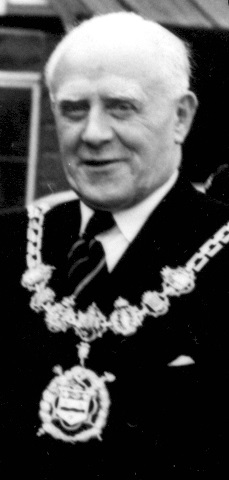
Mayor of Blackburn 1956-57
William was born in Beswick a district of Manchester in September 1895. His father Alfred was a warehouseman and his mother Alice Emma a housewife although in 1911 there were three boarders in the family home as well as William and his younger sister Grace Alice. William was educated at Manchester Grammar School and in 1912 was a clerk in the marine department of the Royal Exchange. In 1915 he left to join the army in the Public Schools Brigade of the Royal Fusiliers and entered France on the 14th of November 1915, he then was commissioned on the 25th of September 1916 to the Manchester Regiment and finally transferred to the Machine Gun Corps in 1917. William was wounded five times, gassed and temporarily blinded and in 1918 was awarded the Military Cross for gallantry in active land operations against the enemy and ended his service as a lieutenant. William was awarded the 14-15 Star, the British War and Victory medals. On demobilisation in 1919 he took a rehabilitation course in commerce and in March 1920 was appointed an inspector to the Guardian Association Company of Blackburn but in 1928 he left to open a sub-branch in Blackburn for the Licences and General Insurance Company. William spent his working life in insurance and was founder- president of the Blackburn and Burnley Insurance Institute.
He was the founder secretary of the Blackburn Rotary Club in 1921 and a founder member of the Blackburn Garrick Society and the Samlesbury Players. In 1922 he joined the Blackburn Amateur Operatic and Dramatic Society becoming President in 1956. In 1926 he was producer for the St. Silas' Lyric Society for the production of Gilbert and Sullivan operas – a position he held until the war. William in 1962 was awarded a bar to the NODA medal for his forty years-service to amateur dramatics in Blackburn. William married Sylvia Alice Clemminson Morgan on the 6th of July 1927 at the parish church of St. Agnes, Birch in Rushholme, his occupation was described as a general insurance inspector – they lived at 135, Lammack Road for all their married life.
William was a member of St. Michael's Conservative Association and was elected a councillor for that ward in 1937 – he remained a member for St. Michael's Ward until made an Alderman in 1954. He was Chairman of the Public Library Committee for twenty three years and served on numerous other committees – in 1972 he became leader of the Conservative Group. As Chairman of the Education Committee he opened the new Technical College and Pleckgate School. In 1939 William, with the rank of Captain, mobilised a national defence company under the Territorial Reserve which later became part of the Border Regiment. In May 1940 he took command of a military police company and in 1943 was appointed the Camp Commandant of Hadrian's Staging Camp from which he was demobbed in 1945.
During his Mayoralty William launched an appeal for Guide dogs for the Blind which led to the establishment of a training centre at Bolton opened by Princess Alexandra. He also opened the new workshops for the blind in Mill Hill on the 25th of April 1957. William had the honour of unveiling the stand commemorating the four Blackburn men who had been awarded the Victoria Cross. He was twice mayor as a result of the unfortunate death of Mr. Dowdall who had followed him in 1957 and Williim finally retired from politics in 1974 when local government was reorganised. On the 9th of April 1976 William died suddenly, aged eighty, he was cremated at Blackburn's new crematorium in Pleasington which he had opened in September 1956 when he was mayor. Probate was granted to his widow Sylvia and the proceeds were £7,131.
Much of the above information comes from the Blackburn Times of March 29th 1963 and September 5th 1975.
Janet Burke
Herbert Vaughan Dowdall
Mayor of Blackburn 1957
Herbert was born on the 26th of December 1882 to Edward and Catherine who were from Ireland. Herbert was born in Rochdale but on the census of 1891 the family had moved to West Street, Blackburn and his father was working in the paper mill. At eleven years of age Herbert worked as a half timer in a cotton mill at Cherry Tree, when he was fourteen, he started work at the Sun Paper Mill where he worked for twenty years. He joined the Feniscowles branch of the National Union of Printing, Bookbinding and Paper Workers in 1912 becoming secretary of the branch in 1921 and finally retired in 1947. Herbert was a member of the union's national executive and the North West Group Committee of which he was chairman several times - for six years he was on the Convalescent Home Committee for the union.
Herbert was elected to the council in 1929 for St. Mark's Ward and in 1934 represented St. Luke’s Ward becoming a Justice of the Peace in 1941 and an Alderman in 1954. He was a member of the Public Assistance Committee from the early thirties until it was superseded by the National Assistance Board. He became chairman of the Welfare and the Hostels Committees but due to health issues had to relinquish these and a number of his other activities. At the age of seventy four Herbert was invited to be the mayor and was Blackburn's third Roman Catholic mayor. He was connected to St. Anne’s Church and latterly St. Peter's in Mill Hill where he lived on Penzance Street. Herbert had married Mary Jane Brown in April 1908 at St. Peters and throughout her life she was a very prominent member of that church, they had two sons and a daughter.
Herbert died suddenly at his home on the 17th of December 1957 becoming the fifth mayor to die whilst still in office. Probate was granted to his widow Mary Jane and the proceeds were £407-3s-5d.
Janet Burke