
 Loading more
Page 3
In the 103 years of its existence as a Borough, Blackburn has had some 79 chief magistrates. They have been men of all professions and walks of life and many have revealed remarkable traits of character. Indeed, it is often the responsibility of high office that brings out unexpected and often unsuspected talents. Men draw upon hidden reserves of courage, or invention, or resource to cope with sudden emergencies and by so doing, reveal themselves to their fellow-townsmen in an entirely new light. Of such was W. H. Hornby, the charter mayor; F. T. Thomas, who held the mayoral office for six consecutive years - a record for the town - and last, but by no means least, that storm petrel of civic strife, "Jackie" Smith.
During his two years of office as mayor, in 1867 and 1868, "Jackie" probably faced more ugly political situations than most men would care to tackle in a lifetime, and he solved them all in his own inimitable way.
"It is a circumstance one can hardly help observing (writes W. A. Abram) that oddity of colloquial speech, of general personal appearance and dress, of habit, motion, gait and manners, does not increase with the growth in numbers of a community, but ineed tends more and more in these times of social fusion to wear out and disappear. When Blackburn did not hold nearly half the number of residents it now contains, it would have been easy for a person well acquainted with the town to name ten or a dozen men and women in the place who were recognised by their neighbours as real originals, and being so, accepted their local reputation and never put forth the smallest effort to confirm themselves to the ordinary standard of behaviour. How many such can be mentioned now?"
Beyond doubt, one of the quaintest and most remarkable of these "originals" was John Smith. Of humble stock, he was born in Snig Brook in 1826, the year memorable for the widespread loom-breaking riots which led to so much destruction of property and some loss of life in several Lancashire cotton centres. At the age of seven he was working in a factory "breaking cans off" for 4s. 2d. a week, being later apprenticed to the firm of Lawrence and Richard Hacking, masons and builders, where doubtless he inherited some of the mannerisms of the younger partner Richard, who was also a notable character in his day. Having finished his time, he took the stone quarry known as "Wagtail Delph," just off Dukes Brow, and by 1860 had progressed so far that he was able to purchase Bank House from Lady Whitehead and embark on a political career. A short, thick-set man, hard as nails, with a plain rugged face and a broken nose, he was indeed a son of toil and he took no pains to hide his origin.
During the desperate and dangerous riots which accompanied the notorious "bludgeon" election of November, 1868, resulting in the return of Hornby and Feilden, he intervened single-handed in a party clash in Penny-street, which might well have resulted in bloodshed. The "Brookhouse Boys," carrying a live gamecock in triumphal procession, were waylaid by a party of militant radicals, and the fray was rapidly assuming the dimensions of a battle-royal when "Jackie" declared that he had sent to the King-street barracks for soldiers, and would have all the fighters "shot like rapputs." Having no reason to doubt his word, the combatants decided that discretion was the better part of valour, and beat a hurried retreat.
When Mr. Justice Willes heard the subsequent petition which led to the unseating of both the newly-elected members on grounds of bribery and intimidation, "Jackie" as mayor took his seat beside the bewigged president of the court. Feeling the atmosphere somewhat oppresive, and serenely indifferent to the majesty of the law, he turned to the attendant constables and roared: "Hey, do summat for yo'r brass. Oppen them windows an' let a bit o' fresh air i' th'hoyle."
On another occasion, he attended a civic banquet at Barrow-in-Furness, taking with him his regalia wrapped up in a bundle under his arm, for fear it might be stolen. He found himself sitting next to a peer, who would insist on discussing the Abbyssinian war, about which "Jackie" knew rather less than a Zulu, as he confessed when he related the story some time later. "Soa aw said 'Ay' to everything he said for a bit, an' then aw thowt id war time to change, soa aw started saying 'Nowe'. Thad lord an' me drunk eawt o't' same bottles, an' aw drunk as oft as he drunk. Eh, lad, aw can sup beer wi' onybody bud aw soon fun eawt aw couldn't sup wine wi' a lord."
When Blackburn's first public baths were inaugurated the whole proceedings were organised by Councillor Smith, who had a flair for anything spectacular. The foundation-stone was laid by William Stones on Saturday, October 28th, 1865, and to mark the occasion a procession was marshalled on the market place in the following order: Artillery and Rifle Volunteers. Grammar School Boys, Clergy, Magistrates. Market inspector with mace, escorted by halberd-bearers. His worship the Mayor accompanied by Blackburn's M.P.s. Town Clerk with inscription plate. Borough Surveyor with plans. Aldermen, Councillors, Tradesmen. Order of Oddfellows Licensed Victuallers. Order of Shepherds. Order of Joiners. Order of Stonemasons. Lamp-lighters, Fire Brigade.
The procession moved along the market place, Victoria-street, Church-street, Darwen-street and Weir-street to the site, and was about half a mile in length. Unfortunately, after this auspicous start, there was some delay in completing the building, as indicated by a letter to the editor of the "Blackburn Patriot," dated April 1866, which declared roundly that:
". . after seven months of patient expectation, all that can be seen is a solitary stone, called a foundation, and a wretched, old abandoned hut something like a dilapidated log but of a solitary migrant in the backwoods of America."
"Jackie" Smith's later years were, as Abram puts it, "years of misfortune and reverse for him."
"Loss succeeded loss and failure followed failure. He was Jack of many trades and eventually none of them was worth a subsistence to him. He was a master mason and builder, but made little out of that beyond building a few houses and rows of cottages for himself. He was for a while, partner with his relatives, Kenyon Brothers, in a cotton mill at Holehouse, but that did not answer. He was many years a quarry master, but that occupation failed him when the two delphs were worked out and closed. Subsequently he had a share in a small brewery, but even his manufacture of beer did not set "Jack" on his feet. . . His struggle to carry on led to queer transactions and involved him in deeper difficulties. At last he was reduced. . . He died in Burlington-street, at the age of 65, on the 26th of January, 1892."
For many years "Jack Smith's Lamp" stood at Sudell Cross as a memorial to the chequered years of his mayoralty. He presented it to the town, or rather, proposed so to do, for unfortunately, he was beset by financial difficulties, and I have heard it said that ultimately the town council footed the bill.
by George C. Miller
Thomas Hartley Pickup
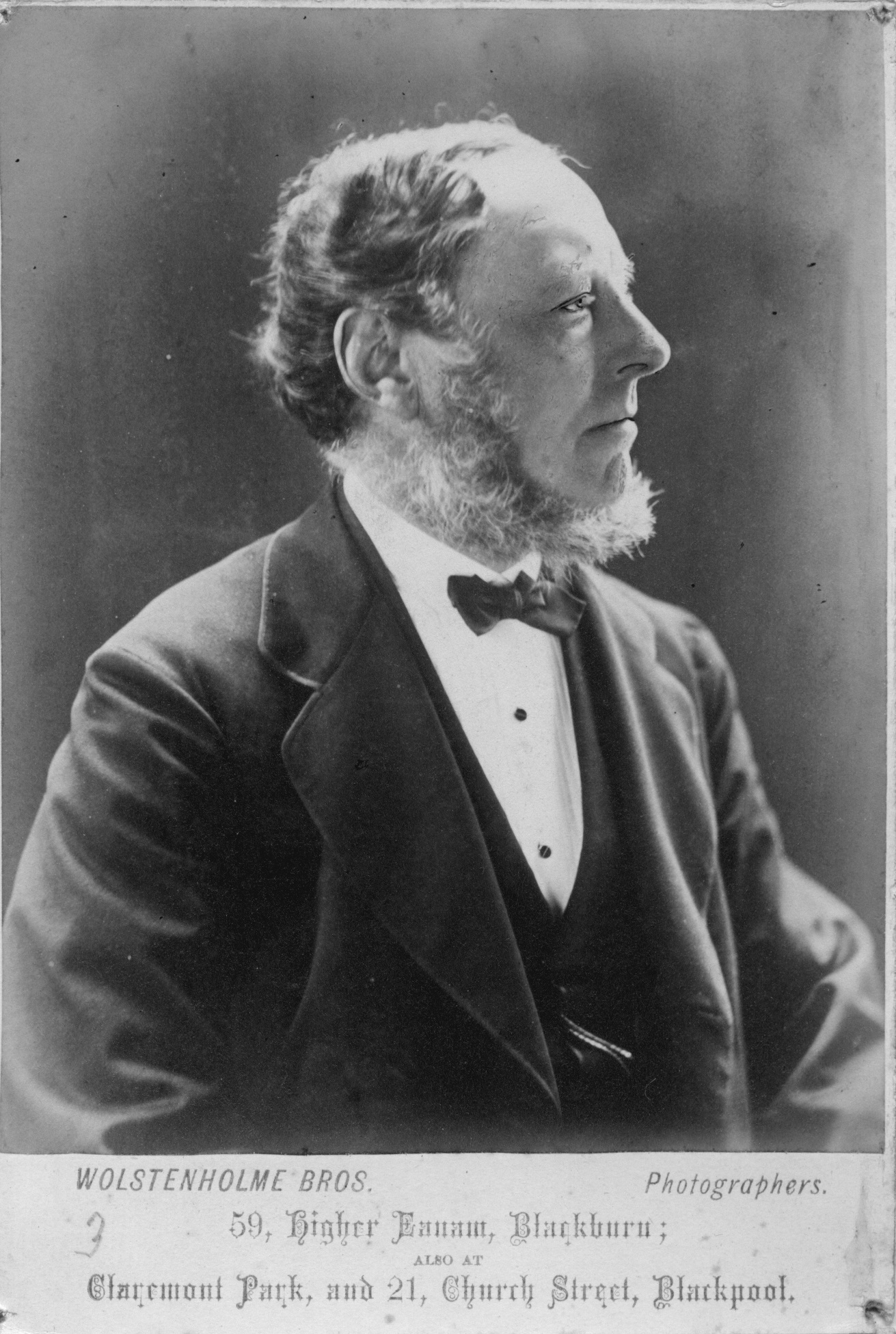
Mayor of Blackburn 1869-71
Thomas Hartley Pickup was born about 1818 to Margaret and James, a plumber and glazier. Thomas was educated at Blackburn Grammar School and attained some proficiency in classics. On leaving school he was sent as apprentice to Mr. Gornall, a chemist and druggist of the Market-place Preston where he remained for seven years. Thomas spent two years in Liverpool and then returned to Blackburn setting up shop at Salford Bridge where he remained in business for some forty years.
In 1841 the family lived at 88, King Street, Blackburn with their sons John, aged 25, a plumber and Thomas Hartley aged 20, a chemist and druggist. In 1851 Thomas was still living at home but his father had now retired. The following year on the 8th June, Thomas married Ellen Greenwood at the Parish Church. Ellen was born in Hoghton and her father William formerly kept the White Bull Hotel.
In 1861 Thomas and Ellen were living at 18, Park Terrace, Thomas was 43, Ellen 38, they had three children – Thomas 5, Betty A. 3 and William 1. Thomas was not in Blackburn for the 1871 census as he was staying with his wife at a hotel in Finsbury, London.
Thomas had begun his interest in public life very soon after he had started in business. He was a member of the old Board of Commissioners by whom the affairs of the town were managed prior to the introduction of municipal institutions and took part in the proceedings connected with the formation of the markets, the arrangement for the site of the Town Hall and many other matters. He was not a member of the first Corporation election of 1857 but became a member soon afterwards. In 1869 Thomas was elected as Mayor of the Borough – an office he filled with great credit and success, so much so that he was elected for a second term. Whilst the head of this civic government he went over to Belgium at the invitation of the King of that country, in the company of chief magistrates of other English boroughs. He also attended the banquets of the Lord Mayor of London and represented the town with great dignity on many occasions. In 1874 he was appointed a member of the commission of the peace for the borough and rendered good service as one of the magistrates of the town. He was an Alderman for some years up to the date of his death. Thomas was a director of the Gas Company, the Waterworks Company and a member of the Burial Board from its commencement. He was also a trustee of the Blackburn and Preston turnpike road and the last surviving member of the Board which erected the toll bridge at Walton where his name remains on this edifice. He was also a trustee of the Bury and Elton turnpike road and a governor of Blackburn Grammar School.
Thomas died, on the 11th April 1880, at his residence in Blackpool, in his sixty third year. For a man of such active habits and unflagging energy it had been hard for him to cease his civic duties as he had been advised. Eventually Thomas was diagnosed with Brights disease of the kidneys for which there was no cure. There was a detailed obituary in the Blackburn Standard of the 17th of June 1880 and a simple notice of his death with a request for no cards. Probate was granted to Ellen, his widow of Shear Mount, East Park Road, Thomas, his son, who had become a civil engineer and a Mr. James Hoyle, described as a gentleman. His estate was said to be under £16,000. In 1891 the family were still at Shear Mount – Oswald 25, a yarn merchant, William 31 living by his own means and Thomas 35 the secretary of the Deaf and Dumb Society.
Janet Burke