
 Loading more
Mid 19th Century
William Henry Hornby Senior | Robert Hopwood | Thomas Dugdale | William Hoole | William Pilkington | John Baynes
Thomas Thwaites | Robert Hopwood Hutchinson | J. B. S. Sturdy | Thomas Lund | William Stones
James Thompson | John Dean | John Smith | Thomas Hartley Pickup
William Henry Hornby Senior 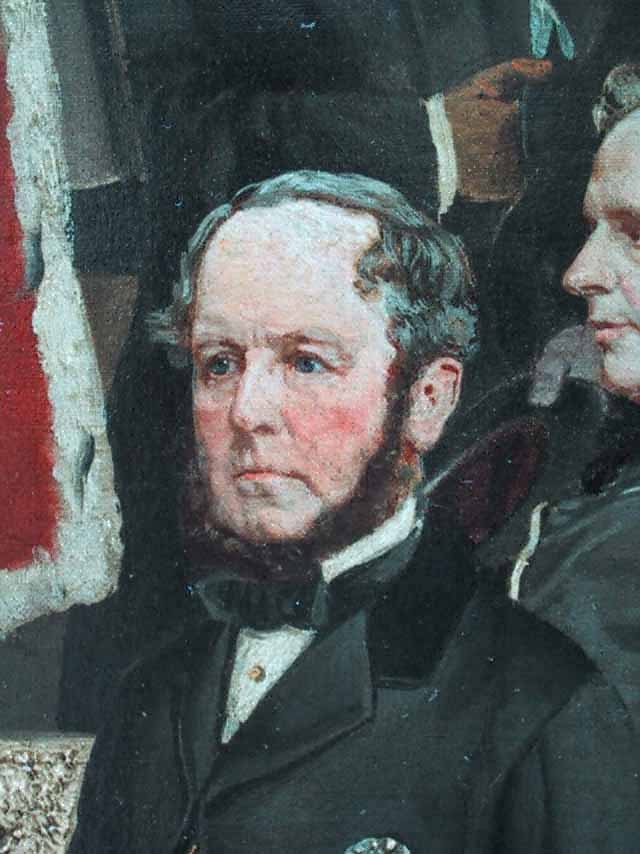
Mayor of Blackburn 1851-52
© BwD - terms and conditions
Today the old Hornby mansion in King-street, somewhat shorn of its pristine grandeur, still retains more than a hint of its Georgian dignity. Here and there may be seen the scars of time, crumbling brickwork and rusting metal, eloquent of the pathetic fact that it has seen better days. The architects of Regency times were great believers in balance and uniformity - Doubtless a reaction from the picturesque irregularity of Tudor and Jacobean building - and the Hornby residence, with its plain facade, is typical of the style. Its regular rows of cashed windows stand shoulder to shoulder like soldiers on parade; its formal forecourt with diamond paving and plain iron railings, strikes a note of monotony almost depressing were it not relieved by graceful pediment and pillared portico. But within there reigned good, solid, homely comfort, heavily upholstered, maybe, but none the less real for all that.
After the death of John Hornby, in 1841, the house was for many years the home of his son, William Henry Hornby, Blackburn's first mayor and sometime member of parliament. It is recorded that the halberds, symbol of civic authority, were first placed outside his door on Saturday, March 27th, 1852.
William Henry Hornby has been justly described as one of the greatest men the town has ever produced. He was born at his father's town house in the year 1805, and when he died in 1884, at the age of 79 years, his life and achievements in the twin fields of commerce and politics, may well be termed an epitome of the town's progress in the 19th century. In 1831 he married Margaret Susannah, daughter and sole heiress of Edward Birley of Kirkham, and had issue, seven sons and four daughters. He inherited most of his father's enterprises, and when Blackburn became a corporate borough, he was regarded as the leading employer of labour in the town. His firm, William Henry Hornby and Co. was one of four employing about 1,400 workpeople, the other three being William Eccles and Co., Robert Hopwood and Sons, and Pilkington, Brother and Co.
In his early days he was something of an athlete, being extremely partial to outdoor sport, as was his father before him, and a naturally aggressive nature, developed by exercise and a sound constitution, he carried with him into the political arena thereby earning the title of "Game Cock," a measure of admiration conceded, albeit somewhat grudgingly, even by his opponents.
Of somewhat sanguine complexion, he was above medium stature and latterly became somewhat stout. He wore an oldfashioned blue coat with brass buttons, the style of which may be gathered from his statue in Sudell Cross, and it was said of him that he knew every workman in his extensive mills. It was under his control that the Brookhouse mills reached the zenith of their fame.
His political activities were equally remarkable. They began with tile passing of the Reform Bill in 1832, under which Blackburn became entitled to return two members to parliament. Although the town's population then was 27,000, the number of voters under the £10 franchise was only 627. At the age of 27, W. H. Hornby found himself chairman of the Conservative party, and the story of his activities in this capacity - would be a volume in itself. After playing a prominent part in the several election campaigns between 1832 and 1852, and following the unseating of William Eccles in 1853, he offered himself for election but was defeated. In 1857, however, he was returned unopposed, together with James Pilkington and at two subsequent elections, in 1859 and 1865, he headed the poll.
Following the Reform Act of 1867, he again topped the poll, but the contest had an unfortunate sequel. A petition, on the grounds of intimidation of voters, was heard at the town hall by Mr. Justice Willes, as a result of which the elected members were unseated. Because of this decision he retired into private life, spending his last years at his country seat, Poole Hall, Cheshire.
It was during an election riot in 1835 that William Henry Hornby was flung over the parapet of old Salford bridge by an infuriated mob, fortunately without serious injury. He had just emerged from the back door of the Bay Horse Inn, in company of a few friends, as the crowd of Bowringite supporters passed, and he was thrown into the mud on the easterly side of the stream. Charles Haworth the artist, who was an eye-witness, helped to scrape the mud from his clothes in the shop of Dack the hatters, on Salford Bridge, where he bought a new beaver. He took the whole incident very complacently, for, after all, had not his man been elected ?
Here is his own account of another such incident:
" In 1841, although I was, like yourselves, merely a voter in the borough, I was objectionable to the Radicals. It was then hardly safe for me to walk through the streets; my house was in danger and at last it was attacked, during my absence, about 8 o'clock in the evening and every window was smashed. Fortunately I got back there before the front door was opened, and and having a brace of pistols, I discharged one, and every man of that gallant crew ran away . In the short space of half an hour they threw above a ton of stones into my house, and my wife and children had to escape by the back door into the District Bank. The same party again -and I could almost point to the men themselves - who broke the windows of my house at the bottom of King-street in 1841 did the same at the top of King-street in 1853."
From this statement it will be noticed that between 1841 and 1853 he had removed to the Markland Mansion previously tenanted by his father and quitted the Leyland House, now numbered 2, King-street. This was built by William and Cecily Leyland and still possesses a dated downspout capping with the inscription " W.C.L. 1741." He must have removed in the summer of 1841, after August 29th, when it was recorded that his fourth son, the late Sir Harry Hornby, was born in the Leyland residence.
The subsequent history of the Markland mansion is not without interest. When vacated by W. H. Hornby on his retirement to Poole Hall in 1867, it became the headquarters of the Mechanics Institute. This excellent organisation was founded on March 27th, 1844, when at a public meeting held in the Assembly-room with John Abbott in the chair, the following resolution was carried:
" We who are here assembled do at once form ourselves in a Society to be called the Blackburn Mechanics' Institute, the objects of which shall be to encourage the acquistion of general knowledge and the study of literature and science by all classes of the community, by means of a circulating library, museum, reading-room, public lectures, discussions, &c., the introduction of party politics, controversial theology, or sentiments having an infidel or immoral tendency being strictly prohibited."
Joseph Feilden became its first president, the membership fee was fixed at 2s. per quarter and the old Music-hall in Market Street-lane was hired at a rental of £15 a year. For the writing classes slates had to be provided, and each person breaking a slate was expected to pay for it, "and that a hole be bored through the middle of each and a string put through to preserve the same."
The secretary was empowered to burn anonymous letters, and to settle squabbles which arose from time to time. These sprang from diverse causes, as for instance when one master persisted in chewing tobacco against the wishes of his pupils, or when the untidiness of the librarian (possibly the venerable bard Joseph Hodgson, who acted in that capacity for many years) called for a severe reprimand.
In the first minute book there is a whimsical note that the two door-keepers shall have a three penny meat pie apiece for their services, to be paid for out of their own pockets.
By George C. Miller
Robert Hopwood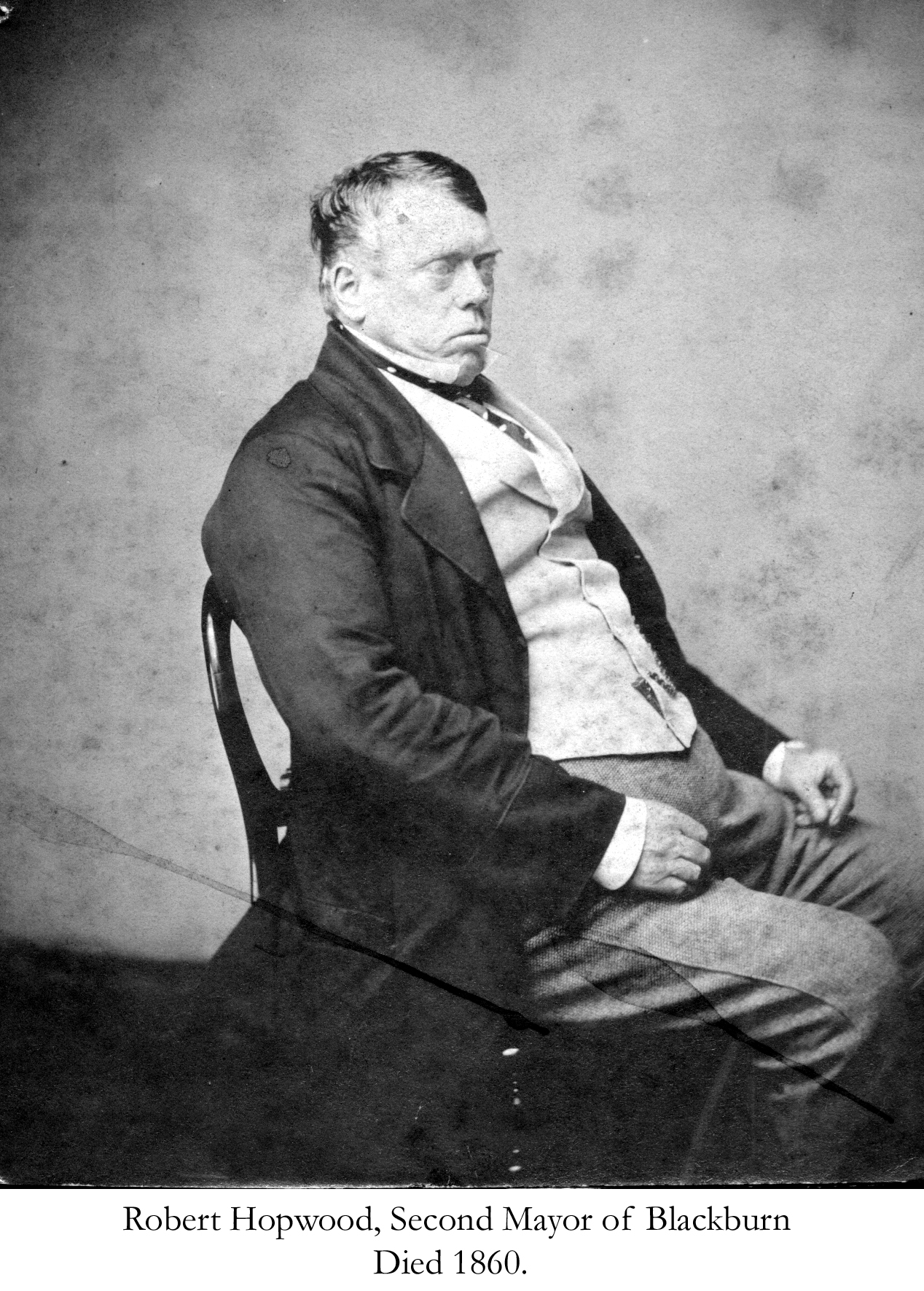
Mayor of Blackburn 1852-53
There are two Robert Hopwoods, father and son, of whom Blackburn has every right to be proud. The father, who has been described as " one of the most remarkable men of his day," was a native of Clitheroe, coming to Blackburn in 1810 to be manager of Spring Hill Factory for the Anderton Brothers. He resided in one of the cottages nearby, which are still standing. He was the founder of the extensive Nova Scotia Mills and died one of the wealthiest of our local magnates.
Spring Hill Factory was erected in 1797, being the second cotton mill to be built in the township, Wensley Fold being the first. In 1810 Anderton's factory was driven by an old beam engine, designed on a very primitive principle. The short street called Well-street, leading from High-street to Mount-street, derives its name from the fact that a well was made in the factory yard for feeding the boiler. The footpath from Higher Hallows ran past this yard, and some of the older residents have graphically described how much they were impressed as children by the sight of the great wooden beam swaying to and fro with every revolution of the driving wheel. The creaking of this ancient wooden wheel, and the thump of the "sway-baulk" must have been startling indeed to one accustomed only to the clacking treadle of a handloom.
In 1851 Robert Hopwood senior was elected one of the first aldermen of the new borough and he died on July 15th, 1853, in his 80th year.
His son Robert Hopwood junior, who was Blackburn's second mayor, succeeded his father on the aldermanic bench. Later he purchased the manor of Bracewell and on his death in 1860 he was buried in Bracewell Church. A stained glass window to his memory was presented to Christ Church, Grimshaw Park, by Mrs. Hopwood.
By George C. Miller
Thomas Dugdale
Mayor of Blackburn 1853-55
The Dugdale family has been native to the parish of Blackburn for many generations, and from an ancestor who lived in Great Harwood have descended the several branches of the Dugdales of Dovecote House, near Liverpool, and of Wroxhall Abbey in Warwickshire; the Dugdales of Ivy Bank, Lancashire, of Craythorne in Yorkshire; of Lowerhouse near Burnley; of Irwell Bank, Eccles; and the Dugdales of Blackburn and Witton. Thomas Dugdale was born in 1797, being the youngest son of Nathaniel Dugdale, of Great Harwood, who died in 1816. In 1824 Thomas married Elizabeth, daughter of Thomas Walmsley, and settled in Blackburn. After successfully practicing in the medical profession for some years, he retired from that calling, having acquired a valuable estate in Witton and Livesey, formerly belonging to the Boardman's, his wife's maternal line. Here he built Griffin Lodge and erected cotton mills. A capable administrator, he was chairman of the Lancashire and Yorkshire Railway Company, the Manchester and County Bank and the Blackburn Waterworks Company.
He was returned for Park Ward on the first town council and elected alderman in 1853 in succession to William Eccles. The first mayor of the borough who served in that capacity for two years, a tablet on the gateway of the Corporation Park records that:
"The adjoining 50 acres of land were purchased for a Public Park and the erection of these gates and porter's lodge was commenced during the mayoralty of Thomas Dugdale, Esquire, in the year 1854-5".
He died on March 17th, 1875.
By George C. Miller
William Hoole
Mayor of Blackburn 1855-56
According to Baines' Directory for 1824, there were in Blackburn no fewer than sixteen private schools. Included in their number we find Hoole's Academy at 86, King-street; the upper storey of which still remains unchanged, although the ground floor is now divided up into shop premises; Miss Parke's Seminary for Young Ladies in Church-street, and George Edmondson's Academy at Lower Bank, facing the top of Branch-road.
In the Blackburn of a hundred years ago the name of William Hoole stood high in the list of local worthies. His private school; a large brick house on the north side of King-street, opposite the site of the old vicarage, was built by Isaac Glover, a prominent cotton manufacturer, late in the 18th century. He married Mary, eldest daughter of James de la Pryme, at the Parish Church on August 25th, 1792, and his residence probably dates from this time. Mrs. Glover survived her husband and continued to reside here until her death on July 31st, 1815, when the premises were leased to William Hoole, who used the ground floor for academic purposes and lived overhead for a period of more than thirty years. During this momentous interval many notable citizens, including John Morley and Adam Dugdale, passed through his capable hands. Mathematics were the chief feature of his curriculum, together with History, French and some rudiments of science. He was a rigid Nonconformist; every day of the week his scholars had to commit to memory some verses of scripture, and twice every Sunday were his boarders solemnly marched under escort to the adjacent Independent Chapel. Like Lord Palmerston, he insisted on good writing and it was said that a boy from his academy could always be distinguished by his meticulous penmanship.
"After Morley became famous (writes F. W. Hirst), stories began to circulate in the town about his schooldays. When Hoole, their headmaster, was elected mayor of the town, the boys decided to elect a mayor of the school, and chose John Morley at a meeting in the playground. . . One example of his boyish humour is preserved. Being deputed on a fine day to plead for a half-holiday, he was asked by Hoole for a reason and replied: 'The oyster season is at hand.' He was a favourite with Hoole, who said after he left: 'John Morley was the best English scholar I ever had in my school.' Another clever boy at the academy was James Eccles, whose father was a cotton broker in Liverpool. The two were fast friends. They studied Latin together and made some progress with Greek. Moore's 'Ushers' were as a rule graduates of Scotch Universities, who were glad to earn a trifle while they waited for their first pulpit appointments. We know from Morley's own recollections that Hoole's Academy laid strong hold upon him: 'It abounded in the unadulterated milk of the Independent word, and perhaps accounted for Nonconformist affinities in some of the politics of days to come. . ."
A Liberal in politics, William Hoole was also a man of great energy and public spirit, taking a leading part in local administration. Prior to the town's incorporation, he was for many years chairman of the Improvement Commissioners and it was in great part owing to his initiative that the Borough received its Charter of Incorporation in 1851. The original petition to the queen was drawn up in the Session-room adjoining the Hotel in King-street, on November 28th, 1850, and it was from the same place some eleven months later that, as Returning Officer, William Hoole issued the following proclamation:
"Borough of Blackburn in the County of Lancaster.
"I, William Hoole, Returning Officer named and appointed in and by the Charter of Incorporation of this Borough, give notice that the Burgesses of these six wards must elect on the first day of November next, six councillors for each ward of the said Borough of Blackburn.
The following Polling Places have been appointed: No. 1. St. Mary's Ward. A shop, No. 77, on the north side of Church-street. No. 2. St. John's Ward. The Independent Schoolroom on the south side of James-street. No. 3. Trinity Ward. The Schoolroom in Mount street. No. 4. Park Ward. Park School, in Grimshaw Park-lane. No. 5. St. Peter's Ward. The Independent Schoolroom on the south side of Chapel-street. No. 6. St. Paul's Ward. The building lately occupied as Barracks, on the south side of King-street.
The Polling will commence at nine o'clock in the forenoon and will close at four o'clock in the afternoon of the same day.
Dated this 28th day of October, 1851.
W. HOOLE, Returning Officer."
William Hoole also had the honour of presiding over the first meeting of the newly-elected Town Council, which was held in the Sessions-room, Heaton-street, on Monday, November 10th, 1851. The first business to be transacted was that of taking the declaration of the town councillors, which normally were taken before two aldermen or councillors, but as none present had yet qualified, the chairman was in something of a quandary. He solved it by appointing two magistrates then present, Mr. W. H. Hornby and Mr. W. Eccles, to administer the necessary oath.
"A considerable crowd (says the report in the 'Blackburn Mail') had collected in the streets adjoining prior to the hour at which the meeting was appointed to take place and during the afternoon it was greatly increased by the accession of parties anxious to ascertain who were elected as aldermen and more particularly, upon whom the honour of the first mayoralty was conferred... As soon as the fact of Mr. Hornby's appointment was known to the crowds outside the most hearty cheering was heard for several minutes. The mayor was then conducted to the chair by Alderman Eccles and Councillor Backhouse."
Whilst chairman of the Improvement Commissioners, William Hoole opened Blackburn's first Market Hall on January 28th, 1848, and to him also was accorded the gratification of opening the Town Hall on October 30th, 1856, during the year of his mayoralty. From 1819 to 1821 he was classical tutor to the Blackburn Independent Academy in Ainsworth-street, in premises still indicated by a plaque, only resigning this appointment to commence his private academy in King-street.
He died in London in 1878.
by George C. Miller