
 Loading more
Page 2
But, across the Atlantic Ocean, war clouds were gathering which would cast a profound shadow over Blackburn's prosperity. The Southern States of America were the chief source of raw cotton for Lancashire's textile industry and at this time black slave labour was still used for cotton-picking, a fact despised by the more enlightened states in the North. This proved to be one of the sparks that ignited America's bloodiest conflict on its own soil - the Civil War. In simple terms, America had divided into 'slave' states (Confederate) and 'free' states (Union) and there could be no peace until one side had sealed a complete victory.
One of the first acts of the Union army was to blockade the export of raw cotton from the South. The impact on Lancashire was instant - manufacturers and operatives alike waited in a state of grim expectation as the supply of raw cotton, the lifeblood of the mills, quickly dried up. The blockade had exposed a fatal weaknesses in the organization of Lancashire's cotton industry. William Gourlay, a Blackburn insurance agent who documented the effect of the Cotton Famine on the town, comments that:
'the spinners and manufacturers of Lancashire were content to build mills and fill them with machinery, and make every preparation for clothing the world in calico - omitting only the important preliminary of making sure that the cotton would always be available.'
For towns like Blackburn where cotton predominated in both the employment of working class 'hands' and middle class manufacturers, the effects were disastrous. Blackburn's population in 1861 was just over 63,000. According to Gourlay's calculations, about 25,000 of these were employed directly in the various branches of the cotton trade, and a further 25,000 relied on a cotton worker for their subsistence (young children, the elderly, sick or infirm). To this figure must be added the workers in trades closely allied to the cotton industry, such as machine-making, engineering, building and so on - approximately 6000 workers including dependants. The bald fact was that 56,000 people, 89% of Blackburn's population, faced ruin and starvation.
Manufacturers did their best to eke out stores of raw cotton, but inevitably wage cuts were followed by short-time working, unemployment and the complete closure of mills. Those lucky enough to have put aside modest savings tightened their purse strings and fell back onto austerity measures, hoping to weather the storm. But the majority were not in such a lucky position and applications for 'outdoor relief' to the Poor Law Guardians increased dramatically, quickly using up the funds collected for this purpose.
Pawn shops did a brisk trade as destitute weavers sold off their trinkets, furniture and finally their clothes in a vain attempt to raise some cash for food. It became impossible to meet monthly demands for rent, so three or more families crammed into one tiny cottage, dividing the rent between them. The owners of cottages, usually weavers who had invested their savings in bricks and mortar, also faced ruin as tenants defaulted on their rent, leaving them with no income from unsaleable property. The streets were filled with that 'middle class nightmare', wandering groups of unemployed young men, with nowhere to go and nothing to do.
The authorities responded to the crisis by forming committees and sub-committees to tackle the most pressing problems, and good Christian folk' like Charles Tiplady were in the vanguard of efforts to relieve the distress. By January 1862, the first soup-kitchens had been opened in a disused mill on Cleaver Street where, on the first day, 130 gallons of nourishing soup were distributed in return for 'soup tickets' which had been handed out to the most needy by the local clergy. However, in order to keep the soup-kitchens open, money was needed - but a local request for funds had a disappointing response. This prompted Tiplady to write a letter which appeared in The Times in April 1862, highlighting the plight of Blackburn's population. The following is an extract:
'Blackburn has witnessed many sad reverses in the cotton manufacturing business, but never since the Bank's panic of 1835-6 has it experienced so extensive and disastrous a reverse as that which now exists and which has reduced a large proportion of the operatives to pecuniary ruin and nearly absolute starvation.
Thrown into adversity by no act or circumstances over which they have any control, we see a numerous and, for the most part, an orderly and industrious population deprived of work, reduced to poverty - to absolute mendacity -while their fellow operatives, a little more fortunate, are subsisting on wages derived from short time, averaging about three days per week, - wages that barely realise sufficient for food and rent. The number of persons absolutely dependent on the pittance allowed by the Board of Guardians and the dole from the Relief Fund is over 10,000, that is about one sixth of the whole population, and I may add that at least 20,000 are on short time. Consequently, one half of the people are sufferers in the general distress.
This appalling distress has hitherto been borne with silent, enduring and exemplary patience and resignation. No threats, no outbreaks, no violent popular demonstrations have been manifested; but even cheerfulness to a certain extent and a wonderful feeling of helping one another have marked the conduct of the suffering unemployed.
A large proportion of the hands are factory girls whose ages range from 13 to 20 years, and who are capable of earning an average of from 10s. to 14s per week. It is painful to reflect that these factory girls have to grieve over the loss of their neat apparel as article after article is pawned or sold for bread. Being a bookseller, I was applied to by a modest girl, 17 or 18 years old, to purchase from her a Wesleyan hymn-book. She had been out of work for 16 weeks-possibly this little hymn-book and her Bible were all the library of this poor girl, all to be sold for food.
Cannot your matronly readers feel for her position and for many such poor factory girls; cannot some of them lend a helping hand? I am sure there is generosity enough in this land of ours to meet this fearful aspect of affairs. A little help will assist many an aching parent's heart, who trembles as he looks around upon his grown up family and contemplates with sad dismay the breaking up of his humble household and the utter annihilation of his own and his children's home.'
Tiplady was accused of having made up the incident of the girl selling her hymn-book. He vigorously denied it but, true or not, his extraordinary letter prompted the desired response - hundreds of pounds poured into Tiplady's Fund from benefactors all over the country. His sentimental approach was, of course, designed to tug at the heart-strings, but anybody visiting Blackburn in the winter of 1862-3 would have quickly recognised the dire situation in the town. Tiplady had pricked the public conscience and the overwhelming response to his appeal encouraged the local wealthy to subscribe sums of money to the relief fund.
The money was distributed by a central Relief Committee, of which Charles Tiplady was a member, who then channelled it into various initiatives attempting to relieve the distress in some way. Beyond those organisations providing the basics of survival such as food, clothes and coal, there were many others who were willing to try and make the times of crisis more bearable for those out of work. Gourlay writes that:
'the Clergy, justly apprehensive that the young women and girls, who early in the spring began to crowd the streets in hundreds, might be tempted into sin, commenced a sewing class-in which the girls were assembled under the care of ladies.'
Sewing classes encouraged mill girls to improve their skills - a factory inspector recalled being astonished that 'one third of the females knew nothing of sewing upon their first attending the classes'. They were taught how to make clothes for themselves, for which material was provided, often allowing them to replace those garments that they had sold for food. For attending the classes three days a week, each woman received one shilling or a good square meal. Similar initiatives were started for men -'Industrial Classes' taught basic literacy and numeracy (many could not write their own name) and useful trades such as cobbling. Such classes not only kept the unemployed off the streets, but the system of payment ensured that the proud weavers did not feel they were receiving charity for nothing.
Less popular were the Public Works schemes in which gangs of men worked in the town's quarries at Shorrock Delph, paved unmetalled roads, or landscaped the newly created Corporation Park. The work was hard, poorly paid, and for many weavers it too closely resembled the 'labour test' imposed on paupers by the Poor Law Guardians. Nevertheless, the work contributed to the improvement of the town and saved the men from 'the temptations of idleness'.
Having reached a low point in November 1862, the Great Distress gradually lessened and by Spring 1865 many of Blackburn's mills were working again. Incredibly, the years of the Cotton Famine saw few mass protests or incidents of violence against the authorities. There was a general feeling that, whatever their class or relative wealth, everybody was 'in the same boat'. If anything, the Famine served to draw employers and workers closer together, the philanthropic acts of one earning the loyalty and respect of the other. Perhaps the last word on the subject should go to the Rev. H. W. Maychurch, addressing a Christmas Relief Dinner for the unemployed in December 1862:
'You have often been taught by misguided men that your masters are antagonistic to you, that they are men who take no interest in your welfare, but are only intent on amassing large fortunes - but I think that what you have witnessed within the last year has shown you that was a mistaken notion. You will find that the masters have a very deep sympathy with you in your troubles. It is very well for men who have large incomes from property to be liberal and give hundreds if not thousands; but it is not a common thing for men who are losing hundreds to give their hundreds', but this is the spectacle which your masters have exhibited. And let us hope that the time will never come when you will dissociate your interests from theirs, or they from yours.'
by Nick Harling & Blackburn Museum
Unemployed Weavers during the Cotton Famine
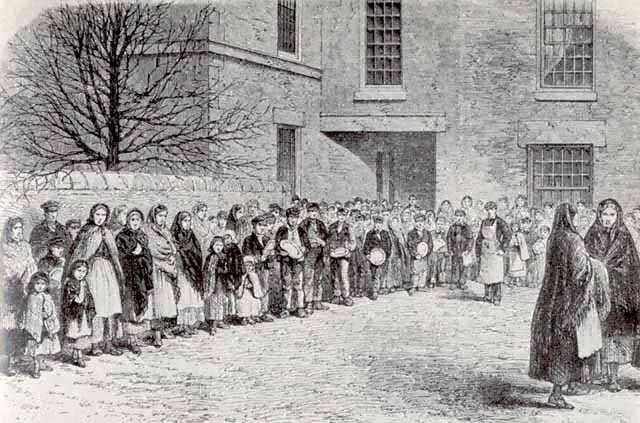
© London Illustrated News - terms and conditions
As the cotton famine became more extreme, greater numbers of unemployed weavers found themselves on the brink of starvation. Nourishing soup was a real life-saver, containing beef, barley, groats, peas, onions, carrots, turnips, salt and white pepper.
Unemployed Weavers Selecting Clothing
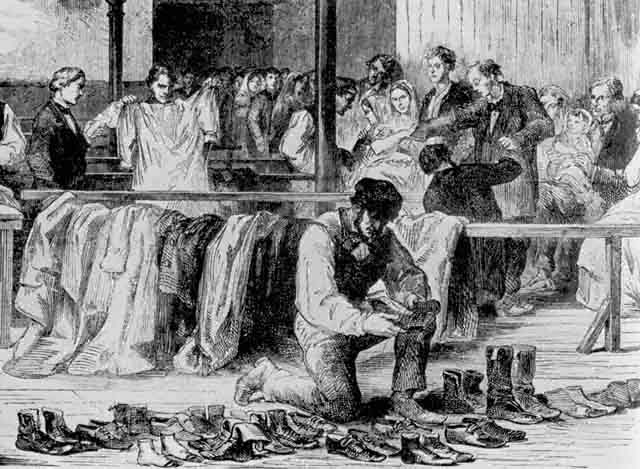
© London Illustrated News - terms and conditions
The last resort for the unemployed during the cotton famine was to sell their clothing. As winter approached this could have fatal consequences. National appeals such as Tiplady’s letter to The Times prompted sympathetic donors to send money and parcels of unwanted clothing. There were reports from Darwen of weavers wearing hunting coats and riding boots!
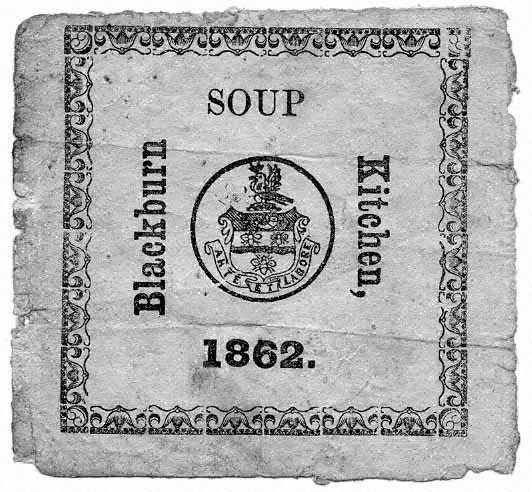
© BwD - terms and conditions
Vouchers such a these were distributed by the clergy and other relief organisations to unemployed mill workers during the cotton famine. Tickets were also issued for bread and coal.
Proud Town
Improvements, Incorporation and civic pride
At the time that Charles Tiplady first put pen to paper and began his diary, Blackburn must have been an old-fashioned looking town, with many of its buildings dating to the mid-18th or even late 17th century. Irregular rows of shops and cottages jostled for space with ancient coaching inns and the parish stocks still stood in the old market place. There were no public buildings to speak of, so meetings usually took place at the Old Bull Inn or in the open air on Blakeley Moor. Many of the town's main roads were as yet unpaved and most were still not lit by gas lamps. With no satisfactory provision for cleaning the streets or controlling the pollution of local streams and rivers, the health of the inhabitants was soon threatened by typhus and cholera.
Tiplady was particularly concerned with the poor quality of the town's water supply. Using the pseudonym 'Anti-Pest', he wrote to the Preston Guardian in 1849 on the deplorable state of the River Blakewater:
'Sir,- The inhabitants of this town, I am sure, will feel extremely obliged to you by allowing a communication to appear in your journal calling public attention to that abominable nuisance, the River Blakewater which, in its present filthy state, disgraces the place-this bog of public defilement is beyond comprehension-any man going under Darwen Street Bridge at the present moment would find no difficulty shovelling up the mud literally by cartloads. Call you this a River, ye men of Blackburn? No, no. It is profanation to use the term. If ever the cholera had a suitable nest, or an epidemic a choice location, surely it will be in your stinking cess-pool which you vainly call a 'river'.'
Shortly after, he noted in his diary that:
'It is gratifying to remark that the week following [the letter's] appearance, the Commissioners commenced cleaning the Brook.'
The Commissioners referred to by Tiplady were Blackburn's Improvement Commissioners, formed by Act of Parliament in 1847 and charged with the task of levelling and maintaining public footpaths, ensuring the proper drainage of highways and attending to all matters of public amenity, safety and health. For many years Tiplady acted as the auditor of the Commissioners' accounts, so was in a good position to voice his opinion of their efforts. In 1850 he was complaining again to the Blackburn Standard, this time about the pollution of Alley's or All Hallows spring near the railway station:
'These springs, long before a water company was ever heard of, were the main supply for Blackburn. Even now, by great numbers of the poorer inhabitants, they are resorted to as the cheapest, purest and most regularly well supplied fountains of the liquid element. Yet, ever since the road leading up to the East Lancashire station from Salford Bridge has been formed, the Alley's Springs have been periodically wrecked up with filth, sand and mud, and rendered entirely useless to the inhabitants.'
But things were set to improve. In the same year Blackburn took its first momentous step towards becoming a Borough. The Petition submitted to the Queen highlighted the fact that the town was 'without any efficient or responsible local government adequate to its necessities'. During the examination of the Petition by Captain Warburton, Tiplady spoke up in favour of having 'one governing body for the town'. The Charter of Incorporation was granted by Queen Victoria on August 28th 1851 and opened a new chapter in Blackburn's history.
On November 5th, Blackburn's first municipal elections took place to appoint councillors for each of the six new wards into which the Borough was divided. At the same time, William Henry Hornby (son of John Hornby, cotton manufacturer) was appointed as the inaugural Mayor. In stark contrast to the riotous elections of previous years, the municipal polls were carried out in the 'greatest good humour'. Miller writes that:
'It was as if in recognition of their town's new dignity and higher standing, the people were determined to show that they possessed the maturity of conduct-to be expected from the burgesses of an ancient township and thriving borough.'
Unfortunately, the town's 'new dignity' was spoiled during the Municipal Elections of 1853, when Tiplady described the 'very riotous and disgraceful proceedings - street fighting, stone throwing, bludgeon attacks and violence of every kind without check from the Police', a comment which does not say much for the newly formed Borough Police Force! Interestingly, Tiplady himself was enrolled as a Special Constable during these disturbances.
Despite these setbacks, Incorporation had changed Blackburn for the better, not least with the erection of some splendid new buildings. Previously, the only public building of note had been the Market House, opened in 1848, which Tiplady described as 'neat, handsome and spacious'. He was so impressed that he composed a rather overblown poem which included the lines:
'Beneath thine ample roof in after days,
May constant crowds attend with happy gaze;
Fulfil their need - supply their daily share,
And still redundant loads be left to spare;
Thy stall well heap'd, - thy measures over pour
Into the poor man's lap a plenteous store'.
Surprisingly, Tiplady did not feel called by the muse again when he saw the plans for the new Town Hall, to be built on ground next to the Market House, but he did describe them as 'very beautiful and the Pile of Building will be an ornament to the town'. The foundation stone was laid on 28th October 1852 by Joseph Feilden, Lord of the Manor. An existing photograph of the occasion must be one of the earliest to be taken in Blackburn, possibly by David Johnson who also took a picture of the building shortly after its completion four years later. For some unknown reason, Tiplady did not record the opening ceremony of the Town Hall, but he was present when the foundation stone of the Blackburn Infirmary was laid in May 1858:
'This day may be considered to be the most important in the history of Blackburn-the event was celebrated by way of a jubilee. First there was a Grand Procession in which joined all the leading men of the town - the Corporate Body, the Gentry, the Ancient Order of Freemasons, the Associated Societies, the Grammar Scholars-and a countless multitude of spectators. The procession was headed by several first rate Bands of Music'.
He goes on to describe the balls, dinners and amusements that followed, including a 'balloon ascent which was magnificent indeed'. The Infirmary scheme was subscribed to by many local worthies, the land having been purchased from Joseph Feilden at a reduced rate. Although the building was completed in July 1864, parts of it had already been used to relieve distress during the cotton famine. In contrast, the new Blackburn Union Workhouse, begun in May 1861, used the labour of unemployed weavers to prepare the site. The building, now part of Queen's Park Hospital, cost £30,000 to construct. Its lofty location, visible from many parts of the town, was a constant reminder to the citizens of Blackburn of the fate that awaited those who did not have the income to look after themselves.
Some of the Corporation's new schemes were of direct benefit to all members of the community, such as the 50 acre Corporation Park, first laid out in 1857. The Mayor of the time, William Pilkington, donated several ornamental fountains. A pair of stone bastions were specially constructed at the top of the park to display a selection of Russian guns captured during the recent Crimean wars. The pleasant lakes and tree-lined walks gave everybody the opportunity to relax in semi-rural surroundings.
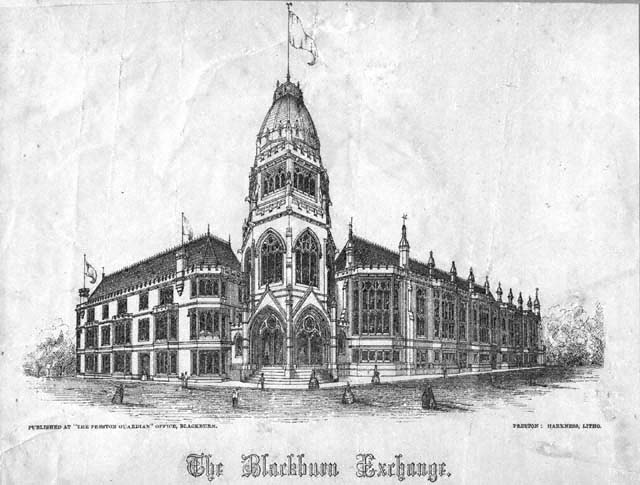
Perhaps the most impressive building in Blackburn, although sadly never finished, was the Cotton Exchange on King William Street (now a cinema). A group of local cotton manufacturers formed a company to construct the building, which they hoped would reflect the importance of the cotton crade to the town. Previously, all business had been conducted in the commercial rooms of the Old Bull Inn. Again, Tiplady was present at the laying of the foundation stone on March 10th 1863. The marriage of the Prince and Princess of Wales was celebrated on the same day and the double celebration included a Grand Illumination, a Monster Bonfire on Revidge, a display of fireworks described by Tiplady as 'poor, expensive and miserable', and a magnificent Banquet 'at which I got more liquor than I ought to have done'.
Most importantly, the laying of the foundation stone was captured on canvas by the artist Vladimir Sherwood, whose enormous picture includes many of the well-known faces of the time (see cover). Councillors, Mayors (past, present and future), Members of Parliament and significant manufacturers are all featured, as are detachments of the Local Rifle Volunteers and the Local Volunteer Artillery. The Volunteers fire a volley, hats are thrown aloft and cheers are raised from the gathered crowds - Sherwood has perfectly captured a moment in Blackburn's proud history. But the painting is also interesting for its omissions. James Cunningham, the brewer and former Mayor, was the Chairman of the Exchange Company, but is strangely missing from the scene, as is the architect William Brackspear. The name of each man in the picture has been faithfully recorded, but the same cannot be said of the women - they all remain anonymous. Finally, we might have expected Charles Tiplady, as an active Councillor, Freemason and businessman to have been present on the platform. But, for whatever reason, we are denied the opportunity of seeing what this fascinating man actually looked like and must be content with Abram's description of 'long-headed Charlie Tiplady'.
By Nick Harling & Blackburn Museum
New Market Place
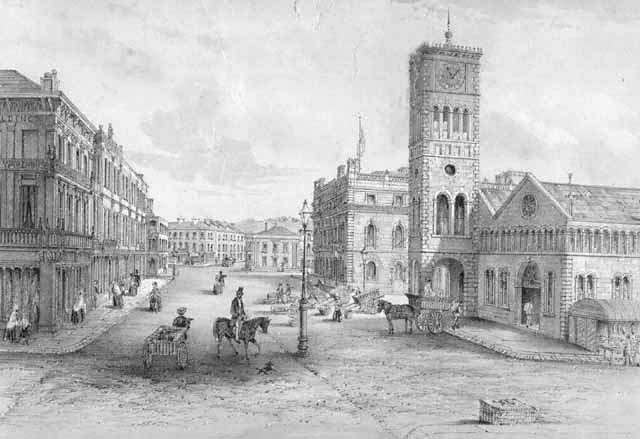
© BwD - terms and conditions
This splendid view of the new Market Place shows two of the best structures, the Town Hall and the Market Hall. The opening of the latter so impressed Charles Tiplady that he composed a poem in its honour. He would have been mortified to learn that the building was demolished during Blackburn’s 1960s redevelopment.
Blackburn Cotton Exchange
© BwD - terms and conditions
The Cotton Exchange could have been Blackburn’s most impressive building, but didn’t reach completion, having been started just as the cotton famine crippled Lancashire’s textile industry. Despite the grandeur of the foundation ceremony the project fell prey to dwindling funds: the left hand range and the upper stages of the tower were never built. The building is now a cinema.
The Men who Made Blackburn
Industrial enterprise and endeavour
We have already seen that, by the time Charles Tiplady began recording events in his diary, Blackburn had become a thriving industrial centre. But who were the driving forces behind this success story? It was often the ambition of individual men that shaped the town's commercial and physical growth, establishing family dynasties that were to dominate cotton, engineering and brewing. The lives of three of these men will serve to illustrate that it was personalities, rather than companies, who gave Blackburn's industry that first vital spark.
Hornby is a name synonymous with Blackburn. The family not only produced the first mayor and several Members of Parliament, but also employed a huge workforce at their Brookhouse Mills. But before the industrial revolution, there were no Hornby's in Blackburn - they were a classic 'industrial family' who arrived and thrived with cotton, and John Hornby (1763-1841), as the founding father of the dynasty, was one of the town's first textile entrepreneurs. John's story is not a tale of 'rags to riches', but rather that of a determined young man from a good family of Kirkham merchants. The following extract from the Blackburn Times, chronicles his arrival:
'…he came to Blackburn as a boy of 16 to learn the business of a merchant with Richard Birley [his brother-in-law]'his capital consisted of exactly £25, invested at 5% in the family business. Arrangements were made for him to live with his sister and brother-in-law. He saved £10 out of his first year's allowance and, with gifts and earnings, immediately began to build up his little capital.'
One of the first things he invested in was a local gazetteer, familiarising himself with the area and the arrangement of the cotton trade which, at that time, was still based on the domestic system of handloom weavers producing cloth in their own cottages. Merchants such as John Hornby were essentially middle-men, known as 'putters-out'. They travelled out to the handloom weaver's colonies, providing them with spun cotton (usually on credit), returning later in the month to collect the finished cloth which was then stored or sold on from a warehouse in town. It is important to remember that while the skills of the handloom weaver were in high demand, the relationship between merchant and weaver was an unequal one - the roles of employer and employee were gradually adopted, to the extent that some merchants used their warehouses as handloom 'factories', centralizing production and paying their weavers a wage.
The introduction of mechanised spinning techniques based on the inventions of Hargreaves and Crompton saw the first textile mills constructed in Blackburn. From the profits made as a merchant, John Hornby built one of the earliest spinning mills at Brookhouse in 1828, which initially took its power from the River Blakewater. Powerloom weaving began on the site in 1830. By the time of Hornby's death in 1841, Brookhouse had been transformed into a thriving industrial village, the mills surrounded by streets of cottages built to house the mill workers. Unlike some self-made men of the period, Hornby's benevolence towards his employees and the poor in general seems to have been genuine. Whittle, in Blackburn As It Is (1852) notes:
'He was very charitable to the poor, and he invariably found out where poverty was deserving of assistance - he made a point of upholding and maintaining the wages of the weavers in times of adversity, when the state of trade rendered such protection a temporary loss to the employers.'
Of course, Hornby could afford to be generous. Since 1796 he had lived in a luxurious house on King Street, from where he watched his fortune increase year by year. He died worth a staggering £200,000, having established his family as the premier employer in Blackburn.
John Hornby was just one of many men who made their fortune in cotton. But cotton's success also provided opportunities for other branches of industry to flourish. Blackburn's first iron foundries were established around the turn of the 18th and 19th centuries, and were mainly concerned with supplying machinery to the textile industry. From the 1820s onwards, the manufacture of powerlooms was perfected by several of the town's engineers - one of these pioneers was Joseph Harrison (1805-1880).
In some ways, Harrison's story is more remarkable than Hornby's. A journeyman blacksmith from Yorkshire, Joseph had heard of the great demand for ironworkers to fit out textile mills in Blackburn. He walked to the town in 1826 with little more than his bag of tools and rented a small smithy in Dandy Walk (a ginnel that runs from Darwen Street to the present Boulevard). Skilled in both wrought ironwork and casting, Joseph soon had plenty of work to keep him busy, from making ornate railings for the grand houses on King Street, to casting lamp posts and bollards. The process of casting from a mould allowed the duplication of identical parts - ideal for mass producing textile machinery components.
To cope with the huge increase in demand for powerlooms, Harrison expanded into the Bank Foundry off Bolton Road, where he produced looms which made good use of new patents to ease labour and increase productivity. As his sons William, John and Henry came of age, they each served their time in their father's foundry. By 1851, business was booming and the Harrisons showed examples of their machinery in the Great Exhibition at Crystal Palace, where they were appointed machinists to H.R.H. Prince Albert Shaw, writing in the Blackburn Times gives an example of the awesome capabilities of Harrison's foundry at this time:
'One year after the Exhibition, Messrs. Harrison and Sons received an order to fit up a cotton factory in Sweden with looms, sizing and warping machines-and they executed the order in the short space of eight days, the machinery in one consignment leaving Blackburn for Liverpool in a train of forty waggons.'
Whittle described this shipment as 'one of the largest quantities of beautiful and well-finished machinery ever sent out of the town'. It is little wonder that, having brought such prosperity to Blackburn, the council should offer Joseph Harrison a high public position. Yet he declined the office of mayor on more than one occasion, preferring to see his sons succeed in public life and content in the knowledge that, from humble beginnings, he had left them a valuable legacy.
Unconnected from the cotton industry but nonetheless very profitable on a local level were Blackburn's breweries. The familiar names of Thwaites and Dutton's have long and successful histories, but one of the more interesting stories is that of the Snig Brook Brewery and its energetic director, James Cunningham (1796-1876). Cunningham is an excellent example of a self-made man who found success in both commercial and public life, but his background is unusual amongst Blackburn's industrialists, having first arrived in the area as a butler to William Feilden M.P. at Feniscowles Hall. In his Characters of a Past Generation, Abram writes:
'He was fresh-complexioned, and of expansive countenance; fine eyes; large head, bald on top; and of a breezy aspect generally, as if, when he entered a room, he had just been taking exercise in the open air.'
This wonderful description is confirmed by a portrait of the man in the Museum collection. 'Jemmy' Cunningham was a Scot by birth and seems to have conformed to the national stereotype of being careful with his savings - during his years in service he built up enough capital to buy the Snig Brook Brewery in 1838. The brewery had been established in around 1820, but was not a large concern. Cunningham expanded the business, constructing rows of cottages for the brewery workers, and establishing several 'tied' public houses around the town. He also built himself a comfortable villa near the brewery in 1855. Named Springburn, the building still exists as St. Paul's Working Men's Club on Montague Street.
In public life Jemmy was ambitious, craving the recognition that self-made men often desire. He quickly put himself forward as a Town Councillor for St. Paul's Ward and was voted in as a Liberal, although he seems to have changed his political colours to suit his own ends. In 1858 he was involved in a rather acrimonious contest for the Mayoralty with John Baynes, a cotton manufacturer. Tiplady recorded the incident in his diary:
'November 9th - Alderman Baynes appointed Mayor. Mr. Cunningham addressed the inhabitants on that appointment, showing his disappointment.'
During his term in office, Baynes had revived the project to establish a Free Library in Blackburn, giving a large donation for bookcases and fittings. When Jemmy was made mayor the following year, he sensed an opportunity to score political and personal points over Baynes.
According to Abram, he decided to:
'take up the scheme and secure for himself the chief credit for the foundation of the Free Library, by pushing it forward so that it could be publicly inaugurated during his Mayoralty [and also] started a fund, for the purchase of books, with a donation of £150.'
His motives may not have been entirely philanthropic, but Blackburn got its library! Jemmy must have been acutely aware of his former servile role, which no doubt encouraged his passion for the middle-class pursuits of hunting and shooting. Perhaps because he didn't let a sometimes embarrassing lack of education get in the way of his social ambition, James Cunningham is one of the most endearing industrialists of Tiplady's time.
By Nick Harling & Blackburn Museum
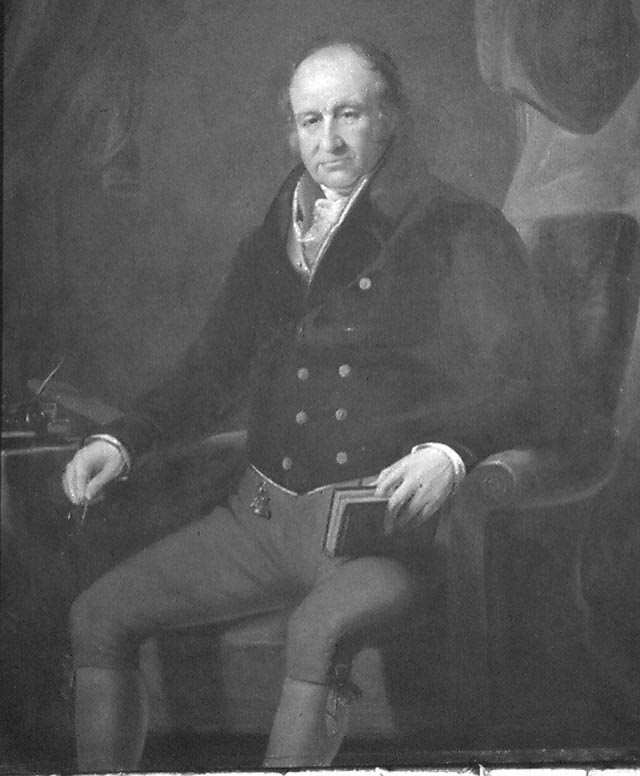
Oil on canvas by J. Lonsdale. Hornby was one of the first men to make his fortune with cotton in Blackburn. The picture shows him in comfortable middle age during the period he lived on King Street. From an initial investment of £25, he died worth more than £200,000, having established one of the town’s most successful family dynasties.
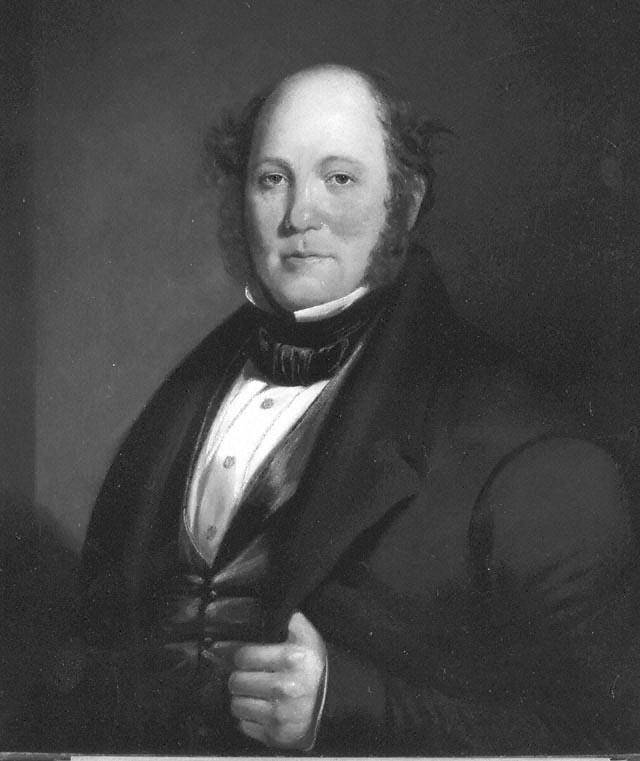
Oil on canvas, unknown artist. Described by Abram as 'one of the tallest and portliest of our Blackburn Mayors', Cunningham’s remarkable transformation from butler to master brewer brought him the social status he desperately desired. A blunt Scotsman, he is mysteriously described in Tiplady’s list of mayors as ‘the inconstant’.
© BwD - terms and conditions
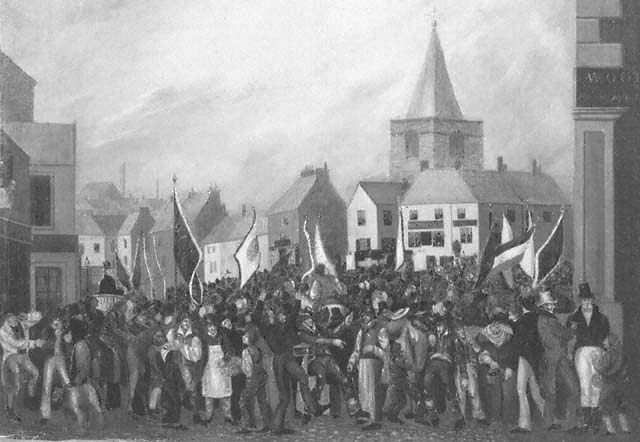
Oil on canvas, unknown artist. This riotous scene shows how volatile local elections could be in the mid 19th century. Political colours are being waved as hawkers sell their wares in the milling throng. More than one person looks the worse for liquor! The building below the church tower is the Old Bull Inn, traditionally the headquarters of the Tory faction and the scene of extreme violence during the election of 1841.
Spring Hill Mill
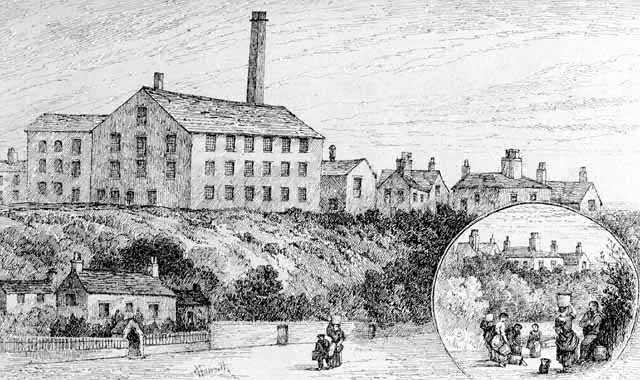
© BwD - terms and conditions
Pen and ink sketch by C. Haworth, c1880. This was one of Blackburn’s earliest steam-powered cotton mills, built around 1790. The roadside alcove in the left foreground contained the ancient All Hallows Well – Tiplady complained about it being polluted in 1850. The houses in the background are on Mount Street where Tiplady lived in the 1840s and 1850s.