
 Loading more
Page 4
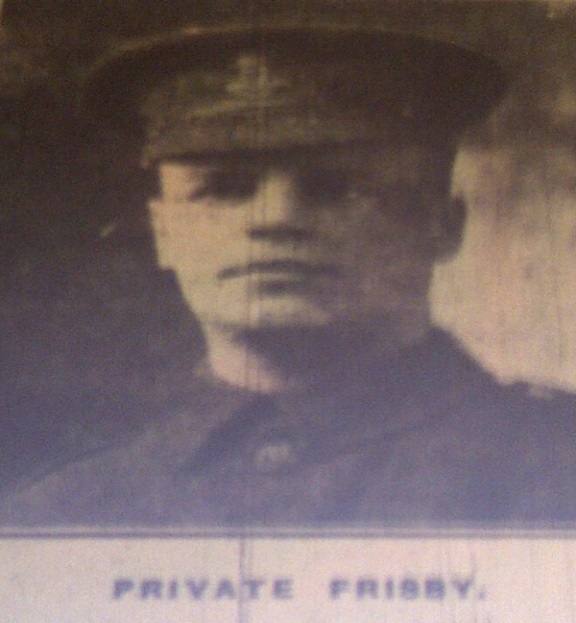
Royal Irish Regiment, 691
Private Edgar Frisby of the 2nd Battalion the Royal Irish Regiment, number 691, was killed on14th July 1916, aged 24.
Edgar was born in 1891 in Oundle, Northamptonshire to Charles and Amy Rebecca Frisby. By 1911, however, the family were living at 2a Portland Street, Darwen. His father was a retired Brickmaker and Edgar was a weaver at a cotton mill. He had previously attended Bolton Road Wesleyan School and Church, for whom he played cricket.
Private Frisby’s enlistment papers have not survived but it is known that he originally served in the 5th Battalion before transferring to the 2nd Battalion the Royal Irish Regiment:
5th (Service) Battalion (Pioneers)
Formed at Clonmel in August 1914 as part of K1 and came under orders of 29th Brigade, 10th (Irish) Division.
About June 1915, converted to Pioneer Battalion of the same Division.
7th July 1915: embarked at Liverpool and sailed to Gallipoli via Mudros. Landed Suvla Bay
7th August 1915.
30th September 1915: moved via Mudros to Salonika.
2nd Battalion
14th March 1915: transferred to 12th Brigade, 4th Division.
26th July 1915: transferred to 11th Brigade in same Division.
22nd May 1916: transferred to 22nd Brigade, 7th Division.
“SOMME 1916”
On the 1st July 1916 the Somme offensive was commenced. These operations were designed to place our army at one stride within striking distance of the German second line, which ran, roughly, on the line at Pozieres, southern side of Bazentin le Petit, Bazentin le Grand, and Longueval. The principal attack of the British Forces was made by the Fourth Army, operating on a front of some fifteen miles to the north of the Somme. The French were operating on our right with one Corps. on the North of the Somme and other troops continuing for some distance to the South.
BAZENTIN RIDGE –on the 13th they moved into position of assembly at Mametz Wood. At 4.30am. On the 14th the attack started. The 1st Royal Warwickshire’s captured the enemy’s front line trenches. The Royal Irish passed through them and C Company, under Captain Tighe, and captured the village of Bazentin le Petit, taking 150 prisoners.
The Royal Irish assembled on the south side of the village and thence marched into bivouacs in Mametz Wood. The Royal Irish captured and held the objectives assigned to them in the orders for the day’s operations but their losses were very heavy:
3 officers killed and 11 wounded.
24 men killed, 208 wounded and 80 missing.”
Edgar Frisby has no known grave and is remembered on the Thiepval Memorial.
His parents would receive his 1914-15 Star and British War and Victory Medals.
Lancashire Fusiliers, 15747
Corporal Harry Gee of the 18th Lancashire Fusiliers (No. 15747) was killed on 15th April 1917 on the Somme.
Harry was born in 1896 at Chesterfield, Derbyshire. He was the son of Walter Gee and Sarah Ann (nee Finney). The couple had 13 children, five who died in infancy. The family moved into Darwen shortly after the 1901 census and they lived in Atlas Road. Harry’s father was employed as a verger at St James’ and the family attended the church. Harry was employed as a cotton weaver and he later worked at Messrs. Place’s Brick Works.
On 4th January 1915, Harry enlisted in the 18th Lancashire Fusiliers, a Bantam Battalion, so he was less than 5ft 3ins tall. He sailed with his Battalion and saw action on the Western Front. He was at the Battle of the Somme and, at the end of the year, the Divisional commanding officer (Major General H. J. S. Landon) submitted a report complaining that the replacement drafts he had received were not of the same tough physical standard as the original Bantams but were undeveloped, unfit men from the towns. A medical inspection was duly carried out and 1439 men rejected from the ranks. A second inspection removed another batch, bringing the total to 2784. These men were, in the main, transferred to the Labour Corps. Their places were filled with men transferred from disbanded yeomanry regiments; they had to be quickly trained in infantry methods and a Divisional depot was formed for the purpose. Brigades were then ordered that no more Bantams were to be accepted. Original Bantams that passed the medical inspection remained in place. Harry was one who passed.
In April 1917 Harry was on the Somme and his Battalion was involved in pursuing the Germans during their retreat to the Hindenburg Line. During action on 15th April he was reported wounded and missing after a successful charge. In a letter of regret to his mother, the Captain of the Battalion states: “He was one of the best lads in the Battalion, and always did his duty, and often more than his duty.”
Harry Gee is remembered on the Thiepval Memorial to the Missing on the Somme, and has no known grave.
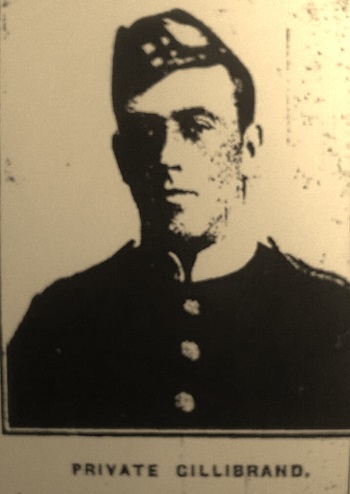
King's Own Scottish Borderers, 15607
Richard Gillibrand was born in 1887 to John Thomas and Martha Jane Gillibrand. By 1911, he had married Margaret Teresa Appleton, and they had one child. The family lived at 112 Exchange Street, Darwen and Richard was employed by Messr’s Joseph Place and Sons, Hoddlesden.
Prior to the outbreak of war, in 1910, Richard enlisted into the local territorial unit. As war was declared, he re-enlisted with four pals. Only one of them would survive and even he would lose a leg.
Richard was sent to the 7th Battalion King’s Own Scottish Borderers. They had formed at Berwick-on-Tweed in September 1914 and came under orders of 46th Brigade in 15th (Scottish) Division. They moved to Bordon and in February 1915 went into billets at Winchester. They then moved to Park House and Chisledon Camps (Salisbury Plain) in April 1915.
The Battalion landed at Boulogne on 10 July 1915. From then on, Richard would have seen action, particularly in the summer of 1916, at the Battles of Pozieres, where Richard would lose his life.
Pozieres was a small, straggling village on the main Albert-Bapaume road. It is situated on high ground that gives the occupier observation southwards along the road towards Ovillers, La Boisselle, Albert and beyond; to the east across to High Wood, Delville Wood and beyond; and westwards to Thiepval. Possession of Pozieres was key to making possible any further advances towards Bapaume, the capture of the Thiepval ridge and the breaking of resistance at High and Delville Woods. The Battle for Pozieres and nearby Mouquet Farm became an epic in its own right, with tenacious German defence keeping determined British-Australian attack at bay for several weeks.
Richard has no known grave, but is remembered on the Thiepval Memorial to the Missing on the Somme, Pier and Face 4a and 4d. He is also remembered at St John the Evangelist Parish.
Durham Light Infantry, 28017
Walter Gillibrand was born 22nd May 1894 and he was baptised 8th August 1894. His parents, John and Elizabeth Gillibrand, were living on Higher Gillibrand Street, Darwen at the time of William’s birth.
By 1901, the family had moved to Oswaldtwistle and were living at 94 Roe Greave Road,
The 1901 census showed that Walter, aged six, had a sister Maggie who was eight years old.
The 1911 census shows that the family were living at 19 Stanhill Street, Oswaldtwistle and included another child, Henry, aged twelve.
Walter enlisted 5th January 1916 and left for France 4th May 1916.
The Division took part in many of the significant actions on the Western Front.
On Saturday 23rd September 1916 an announcement was placed in “The Darwen Gazette” entitled: "A GOOD SOLDIER" AN OFFICER'S TRIBUTE
Mr. Gillibrand, who lives at 77, St. Albans's road, has received from a Lieutenant of the West Yorkshire Regiment, a letter stating that his son, Private Walter Gillibrand, was killed on the 3rd inst whilst in action. Private Gillibrand was connected with St. Cuthbert's Church and was a weaver Messrs. Gillibrand's Hollins Grove Mill before he enlisted on the 3rd of January, this year. He joined the Durham Light Infantry, but was afterwards drafted to the West Yorkshire's. He was 22 years of age. The Lieutenant's letter is as follows:_
"You will already have heard of the death of your son on the field of honour on the 3rd September. It was a sad day for the Battalion and we lost many of our bravest boys. But surely their supreme sacrifice will gain for them eternal glory. To die fighting for King and country and to save the homes of England from the devastation which has overtaken France and Belgium, is the finest death a man can die. It must be a terrible blow to you, and all his officers and comrades join you in mourning a cheerful and brave soldier."
Private Walter Gillibrand was awarded the Victory Medal and the British War Medal
Royal Fusiliers, 10562
Henry Green, born in 1897, was the son of Wesley Green and Eleanor Louisa Green of 43 Green Street, Darwen. Wesley was a boot maker, whilst Henry’s sister Eleanor was a teacher. Henry was one of six siblings. He worked as a clerk, alongside his brother, at Messrs. John Catlow and Sons, Olive Mill, and he was in the choir at the Railway Road Wesleyan Church.
Henry enlisted into 8th Battalion Royal Fusiliers in March 1915. His Battalion was part of 12th Division which had been fighting on the Somme in July and August during the battles around Albert, Pozieres, and then, at Le Transloy in early October 1916.
His Battalion marched for five days after leaving Somme and relieved the 11th (Northern) Division on the Arras front on 22nd August. It was a comparatively quiet time, punctuated by trench raids. They were relieved on 26th-27th September and moved back to the Somme, taking over forward positions in appalling conditions at Geudecourt.
The Fourth Army mounted an attack on 7th October: the objective for the Division was Bayonet Trench and 500 yards beyond. A small gain was made in spite of heavy enemy fire. So few men made it to Bayonet Trench that it could not be held. Troops came under machine gun fire from German aircraft on 9th October. More efforts were made on 12th and 19th October, that got no further. The Division - except its Artillery - was relieved on 19th October and returned to Arras. Another 135 officers and 3176 men had become casualties. In all, almost 11000 casualties had been sustained in a total of just 43 days fighting on the Somme.
In this chaos, Henry was killed. He has no known grave, but is remembered on the Thiepval Memorial to the Missing on the Somme.
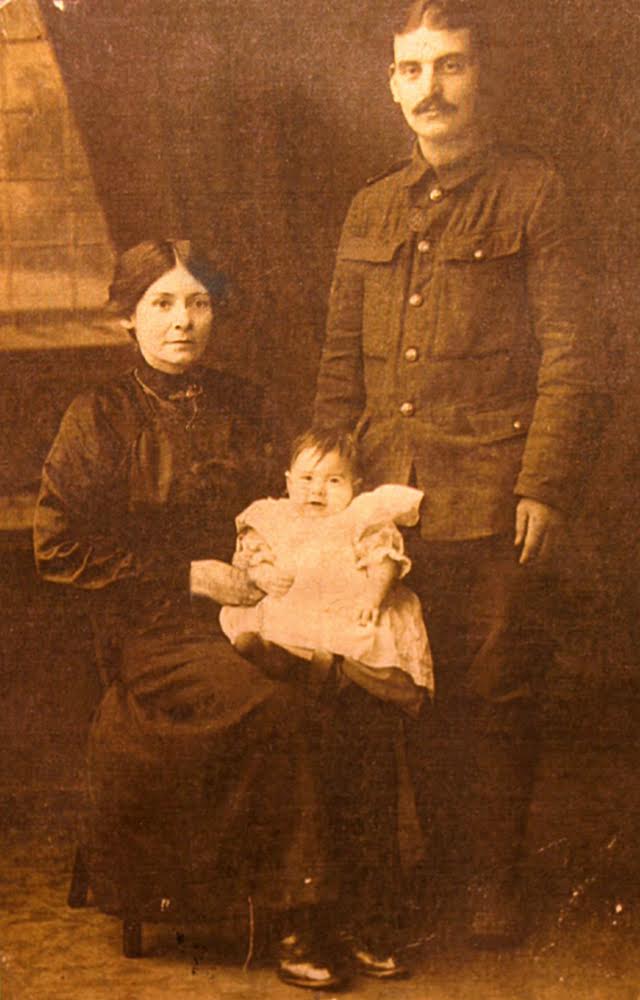
The King's (Liverpool Regiment), 25118
The Greenhalgh’s were a very close family, but one blighted by tragedy.
Jack’s father died in November 1914 as the result of an accident at the spinning mill where he worked. The family all attended St. John the Evangelist Church in Darwen and Jack was also a member of St. John’s Institute and St. John’s Minstrel Troupe. Jack was a weaver at Bowling Green Mill.
Jack was well known in sporting circles in Darwen, being a referee in the Darwen and District Sunday School league, and a former secretary of the league.
Together with his brothers, David and Joseph, Jack enlisted as a volunteer in the King’s Liverpool Regiment in January 1915 and he was sent to France in May of that year. Before he was posted abroad, he married his sweetheart, Nellie, who was carrying his child. His son, John Thomas, was born in August 1915. Jack was granted leave at Christmas 1915 and returned to Darwen; hence the photograph of the three family members.
His brother, David, was killed in action at Ypres in April 1915, probably at Lange Mark.
Jack was wounded at Loos in September 1915, but returned to the front. He was promoted to Lance-Corporal shortly afterwards.
War Diary Regiment's War Diary 8th August 1916 reads as follows:
Front line ‘new trench’ west of Guillemont.
At zero hour (4.20a.m.) B, C and D coys (under Capt Wichington) advanced to attack 1st objective, german front line from Brompton road to strong point near 24.2.0.0.. Lt Goff, Capt King (adjt), Major Mccael behind artillery coy. 1st objective was taken except strong point as the coys were hove off to the right during the advance.
Very misty when attack was launched, very hard to see more than 10 yards. At 4.50a.m. A coy moved forward to occupy the line vacated by A, B, C and D coys. A coy were met with severe machine gun fire and bombs from strong point. Meanwhile B, C and D coys had gained their 1st, 2nd and third obfectives.
Ist objective German front line
2nd objective Guillemont railway station
3rd objective High Holborn (trench n of s74)
At this stage whilst A coy was engaged with Germans at strong point, large numbers of Germans came streaming down the original german front trench at Guillemont. This was due to the fact that our Battalions on our right had failed in their objectives.
Cpt Last, who was wounded in the leg when with his company, crawled back towards our lines. There he met Lt Hudson, coy A, where he was informed that about 150 of our men were consolidating their newly gained positions at High Holborn (3rd objective} and about 70 men the same at Guillemont station (2nd objective).
Orderlies were dispatched by officer in charge to B, C and D companies to inform them that their right flank was being encircled and threatening the line of communication. Reinforcements were called for by A coy. Repeated attempts to reach leading companies failed. No further news was received from B, C and D coys.
(early next morning (9th) aeroplane reconnaissance produced a photograph showing that our companies were still holding out and digging in.
During the night of 8/9, a coy of 2 South Staffordsmade a bombing attack by the left to try to reach our men. This attack failed.
13th Essex were ordered by GOC 6th batt. To attack to reach our men. This attack was launched at 5.00 a.m on 9th, after an hours intense bombardment owing to the large amount of barbed wire that the enemy had put out during the night. Attack failed. With the exception of a message sent by carrier pigeon no further news was received from the leading coys. Early in the operation major mccael received a wound in the leg.he was being conveyed back to our front line but just before reaching it he was killed by a bullet which passed through his head.
killed wounded missing/taken total
Officers 1 6 18
Other ranks 235
Jack was killed in action at Guillemont on 8th August together with 62 of his comrades. He has no known grave and his name is commemorated on the Thiepval Memorial.
Ten days later on 18th August his brother, Joseph, was also killed in action whilst helping a wounded comrade.
Hartley, James | Harwood, John | Healey, John | Hearth, Charles | Holgate, William Lawson | Houghton, Harry
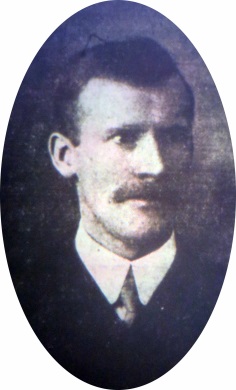
West Yorkshire Regiment (Prince of Wales' Own), 38110
Private James Hartley of the 16th West Yorkshire Regiment (Prince of Wales's Own) (No. 38110) was killed 27th February 1917 on the Somme.
James was born in 1880 at 2 Moscow Mill Street, Oswaldtwistle. He was the son of Seth Hartley and Jane (nee Sutcliffe). By the time the 1891 census was taken the family had moved to Darwen and his father was working as a grocer at 19 Grimshaw Street. The family business was a success and ten years later they had shops in Darwen and Oswaldtwistle. James was a member of the Darwen Grocers’ Association, in which he took great interest and occupied the position of president in the year 1910. The family attended Bolton Road Wesleyan Sunday School. In 1901, James married Jane Kitchen at St Mary, Lancaster and they had three children Harold (1903), Eric (1904) and Doris (1907).
By the time war commenced James and his family had moved to Barnoldswick. As his army record has not survived it is not clear as to when he joined the army but it is known that he enlisted at Halifax in the 16th West Yorkshire Regiment (Prince of Wales's Own). By 1917, he was with his Battalion on the Somme. On 26th February they were at Bayencourt and had moved into the line at Hebuterne Sector to take part in the operation against the enemy who were known to be evacuating their position. At 6.30am on the following day the Battalion made an attack on Rossignol Wood – two companies were attacking and two in support. The Battalion suffered heavy causalities, chiefly from machine gun fire and shrapnel. It was in this action that James lost his life.
James Hartley is remembered on the Thiepval Memorial to the Missing on the Somme and has no known grave.
At the end of the war his wife received his war medals - Victory & British War Medals.
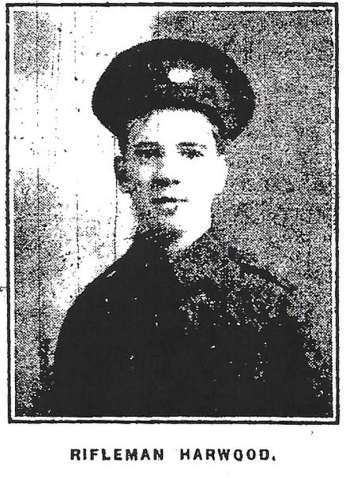
Rifle Brigade Z/2333
Rifleman James Harwood of 1st Battalion the Rifle Brigade, Number Z/2333 was killed on 1st July 1916. He was born on 23rd July 1895 and baptised at St John’s Church, Darwen to parents John and Ellen, who were living at the time in Pine Street. By the 1911 Census James was living on Exchange Street with his parents and siblings. He worked as a Reacher-in at a Cotton Mill.
James Harwood enlisted into the army on 31st August 1914 at Darwen (aged 19 years) but by the time he joined his joined his unit at Southend he had taken to using the name John Harwood. He was subsequently married under this name to Dorothy Clare Golding at Southchurch Tabernacle, Rochford, on 24 April 1915.
Opening phase: the Battle of Albert, 1 - 13 July 1916
In this opening phase, the French and British assault broke into and gradually moved beyond the first of the German defensive systems. For the British, the attack on 1 July proved to be the worst day in the nation's military history in terms of casualties sustained. It is the aspect of the battle that is most remembered and most written about, and for good reason - but to concentrate on the failures is to entirely miss the point of the Somme and why the battle developed into an epic period of the Great War. On the first day, British forces at the southern end of the British line made an impressive advance alongside the French Sixth Army, capturing the villages of Montauban and Mametz and breaking through the enemy's defensive system. North of Mametz the attack was an almost unmitigated failure. The situation led to a redirection of effort, with the offensive north of the River Ancre effectively being closed down and all future focus being on the line south of Thiepval. There was a stiff fight for Trones Wood and costly, hastily planned and piecemeal attacks that eventually took La Boisselle, Contalmaison and Mametz Wood during the rest of the period up to 13 July.
John Harwood (otherwise James Harwood) has no known grave and is remembered on the Thiepval Memorial.
His widow received his 1914-15 Star and British War and Victory Medals.
Royal Welsh Fusiliers, 33535
Private John Healey of 10th Battalion Royal Welch Fusiliers (Number 33535) was killed on
16th August 1916. He was the son of John Patrick and Margaret Healey and was baptised at St Joseph’s Church, Darwen 15th April 1875. In 188, the family were living at 28 Water Street. John enlisted at Blackwood, Monmouthshire 7th September 1914 initially into the South Wales Borderers with the Regimental Number 17656. He was transferred to 10th Battalion Royal Welch Fusiliers on 8th May 1916.
John Healey’s enlistment papers show he was 5 feet 61/2 inches tall and weighed 144 lbs. Complexion – dark, Eyes – blue, Hair – turning grey. He gives his brother James’ address in Darwen as Sunnyhurst Wood. He states his age as 33 years and 5 months.
The attacks on High Wood, 20th – 25th July 1916
The fight for High Wood, which had begun on 14th July, went on until mid-September. The wood sits on ground that gives the occupier militarily vital observation south to the Montauban ridge, east to Delville Wood and north east towards Flers and Guedecourt. The first British units entered the wood late on 14th July 1916, but the Germans had recovered from the British breakthrough at Bazentin earlier that day and were now manning the "Switch Line" trench system which ran through the back of the wood. Both sides fought tenaciously to possess the wood. It became an epicentre of the bloody attack and counter-attack attritional fighting that characterised much of the Somme offensive after 14th July.
The Battle of Delville Wood, 15th July – 3rd September 1916
Delville Wood, which is within sight and today an easy walk of High Wood, was also fought over countless times for similar reasons and became a charnel house, choked with the dead of both sides. It is perhaps most remembered for the sustained attack mad by the South African Brigade of the 9th (Scottish) Division, a formation which was to all intents and purposes destroyed during its valiant efforts.
John Healey is remembered on the Thiepval Memorial and has no known grave. He was entitled to the British War and Victory Medals.
When John Healey’s affairs were finally resolved his parents were both deceased and his estate was divided between his brothers Hugh, James of Lyndhurst Road, and his sisters:
Mary, Bridget, Julia, Ellen, Ann and niece Miss Martha Billington, daughter of his sister Margaret.

Coldstream Guards, 6360
Charles was the son of John Thomas and Sarah Sophia Hearth, nee Mellish. He had joined the Coldstream Guards in 1903 as a Regular and served with them for three years. He married May Parkington in 1910 and they had two sons, James and Charles who were born in 1912 and 1914.The family lived in Atlas Road, Darwen. Prior to the War, Charles was a varnish manufacturer at Walpamur, Darwen.
Being a Reservist, Charles was called up in August 1914 and went to France immediately. He was wounded in the shoulder but returned to the ranks, and by 1916, he was fighting on the Somme. Charles, aged 30 years, was killed 25th September 1916.
WAR DIARY 25th SEPTEMBER 1916
The Battalion moved forward to Green Line at 1.35pm, No. 3 Company were then sent forward to bomb through the Northern end of Les Boeufs, then to take up a position in front of Les Boeufs – Gaudecourt Road, in support. No. 1 Company advanced to Brown line and started to dig in followed by No. 4 Company and half of no. 2. Battalion HQ moved up to Sunken Road, West of Les Boeufs, at about 4p.m. No 1 Company, 4 Company and half of 2 Company went forward from the Brown Line and dug in immediately in front of Les Boeufs, in close support to the Irish.
The remaining half of no. 2 Company were kept at Battalion HQ as reserve.
War diary 26th September 1916
Consolidation of line. Heavy hostile shelling. Relieved at about 9 p.m. by company of 2nd Irish Guards. Moved to bivouacs at Carnoy. Casualties 1 officer and 136 other ranks.
Charles has no known grave and he is commemorated on the Thiepval Memorial.
He attended St John the Evangelist Church, Darwen and is commemorated on this war memorial.
Royal Welsh Fusiliers, 18983
William Lawson Holgate, born 11th September 1895, was the son of Thomas Edward and Angelina Holgate of Blackburn Road, Darwen.
He was educated at the Municipal Secondary School Darwen, and Manchester Grammar School, where he held a Lancashire Junior Exhibition. William was a student at the Municipal School of Technology at Manchester and was taking University courses in Mechanical Engineering. He was a member of the University Officers' Training Corps, and had twice been recommended by the Colonel commanding the Battalion for a commission in October 1915 and again in April 1916.
William served with the 16th Battalion Royal Welch Fusiliers in France and Flanders from 15th December 1916, and was killed in action, aged 20 year, at Mametz Wood on 10th July, 1916.
The Darwen Gazette, Saturday July 22nd, 1916 recorded William’s death as follows:
His Commanding Officer wrote: "The battalion was joining up to attack the German position, when a shell burst close to him, killing him instantaneously. He was one of the very many brave soldiers who fell that day, but there is none whose loss will be more keenly felt by his comrades or by myself personally. His bearing throughout his period of service, especially in France, was invariably that of a true and loyal soldier, and a comrade: * He was first wounded in the cheek by a bullet, and soon after a shell burst just in front of him, killing him instantaneously."
No greater sacrifice can a patriot make for the country he loves and the King he honours than to lay down his life in defending their cause against a barbarian and ruthless enemy.
Many of Darwen's bravest and best lads have gone out to face the foe, and have fallen in battle in this sorry and terrible war. When the roll of all our lost heroes is compiled, and to them some splendid permanent memorial is set up in the town, an honoured place will be given to Lance-Corporal William Holgate, the youngest son of our esteemed townsman, Councillor Thomas E. Holgate, who, whilst in action with the Public Schools Battalion of the Royal Welsh Fusiliers, was killed by a shell.
The sad news was conveyed to the family at their home in Hollins Grove, on Wednesday morning in a letter received from Private W. Farrer Lonsdale, son-in-law of Mr James Duxbury, Atlas House, and it was confirmed by another letter received yesterday morning.
With the death of Lance-Corporal Holgate a career of great promise is closed. Only twenty years of age, he was educated at the Manchester Grammar School, where he won distinctions and then he passed on to the Manchester School of Technology where he was studying when the troops of the Emperor of the Huns invaded Belgian territory. In month following the declaration of war he joined the Officers Training Corps and went to the front in December last year.
To Councillor Holgate and his family we offer our sincere sympathy in their terrible bereavement.”
Coldstream Guards, 11381