Banner image
Reminiscences See more See less
Back to Down Memory Lane

Reminiscences

​​Blackburn When I Was A BoyReminiscences from 1879A talk with Blackburns Oldest Inhabitant 
 More Blackburn Memories 


 These reminiscences were written by Charles Holt Stirrup and printed in the Blackburn Times on July 15th and 28th 1933, and they look at Blackburn in the 1880s.
Charles Holt Stirrup was the eldest son of William and Frances Stirrup.  He had two brothers Stanley and Reginald.  His father was a “Boot and Shoe Maker" and had his shop at 8 New Market-street, their home for many years was on Preston New-road.

Charles married Mary Elizabeth Metcalf in 1894.  For a time he was a free-lance journalist in America, he later started a “direct advertising agency” in London.


Blackburn When I Was​​ A Boy

 
By Charles Holt Stirrup
 
The other day I took a stroll along some of the streets of central London accompanied by an old friend newly arrived from Australia after an unbroken absence from England covering 33 years. “Changes everywhere,” he remarked reminiscently; “many, many changes.  Yet the face of London is much as it was when I left.  Some of these streets are almost exactly as they were.”
 
His thoughts reminded me of my impression of Blackburn when I paid a short visit to my native town a little while ago.  How familiar nearly everything seemed, though I had not lived there for nearly 40 years!  My recollections made me feel old, for, they carried me back to my boyhood days of the eighteen-eighties.
 
Yet as I walked up Preston New-road I saw that the hand of time had left very little impression on it—hardly any at all between Sudell Cross and the “Fox and Grapes.”  A few more shops at the town end, then the same houses and churches, the same Park entrance, the same vistas along the roads running north and south.  The trams supplied the only striking modern note.
 
There were no trams when I first knew Preston New-road.  No buses either, though a 15-minute horse-bus service was started later.  It did not amount to much.  The vehicles were small, the floors were strewn with straw in the winter, there was no conductor.  Passengers dropped their fare into a box.  Still, the town felt that progress was being made when those buses started to run.
 
 
WHERE THINGS ARE MUCH AS THEY WERE.
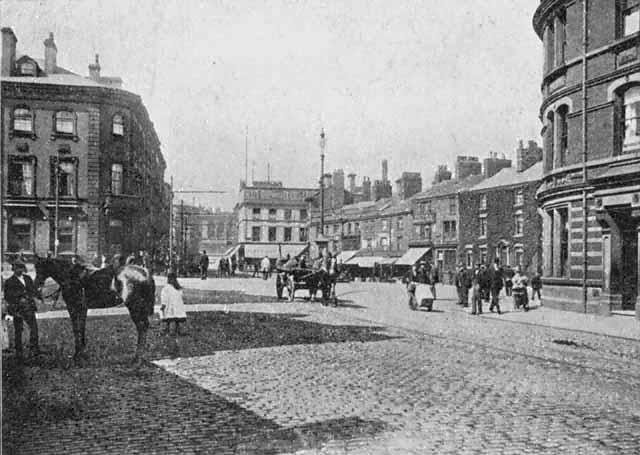
Darwen-street, Penny-street, Church-street, King William-street, Victoria-street, Richmond-terrace, in those thoroughfares I saw few changes, except that many of the shops were no longer in the old hands and the tramway office occupied the site where once stood the residence of a well-know medical man, Dr. Pollard.  The Post Office is not where it was and, of course, the Public Buildings in Northgate are a most notable improvement.  The Town Hall has, I think, been enlarged since my boyhood, but the Market House and Fish Market, the Exchange Hall, the Public Library, the Arcade, the Theatre Royal, the Old Bull and White Bull Hotels, the Old Bank and the Manchester and County Bank, showed to me at least no outward sign of considerable alteration.
 
I noticed one change, however, in the centre of the town which did not appeal to whatever aesthetic sense I may possess—the more or less permanent stalls close to the Market House.  In the old days the stall were taken down and away during Wednesday and Saturday nights.
 
jb24101.jpg 

© BwD - terms and conditions


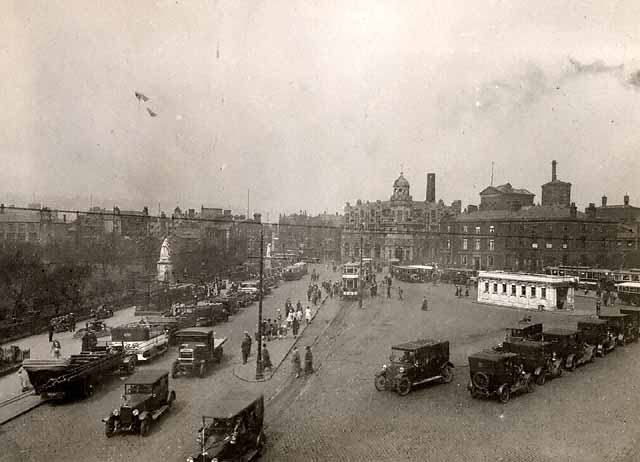
THE OLD RAILWAY STATION.
Well do I remember the old Railway Station, and that is going back nearly 50 years.  It was about a quarter the size of the present one and dirty.  The platforms were only a few inches high and passengers for the Manchester, Liverpool and Preston trains walked across the line running in the opposite direction.  I loitered for hours in that station on Wednesday and Saturday afternoons, generally with my school-chum Harry Armistead, later in medical practice at Oswaldtwistle and now, alas, but a memory.  We were keen “collectors” of engine names, which each of us kept in a little book.
 
Facing the station and open to the wide world was a narrow black and often noisome stream since, fortunately, covered by the Boulevard.  The station and the Boulevard, with the fine big space between, constitute by far the biggest improvement in Blackburn affected in my time.  The work was carried out about 1884-85.


ABOUT THE PARKS
Another improvement which came a little later was the formation of Queen’s Park—Blackburn’s recognition of Queen Victoria’s Jubilee.  Of the opening ceremony I remember nothing, but I do recall that the boating facilities on the lake quickly became popular.  Among the younger generation it was considered very dashing to take a girl for a row on those pleasant waters.  But the Queen’s Park, new and in some respects novel though it was, did not even at that time seriously rival the Corporation Park in local affection—lake or no lake.  The beauty of Corporation Park was enough in itself, and when the band stand was constructed there were many who not only thought it unnecessary, but feared that concerts would tend to lower the charm of one of the loveliest enclosures in the Kingdom.
 
Some of the Unco’ guid feared even worse things and prophesied after darkness disorder and wickedness.  But they were wrong.  Those were the people who agitated for the closing of the side gates at dusk.  For the Park was—and maybe still is—the lovers’ paradise, and side gates were open all night. That, to certain minds, meant evil.  They wrote to the papers about it.  And in this also were they wrong.
 
 
jb08620.jpg 

© LET - terms and conditions


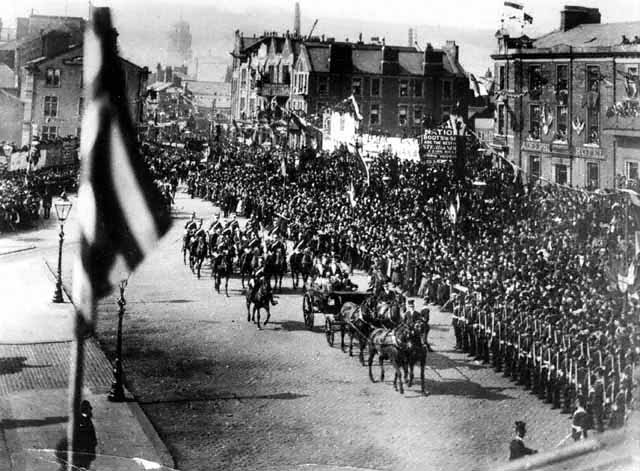
WHEN THE PRINCE CAME IN STATE
 Probably only a small percentage of my readers can remember the visit of the Prince of Wales, afterwards Edward VII., to lay the foundation stone of the Technical School on that one-time area of hovels, Blakey Moor.  That was a day.  Blackburn had been agog for weeks and did the honours of the occasion right royally.  The line was stoutly barricaded, the decorations were splendid, there were several great triumphal arches, the weather was gloriously fine and warm, and as the Prince drove down Preston New-road, accompanied by a prancing detachment of the 9th Lancers, he was greeted with tremendous enthusiasm by huge crowds that had gathered from all parts of East Lancashire.  My pal Harry and I were all over the place and enjoyed the single distinction of talking with some of the Lancers while they waited to escort the royal visitor from the Town Hall, where he had lunch, to the station.  That memorable conversation took place in a stable, and as nearly as I can recollect the stable was where the Palace Theatre now stands.  We gave two of those dazzling heroes a shilling to buy drinks with, an act of generosity of which we boasted for many a day.
 
 
THE GRAMMAR SCHOOL AND TWO OTHERS
I have not seen the Grammar School for many years, but as I understand there are 500 boys there now, it must have been considerably enlarged since my time, when there were not more than about 190 of us.  Mr. Ainsworth was the head master, and Mr. Syclemore his chief assistant.  Still, some of the boys made names for themselves when they went out into the world.  One of my schoolfellows was John Garstang, now the distinguished Professor of Archaeology in the University of Liverpool.  Another was Edward Shillitoe, who entered the Noncomformist ministry and achieved considerable reputation as a poet.  He contributed a number of short articles to popular weekly papers before he left his teens behind him.  Before going to the Grammar School I was for a couple of years at Wields Academy.  Mr. Wield, a short stout and of course, bearded man, lived in the square-fronted house on Preston New-road a few yards beyond Duke’s Brow.  The school was a separate building in the rear, and the playground was enclosed by a high stonewall, over which, at the Adelaide-road end, a few idle spectators would watch our games.  Sometimes they offered us gratuitous criticism and advice and, throw snow-balls at us, thereby starting a brisk fusillade both ways.
 
The first of my three schools was the Commercial School in Duke’s Brow, a brick building at the corner of Alexandra-road.  Mr. James Sayle conducted it.  I remember him as a kind, yet sad-looking man, tall and lean.  Some years later he frequently acted as umpire at East Lancashire cricket matches.  The boys’ chief pastime was a game with marbles called “chuck-it hole,” at which I became highly skilled.  Every boy carried about with him a linen bag containing a few or many marbles, according to the varying fortunes of the game.  A full bag, weighing a pound or two, was exhibited with great pride.  Two of the older boys, with whom I was occasionally privileged to play, became two if the greatest footballers of their time, indeed of any time—Edgar Chadwick and Johnny Holt.
 
big lamp.jpg

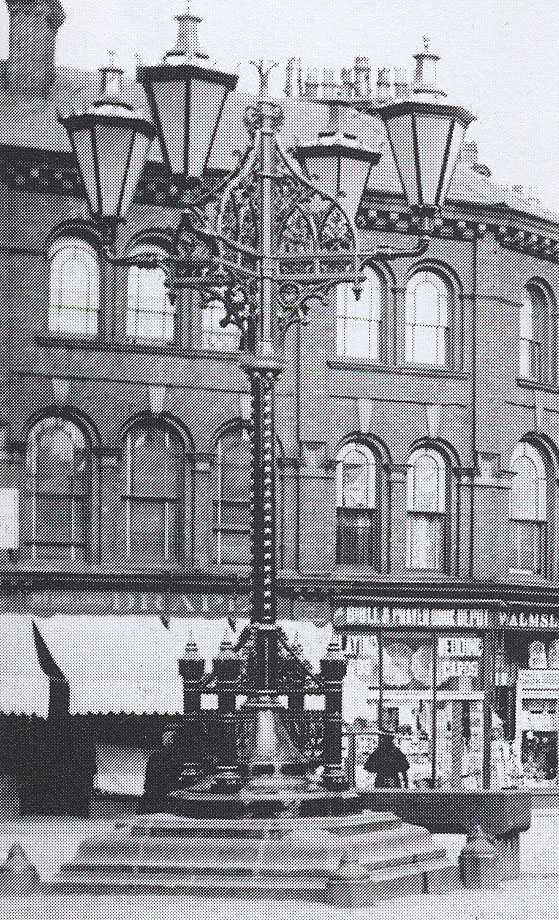
A “BIG LAMP” EPISODE
The big lamp in the centre of Sudell Cross was one of the town’s landmarks.  Its standard had, I think four arms, each supporting a gas-lamp.  There it was that sweethearts met by appointment; indeed, it was the most commonly used meeting place in Blackburn.  By the lamp stood a horse-trough, once the scene of an incident which caused a tremendous sensation.  A weekly scandal-sheet called the “Blackburn Spy” had made annoying references to certain ladies.  This was continued, despite warnings sent to the editor.  One day a friend of these ladies chanced to meet the editor at the Sudell Cross, and seized the opportunity to duck him in the horse-trough.  Police Court proceedings followed, from which the champion of fair dames emerged triumphant.  I was extremely proud of the fact that he was my Cousin, Walter Stirrup.

 
ATHLETICS EVENTS
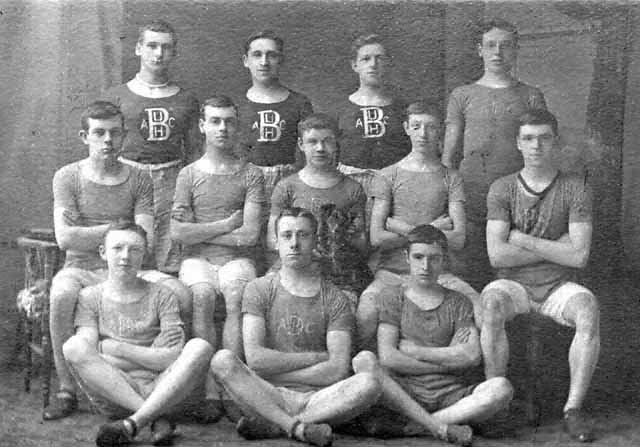
Walter was one of our celebrities, being captain of the Blackburn Harriers and the best-known local runner of his day.  He was a “distance” man.  When the great American world-champion, L.E. Myers, visited England about 1886, he competed in an open handicap race at the Rovers’ Leamington ground.  Myers made a striking figure, for he always wore a white turban and ran in long raking strides, with great ease and grace.  As was expected, he won, but Walter was a good second, and local pride was satisfied.
 
That race was, of course, run on grass, as were memorable “sprint” events at Witton (the Witton F.C. ground) between James Southworth, of Blackburn Rovers fame, and Bradley, of Huddersfield.  Both were tall magnificent men, and in their several desperate struggles inches only separated them but Southworth had slightly the better of the pedestrian argument.  Jim was undoubtedly the fastest full-back in the kingdom 40 years ago.  He belonged to a musical family and played the violin in the Theatre Royal orchestra, his brother John, that superb international centre-forward, playing the trombone.
 
 
CRICKET AT THE “MEADOWS”
There were annual athletic sports on the Alexandra Meadows grass as far back as memory will take me.  My clearest recollection of them is the bicycle races on the “penny-farthing” machines before the introduction of the “safety.”  At cricket matches on that pleasant lawn-like ground I spent many happy hours.  Albert Smith and George Carter, the polished batsman; Ralph Bell, the fast bowler;  “Bummer” Hamer, the mighty, laughter-provoking slogger—I see them in my mind’s eye as clearly as if it were but yesterday that I watched them play.  Frank Sugg, first-wicket-down for the country, was match professional for some time when circumstances permitted and gave many fine exhibitions.  Of the regular professionals I best remember Price, a Notts. man, and Ackroyd, a tall loose limbed Yorkshire colt.
 
When Price took his benefit one year he was fortunate enough to obtain the friendly assistance of the mighty Arthur Shrewsbury, then easily at the head of the batting averages.  A record crowd assembled to see the great man.  When he came out to bat and took his place at the wicket, one and all of us felt that at the end of the innings he would be at least 100 not out.  He scored a single, then two to murmurs of ecstatic admiration.  “He’s just toying with the bowling,” we said to each other; “it’s child’s play for him.”
 
Then an utterly incredible thing happened.  We gasped dumfounded, our eyes staring unbelievingly.  But there he was, walking back to the pavilion.  Arthur Shrewsbury, master of every art in batsmanship, who had scored centuries on every county ground and won test matches in both England and Australia, had been clean bowled his wicket shattered for three.
 
jb11549.jpg 

© BwD - terms and conditions


jb08126.jpg 

© BwD - terms and conditions


FOOTBALL’S GLORIOUS DAYS
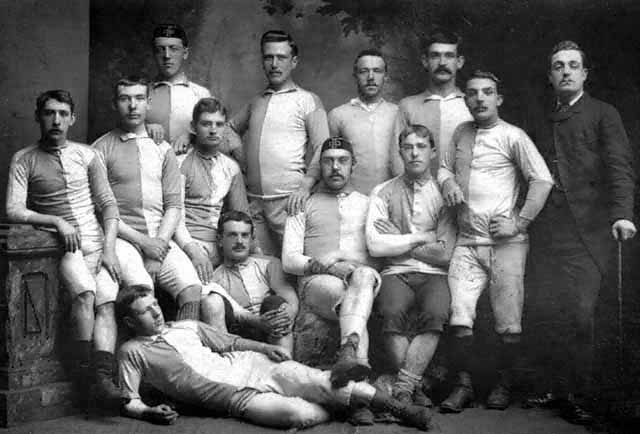
Football!  What memories that word conjures up.  Never shall I forget the painful excitement of the Cup-ties of 1883-6, and the terrific enthusiasm when first the Olympic and then the Rovers returned home with the “little tin pot.”  Fifty years ago Blackburn was already famous not only for its Rovers and its Olympic and to a lesser extent, its Witton and its Park-road teams, but as a veritable hot-bed of budding talent.  There were hundreds of boys’ clubs, scores of whose players afterwards became well-known professionals.  One of these teams, the Little Dots, were said to have been undefeated for years.  About 1890 the Etrurians were among the best amateur organisations in the North of England.  My First glimpse of big football was obtained when my father took me, a very small boy, to see the Rovers play Darwen at the Alexandra Meadows—then the home of the blue and whites.  Darwen were among the leading clubs, and local rivalry was intense, even bitter.  From that time on I was one of the most fervid of the Rovers followers, and knew the idolatrous bliss of hero worship.
 
When the accommodation at the Meadows became inadequate, and the Rovers decided to construct a new ground at the top of Leamington-street, people living on and near Preston New-road were greatly annoyed.  It turned into a monkey-parade every Sunday evening; now it was to be filled with a river of football enthusiast twice on Saturday afternoon!  But the Rovers went to Leamington-street, and they achieved football immortality.  My cheers must have helped them towards that glory; they were loud enough anyhow.
 
 
AN EXPERIMENT AND A DISASTER
Recently the possibility of playing football at night in artificial light was discussed at length in the sporting columns of the newspapers, and one or two trial games were played in London, all as if such a thing had never happened before.  But those who thought saw talked without the book.   I saw an exhibition game between; I think the Rovers and the Olympic, played in artificial light about the year 1885.
 
That was not at the Leamington ground or at the Hole It’th Wall ground, right at the top of Shear Brow, where the Olympic had their pitch, but on the old athletic ground at Ewood, the site of the greater Ewood Park of today.  The play followed fairly well.  My impression is that the event was an early test of the power of the electric arc lamp, probably the earliest in connection with sport.
 
Another of my visits under parental control, to Ewood, left a vivid impression.  We were to see the final for the East Lancashire Charity Cup.  Our efforts to get on one of the steam-trams in Darwen-street were unsuccessful, so we decided to walk.  As we were nearing the ground a tram, going fast, passed us, and my father said, “Look how packed it is.  I’m glad we’re not on it.”  It was swaying dangerously, and as it descended the dip towards Ewood we saw it turn over.  Many of the passengers were seriously injured and unless my memory betrays me, one or two of them fatally.
 
 
EARLY DANCING RECOLLECTIONS
My introduction to the lighter social accomplishments took the form of my first dancing lessons.  My mother had (and I am happy to say still has) decided opinions on these matters and when I was about nine, took me one Saturday afternoon, much against my will, to the children’s class at Mrs. Taylor’s Dancing Academy.  The classes were then held in a long, narrow, pleasant upper room somewhere near Victoria-street, and there I learned the polka, the mazurka, the schottische, the lancers, and the quadrille; the waltz came later.
 
Mrs. Taylor was an exceedingly nice and kind lady, and had great gifts as an instructress.  Her charm of manner made her highly popular and, especially after moving to commodious quarters in Preston New-road, she enjoyed much success.  She was assisted by her two sons.  One of her classes, held, I think, on Thursday evenings became a regular social institution and many married men, induced by their respective wives to repair the neglect of the past, there acquired some measure of dancing proficiency.  Perhaps Mrs. Taylor is best remembered for her annual children’s fancy dress ball in the Town Hall when, year by year, crowds of parents and friends were spectators of a delightful and clever display.
 
The Liberal and Conservative Balls were great events, with Herr Vetters Band from Manchester generally providing the music.  It was at one of these affairs, escorting my mother that I first appeared in all the glory of a dress suit.  I recall that I wore loose cuffs, a dicky and a ready-made tie.  Also I had a coloured silk handkerchief carefully tucked into my waistcoat, in accordance with the fashion of the period.  My opinion of myself that night was not modest.  Forgive me; I was only 17.
 
jb09766.jpg 

© LET - terms and conditions


THE THEATRES
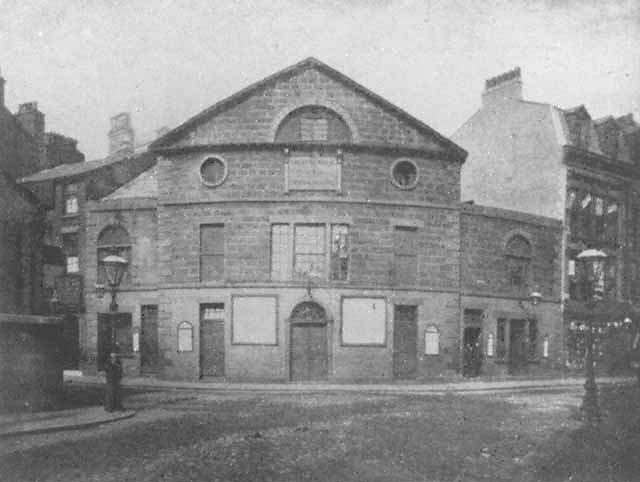
Even though we had no cinemas in the 80’s of last century, the town did not lack a fair supply of entertainment; indeed, I am inclined to think that those must have been the Theatre Royal's palmiest years.  Some of the best travelling companions appeared on its boards, among the most popular being the J.W. Turner Grand Opera organisation. Osmond Tearle, father of Conway and Godfrey, often played Shakespearian roles there, and I saw the first presentation in the town of  “ The Gondoliers.”  “The Yeomen of the Guard,” and “Dorothy.”  Shiel Barry in “Les Cloches de Corneville” was always a big draw.  J.L. Toole, then an old man, was, frankly a disappointment.  We went to see him expecting to laugh uproariously; but didn’t.
 
Every year there was a pantomime.  The first one I ever saw was in the old Royal—“Robinson Crusoe,” I think.  It was a real pantomime, with a “Gorgeous Transformation Scene” and a Harlequinade.  Mr. and Mrs. Duval ran the theatre at that time; later, after it’s rebuilding, the genial Mr. Harry Yorke was for years a most popular host.  On special occasions he would sing some of his own songs, including:
 
“Aw’m allus glad to see a man like thee.
Tha’rt as welcome, lad, as welcome as welcome as con be;
Hang thi hat  wheer tha ar’t able.
Bring thi chear up to th’ table.
For aw’m allus glad to see a mon like thee.”
 
 
At the Prince’s Theatre there was a melodrama of the good old kind—curly-haired hero, persecuted heroine, hissing villain (with wax pointed black moustache) and comic crook with a good heart.  That was forbidden pleasure to me, but, boy-like, I occasionally spent sixpence at the pit entrance to see “ The Stranglers of Paris,” “The Divers Luck,” “Secrets of a Great City,” and other full-blooded shows.  But the Prince’s sometimes became fashionable, as when the Blackburn Amateur Operatic Society played “H.M.S. Pinafore” for a week, and when, one afternoon, Charles Wyndham and Mary Moore came from Manchester to appear in “David Garrick.”
 
 
VARIOUS ENTERTAINMENTS
Entertainments of many kinds were given in the Exchange Hall, these alternating irregularly with political meetings, bazaars, and the like.  The Cecilia Concerts were conducted there—important social events those—but for my own part I preferred the Christy Minstrels and, above all, Hamilton’s Diorama, which might be regarded as the forerunner of the modern movies.  Guided by a gentleman with a long pointer, we were taken pictorially round the world.
 
There was always a “Grand Spectacular Scene,” the one I remember best being the ships of the British Navy moving into fighting position, thanks to the lighting arrangements behind, then spits of fire and smoke came from the guns, to which the forts responded.  The ships were hit occasionally, but the forts suffered much more, eventually being reduced to ruins.  At last the Egyptian flag was lowered in sign of surrender and, to the tune of  “Rule Britannia,” we all applauded with patriotic enthusiasm.  There was genuine entertainment value and some instruction in Hamilton’s Diorama.
 
The Town Hall was not used much for entertainment purposes, except balls and concerts, but many excellent lectures were given there.  I always made a point of being present when Father Perry, of Stonyhurst College, the eminent astronomer, was the lecturer.  He never talked above the heads of his audience, but was singularly lucid and interesting and had a vein of humour which added greatly to our enjoyment of his discourse.
 
A place of recreation rather than entertainment was the skating rink in Canterbury-street.  It was one of the earliest roller skating rinks in the country, but I doubt whether it enjoyed much success.  To the best of my recollection, nearly 50 years have elapsed since it was closed.  I was a very small boy when I was taken, two or three times, to see the skaters, but I remember nothing of it later.
 
 
MUSIC HALLS
I saw a show at the Palace when I was last in Blackburn, a good one, and involuntarily thought of the music-hall we had in the town when I was a fella-lad of 17 or 18.  It was called the Lyceum, and situated in Market-street Lane, just off Darwen-street, and within a few yards of the Castle Inn, on the opposite side.  Small, frowsy, old-fashioned even then, it was patronised by young bloods of the town—more or less surreptitiously.  That is to say, they refrained from mentioning it at home their visits to that temple of unrefined pleasure.  They went as a rule on Monday night at half-time, when admission to the best seats was 9d.
 
The artists who appeared on the tiny Lyceum stage were, of course, third rate and the favourite songs were beerily course or about “life”—often treated sentimentally—in the wicked west end of London.  “Outside the Cri. Outside the Cri…Thank God she perished outside the Cri,” wailed a fat “lion comique” in ill-fitting evening clothes as he took off his silk hat in reverence to the memory of the unfortunate girl who had been knocked down by a hansom and killed outside the Criterion Restaurant.
 
Occasionally, however, a “star” was engaged.  One of them, an entertainer at the piano, the celebrated Mr. Corney Grain, declined to perform when he saw the place; but the incomparable “London Idol,” Miss Vesta Tilley, then at the beginning of her career was made of sterner stuff.  The hall was besieged throughout the week of her appearance.
There was another music-hall or sing-song resort in Blackburn a little before my time.  Report gave it a very bad reputation.  It was situated on the edge of town just off Addison –street.  There were grounds attached to it, and these, it was said, were the scene of the lowest type of sport and much drunkenness.  When it had for years been a moral plague-spot and an offence to all decent people, public clamour led to its being closed and the hall became the first church of St. Barnabas in Blackburn.
 
THE CHURCHES I WENT TO
The Rev. P.E. Thomas was curate-in-charge at St. Barnabas’, and had a terribly uphill fight while he built the new church a few yards away.  My grandmother had a great admiration for Mr. Thomas and attended his services.  She frequently took me along with her, and I clearly remember the one-time music hall.  The stage was still there, but had been converted into the altar.  The pulpit also was on the stage.
 
Another substitute far a church to which I was taken as a small boy was the old St. Silas’ school-house on Preston New-road, used for worship before the present St. Silas’ Church was built.  Which reminds me that all that area north of the road to the rear of the school-house was open land on which were two or three football pitches, so much used that there was very little grass.  I often played there my self.
 
But our family church was St. John’s, with its old fashioned boxed pews.  The choir sat in the organ loft in the Rev. John Baker’s time, but were brought below, and surpliced, after the interior of the church was partially reconstructed.  The restoration service, held on a week-day, was distinguished by the presence of Dr. Thomas, Archbishop of York.
On my way to church on a Sunday morning I would see Dr. Morley, brother of the great statesman, outside his house in Richmond-terrace, providing porridge for the birds.  A man of heterodox opinions, he would look a little aggressively at the churchgoers, as if to say that his religion, expressed in feeding the sparrows, was quite as good as theirs.  The doctor was famous for his caustic wit, freedom of tongue and handsome appearance.  His trim grey moustache, keen eyes behind pince-nez, glossy, slightly-tilted silk hat, and cigar, were well known on every important football ground in the country.  Vice-president of the Football Association, he was the most outspoken and most frequently reported ornament of the winter game for more than a generation.

 jb04522.jpg

© BwD - terms and conditions


COTTON RIOTS
A stone crashing through a window heralded the beginning of what I now call my memory.  For in my minds eye there is nothing further back than the day when the “Rioters” went up Preston New-road and demonstrated their grievances by breaking windows.  There was a dispute in the cotton trade and the police became aware that the disorderly element meant to get rough along the town’s principle residential thoroughfare.  Warnings led to a general lowering of blinds as a protective measure, and I recall how dark our house seemed when the Venetians had been let down.  We were living at the corner of “the road” and Leamington-street at the time and one big stone came our way.  I yelled with terror, but broken glass represented the only damage we suffered.
An event of a pleasanter nature that interested me greatly was the visit of Field Marshal Sir Garnet Wolseley to Blackburn.  He brought a cavalry detachment with him and stayed with General Feilden at Witton Park.  The park was thrown open to the public.  On one afternoon the soldiers gave a display similar to what we see nowadays at the Military Tournaments at Olympia.  And, of course, there were fireworks at night.  That was inevitable on all such occasions.  “Sir Garnet’s” visit was talked about for years afterwards.
 
 
THE JACKSON CASE
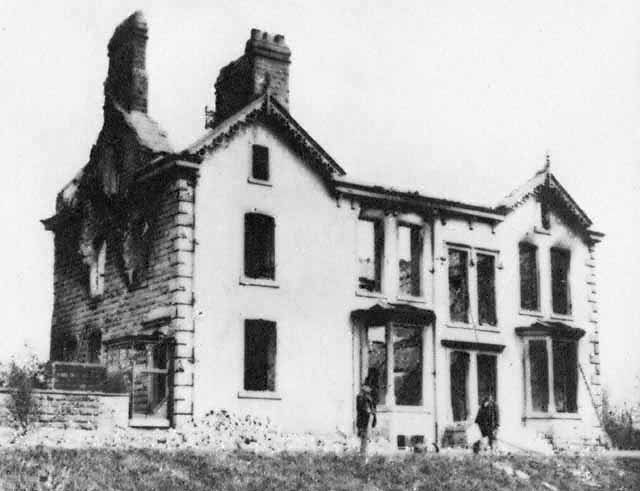
Still another event that stands out clearly among my recollections was the famous “Jackson Case,” which led to the judicial ruling, often quoted in our Courts, that a man cannot compel his wife to live with him against her will.  Mr Jackson, a handsome man of independent means, was well known to me by sight, and I often heard ladies refer to him as “such a perfect gentleman.”  He and Mrs. Jackson were living apart, and as she refused to return to him he kidnapped her as she was leaving a Clitheroe church one Sunday morning and carried her off to his residence near Duke’s Brow, Blackburn.  Then he barricaded the house, which at once became the centre of national attention.  Her relatives made several attempts to get Mrs. Jackson out, and at last the law intervened.
 
While the siege lasted there was at all times a crowd looking on, hopeful of thrills.  They didn’t see much, however.  Occasionally some interested party banged in vain at the front door, and from time to time food was hoisted in a basket to an upper window.  All kinds of absurd rumours went the rounds, and folk who were easily credulous whispered that the kidnapped lady was bound hand and foot to a chair and was at the point of death.  But Mr. Jackson was far too kind a man to ill-treat anyone and, in general, sympathy was with him.  Many people, especially schoolgirls, regarded his action as highly romantic and likened it to the gallant deeds of the knights of old.
 
 
SUNDAY OBSERVANCE
I was not in Blackburn when the Crown Hotel, Victoria-street, was blown into the air by an accumulation of gas in its cellars, but I do recall an explosion of another kind—that which followed the railway company’s announcement of cheap excursions to Blackpool and Southport on Sundays.  There was great indignation among those who opposed Sunday recreation and a mass meeting of protest was held in the Town Hall.  I never heard more impassioned oratory.  If I remember rightly the excursions were soon withdrawn.
 
Sunday observance was much more sternly practiced then than it is now.  There was no golf.  Respectable people did not drive out into the country, though they might walk as much as they pleased.  It was considered improper to buy a Sunday newspaper, or at least to carry one through the streets.  I have a vivid recollection of being stopped near home by an elderly gentleman who knew me and being severely reprimanded for having “encouraged the sale of a Sunday newspaper.”  The incriminating evidence was in my hand.  It was clear that my preceptor thought I was on the road to ruin.
 
People may have been better in the 1880’s than they are in the 1930’s but I very much doubt it.  There is more “freedom” on the seventh day than when I was a youth, but is the day less decently kept?  Anyhow, there is not nearly so much drunkenness on Sunday nights these days as in those, and the last time I was in Blackburn I did not see wagonette after wagonette, or the modern motor-coach after motor-coach, laden with roistering “bonafide travellers,” retiring home after a day’s debauch, as I did once upon a time.I was not in Blackburn when the Crown Hotel, Victoria-street, was blown into their by an accumulation of gas in its cellars, but I do recall an explosion of another kind—that which followed the railway company’s announcement of cheap excursions to Blackpool and Southport on Sundays.  There was great indignation among those who opposed Sunday recreation and a mass meeting of protest was held in the Town Hall.  I never heard more impassioned oratory.  If I remember rightly the excursions were soon withdrawn.
 
jb04028.jpg 

© BwD - terms and conditions


WILPSHIRE AND PLEASINGTON
I said at the beginning of these memories that it seemed to me much of the central part of the town had changed but little in the last forty years.  But great are the changes on the outskirts!  I noticed these particularly at Wilpshire, where I spent many happy boyhood days with young friends.  It had a separate entity then; now it is part—a very pleasant part, but still a part—of the town.  It has far more houses and all sorts of modern improvements.  But to me, at least, the charm and village quietness of the old Wilpshire are gone.
 
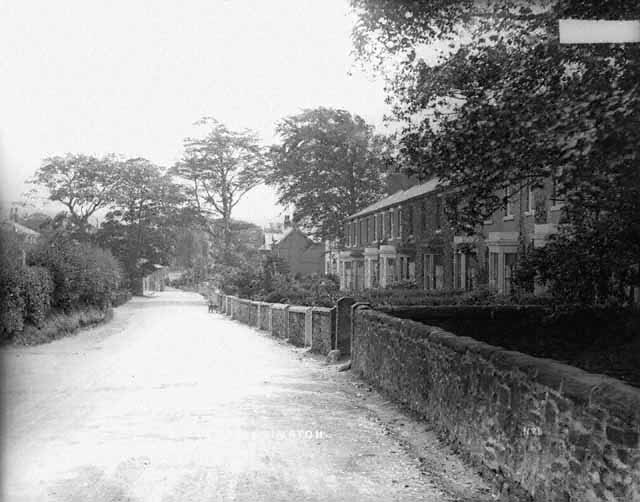
Meins-road was entirely rustic and very beautiful when I first knew it, and remained so for years afterwards.  It was delightful, on a summer’s day to turn into the cool shades of the leafy paradise and then to go on the north wall of Witton Park, with tree-covered Billinge Scar to the right, and so to the path that led over open fields to Pleasington.  To the best of my recollection, the only buildings one passed near to in walking from Preston New-road to Pleasington were a small farm and the Priory.
 
 
PRESTON NEW-ROAD AS IT IS AND WAS 
The Motorcar is responsible for much.  It has gone far towards destroying the beauty and charm of many of our country roads, including Preston New-road.  I hardly knew that fine highway when I saw it from a car, for the first time in many years.  Dozens of houses, garages with their coloured advertising signs, small structures for various purposes, and so on—a live road, undoubtedly, but much of what is new is garishly ugly.
 
It was serenely quiet and unspoiled when I used to walk its entire length for the sheer joy of doing so.  Beyond the Yew Tree Inn—alas the tree is gone—you were in remote parts, except on Sunday afternoons.  Very few pedestrians, very few vehicles, two or three mansions in spacious grounds.  The Windmill corner and Half-Way House were isolated.  For six or seven miles just a very quiet road, hedges, fields, trees, semi-solitude; practically nothing to remind you that two great towns were so near.  It was only when you had crossed the Halfpenny Bridge that you got in touch with evidences of things urban.
 
 
THE FRIENDS OF ONE’S YOUTH
There is a saying in America that if you intend going back to the old hometown don’t delay your return more than seven years.  If you wait longer you’ll find old friends scattered and, for you at least, the old atmosphere gone.  Well, it is now forty years since I, wearing a tailcoat and a silk hat, left Blackburn for London, travelling in a train without corridors, which at the time were unknown.  When I go back for a day or two I feel that I am a stranger on more or less familiar ground.  I wander about, like the ghost of my dead self, trying to capture a few fragments of the past.  If I am lucky—it has happened occasionally—someone will come up to me and say, “Why, it’s you, Charlie, isn’t it?  Yes of course it is”—and he’ll hold out his hand, mentioning his name.  An old school fellow but changed almost beyond recognition.  Then I eagerly ask him questions, about Tom and Jack and Billy, to be told of only too many that their race is run.
 
Still, there are the others who are going strong, the years sitting lightly upon them.  Whether by design or happy chance, it is great to meet them again, for then, like Iolaus, I am restored to youth, if but for a brief Hour.
 
 
jb09390.jpg 

© LET - terms and conditions


  IN  CONCLUSION
In writing these rambling recollections I have trusted entirely to memory, not having made the least attempt to verify anything.  So it may be that here and there I have fallen into an inaccuracy.  In general the pictures in my mind that I have endeavoured to transfer to paper are vividly clear, and such is the way of life, become clearer still as the years go by and the gulf between then and now ever widens     


Reminiscences from 1879​​


It will help in reading this article if you had an old map of Blackburn handy
 
From the Blackburn Times December 15th 1939.
 
BLACKBURN 60 YEARS AGO (1879)
REMINISCENT SURVEY OF THE TOWN
By Alderman W. Kenyon


jb24206.jpg 

© BwD - terms and conditions


Many articles have been written on “Old Blackburn,” giving different descriptions, according to the particular writer’s personal observations.  I have enjoyed reading them all.
 
I feel at the moment that my knowledge of things may produce another article from a different point of view.
 
For instance, starting at the Railway Station front.  It would be hard for people of the present day to imagine a timber yard, which began opposite High-street and the top portion near the station entrance.  The station had only two platforms.
 
The east side of Station-road from High-street to “Fish hillock” is much the same, with Springwell House and property behind.  It will interest the people of the present day to know that in the days referred to a “well” of beautiful spring water existed.  It is regrettable to relate that to-day it resembles more of a rubbish heap than anything else.
 
 
DANDY WALK SMITHY
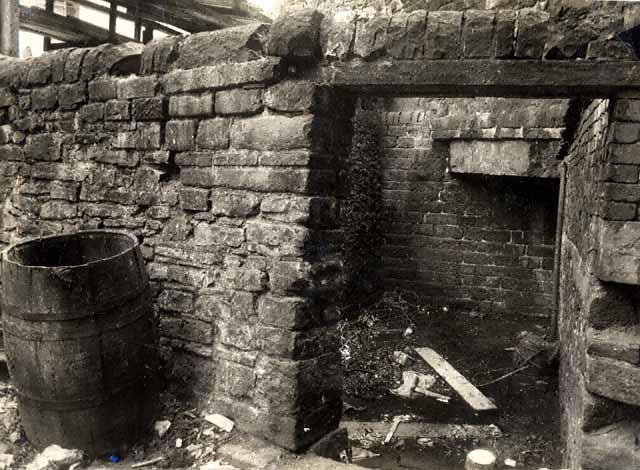
Bridge-street (now called the Boulevard) stretched from Station-road to Jubilee-street.  A wall about four feet high offered protection from the river.  The land on which now stands the Palace Cinema was vacant.  A footbridge was the means of entering Dandy Walk and passing the old blacksmith’s shop on the left one emerged into Darwen-street.  The blacksmith’s forge was famous for the haimes and chains, which was a flourishing business in the good old horse days.  The smithy was pulled down by the writer, after a photographic record had been made of it.
 
The width of the present Post Office was occupied by a low range of shops, in the middle of which was Poldings, Corn Millers.  The entrance was through an old fashioned porch, such as are to be seen at country farms.
 
From Dandy Walk to the “Old Bull corner” is very little different to the old days save for many alterations made to the hotel, the top storey of which was one of the large alterations.
 
The south side of Church-street is much the same, save for the interior alterations in many of the shops, and new shop windows.
 
Boots’ shop was occupied for many years by the late Sir Edwin Hamer as auction rooms.  Later by the Standard Press printing works.
 
On the North side of Church-street stands to-day Sagars, jewellers, one of the very few old Blackburn business families remaining.  Adjoining was a drapery and carpet warehouse, owned by the father of the late Alderman Nuttall.  In my mind's eye I can see the carpets hanging out of the windows, immediately opposite the church gate.  There was no Arcade then.
 
jb03618.jpg 

© BwD - terms and conditions


EVADING THE “BOBBIES”
Proceeding down Church-street to Salford Bridge the boys would go down and “wade” or climb hand over hand on the girders and some come out at the Boulevard end.  We had “watchers” at the Salford end to shout when the “Bobbies were coming.”  Many were the times we had to stay down a long time to tire the “Bobbies” out and then slink home to receive a drubbing from our parents.
At the corner of Woolworth’s building was a doctor’s house, the gable of which was covered from top to bottom with beautiful ivy.
Before the building of the present Rialto Cinema the whole of Penny-street was one long mean street, with Shakeshaft’s tallow works behind.  Proceeding up penny-street to the Cemetery, there has been no material change.
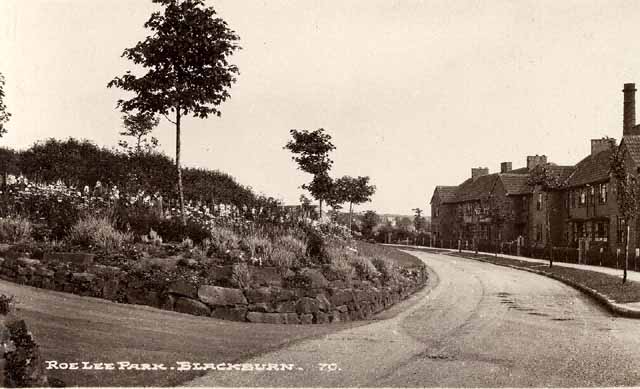
Form the Cemetery gates to Brownhill was one long sweep of land with not a single house on the east side.  To-day, with the exception of one small plot, there are hundreds of houses.  In addition, there is the very fine housing estate.  To the writer this site has added interest from the fact that together with ex-Alderman J. Fielding and another councillor (whose name I forget for the moment) we decided to buy the land.  Later we found that Messrs Duckworth and Eddlestone had already given land valued at £1,000.  The Engineer Mr. Gooseman approached Mr. John Duckworth and asked would he allow the gifted portion to be included with the Corporation’s.  He readily agreed.  That is the reason you find houses inside a park, surrounding the flower beds, suggested site for a bandstand, bowling greens, tennis courts, and lower down a children’s “wading” pool.  Of the many housing estates I have seen in England and the Continent there is not one approaching the idea of Brownhill.
 
jb23290.jpg 

© BwD - terms and conditions