
 Loading more
Page 2
A few weeks later, the Blackburn Mail reported “that the late regulations in our Market continue satisfactory to the frequenters of it, and it is also plentifully supplied at much lower prices than for some time past. Yet there is still a matter calling for redress, much complained of by many as being a great nuisance, which is the permitting the lime-carts immediately in the Market-place; and a correspondent recommends their removal to some more convenient part, the unloading and emptying them in the street proving very injurious, not only to the people who bring their wares to market, but likewise to the private house and shop keepers.”
The Trade in Cotton textile fabrics was a hundred years since, as it is today, the staple or principle trade of Blackburn. But it was carried on, both as a manufacture and a mercantile business, in 1793, under conditions different from those which we are at present time familiar as it is possible to imagine. Although the “Spinning Jenny” of James Hargreaves (a Blackburn man) had been invented and its practical utility proved more than twenty years, and there were many “Jennies” employed for spinning cotton yarn in the Blackburn district, the establishment of factories for cotton spinning had been tardy in this part of Lancashire. Most of the “Jennies” were in the hands of small traders, who set them up, by twos and threes, in such premises as could be secured, and driven by hand or by water power. The great traders of the town had not as yet, embarked in cotton spinning on a large scale. They are not described as cotton spinners, but as “Calico Manufacturers,” “Dealers,” “Chapmen,” or “Merchants.” Strictly, as the word “Manufacturer” is now understood, these old Blackburn calico merchants were not “manufacturers,” any more than they were “spinners.” The peasant weavers were the “manufacturers,” and so often designated then. The dealers were their employers, or masters, who supplied them with warps and wefts, and paid them wages for weaving yarn into cloth. The warehouses of these capitalist traders but partially answered to the mills or factories of their present day successors. In them was stored the cloth, after it came from the weavers and was thence carried in wagons, over the highroads to Manchester, for sale in domestic markets, or to Liverpool for export. The Sudells, the Feildens, the Liveseys, the Boltons, the Hindles, the Yates, the Whalleys, the Thorntons, the Boccocks, the Marklands, the Haworths, the Leylands, the Cardwells, the Birleys, the Chippendales, the Smalleys, the Glovers, the De la Prymes, the Hornbys, and the Mauds, were in the fifty years from say 1760 to 1810, the leading merchants of Blackburn who dealt in the “Blackburn Greys” the checks, and the plain cloths of mixed linen and cotton for bleaching. Collectively they employed some thousands of weavers, but they did not find them looms, or rooms to work in, only materials for the calicoes in the shape of cops of weft and sized twist warps. The warehouses were situate in or behind most of the half-score streets which I have named as constituting the business centre of the town. Some were in the courts at the back of Church-street, and those were amongst the oldest; others were in Fish-lane, Back-lane, Market-street Lane, Clayton-street, Heaton-street, Paradise-street, Duke-street, Lord-street, and Ainsworth-street. Many of these old warehouses remain but they have long since ceased to be filled with warps, weft-skips and piles of grey calicoes. They have been converted into small workshops for minor mechanical trades.
As for the working weavers on the hand-looms, their cottage dwellings were also their “shops,” and, a hundred years ago far more than the weavers employed by the Blackburn master traders in calicoes lived within the compact limits of the town. They were not under any necessity to dwell near the warehouses, visited no oftener than once a week. It was cheaper and healthier to live on the outskirts of Blackburn, or three or four miles of at Mellor, Ramsgreave, Clayton-le-Dale, Salesbury, Billington, Harwood, Knuzden and Stanhill, Belthorn, Lower Darwen, Livesey, or Tockholes. The hand-loom weavers of the period were a more unsophisticated race than the operatives, or mill-hands, who have displaced them, less accustomed to luxury in food or costly materials and showy style in dress; but they had infinitely more personal liberty and choice of working hours, and they could and did gratify their inbred love of field sport on other days than Saturday afternoons. In the town, the living and sleeping rooms of the cottage weavers were extremely small, and lacking in sanitary appliances, but the air around them was little contaminated by smoke, and flowers bloomed in almost every cottage window, and in the little garden plots at front or back of most of them. Their wages fluctuated so much with the ups and downs of the markets for the several kinds of cloths they wove, that whilst at times they lived like fighting cocks, utterly careless of the future, at other seasons, when trade was persistently bad, they were reduced to the lowest state of indigence and distress. One circumstance in which they differed from their decedents, the operatives of our day, was that they extensively wore the grey cotton, the checks, and the calico prints which they helped to produce—the grey calicoes for men’s shirts and female underclothing and for household use and bed-sheets; the checks for aprons as well as for shirts, and the prints for women’s dresses and girls’ frocks—thus contributing to keep going a manufacture which was still mainly one to supply clothing for the people of Great Britain.
I cannot finish in this article the sketch of Blackburn trades and industries a century back; but leave to the next notes of the earliest cotton spinning firms and of trade’s subsidiary to the cotton manufacture carried on at that time; also of iron foundries, the first public brewery in the town and banks existing in 1793.
*Groats are the hulled and crushed grain of oats, wheat, or certain other cereals.
THE EARLIEST COTTON SPINNERS; SPINNING AND CARDING FACTORIES AT WENSLEY FOLD, MILL HILL, EWOOD AND SPRING HILL; CONNECTED TRADES—SIZERS, BLEACHERS, DYERS, REEDMAKERS, &C THE OLDEST IRON FOUNDRY ; THE GRIMSHAW PARK BREWERY.
The account of the calico manufacturing trade of Blackburn as it was carried on in 1793, which I gave in last week's article, would not be complete without some reference to the two or three cotton spinning factories which had then been built and worked in the town and its vicinity. It would be understood that the old opulent firms of merchant traders in calicoes did not embark in cotton spinning with the new spinning machines invented by Hargreaves and Crompton under the factory system. They were content to pursue their business on the accustomed lines, purchasing the twist and weft they wanted where they could, and being satisfied so long as they could procure it in adequate quantities and good quality. Down to 1793 and for years after, the merchant princes of Blackburn, the Sudells the Hindles, the Feildens, the Cardwells the Birleys &c., none of them owned a spinning mill. Rather strangely it chanced that the first Blackburn man, who ventured his capital in cotton spinning on a considerable scale with the spinning frames newly invented, was not previously connected with the cotton manufacture as a trade, but was a professional gentle man, namely, Dr. Joseph Lancaster. “Physician,” son of Mr John Lancaster of Blackburn, “Apothecary.” I conjecture that Dr. Lancaster must have made the acquaintance of Mr Samuel Crompton, of Bolton, the inventor of the “Spinning Mule,” and have been introduced by his representations of the revolution the spinning machine must effect, to erect a factory, fit it with the novel machines, and start cotton spinning in a bold and enterprising way. The surmise has for its support the fact that Dr. Lancaster’s daughter, Sarah, afterwards married Mr. Samuel Crompton’s son, George Crompton. Dr. Lancaster’s mother, who was a daughter of Mr. Richard Wensley, had inherited from her father a freehold farm on the western border of Blackburn Township, and the hamlet which stood upon it, which was named “Wensley Fold,” after the owner’s family surname. The Blakewater Brook ran at the foot of the hill along the south limit of the freehold, and afforded a stream of water strong enough to turn a water-wheel, and this factory at Wensley Fold, like all the early cotton mills was to be driven by water power. It was not later than the year 1777 that Dr. Lancaster built the original factory on the right bank of the Blakewater at Wensley Fold. This was one of two or three spinning factories established in the district about the same date (Mr Robert Peel’s factory at Altham was another), the starting of which excited the animosity and dread of the hand-spinners, who saw their craft in danger, and resolved to put down the “Spinning Jennies” and water-frames.
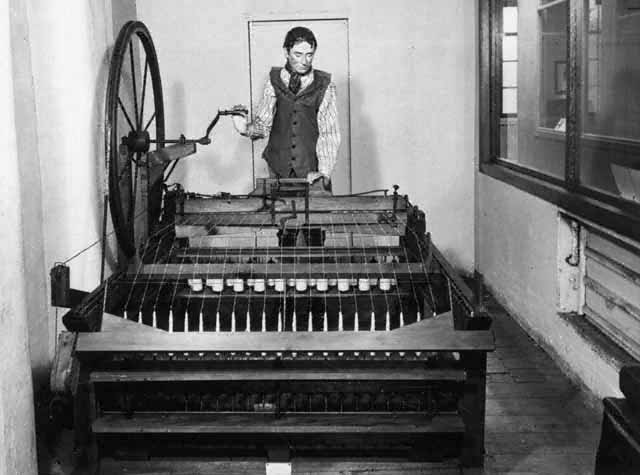
Replica of the final version of Hargreaves Spinning Jenny
© BwD - terms and conditions
In the year 1779 they gathered in a mob, and scoured the country for miles around Blackburn, destroying the spinning frames, and carding engines, and every machine driven by water or horse, whether found in private-houses, small workshops, of factories. Wensley Fold Factory was attacked, and its machinery broken to pieces. After this outbreak of popular resentment, Mr Peel and other users of the “Jennies” and carding engines, emigrated from the district. Dr. Joseph Lancaster stood his ground, and replaced the smashed machines. He carried on the business of cotton spinning about eighteen years and deserved to have made a fortune in it but he didn’t. The Wensley fold Factory was in busy operation in 1793 and a proportion of the cotton yarn used in weaving the Blackburn Calicoes and printing cloths was produced there. Dr. Lancaster was a young man of about thirty-two when he built the factory, and in 1793 he was forty-eight years old. Two years later, in 1795, cotton spinning became depressed and he was compelled to stop. His failure involved the sacrifice of Dr. Lancaster’s reversionary interest in the freehold lands at Wensley Fold, Miles Wife’s Hey, and Galligreaves. In June, 1795, his assignees offered for sale by auction at the Old Bull Inn, Blackburn, “the freehold and leasehold lands, buildings, &c., late the property of Mr Joseph Lancaster.” They were sold in eight lots, described as (1), a commodious dwelling-house, on the west side of Northgate, in Blackburn, with stables and other out buildings, in the possession of Mr Lancaster; (2), a freehold close of land on the west side of the Stone Delph in Wensley Fold estate; (3), the large freehold building five storeys high, at Wensley Fold, used as a factory, with water-wheel, pit wheel, &c. also the privilege of carrying water thereto (by a sluce) through the “great meadow”; four dwelling-houses at the east end of the factory, and five newly erected cottages, &c. (4), the reversionary interest of the assignee (Mr Lancaster) expectant on the death of Mrs Sarah Lancaster, widow, aged 74 years, in one half of the messuage and tenement in Wensley Fold consisting of farm house, barn, and 17 acres of land; (5), the reversionary interest of Mr Lancaster in one half of another messuage and Tenement called Miles Wife’s Hey, consisting of farm house, barn, and 10 acres of land; also (6), in a close of meadow ground called Galligreaves Meadow, 31/2 acres; (7), the beneficial interest of Mr Lancaster in three Rectory closes of meadow land lying near Bent Gap and Whalley Banks, 41/2 acres; and, (8), his beneficial interest in a messuage or dwelling- house on the west side of Northgate, and workshop, buildings, gardens, &c., in occupation of William France, brazier. The two latter lots were leasehold of the rectory.
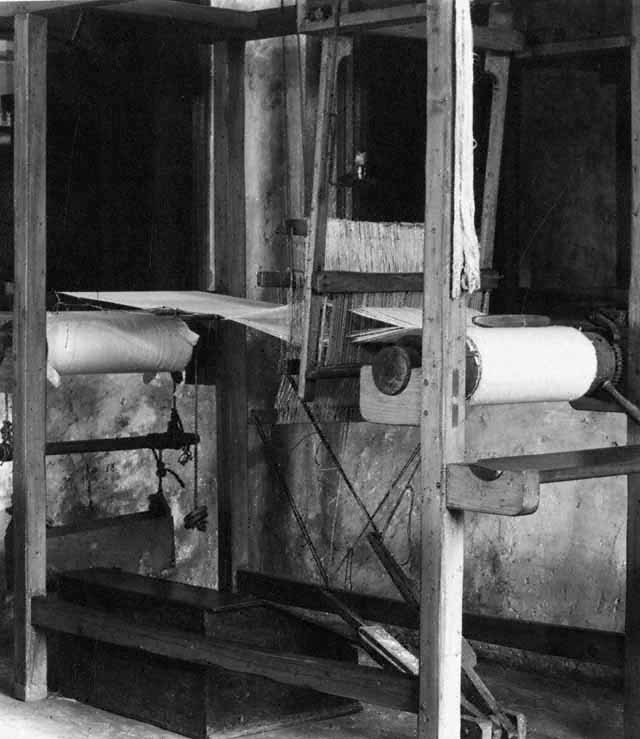
Plain Hand Loom from the Lewis Textile Collection
© BwD - terms and conditions
The winding-up of the estate of insolvent traders was a slow process a century ago, as it often is in these days; and I find that the affairs of Dr Lancaster, as a cotton spinner, which were placed in the hands of a commission of bankruptcy in 1795, were not finally disposed of until five years had passed. In July 1800, it was notified that the Commissioners in the bankruptcy of “Joseph Lancaster, Of Blackburn, Physician, Cotton Manufacturer, Dealer, and Chapman,” would meet in December of that year to make a final dividend, Beardsworth, Barlow, and Neville, solicitors. Meanwhile the Wensley Fold Mill had been worked from 1795 to 1797, by Thomas Green, John Watson and James Houlker in partnership, which was dissolved early in the latter year. Dr Joseph Lancaster after his failure continued to practice as a physician in Blackburn until his death. He married, and had a son, John Lancaster, born in 1793, who afterwards became a surgeon, dying unmarried, aged 33, in July 1828. There were also two daughters of the elder Dr Lancaster, namely, Alice, who died unmarried, aged 52, in November, 1832; and Sarah. The latter, eventual heiress to then estate of her grandmother, old Mrs. Sarah Lancaster (who died, aged 84 in 1798), married in 1821, Mr Crompton, and died in childbed of a daughter, christened Sarah Nancy Lancaster Crompton, who was well known to many readers of this paper as the wife of William Irving, Esq., M.D., and who died in January 1891.
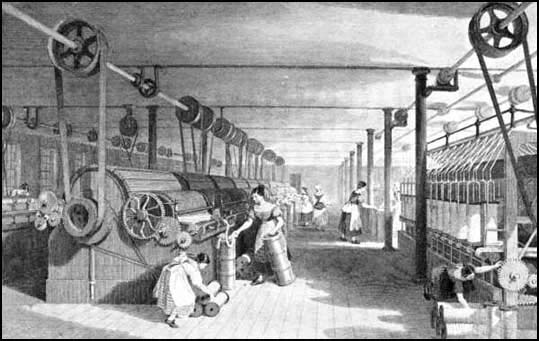
Carding Room
Another cotton spinning factory which had been founded some years before the end of the last century, but has hitherto been overlooked in the historical record of the factory system locally, was one built by the firm of Haworths (kinsmen of the Peels), who carried on for thirty years or more with fluctuating fortunes, as extensive calico printing business at their print-works situated on the bank of the River Darwen at Stakes and Mill Hill, where the Township of Livesey and the Township of Blackburn are bounded by the river. I have unpublished materials for a detailed history of that concern, which existed, with changes of ownership, some seventy years in all, until 1842 (the Turners had possessed the business during the latter half of the time). Here it will suffice to mention that the Haworths, perhaps between 1785 and 1790, added a factory for cotton spinning to their Print-Works at Mill Hill. In the latter end of 1799, the firm were in difficulties, and had to make an assignment for the benefit of their creditors. The three members of the firm at that date were Edmund, John and Jonathan Haworth. The Works were offered for sale by public auction on the 30th of January 1800. One of the properties sold as a separate lot is described as a “capital freehold mill, three storeys high, 33yards long, and 91/2 yards wide, situate near Mill Hill, for Carding, Roving, Drawing, Preparing, and Spinning Cotton Wool by water [i.e., driven by water-power], with two valuable Water-Wheels and gears, 26 Spinning Frames, containing 1,788 spindles, Carding Engines, Drawing Frames, &c., and about 5 acres of land near thereto.” The description is interesting, as showing the machinery of a spinning mill as it stood 93 years ago, and as it was fitted up at least 100 to 110 years since. A factory building, 99ft. long, by 26ft. 6in. wide, and three storeys high holding 26 spinning frames with a total of 1,788 spindles, and a number of carding engines and drawing frames, would be deemed a good-sized one when this Mill Hill cotton factory was erected. Some months previous to the sale of the above factory, in April, 1799, was advertised a sale at Mill Hill of a quantity of cotton yarns, and several Carding engines, “Roving Billies” (as the roving frames were named), &c.
At Ewood, in 1793, a building something like a small factory stood, in which the branches of carding and roving cotton were carried out by James Hitchen and James Barker, under the firm of Hitchen and Barker, described as Carders of Cotton Wool. The partnership was dissolved in 1794, and in August, of that year, was sold “on the premises, at Ewood, near Blackburn, two Carding Engines nearly new, the one double, the other single, one Roving Billy, containing 42 spindles, a Water Wheel, Pit Wheel, and shafts, with the gears belonging thereto.” Also, in November, 1793 a “new Roving Frame, by Boothman and Eccles, of Knowl Green, was on the market.”
© BwD - terms and conditions
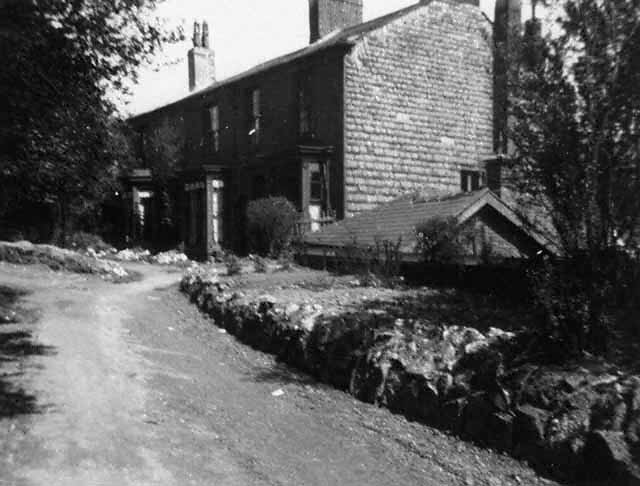
Spring Hill House. Formerly the residence of the Anderton family, who built the factory on Spring Hill overlooking the area now known as the Boulevard. Spring Hill cotton factory, erected in 1797, was the second cotton mill to be built in Blackburn, the first being at Wensley Fold. Robert Hopwood, who was manager here before founding one of the largest factories in the town, lived in the house next door. Hallows Spring is in the vicinity.
One other forgotten firm of early Cotton spinners in Blackburn is mentioned in the Blackburn Mail for August 14th 1793. It consisted of three members of one family, and carried on business under the style of “Matthias, Thomas, and Richard Corless, cotton spinners, Blackburn.” I cannot state whereabouts their premises were situate, but I think the building must have been of small dimensions, and probably was an adapted structure. The old factory on Factory-hill, a few yards away from the present Station-road, on the east side, remains as the last vestige of the beginnings of the factory system in the Blackburn cotton trade; for the old spinning factory at Wensley Fold was demolished years ago. Traces are few of the business operations of the builders of that old factory in the town, which, though within a stones throw of the Parish Church was the end of the town in that direction when it was reared. The date of the erection is not exactly fixed, but several years before the end of last century it certainly was going. Mr James Anderton was its builder, tradition says. He and his brothers, who were associated with him in the venture, were not natives of Blackburn, but came, I think from towards Preston; and Mr Samuel Horrocks, of Preston, brother of John Horrocks, the great developer of cotton spinning in Preston, was a partner with the Andertons in the business at Blackburn in 1797. If the local story that the first Robert Hopwood, founder of the Nova Scotia Mills, came to Blackburn from Clitheroe to assist in fitting up the machinery in the Factory Hill Mill, he must have been a very young man on his coming, for he was born in 1773, and the family tradition of the Hopwoods was that he did not settle in Blackburn until about a year 1810. The Andertons, after a few years, gave up cotton spinning, and the factory was transferred to Mr Richard Haworth, who afterwards lived at Factory Hill. Formerly he had been in business as a draper in Northgate. Mr James Anderton, then described as “gentleman,” was living at “Spring Hill,” the older name for Factory Hill in 1824, and at that date, of half-a-dozen firms of cotton spinners and manufacturers in the town, “Richard Haworth, Spring Hill Mill,” was one.
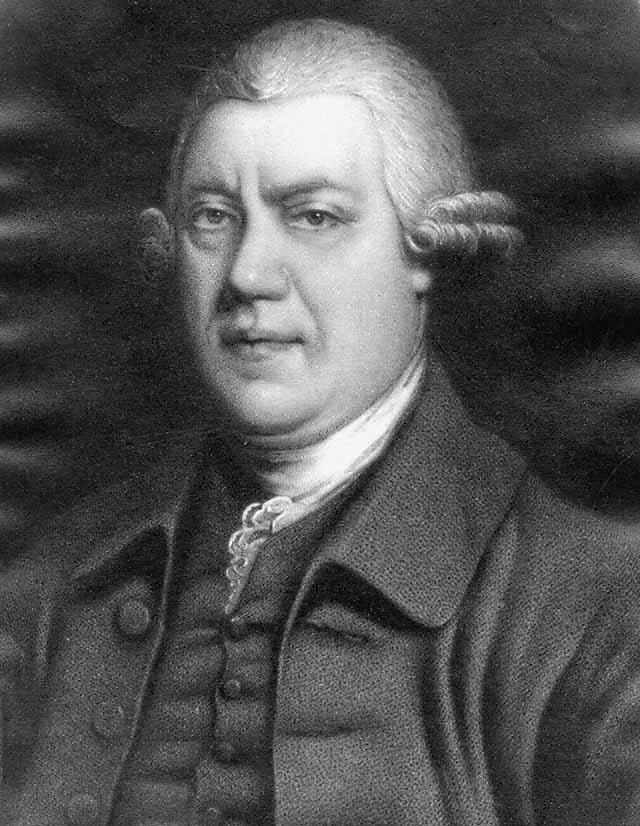
Sir Richard Arkwright, 1732-1792 inventor of the Water Frame
© BwD - terms and conditions
The trades connected with cotton manufacture as it was prosecuted in 1793 included sizing, warping, calico-printing, dyeing, reed making, iron and brass founding, carriers, &c. The sizer’s was a separate and important branch, and there might be half a score of size-houses in or near the town. Mr Henry Sudell had his own size-house, near his warehouse in Ainsworth-street. Other sizers towards the end of last century were Messrs. Birley and Hornby, Brookhouse; Mr Joseph Ainsworth, Old Chapel-street; John Grime, Salford; George Baron; James Towers; and the firm of Astley, Berry, Holloway, and Hopwood. The bleachers were, Mr Thomas Bolton, at Derrikins, succeeded by Mr James Bealey, who was in business there in 1793, upon the site of the largest spinning-mill of Messrs Hornby and Co., still known, I believe, as the Derrikins Mill; the Messrs. Haworth, at Mill Hill, as well as being calico printers and cotton spinners; Mr Richard Bentley, at Whitebirk; Mr John Holme, at Cob Wall; and Mr Hugh Suart at Knuzden. Of several dyers (in 1793) I can name Abraham Bury and James Walkden. The principal reed makers were, Mr Walmsley; William Watson; Mr Procter Ratcliffe; and Messrs. Richard and Thomas Sharples. The leading public carriers of manufactured goods between Blackburn and Manchester, in 1793, were Mr Joseph Wilcock, Mr George Haworth, and Mr John Hargreaves. Powerful teams of horses were needed to carry the goods in capacious wagons by the road over Oswaldtwistle and Haslingdon Moors to bury, then the only highway from this town to Manchester. Mr Henry Astley was the carrier between Blackburn and Preston.
There was a firm of Iron Founders established in Blackburn sometime before 1793. Its members were Mr Richard Crossland and Dr. Joseph Lancaster (the latter was the same gentleman who was a cotton spinner at Wensley Fold). Their foundry was known as the “Blackburn Foundry,” importing that it was the only foundry the town then possessed. Mr Crossland was the partner who had practical knowledge of the business. The partnership endured a few years, and was dissolved in May 1799. Mr Crossland continued the foundry by himself and published this notification:—“Iron Foundry, Blackburn. Richard Crossland, senior, respectfully begs to inform the public that the Iron Foundry business will be carried on at the same place as usual, and hopes, by having a through knowledge of the same, he will be enabled to give entire satisfaction to those who employ him.” Before long he failed, however, and I am sorry to have to add that this pioneer of the iron-founding trade in Blackburn became in his last years so impoverished that he died in Blackburn Workhouse in 1820. If I am not wrong in my conclusion the foundry he started was no other than the old foundry in Nab-lane, later carried on for many years by Mr Robert Railton. In September, 1800 Messrs. George Barnett and son took that foundry, described as “the old-established Iron Foundry, Nab Lane near Blakey Moor,” and announced to the public of Blackburn that they would carry on the business in all its branches and that “all sorts of cast iron work, wrought iron, brass work,” &c., would be executed, as well as all parts of “steam engine work,” so that steam engines were being made in this town 93 years since, if not earlier. Messrs. Barnett likewise recommended “their casting of various kinds of brass utensils used in cotton manufactories.”
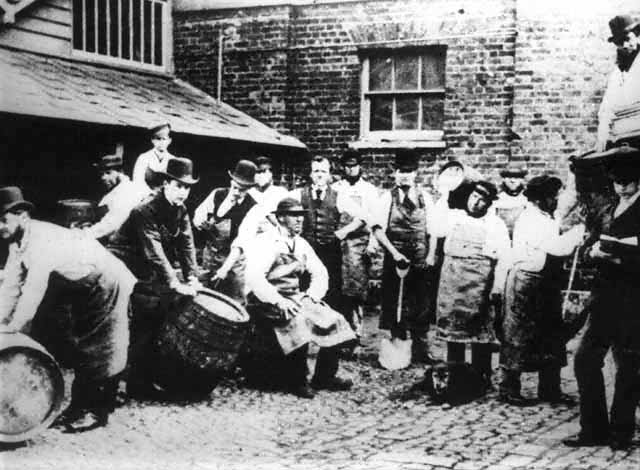
An old picture of Coopers and Brewery Workers (believed to be Dutton's Brewery)
© LET - terms and conditions
I must refer to a manufacturing business which has since attained vast magnitude in Blackburn that had its genesis in the town just a hundred years back. I mean the production of malt liquor, ale or beer, in a public brewery. The firs brewery was building in 1793, and was completed and got to work, making ale for the townsfolk by wholesale, early 1794. And it was hailed by all classes in the town as a splendid acquisition. The theory was not yet propounded in Blackburn that ale was anything but a wholesome beverage, if properly brewed, with good malt and hops, and I fancy the reason why the New Blackburn Brewery was welcomed was that the innkeepers of the town who brewed their own ale had not given satisfaction in that article to their customers. The brewery was erected on the south-east side of town, at Grimshaw Park. It is noticed by Dr. Aikin as “a capital brewery a little to the south of the town.” The Blackburn New Brewery was opened with circumstance on February 3rd 1794, and in its issue of the Wednesday following the Blackburn Mail wrote on it in the following gratulatory strain—“Monday last the new public Brewery, lately erected at a very great expense near this town, began to work, and the proprietors expect in a reasonable time to be able to convince the inhabitants of the great utility of this concern. Their intended plan of brewing ale of different qualities, to suit every degree of purchasers, must render an essential service to the middling and lower classes of the people; more especially as, from the great conveniences and extensiveness of the Brewery, which is inferior to none in this country, and the capital supply of pure water, with the most judicious brewers and workmen, along with a large supply of every material used in the making of ale being laid in from the best markets, they must be able to sell on very reasonable terms,” &c. The original partners in the brewery were five, of whom all but the first were well-known Townsmen engaged in other avocations. They were, John Nicholls, Peter Ellingthorp, Richard Meanly, William Hewitt, and William Stackhouse. In July 1794, John Nicholls left the concern, and the other four partners kept it going. At the end of about 15 years the Grimshaw Park Brewery began to be supplanted by the Jubilee Brewery, founded 1809, which had no long turn of prosperity, and by the Eanam Brewery of the elder Mr Thwaites, and the Salford brewery of the elder Mr Dutton, both which flourish to this day.
Blackburn in 1793 By W A Abram Article 4
© BwD - terms and conditions
PLACES OF WORSHIP; BANKS; FRIENDLY SOCIETIES; OCCURRENCES IN 1793.
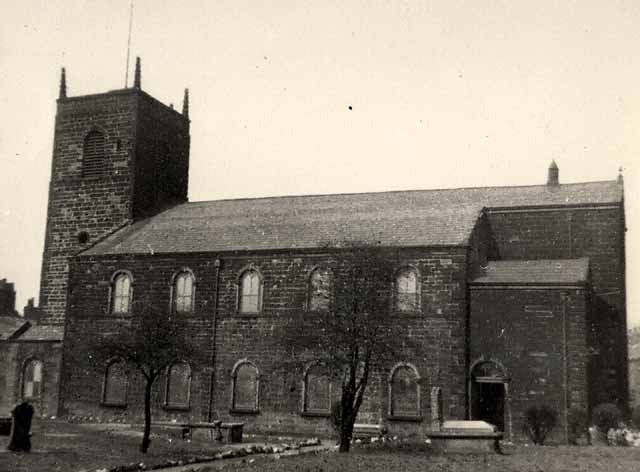
It is needless in this sketch of the town as it was a century back to more than mention the places of worship then existing. Their foundation and annals have been amply recorded, by my self and others, on the occasion of the celebration of their centenaries, and in the History of Blackburn. In 1793 there were two Churches of the Establishment, the Parish Church and St. John’s; one church (St. Paul’s) built by Churchmen, but at first placed under the Countess of Huntingdon’s Connexion; one Baptist, one Independent, one Methodist, and one Roman Catholic chapel. All these congregations are still maintained but only three of the church and chapel fabrics standing in 1793 are left; namely, St. John’s Church, St. Paul’s Church, and the Baptist Chapel at Islington. The Baptist Chapel is the oldest, and is externally unaltered. It is very small and plain—the type of the humble Dissenting meeting house of former times. The Old Parish Church has been re-built; and the independents, Methodists, and Roman Catholics have replaced their original sanctuaries by more spacious and stately fabrics, in Chapel-street, Clayton-street, and St. Alban’s, respectively. The two first-named occupy the same sites as the old chapels; but the first Roman Catholic Chapel, a plain brick building, in a yard between Chapel-street and King-street, is a good mile away from St. Alban’s Church, which is its successor.
© BwD - terms and conditions
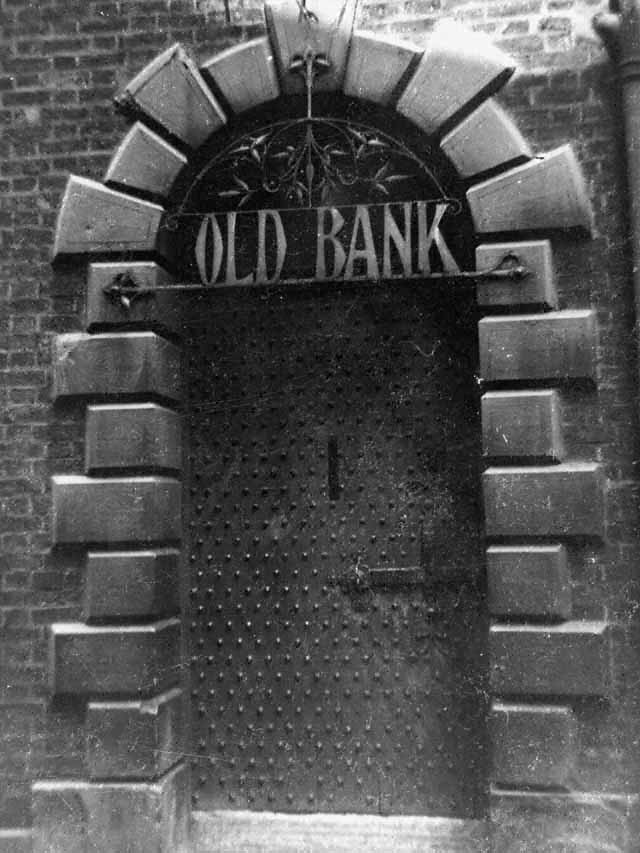
Messrs. Cunliffe and Brooks’ Old Bank was founded in 1792, and was in its infancy in 1793. It ranks amongst the two or three oldest businesses in the town, which have endured through the changes of a century. The short, narrow street between King-street and Clayton-street was named Bank-street from the old bank premises in it, which are still there, but the Bank has been removed to the massive and costly building at the junction of Church-street and Darwen-street.
There had been for some years an older Bank in the town, which came to misfortune soon after Mr. Roger Cunliffe and Mr. Samuel brooks opened their Bank. In September, 1793, proceedings were notified of the winding-up of the affairs of the Messrs. John Bailey, Richard Smalley, and William Smalley, of Blackburn, Bankers, who were bankrupt. This firm were also Calico Manufacturers in Blackburn and Manchester, and Warehousemen and Chapmen in Lothbury, London.
Blackburn contained in 1793 no fewer that twenty Friendly Societies, which numbered collectively more than 3,000 members (equal to one-third of the entire population of about 9,000). These Societies, or Clubs, held their meetings in the inns of the town, each having its own house. The members included tradesmen, clerks, mechanics, and working spinners and weavers. The houses and numbers in the clubs were as follows:—King’s Arms Club (100 members); White Horse (99); George and Dragon (120); Lower Sun (90); Higher Sun (94); Bull’s Head (114); Queen’s Head (88); Old Bull (79); Golden Lion (72); Shoulder of Mutton (66); General Wolfe (76); Blackburn Greyhound (32); Wheat Sheaf (98); Anchor (93) ; Weavers’ Arms (160); Swan with two Necks (126); White Bull, Salford (136); Dun Horse (94); Bay Horse (Robert Pickup’s) (84); Bay Horse (Cumpstey’s) (49).
The subjoined items relating to occurrences in the town in 1793 are culled from the numbers of the Blackburn Mail, from the date of the issue of its first number, at the end of May in that year.
1793, May 29. “On Tuesday last, as Thos. Mitchell, a workman in the service of Messrs. Haworth and Smith’s of Mill hill near this town, was attending a water-wheel, his foot slipping, he was unfortunately crushed to death.”
There are now living near this town five persons, brothers and sisters, whose age’s together amount to upwards of 402 years.”
June 5. “Yesterday being his Majesty’s birthday, when he entered the 56th year of his age, it was observed here with ringing of bells and other demonstrations of Joy.”
Potatoes, on our last market day, were sold at the enormous price of 17s. 6d. per load (4 bushels).”
© BwD - terms and conditions
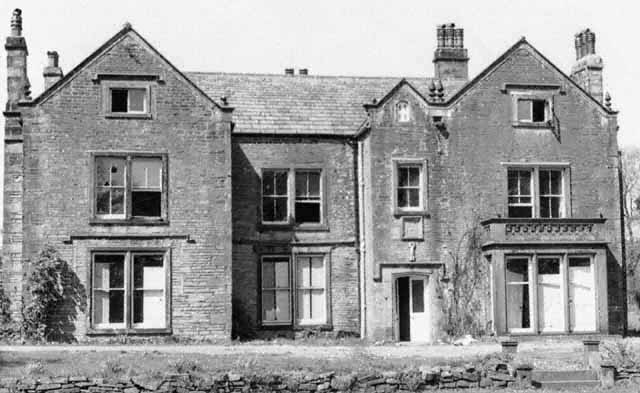
“One night this spring, during the prevalence of the high winds, the centre parts of the walls of the long gallery at Hoghton Tower were blown down.”
June 12. “On Sunday last was plucked, in the garden of Mr. Christopher Eccles, Spring Gardens, in this town, a radish which measured thirty-one inches in length.”
July 17. “It behoves the inhabitants of this town to be very watchful with respect to their property, and careful in securing their doors and windows at night, as there are many in this place at present who have made frequent attempts to break into dwelling-houses here, and several warehouses have also been broken into.”
July 24. “Last Wednesday, Captain Daniel Hoghton, son of Sir Harry Hoghton, M.P., Thomas Parker, Esq., High Sheriff, and other gentlemen, arrived in Blackburn. The bells were rung most of the day; ale was distributed amongst the populace, and a procession, consisting of the principal inhabitants of the town, paraded the street with cockades in their hats, preceded by Captain Hoghton, and attended by an immense concourse of spectators, when several young men enlisted into an independent company which he now raising.”
September 4. The Blackburn Mail announces that so much liberal support has been given to the paper since its commencement (three months previously) that “our impression at the present amounts to nearly One Thousand, which are immediately distributed through this and the neighbouring counties by special messengers, post &c.” The price was 3 1/2. Per copy.
September 11. “On Saturday afternoon, a sheep, given by a gentleman of this town was roasted whole, before a large fire kindled for the purpose in the Market Place, as a present to Captain Hoghton’s company of recruits. A great quantity of ale was distributed to them and the populace.”
October 16. “At our Fair, which commenced on Wednesday last, there was a tolerable show of both fat and lean cattle, the former of which sold very high, but the lean went off rather slowly. There was much woollen cloth, which was generally sold very low.”
“We expect to be able to give an account about this time next year of the spire [tower and cupola] of our commodious and beautiful church of St. John, in Blackburn.”
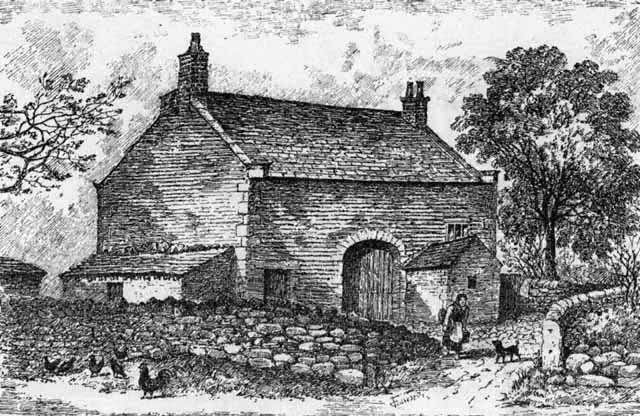
The Blackburn Mail of November 6th relates that a highway robbery of Elijah Harwood, a Blackburn man had taken place near Mellor; that the dye house of Messrs. Peel, Yates, and Co., in Oswaldtwistle, had been broken into; That the house of a farmer at Stakes, near Blackburn, had been entered by robbers, in the absence of the occupants, and £20 in money taken; and that the shop of Mr. Aspinall, of Great Harwood, had been robbed of several cheeses, and a quantity of sugar, and other groceries. None of the thieves had been secured.
© BwD - terms and conditions
November 20. The Rev. J. Fletcher, of Blackburn, was returning home from Haslingdon, on November 12th, about eight o’clock at night, when “he was attacked, a little on this side of the three-mile stone, by a man on horseback, who attempted to seize his bridle, but was prevented by means of a good stick. Seeing his intent frustrated, he gave a signal, when instantly two men sprang up opposite sided of the road, but being too late to stop Mr. Fletcher, discharged each a pistol after him, happily with no other effect than accelerating the speed of his horse.”
December 11. About the same spot at which the Blackburn clergyman had been waylaid and attacked by footpads as above related, near the third mile-stone from Haslingdon on the road to Blackburn, Thomas Clayton carrier, was similarly attacked on the night of December 5th. One of the footpads seized his horse’s bridle, and another struck him violently on the head but he returned the blow with such effect as to disengage himself and rode of to safety.
December. In the last weeks of 1793, a public subscription was started in Blackburn and other English towns, to send additional winter clothing to the British troops serving against the French in Flanders. In Blackburn a great many of the townspeople contributed and a very handsome fund was raised in the town. Amongst the gifts of the labouring class, it was reported in the Blackburn Mail on Christmas Day (December 25th), that “the workmen at Messrs. Haworth’s and Smith’s calico-printing works at Mill Hill, near this town, have subscribed this week the sum of £3 11s 6d, towards the local fund for providing warm clothing to the soldiers in Flanders.
“On Friday evening, December 27, Mr. Winder had his Ball at our New Assembly Room.” A Better Ball has not been seen here since the days of that once famous master, the late Mr. Bradley.”
A few months onward in 1794 the Blackburn Mail gives the following account of the water supply and Fire-Engine service of the town, which, of course, is as applicable to 1793 as to the year after. First, as to the principal towns well, the Hallows Spring, below Spring Hill, situated just where High-street now crosses the hollow and joins Station Road.; — “There are many little matters of improvement wanting in different parts of the town, which must strike the eye of the discerning. One is, the raising of a suitable arch or covering to the Common [i.e., public] spring, the fountain which supplies the principal part of the town with wholesome water. In its present condition it not only lies exposed to the heating sun and adulterating rains, by both of which the water is rendered less congenial to the taste, and unwholesome, but like wise to the drifting sand and rubbish, which lie over it, in stormy weather. It is needless to point out the small expense such improvement would be attended with. The improvement of Blackfriars-bridge [query—was Salford Bridge then called Blackfriars-bridge?] was a long time shamefully neglected, yet when taken in hand was soon completed, at an expense scarcely observable.”
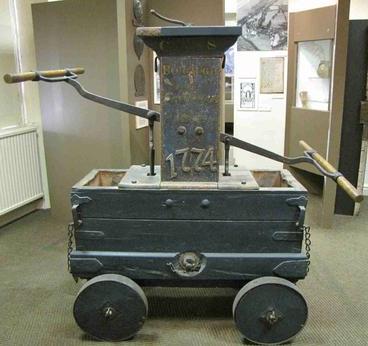
About the means for extinguishing fires, the Blackburn Mail wrote:—“We are happy to observe that the Fire Engines belonging to the town are duly attended to., being regularly brought out on the first Monday in every second month, when if the least repair is wanted, it is immediately made. The men employed in the exercise of these most useful machines, to the number of 17, properly accounted in their fire caps, &c., have heretofore evinced their expertness, insomuch that , should a fire break out, the inhabitants at present seem to be well protected from any great injury. Such consideration should attract the attention of every person who has property to lose, and as expenses must be incurred, it is no more than common justice to themselves for every inhabitant to join in promoting a subscription for defraying such expense.”