
 Loading more
Page 2
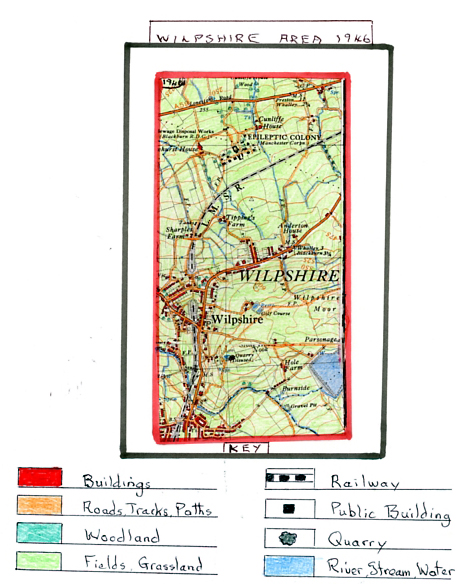
1946 Ordnance Survey Map of the Wilpshire area
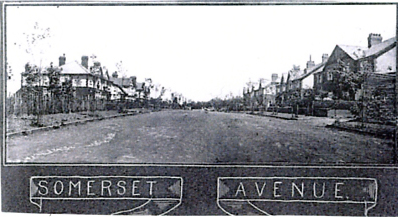
1920's/1930's view along Somerset Avenue, Wilpshire
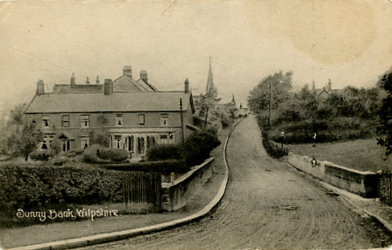
Photo of Ribchester Road crossing the railway from Whalley
New Road with Sunny Bank to the left and rising up to Wilpshire
Methodist Church and Somerset Avenue.
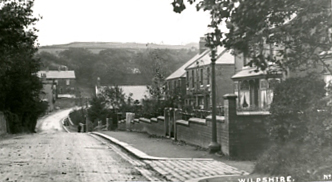
View looking back over the same area from Wilpshire Methodist Church with new housing on the
right – large semi-detached houses.
Area 2. – The Sunnyside Avenue Development with a smaller parallel development beyond.
Area 3. – Development along Parsonage Road from its junction with Whalley New Road with avenues off both sides of the road.
By 1946, motorised transport was well developed and, along with the earlier development of tram links to the Wilpshire area, provided easy access to the area from nearby towns and villages and explained the siting of increased housing close to the main road/ tram links. All new housing areas significantly had their own road/street access and all new housing had plots large enough to include garden fronts and backs which was a great pull factor for the growing middle-class population, most of whom, by 1946, now owned a car. Initially, however, it was the extension of the tram network to Wilpshire that provided local people and inhabitants of Blackburn with an easy access to Wilpshire. The Wilpshire Tram Route opened in February 1902 when the existing route to Blackburn Cemetery on Whalley New Road was extended to Wilpshire at a cost of £15,000 and electrified. Up to this period trams had been pulled by steam engines. Wilpshire's link to the existing tram network from Blackburn Centre led directly to the growth of suburbs in Brownhill and increased housing in Wilpshire beyond and the opening of the new Bulls Head Hotel in 1902. Housing then grew further as motorised bus and car transport took over in the 1920's/1930's. In the earlier tram days many Wilpshire residents used the tram then walked from the terminus the remainder of their journey to their homes. In the 1920's there was a proposal to extend the tramway to Whalley but it failed to be taken up. At this time the Wilpshire tram-line terminated on the Blackburn side of the Borough boundary with the Ribble Valley. The trams themselves were cheap, clean, frequent, energy efficient and could carry large numbers of passengers. From its inception the Wilpshire service was promoted as the “Country Route" and was well used at weekends and holidays as a means to escape the industrial urban areas of Blackburn to enjoy the fresh air of what was then the open country of Wilpshire and beyond. As a result, packed trams carried people who wanted to walk in fields, lanes and local footpaths through Wilpshire and Salesbury. As Wilpshire Bottoms / Parsonage Road and Hollowhead Lane were close to the terminus they became well used access points to the local open spaces especially Wilpshire Bottoms as this led to the popular destinations of Copster Green, Sale Wheel/Dinkley and Ribchester / the De- Tabley Arms. In response, local people provided facilities to meet the passenger's needs with a small wooded kiosk constructed next to the tram terminus to sell drinks, sweets and cigarettes. A tea garden was opened at a cottage opposite Parsonage Reservoir and residents in Copster Green sold jugs of tea from their front doors. The Wilpshire route grew in importance and, in 1926, a substantial waiting room was constructed at the terminus beyond the Bulls Head hotel at the top of Knowsley Road/ Wilpshire Bottoms which also housed a parcels office and public toilets. Over many years the tramway provided an efficient local parcel service to residents and shopkeepers in the area who could send packages to Blackburn at rates lower than the postal service. Up to the 1920's the trams stopped in the middle of the road at the terminus but increased motor transport caused a spur to be built into a lay-bye. During the 1930's and 1940's the use of the tramway decreased and investment in the system was limited. During World War 2, it did get a reprieve and provided an excellent local service when oil and petrol were severely limited but the system officially closed on December 21 1947 and overhead wires and lamp standards were removed and eventually the tram tracks were covered in tarmac. A new Corporation bus turnaround was constructed at the old lay- bye with the waiting room and toilets remaining in use until the late 1960's/early 1970's.
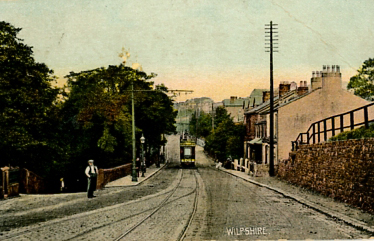
Early 1900's photograph showing the original Wilpshire Tram Terminus in the middle of the road
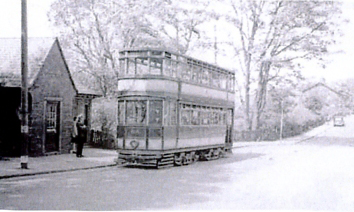 View of the new tram terminus on a spur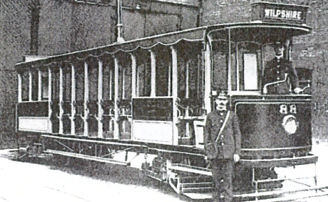
Toastrack tram built specially for the “Country Route" to Wilpshire
The map above, as earlier ones, show major changes to the landscape over the last 48 years with housing areas once again growing significantly. The three new major housing development areas are -1. Between Whalley New Road and Ribchester Road 2. Beyond the Orphanage 3. Parsonage Road area. Each of these development areas are sited off the original linear developments along Whalley New Road and consist mostly of semi-detached and detached properties mostly made of brick with many built in the 1920's/1930's but with continued building to post 2nd World War times. These more modern properties met the increased demand for housing outside the more industrial Blackburn central areas in more rural locations as transport facilities improved dramatically making commuting more viable. A good example of housing in area 1 is the Somerset Avenue development whose name came from the principal landowner of the area namely the Duke of Somerset and, in 1939, some ladies ran a private school called Moorland School on the avenue.
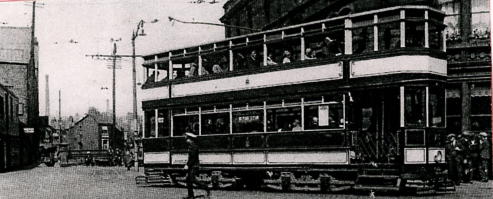
A fully enclosed double-decker tram leaving for Wilpshire from the town terminus outside
the Bay Horse Hotel, with Water Street in the background.
In 1905, Blackburn Orphanage in Wilpshire developed further when a separate building for girls was officially opened, Thursday 29th July, 1905. The new building was close to the existing home fronting on Whalley New Road and was built of similar stone at an estimated cost of £6600, providing accommodation for 50 girls. Its basement floor housed a washhouse, laundry, bathroom, recreation room and cloak/boot room. On the ground floor was a dining-room, sewing/day room, kitchens, matron's sitting room and parlour and a visitor's room. The upper floor contained dormitories, matrons and other bedrooms, bathroom and school-room. At the opening ceremony, Mr. Dixon stated that the new building would complete the Orphanage Building Scheme and he noted that since the Orphanage first opened in 1891, 217 orphan/destitute children had been admitted to the home with 114 boys and girls being helped outside the Orphanage, making a total pf 331 who had benefitted from the institution. The original building had held both boys and girls but was overflowing so that now boys could use the original building and the girls, the new, providing a total accommodation for 120 orphans who were cared for in a safe and secure environment till they reached 16 years old. Mr. Dixon went on to say they had received £2300 towards the cost of the new building via donations leaving a debt of £4300 but further donations had reduced this sum. The Mayor of Blackburn presided at the opening ceremony and Miss Baynes, daughter of Fred Baynes, performed the opening.
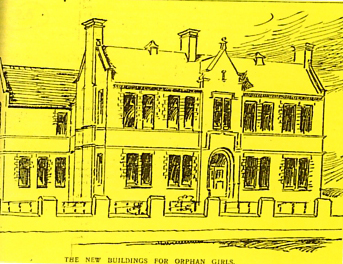
Sketch of the new building for orphan girls
During the 1st World War, 116 past orphans fought for their country and 10 died, whilst during World War 11, 7 died. As orphan children grew-up and left the orphanage many of them felt indebted and would help the orphanage funds with donations alongside generous legacies from other charitable well- wishers who were proud of the work done for disadvantaged children.
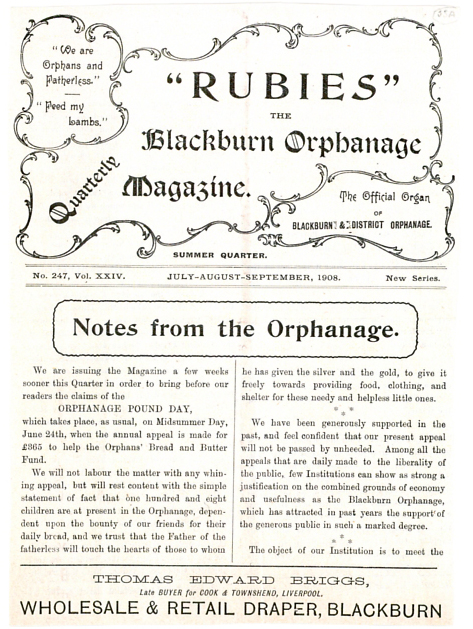
Front from Blackburn Orphanage Magazine for their patrons
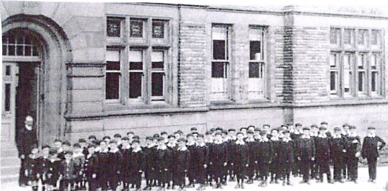 View of orphan boys lined up outside the Orphanage in the 1920's
 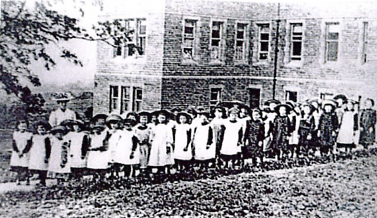 View of the orphan girls lined up outside the Orphanage in 1928 before going for a walk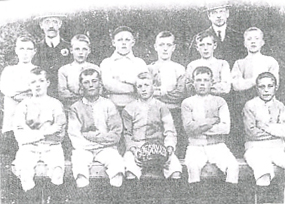
Blackburn Orphanage boy's football team in the 1920's who went on to sponsor the Orphanage Cup football competition
which became very popular with Blackburn football teams to this day
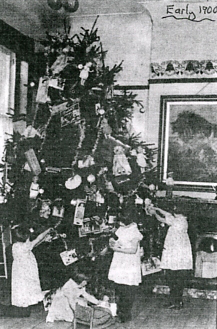 Orphan girls hard at work dressing the Christmas-Tree Early 1900's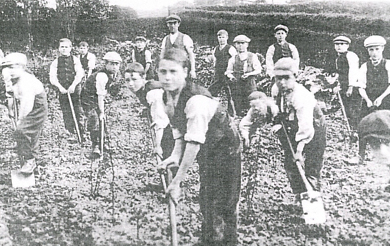
Boys at Blackburn Orphanage work in the Orphanage garden before World War II.
During the early 1900's Wilpshire Methodist Church was built on Ribchester Road by its junction with Knowsley road adding to the existing church in Salesbury. At the same era Brownhill United Reform Church was opened just outside the Wilpshire boundary. These were to cater for the increased religious needs of the rising population in the area.
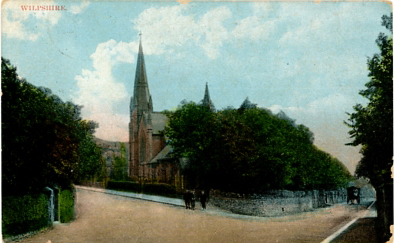
Wilpshire Methodist Church at the junction of Ribchester and Knowsley Roads
The Barrett's Directory for Wilpshire in 1939 is illuminating because in those days few people had telephone directories but could pay a small fee to have their name and address placed in a directory covering their local area. As a result, many Wilpshire residents subscribed to Barrett's Directory at a time when Wilpshire was in the Darwen Parliamentary Constituency with the parish having a rateable value of just over £14,000 and included the precept for Blackburn Rural District Council. At this time, the Post and Telegraph Office was at J. Stotts on Ribchester Road, with a grocers shop at 5, Sunnybank and the Police Station was run by Sergeant Robert Cowin. J & W Holgate had a depot at Wilpshire Railway yard from which it supplied coal and coke for domestic and mill use and lime for local farms to help neutralise their acidic soils at a time when 16 farmers were in business in the area with 5 engaged in poultry farming to supply the growing population. During this period Tom Street was the Orphanage superintendant, Thomas Bishop the steward at Wilpshire Golf Club, John Mullen the Stationmaster and Miss M Grey and Miss R. Goodman were the matrons at Grove Nursing Home, Beech Bank, Knowsley Road. In the 1940's there was a boarding Day school for girls with a propriety class for boys at St. Margaret's, a large house in Wilpshire (see below).
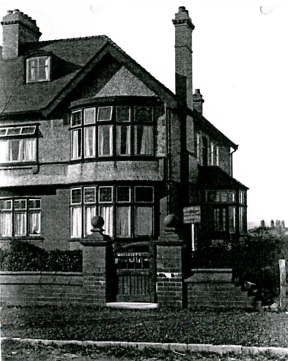
St. Margaret's Day Boarding School for Girls at Wilpshire
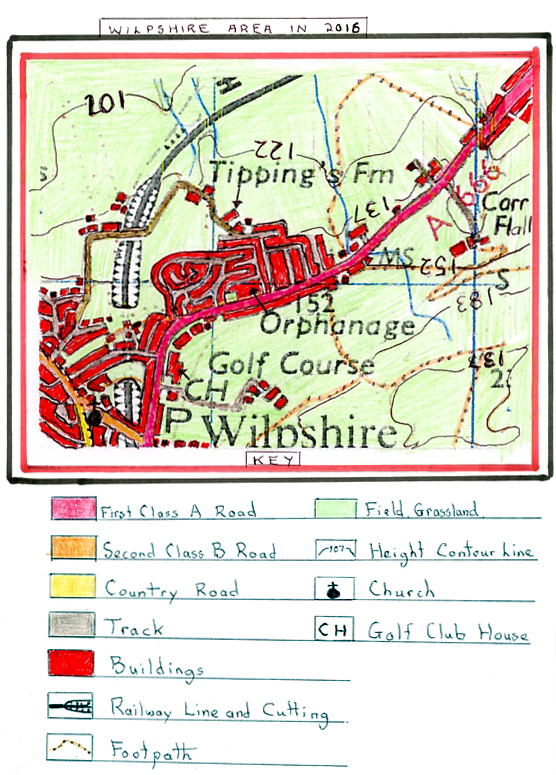
2015 Map of the Wilpshire area
During the last 50 years the Wilpshire Area has changed its landscape again especially with additional modern housing developments. The area around the Orphanage has now been completely infilled with a mixture of housing styles from the 1950's to the 1990's with bungalows favoured by retirees making an appearance. Another large area of housing developed off Hollyhead Lane and Parsonage Road, mostly semi-detached, but more lately, modern detached.
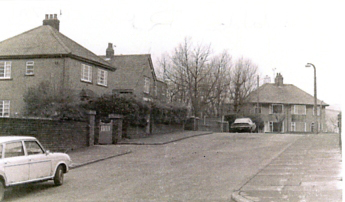
Post war semi-detached and detached housing on Waldon Road off Parsonage Road
This process continues today with a new estate being added to one end of Belvedere Road opposite the Warrenside estate with others in the pipeline as planning permission for housing developments has been relaxed in Green Belts to meet the need for more housing. Between Knowsley Road and Ribchester Road into the Salesbury area has seen another major modern housing area developed with mixed housing mostly detached bungalows and houses. Any remaining pieces of open land along Whalley New Road have also been completely infilled. The Grange, a former notable large private residence, was taken over by the Local authority and adapted as an Assessment Unit for girls.
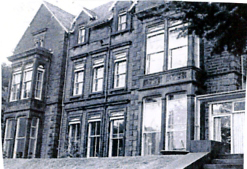
The Grange an Assessment unit for Girls in the 1980's
In more recent times, however, it has been demolished and the site developed into a small, private, modern housing estate off the bottom of Hollowhead Lane with flats and detached properties. At the same time some of the former large residences along Whalley New Road have become too large for modern needs and have been transformed into Residential homes for the elderly e.g. Warren Holt or their land used to build new detached houses as at present alongside “The Knoll". The number of working farms in Wilpshire as in Salesbury has reduced considerably with many of the old farm houses and their barns have been converted into modern housing but at the same time keeping their traditional outside appearance e.g. Tippings because they provide sizeable residences in attractive rural locations. Carr Hall Farm has changed first into a large retail outlet with modern attached buildings but has since become a business park using the modern buildings, with the original house remaining having been fully restored. Blackburn Orphanage has seen many changes in modern times with a move away from the “Orphanage" symbol which is no longer seen to meet modern needs. First it was renamed “The Homestead" run by Blackburn and District Children's Trust on a more family orientated line in smaller units with a few residential children. More recently the main building became empty as it had only large dormitory facilities but Blackburn have linked up with the NSPCC to create a family resources centre there with the ground floor converted into offices, lounge, play room and an activity area where parents and children with problems can meet and receive help without the need for residential care.
As in previous periods the main roads have been upgraded to meet the huge rise in motorised transport with traffic restrictions including no parking areas, more traffic lights, mini-roundabouts, speed bumps and a huge number of yellow lines. Due to the large increase in housing areas more roads were created to provide access and commuter traffic to and through Wilpshire and to and from the popular mostly affluent Ribble Valley increasing enormously creating problems at peak times especially in the Brownhill area with queues, where pedestrian crossing areas became imperative and air pollution a problem. The railway system has little changed although at present there are plans to upgrade the route to Manchester which has become popular with commuters. However the freight traffic on the route is now negligible because road freight traffic dominates and the rail system from Wilpshire reduced in the 1960's. Steam power changed to diesel power as stations were reduced in size and modernised without staff, as displayed at Wilpshire where there is now only two platforms, one of which was originally wood but replaced with concrete in 1955 but as a sign of the times there is now a small car park for rail users.
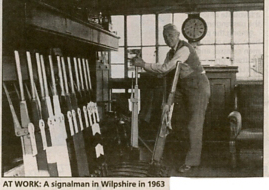
Before the more modern rail light signals a traditional signal-man at work in 1963
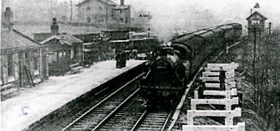 A steam goods train passing through Wilpshire Station with
 the old wooden platform being replaced In 1954
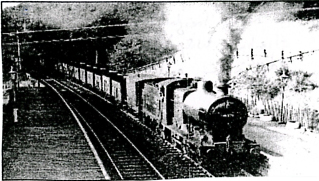 A heavy freight train climbing Wilpshire Bank
 to the station in the early 1950's
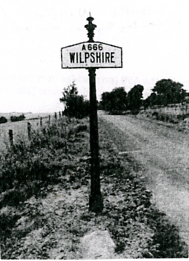
York road Wilpshire
A sign of the times is the recent closure of the Bulls Head Hotel; one of the many hostelries closing due to changing social customs. The Wilpshire Hotel and Rising Sun, however, continue to thrive, offering a variety of specialist beers. The Bulls Head is due to be changed into a Co-Operative Store in the near future ideally situated for the modern commuters passing to and from the Ribble Valley with its large car park. Wilpshire Golf Club situated further along Whalley New Road has continued to grow and improve its facilities especially its club house and better drained fairways and greens. In June 2009, the Club took steps to become a Community Amateur Sports club (CASC) to show its desire to play a bigger part in the local community by developing links with local schools and other organisations in order to encourage more participation in golf. The club has improved its catering facilities which can now be offered to the local community and beyond for a variety of functions which play an important part in helping the club increase its income streams.
Although Green belt land is being lost to modern housing demands it is nice to see local footpaths retained in many areas of Wilpshire to allow people to enjoy the remaining open spaces and as a sign of Lancashire County councils desire to encourage walking in the area some footpaths have been upgraded to protect them from increased traffic.
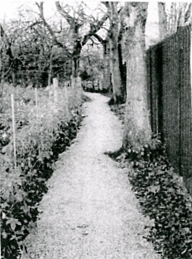
A footpath improved by Wilpshire Parish Council
By 2016, Wilpshire no longer has a post office as in other areas the number have decreased with the nearest facility being a combined newsagents just over the border with Brownhill. The area of Wilpshire today, however, has become a very popular residential area with a much larger population and is well facilitated to meet the needs of modern society.