
 Loading more
Page 2
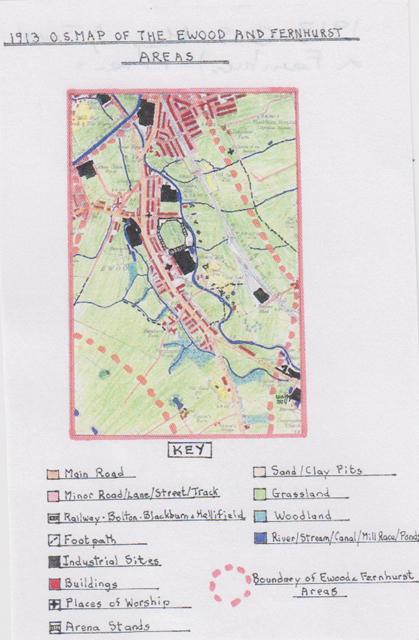
The 1913 O.S. Map of The Ewood and Fernhurst areas
The map shows some significant changes that have occurred during the last twenty-two years through the Edwardian and early Georgian Periods to a time just before the Great War of 1914-1918. On the industrial front, there has been three more textile mills built in the area on former green-field sites. One of these, in Lower Darwen, just outside the Fernhurst area, was called Unity Mill with the others being Salisbury and Fernhurst Mills; all brick built weaving mills with large weaving shed facilities. This was a time when the textile trade had reached its zenith before being hit badly by the impending Great War. Fernhurst mill was a red-brick weaving shed with a two storey warehouse built on the banks of the River Darwen for a good water supply to provide steam power and sited on Nuttall Street. It was built by Lawrence Cotton in 1906/7 with 891 looms operating when at full capacity. The mill was designed to operate the Northrop Automatic Steam Powered Looms which required roof pillars being widely spaced to create broader alleys by comparison to those mills operating Lancashire looms. However, the looms did not prove effective so they were sold back to the Northrop Loom Company in Blackburn during the war when the Northrop factory was being used for war production and used for exports. Lawrence Cotton learned his trade with Robert Hopwood and Sons and started up with his brother in 1893 when they took over the Armenia Mill, subsequently going on to run the Lower Hollin Bank and Appleby Street Mills, all in Blackburn. However Lawrence ran Fernhurst Mill on his own and became Mayor of Blackburn in 1917/18, and again, in 1920/21. He also inherited textile mills in Swansea, Chorley and Whittle-le-Woods from his uncle, James Nuttall Boothman. By the start of the 1st. World War, he controlled 600 looms and 70,000 spindles, and, at the end of the war, was prominent in finding work for disabled ex-service men and he also visited many Blackburn mills in order to persuade their owners to take their quota of the men. Of the existing textile mills, Albion and Hollin Bank had both developed extensions to increase their weaving capacity with steam power still reigning supreme. The paper mill built on the Fernhurst/Lower Darwen boundary alongside Branch Road now specialised in coloured paper with new filter beds created near to the River Darwen. At the same time, the clay pits for brick making in Mill Hill had also expanded but the sand pits in the area were reduced as supplies became exhausted.
As industrial sites had expanded, so too, had terraced housing sites built around them, especially in the Hollin Bank area, and, by infilling empty sites along or near to Bolton Road especially close to Salisbury and Fernhurst Textile Mills and along Branch Road. Many of the terraced houses on Bolton Road were better built and had small front gardens and front bay windows. Other buildings of importance in the area included three new churches; the Church of the Saviour sited on the north-east border with Longshaw and two along Bolton Road. The first at the Bolton Road end of Kidder Street near the Rovers football ground was a chapel and the second in the Fernhurst area was the new St. Bartholomew’s Church, built adjacent to the junior school which had previously been home for the original manse from 1876. These new churches were required to meet the spiritual needs of the growing population at a time when church worship was deemed important and attracted large congregations. The building of St. Bartholomew’s Church commenced on St. Bartholomew’s Day in August 1909 as the school rooms could no longer cope with the rising number of worshipers. The first sod was cut by the Reverend C.C. Browitt on the ground where the chancel was erected. He informed the assembled people it would become an important but cheapest built church in the whole diocese as they intended to build it within their means. At the same time, he urged parish members to work hard for a bazaar to be held in November 1910 to raise finance to fit out the church appropriately. The estimated cost of the church building was £4000 and almost half of this had already been subscribed or promised with the church built to accommodate a congregation of 500. This Gothic styled church was designed by Preston architects who used local stone with an open timbered roof, furniture made of oak and it was expected to open in September 1910.
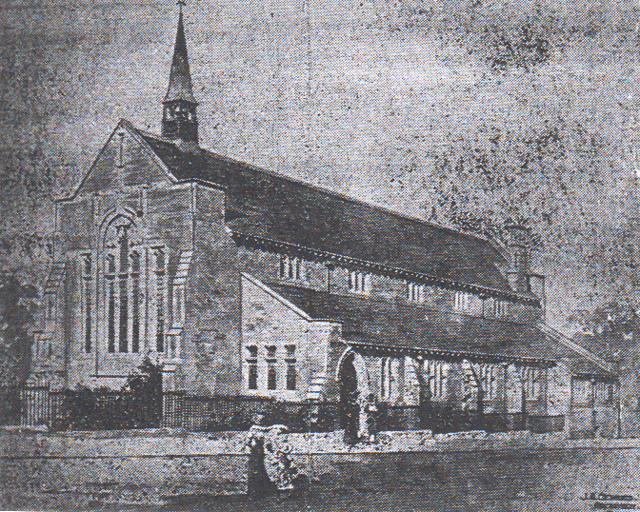
This is a sketch by the architects of the Gothic design for St. Bartholomew’s Church in 1909
By March 1912, the church had a memorial tower added to it due to a generous gift made by Miss. Mary Ann Lund and cost approximately £3000. The tower was built with four dialled clocks on each of its faces with two mechanical bells.
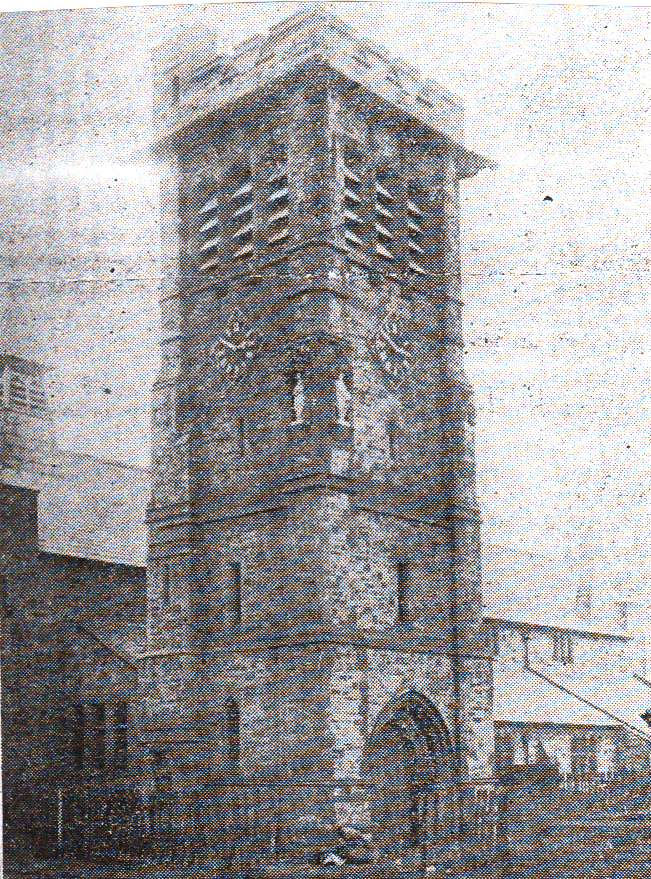
A photograph of the Lund Memorial Tower with two of its four clock faces visible
with religious statues built into alcoves on the corners of the tower and the church main entrance at its base
with religious statues built into alcoves on the corners of the tower and the church main entrance at its base
In 1919, after the First World War had ended, it had memorial gates fitted to its entrance in memory of church members whose lives were lost in the war.
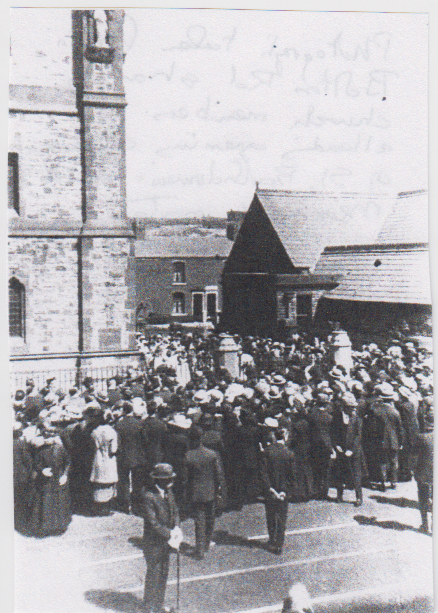
A photograph taken from Bolton Road showing church members attending the opening ceremony
of the opening of the memorial gates which also shows the side
of St Bartholomew’s School and terraced houses beyond.
of the opening of the memorial gates which also shows the side
of St Bartholomew’s School and terraced houses beyond.
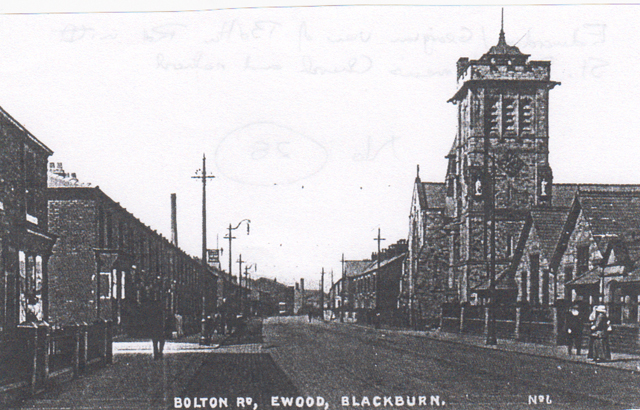
An Edwardian/Georgian view of Bolton Road with St. Bartholomew’s Church and School
To the right and terraced houses and shops leading from Fernhurst to Ewood in the background, many with attendant small front gardens.
Other significant new buildings erected by 1913 included the large Victorian/Edwardian Fernhurst Hotel which offered accommodation and function rooms. It was situated on the mill-race side of Bolton Road on a large site.
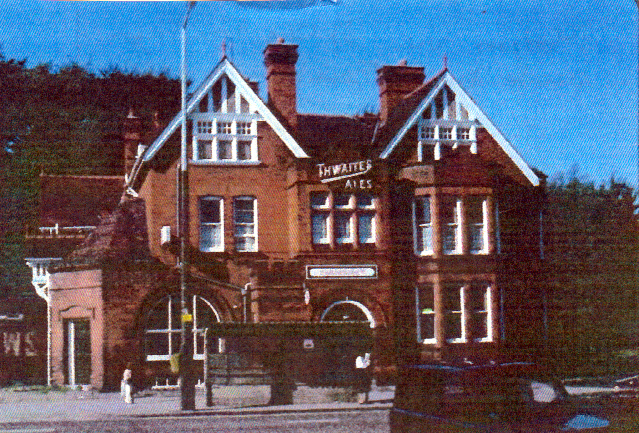
A modern view of the frontage of the brick built Fernhurst Hotel
with its ornate gables, tall chimneys and covering three floors
Another new public house erected by 1913 was the Albion Hotel, built at the junction of Albion Road and Bolton Road. Albion Road was created by linking Livesey Branch Road to Bolton Road close to Ewood Bridge at a time when road traffic had increased. These new public houses now meant the area’s population was served by four establishments together with the Conservative Club. Another significant addition to the areas sky-line was the erection of the Empire Electric Theatre which became one of the earliest cinemas in the Blackburn area. The theatre cost £1400 to build on land owned by Elma Yerburgh, daughter of Daniel Thwaites the second, who inherited the brewery in1888. Founding members of the Theatre were Ferdinand Caton of Catterall Street, Livesey Branch Road and Christopher Hope of Downham Street, Wensley Fold who signed the lease for the 970 square yard section of land with a rent of £12-2s-6d. Within a year, three more directors from similar humble backgrounds joined the founders, namely Henry Duckworth, Benjamin Meadowcroft- Hall and Henry Ainsworth. It opened in the 1910’s as a cinema, adjacent to Bolton Road and Aqueduct Road that led from Mill Hill at the side of the River Darwen which, at a later date, created a court case when it damaged the river bank wall behind the cinema with the Corporation made to pay for repairs. The Empire Cinema was one of a dozen cinemas opened in the Blackburn area as films developed. These early cinemas were very popular as they were affordable for most people and regarded as wholesome entertainment. At the time of its opening, films were silent but audiences would often react to the scenes and a pianist would be used to add to their drama. As watching films for long periods was thought to damage the eyes, variety acts were booked for added attractions, for example, Tom Florence who was a clog dancer even though he had only one leg!, Peter Rhodes was a singing miner and Leonard Clarke who, as young boy, entertained as a club and sword swinger! The first advert for the Electric Theatre appeared in September 1912 boasting of a new film called “Mysteries in Paris”. Most silent films of the period lasted for about one hour and a quarter.
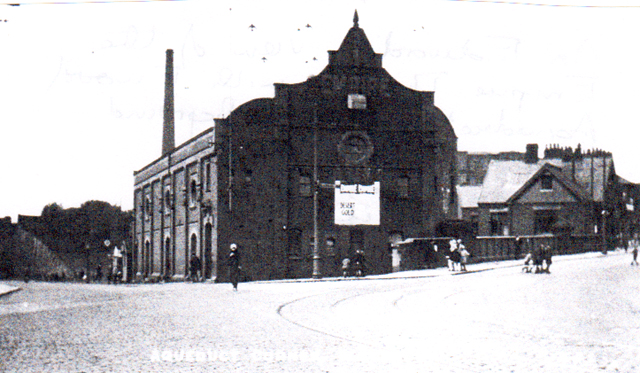
An Edwardian view of the Empire Theatre with Ewood Aqueduct in the background
together with a textile mill chimney and Ewood Bridge and Conservative Club alongside
it on Bolton Road. The cinema is displaying an advert for the latest film called “Desert Gold”
together with a textile mill chimney and Ewood Bridge and Conservative Club alongside
it on Bolton Road. The cinema is displaying an advert for the latest film called “Desert Gold”
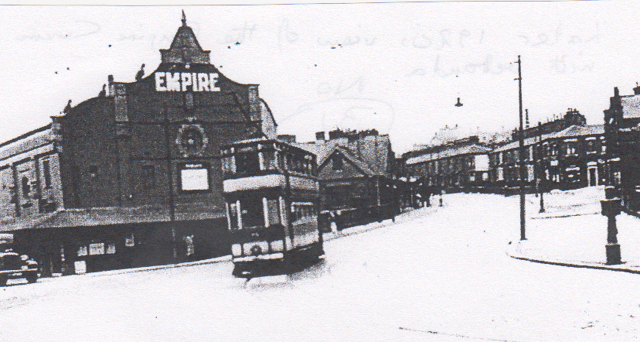
This later 1920’s view of the cinema shows it now has an added veranda around
the entrances to protect film goers, with a Blackburn Electric tram passing down
Bolton Road and an early car exiting from Aqueduct Road at the side of the cinema
the entrances to protect film goers, with a Blackburn Electric tram passing down
Bolton Road and an early car exiting from Aqueduct Road at the side of the cinema
Another significant change had now occurred at Ewood Park, the home of Blackburn Rovers; their success on the field led to increased crowds, and therefore, ground developments had to accommodate both standing and seated supporters within three new stands built on three sides of the ground. During the 1890’s, however, the standard of football declined, and, at the end of the 1897/8 season the team were in a relegation place of the 1st Division. Fate helped the club from an unlikely source, namely their rivals, Burnley F.C., who proposed that the 1st division be enlarged which resulted in the Rovers staying in the division. The arrival of the great footballer, Bob Crompton, to the Rovers defence along with new footballers, led to an improvement in their form but, in the early 1900’s, the team again flirted with relegation. On the 28th. March 1905, Lawrence Cotton, a local textile magnate was elevated to club chairman, and, using his business acumen, set about a programme of upgrading Ewood Park facilities (similar to a modern day Jack Walker). In 1905, the Darwen End with a capacity for 12,000 standing spectators was covered at a cost of £1650, and, in 1906, the Nuttall Street Stand was completed, opening on New Year’s Day 1907. His programme continued raising the ground’s capacity to 40,000 and he also signed a number of key players, including forwards Wattie Aitkenhead and Eddie Latheron, together with a defender, Billy Davies, to work with Bob Crompton. This led to the team attaining top finishes in the league and a cup semi-final in 1910. During the 1910/11 season the Rovers broke the British transfer record with a fee of £1800 paid for Jock Simpson an outside right and subsequently became 1st Division Champions in the 1911/12 season. This success due to Lawrence Cotton’s financial backing led to increased gate receipts rising from £7185 the previous season to £9432 in the Championship season. The Rovers chased the Championship again in 1913 but suffered from injuries but again broke the transfer record paying £2000 for Danny Shea from West Ham United and eventually retained the Championship in the 1913/14 season and stood at the pinnacle of English League Football. During this season a new double-decker stand estimated to cost £7000 was constructed on the Riverside accommodating 7000 seated and 9000 standing spectators and by the time all ground improvements were completed its total capacity rose to 70,866. Rover’s progress was then brought to a halt by the 1914-18 Great War as players were called up and lost to the team.
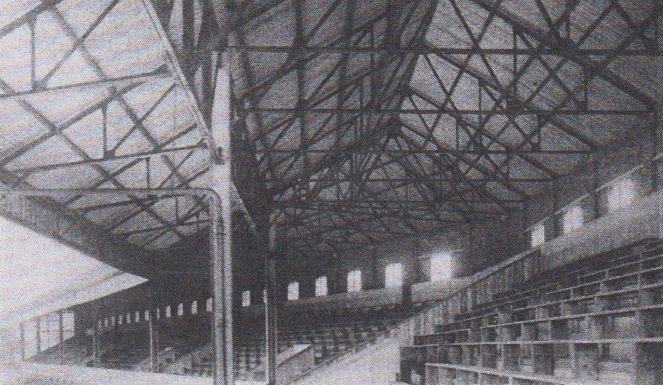
The new Nuttall Street Stand
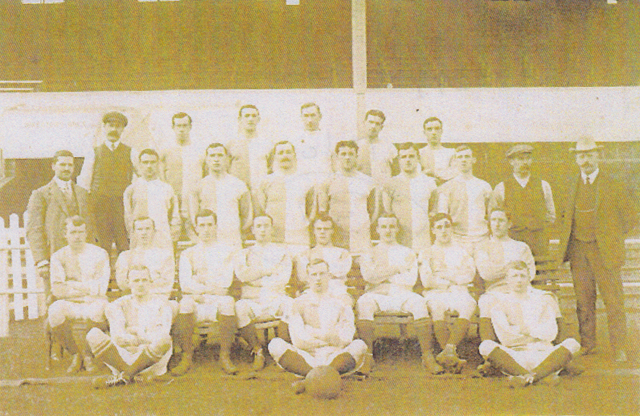
A sepia picture showing the Rovers team in the 1909/10 season with the Nuttall Street Stand in the background
Back Row – Walter Woods (Groundsman), Ellis Crompton, Jimmy Ashcroft, Billy Garbutt, Jimmy Heywood.
Third Row – Robert Middleton (Secretary), Ben Proctor, Hugh Stevenson, Bob Crompton, Tom Griffiths, Albert Walmsley, Billy Bradshaw, Bob Holmes (Trainer), T.D. Leaver (Director).
Second Row – Richard (Dick) Wombell, Tommy Suttie, Wattie Aitkenhead, Johnny Orr, William Cameron.
Front Row – Ernest Bracegirdle, Billy Davies, Eddie Latheron.
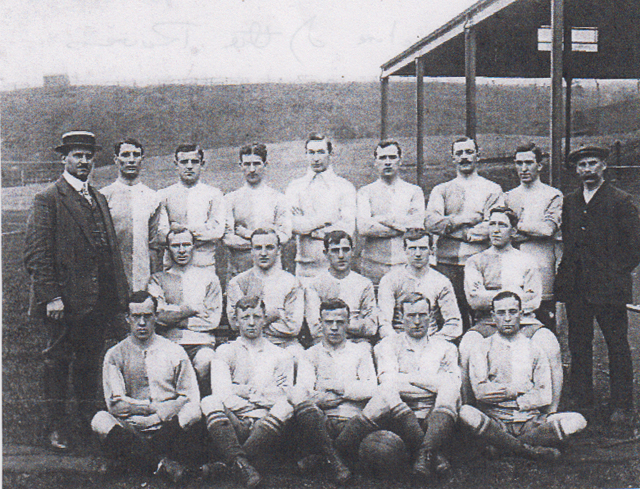
A picture showing the Rovers team in the 1910/11 season with the newly built
Riverside Stand to the right and the Blackburn End open stepped terraces rising in the background.
The Riverside stand had a double tier added in 1913.
Riverside Stand to the right and the Blackburn End open stepped terraces rising in the background.
The Riverside stand had a double tier added in 1913.
Back Row – Robert Middleton (Secretary), Percy Smith, Albert Walmsley, Billy Garbutt, Jimmy Ashcroft, Hugh Stevenson, Bob Crompton, Wattie Aitkenhead, Bob Holmes (Trainer)
Middle Row – Tommie Suttie, William Cameron, Arthur Cowell, Billy Bradshaw, James Ferguson
Front Row – Ellis Crompton, Eddie Latheron, Johnny Orr, Billy Davies, Walter Anthony
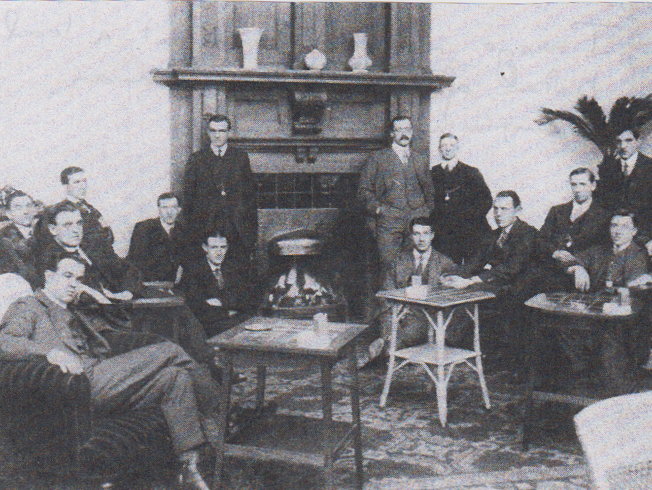
A scene from a local hotel after the 1913/14 season Championship
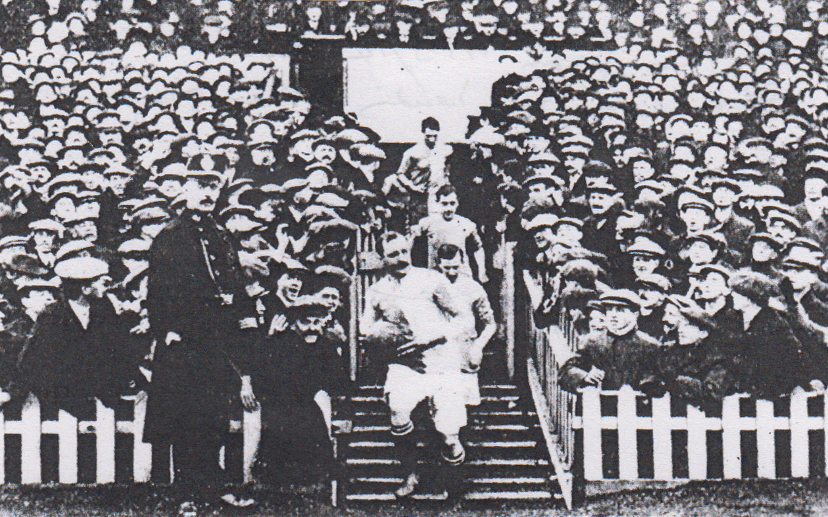
This picture from the 1913/14 season shows Bob Crompton leading the Rovers players out onto the pitch
It is noticeable in the forward Nuttall Street Stand area there was not one female in view, and, virtually all the male supporters were wearing flat caps typical of the working classes of the day. Sadly, many of these men would be dead within four years and buried in France as a consequence of the Great War.
By 1913, a number of new streets had been created to house the new terraced property in the area and Albion Road had been straightened. Road transport at this time had increased with both steam powered and petrol driven vehicles and less horse drawn traffic. At the end of this period, the earliest petrol driven cars had been introduced for the well-off members of society and some trucks.
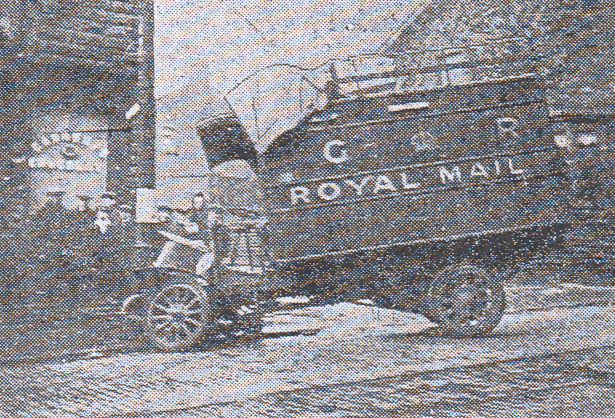
This action picture shows a Royal Mail Truck that had been travelling down
Bolton Road but unfortunately had lost a wheel causing it to crash into an electric tram standard in 1916
Bolton Road but unfortunately had lost a wheel causing it to crash into an electric tram standard in 1916
Railways in the area were unchanged but travel by tram had been upgraded fully to using electricity using overhead power lines held up by electric standard posts. This led to more trams and significantly increased passenger numbers.
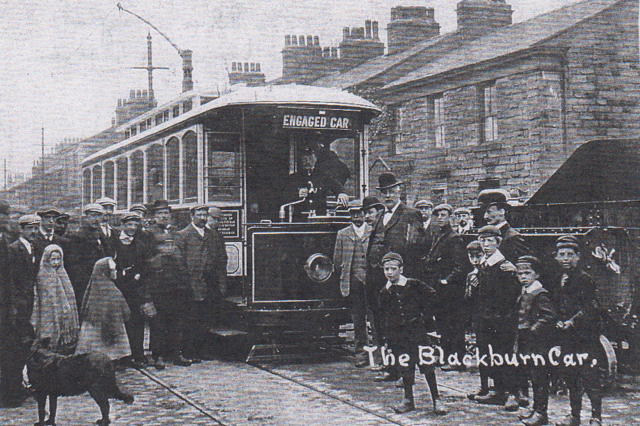
This picture shows a Blackburn single decker electric tram leaving Darwen on its way to
Blackburn centre with local dignitaries on board and spectators viewing its maiden journey
Blackburn centre with local dignitaries on board and spectators viewing its maiden journey
On Rovers match days many special electric trams were laid on to take supporters from Blackburn and Darwen areas to Ewood Park. Eventually, Kidder Street behind the grounds Blackburn End became a tram terminus with a link line off Bolton Road.
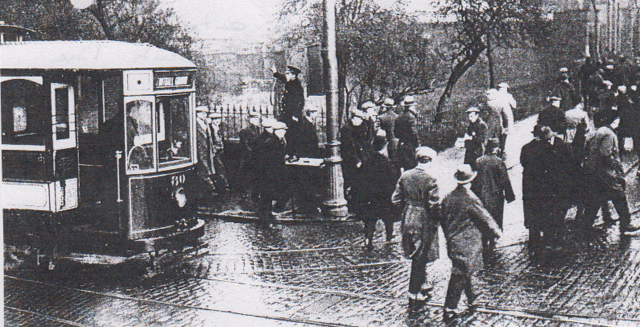
This image shows a tram entering Kidder Street on match day using the link line
with an automated electric point controller in view along with a police officer
controlling events as spectators hurry past on their way to the match
with an automated electric point controller in view along with a police officer
controlling events as spectators hurry past on their way to the match
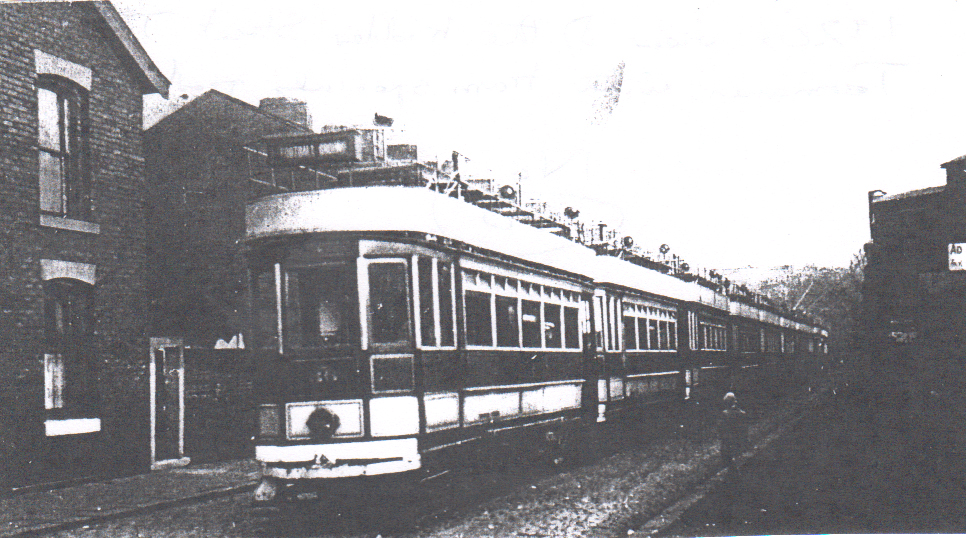
A 1920’s view of the Kidder Street Tram Terminus with tram specials parked
up during the match with the corner of the Blackburn End in the picture
up during the match with the corner of the Blackburn End in the picture
On the rural scene at this time little had changed to the farming areas apart from the loss of valley pasture land for new terraced housing areas. By now, there was more farm mechanisation but horse power was still widely used.
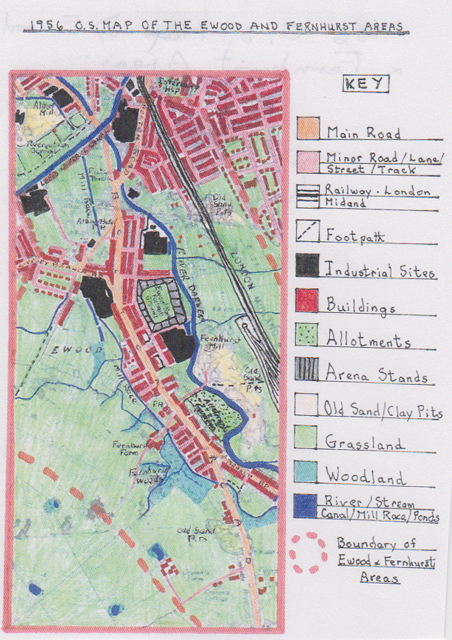
The 1956 Ordnance Survey Map of Ewood and Fernhurst areas
The above map shows that in the 43 years since 1913 there had been significant changes in the areas over the period covering the two World Wars. Evidence of this is the significant increase in new housing areas on the outside edges of the area with the lower parts of the Local Authority post 2nd World War housing estate at the Shadsworth side and in the Mill Hill areas. This new type of housing was mostly semi-detached Council houses built to house people displaced from condemned older terraced properties in the Borough sited in better quality more rural areas complete with gardens. Within the Ewood and Fernhurst areas new semi-detached private houses had been built off Livesey Branch Road above Ewood Mill on a former green-field site with a few detached properties also built off Cravens Brow including a vicarage.
There was little change on the industrial front apart from small extensions at Albion and Fernhurst Mills together with a new unit built alongside Albion Road which produced healds and reeds for the textile trade. By now the textile industry was feeling the threat from overseas competition and therefore having to adapt into producing more varied textile products which required more skill including industrial textiles and clothing products. Mill machinery was now operated by electricity and had received many improvements to meet the changing needs of the day.
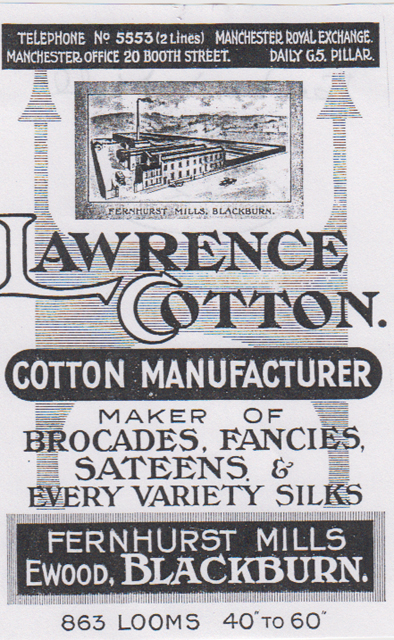
This 1923 advert for Fernhurst Mill shows that it is now producing cotton brocades,
fancies, sateens and silks as it had diversified production to be competitive
fancies, sateens and silks as it had diversified production to be competitive
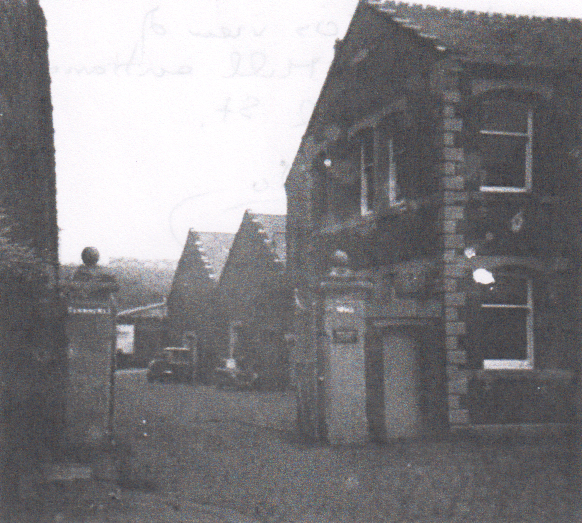
This late 1950’s view of the Fernhurst Mill entrance was taken from Nuttall Street
and shows the cobbled court-yard and more modern vehicles
and shows the cobbled court-yard and more modern vehicles
By now the Fernhurst Mill had been taken over by the Birtwistle Textile group which was a feature of the period when many mills were taken over by larger manufacturers in order to survive. However, by 1951, Birtwistles had disposed of the mill which was unoccupied for a few years before being taken over in 1956 by Redmayne and Isherwood who were cotton waste processors. The Mill later became part of the Carrington Viyella Yarn Company.
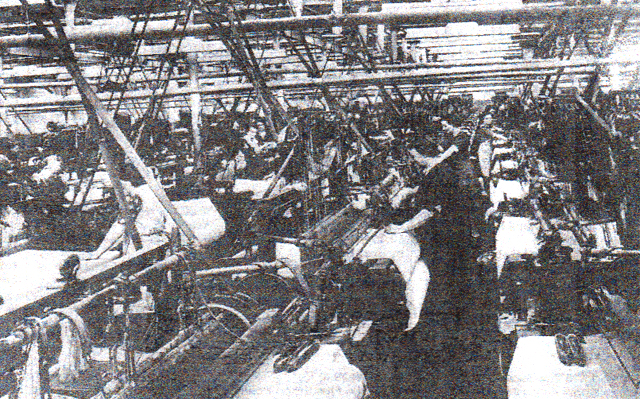
A typical view in the weaving shed at Ewood Mill in 1957 when looms were solely driven by
electricity and as in the past mostly operated by females.
electricity and as in the past mostly operated by females.
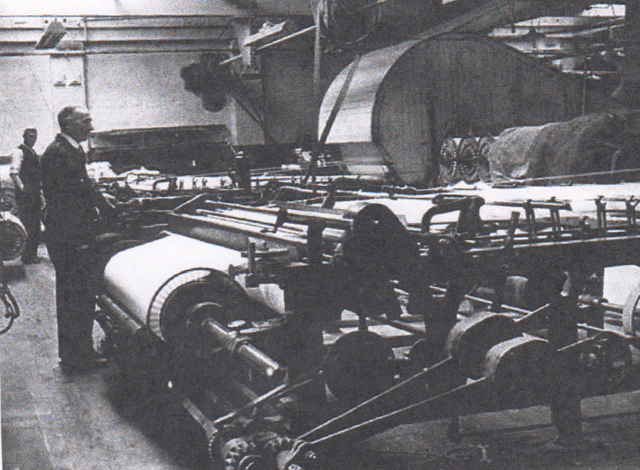
A 1948 view of an operative working a taping machine at Ewood Mill
Since 1913, the map shows there had been no increase in new roads but increased streets for new housing areas. By now, motorised traffic especially cars and lorries had greatly increased from the 1920’s as post war prosperity especially due to increased wages after the 2nd World War allowed greater private car ownership aided by much improved mechanisation in the production of vehicles. All commercial traffic was now by roads with the canal rarely used and railways mostly moving only very bulky items and relying more on passenger transport. Railway ownership in the area had changed with the track now operated by the London Midland Company. Trams which had been so important up to the 2nd World War were still in use but lost out to motorised buses creating very congested main roads.
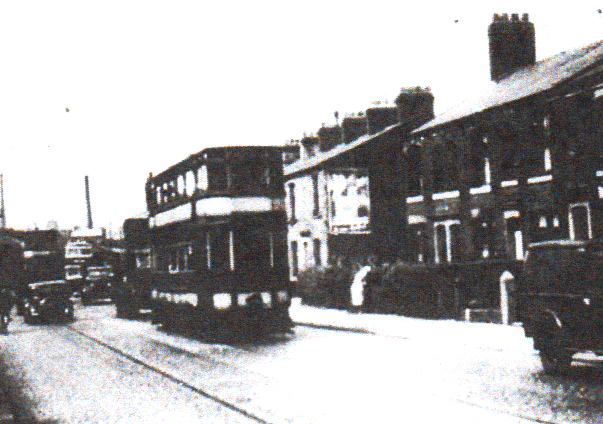
A great mixture of traffic on Bolton Road as trams, buses vans and cars all fight for space in the early 1950’s
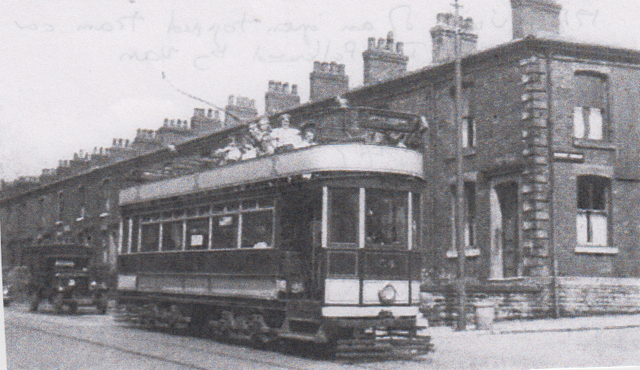
An open topped tram car on Bolton Road followed by a van as it neared Ewood
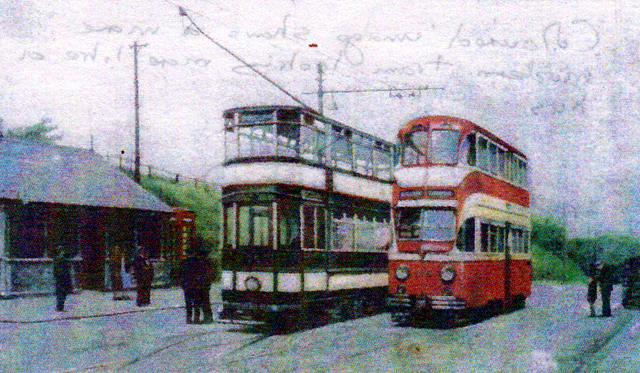
This coloured image shows a more modern tram looking more like a bus
alongside an older tram at the terminus at the top of Craven’s Brow.
alongside an older tram at the terminus at the top of Craven’s Brow.
Tram accidents like those of motor vehicles were quite common and often reported in the local news.
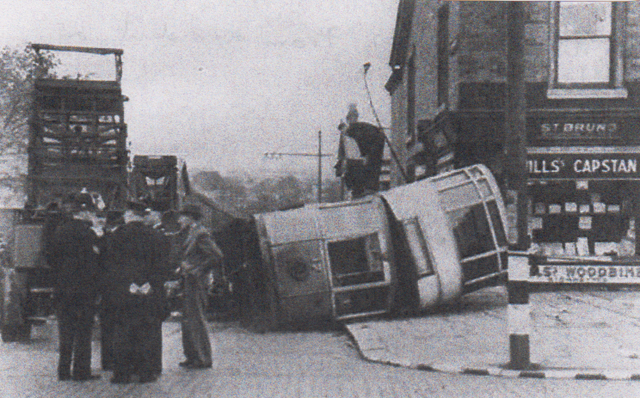
On the 20th. September 1941 a tram accident occurred where the driver lost his life.
The tram had been travelling to Darwen along Bolton Road but at the junction with Kidder Street jumped the points causing it to turn into Kidder Street and topple over. The 24 passengers and conductor managed to crawl out via the stairway and upper windows to safety. The picture shows the police attending with a recovery vehicle alongside.
The tram had been travelling to Darwen along Bolton Road but at the junction with Kidder Street jumped the points causing it to turn into Kidder Street and topple over. The 24 passengers and conductor managed to crawl out via the stairway and upper windows to safety. The picture shows the police attending with a recovery vehicle alongside.
Increased traffic problems in the Ewood area along Bolton Road during Rovers home matches led to the widening of Ewood Bridge in 1925.
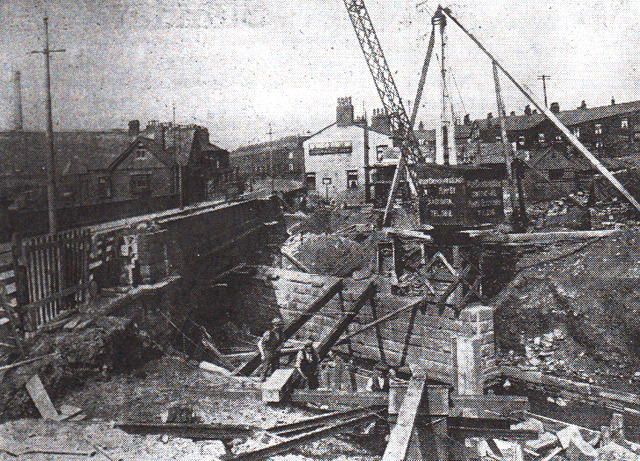
This image shows the widening of Ewood Iron Bridge during construction
With the Aqueduct Inn, now missing, as the road width was increased from 45 to 65 feet along with a footpath of 25 feet to provide more safety to pedestrians on their way to the Rovers. These bridge changes caused the moving of the Aqueduct Inn to a new site further up from its original one.
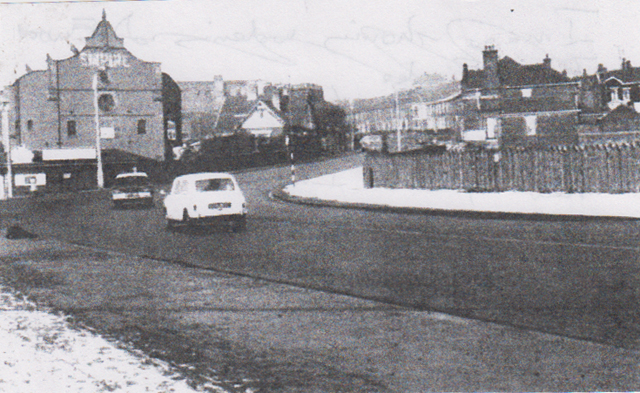
This late 1950’s early 1960’s view shows the completed bridge and footpath together with the new
Aqueduct Inn on the right side of the road beyond the bridge
Aqueduct Inn on the right side of the road beyond the bridge
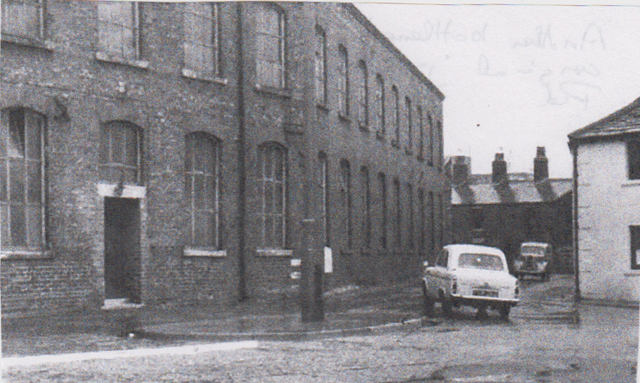
Another bottleneck remaining at this time was this narrow original junction where
Livesey Branch Road met Bolton Road at the side of Ewood Mill
also visible in the image are old original terraced cottages soon to be demolished. By now, the new Albion Road link from Livesey Branch Road to Bolton Road had helped to take pressure off this junction.
Since 1913, Blackburn Rovers ended the final season of peacetime football after the 1st World War in third place within the First Division. By the summer of 1915, the Football League replaced the normal league structure with two regional sections but Rovers directors, aware of local problems, suspended their football activities for the 1915/16 season. As conscription for the 1st World War was introduced, the directors arranged a couple of friendly matches. They then joined the regional competition but, by then, many players had gone to war and were in short demand therefore standards generally dropped. During the war, one of Rovers star players, Eddie Latheron was killed and several other survivors could no longer play such as Wattie Aitkenhead and Jock Simpson; others such as Bob Crompton had to retire by 1920 due to their age. In 1919, Lawrence Cotton stepped down as chairman of the club and the 1919/20 season saw a period of re-construction as the club brought in new players. In 1922, the club directors decided to employ a full time manager for the first time and chose the experienced Jack Carr. Despite showing indifferent form over the season, the Rovers reached the semi-final when they beat local club Blackpool at Ewood with a Sid Puddefoot goal in front of a 60,011 crowd! By the end of 1926, Bob Crompton the former club captain took over as manager, and, by the 1927/28 season, the Rovers had reached Wembley again to face the much fancied Huddersfield Town who were also chasing the 1st division title. To the surprise of many, the Rovers had a shock 3-1 triumph to capture the trophy.
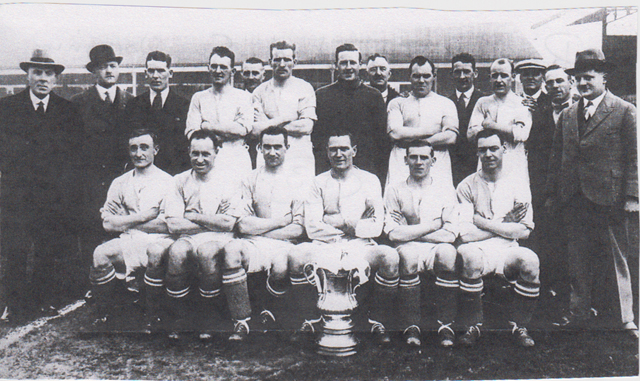
A view of the Rovers 1928 F. A. Cup winning side with their manager and dignitaries.
Back row left to right – Mr. J.W. Walsh (chairman), Mr. R. Crompton (director and manager), T. Mitchell, A. Campbell, Mr. J. Eddleston (director), W. Rankin, j. Crawford, Counsellor J.H.Chadburn (director), J.Hutton, R. Roxburgh, H. Jones, M. Atherton (trainer), P. Holland, Mr. A. Barrit (secretary).
Front Row – G. Thornwell, S. Puddefoot, J. Roscamp, H. Healless, T. McLean, A. Rigby.
The financial rewards of this cup run together with money gained from transfers allowed the club to erect a concrete safety wall round the pitch and replace the Riverside Stand roof. Huge crowds attending matches of the day included 62,522 when the Rovers played Bolton Wanderers in the 1928/9 season F.A.Cup. These massive crowds with increased motorised traffic caused great congestion round the ground.
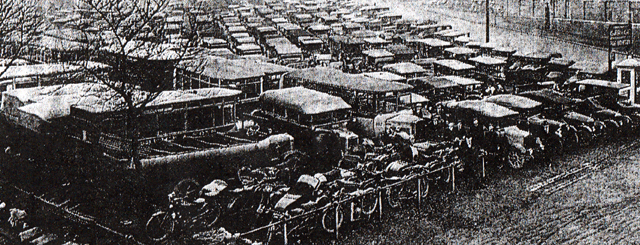
This 1920’s view shows the Corporation car-park off Albion Road behind Bolton Road’s
terraced houses in the days of early coaches, motor cars and bicycles.
The car-park is still used today on match days for buses and coaches
The early 1930’s were difficult for the club as trade depression left little money for football and the team suffered through a lack of new players and reduced gate receipts. As the club continued to fail the club supporters became depressed and the club were finally relegated to Division 2 in the 1935/6 season and little improvement followed. Bob Crompton who had been sacked was eventually persuaded to return and soon rejuvenated the team to win the 2nd Division Championship in the 1938/9 season.
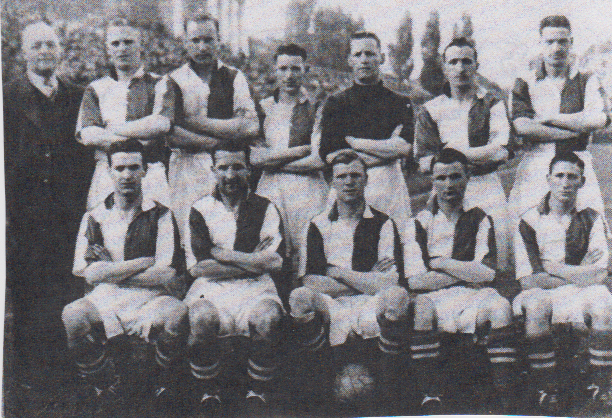
Blackburn Rovers Championship winning team 1939
During the 2nd. World War period from 1939-45 a variety of guest professional players stationed near Blackburn turned out for the club. In the 1939/40 season, a team of mostly Rovers players managed to reach the war cup final but lost to West Ham United. During the war years, Bob Crompton collapsed and died watching a Rovers game with Reg Taylor taking over as manager before Eddie Hopwood took over in 1946. By 1948, Jack Bruton, a former Rovers player was installed as club manager after the club had again been relegated from Division 1. Later, as club managers and players came and went with little improvement the team just avoided another relegation to Division 3. By 1953, the Rovers had made Johnny Carey club manager who had been a Manchester United stalwart in his playing days. He developed a more attacking style of football that attracted larger crowds with many more goals being scored and promotion back to the 1st Division a reality.
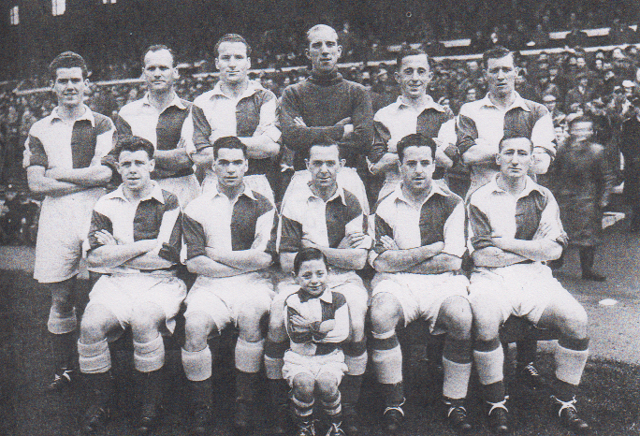
Blackburn Rovers 1954/5 football team
The 1956 O.S. Map shows that Ewood Park ground was now completely covered with stand roofs including the all-standing Blackburn End Terrace.
Since 1913, St. Bartholomew’s Church had developed its own parish and its Junior School was flourishing.
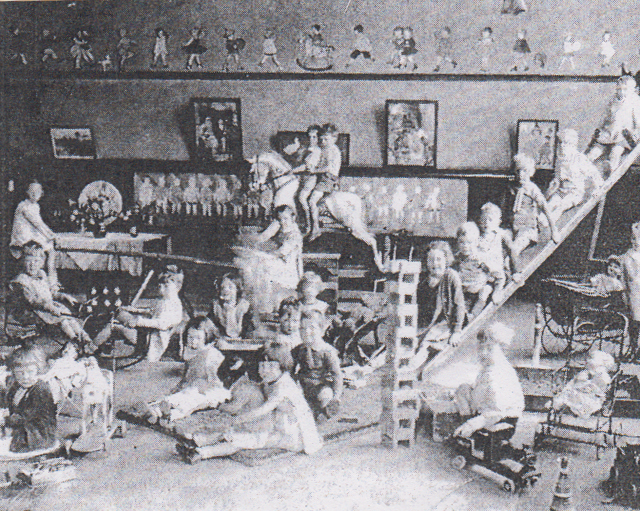
A view of the very well stocked Reception Classroom with its teacher and children in 1935
There is a giant rocking horse, two see-saws, dolls, building blocks, numerous toys, doll prams and a super slide. Although there are many toys the three year olds were actually being taught mathematical fractions at such an early age using paper houses that could be folded in half, quarters and eighths!!
At the Empire Theatre in Ewood patriotic films were being shown during the 1st World War, and, by the 1930’s, the first “Talkie” films had been introduced. In 1946, the cinema was sold to the Northern Theatre Company for £13,000 and, by 1957, had become an Essoldo cinema.
Farming by 1956 was now mostly operated by diesel engine tractors but, as in the past, was still dominated by pastoral farming. However, the map shows an area behind Ewood Mills which is divided into numerous smaller units which could indicate more specialised arable or allotment use. A similar area is shown east of Salisbury Mill on the opposite side of the River Darwen. Some farmland had been lost yet again for housing development in the area. There was also a large area of new allotment gardens developed near Fernhurst Mill as post- war terraced house occupants without gardens could now grow their own fruit and vegetables.
The 1956 map also shows the former sand pits in the area were no longer used and Mill Hill’s clay pits were greatly reduced.
Both Ewood and Fernhurst areas had benefitted from the early 1900’s from the development of Blackburn Royal Infirmary which was a large medical facility sited in the Hollin Bank area just beyond Ewood giving local inhabitants easy access to its facilities.
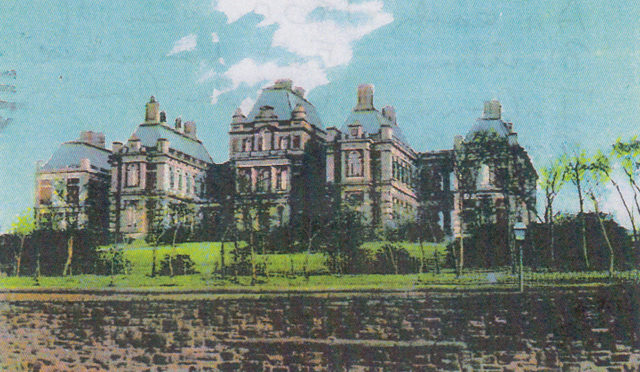
This is an early 1900’s view of Blackburn and East Lancashire Infirmary site taken from Bolton Road
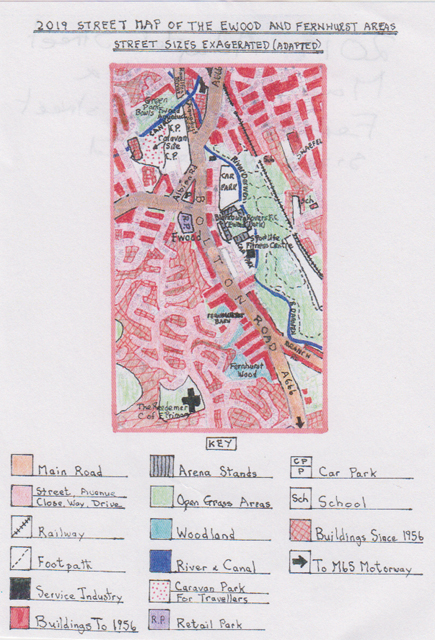
A 2019 Adapted Street Map Of Ewood And Fernhurst With Street Sizes Exagerated To Show Developments In The Areas
During the 63 years since 1956 the areas had seen major changes with their transformation from being dominated by the textile industry to one being predominantly a suburban housing area especially in the 2000’s.
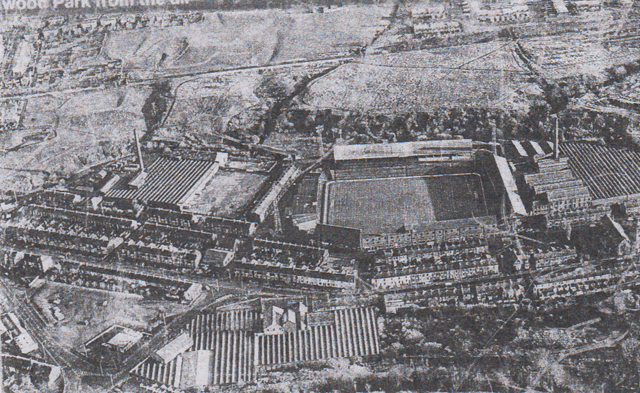
This air photograph of Ewood Park and the textile mills on either side of it is a vista that has since completely changed
The only industries remaining today are on a small scale providing services including shops such as hairdressers, newsagents and fast food on Bolton road to local garages and vehicle repair units. Additionally, a small retail park has been established on the site of the former Ewood Mill that now contains a McDonald’s outlet and two small supermarkets namely Aldi and Iceland with large car parking facilities. The new Ewood Park complex developed during the Jack Walker era includes a new ground roughly on the site of the old one and now offers conference, catering, store, fitness, gym, training facilities and extensive car parking. This huge complex covers the original football ground and two textile sites that were on either side of it originally.
Today, the only true public house remaining is the Fox and Hounds (although currently closed awaiting new tenants and due to re-open in September 2021). The Golden Cup just outside the areas boundary still operates. The former Aqueduct Inn is now a bicycle shop, the Albion Hotel has been developed into a business unit and the Fernhurst Hotel has been transformed into a travel lodge with catering facilities.
All the original textile mills have now been demolished including the ones already mentioned namely Ewood, Salesbury and Fernhurst mills, additionally Hollin Bank Mill site was initially used for a garage and supermarket (Kwick-Save) which has itself been demolished for a modern flat/apartment development with a modern Texaco Garage alongside Bolton Road. Albion Mill has also been demolished more recently; it survived for a time as a sports centre but has now had its site developed into £12.5 million extra-care facility for the elderly which will provide 109 beds including 50 extra care apartments, 31 en-suite rooms for intermediate care, 24 dementia apartments and 4 rehabilitation apartments . The facilities include a community hub to provide community activities for residents and the wider community. This new development will also take overspill patients from Blackburn Hospital and help free up beds from long stay patients.
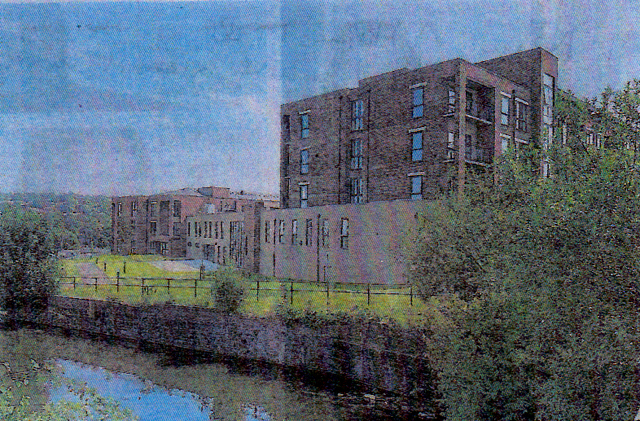
The new Albion Mill Development which will open in August 2021
Albert Mill in nearby Mill Hill has also been demolished and the site redeveloped into a small housing estate.
The Ewood Park site was developed to meet Premiership Football needs although the club are presently in the Championship. Since 1956, the Riverside Stand was first demolished in the 1987/88 season due to fire safety regulations as it was mostly wooden and closed since 1985 leaving the terraces available below which still exist in the new ground.
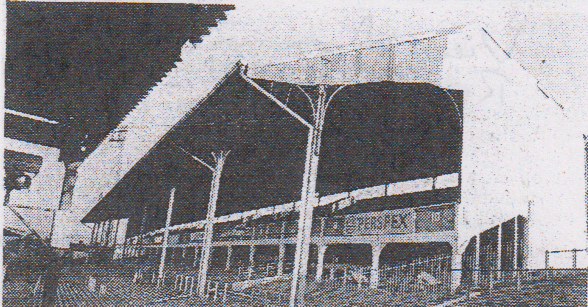
A view of the original Riverside Stand in 1987
Jack Walker, then a club director, provided the steel work free of charge to develop a new stadium especially when he took complete control of the club in 1991. On the field, the club had achieved promotion back to the 1st Division in 1958 with their manager Johnny Carey and made the F.A. Cup semi-finals. The Rovers achieved promotion at Charlton Athletics ground in front of 56,435 spectators and the club also won the F.A. Youth Cup. In 1960, the club reached the F.A. Cup final after an exciting run in front of huge crowds but lost to Wolverhampton Wanderers. However, during the 1965/6 season, the team were relegated back to the 2nd Division and between 1966 and 1974 had little success being again relegated to the 3rd Division. In 1975, under manager, Gordon Lee, they won promotion back to the 2nd Division. Things changed dramatically in 1991 when Jack Walker took control and invested heavily in the club, first using manager, Don Mackay, and then attracting Kenny Dalglesh who began to attract top footballers to the club, starting the Walker Revolution. By May 1992, the club had won the 2nd Division play-off final at Wembley, beating Leicester City 1-0 to join the new Premiership Division (old 1st division) as a founding member. This led to the club attracting more star players and chasing the Premiership League title, and, at the same time, the ground was transformed on three sides apart from the original Riverside terrace with modern all-seater facilities and executive boxes and varied club facilities to hold 30,263 spectators.
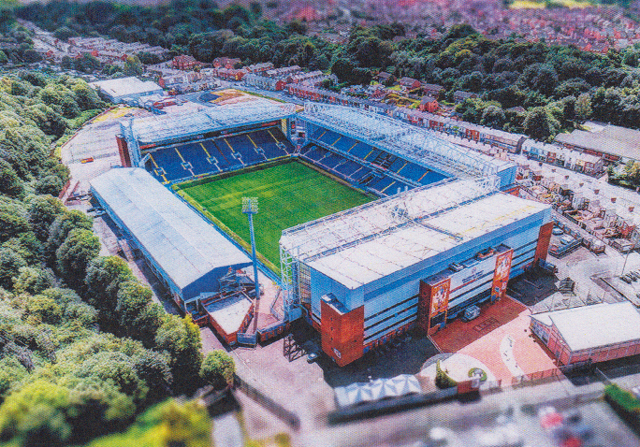
A view of the new Jack Walker Stadium completed in 1994
The club then went on to win the Premiership Title in 1995, the first and only town team to achieve this honour!
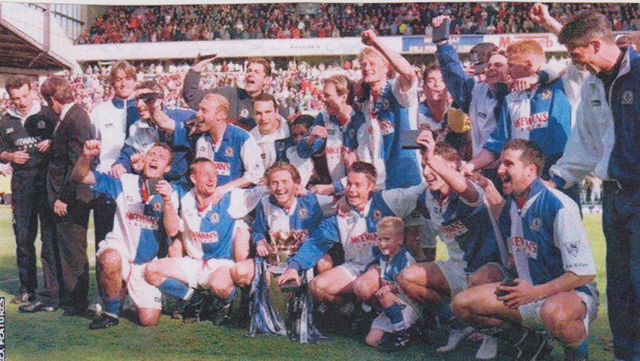
The title winning Rovers team for the Premiership Title in 1995
However, during the 2000’s the club were once again relegated to the Championship. The club were taken over by the Venky family from India after Jack Walkers death and continue to fund the club.
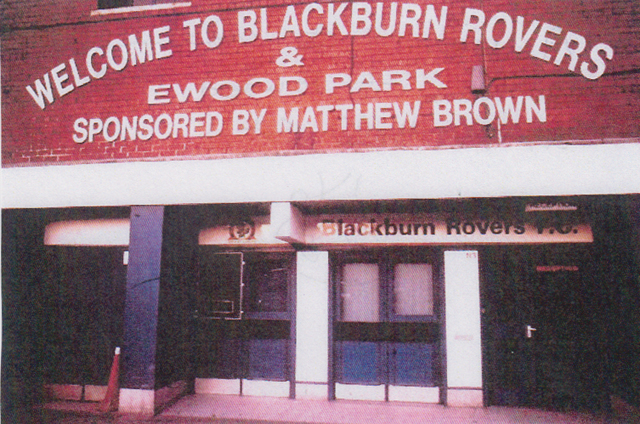
A view of the original entrance to Ewood Park on Nuttall Street
The largest change visible on the 2019 street map is the large modern housing estate built on former farmland on the valley sides west of Bolton Road namely the former Fernhurst Hall farmland. This now joins on to another new housing estate built off Cravens Brow further up Bolton Road and also extends to Livesey branch Road housing and surrounds Fernhurst Wood. These housing areas are all built off a labrynth of named closes, ways, drives and cul-de-sacs and consist of predominantly modern detached houses with a few semi-detached and access roads linked to Bolton Road, with the Fernhurst access passing the modernised remains of the original Fernhurst Farm building. A new Primary School has been built to cater for the increased population educational needs. The Shadsworth Council Estate, partly shown on the 1956 map, has had some new private housing developments added to it taking up former open spaces. However, the former sand pit areas on this side of the River Darwen have been protected by planning and offer designated footpath retreats from the built up areas. A large new housing development on Albion Street in the form of flats/apartments has been completed next to the original Albion Textile Mill site. The former open ground between Ewood Aqueduct and Albion Road below the former Albion Mill site has been developed by Blackburn Council into a purpose built Caravan Park for the Travelling Community with facilities and is always fully occupied. This is surrounded by large car parks used for Rovers home games and Ewood Theatre visitors. In the 1960’s/1970’s this area was the site used for the visiting Easter Fair attractions before they were moved to Witton Park.
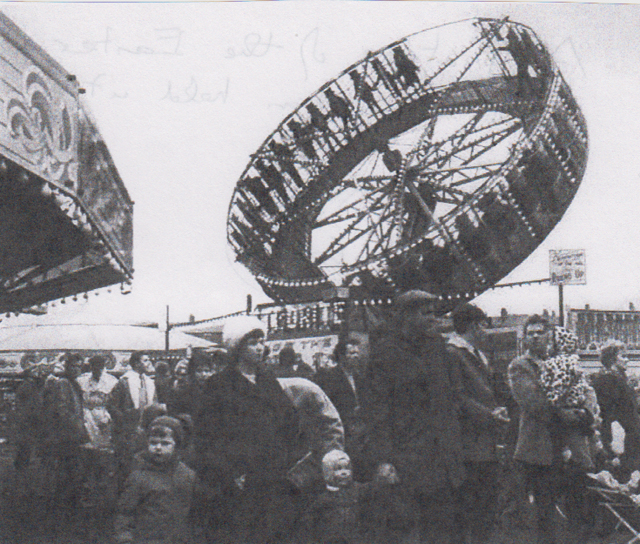
A picture of the Easter Fair attractions held at Ewood
Many of the original terraced houses that still survive today have had a huge variety of alterations, upgrades and additions to modernise their appearance and create more room by their owners often with the help of Local Authority grants.
Major changes to the areas transport system since 1956 include the upgrade of all existing road surfaces to cope with the huge rise in modernised road traffic as most people now own/lease cars and the majority of goods are transported by goods vehicles. Albion Road has been widened to take all by-pass traffic from Bolton Road as the section leading to Ewood Park is closed and open only to residents. All major roads now have a variety of safety features added to them for vehicles, pedestrians and cyclists. Aqueduct Road that runs into Hollin Bank Street and then Spring Lane now forms a major road link to Preston Old and New Roads. Bolton road now has a major road junction just beyond the Golden Cup Inn which provides access to the M65 motorway which links to Preston and Burnley and the M6/M61 motorways. The Blackburn Bolton railway is now mostly used by commuter passenger traffic.
By 2019/20, the only open green spaces in this large built-up area are Fernhurst Wood, the old sand pit area now grassed over and Green Park on the boundary with Mill Hill which contains bowling greens, footpaths and shrubbery adjacent to the Leeds Liverpool Canal.
The course of the River Darwen in modern times has been restricted especially from Ewood Bridge through Mill Hill to reduce the chance of flooding. Shops still exist amongst the older terraced property along Bolton Road although their retail function has long since changed from their original use as most provisions are now purchased from large supermarkets.
Thwaites Ewood Empire Theatre exists today; it was brought back to life due to the efforts of members who raised funds to help upgrade it and gave up time to complete some of the work over a period of years. Eventually, the theatre attracted funding from the Local Authority and Thwaites Brewery which led to it developing modern staging and upgraded accommodation. The theatre now attracts a variety of acts and also provides in-house productions. Attached to the theatre is a modern dance studio developed from former garage buildings with a small car park.
Despite the many modern changes to the area, it is today a popular urban area as it has easy access to other areas for commuting to work, contains a variety of property to suit all tastes and is within easy reach of more rural areas such as Tockholes, Witton Park and Darwen Moor all of which offer open areas for recreation.
Finally, Blackburn with Darwen has a local plan for future development for the period 2018-2037. This shows there are plans to allow more housing sites east of the River Darwen and Bolton Road areas to add to the existing ones below the Shadsworth Estate and further up the valley sides beyond the existing Fernhurst/Cravens Brow Estates, further urbanising the whole area.