
 Loading more
Page 2
Christmas Miscellany
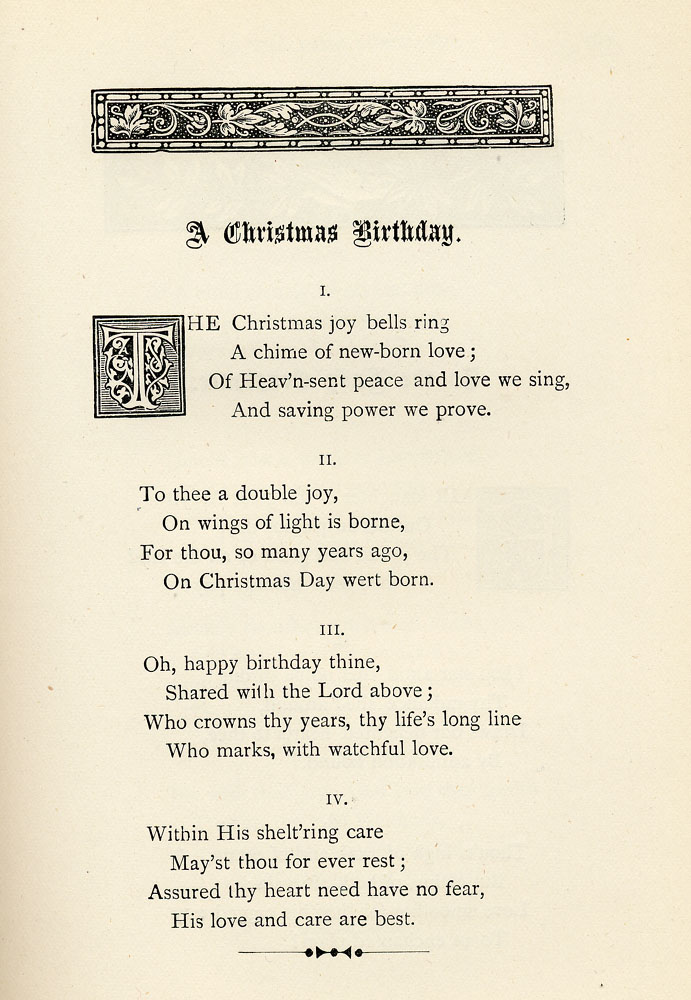
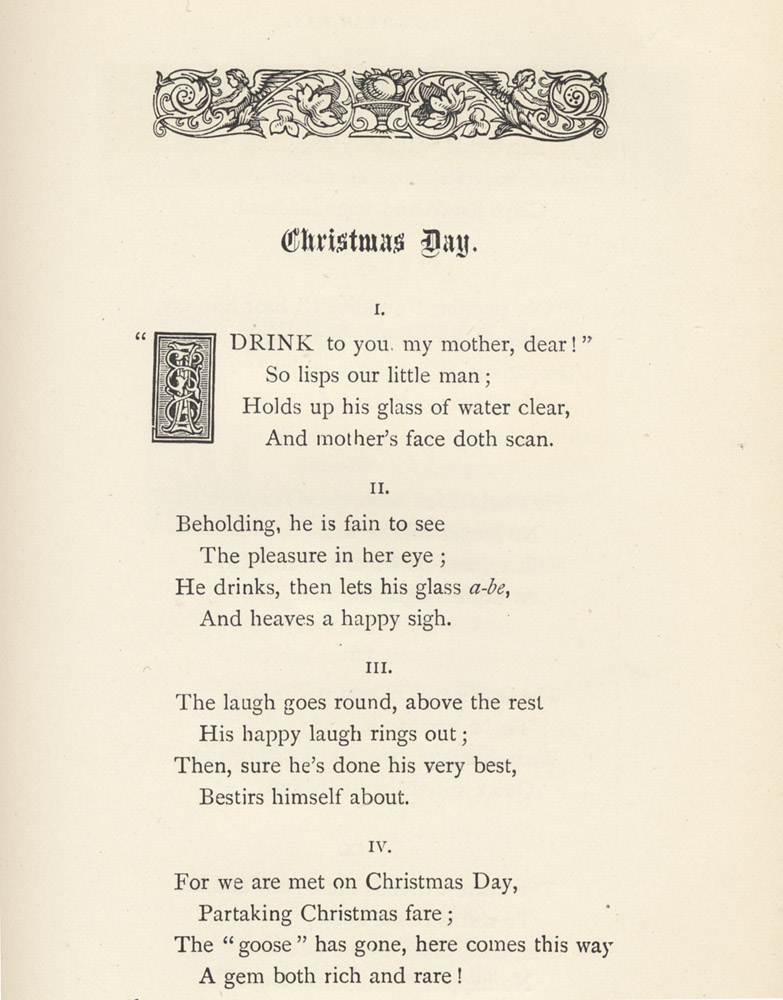
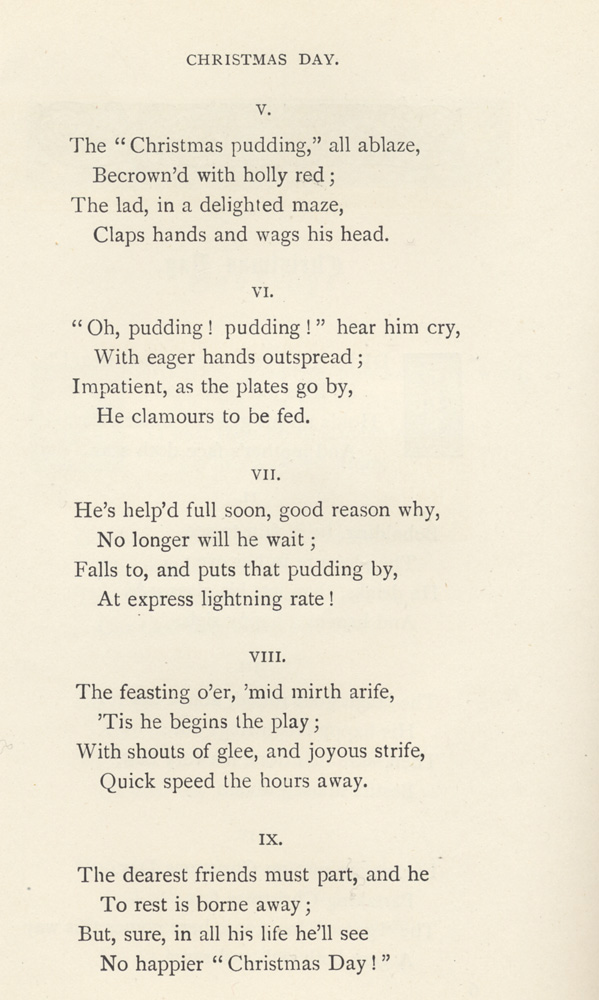
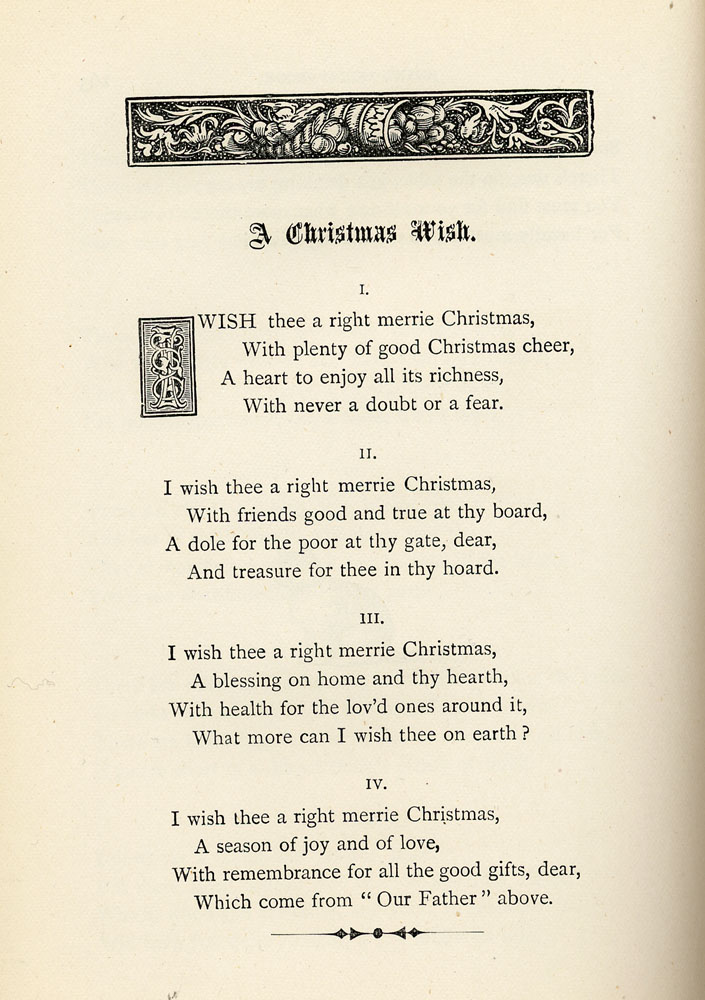
For this festive time of year we are featuring 3 seasonal poems by Helen Lee, taken from an anthology entitled "Bits of Things", published 1893; along with articles from the Blackburn Times on Christmas fare and Christmas weather.
The Christmas Dinner
It seems to be well nigh impossible to vary the Christmas dinner very much, and the majority are well content to sit down year after year to a turkey, goose or big joint of Christmas beef, with plum pudding, mince pies and Stilton cheese to follow. Some indulge instead in a roast sucking pig, a leg of pork or a hare, but somehow these scarcely seem so Christmas like as the turkey. Fowls, ducks and pheasants come in for small families where a turkey - even a small one is deemed too large and where warmed up foods are not liked. The day after it has been roasted the turkey is however quite delicious served cold. When it is re-heated it is important not to give it a harsh-like taste or to take away the piquant flavour of the bird itself by adding too many other ingredients. To re-heat gently in a delicately flavoured sauce is better, never letting this boil when once the meat has been added. Stewed celery, Brussels sprouts, parsnips, haricot beans are all suitable vegetables to serve on Christmas Day.
A seasoned pudding may be served with a roast leg of pork instead of stuffing, if liked. It is made with 1lb of crumbs of bread, a large boiled onion, a dessert-spoonful of dried sage, a little salt and pepper and one or two eggs.
A very simple stuffing for a turkey is preferred by some and is far more likely to agree. It can be made with 4oz. breadcrumbs, 2 oz. suet, a tablespoon of mixed herbs, seasoning to taste and an egg and a little milk.
For stuffing a goose, take 4 onions, boil till tender, mince them very finely with 7 or 8 well scalded and dried sage leaves and mix with 5 oz. freshly grated crumbs, 2 oz. chopped beef suet and a good seasoning of salt and black pepper. Bind with the yolk of an egg.
A good cold sauce for the plum-pudding is made by beating to a light white cream, equal quantities of fesh butter and brown sugar and flavouring with a squeeze of lemon and a dash of grated nutmeg. Set in a very cold place till wanted and send to table in a glass dish.
For the Christmas dinner of an invalid, a chicken may be placed in a large basin ina steamer over boiling water. Cover tightly with a lid, steam for 2 hours and serve with white sauce. This may often be eaten when the doctor will not allow roast birds.
It is not a bad plan when preparing the Christmas turkey to fill the crop with sausage meat and to make a veal forcemeat for the inside. Two or three slices of bacon can be skewered over the breast, but must be removed 20 minutes before serving.
The feet of a goose should be yellow, because as the bird gets older the feet take on a deeper hue. Only add just enough water to the apples for apple sauce for the goose to keep them from burning. When reduced to pulp, mix in a little sugar, a squeeze of lemon and a tiny bit of butter. Some people who object to the richness of an ordinary stuffing, fill a goose with sliced apples instead and then do not make apple sauce.
Never use indifferent fat for roasting a bird on Christmas Day, it can give the meat an objectionable flavour. Be quite sure beforehand that the dripping you are going to use is of the best. Don't cook the Christmas beef in a cool oven or it will be sodden.
A hare pie, with forcemeat and fresh sausage in it is very nice at Christmas time and hare soup is delicious. So if generous people shower more than one hare upon you, hang the one that will keep best and then serve it up quite differently from its predecessor.
Blackburn Times, 1913
The Christmas Weather
In olden times there were many simple and inexpensive means of foretelling the weather and people would as boldly predict for next years as for the ensuing afternoon. There were certain days in the year which were set apart as specially guiding them to the climatic conditions for weeks or months after, and rightly or wrongly, the belief in many of these days still holds good when a large number of people are gathered together.
Although we no longer look on Christmas Day as an infallible guide to the future, there are many persons who have a hazy notion of the day's influence on coming events. All Saints and Christmas Days were said to have the same weather, while according to the Sardinians, that of St. Lucy (December 13th) was just the reverse. As to Christmas and the days near the festival, they served to foretell the whole of the following year, and naturally the old saying-"A green Christmas makes a fat churchyard" was taken for granted.
According to various prognostications we find: When Christmas Day cometh while the moon waxeth, it shall be a very good year, and the nearer it cometh to the new moon the better shall that year be.
When on the Christmas night and evening it is very fair and clear weather, and it is without wind and rain, then it is a token that the year will be plentiful in wine and fruit. An abundant crop of apples was expected if on Christmas Day the sun came through the apple tree.
Blackburn Times 1918
My Memories of Bonfire Night
By Stephen Smith
“Bonfire night, the stars are bright,
And all the little angels are dressed in white.”
And all the little angels are dressed in white.”
That was a song for the girls, and for the little kids, not for the likes of us. You wouldn’t catch us singing songs like that, no way. At eight years old we were above songs like that, except at school when we were forced to, but the words stuck in our throats. We had to imagine a bonfire in the middle of the hall and skip round it singing those words, uhk! Perhaps if the teachers had let us sing the next few lines we would have been suited, but they never did.
Can you eat a biscuit?
Can you smoke a pipe?
Can you go a-courting
At ten o’clock at night?
Can you smoke a pipe?
Can you go a-courting
At ten o’clock at night?
Bonfire night came in its season like everything else in those days. There was a marble season, conker season, football and cricket seasons, and they all came round in their turn. There wasn’t a recognised time for these seasons to start, they just happened. One day you would see everybody playing marbles, or some other game and that would be the beginning of it and just as suddenly, it would be over. Bonfire night was like that, one day, about two weeks before the 5th of November, or it might have been three weeks, the kids from our part of the estate would all gather together on the backfield.
Let me explain about our backfield. I was born and bred on Tintern Crescent, Little Harwood. The houses there all backed on to the field. Our field was surrounded by houses on Tintern Crescent, Kelsall Avenue and Fountains Avenue. At times like bonfire night, I always imagined the houses to be covered wagons surrounding our camp like at the pictures, we were the cowboys. As well as our backfield, which we called the bottom backfield, there was another field further up which we called the top backfield, like ours. It was also surrounded by houses. We never mixed with the top back fielders at the best of times, but at bonfire night we became deadly enemies.
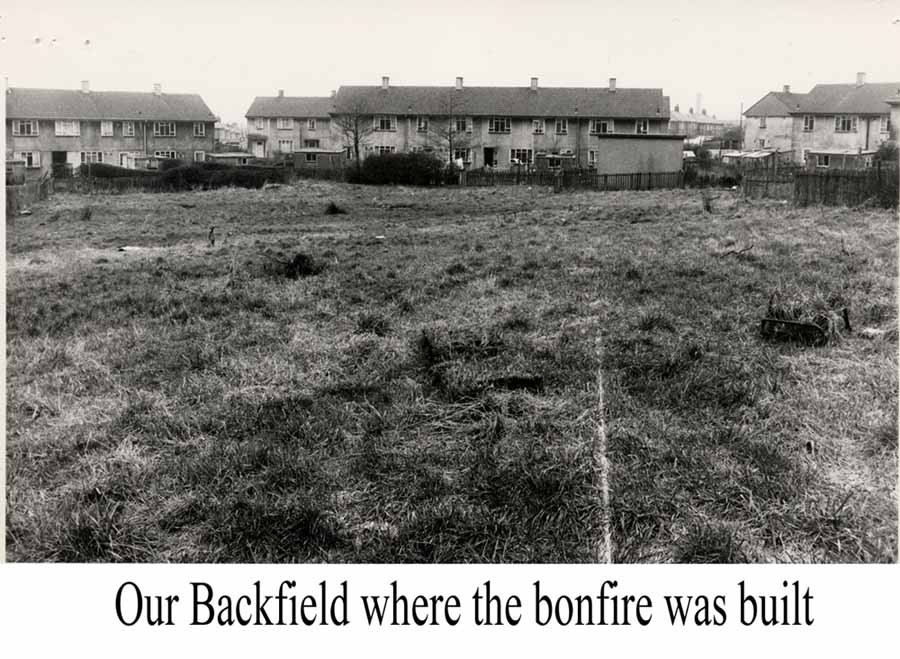
The time I am talking about would be in the late fifties. Money was still tight but it was a golden time to be a child. There were very few restrictions put on us, as long as we came in for our dinner and tea, the rest of the time was our own to go and do as we pleased. We played army in the fields, football and cricket on the reck, chasing games around the streets. But one thing we hardly ever did was to play on the backfield. It was rough and muddy, full of holes and the grass was long. I remember once trying to cut the grass and make a football pitch, but it came to nothing. So the backfield was just used as a short cut from Tintern Crescent to Kelsall Avenue, building bonfires and very little else.
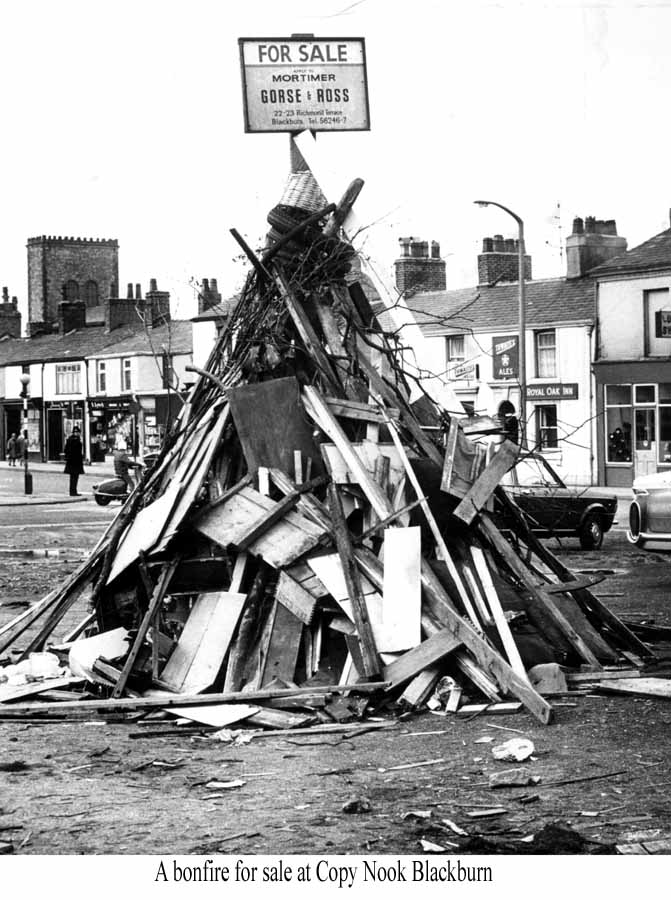
As I said, a few weeks before bonfire night we would gather on the backfield to decide where we would build the fire. This was a ritual that happened every year, but it was always built in the same place. We also would decide who would go with who to collect wood and where we would go and all the other complicated arrangements that go with building bonfires. This process could in itself take a day or two because we always would get side tracked, “let’s go and see if they’ve started their bonfire on the top field,” someone would say. So of we’d go. We’d all make our way to the top backfield. Near to it we would send a reluctant conscript to go on ahead to see if anyone was there, because we knew if there was they would not like our intrusion and would chase us off, better to sacrifice one than us all.
If they had started building their bonfire we would ask the scout how big it was, did they have a guard and other such questions. If they hadn’t started theirs, then we felt good and knew we were one step ahead of the game.
Collecting the wood was always the most fun, or at least that’s what I thought. If you were left as a guard, especially at the beginning before the bonfire began to take shape, it was awful. The guards would be expected to prepare the ground where the fire was to go and guarding an empty piece of grass was not an enviable job. No one, for the first few days, took the job seriously. You might come back and find all the guards gone and the field empty. Those collecting wood might decide a game of football was a better option, and if you were a guard the first thing you would know about it was the sound of a football being kicked on the street. But after a day or two things would settle down.
During the week we would be at school so the business of the bonfire could only be tackled at night and weekends.
The school we attended was St Stephens, which was just a short walk away from were we lived. We could be home in five minutes. On our way we would look for any likely places for wood. On reaching home there would be a quick change of clothes and onto the backfield until teatime. Straight after tea we would be out again collecting wood. There were many places we could go for wood. There were the plots just off Philips road, always good place to start. There was always an old cabin or fence that needed removing and, with a little help, a half good cabin could always be made in to ruined one.
There was one place in particular which always seemed a good bet for wood and that was at the back of St. Stephens Conservative club, where there were the ruins of what I assume was the old stable block that once belonged to Little Harwood Hall. I remember one year getting a real prize there; an old rafter, which had fallen from the roof. The thing was how could we drag it all the way up a rough track and then up Greenhead Avenue? We tied some rope around it and began pulling. After a good hour of back-breaking work, we'd managed to get it to the top of the track, but knew it would be near impossible for us to get it to our bonfire, even with six of us.
Now, on one side of the track there were some sheds. In the top one was a sail-maker. He used to make and repair canvasses for wagons. While we were contemplating how we might drag the rafter up the hill, he drew up in his old van, asked us what we were doing and where we'd pinched the wood from. That’s it we thought, all that hard work for nothing. We told him.
"Right then fasten it to the back” he said and turned the van round. We tied it to the bumper of the van. He was our saviour; he towed it all the way to the backfield, with us kids chasing after him up the road. When we’d got it to the field, he told us to go back to his cabin the following night and he would sort out some wood for us. When we went there was a large pile of wood on one side of the shed and a pile of old canvas on the other.
We took the lot. Going to school the following day he stopped us and asked us if we had taken the canvas.
“Yes,” we answered and thanked him.
“You bl..dy fools, that was for a job I was doing!”
That night we had to take it all back. We would also go knocking on doors, asking for things for the bonfire but we never strayed far out of our area and we certainly would not dare to encroach on the top backfield’s territory, as they wouldn’t into ours. You would always get a good response because it gave people the chance for a good clear out. We wouldn't only get wood, but also hedge cuttings and branches, in fact anything that would burn and although you didn’t like taking this rubbish, you had to take the good with the bad. All this would be transported to the bonfire and gradually it would begin to grow. The guards now played an important part in the process and everybody wanted to be one. The first job you did, as a guard was to build a den and light a fire, then as the wood came in it would be sorted and stacked. Everyone had a turn as a guard. There would always be two or three, usually two big lads and a little one.
I remember once we returned with a load of wood and found the guards had a large pan boiling away over the fire. They told us it was some broth they had made. It smelt good. Using anything to hand we all began to eat it, all that is, except the ones who had made it. When we had had our fill, we asked them where they had got the vegetables from. We realised our mistake. It turned out that they'd used all the old vegetables from the compost heap my father kept on the field.
As bonfire night approached things would become more hectic. Our only goal in life now was to have a bigger bonfire than the top backfield, by fair means or foul.
As bonfire night approached things would become more hectic. Our only goal in life now was to have a bigger bonfire than the top backfield, by fair means or foul.
We began to plot. Plans were drawn up as to how we could make raids on their bonfire and pinch their wood. They were doing exactly the same thing as we were. They to were planning raids, on our bonfire It was just a case of who would strike first! I remember one year when we decided to raid their bonfire. We were determined to strike first and so we plotted and schemed. Some of us would go round to the top of the field, as though an attack would come from that direction; the rest of us would go by the bottom path and, while they were distracted, would take as much wood as we could, and get away. That was the start of a tit-for-tat spate of bonfire raids which lasted right up to the day before bonfire night, when all told, we probably all ended up with our own wood anyway.
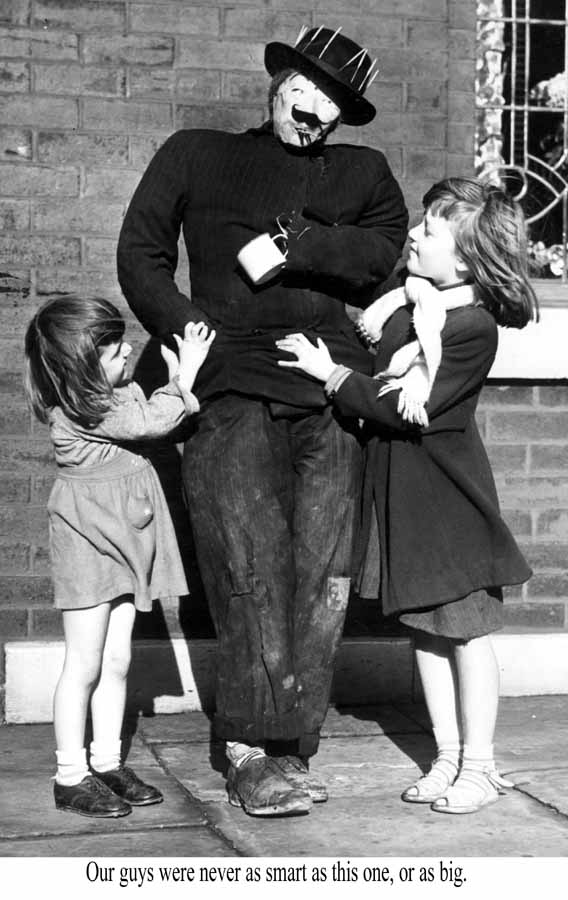
It was not all about collecting bonfire wood; there were other things to be done. The most important of these, after the wood, was the guy! The guy was so called after Guy Fawkes or Guido Fawkes He was the one, with some others, if you can remember your history, who attempted to blow up the Houses of Parliament in 1605, and failed, miserably some might say. He was hung, drawn and quartered for his troubles and was never thrown on a bonfire at all. However it was that same year, 1605, when King James I told everybody to celebrate his deliverance by lighting bonfires, whether an effigy of poor Guy Fawkes was thrown on that first bonfire I don’t know, but later just about everybody else was - the Pope, politicians, and, I have no doubt, the King himself. But at eight or nine years old we weren’t interested in all that ancient history. The guy for us was a money-making venture. The guy’s role, long before he was placed in pride of place on top of the bonfire, was as I said to make us kids money!
Again it seemed like weeks before bonfire night, we would collect together old cloths and newspaper or straw and begin to put our guy together. It was never as spectacular as the one shown above, but was passable, just. It had to be or we’d get nothing. We would tie the bottom of the legs up of an old pair of pants and then stuff them with paper until it had thighs like an all-in-wrestler. Then we would stuff a shirt with more paper, which we would put into a jacket. How to join the bits together would always cause a problem for us. We’d usually let the girls do that bit. The head was always a small bag or pillowcase stuffed with paper, the face being painted either in black paint, or drawn on in charcoal.
One year, we thought the eyes would look better if we used pin-wheels. They made them look big and staring. Unfortunately they somehow went off when no one was there. Probably a spark from the guard's fire caused it. We found it the next day burnt to a cinder. Another time we gave him a cap, instead of the usual painted hair. One of the lads fetched it, telling us it was an old one of his Dad’s. We fastened it on by making holes in it and tying it to the head. It turned out that it was his Dads best flat cap. He was looking for it weeks after, we never said anything though.
The prime object of the guy was to make us money, not just to buy fireworks, although we did use it for that, but also to buy pop and toffee and such things. To achieve this we needed to be mobile. As kids, and living on an hill, we all had flat wagons. We would pick the biggest and best-looking one, usually mine and my brothers, because my dad was an expert at making them. We would use this to transport our guy all round the estate. We were fortunate enough to live near Mullards, probably the biggest employer in Blackburn at that time. After school we would load the guy on to the flat wagon and pull it round to Fountains Avenue and wait like vultures for the workers to come out, which they did in their hundreds, and we would pounce.
“Penny for the guy mister?”
On the flat wagon would be an old biscuit tin which, we hoped, would soon begin to fill with pennies and half pennies or even better threepenny bits and sixpences.
“Penny for the guy Misses?”
The women always seemed to give the most. Men would tend to push through you or perhaps throw a ha'penny. Women on the other hand would nearly all give something, that is, if you could catch their eye. When the rush was over from Mullards we would knock on doors asking for money, but only at the houses in our area. We would, I suppose, make nuisances of ourselves by doing this, but as most of the houses on the estate had children we could always expect a copper or two from them.
Lighting up the Sky
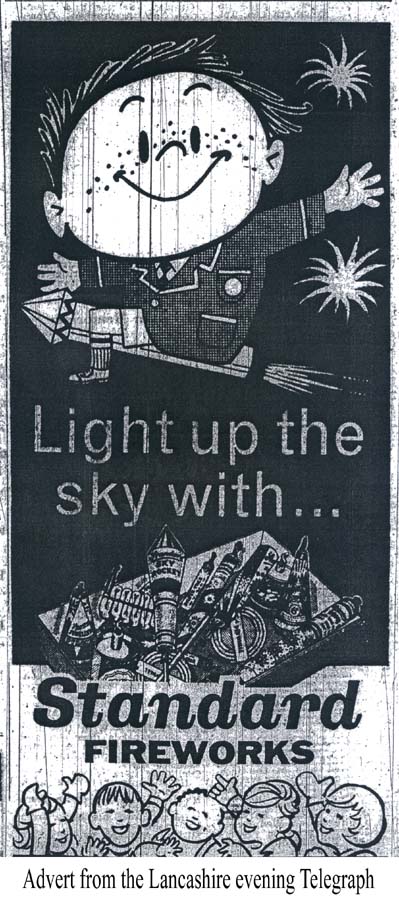
I don’t think they were as strict about who could buy fireworks in those days, because I can remember always having a few bangers that we would set off, but it was much nearer to bonfire night before they started selling them than it is nowadays. A banger would cost a penny and you could have a lot of fun with half a dozen. It would be a lie to say we never got up to mischief with them, or never played dangerous games because we did. On one occasion my older brother put a banger in the lock of a neighbours coal shed door. It exploded like a bomb going off and blew the lock right of the door, but I suppose that’s the sort of thing that kids have always done. We also liked putting them under buckets on the street and setting them off as people passed, which usually made the jump.
Waiting for the night to come was always exciting. I don’t know if we were allowed out longer on the days leading up to bonfire night, but it always seemed like it. We would all sit around the camp fire next to the bonfire with bottles of pop, biscuits and toffees bought with the money we had collected, telling jokes and saying what fireworks we would get, always exaggerating.
There was always one night off from working on the bonfire, at least for our family, and that was Halloween. On that night Dad would take us up Pendle Hill to see “the witches”. Even in those days, the early 60’s, it was a popular place to go and people would flock there. One year I totally convinced myself that I actually saw three witches riding on horse-back over the Nick of Pendle, with their black capes flying out behind them. They were even carrying their broomsticks. It was raining and very dark, but as far as I was concerned they were there. A few weeks ago, while relating this tale to my sister, she utterly surprised me by confirming it. She too remembered the witches on horseback that night, but not the broomstick!
There was always one night off from working on the bonfire, at least for our family, and that was Halloween. On that night Dad would take us up Pendle Hill to see “the witches”. Even in those days, the early 60’s, it was a popular place to go and people would flock there. One year I totally convinced myself that I actually saw three witches riding on horse-back over the Nick of Pendle, with their black capes flying out behind them. They were even carrying their broomsticks. It was raining and very dark, but as far as I was concerned they were there. A few weeks ago, while relating this tale to my sister, she utterly surprised me by confirming it. She too remembered the witches on horseback that night, but not the broomstick!
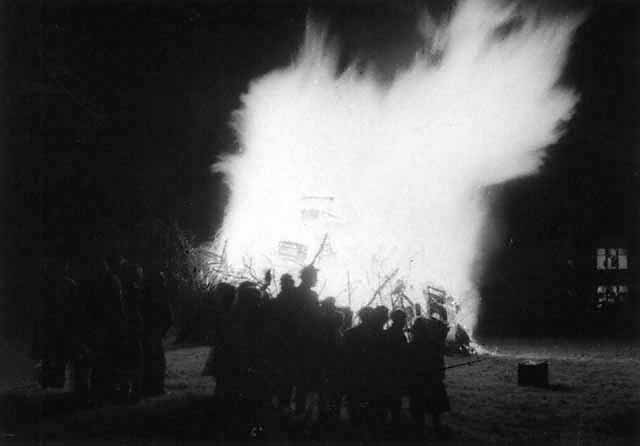
Bonfire night would finally come around. All the waiting and preparation would come together. I can’t remember if we had a day off school, if the fifth happened to fall on a weekday. We would rush through our tea, and then be out onto the field to make any finishing touches to the bonfire. Then it would all be spoiled. All the hard work and time we had put in would be for nothing. I am not talking about it raining or anything like that. I can’t ever recall it raining on bonfire night. No it was much worse - our Dads!
They would come out in force! It would be about half past six at night. They would all gather together on the back field and look at the bonfire we had spent weeks creating. You could guarantee that it would have either been built in the wrong place or the wrong way, so down it all had to come and a complete rebuild performed. We would not be allowed to touch anything. It was now out of our hands. They would send us round to houses to collect stacks of old newspapers that had been put aside for this night, or bits of old wood out of backyards that had been forgotten until now. We could only watch, as our hard work was systematically pulled apart, our den, built into the middle of the bonfire with such care, with its carpet on the floor and if there was plenty of it, lining the walls too, all destroyed. This part of the proceedings would probably take the best part of an hour. A good sturdy centre pole had to be found and secured into the ground, with the rest of the wood being carefully built around that. Finally they would be satisfied. Meanwhile, our guy would have been sitting patiently on its chair waiting to take pride of place on top of the fire. When everything was ready, he would be paraded round the bonfire by us kids with all due ceremony, held over our heads, while we all sang this old song
Guy Fawkes, Guy
Stick him up on high,
Hang him on a lamppost
And there let him die.
Stick him up on high,
Hang him on a lamppost
And there let him die.
All the mothers would have come out to watch this part of the proceedings, some around the fire, but most standing in their own, or a neighbour’s garden looking over the fence. There would be wild chatter and shouting and it would now be dark enough to think about lighting the fire. The guy would be taken from us and, still on his chair, would be hoisted to the top bonfire and secured, while we continued our singing.
Guy, Guy, Guy,
Poke Him in the eye,
Put him on the fire
And there let him die.
Poke Him in the eye,
Put him on the fire
And there let him die.
Our excitement was intense, now that the time of lighting the fire was so near. We would be getting under everyone's feet, as we ran about in anticipation of the fun to come. The occasional swear word would come from one of the fathers, whose ankles had been caught with a piece of wood that someone was waving around. There were always stray pieces of wood knocking about. The dads would have made a reserve pile of wood, to be put on the fire later. We would take this wood to throw on the bonfire and, if caught, get a clip round the ear for our trouble. Everyone was allowed to shove the paper into the fire. Some of the more careful fathers would tie the paper in knots to make firelighters, but the majority would just crumple it up and stick it in any suitable gap.
Half past seven was the usual time that the fire would be lit. Petrol would have been thrown on the fire and matches or lighters taken out. Brands of paper would be lit, taken to the bonfire and used to light it. There was always that five minutes when you were unsure whether it would burn.
Half past seven was the usual time that the fire would be lit. Petrol would have been thrown on the fire and matches or lighters taken out. Brands of paper would be lit, taken to the bonfire and used to light it. There was always that five minutes when you were unsure whether it would burn.
“It’ll never take hold,” someone would say, or “Get more fire over this side, it’s nearly out here,” someone else would shout. But slowly, with the petrol and paper it would take hold. It seemed our excitement could not get any higher, we would be running round the fire whooping like a bunch of wild animals singing
Remember, remember the fifth of November
Gunpowder, treason and plot.
I see no reason, why gunpowder treason
Should ever be forgot.
Gunpowder, treason and plot.
I see no reason, why gunpowder treason
Should ever be forgot.
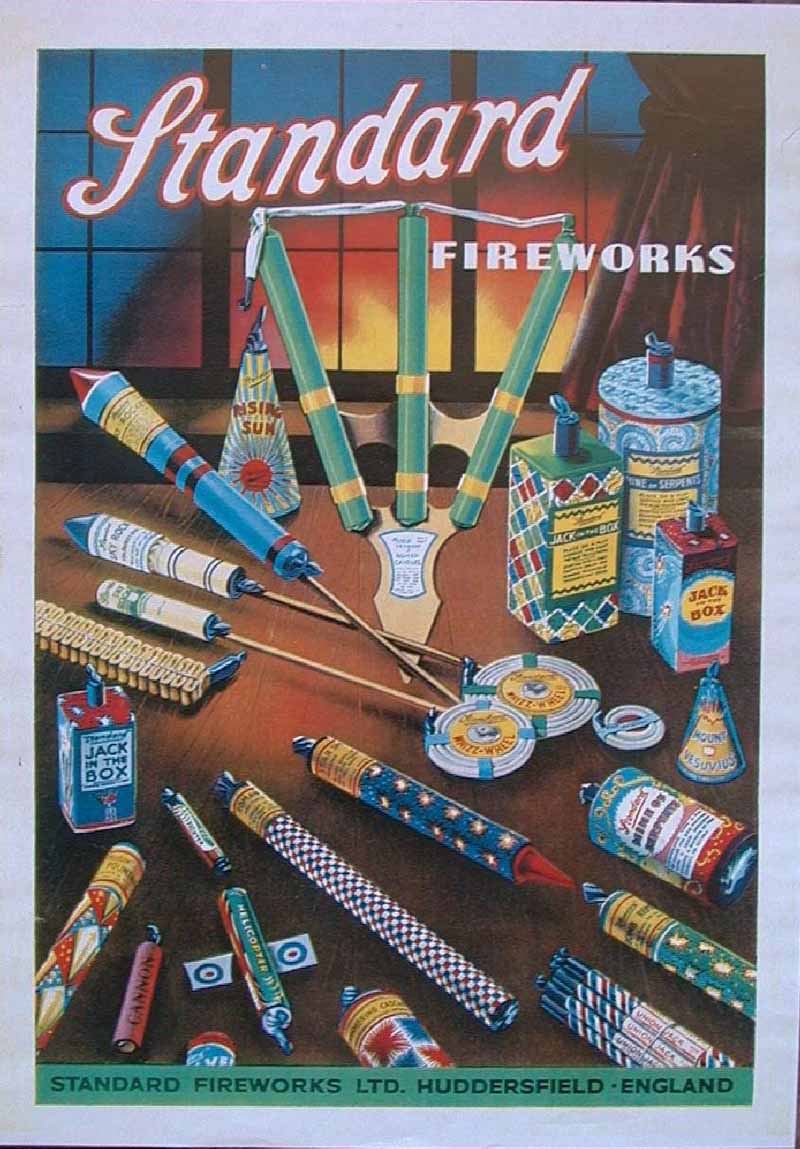
When the fireworks were brought out, our excitement reached its height. I can remember going with my father for our fireworks and always thinking he’d not got enough of them. He always seemed to leave it until the last minute and it seemed the best had already gone, but we always got enough and they made a good show.
Setting the fireworks off was again a job the dads always performed, at least round our bonfire. A trestle table had been set up for some of the fireworks and milk or pop bottles were there to set off the rockets. I can just remember some of the fireworks we used to have. There were sky rockets, which always seemed to me the best. You could see these exploding in the sky in every direction.
There were Roman Candles which sent a burst of stars into the sky; things called Jack in the Box; and Mount Vesuvius. There was one called an aeroplane. It was small and had wings and was launched from a ramp. All these were set off by the dads, with us watching on. There were some fireworks we kids were allowed to set off ourselves; one you would hold in your hand and wave about, as sparks came flying out. They finished with a loud bang. Others were sparklers, but I think the best we were allowed to set off were what we called “flip flaps.” Whether that was their real name I don’t know. They were made in a zigzag. How we loved throwing them amongst the older girls The flip flap would bang and jump and cause havoc amongst them. They would scream and hold each other in terror, whether real or assumed I don’t know.
The fireworks were generally kept in old biscuit tins, with the lids on and taken out one at a time. They were lit with a slow match, a piece of rope that came with the fireworks. It was lit and would smoulder all night. I remember one of the older boys who had his own fireworks, which he kept in a biscuit tin. He had also got some money, about £3 or so in notes, which he had put in the tin with the fireworks. Unfortunately he was not as careful as he should have been and did not use a lid. Whether it was a spark from the fire, or from a firework, no one knows, but all his fireworks exploded and everything in the tin including his money was destroyed. For a long time afterwards he was known as the lad with money to burn!
The fireworks were generally kept in old biscuit tins, with the lids on and taken out one at a time. They were lit with a slow match, a piece of rope that came with the fireworks. It was lit and would smoulder all night. I remember one of the older boys who had his own fireworks, which he kept in a biscuit tin. He had also got some money, about £3 or so in notes, which he had put in the tin with the fireworks. Unfortunately he was not as careful as he should have been and did not use a lid. Whether it was a spark from the fire, or from a firework, no one knows, but all his fireworks exploded and everything in the tin including his money was destroyed. For a long time afterwards he was known as the lad with money to burn!
Apart from some minor burns and singed hair, accidents were rare. I can only remember one fairly serious event and that was when my sister picked up a spent sparkler. Unfortunately it had only just burnt out and she picked it up at the wrong end. It left a very bad burn on her hand, and a very distraught little girl.
When the fire had burnt down a bit, which was usually after the fireworks, it was time for the potatoes to go into the fire. Mothers would fetch the biggest potatoes they had and they would be put into the embers at the side of the bonfire. They never had a chance of being properly cooked, long before that point was reached, we would, if we got a chance, pull them out with sticks. They would invariably be black on one side and hard on the other, but we loved them and would try to get as many as we could without being caught by a grown up. I don’t think any of them got properly cooked.
My Dad once bought a large bag of chestnuts to put on the fire, but this was a complete failure, as I don’t think we found one of them. Another special treat was treacle or bonfire toffee made by our mother. I seem to think the recipe was something like treacle, brown sugar and lard, or butter. It was made in a large frying pan and then poured onto the cold floor so it would set quicker. it would set like concrete and you would chew until it made your jaw ache.
My Dad once bought a large bag of chestnuts to put on the fire, but this was a complete failure, as I don’t think we found one of them. Another special treat was treacle or bonfire toffee made by our mother. I seem to think the recipe was something like treacle, brown sugar and lard, or butter. It was made in a large frying pan and then poured onto the cold floor so it would set quicker. it would set like concrete and you would chew until it made your jaw ache.
Finally the time would come when the mothers and older sisters would begin to wander back home. The very young children would be taken with them. Shouts would ring out: “another half hour you kids and then home,” and we would make the best of the time, running round the fire, throwing the last remnants of wood on to it. We would be dirty. Our cloths would reek of fire. Our hair and eyebrows would be singed. Our eyes stung from the effects of the smoke and we would be tired, but we were happy and generally ready to go in.
After we kids had gone, the fathers would stand about for a bit longer and talk, perhaps even have a tot of whisky, if someone had brought a bottle out. Having gone in we would be given a bath and our supper and sent to bed. From our bedroom window we could look out over the field. By now the bonfire would have been given over to the older boys and courting couples. My sister Marian always remembers seeing our eldest brother Bob standing by the bonfire with his arm round his first girlfriend.
The next morning, on our way to school if it was a weekday, we would collect spent fireworks. Was this a throwback to the war when kids would collect shrapnel? We would collect all we could and swap ones we already had and then display them to see who had the best collections. After a couple of days they would all be thrown away and bonfires, guys and fireworks would be forgotten for another year.
DARWEN MOORS TRAGEDY: DECEMBER 1917
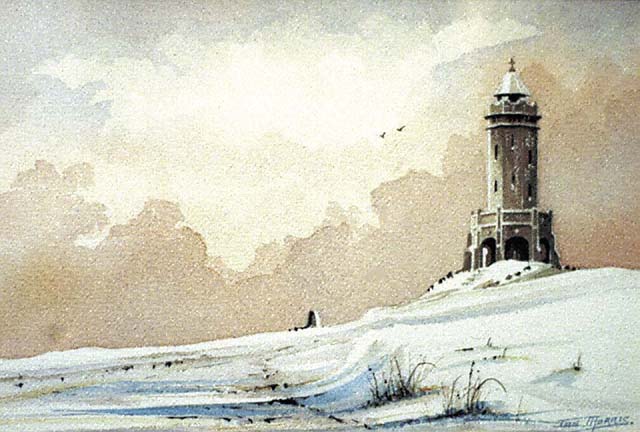
© Harold Heys - terms and conditions
Darwen moors can be inhospitable and dangerous in the winter, painting by Ian Morris.
Greater love hath no man
By Harold Heys
DARWEN'S sweeping moorland has always had a rugged attraction, especially in the summer months when families take to the footpaths and tracks which meander through the surrounding hills to enjoy both the exercise and the fresh air.
In winter, however, the moors can be inhospitable and dangerous, especially if walkers are not prepared for the weather which can change in minutes.
It was much more perilous many years ago when footpaths were rough and ready and when danger from deep gulley’s and old mine workings lurked at every turn.
It was just a few days before Christmas, 1917, when three local lads decided on an afternoon walk on to the moors to the southwest of Darwen after Sunday School at St Bamabas'. It was both adventurous and dangerous for they set off in the face of the most severe blizzard the town had seen for years.
All three were found dead in the snow drifts during the next few days of frantic searching by police and volunteers.
It was a tragic story made even more poignant by the revelation of a selfless act of courage by 16 year-old Ralph Bolton ...
The joint funeral and the formal inquest were over in days and the tragedy was soon pushed into the background as the prospect of another long year of war dominated every part of life - and death - both locally and nationally.
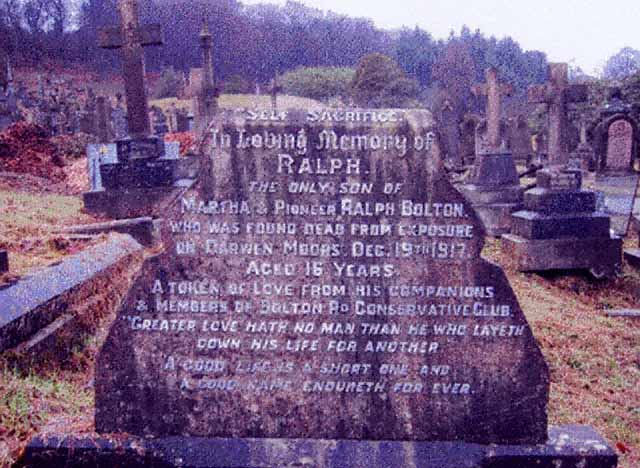
© Harold Heys - terms and conditions
"Self Sacrifice" reads the top line of Ralph Bolton's headstone.
The three lads were William Cooper Longton of Culvert Street, which was close to the church, just 18 and due to join the Army within a few weeks; Ralph Bolton, of Maria Street and his ten-year-old cousin James Bolton of Princess Street - where Mayfield Flats now are.
Why did they set off for the threatening moors when it would be dark in an hour and in weather which, according to the Darwen News was "wild in the extreme" and with "their only shelter the heavens above"?
The paper said: "It must forever remain a mystery." But, looking back now, with old maps of footpaths to hand, it seems fairly clear that the boys simply took a wrong fork.
William was wearing a blue serge suit and a dark, heavy overcoat; Ralph had a blue serge suit, brown overcoat and leggings and little James wore a black suit and a light top coat.
They knew the moors well, but this was precious little protection against the drifting snow and piercing north-east wind.
The alarm was raised that Sunday evening and by dawn a big search was under way. The boys had been seen heading in the direction of Rough Height Farm above Bull Hill Hospital on the southern moors. Snow had drifted up to 10ft and conditions were very difficult.
It was on the Tuesday afternoon that the body of William Cooper Longton was found to the south of Old Lyons farm which was over to the west, on the Cadshaw Brook side of Black Hill and a couple of miles from the safety of Bull Hill. It seems that he had set off to get help and had reached the farm only to find it unoccupied before pressing gamely on.
On the Wednesday, after a slight thaw, the body of little Jimmy was found under drifting snow in the lee of a stone wall about 400 yards to the north of the empty farm.
He was wrapped in his cousin's brown topcoat which had been carefully placed over his own light coat.
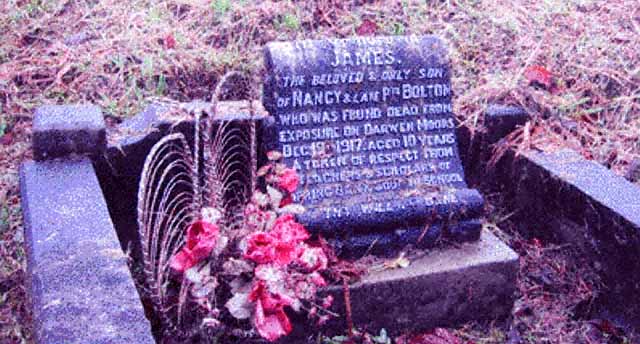
© Harold Heys - terms and conditions
Ralph himself, left with just his cheap suit, was found frozen to death about 200 yards away. It seems as though he, too, had set off to get help after making the little boy as comfortable as he could.
In the pocket of the coat Ralph had wrapped around the child was an emblem bearing the legend: "Fight The Good Fight" and, as the Darwen News report asked: "Had he not done just that when he gave his overcoat to his young cousin?"
On the Saturday the bodies of the three pals were taken from their homes to a moving funeral service at St Bamabas' where the older boys had been in the Church Lads' Brigade and in the choir. William had also been the Sunday School secretary.
Hundreds of mourners packed the church and there was no more sad a figure than frail Mrs Nancy Bolton, whose husband Joseph had been killed in action in France the previous summer and who had now lost her only child at the age of just 10.
Hundreds more lined the route to the nearby cemetery, their sadness compounded by the desperation of a continuing and bloody war and the selfless heroism and fine example of a 16-year-old boy.
William was buried with his grandparents. The cousins were interred together, just a few yards away. Ralph's gravestone bears an inscription taken from John 15:13 "Greater love hath no man than he who layeth down his life for another. "
A simple wrong turning in the blizzard looks the likely cause of the tragedy. An uncle of the younger boys and his family lived at Duckshaw Farm above Bury Fold and it was thought that they might have been heading there. It would have been adventurous and dangerous but perhaps not as foolhardy as it had seemed.
As they approached Rough Height a right turn to the footpath through Higher Barn, Meadow Head and Wet Head would have taken them to the safety of Duckshaw Farm before it went dark. From there it was an easy walk home; down through Whitehall or Bury Fold. Instead, above Bull Hill, they pressed on slightly more to the west - and on to their deaths.
The hurried inquest on the day after the last body had been found discounted the theory that the pals were heading for an uncle's farm as it was "in the opposite direction." It wasn't. Duckshaw Farm, where William Bolton and his family lived, was just to the north of Black Hill and the lads had probably simply taken a wrong turn in the heavy snow as the footpath forked..
A moving postscript to the drama was penned by the writer of a letter to the Darwen News a few days later when local folk were still asking what had made them embark on what had seemed such an ill advised venture.
"Such confidence, strength of purpose and love of adventure was obviously displayed by these lads and the crowning sacrifice made by one in giving up his overcoat only emphasised the true British spirit which their elders are displaying every day on the battlefields of Europe."
Everyone has their hero. Ralph Bolton is mine.
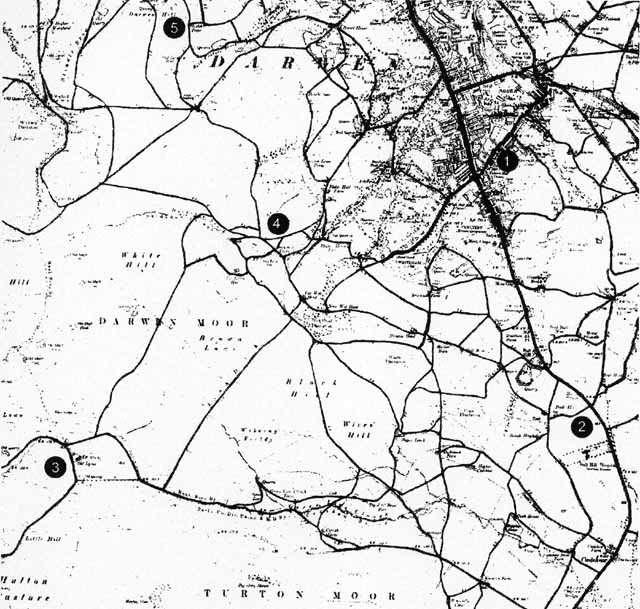
© Harold Heys - terms and conditions
1. St. Barnabas'; 2. Bull Hill; 3. Old Lyons; 4. Duckshaw Farm; 5. Darwen Tower.
Article written and researched by Harold Heys.
Harold Heys
Harold Heys is a semi-retired journalist who has always lived in his home town of Darwen. An old boy of Darwen Grammar school, he was a journalist with the Lancashire Evening Telegraph before joining the Sunday People where he became chief sports sub-editor and production editor. He retired as editorial systems manager of Newsquest in 2001. He has had a lifelong interest in Darwen and its history and is on the committee of the town's Civic Society. Among his other hobbies he includes horse racing and its history, DIY, snooker, painting, design, writing and computers. He says he is now, in his early 60s, "a professional grandfather."
Collecting Conkers
by William E. Ferguson
© Gordon Hartley - terms and conditions
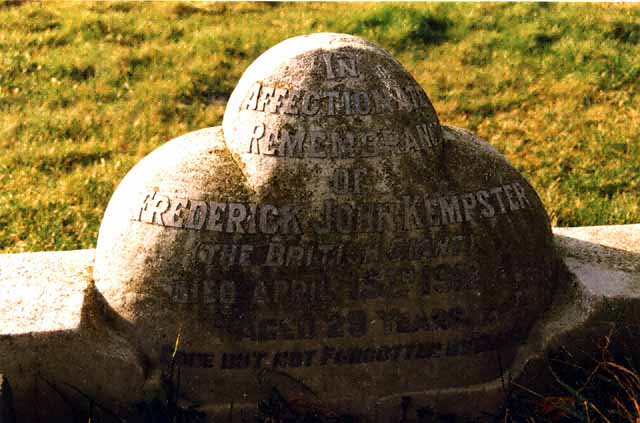
Reading the pages about Fred Kempster brought back fond childhood memories of visiting this grave and collecting conkers. I recall it was a late summer game played in September.
This coincided with the start of a new school academic year. Collecting conkers was the first thing to do and this was often an evening activity. I did not change into play clothes but went on the conker expedition still dressed in my new school clothes.
There were lots of trees around where I lived in Little Harwood but the best place to go conkering was to the town cemetery. It was a short 15-minute walk from home to the cemetery.
It was a quiet, spooky place. My friends and I felt scared and apprehensive. It was the thought of ghosts and the cemetery watchmen who I called 'Old Sam.' I never found out what he was really called. He would chase you away. If he caught you, you would be in a lot of trouble. Everyone was scared at the thought of police arrest; being scolded by our parents for playing in a place we should not have been.
These fears made our conker expedition all the more daring. It was these fears that made us not go alone. Collecting conkers was a group activity, which was done with your friends. Our fear was conquered by strength in numbers. As well as the abundance of conker bearing trees we also liked to visit interesting graves. The best was the Giant's grave.
My Gran had told me about Fred Kempster who was known as the British Giant. Our first activity on arriving in the cemetery was a pilgrimage to this grave. We marvelled at the length of his grave and exaggerated how tall he had been. We also left flowers on his grave. These were picked wild but sometimes mischief reigned and we ‘borrowed’ flowers from the gardens we passed on our way to the cemetery.
We never disturbed the graves we went by. We treated them with childish respect for we believed bad luck and scary things would happen to you if you messed about. It was okay to hide behind them but not to walk across them. It was for this reason that we checked most carefully the area around the ‘conker’ trees for we did not want to suffer misfortune by accidentally standing on someone’s grave.
Our first task was to search the ground for windfalls. These belonged to the person who found them so it was a free for all in this task. Once this was over there were the ones in the trees to collect. This was a task in which we needed to work together. The way we got the conkers to the ground was to throw sticks or stones into the trees. These missiles had first to be collected and this was a job for everyone.
We would take it in turns to throw the stones into the trees and then collect the conkers the stones dislodged. We would do this for a considerable time until it was judged that we had enough conkers to play the game the following day in the school playground.
It would be dusk as we made our way out of the cemetery. The gates were closed about 8:30pm so we did not want to be locked in and clamber over the wall to escape but more often than not that was how we had to leave for we had misjudged the time.
There was one occasion that Old Sam scared the living daylights out of us. He had seen us collecting conkers when he went to lock the gate. We did not know that he had hidden behind a grave. On our way out he suddenly appeared and we fled in terror and scrambled over the high wall in seconds.
Once on the other side a head count to ascertain that we had all escaped and with our pockets full of conkers we ran home. The scary experience ensured that our annual conker collecting expeditions were brought to an untimely end.
Trouble was in store for me when I got home because my new shoes were now badly scuffed and my new clothes were dirty. I got a telling off and was sent to bed early because of the state I was in.
By William E. Ferguson
By William E. Ferguson