
 Loading more
Places of Worship
St Aidan's Church of England | Ringing the Changes: Holy Trinity's Church Bells
The Rebuilding of St Jude's | | St. Thomas's Church | St. Mark's | St. Philip's
All Saints | Holy Trinity | The Early History of the Parish Church of St. Silas | The Old Church of St. Mary The Virgin
Blackburn's Mosque Journey to Masjid Vali
St Aidan's Church of England
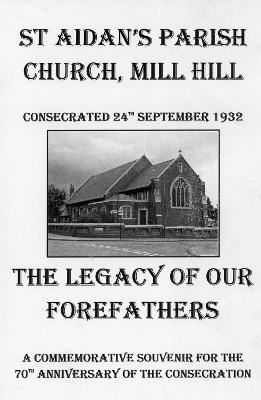 With the advent of the railway and the progress of the Industrial Revolution, sites were offered free of cost for the erection of cotton mills, and the area became populated. Before this there was only the parish of St Francis, Feniscliffe which extended from the bridge in Pleasington Fields on one side to Hollin Bank on the other and embraced the districts of Cherry Tree, Mill Hill and Waterfall.
The building of the Iron School at Bower House Fold and the erection of a beautiful church at Feniscliffe did not completely solve the problem, and a Mission Room was opened at Stakes Hall in January 1894.
Stakes Hall Mission Church, Mill Hill was consecrated on May 31st 1894. It was a substantial building of dressed stone and cost £500. Attached to the church was a clergy vestry, classroom and an institute for men. The church had accommodation for 350 persons.
A report in the Blackburn Times of September 14th, 1895 states “This quickly filled, showing at once the need of a branch of the church there. So successful has this mission been that although the place for service is an old fashioned low-roofed, disused farm kitchen, it has often been crowded to excess". Two upstairs rooms were used for Sunday school classes.
The Blackburn Weekly Standard of the same date stated “The Farm House, which was rented had been previously by a poulterer for dressing fowl and had to be fumigated. Rooms adjoining the building were used by a tripe dresser and the yard behind was used by a cow-keeper". No wonder that the Blackburn Times reported “The surroundings of this Mission are not attractive and agreeable, but so resolute has the Vicar been, that not even the most disagreeable smells, the poverty of his parishioners ,the need of funds nor the miserable place for worship,combined,have deterred him from carrying out his great purpose".
Part of that purpose was the building of a church and school at Mill Hill. On August 31st 1895, St Aidan's Day, John Rutherford M.P. laid the foundation stone of St Francis Mission Church Mill Hill. When the building was completed, services were held in the school, a chancel having been built at the east end of the school. The school was later known as Mill Hill C.E. School, then Norfolk Street School, and eventually took the name of St Aidan's C.E. School.
As well as the Rev Canon Blackburn Brown, other Ministers over this period were Captain Attwood of the Church Army, the Rev W. Woodall (1910) and the Rev James Sumner. In 1916, the Rev H. Moss was appointed Curate of Livesey with the care of the work at Mill Hill; this is the connection between the churches of St Andrew's and St Aidan's. In 1920, St Aidan's became a conventional district with Mr Moss as Curate-in-Charge, and, in 1926, the Parish of St Aidan's was formed with Mr Moss as the first Vicar.
The Rev. Harry Moss was a character in his own right and the people rallied round him and his wife to such an extent that the foundation stone of the present church was laid on the 11th July 1931, by the first Bishop of Blackburn, the Right Rev P.M. Herbert, D.D. Fourteen months later the building was completed and consecrated on the 24th September 1932 by Bishop Herbert. St Aidan's can claim the distinction of the first church to be consecrated in the Diocese of Blackburn. In 1938 a new altar was dedicated. This is now in the Memorial Chapel (Lady Chapel).
Following the death of the Rev Harry Moss, L.Th, the Rev J.H.O'Brien became the second vicar of St Aidan's on the 31st May,1947. During his vicariate, the interior of the church was considerably enhanced. In 1950, the Mothers Union banner was dedicated. In 1953, twenty one years after the dedication, many changes were made. A new High Altar with frontals and Riddell Posts, a Processional Cross, an Altar Cross and Standard and Altar candlesticks were consecrated.
A new Baptism Font was made by sculptress Josephine de Vasconcellos, F.R.B.S., originally intended for Blackburn Cathedral, was also dedicated, as were a new Prayer Desk, furnishings in the memorial Chapel and a Silver Wafer Box in memory or the Rev Harry Moss.
In 1954, the Duckworth Memorial Window was installed, while in 1956, a porch at the south west corner of the church was built on what was to have been the site of a tower in the original plans. Dr W. Baddeley, Bishop of Blackburn, in the presence of Mrs Moss and her daughter dedicated this porch to the memory of the Rev H Moss. The lighting system of the church was completely re-planned in 1966 prior to the decoration of the interior. The old pulpit was replaced by an oaken one the gift of Mrs J Ormerod and the late Mrs Gillibrand. New chairs were placed in the Memorial Chapel and, in the same year, the organ was moved into the nave of the church. In 1967, Mrs Topping gave a stained glass window of "Christ the Carpenter" in memory of her parents. During the vicariate of the Rev. J. Maxwell Lucas, 1968-1972, the heating system of the church was converted to oil firing, the Memorial Plaque in memory of men who died during the two world wars was placed in position and the lighting of the Altar improved. In 1964, when the Rural Deanery of Darwen was created, St Aidan's Parish was transferred from Blackburn Deanery to the Darwen Deanery. The Rev J.H. O'Brien who was vicar of St Aidan's at the time became the first Rural Dean of Darwen.
St Aidan's Girls Friendly Society was formed in 1950 and is still going strong today.
St Aidan's Mothers Union was formed in 1948 and is still going strong today.
The church's first Rose Queen was crowned in 1933 and paraded round the parish, this tradition still continues.
In 1998, the church was returned to the Blackburn Deanery from Darwen. In 2000, thanks to the generosity of a church member, a Charity Shop was opened on Mincing Lane in Blackburn which is still going strong. In 2001, a Garden of Remembrance was consecrated by the Bishop of Burnley, the Right Reverend John Goddard, and the first ashes to be interred where those of St Aidan's former Vicar, Canon James H O'Brien. In 2004, the Diocese amalgamated St Aidan's with St Francis to become “The Benefice of Blackburn St Francis with St Aidan".
In 2009, Organist and Choirmaster, Mr Ernest Halliwell died; he was a benefactor to the church and, thanks to his generosity, church renovations were completed in 2011 which involved facilities for the disabled, removal of four sets of pews from the front and back of church in order to provide more space for charity events.
The congregation also erected a memorial glass panel in memory of Organist, Ernie Helliwell, between the Memorial Chapel and the Choir pews. In the midst of all the renovation work the illuminated Cross which had been a beacon for people in the Infirmary since the mid-60s was blown down in a gale and damaged the roof. When the renovation was finished, a new illuminated Cross was placed above the porch door.
In 2012, St Aidan's embraced the Internet and obtained Twitter, Facebook an Email address and a listing on a "Church Near You".
During 2014, the Church split with St Francis and the Diocese twinned us with St Luke's St Marks and St Phillips Benefice.
VICARS OF ST AIDANS
Reverend Harry Moss, 1926-1947
Reverend James Henry O'Brien, 1947-1967
Reverend John Maxwell Lucas, 1968-1972
Reverend Harold Holt, 1972-1985
Reverend James Stewart McDonald, 1985-1996
Reverend Alan Fishwick, 1996-2002
Reverend David George Kennedy, 2003-2006
Reverend Philip Chew, 2008-2010
Reverend Catherine Brooks, 2013 -
Article compiled by Jeffrey Booth (Library Volunteer)
Taken from St Aidan's History Book by Kath and Wynn Shepherd.
Ringing The Changes: Holy Trinity's Church Bells
Holy Trinity Church was consecrated in 1846 and closed in 1979. Due to structural problems, the eight bells had not been rung for several years. To obviate the risk of sale of the bells, cast in 1888, to America, the Blackburn branch of the Lancashire Association of Bell Ringers approached the Vicar of St Silas' with a view to the transfer of the Holy Trinity bells to St Silas' Church. This film records the removal of the bells in 1982, and subsequent shipment to John Taylor & Co, who cast the original bells, for restoration and retuning. The film then records the delivery and installation of the bells to their new home in January 1983. The Service of Dedication was held on 12th February 1983. DW 2018
This film appears on Cotton Town by kind permission of Norman Bretherton.
This production is protected by copyright, and may be used for private viewing only. It may neither be broadcast in any way, including the internet, nor be copied or reproduced either by film or electronic means, without written permission from the copyright holders.

The Rebuilding of St Jude's
The original St Jude's Church on Accrington Road was opened in 1914. The Parish of Saint Thomas was subdivided to create the new Parish. By the 1980s, the old church had serious structural problems, and so a decision was made to demolish the old building and to build a new one within the original curtilage, while keeping the tower.
The new building was consecrated in 1993. This video, made by John Howard, shows the part-built church with the builders still on site. Scenes of the interior of the tower are captured, along with a demonstration of the 'keyboard' used to ring the peal of eight bells. The bells, later refurbished, are also shown in situ in the bell chamber. John then climbs a ladder to the top of the tower and, somewhat precariously, balances on another ladder and films a view of the Parish in all directions, albeit on a somewhat typically misty Blackburn day. Viewers will recognise several buildings that have vanished in the past twenty or so years. 26 minutes.
DW 2018
This film appears on Cotton Town by kind permission of the late Jim Halsall (a former choirboy) and of Saint Jude's Church.
This production is protected by copyright, and may be used for private viewing only. It may neither be broadcast in any way, including the internet, nor be copied or reproduced either by film or electronic means, without written permission from the copyright holders.

St. Thomas's Church, Lambeth Street
The Parish of St. Thomas was part of the Parish of St Mary until March 1866 and was thus a portion of what was possibly the oldest Parish in England. It apparently came about when the Vicar of Blackburn, the Reverend D. Whittaker in 1822 was riding out of Blackburn along the Accrington turnpike when a gang of youths hurled abuse and obscenities and hit him on the face with a clod of earth. The local cottagers had already recognised the churchman and came to his assistance. They were angry at such an affront to a churchman but he would not punish the youths and simply said "I will do something better than that -- I will build them a church."
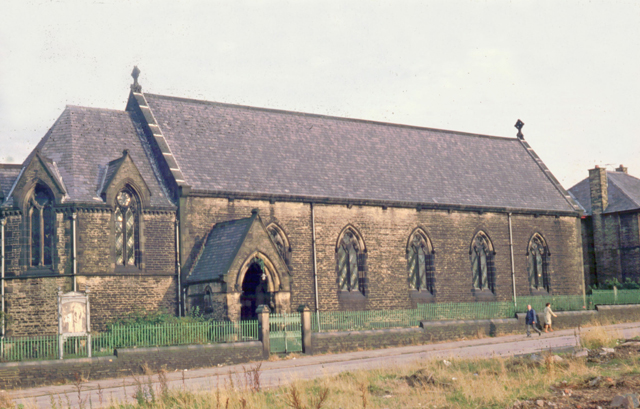
St Thomas's Church in 1979
Of course to build a church would take both time and money but in 1826 Whittaker succeeded in building a school in Copy Nook. At first it was called St. Clement's and was used for Sunday and Day School purposes and also licenced for Divine Service. The name was afterwards changed to St. Thomas. In 1860 the foundation stone for the church of St. Thomas was laid and the building work started. Unfortunately the civil war in America caused the cotton famine and particularly in a town like Blackburn so dependent on imported cotton there was great distress which greatly hindered work on the new church. However, in 1865 St. Thomas's was consecrated and the Reverend H. Wescoe appointed Vicar - he had been a major driving force to raise the funds to get the building completed. Also, in 1865, a new school in Skiddaw Street was opened. In 1883, a bazaar was held to raise funds for a vicarage, and, by October, the vicarage was completed. In 1901, Canon Wescoe resigned, having achieved the monumental task of building six schools, two churches and two vicarages. The Reverend F. G. Chevassut was appointed Vicar. Mr. Maddock, the Head Master of the boys school retired in 1907 after forty two years’ service and some ten thousand scholars had passed through the school. Finally, after the scheme had been decided in 1903, a Parochial Hall was opened by Lord R. Cecil in 1909.
The first Roll of Honour was unveiled and dedicated on August the 5th. 1917, and, on August the 1st. 1920, the second Roll of Honor was unveiled in the Chancel. A War Memorial was unveiled in the churchyard on the 15th of August that same year. When the church was demolished the memorial was moved to the Cathedral grounds. In 2003 it was again moved to St Jude's Church, Accrington-road, which had amalgamated with St. Thomas's parish. In 1926, there were various celebrations for the Diamond Jubilee.
A house for the Curate was sought and funds raised for that and the Hall. Two tennis courts were made and a sport's field leased. St. Thomas's became well known for the football matches played for St. Thomas's Medals. The field was also the destination on the walking day when the procession arrived and people enjoyed themselves with different races and games and refreshments of rock buns and raspberry buns with large mugs of tea served by the Mother's Union members. There are some cine pictures on Cotton Town of the walking days taken by Harry Aspin.
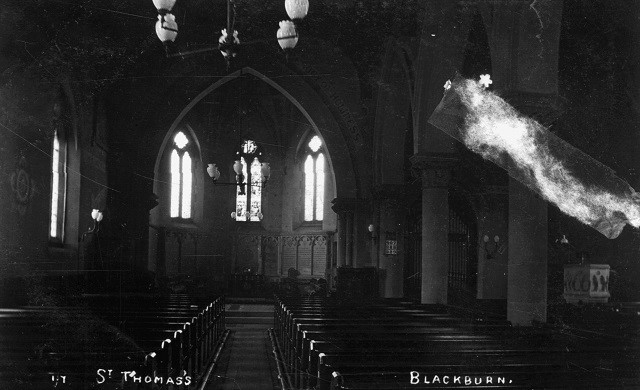
Looking along the nave of St. Thomas's towards the alter
A Youth Club had been in existence for some time but in old premises - eventually in the early sixties a government scheme was launched to enable youth organisations to have their own premises. St Thomas's was able to take advantage of this scheme and the government provided 75% of the cost for a building next to the church hall. It was one of the most modern clubs in Lancashire with a gymnasium, coffee bar, games room and television lounge.
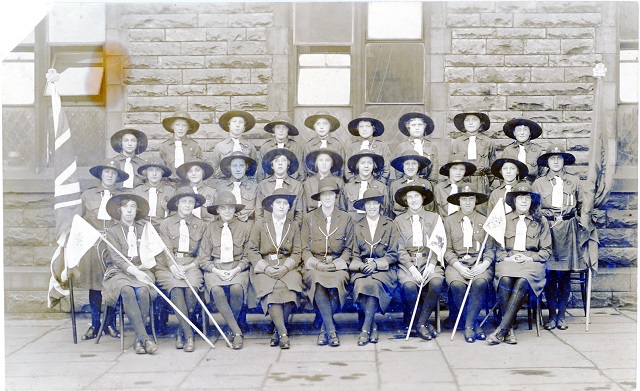
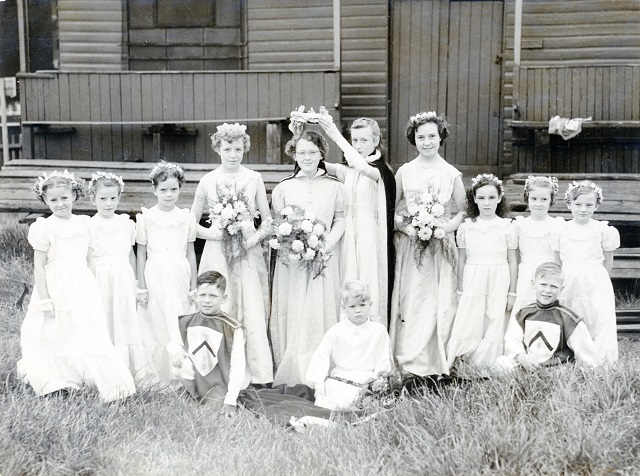
crowning the new queen Barbara Henry aged 13 in 1957.
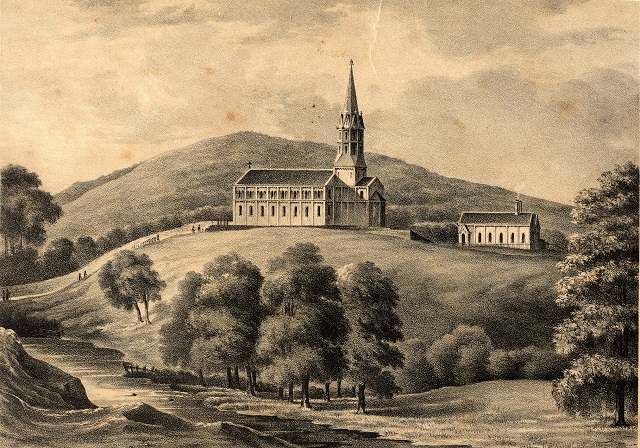
An early image of St Mark's Church. Witton School is seen on the left.
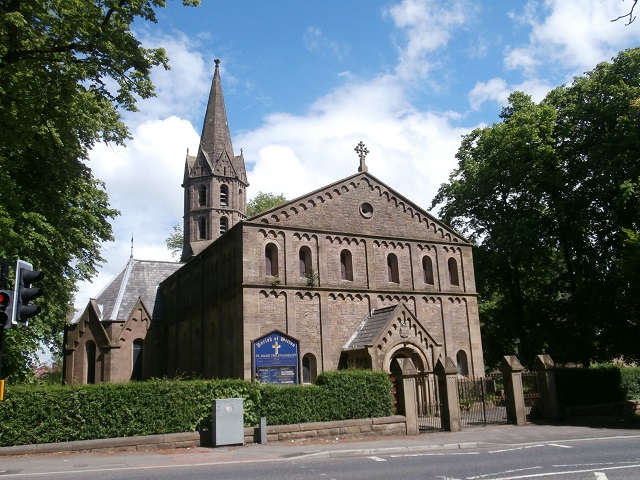
St. Mark's Church from Buncer Lane.
Much of this information is from A History written by Christine Walmsley, several articles in the Blackburn Times and Wikipedia.
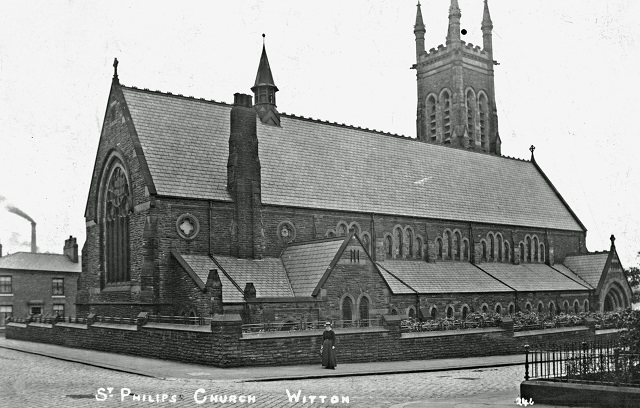
St. Philips Church Witton. Opened in 1871

Janet Burke
The plans for the Church were prepared by John Lowe F.I.B.A. of Manchester and this allowed the development of the building works to be advanced.
As was the vogue in those days the whole scheme required patronage from the great and the good and this was secured through the following Patrons:
Major General Feilden M.P.
Dr. Willams of Crosshill
Mrs. Rodgett
Mr. Adam Dugdale
Mr. J.B. Dugdale
The builders and craftsmen appointed to build the new St. Philips were Messrs. Stones and Sons of Blackburn under the direct supervision of the Architect, Mr. Lowe.
On completion of the building the consensus was that the Church exhibited a fine piece of architecture, with its prominence, and there was little doubt that it added greatly to the street landscape and environment. Such was its prominence that it was certainly viewed easily within this area of the town and represented a very attractive addition to the skyline.
Lowe's design was indicative of early English, despite its loftiness, it was simple in structure whilst the overall effect was substantial but practical.
Dimensionally, the Nave was 89ft. 6 inches by 30ft. with the North and South aisles being 11ft. 8 inches wide. The Chancel was the same width as the Nave and incorporated on the South side a spacious organ chamber. Beneath the vestibules was the heating chamber comprising a hot water system. The walls were constructed of rubble masonry throughout, faced externally with Yorkshire par points, tooled stonework liberally introduced in windows, doorways and buttresses. The featured Tower was conspicuous with angled pinnacles standing at the West end of the South aisles and rising to a height of 112ft. The lower stage of the Tower formed a spacious porch with a boldly arched and recessed doorway giving access to the Church from Witton Parade. A gabled porch with similar doorway occupied the West end of the North aisle entered from St. Philips Street.
Internally the walls were plastered and coloured with a slight tint in appearance.
The arches supporting the Nave and Aisles were carried on columns with shafts of red Mansfield stone with molded capitals—there was no arch in the Chancel. The roof was of open timber, 49ft. above the Nave floor and was continued as one level over the Nave and Chancel. The Chancel portion was molded externally by a terminal creation of wrought iron. The roofs were covered in blue slate with purple bands and red Staffordshire ridge tiling. The windows were simple grouped lantern lights, with cusped heads, except those in the East and West gables and organ chamber, which had tracery of simple design and were glazed with simple glass in geometrical design. The Aisles were laid with stone landings and the Chancel with encaustic tiles in pleasant designs. The Choir seats, Prayer Desk and Communion Rail were oak, with wrought iron standings. The congregation Pews were made of pitch pine, stained and varnished. The Pulpit on the North side of the Chancel steps was made of Bath stone supported by a pillar of dark red marble and in the Chancel centre was a polished brass lectern in the form of an eagle. The Altar and reredos of oak was flanked by panels depicting the words of the Ten Commandments and the Lord's Prayer which lifted your eyes to the magnificent east stained window depicting Christ crucified. Amidst the Nave at the West end of the Church was situated the Font—six sided in stone. The Church accommodated 600 people. (300 appropriated—300 free). The site itself covered 1,704 square yards.
The total building and other costs were £8,500 (£1.2m today). (Total subscriptions in support of the build were £7,000 leaving a debt on the building of £1,500).
A later addition to enhance features within the Church, was the five panelled reredos and oak panelling Great War memorial at the west wall. An inscription and regimental shields on oak panelling with gothic tracery design on the reredos and panelling.
The centre panel inscription read:
"To the glory of God and in memory of the men from this Church and Parish who died in the Great War 1914 – 1919
Their name liveth for evermore".
On the Memorial are inscribed 108 names of the Fallen.
The information provides Forename, Surname, Rank and Regiment. On the demolition of St. Philips, the panelling was relocated to the new Benefice of St. Luke with St. Philip in Blackburn.
Fred Cumpstey
November 2023
See also Griffin C of E School
Published December 2023.
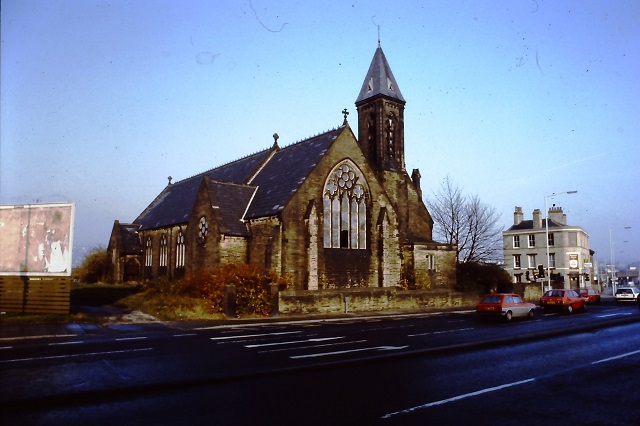
All Saints Church in 1989 waiting Demolition in 1991
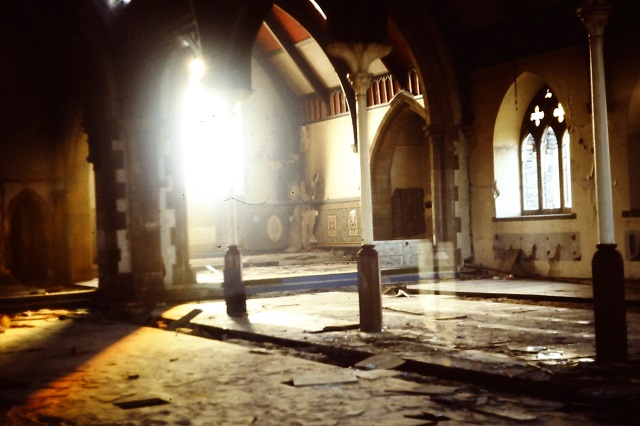
The inside of All Saints Church in 1989 befor demolition in 1991
Janet Burke

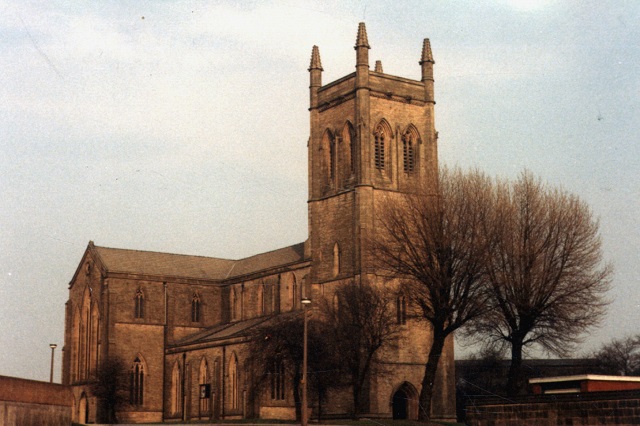
The Parish church of Holy Trinity. Photograph Taken 28th March 1982.
Introduction.

The War Memorial Pulpit