
 Loading more
Thesis by Andrew Taylor
Blackburn in The 1850s: A Case Study | Urban Growth in Lancashire from 1770 | The Situation in Blackburn
The Non-conformist view of Nineteenth Century Blackburn | Examining The Evidence
Conclusion | Bibliography
Blackburn in the 1850s: A Case Study
Contemporary perspectives of the effects of Urbanisation and Industrialisation:
A Case Study of Blackburn during the early 1850s
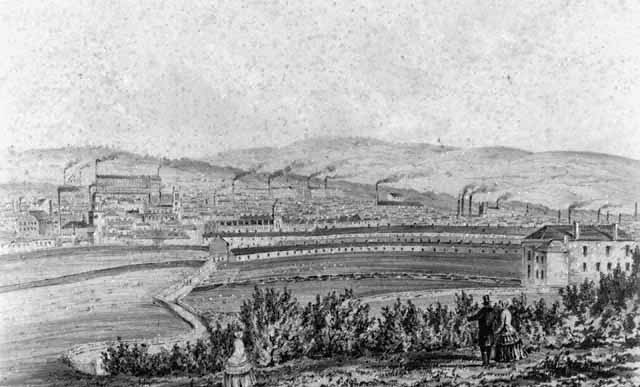
© BwD - terms and conditions
Abstract.
The aim of this work is to attempt to produce a picture of the Lancashire town of Blackburn during the mid-nineteenth century to see what this place was actually like as it grew in size as a consequence of the industrialisation and related urbanisation processes as they swept through the county.
In order to achieve this aim, a number of primary sources are considered including maps, population figures, newspapers, photographs, census returns, trade directories and the 1853 Health Report. From the evidence provided by these sources a piece is developed to show what conditions were like in Blackburn in these years and whether it conformed to the popular image of life in an industrial town or whether it was different.
Introduction.
Throughout the history of Great Britain, there has never been a period which has witnessed as big a change in the population of the country, as in the period between 1770 and 1900. This was the era of industrialisation and with the urbanisation process which ensued, thousands of people left the country to descend on the larger towns in the hope of making their fortunes. As a consequence towns were inundated with hundreds of people and in order to cope with these huge influxes of folk, houses were speedily constructed with little consideration to planning whilst larger town houses were converted in order to house these people as for many the industrialisation did not bring their poverty to an end. The general idea at the time was to squeeze as many people into as little space as possible. The Irish potato famine also caused Irish immigrants to flee their homeland for Great Britain in a desperate bid for survival. The Irish also headed for these industrialising towns further exacerbating the problem of where to house these people, many families having to share single rooms in order to have a roof over their heads as a consequence of their dire poverty and having to endure the very worst in conditions imaginable. Into such conditions came the dreaded scourges namely disease; typhoid, typhus and cholera the conditions being perfect for the spreading of these diseases, wiping out many in their wake. This is the accepted picture of this age but does that make it completely true? Did this blanket of despair cover the whole towns and cities, enabling no one who lived within these growing metropoli to escape the undesirable effects of urbanisation and industrialisation?
The underlying theme of this dissertation is to investigate those sources which are available from the 1850s and attempt to present an accurate image of what one of these expanding population centres, the town of Blackburn in Lancashire was actually like in the 1850s and whether it was as bad as implied or whether there was something good about this industrialisation which affected this place so profoundly.
Chapter 1, begins the dissertation with a historiographical review of urban growth in the late eighteenth to the mid-nineteenth centuries and the effect that this had upon society. It starts with a brief consideration of the growth in the population of Great Britain as a whole, showing that it was not a phenomenon restricted to specific areas, that all over Britain there was a surge in population growth from the 1770s. It then moves on to concentrate on population growth in Lancashire's towns and cities and the impact that this had on these centres and what the consequences of the sudden surge in population had on these places.
Chapter 2, then discusses the situation in Blackburn at that time utilising maps, population figures and the Report of the town's sanitary conditions compiled by John Withers in an attempt to see if conditions in Blackburn mirrored those conditions experienced in other places in Lancashire and whether Blackburn as an industrial town conformed to this overall picture or whether it was different. The chapter also tests theories to see if these could be applied to Blackburn and also whether the same results could be obtained.
Moving onto the third chapter, this tackles the situation from another angle and here the attempt is made to present a alternative image of the town in the face of industrialisation and whether there was a favourable side to this place. Utilising available Trade Directories from 1818 through to 1855, these are examined to see if there was any profound changes in the way that they presented the town as it expanded in the grip of industrialisation, as the population multiplied and living conditions traditionally being portrayed as hell on earth increased.
Chapter 4, questions the reliability of the information that both sources are presenting. By examining the evidence and scrutinising both the trade directories and the health report an attempt is made to see just how accurate and dependable they actually were by undertaking this independent investigation. Such primary sources as the large scale 5 feet to the mile Ordnance Survey maps published in 1848 and the 1851 census of Blackburn are utilised in order to see just how widespread severe overcrowding was at that time.
Finally, the fifth chapter pulls all the evidence together in order to present an image of what Blackburn was actually like in the 1850s. The motives of those sources which were presenting either a positive image of the town or a negative image of the town are also considered here and what both were trying to achieve. Did Blackburn conform to any of the points of view presented by the Health Report and the Trade Directories or did it in the 1850s occupy the middle ground between good and bad; the attempt here is to provide as truthful and honest an account as possible in the light of the evidence offered by the two points of view of exactly what conditions were like in Blackburn in 1850.
by Andrew Taylor
Urban Growth in Lancashire from 1770
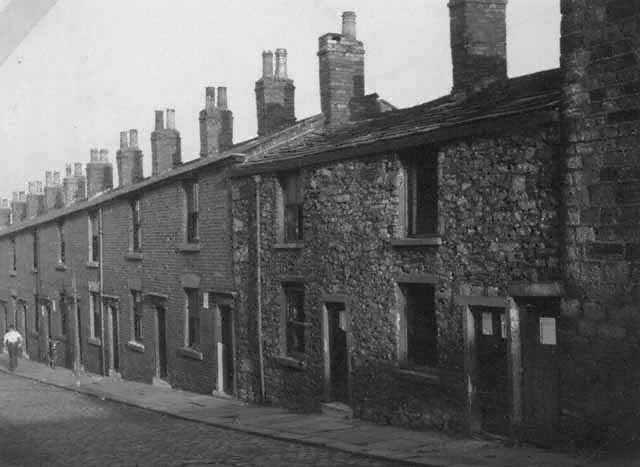
It is so easy when thinking back to how life might have been 150 years ago when the Industrial Revolution had taken a grip on the nation to imagine an horrific scene, by utilising a thought process prejudiced by literature and the media intent on pushing home a view of life at that time that is almost unbearable to think about. When setting up a mental picture of life during the early to mid-nineteenth century the mind conjures up a mental picture consisting of overcrowded houses all crammed into a relatively small area existing cheek-by-jowl with factories, of smoke filled skies constantly blotting out the sun, the smog and grime from exhalations from chimneys attaching itself to everything: to buildings, to clothes, to animals and the exposed skin of everybody. In imagining this view of life back then, the mind even pictures this scene in monochrome, a black and not so much white but varying shades of grey world of dampness and cold and of rivers whose surfaces are crusted with all kinds of pollutants from houses and factories. In this imaginary scene, crumbling houses are pictured with walls, scarred with the white marks of water constantly leaking down, mixed with the dark grey-green of moss and those who existed within are pictured laying on bare floors, suffering and dying from both respiratory and bacterial diseases, caused by the poor conditions outdoors with streets covered in raw, untreated sewage and coupled with the squalor which existed indoors. One feature about thinking of the industrial towns is that the mind envisages a scene completely lacking in any form of vegetation, not even a weed growing out of a grime laden street gutter. But where did this image of nineteenth century Britain come from and where conditions as bad as a sub-conscious poisoned by accounts of how bad everything was back then depicts.
It is the writings of such distinguished writers as Charles Dickens who in his book "Hard Times", provides us with a snap shot of life in 1854 Coketown, a fictitious place but which was modelled on the Lancashire town, Preston. Of this place, Dickens' wrote: "You saw nothing in Coketown but what was severely workful...It was a town of red brick, or of brick that would have been red if the smoke and ashes had allowed it; but as matters stood it was a town of un-natural red and black like the painted face of a savage. It was a town of machinery and tall chimneys, out of which interminable serpents of smoke trailed themselves for ever and ever, and never got uncoiled. It had a black canal in it and a river that ran purple with ill-smelling dye...Seen from a distance ...Coketown lay shrouded in a haze of its own, which appeared impervious to the sun's rays. You only knew the town was there, because you knew there could have been no such sulky blot upon the prospect without a town." (1) Powerful talk indeed and for someone as eminent as Dickens to write of such a scene then the reader of the novel can only assume that the picture presented by Dickens must be true. Also the fact that it was no secret that Coketown was Preston, it can only be assumed that this is exactly what 1854 Preston was actually like and if this is what Preston was like the implications are that other manufacturing towns in Britain were also like this, brought about by the mass industrialisation of the era. However it also such writings that have the power to indoctrinate the most open of minds in the twenty-first century into believing that this must be so without question.
Between 1741 and 1801, the population of England and Wales increased from 6.0 million to 8.9 million, representing a 48.8% growth rate in sixty years. (2) By 1851, the population had more than doubled and sixty years later the figure had more than doubled again. By 1801, the areas where there were high population densities tended to be isolated communities, small by modern standards, which tended to be provincial capitals and commercial centres.
By the census of 1851, the population of England and Wales had experienced an almost three fold increase in just over a hundred years. Looking at the distribution of population centres, throughout the whole of Great Britain, those places with the highest densities of population tend to dominate in those areas near to coalfields and other of the country's natural resources and commercial ports not unexpected giving rise to those resource based industries. These areas of high population emerged around London in the South East, Birmingham in the Midlands, Bristol in the South West, Liverpool and Manchester in the North West, Kingston Upon Hull and Newcastle in the North East and Glasgow over the border in Scotland, indicating that population growth followed a similar pattern throughout the whole of Great Britain. Between 1801 and 1851, London's population increased from 960,000 to around the two million mark, more than doubling in 50 years (3). It would be easy to suggest that as birth rates were increasing that this was the reason why the country's population was growing, however in some areas mortality rates were in excess of birth rates indicating that the increases in population were primarily as a result of people migrating from the rural places into the growing towns and cities. That being said, the increased birth rate must have had some impact in population growth since the census of 1851, reported that 36% of the total population of the country was under the age of fifteen years (4), therefore the role played by the increased birth rate cannot be discounted completely.
As already noted, Lancashire's towns and cities where also involved in this process of industrialisation and the mass urbanisation that it brought experiencing a growth in population between 1770 and 1850 unparalleled to any period in history which had gone before. As a consequence of the revolution sweeping the industrial world during this period, people were experiencing a decline in living standards as long established domestic trades were being threatened in the face of technological advances, which were beginning to accelerate. In response, thousands began to leave their small hamlets behind and head for the towns in search of work and greater prosperity. Even without this immigration process the towns themselves were growing naturally over this same period, yet their growth would not have experienced the profound increases in population that industrialisation brought. In Lancashire before 1770, there were few towns in the county that were of any size, most being little more than large villages, the exception being Manchester. Oldham to the east, Preston to the West and Bolton to the centre all experienced a similar eight-fold increase in their populations between 1770 and 1850 all individual towns, yet all demonstrating a similar trait with respect to both growth in population and the reasons for it. In 1770 the town of Bolton was described as "a district almost rural, an idyll made up of bleaching crofts, orchards and garden cottages" - a very quaint sounding place yet even before the end of the eighteenth century water powered textile mills and engineering works had drastically altered the Bolton landscape in less than thirty years (5). This influx into the urban centres coupled with the increases in population brought one immense problem - how were of these people to be accommodated? The quick and easy solution to this ever-growing problem was to come in two forms. Firstly hurried house-building schemes were put into operation and secondly rapid conversions of existing properties at the centre of these expanding towns were also undertaken in reaction to the growing crisis which was occurring as a result of the accelerated growth rates in both industry and towns alike.
Starting with Liverpool, records show that the population was increasing at an alarmingly fast rate in the early industrial revolution period. The population of 5,000 recorded in 1700 had increased to around the 22,000 mark in only fifty years and was still accelerating (6). To cope with these increases, housing was urgently required and speedily constructed to meet the needs of the working classes, drawn towards the supposed opportunities the city was generating. Hundreds of families were crowded into the town houses of Liverpool, once the preserve of the well-to-do who had abandoned them to move well away from the centre of the city and the newly developed industrial zones to enable them to distance themselves away from the lower classes. These houses were divided up and rented out to several migrant families and the former gardens were transformed into courts in a bid to deal with the population explosions. The cellars at these houses were put to good use also as landlords realised their potential for accommodating many families in such a small space. These were detached from the house above and outside steps led down to the cellars home for those on the lowest rung of the social ladder, the poorly paid, with as many as possible being accommodated in a small as space as possible. By 1790, it was estimated that in Liverpool one eighth of the city's population lived in cellars (7). A count in 1839 found there to be between 35,000 and 40,000 living in these below ground dwellings rising to a peak of around 80,000 by 1848 (8). Apart from the overcrowding, there was also a tendency for these cellars to flood after heavy downfalls of rain and at time effluence from the streets above would inundate these dwellings creating a seed-plot for the spread of highly infectious diseases made particularly contagious as a consequence of the massive numbers of overcrowded-dwellings.
Not surprisingly, cellar dwellings were also a feature of Manchester where conditions were every bit as bad as they had been in Liverpool. Even as early as 1801, the Manchester Board of Health found cellar dwellings so dark that candles were required in these incredibly ill-ventilated dwellings during the day (9). Five years later the same board found extensive numbers of these damp and ill-ventilated dwellings within the city. Floors were often unpaved, with beds fixed on damp earth and as more families flocked to Manchester these scenes multiplied enormously (10), due to the fact that there was a shortage of places to live. In response more houses were built but the consequence was that although these were high in quantity, the quality in many cases left a lot to be desired. From about the 1790s Irish immigrants were flooding into the city as a result of the potato famine in Ireland. As a consequence the Irish immigrants became the typical cellar dweller, becoming recognised as the most destitute of the working classes, with a tendency for them to crowd into the same dwellings because of their poverty.
Before 1850, there was little by way of building or sanitary regulations. The principle with regard to housing the working classes in Liverpool was to pack as many houses in as small a space as possible (11), the reason being two fold. Firstly, land was high in value and secondly to receive as much by way of rents as possible. Back to back houses conformed to this principle very well as they were cheap to build, easy to construct and took up very little space enabling many to be constructed in a relatively small area. In both Manchester and Liverpool, most of these back to backs were three storeys high with an average of six feet between blocks of houses and with cellar beneath to accommodate even more people. Most of the small streets where these houses were located were of a cul-de-sac style, with no through draughts and as a result many of these streets faced serious sanitary conditions due to failures in the authorities to implement any form of physical constraints. It appeared that anyone who owned a plot of land could build on it what he liked being subjected neither to stringent inspection or planning constraints (12). Consequently, green fields and rolling hills were disappearing beneath a blanket of mass urbanisation throughout Lancashire and those in control of the situation had little regard for anything apart from making greater profits on their capital. In Manchester as the city rapidly expanded, green pastures were banished to the past, being replaced with blocks of poor quality houses at a stroke. The distinguished doctor, JP Shuttleworth described the centre of Manchester as being "a mass of buildings ...intersected by loathsome streets and close courts defiled with refuse" (13). In the Irk Town region of Manchester as many as ten people were being accommodated in one up one down dwellings and in Back Ashley Street, again in the Irk Town district there was just 4'4" between houses in that street (14). But it had not been in the interest of landowners and landlords to insist on the provision of proper planning. Before 1850 the general principle had been to build as many dwellings in a small a space as possible which meant that landowners could double their revenue from rents from a relatively small area (15). Assistant poor law commissioner Charles Mott found in 1841 that some of these houses lacked foundations and the structures were so flimsy that one contractor visited some house after a storm to find that they had been levelled to the ground -such houses becoming known as"pickpocket rows" because of the insecurity and nature of the structure (16).
Things appeared to be little better away from the regional centres of Manchester and Liverpool and throughout Lancashire a similar picture emerged. Jenny Fields wrote of cellars in Bolton as being "the fever nests of the town", where people, donkeys and even pigs all were housed (17). Yet the Sanitary Survey of Bolton compiled by James Entwistle in 1848 claimed that by far the worst and most infamous dwellings of Bolton were the overcrowded lodging houses, with their filthy courts and alleys which were situated behind the town's main thoroughfare, Deansgate (18). At St Helens the Edinburgh Journal wrote that houses "...appeared to have been built in a hurry" (19). In Bury, it was discovered that that less than half of the town's dwellings were described as "comfortable" by a report there which also found that there were sixty three families where five members of the same family slept in one bed (20). Further up the valley of the River Irwell, in the Rossendale region, rows of back to back houses were built clinging to the steep valley sides, their existence being justified by property owners as being the only type of dwelling which could be accommodated in such a small and restricted amount of space. As a consequence many were blind backed, had little light pouring into them, they were damp and possessed virtually no ventilation. In one of that region's towns, Bacup, tenants paid a shilling a week to rent a small back to back dwelling, overlooking a communal yard where diseased live-stock roamed. The walk to a single privy shared by several households was for some tenants a 170-yard walk and there was a half-mile trek to the nearest well. Those in Bacup who lived in lodging houses were no better off and one family was found where a whole family and their dogs shared one bed in a single room (21).
Documentary evidence available at the time suggests that although the population was expanding at a profound rate within Lancashire's settlements, the area of the towns were not growing in proportion to this highlighting the seriousness of the overcrowding of dwellings at the time. In Preston documents show that although the town's population grew by almost 40,000 between 1801 and 1845, maps show that Preston had expanded outwards by only a very small margin. The explanation for this is interpreted by Nigel Morgan as being proof that Preston was experiencing inward expansion (22). Where town house gardens had once stood, these had been in filled by a number of smaller dwellings to accommodate the deluge of people flooding into Preston at that time indicative of the small area of living space allocated to each person, which diminished still further as population figures increased in the town. Josaphine Roberts also has found evidence of this infilling process in Manchester's Irk Town, where garden walls still stood, with blind backed house built up against these (23). Because of the numbers of people who surged into these settlements was at a rate higher than the rate for building new houses, it was not uncommon for families of eight and nine members to be living together and if each of these families inhabited just one room then it could mean that in just one single one up one down dwelling a total of twenty people could be living there (24). Roberts found that in Irk Town families had to double up in two roomed houses, which could explain why in physical terms, physical expansion in Lancashire's towns and cities appears to have been minimal.
Any suggestions which were made to improve Lancashire's housing conditions were frowned upon and objections were raised to money being spent on social improvements, that is until 1832 when cholera appeared on British shores (25). The distinctive feature of cholera was the fact that it began to affect all people not just the most wretched of Lancashire's population. Augmenting the already well established typhus and typhoid, cholera effectively demonstrated that class held no bar to such infection since these diseases were just as likely to kill the affluent as much as the poor. Suddenly it became the interest of property owners and industrialists alike to take immediate action. As a consequence, measures were introduced including the establishment of local Boards of Health in an attempt to improve the appalling housing conditions and to erase the spread of those highly infectious diseases amongst the population of the county. Early measures introduced to prevent the spreading of these highly infectious diseases included the outlawing of the building of an further back to back dwellings, introducing regulation governing the construction of privies and also regulation in connection with the recommended amount of space there should be between dwellings (26).
So from the evidence obtained from secondary sources about condition throughout Lancashire in the Industrial Revolution period, it would appear that a blanket of unacceptable living conditions and disease brought about by mass urbanisation covered the whole of the county from the county's two cities Manchester and Liverpool northwards into the West Pennine valleys taking in Bury, Rossendale, Bacup, eastwards to Oldham further north to Bolton and on to the coastal plains taking in Preston and further south St Helens. Nowhere seemed to escape the squalor, the filth and poor levels of town planning which descended on Lancashire during the early nineteenth century and that within these towns it would appear that there was nowhere realistically fit for human habitation and as the influence of the industrial revolution gained even more momentum, any greenery which existed was being turned over in an attempt to cope with this mass industrialisation and the related migration process which was sweeping not just through this one region, but throughout Great Britain as a whole at that time.
by Andrew Taylor
REFERENCES
Chapter 1.
(1) Dickens p18-19
(2) Lawton p10
(3) Lawton p12
(4) Lawton p 16
(5) Field p44
(6) Chapman p167
(7) Chapman p168
(8) Bagley p112
(9) Aspin p130
(10) Chapman p176
(11) Chapman p 176
(12) Aspin p128
(13) Bagley p112
(14) Roberts p25
(15) Aspin p128-129
(16) Aspin p 130
(17) Field p44
(18) Field p44
(19) Aspin p128
(20) Aspin pp135-136
(21) Aspin p 137
(22) Morgan p21 (23) Roberts p23
(24) Roberts p25
(25) Bagley p112
(26) Bagley p1 13
Bibliography
1. Primary Sources:
Published Sources.
Baines, E - History, Directory and Gazetteer of Lancashire Vol I (1824)
Mannex -Directory of Mid Lancashire (1854)
Rogerson, T - Lancashire General Directory (1818)
Slater - Lancashire Directory (1851)
Slater -Lancashire Directory (1848)
Withers, J - Report on the Sanitary Condition of the Borough of Blackburn, with observations on the Drainage and other subjects, calculated to improve the health of the inhabitants (1853).
Newspapers.
Blackburn Standard 12 May 1841
Blackburn Standard 10 August 1842
Maps and Plans
Yates's Map of Lancashire (1780)
Untitled Map of Blackburn (c1795)
1824 Map of Blackburn
1795 Map of Blackburn
Ordnance Survey 6" to 1 mile map of Blackburn (1848)
Ordnance Survey 5' to 1 mile map of Blackburn (1848)
Other Primary Sources
Census Return, 1851
Secondary Sources:
Books.
Aspin, C - The First Industrial Society - Lancashire 1750-1850 (1995 - revised edition) Bagley, JJ - A History of Lancashire (1982)
Beattie, D - Blackburn - The Development of a Lancashire Cotton Town (1982).
Chapman, SD -The History of Working Class Housing, Chapter 5 - Liverpool
Working Class Housing 1805-51 - James H Treble (1971)
Dickens, C - Hard Times (1969 re-print of the 1854 edition)
Langton, J and Morris RJ - Atlas of industrialising Britain 1780-1914, Chapter 2 Population - Richard Lawton. Chapter 22, Urbanisation, RJ Morris.
Miller, G - Blackburn - The Evolution of a Cotton Town (1951)
Morgan, N - Vanished Dwellings, (1990)
Roberts, Dr J - Working class houses in Nineteenth Century Manchester - The Example of John Street, Irk Town, 1826-1936 (1983)
Whittle, P - Blackburn As It is (1852)
Victoria History of the Counties of England - Lancashire Vol 2 (1966 re-print of the 1908 edition)
By Andrew Taylor
© LET - terms and conditions
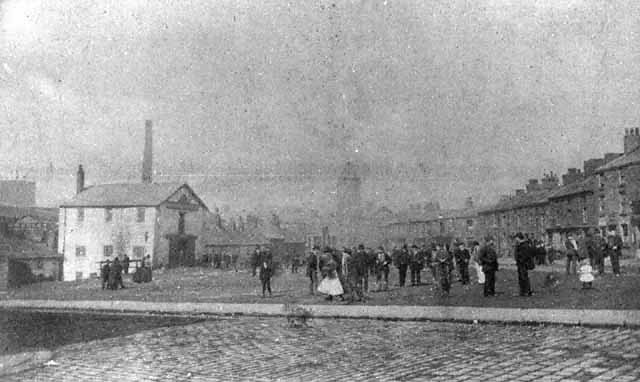
As discussed, in the years between 1770 and 1901, Lancashire's towns experienced a growth in population the like of which had never been experienced before as industrialisation gained a foothold in this area. In a region noted for the production of textiles, the Lancashire town of Blackburn had at the close of the nineteenth century emerged in its own right as the weaving capital of the world, yet only a hundred and twenty or so years before was a small rural settlement which had lain virtually untouched in folds of the western-most vestiges of the West Pennine Moors, with roads little more than cattle tracks connecting this place with the outside world. An estimate of 1770, gave Blackburn of having a population of 5,000 the same as it was at Bolton at the same time (1). Not surprisingly Blackburn at that time was little more than a village, its primary role acting as a market centre serving the communities which surrounded the town. Unlike the towns of Bolton, Preston and Oldham, the topography meant that it was virtually isolated from most of the developing Lancashire. By 1801 Blackburn's population had increased to 11,980 having more than doubled in 30 years (2). Despite the fact that Blackburn's population was almost identical to Bolton's in 1770, by 1801, the two were world's apart in population terms, Bolton's numbers having galloped away in the interim years. Preston and Oldham had also increased at a greater rate leaving Blackburn somewhat trailing behind and in the shadow that it historically become accustomed. By considering the idea that prior to 1750 the town had been effectively isolated from most of Lancashire and that its population growth rate was proportionately less than those others, does this then indicate that the changes which occurred in Blackburn between 1770 and 1861 were not as dramatic as those in Preston, Bolton and Oldham and as such where those conditions which were apparent in them also evident in Blackburn? Looking at Bolton, it seems that in the thirty year period from 1770, that the landscape had "dramatically altered" (3), but since Blackburn's population growth was not at the same rate, does this mean that this alteration in landscape was not true of Blackburn and such changes did not take place in Blackburn? In order to determine whether conditions in Blackburn were indeed different that the long accepted view of Lancashire's cotton town as depicted by such writers as Dickens, it is necessary to focus on the town and investigate further. To enable this it is necessary to pick up on one or two of the points detailed in Chapter 1 and test those theories to see whether they provide details which show whether the information provides a view of a very different place setting it apart from Bolton, Oldham or Preston or whether the picture obtained illustrates that Blackburn conformed to the general belief of Lancashire town's in the era of industrialisation.
Population Figures | 1801 | 1811 | 1821 | 1831 | 1841 | 1851 | 1861 | 1871 |
Blackburn | 11980 | 15083 | 21940 | 27091 | 36629 | 46536 | 63126 | 76339 |
Oldham | 12024 | 16690 | 21662 | 32381 | 42595 | 52820 | 72333 | 82269 |
Bolton | 17416 | 24149 | 31295 | 41195 | 46793 | 60391 | 69326 | 82011 |
Preston | 11887 | 17065 | 24575 | 33112 | 50131 | 68537 | 81101 | 83515 |
The first source considered in order to determine, whether Blackburn's experiences either conformed to the established theories or were in fact different are the population figures collated for this period. By using the above named Lancashire towns, the above table show population figures for these places from 1801 to 1861 (4). From the table, it would appear that by 1801, Blackburn's population was very similar to that of Preston and Oldham albeit less, although Bolton had surged well ahead of all of the other three in population numbers by almost 6,000 over its nearest rival. By the following census of 1811, Blackburn although increasing in size in population terms was beginning to slip behind all the other three towns, by almost 12% in terms of the rate of growth. In real terms its population was not far behind either Preston or Oldham although Bolton still lead the way by almost 8,000. In 1821, a similar picture could be obtained, Bolton was still way ahead this time by nearly 7,000, with just 2,000 people separating Preston, Oldham and Blackburn although the censussurvey of 1831, illustrated that both Preston and Oldham experienced a surge in population. In Blackburn however, although the population was still increasing, it had fallen behind a little, by 5,000 on its closest rival. The following census saw the gap open up still further between Blackburn and Preston and Oldham those latter two leading by almost 7,000 over Blackburn and a similar picture emerged in 1851 with the gap still being 7,000 though having fallen by a thousand by 1861. As a consequence of the population surges in both Preston and Oldham, Bolton's lead was been overtaken by both of these towns.
It can be clearly seen that all four of the sampled towns grew at a similar rate between 1801 and 1861 and should a curve be drawn on the graph it would be seen that all of the towns were increasing proportionately though by differing amount of people. It can also be observed from the above graph that the percentage-wise there was just 4.28 between the town with the fastest growth rate in this period and that with the lowest, which is very small further indicating, that all four of the Lancashire towns sampled were increasing at a very similar rate.