
 Loading more
Page 2
The first entry in the first logbook is dated February 4th 1881, and I wondered what it was like in the area before the school was built.
Attendance
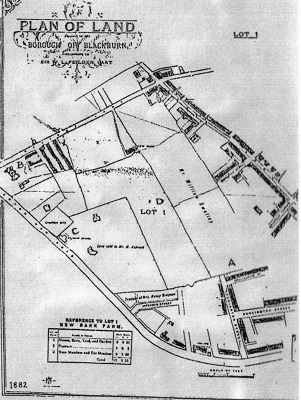
I was very fortunate to find a plan of the area in the Reference Library. It was published in 1882 by Sir William Fielden of Feniscowles Hall. The family was selling off its land and moving to Scarborough, and this plan referred to the New Bank estate. The plan shows some settlement at Mile End, Limefield, Revidge Lane Ends and Dukes Brow, bu the rest of the area is occupied by fields. One very interesting field (A) was where Blackburn Rovers played their home matches from 1881 until 1890, prior to moving to Ewood Park.
St. Silas's School was originally a Sunday School. Classes were held in the upper room of an old cottage in Dandy (now Dinkley) Square (B). When the building became overcrowded, the Vicar of Blackburn, the Revd J. W. Whittaker, applied to the National Society (National Society for Promoting the Education of the Poor in the Principles of the Established Church) for a grant towards the building of a school at Billinge End for "boys and girls of Long Row and the outlying farmsteads".
The school was subsequently built, and the inscription over the central window shows the date as 1834. As there was no St. Silas's Church in those days the building also served as a Chapel of Ease for St. Paul's. It is now St. Silas's Parish Centre. (C) For forty years it flourished as a Sunday School, but on February 4th, 1881 it re-emerged as a day school, with 24 girls and 41 boys. The Headmistress was Miss A. Moulding who was assisted by Miss Smith and two monitors. The hours worked and the holidays taken would not have gone down very well with the present generation. The sewing class lasted from 2pm until 4.30 pm, and when they broke up for the holidays in July, it was for 2 weeks, not 6. They did however get 2 extra days holiday in September 1882 to attend the Preston Guild.
The children were examined each January by one of Her Majesty's Inspectors of Schools. The result of this examination, as well as the attendance of the children at school, had a direct bearing on whether or not the school should receive the annual grant. At this time, the H.M.I.S was Mr W. H. Brewer, and in January 1882 he examined the children in Grammar and Geography.
In February the Curate-in-Charge Revd J. P. Petty brought in the Inspector's report: "This new school appears to be taught with care, and fair method...Grammar is only moderate. Geography is just fair. The Infant classroom should be fitted with a gallery or furnished with suitable desks."
I had no idea what a gallery was, but my mother-in-law, who attended the school in 1899, remembered. It was a set of benches starting at floor level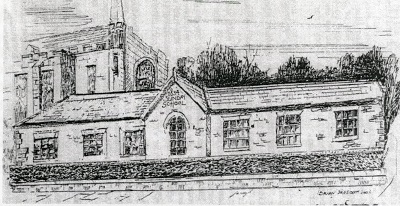 and rising up like the gallery in a theatre. She thought that the teachers lived at the top of the gallery. Well, she said, they were there when you went home from school, and they were still there when you returned to school the following morning, so she presumed that they slept ip there. One old lady, Edith Dewhurst, remembered sitting in the Gallery in 1892 when she was 3 years old. The teacher down below had a black lead brush in a jar of water on her desk. Every now and then she would walk up the gallery steps splashing the children's slates with the water. This was so that they could clean the slates properly without spitting on them!
and rising up like the gallery in a theatre. She thought that the teachers lived at the top of the gallery. Well, she said, they were there when you went home from school, and they were still there when you returned to school the following morning, so she presumed that they slept ip there. One old lady, Edith Dewhurst, remembered sitting in the Gallery in 1892 when she was 3 years old. The teacher down below had a black lead brush in a jar of water on her desk. Every now and then she would walk up the gallery steps splashing the children's slates with the water. This was so that they could clean the slates properly without spitting on them!In 1883 Mr. W. H. Brewer inspected the school again. For their examination in repetition, the children recited:-
Standard I The Parrot and the crow
Standard II The Pet Lamb
Standard III lines from Casabianca
Standard IV-VI lines from The Ancient Mariner
The report was not very good.
"Arithmetic below fair. Other subjects only moderate. The Grant may incur a deduction next year under Article 115 unless the H.M.I.S can report more favourably. Monitor Annie Whiteside- failure. The issue of a certificate to Miss Moulding is deferred for a better report."
In 1884 there was some improvement, but the report said, "The teaching lacks vigour and reading is without intelligence and writing lacks uniformity of style. Annie Whiteside - failure. Miss Moulding will shortly receive her certificate". This however did not prevent Miss Moulding from receiving her notice, as her place as mistress was to be taken over by a master in the new school.
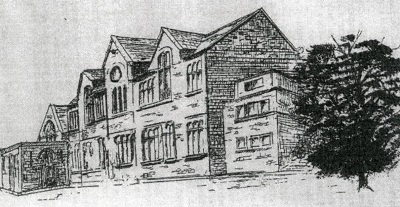
Due to a rapidly increasing population in the surrounding newly built streets, the little school on Preston New Road was becoming overcrowded. The School Board identified a need for a new school. A few worthy gentlemen got together and formed a Building Committee- Messrs W. H. Hornby, T. A. Aspden and C. Dixon. A site was secured between what is now St. Silas's Road and Clematis Street. The School Board was informed that a Church school would be built to accommodate 750 scholars. It was built with only one storey and a slim spire and was known as the School-Church. The building served also as a church until St. Silas's Church was built in 1898. A second storey was added to the school in 1904.
The new school was opened on August 10th 1885. Mr. Mark Russel was appointed headmaster. He had some scathing remarks about what had been going on before he took over and he wrote these down in the log book
"Order has been very lax. The work in each class appears to have been carried out in a slipshod manner. Late coming is very prevalent. I have had to punish a number of children to maintain better order. They do not seem to understand that they must do a thing with being told once."
"October 14th. Standard III has improved a little under Miss Bish. I think the sooner Annie Whiteside retires from teaching the better for herself and everyone else."
"Standard II is a complete failure, there not being one redeeming feature in its favour. The only way to make any improvement at all is to get a master in the class in preference to a mistress."
From Mr. Russel we learn that the school day ended at 5 o' clock. On October 2nd 1891 he closed the school earlier than 5 pm owing to the weather having been so bad and the children not being able to play out. On another occasion he let them go at 4.30 pm during the Winter months as it was dark at night and some of the children had a long way to go.
In the days before education was compulsory, the teachers had a difficult time getting the children to go to school. Mr. Russel was frequently exasperated by it all.
October 9th 1885. "The attendance does not improve much, if any being specially faulty on Friday afternoons. I have only 23 children present against 42 this morning. It is quite the prevailing opinion that they can have 2 or 3 half days holiday a week and the Attendance Officer acknowledges himself powerless."
The weather played a large part in the non-attendance of the children.
January 5th 1887. "The attendance has decreased because of the snow. This is not new. A shower of rain at any time of the year and just before 9 or 2 o'clock caused the same decrease."
June 17 1888. "The attendance is very poor. Nearly the whole of the outside district children are absent, haymaking."
Many of the older children between 10 and 13 years old were half-timers, spending half a day at school and half a day at work. In September 1887, Mr Russel had a visit from Mr. Hamilton, the Factory Inspector, because John Riley, a boy working half-time at Garden Street Mill, had altered some of the figures in Mr. Russel's Time Book.
In 1892 an entry shows how the half-timers were employed:
36 worked in a cotton factory
2 worked in a workshop
3 were errand boys
10 were in domestic service at home!
In July 1891, Mr. Russel decided to give tickets to all children who attended school regularly. In the first week he gave out 128 tickets to all children who had been to school 10 times during the week. The children with the most tickets would receive a prize. A concert was held to raise money to pay for them.
In April 1892, 120 books were presented by Mrs. Henry Harrison to the successful scholars. Mrs. Harrison lived with her husband Alderman Henry Harrison J.P. across from the old school on Preston New Road in a house called Stanley. After her death in the 1930s, Stanley was demolished and Sacred Heart R.C. Church was built on the site. Hilda Stanford has a book "Next Door Neighbours" which was presented to her mother, Jennie Williams, for regular attendance at school in 1901. It is signed by Mark Russel
Inspection
In January 1886 Mr. Russel had his first Inspection. This is the programme of lessons which the teachers had to teach while being observed.
Miss Roylance The Ostrich. Joining new needle full of cotton.
Miss Bish First lesson on compound addition. Cutting out a chemise.
Miss Eastwood A darn. The noun.
Annie Whiteside Backstitching. The adjective.
Clara Kemp Needledrill. The Reindeer.
Mr. Russel's strictness and perseverance must have paid off. The report was good, the school only just falling short of receiving the highest merit grant.
Before the end of the first year the new school building had become overcrowded. It was decided to send the infants back to the old building and retain the new one for the Junior children.
February 4th 1886. "Gave a holiday for Friday so that the Gallery could be removed and taken and rebuilt in the old school on Preston New Road. This is to be reopened as a separate Infants Department on Monday morning with Miss Roylance as Mistress and Clara Kemp to assist her. Annie Whiteside left me as she has failed during the last 3 years to pass her examinations."
Corporal punishment has been phased out in schools now-a-days, but then, as in my day, most headmasters ruled with a cane:
Feb. 17th 1886. "I have caned a number of children for being late this morning."
Feb. 24th. "I gave William Henry Eddleston a stroke on the right hand and 3 on the back for disobeying Miss Dewhurst, and telling her that he did not care for her or anyone else."
Oct 24th. "I have had to speak very strongly to the children about throwing stones and swearing etc. at an encampment of gypsies above the school, and to cane 2 boys for interfering there after my warning."
Mr Russel however does not approve of other teachers using corporal punishment.
Feb 12th. "Complaints have been made against Miss Bish for using a stick to the children."
June 10th. "I have had to speak to all the teachers again about their using sticks and boxing ears."
The children received corporal punishment at the Police Station however.
Nov 13th 1888. "Three shawls were stolen from the cloakroom yesterday by a boy who lives in the neighbourhood. I called a policeman who captured the boy, who had sold the shawls and spent the money. He has been detained in custody and received 6 strokes with the birch as punishment."
Nov 17th 1890. "James Corless and Herbert Edmundson have been detained and sentenced to 6 strokes each with the birch for breaking into a neighbouring shop and stealing apples and cakes on Saturday night."
Interfering Parents
Jan. 27th. Dinners were provided for the poor children by the kindness of Mrs. Henry Harrison and others.
Holidays
Teachers had complaints and notes from parents then, as I am sure they still do today:
June 1886. Robert Aspin sent a note saying that he wished his children not to be taught the Church Catechism as he did not believe part of it.
Aug 31st. Mr. Aspden, a farmer, the parent of 3 children, asked me to allow his boy, a half-timer in Std IV to leave school at 4pm every afternoon as he was required to assist with milking. This I was obliged to refuse, with the result that he has threatened to take all his children away and send them to Mellor or some other school where it can be allowed.
Mar 8th 1887. Some children named Barnes who left this school before Christmas have returned bringing a note from the mother saying that she could not get them to go anywhere else but here, and asking me to let them return, promising to pay the school money they owe.
Illnesses
School Dinners
There was a great deal of absenteeism through illness in those days. If one child caught measles or chicken pox or diphtheria, the whole family was excluded.
In December 1886 Mr Russel reported one of his teachers ill. Dec 7th Miss Bish is dangerously ill with pneumonia and a brain disease. There is not much hope of her recovery. Dec 13th - I am sorry to state that Miss Bish died today. Dec 15th I am absent from school this morning having to go into town respecting a flower wreath for which the children have subscribed to be placed on their late teacher's grave. Dec 16th In one of the local papers the death of Miss Bish is attributed to overwork. There is not the least foundation for such a report. She has never once complained of having too much work and up to falling ill she was most cheerful and to all appearances well.
Oct.1889 Scarlet fever has broken out in the district. One scholar Elsie Higson, died today.
Nov. 1889 The school has been washed out well and disinfected with sulphur.
Dec. 1889 All the diseases of mankind seem to have been let loose upon this school. Another scholar, James Edward Walsh, died on Saturday morning. The families at the following addresses are excluded:
It is interesting to note that the following addresses are so different from what they are today.
Long Row is now Manor Road Tean Barn Road is now Lynwood Road
Broom Street, Woodfold Place Double Street, West View Place
Rover Street, Wellfield Road Dandy Row, Mile End Row
Sarah Ellen Street, Devonport Road Banana Street, Brighton Terrace
I always thought that it was a result of the Second World War that school dinners were started but there is evidence of them in 1891.
Jan. 22nd. Dinners were provided for 24 of the poorest children in school today, through the kindness of several people giving articles of food and the teachers preparing and cooking them.
Holidays were given during the year usually for Royal Events:
June 1887 The school was closed for a week to celebrate Queen Victoria's Golden Jubilee.
May 1888 A holiday was given on the occasion of the Royal Visit by the Prince and Princess of Wales, to lay the foundation stone of the new Technical School.
July 5th 1893 Gave a holiday for tomorrow in commemoration of the Royal Marriage of the Duke of York and Princess Mary of Teck. Also gave notice that the school will not open until 9.30 am on Friday as no doubt many children will be up late on Thursday night seeing the fireworks in the Park.
May 24th 1900 Ascension Day and the Queen's birthday. Gave a holiday. The scholars attended church and returned to school where they all received an orange. After singing "Soldiers of the Queen" and "God save the Queen" with 3 cheers for the Queen and Lord Baden Powell, the children went home to celebrate the relief of Mafeking after its 'gallant siege of 216 days'.
Jan 28th 1901 Following Queen Victoria's death King Edward VII was publicly proclaimed by the Mayor. The school closed for the remainder of the day to allow scholars the opportunity of going into town and witnessing the event.
The end of the Victorian Era was also the end of Mr. Russel. He finished as headmaster at the end of the year, and the school entered the Edwardian Period, or in other words, the reign of Mr. Clough.
There were changes to the map as well. Streets of houses had grown where there were once fields. Blackburn Rovers Football team had gone to Ewood Park, and Leamington Road Baptist Church had been built on the site (1895).
Early 1900s
Children inevitably found more interesting things to do than attending school, as we learn from the entry of July 10th 1903. The following boys disappeared from the school at playtime this afternoon.
Children inevitably found more interesting things to do than attending school, as we learn from the entry of July 10th 1903. The following boys disappeared from the school at playtime this afternoon.
James and Richard Blackburn 21 Double Street
Thomas Williams 143 Dukes Brow
Fred Thomas 120 Dukes Brow
"Investigation elicited the information that they had gone to the golf links to caddy. Their attendances were cancelled and a list of names sent to the Attendance Officer."
Nov 1904 The following boys are late for school every morning due to milk kitting. William Clark and Frank Merrin engaged by James Coar, Meins Road and George Dewhurst employed by Thomas Haydock, who did not liberate him until 9.50am.
There is an occasional reference to the type of lessons that the children had in those days.
May 1905 Mr. Clough took a party of 20 children to Billinge Wood to teach them to recognise trees and plants.
Jan 1906 Miss Knowles gave a criticism lesson on "the moods of verbs".
May 1906 The children had a lecture on "Alcohol and its effects" by Mr. de Vit, a C of E Temperance Society lecturer. The children had to write essays afterwards, and the best received a silver medal.
Accidents
The accidents which took place in the school were not very serious, mostly trapped fingers and banged heads, but they had to be recorded in the log book.
The accidents which took place in the school were not very serious, mostly trapped fingers and banged heads, but they had to be recorded in the log book.
Jan 1836 Phoebe Dodd, Std I, caught her eyelid on a small dress hook on a cloak in the cloakroom when marching into school. Mr. Russel succeeded in getting it loose and after bathing the eye in cold water it was no worse from the accident.
Oct 24th J. Whalley fell off a form in the classroom, and striking his head against the firegate he made a fearful gash in it. This incident was a pure accident. The boy blames it on his clogs.
In November 1907 there was a dramatic account of an accident concerning a game of diabolo. "This afternoon immediately before the bell rang for Assembly, Freddie Short in Std I received a nasty cut on the right temple which necessitated medical attention. The scholars were arranged in a ring watching the boy play diabolo. He had thrown his diabolo to a rather great height, somewhat obliquely, and was rushing sideways to catch it in its descent when the bell rang. The rush of the boys caused little Short to be knocked on the floor, and he appears to have been kicked by a boy's clog. The doctor put 3 stitches in the wound. This morning he is reportedly to be progressing satisfactorily."
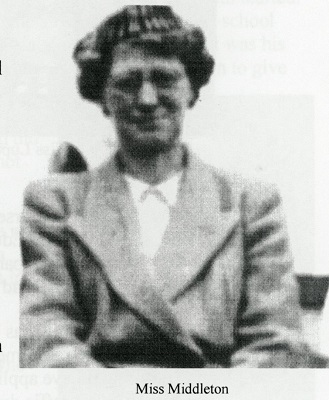
Teachers were not immune from accidents. In May 1921 we learn that Miss Middleton was off duty due to a broken fibula while learning to ride a bicycle. On another occasion Miss Middleton was absent, having broken her teeth.
1914-1918 War
The First World War did not make as much impression on the school as the Second World War was to. In November 1914 Mr. Clough received a sovereign from St. Silas's Conservative Club to provide wool for the children to knit scarves and mittens for the troops at the front.
Mon 11th Nov, 1918 The school was closed to celebrate the signing of the Armistice. Sept 5th 1919 The Peace celebrations took place. The school closed at noon and a children's party was held. After tea there was a concert and on the Saturday children's sports were held at the Rover's Football Ground at Ewood Park.
1914-1918 War
The First World War did not make as much impression on the school as the Second World War was to. In November 1914 Mr. Clough received a sovereign from St. Silas's Conservative Club to provide wool for the children to knit scarves and mittens for the troops at the front.
Mon 11th Nov, 1918 The school was closed to celebrate the signing of the Armistice. Sept 5th 1919 The Peace celebrations took place. The school closed at noon and a children's party was held. After tea there was a concert and on the Saturday children's sports were held at the Rover's Football Ground at Ewood Park.
More Holidays
June 2nd 1902 The school assembled as usual but was dismissed at 10 o'clock after singing the National Anthem. The event was the signing of the terms of peace in the Boer War.
June 22nd and 23rd 1911 Two days holiday for the Coronation of King George V and Queen Mary.
The children always had a holiday on Shrove Tuesday but the Education Committee was very wise when it cancelled the Shrove Tuesday holiday in 1925. Blackburn Rovers were playing Tottenham Hotspurs in a cup tie match the following Thursday. Anticipating that some of the children might be staying off school to watch the match, they gave them the Thursday holiday instead.
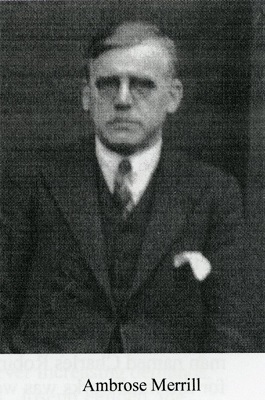
The last holiday under Mr. Clough's headship was in June 1928, when all the schools in Blackburn had a holiday to commemorate the Opening of the War Memorial Wing of the Royal Infirmary. Mr. Clough retired in the August, his place as headmaster being taken by Mr. Ambrose Merrill.
Mr. Merrill
Mr. Merrill was coming home to roost as it were. He'd been a scholar at St. Silas's School and then a Pupil Teacher. He'd taken various exams and gone on various courses to qualify for his certificate. For the previous five years he had been the headmaster of St. Paul's School Oswaldtwistle.
So now the third part of the story brings the school up to its 65th birthday in 1950. The greatest difference between the three eras is the amount of space in the log book given to illnesses. A teacher and two pupils died in Mr. Russel's time. Whole families were excluded if one child was ill. In Mr. Merrill's time the only reference to illness comes in January 1930 when the Medical Officer authorised three boys to be excluded, 2 for ringworm and 1 for scarlet fever
Christmas
I remember very well the Christmas parties we used to have at St. Silas's School. We had to go in fancy dress, play games, sing Community Songs (My Darling Clementine, Polly wolly doodle all the day) and be entertained by Mr. Brown performing conjuring tricks. Mr. Merrill reminded me of them in the log book.
December 1934 The 7th annual Christmas party. The mothers provided refreshments. Under the supervision of Mrs. Merrill four senior girls set the tables. Mr. Brown entertained with conjuring tricks, followed by games conducted by the headmaster. All the teachers, with the exception of Miss Middleton, loyally assisted in this effort, which finished at 7pm with "Auld Lang Syne".
December 1935 The 8th annual Christmas party. The arrangements were as in previous years. All the teachers assisted, with the exception of Miss Middleton.
December 1936 The 9th annual Christmas party. Mr. Brown entertaind with conjuring tricks. All the teachers, with the exception of Miss Middleton, supported me in conducting the games programme.
Mr. Merrill had quite a bit of trouble with Miss Middleton as we all had. We were terrified of her, but with hindsight realised what a good teacher she was. In July 1937, Mr. Merrill wrote that the exceptional number of scholarships that year was undoubtedly due to the efficient teaching in English to Standard V by Miss Middleton.
Russell Harty put Miss Middleton on the map when he wrote an article about her in the Daily Express in 1982, "A Voyage around my Teacher" told how he was in awe of 'Miggy' which was her nickname. He remembered her unorthodox methods of teaching (by today's standards), the hymns and songs she taught, the way she played the piano, her Morris convertible car. Her teaching of grammar, her love of English, her handwriting all had an influence on his education and future career.
Special Events
The children of St. Silas's School, as those in all other schools were encouraged to grow bulbs each year for an exhibition. In 1930 Mr. Merrill records "111 children conveyed by tram to King George's Hall carrying pots of bulbs they had grown for the Bulb Exhibition."
In 1934 Mr. Merrill and Mr. Brown took a party of 48 children to London. It was the Blackburn and Darwen children's trip, and two trains conveyed 1200 children at a cost of 13 shillings each. This included train fare 8/6d, bus fare 1/1d and two meals at a shilling each.
In 1937 the country celebrated the Coronation of King George VI and Queen Elizabeth. Before being given a holiday the school held a fancy dress party. I remember feeling very patriotic because I went in a red, white and blue sailor suit which I had worn for a dancing display. Mr. Merrill records that the Local Authority provided cakes, tarts, chocolate, ice-cream, oranges and coffee, and each child received a souvenir mug or cup and saucer and plate.
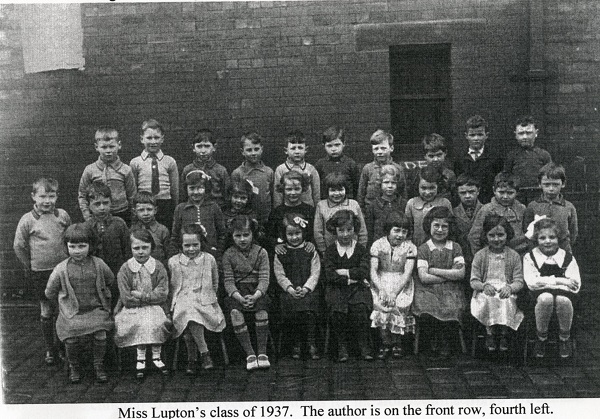
In December 1937 the scholars gave a Grand Concert to raise money for repairs to the school yard. There was a copy of one of the programmes in the log book. Each class provided a different item, a play, a puppet show, a physical training display, a musical item. Standard 1 opened the concert with "A Visit from Fairyland" performed by Barbara Brett (the author)! I was going to a dancing class in those days so fortunately I had a ballet dress. With a wand and a pair of wings I was soon transformed into a fairy!
Many children had their first taste of Shakespeare at St. Silas's School. On the rare occasions when Miss Middleton was away Mr. Merrill took the class and we read and acted "MacBeth" and read, acted and learnt songs from "As you like it".
World War II
The Second World War of course upset the smooth running of the school. As early as September 1938, Mr. Hall, the Director of Education, visited the school to discuss emergency plans. It was decided to move the Infant Department to the Parish Rooms on Preston New Road and the Junior Department to Leamington Road Baptist Sunday School.
August 1939 "This building has been requisitioned as a First Aid Post. The school was closed this morning and the children informed that they must attend Leamington Road Baptist Sunday School on Monday morning. I have applied to the Chief Constable that the lower half of Lynwood Road, a cul-de-sac, be closed to traffic during school hours as I should like it for a girls' playground. The boys are to use the passages at the back of the school as their playground".
Behind Lynwood Road there is a patch of spare land known as Fox Delph. In 1940 an underground air-raid shelter was built there for the children of the school. August 19th, "I received the key of the air raid shelter built on the delph at the end of Cheltenham Street". August 20th, "The first air raid practice-Time taken for all the children to pass through the shelter and back to school, 14 minutes." August 21st, "Second practice with coats and gasmasks was 11 minutes". January 10th, "The first lesson was given in the air raid shelter following an 'alert'."
The winter of 1940 was particularly severe, there was no outdoor P.T. Snowdrifts prevented the children from getting to school. School was closed when there were only 83 children present. School was closed again when there was no coke to heat the building.
During the war there was a large thermometer painted outside the Town Hall. As you rode past on the tram you could see the red line on the thermometer rising higher and higher as the money rolled in. The school children in Blackburn contributed to that money.
February 1942, A holiday given for Warships Week. The school collected £63.
April 1943, Total collected for Wings for Victory Week was £320.
April 1944, The school collected £449 for Salute the Soldier Week.
In April 1943 the Junior School returned to the building on Clematis Street, after an absence of 3 1/2 years. Mr. Merrill wrote that the conditions at Leamington Road had been far from ideal. The rooms were not large enough, and the toilets inadequate. There were leaded lights in the windows and the children had to dodge cars and washing in the playground. But the Committee at Leamington Road had been very considerate, and the caretaker Mr. Robbins had given loyal service.
Aftermath
However, conditions were not back to normal. There were still blackout shields at the windows, and linen instead of glass in the partitions between the classrooms. The boys cloakroom was still being used by A.R.P. personnel. The air raid shelters in the playground were in a filthy condition. There was no staffroom and the head teacher's desk was in the corridor.
In November Mr. Merrill was off ill. On his return he wrote, "I resumed duty after an absence of 10 weeks due to personal illness. As this breakdown in health has been due to the school conditions during the last 5 years, it is interesting to note that the only improvement during those 10 weeks has been the removal of the blackout shields."
In March 1945 things started to improve. The plumber dismantled some washing apparatus in an upstairs classroom. Now Mr. Merrill would have a head teacher's room and be able to move his desk from the corridor. In July 1946 the WCs were whitewashed, for the first time since the war started. But it was February 1947 before workmen started to demolish the air-raid shelters in the school playground. May 18th 1950 was Ascension Day and a special day for Mr. Merrill. It was his last official visit to the church with the children and the vicar kindly gave him permission to give the address. This revived my memories of going to St. Silas's Church on Ascension Day morning after which we had a holiday. But the girls had to wear a hat! If you had forgotten yours, and did not live near enough to be sent home for it, you had to tie a know in four corners of your handkerchief and wear that!
August 31st 1950 This day, I, Ambrose E. N. Merrill complete my services as headmaster of this school. I entered the school as a scholar, was a pupil teacher and a teacher here, served 3 years in the First World War and 5 years as headmaster of St. Paul's, Oswaldtwistle.
I here record my appreciation of the services of the teachers who have been my colleagues. Miss Middleton-32 years, Mrs Nicol-22 years, Miss Shuttleworth-14 years, Mr McLellan, my successor-3 years and Mr Hallows-1 1/2 years. I thank them for their help, especially during the last few years, and making it possible for me to commence my retirement, a very contented man.
And so, as Charles Lamb wrote, "Gone, all gone are the old familiar faces". Gone, yes, maybe, but never, never forgotten.
Sources used-
St. Silas School Log Books
Blackburn Reference Library
Transcribed from Blackburn Local History Journal by Shazia Kasim
February 2024
February 2024