
 Loading more
Home Front WW1
Blackburn in World War 1 | Blackburn and Darwen in the Spanish flu pandemic | Influenza strikes again
The Largest Refugee Movement in British History | Military Hospitals
Blackburn in World War 1
Blackburn, in common with the rest of the nation, was deeply concerned by the momentous events of early August 1914. The major nations were mobilising their forces and scenes in Blackburn were likened to those witnessed in the days preceding Waterloo. Sunday the 2nd August was a day of suspense. From morning to night, crowds gathered outside newspaper offices waiting for the posting of telegrams. That the Cabinet was sitting on a Sunday indicated the gravity of the situation. In the churches there were prayers for peace. War was declared on the evening of August 4th.
As a result of the outbreak of War, there was a rise in food prices and housewives began stockpiling provisions, in case of future shortages. Parliament rushed through an emergency Act which enforced the closure of banks until Friday 7th August. This was to allay any financial difficulties caused by a temporary shortage of gold.
Blackburn's holidays which had begun the previous Friday were spoiled. Railway companies stopped running excursions. People cancelled their holidays in order to conserve their resources.
Mobilization of local troops began. Blackburn Territorial’s who formed the 4th Battalion of the East Lancashire Regiment assembled at their headquarters on Canterbury Street. Billets were provided at schools close by until August 19th when the 4th and 5th Battalions (the 5th being based in Burnley) marched to Bury where they were based at Chesham Fold Camp.
Blackburn and Darwen in the Spanish Flu Pandemic
In recent years concern has grown over the threat to human health posed by bird flu, especially the H5N1 strain of the bird flu virus and after the most recent outbreak in Suffolk newspapers featuring pictures of dead birds also carried references to the Spanish Flu pandemic of 1918-1919.
This pandemic killed killed at least 50 million people in a little over a year (WWI itself killed 15 million people) and yet, until recently we knew very little about the cause of this terrible event.
So what was the great flu pandemic and how did it affect the people of Blackburn and Darwen?
Recent investigation of preserved tissue samples from its victims have shown that it was caused by an unusually severe and deadly strain of the H1N1 form of influenza. The whole world, from the north to the south poles was affected, apart from some isolated islands in the Pacific Ocean. The pandemic lasted from March 1918, when the first outbreaks were reported in an American military camp, to May 1919.
However, it is well known that it is very difficult for humans to catch bird flu so what changed to make this form so easy to catch and so virulent? Unfortunately, Britain or, more accurately, a British Army Base in France during WWI may well be to blame.
In 1916 four soldiers died in the British military hospital at Etaples in France. The men had flu-like symptoms but the cause of death was given as pneumonia. However, it was noticed that their faces had turned a peculiar blueish-grey colour before they died.
It is likely that these unfortunate soldiers were victims of an early form of the virus but why did it startin Etaples? Etaples was a vast military camp with a population of 100,000 men. They needed to be fed and the camp had a farm with chickens and pigs. These crowded conditions were ideal for the virus to evolve, possibly using the pigs as intermediary hosts, from the 1916 form, which was deadly but difficult to catch, into the 1918 form that was both deadly and easy to catch.
In the middle of a war, with vast numbers of soldiers and civilians moving around the globe, the virus spread rapidly and the first outbreak in March 1918 began in Fort Riley, Kansas, when a soldier reported sick complaining of a fever, sore throat and a headache. He was followed by another solider and by the end of the day; the Army Hospital had a total of 100 patients complaining about similar symptoms. By the end of the week, there were over 500 of them.
The virus would have reached Britain carried by a soldier returning home on leave. It reached Blackburn in May 1918.
In this first outbreak the number of deaths due to the ‘three day fever’ was low and the newspaper reported “While there are many cases in Blackburn the town is not suffering apparently so severely as some other centres.” Nevertheless, on 30th June seven members of the borough’s police force reported sick (next day the number rose to sixteen) and the wife of a local J.P. was struck down; taken ill on a Friday, by Sunday Mrs Peel was dead. The newspapers carried daily reports of the outbreak but it wasn’t until mid July that the local area was badly hit. The Hoddlesden pipe works was forced to close and mill owners in Darwen reported hundreds of workers sick; supplies of medicines began to run out at chemists and suddenly the death notices in the newspapers were of young people as, unusually, most of its victims were aged 25-40.
From then on the disease spread rapidly, closing St Anne’s, St Luke’s and Emmanuel schools as well as Sunday Schools. There was nothing doctors could do and the newspapers filled with adverts for ‘quack’ remedies.
At this point, close to the summer holiday, the decision was taken to close all of the schools. The workhouse and the hospital announced that visitors would not be allowed until further notice. These acts coincided with a decline in the disease; however, if people thought the worst was over, they were sadly mistaken.
Over the summer and autumn the disease seemed to disappear, in fact it was mutating into a more lethal form.
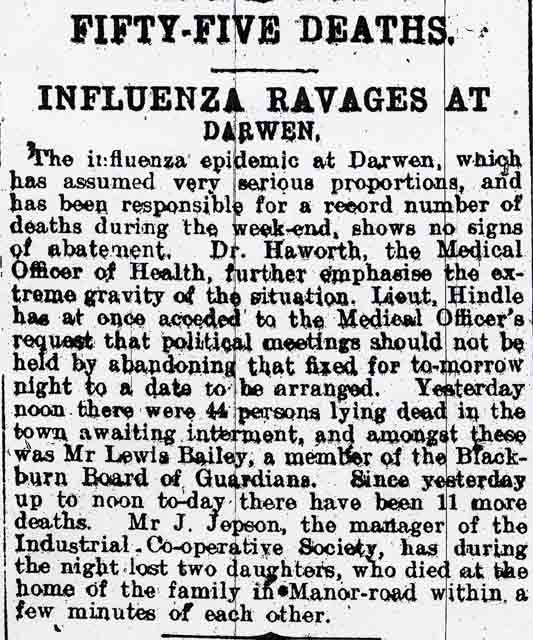
By October 1918 influenza was back in the newspapers, along with the adverts for ‘Formamint’, and this time they were reporting a rapidly rising death rate. Germany was severely affected, the virus having been carried there by prisoners of war.
By late October the flu had reached Southport and for the first time there were reports of people collapsing in the street.
Some victims died within hours of their first symptoms. Others lasted five or six days; before finally dying of the other symptoms, usually pneumonia. The death notices in local papers began to feature the phrase “from pneumonia, following influenza”.
By October 1918 influenza was back in the newspapers, along with the adverts for ‘Formamint’, and this time they were reporting a rapidly rising death rate. Germany was severely affected, the virus having been carried there by prisoners of war.
By late October the flu had reached Southport and for the first time there were reports of people collapsing in the street.
Some victims died within hours of their first symptoms. Others lasted five or six days; before finally dying of the other symptoms, usually pneumonia. The death notices in local papers began to feature the phrase “from pneumonia, following influenza”.