
 Loading more
Eccles Shorrock
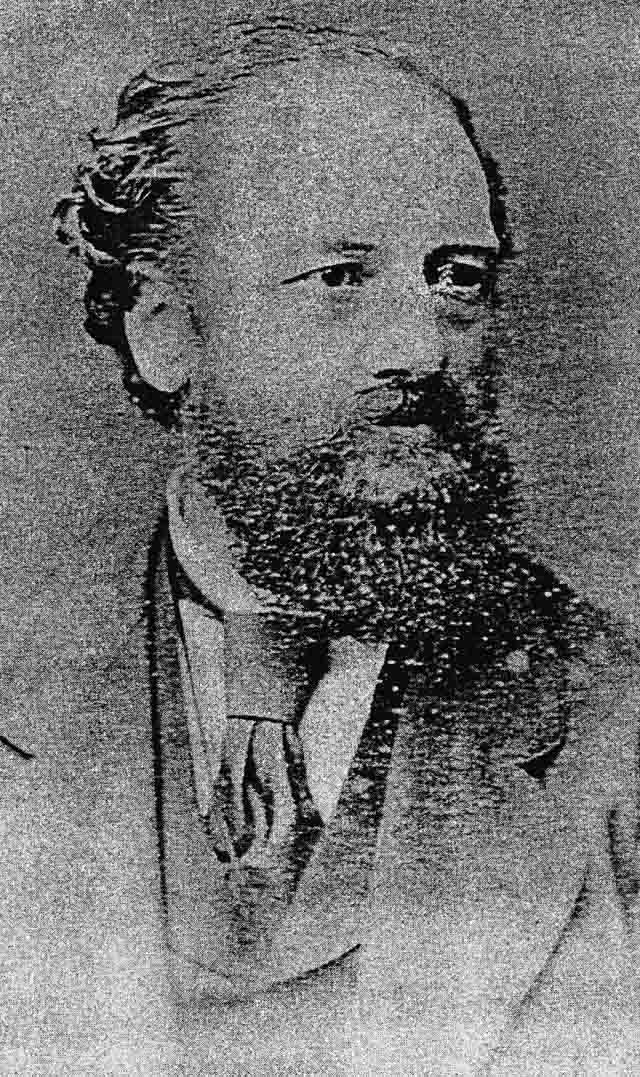
The image used is a presumed likeness of Eccles Shorrock.
© The Eccles Family - terms and conditions
Eccles Shorrock was the mastermind behind India Mill. He was the second of three generations bearing that name. He was the nephew of the first Eccles Shorrock, a founding Darwen mill owner. Eccles Shorrock Ashton was born in 1827 in Clitheroe. He dropped the Ashton when he was adopted by his uncle. He later had a son, the third Eccles Shorrock.
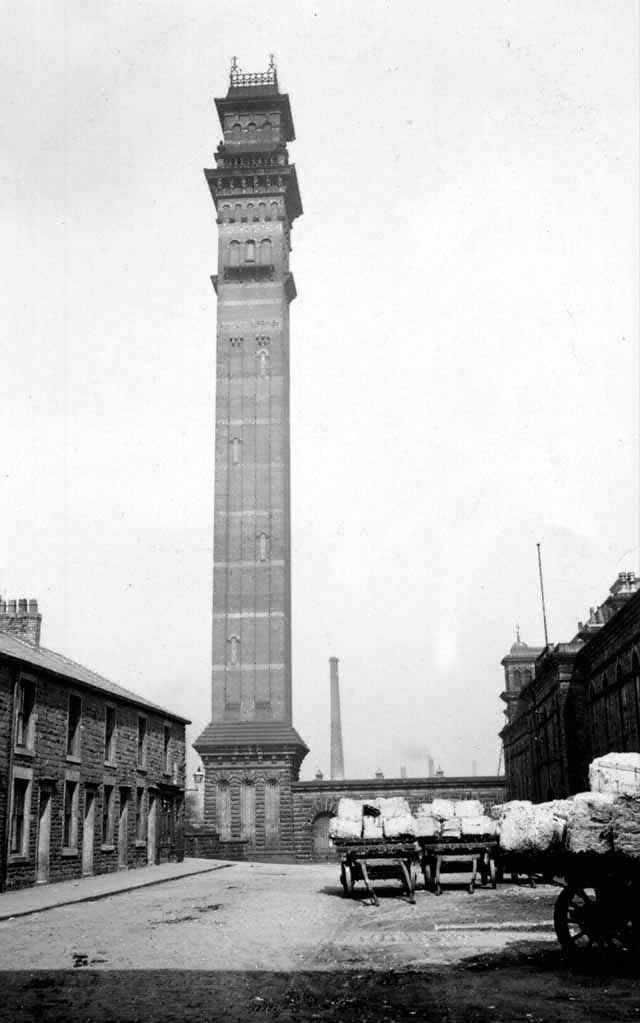
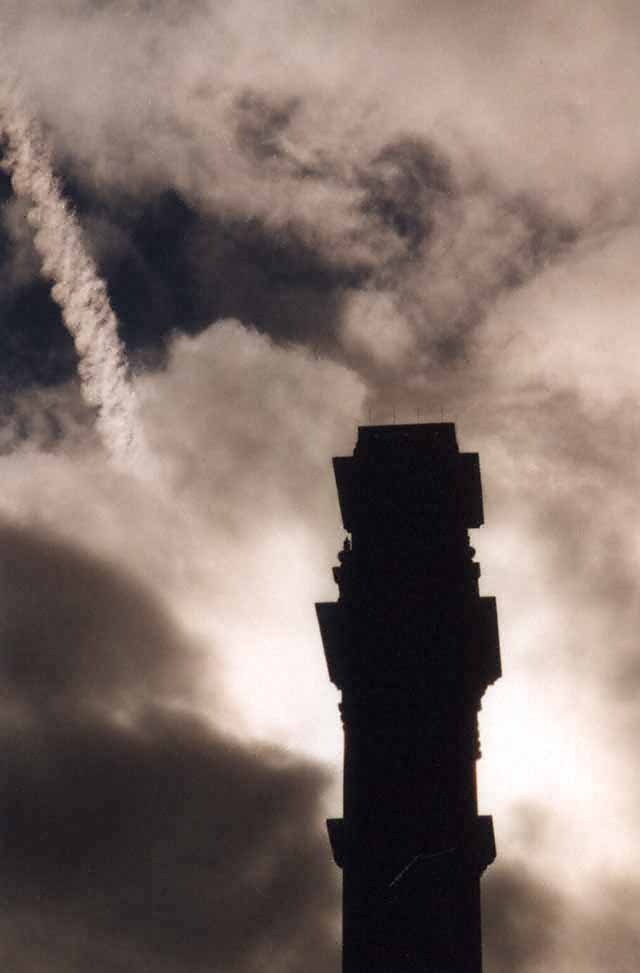
It was the second Eccles Shorrock who left his mark on the town, whose memorial is India Mill Chimney, a landmark that dominates the town just as much today as it did 140 years ago when it was built.
The Education of Eccles and Ralph
'Uncle Eccles' was the initial powerhouse behind the growth of the Shorrock Empire. He was without doubt, a respected businessman. In 1830, at the age of twenty six, Eccles Shorrock had saved enough money to buy Bowling Green Mill from the Carrs whose business had been destroyed by the mob destruction of their power looms in the 1826 riots. Earlier, in 1823 he bought Low Hill House from Samuel Crompton's son.
Eccles Shorrock would have been a boy of eleven years old at the time of Queen Victoria's Coronation Celebrations. His Uncle's patronage of this event, recorded in the newspapers may have made a lasting impression on the young boy and his brother Ralph.
'The Blackburn Standard', May 4, 1838 reported:
"Eccles Shorrock gave his workpeople a dinner to celebrate. There were 1400 workers and tenants to enjoy the Roast Beef, plum pudding, nut brown ale ...3,300lbs of food, 220 gallons of ale were consumed! The whole day was given over to jollification from 10am - 8pm."
The young Eccles would also have knowledge of his Uncle's other public duties. 1838, was the year Over Darwen Gas Company was formed. Gaslights were lit in the streets of Darwen for the first time on November 23 1839. As well as being on the Committee of the Over Darwen Gas Company, Eccles Shorrock Senior also formed a Fire Brigade, which was used for Town as well as Mill Fires. Eccles Shorrock Senior was also on the provisional committee (1843) to establish a new railway line from Blackburn to Bolton.
These examples serve as an insight into the inspiration within the Shorrock household. Eccles Senior was a man of drive and enthusiasm who was imbued with a deep sense of public spirited duty.
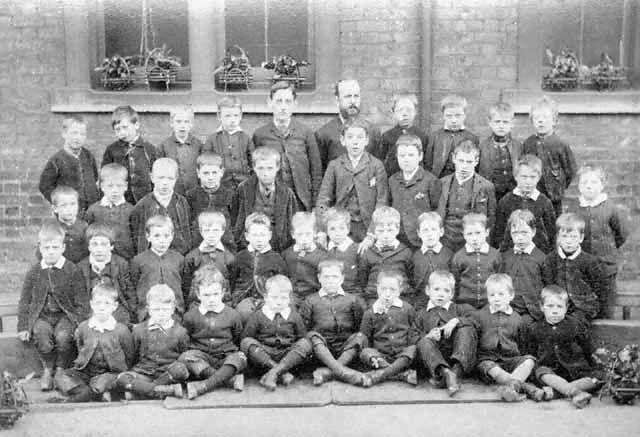
Eccles Shorrock undertook the expense of educating his two nephews. Eccles and Ralph were sent to Hoole's Academy in Blackburn during their formative years. Between leaving school and entering University College London they were tutored privately. 1844 found them embarking on their educational career at University College London, a non-denominational University, and both boys were brought up as Independents.
Eccles and Ralph returned to Darwen in 1848, and in 1849, Eccles formerly joined his Uncle's business, 'Eccles Shorrock & Co.' and started to learn about the Cotton Trade.
The End of an Era
By 1882, 'E. Shorrock, Bros & Co.' had gone into liquidation. The Mills were up for sale. The sons of Ralph and William (Eccles' nephews) left for India and America. Ralph moved to London. Nevertheless, some of Eccles Shorrock's family stayed on at Low Hill House. Shorrock tragically, died in Edinburgh aged 61, on 26th September 1889. His medical notes reveal that he was "steady and industrious up to the commencement of an attack", and poignantly, "he takes a great and paternal interest in some of the other parties". Local newspaper reports of his demise recorded his personal and commercial achievements and praised him for providing significant benefits for the people and town of Darwen.
Building India Mill
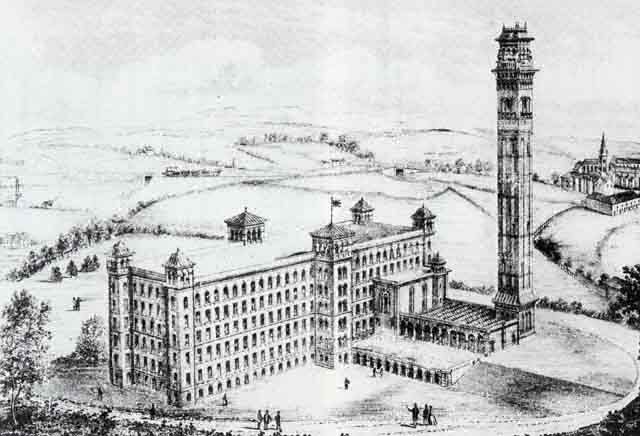
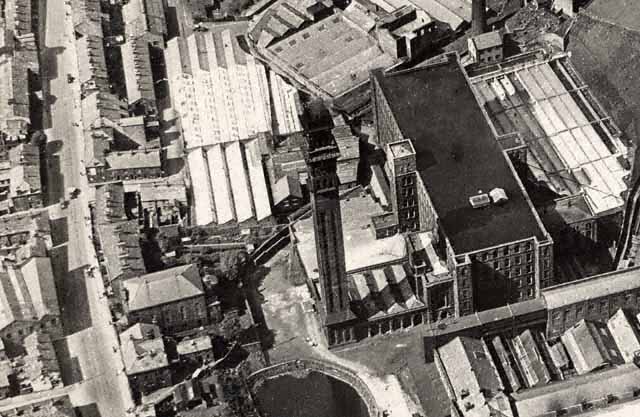
1860 saw the start of building India Mill and the heroic story of Briggs Knowles deserves recording. The bricks and mortar to build the Chimney were wound up in a large box by rope over a pulley fixed to the top, which of course had to be moved higher as the Chimney grew taller. One day the procedure failed. The only solution was for a man to climb up and free the pully. The man who bravely volunteered for the task was Briggs Knowles. An account of his exploits was featured in the 'Blackburn Times', 1st October 1864:
"He climbed unaided up the chimney in order to loose the tangled pulley rope. He was loudly cheered by the bystanders for the calm, collected and persevering spirit manifested by him in performing the feat."
Twenty shillings was the reward offered to this brave gentleman. The building was more or less completed in 1867, and significantly seemed to reflect a more prosperous time for the town. A Table of Works in Darwen in 1867 shows how unemployment had improved since 1861-1864. The Table illustrates that there were now were now 32 Cotton Weaving Works employing nearly 7,000 people with an Annual Production of 28,550,00 lbs of cloth.
Social dinners were arranged to celebrate the building's completion. The next enlightened step was to use the Mill in order to host the Art Treasures Exhibition in May 1868 in the hope that the money raised would finance the building of Belgrave Congregational School. The whole scale of the Exhibition was colossal for its time, and visitors flocked to Darwen from all over the North West. Click here to read more details about India Mill.
Decline in Fortunes
Eccles Shorrock left the 1860s in a somewhat triumphant mood and all harboured well for the next decade. Trade and business were on a sound footing at the start of the 1870s.
The 1871 Census records that at Low Hill, resided Eccles Shorrock, Landowner, Cotton Spinner and Manufacturer employing:
630 males
652 females
122 boys under 13
101 girls under 13
(Total 1,505 people)
By 1876, this figure would have increased significantly. There was full-time working, increased sales and by March 1874 the new company "India Mills (Darwen) Cotton Spinning Co." was founded. During this year, Eccles had also been elected as Chairman of the North East Liberal Association, which stimulated his interest in politics and brought him into contact with such influential people as Cavendish, who became leader of the Liberals when Gladstone resigned in 1875.
1876 did not appear to harbour any indications of troubles ahead. Catastrophically, recession struck in 1877, catching most manufacturers unawares. There was a threat of possible involvement in the Russo-Turkish War of 1877, which began to destabilise the economy. Also, there was discontent about Taxation, and in particular import-export duties. French goods were not taxed on entry into Britain but British goods were taxed highly in France. However, by July 1877, the Shorrock business was in difficulties. An Editorial in the 'Darwen News', 18 August 1877 speculates on the unforeseen calamity of the situation:
"the disaster which has overtaken the above well known and justly respected firm having come upon the public with painful surprise ...the widespread sympathy felt for members of it ...demonstrates a general conviction of their high character and honourable conduct, and it is a significant as well as pleasant fact that this conviction is universally felt by the working classes ...the hope may be reasonably entertained that by the exercise of forbearance on the one side, and of care and economy on the other, an old and eminent firm may retain its important position as a large employer of labour in Darwen".
Sadly, more strife was to ensue. Similar effects of poverty and distress experienced in the 1860s struck Darwen once more. In 1878, the March Celebrations of the Town's Charter were muted due to the beginning of a ten-week strike against the Manufacturer's Association decision to cut wages by 10%, as a temporary measure. Rioting broke out in Blackburn and Darwen. Ashton effigies were burned. The effects of the suffering of his workers and business difficulties began to distress Eccles, heralding the first visible signs of a decline in his health and business acumen. He was sent abroad for a short period by his Doctor, thus avoiding the fierce disruption caused by the strikes and riots. Nevertheless, there was further unrest in the cotton districts between 1878-1880.
Unfortunately, it becomes evident from reports in the Darwen News that friction had been developing between Eccles, Ralph and William for some time, but this 'frisson' reached a dramatic culmination in August 1880. Ralph and William wanted to bring in the receivers and liquidate the firm, but Eccles was not in favour. Ralph and William sought an injunction at the High Court in London to prevent Eccles from interfering in the business. Eccles ignored this injunction and evaded the authorities in London. He returned North to Darwen. The 'Darwen News' of September 1880 records that Eccles ordered the extinguishing of fires, thereby stopping work at the Mill. The Town Clerk, Charles Costeker sent a note explaining that Eccles Shorrock would be in contempt of Court and imprisoned if he did not retract his stance. Eccles, in fury, dismissed this notification and continued his disruptive behaviour by ordering stopping the payment of wages and accounts. He informed the bank not to recognise his brother's signatures, and the Postmaster not to deliver any letters to anyone but him. The results of these actions were disastrous. The family was split asunder.
William Ashton states in an Affidavit of August 27 1880:
"New Mill with 40,000 spindles and 840 looms has been stopped ...in consequence of the defendant's acts. The Darwen Mill's 50,000 spindles have been stopped ...We shall undoubtedly sustain heavy losses through the defendant's conduct (and) our character and credit are being greatly impaired"
Ralph in an earlier Affidavit (August 23 1880) reported that Eccles:
"...has rendered it impossible for the partnership to continue. I have lost all confidence in him and have serious doubts as to his sanity."
Eccles was bundled out of the Town, by no means placidly on the 10.27 am train in order to avoid any publicity or contact with his workpeople who would have been released from the Mills at 12.30 p.m. on a Saturday. The account reported in the 'Darwen News' September 18 1880 was quite harrowing.
Eccles was "...taken to the station with his legs dangling out of the cab, by an indirect route, so as to avoid publicity"
He was en route to Holloway Prison where he would reside for four months, publishing a pamphlet regarding his experiences therein. A condition of his release was that he was not allowed near Darwen for the next four months. From this point onwards there was a steady decline in the Shorrock fortunes and Eccles' health.
Bibliography and Acknowledgements
My thanks must be recorded to Julian M. Marshall for allowing me to use her work cited below.
My interest in Eccles Shorrock, stems from my first meeting, in 1991 with Julian Marshall, Eccles Shorrock's Great-Granddaughter. Eccles Shorrock's eldest child, Constance was Julian's Grandmother. Julian was looking for information about her antecedent. Surprisingly, an initial trawl through the resources held in Darwen Library yielded very little about Eccles. Faced with such an overwhelming lack of material, Julian's quest to discover more about the life and times of her Great-Grandfather had begun. I am convinced that Eccles Shorrock would have been proud of her efforts in researching and compiling this study. For future students and 'Darwener's' interested in their heritage, Julian's dissertation stands as a definitive history, re-counting as it does by fictional narrative and extensive notation the many faceted life of an eminently remarkable man.
I have used Julian's biography of Eccles Shorrock extensively as my main source of information, containing as it does a wealth of resources, including newscuttings, pamphlets, maps, census returns and illustrations.
Marshall, Julian M., Eccles Shorrock (1827-89): His Biography. An Experiment in Literary Form. A dissertation submitted for the degree of Master of Philosophy in the Faculty of Arts, Department of English. October 1994. West Sussex Institute Of Higher Education, an accredited college of the University of Southampton.
Death and Marriage
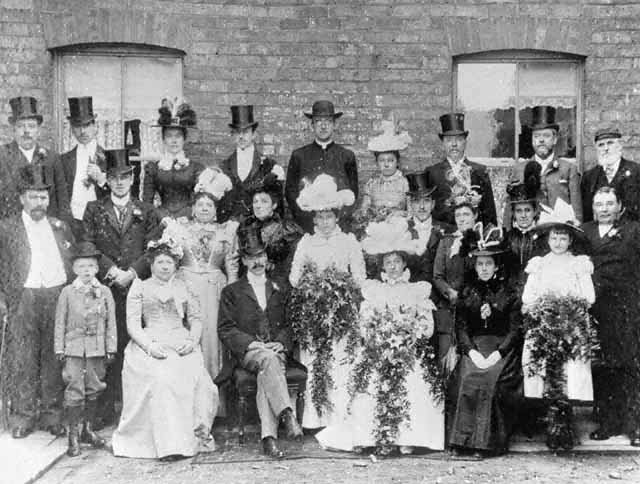
Very briefly, Eccles Shorrock married Sarah Dimmock on April 23 1851, but in 1853 his Uncle Eccles died, and in spite of two marriages, did not leave an heir. Consequently, Eccles, who was only twenty six, inherited, and moved into Low Hill House. He took his brothers Ralph and William into partnership and dropped his father's surname Ashton, thus becoming Eccles Shorrock. From this point, until his illness began, his business interests, civic duties, public speaking and family life would illuminate this part of East Lancashire during an age of expansion and increasing industrialisation.
A year after his Uncle's death, Eccles was expanding the firm's interests to include coal-pits, papermaking and a sawmill. Eccles Shorrock was elected to the Local Board of Health, and in 1854 the eldest of his eight children, Constance was born. The following year Eccles became a Justice of the Peace. The family business was expanding all the time. Eccles built Hope Mill for his cousin W T Ashton. In 1858, Eccles became Chairman of the Health Board. The following year in 1859, a 'New Article For Ten Year Partnership' was agreed between family members. Finally, during this period Eccles Shorrock was active in promoting education in Darwen. He was several times Chairman of the Mechanics Institute.
Biographical Details
The Eccles Shorrock story begins in 1827, when Eccles was born in Clitheroe to Thomas and Mary Ashton. Mary was the sister of a man called Eccles Shorrock. Sadly, only two weeks after the birth of Thomas and Mary's second son, Ralph, in 1829, Mary died leaving Thomas a widower with two young sons. Thomas did go on to re-marry and also had another son, William, half-brother to Eccles and Ralph.
Mary's brother, Eccles Shorrock and his wife adopted Eccles and Ralph Ashton who became known as Ashton Shorrock or Shorrock Ashton depending upon the source. Therefore, from somewhat tragic circumstances, the two young Ashton boys were sent to live with their Uncle and Aunt who provided the foundations for their nephews' future success in public and commercial life.
Events During the 1860s
Attention needs to be paid to world and social events impacting on the Town in an attempt to glean the tenor of life in Darwen during this period, and to fully understand what inspired Eccles Shorrock. The 1860s proved to be a fascinating period in the life of Eccles Shorrock, and Darwen. This decade saw the culmination of the building of India Mill Chimney, followed by the prestigious Art Treasures Exhibition (1868), set against the backdrop of poverty and distress caused by the Cotton Famine. These years seem to define Eccles Shorrock. He emerges from the 1860s as a man of vision, a powerful business force and yet compassionate and responsible to his large workforce. He worked assiduously, along with others to assist Darwen's poor and starving, with the 'Relief Effort' throughout the crisis in the Cotton Industry.
During 1861-1865 the American Civil War raged and its impact devastated Lancashire and surrounding areas dependent upon the Cotton Trade. Basically, the supply of raw cotton from the South ceased. Poorer quality cotton was imported from India. Sources indicate that before the end of 1862, the price of raw material advanced by as much as 300%, and no-one could afford to purchase at those prices.
However, some firms like 'E.Shorrock' had bought in extra raw material at the start of the war - those that did not - shut down. Spinning Mills were affected first, because they could not function without the raw material.
By October 1862, four spinning mills including three belonging to Eccles Shorrock were on short time. Weaving mills fared better to begin with. At one point, in Darwen alone over 3,300 looms were idle. The firm of E. Shorrock & Co. continued working on short time using existing stocks of cotton. However, needless to say, the distress caused to the 'laid off' working folk of the town was evident to all.
Eccles Shorrock gave £1000 towards the Darwen Relief Fund. The Company offered training to operatives in order to re-skill them for other trades. The William Street School, founded and built by the first Eccles Shorrock became a centre for assistance to the poor. The upper room was opened for unemployed youth and men from 9am - 9pm. It was warm, well lit and lessons were provided.
The numbers of those requiring assistance rose from six hundred at the beginning of 1862, to over nearly three thousand by that Christmas.
Eccles Shorrock and others on the Relief Committee gave out two thousand Christmas Dinner Tickets and William Duckworth, Lord of the Manor gave the money for a further two thousand. Tickets were also issued for clogs and coal.
There was even an attempt to persuade people to emigrate. A deputation from the Queensland Cotton Growing Company was invited to the Assembly Room in 1863. The title of the address was "Emigration or Starvation!". Life must have been hard.
 © BwD - terms and conditions
Conclusion
In conclusion, the following two excerpts resonate with admiration for this remarkable gentleman.
The 'Darwen News' September 28 1889, sums up the sorrow which was generally felt by his death.
"We have just lost one of our most prominent, worthy and highly respected townsmen by death, whose departure, had it occurred some ten to twelve years ago, would have cast gloom over the whole district ...it is not because public esteem for him is any the less, but simply because the affliction from which he has suffered in the meantime has been of such a painful character that his removal may be regarded in the light of a happy release... Eccles was not long in finding his way to the front rank of Lancashire cotton spinners and manufacturers, and but a few had a keener, more accurate, and more thorough knowledge of the minuter details of the trade than he had. All calculations relating to the buying and selling of cotton he had literally at his finger' ends ...and it was simply owing to his wonderful speculations in cotton that the firm was enabled during the entire period of cotton panic, consequent upon the American Civil War, to keep the whole of their mills fully at work."
An unattributed cutting, which was found, pasted in his case-notes in Edinburgh states that:
"At one time... his firm were the largest owners of shop and cottage property in Darwen. Most of the shops in Market Street ...belonged to his firm ...as did all the cottages in and about William Street, Henry Street, George Street, including the William St. Schools ...The moral tone of the people of Darwen probably never stood higher than in the days when Mr Eccles Shorrock was looked up to not as the largest employer of labour, but as the finest platform speaker in the town and leader of the people in all that was noble and good."
Today, India Mill and its famous Chimney still stands as a proud reminder of Darwen's Industrial and Textile Heritage. It is fitting that the current owners 'Brookhouse Developments' have 'let' areas of this magnificent building. Employers such as Capita and the Criminal Records Bureau are now setting up business within the Mill, thus providing employment for local people and welcome regeneration for Darwen.
By Mary Painter
The Darwen Connection
For many years Darwen existed for me only as a far-away childhood memory of my mother's. She and her cousin Barbara used to stay at Low Hill with their uncles, Lionel and Howard, and Aunt Kate the youngest Shorrock.
None of this seemed important until my final year at Bishop Otter College, Chichester, where, in 1989, I was reading for a degree in English. A chance discovery among old letters revealed that my Grandmother, Constance Shorrock, had been one of the first female students at Cambridge; she and two others were the "intake" for 1872! This unusual achievement came as a startling surprise to me. The idea of researching and telling the story of her three years at Girton College possessed me; fortunately my tutor gave permission for me to use this unorthodox subject for my Dissertation (A World of Women 1990).
Many questions about my Shorrock family still remained unanswered. My response was to embark on a further three years' research; my subject being Eccles Shorrock, my great-grandfather and a "cotton-man" of Darwen. To present this work for an MPhil (The Degree of Master of Philosophy) in English - rather than History - required "a strong literary element". To supply this I decided on an experimental form, a pseudo-autobiography. Eccles should "write his Memoirs" with supporting data in note form on the left-hand pages, his remembrances on the right. It was a daunting task, living on the south coast of England, when everything I needed was miles away in Lancashire. Without my contacts made in and around Darwen, who provided unstinting help with information, library searches and encouragement, I should never have completed the work (Eccles Shorrock (1827-89): His Biography).
Presently without a writing project I am spending time in my studio, trying to become a "serious artist" rather than a hobbyist! I specialise in printmaking: linocuts, screens and etching. Exhibitions will start again this year with a show at Cranleigh and Open Studios at home in May.
Julian M Marshall, 2003