
 Loading more
A to L
Men from the Darwen area commemorated on the Thiepval Memorial.
A B C D E F G H I J K L
Letter A
Ainsworth, Albert Edward | Ainsworth, Arnold | Almond, Frank | Aspin, James
Private Albert E Ainsworth
1st East Lancashire Regiment, 17233
Albert was the only son of Albert and Florence Ainsworth. In 1907, he married Jane Alice Lucas and they had two children, Florence, who was born in 1909, and Albert who was born in 1914. Albert enlisted into the 1st Battalion East Lancashire Regiment in November 1914 and he was sent to France in 1915.
He was killed in action on 1st July 1916 during the first day of the Battle of the Somme. At 7.30 a.m. the artillery lifted and the British infantry advanced in extended lines towards the German trenches. For a few moments there was silence and then suddenly machine guns opened up from behind largely unbroken barbed wire and cut down the attackers in swathes. The casualties, some 57,740 men, were the worst ever suffered by the British Army in one day.
Albert has no known grave and is commemorated on the Thiepval Memorial Pier and Face 6 C. He is also commemorated on the war memorial of St John the Evangelist Church, Darwen, where he was a regular worshipper.
Albert’s obituary in The Darwen News, Saturday July 29th, 1916 featured the following lines:
Sleep on dear lad in a foreign grave
Your life for your country you nobly gave.
No friends stood near to say goodbye
But safe in God’s keeping you now lie.
Corporal Arnold Ainsworth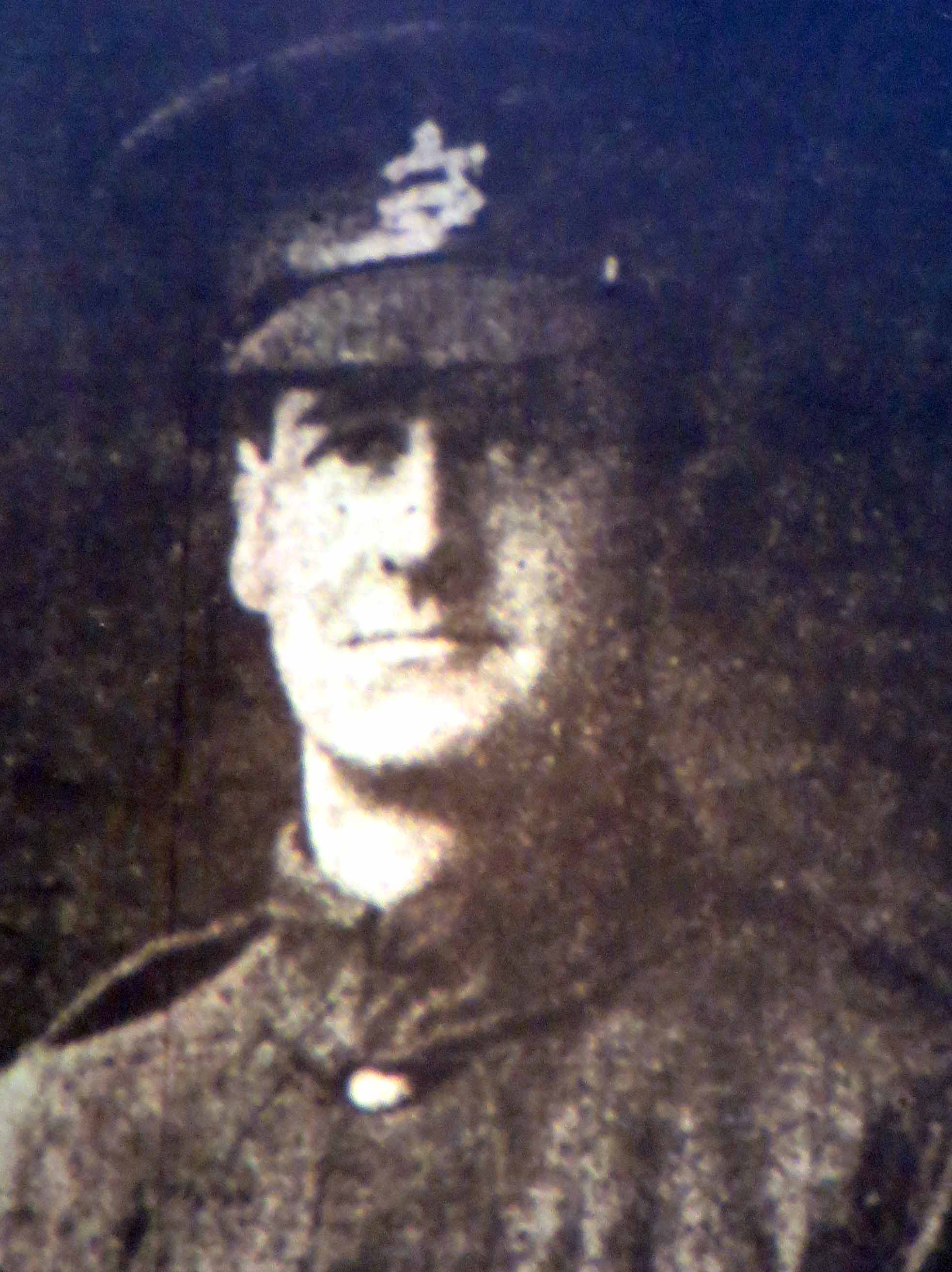 46th Company Machine Gun Corps, 3328
Corporal Ainsworth’s mother and father were John Ainsworth and Sarah Ann Cowell who married in 1871. Arnold was one of a large family and his siblings were William Albert, who was born in 1872, Hannah Marie in 1874, Clara in 1878, John Edwin in 1882, Sarah Elizabeth in 1883 and Herbert Cowell Ainsworth in 1884. By the 1911 census Arnold (34 years), and his wife, Ada Ainsworth (36 years) were living at Rydal Mount, Darwen. Sadly, the same entry records a crossed out entry of one female child who was still born. Arnold, at this time, is listed as being employed an Estates Agent Assistant. Corporal Arnold Ainsworth’s death September 15, 1916 was widely reported in the Darwen newspapers:
“The Darwen News”, Saturday September 30th, 1916:
The death in action is reported of Corporal Arnold Ainsworth of Rydal Mount, Leach Street, Belgrave Road. The Captain of his regiment writes to Mrs. Ainsworth as follows:-
‘’I very much regret to have to inform you that your husband, Corporal Ainsworth was killed in action on the 15th instantly. Whilst leading his team forward into action against the enemy. I am most extremely sorry to have lost your husband. He was one of the trustworthy N.C.O’s in my company and always willing to do any dangerous task. About a month ago I had offered to make him a sergeant, but he asked time to think it over. He was also thoroughly liked and respected by all officers, N.C.O.’s and men in his company and will be missed by everyone. He was buried on the battlefield by his men in a spot which he had just helped to capture from the enemy.
’’Corporal Ainsworth, who was 40 years of age, was a well-known townsman, being the son of Mr John Ainsworth, of Post Office Chambers, with whom he was in business as estate agent and tax collector. He enlisted voluntarily in a Liverpool Regiment and was latterly in the machine-gun section. Before joining the army, Corporal Ainsworth moved in many public circles. He was for many years identified with the United Methodist Church and Sunday School, where, amongst other official positions, he was a local preacher, Sunday School superintendent and Sunday school secretary. Interested in amateur theatricals, he was on many occasions a performer at the annual Café Chantants, and was also prominent in Temperance circles. Being connected with the old Temperance Society.
Corporal Ainsworth was one of the promoters locally of the Athletic Volunteer Force and was treasurer up to the time of enlistment. During the long number of years that Mr. John Ainsworth was secretary to the Agricultural Association Corporal Ainsworth was closely identified with the work and during the latter years he was assistant secretary. By his untimely end a promising career is cut short and indeed the supreme sacrifice has been made.
Mr. and Mrs. John Ainsworth, the parents of Corporal Ainsworth, have this week received the following letter from the United Methodists Church, with which Corporal Ainsworth was so closely associated:
At a meeting of the church and congregation held last evening (September 27th. 1916), the following resolution was unanimously passed:
‘’That we place on record our deep regret at the loss of Corporal Arnold Ainsworth, who was killed in action, when leading men against the enemy, on Friday 15th. September 1916, somewhere in France; and that we convey to Mrs Arnold Ainsworth, Mr and Mrs. John Ainsworth and family our sincere sympathy with them in their bereavement.’’‘’ This meeting remembers with thankful appreciation the late Corporal Ainsworth life long association with our church and school, his interest in every department of our life and work and the many years of faithful and willing service he has rendered as, teacher, secretary, superintendent , choirmaster of the Band of Hope, leader and local preacher.’’
‘’ It rejoices to know that by his heroic courage and conscientious devotion to the perilous duties of his calling, he won the confidence and esteem of the officers and men of his Company; recognizes that in his death he has the supreme sacrifice for his King, his country, humanity and the Kingdom of God; and prays that the Divine consolation may be given to those whose hearts are stricken by his loss.’’We forward the above in the hope that you may derive a little comfort in your sorrow from the knowledge of the sympathy of your many friends.On behalf of the meeting,
Yours sincerely,
H.C. Renshaw (Chairman)
James A Greenwood (Secretary).The Darwen Weekly Advertiser, Friday September 29th 1916 also covered the obituary:- We regret to announce that Mrs Ainsworth, 201 Bolton Road, has received a letter from Captain Morragh of the Machine gun section, stating that her husband Corporal Arnold Ainsworth was killed on the 15th. Inst. The Captain says:- ‘’ I very much regret to have to inform you that your husband, Corporal Ainsworth was killed in action on the 15th Inst., while leading his men forward into action against the enemy . I am most extremely sorry to have to lose your husband. He was one of the best and most trustworthy N.C.O’s in my company and always willing to do any dangerous task. I had offered to make him a sergeant, but he had asked for time to think the matter over. He was also thoroughly liked and respected by the officers, N.C.O’s and men in the company and will be missed by everyone. He was buried on the battlefield by his men in a spot which he had just helped to capture from the enemy.’’ Corporal Ainsworth was 40 years of age; and enlisted in June last year. He was a son of Mr. John Ainsworth formerly secretary of the Darwen Agricultural Association, to whom he acted as assistant. He was prominent in connection with the Duckworth Street United Methodist Church as a local and with the Sunday School as secretary and superintendent.The Darwen News dated Saturday October 21st. 1916 also carried a very interesting article, this reads as follows:
The Late Corporal Ainsworth; Rev. H.C. Renshaw a Tribute
On Sunday morning, the company of the 10th. Battalion Volunteer Regiment, under Commander J. Bradbury, attended public worship at the United Methodist Church, Duckworth St. out of respect to the memory of Corporal Arnold Ainsworth, who was killed in action a fortnight ago. Corporal Ainsworth was one of the promotors of the Volunteers in Darwen and up to his enlistment was treasurer. The large congregation to which the Volunteers contributed was evidence of the regret felt at the loss of one so promising as Corporal Ainsworth.In the course of the address The Reverend H. C. Renshaw said:
‘’Has the war brought us nearer to God? Has it induced the spirit of repentance for our national sins? Has it raised and spiritualised our ideals? Has it remedied the widespread indifference of our people to the Churches? Has it reduced the drink bill? Has it seriously affected the extravagance and self- indulgence of the rich? Has it delivered us from the lust of gold that sees the war as an opportunity for making abnormal profits and of earning abnormal wages? Has it cleansed the lips of our people from filth, impurity and blasphemy? Before the war we were fast lapsing into Paganism. Can we honestly say that tendency has been arrested? We all are longing for the end of the war; but why are we doing so? Is it that we may return into the state of things that obtained in the former days of peace? We are hoping and praying for victory but why are we doing so? Is it that having been freed from the German menace, we may be more at liberty to peruse again our Pagan way? Do our prayers really mean that we should like to make a convenience of God and attach Him to our side as our Grand Ally? – That we should like to make use of him now to beat the Germans but with the tact and understanding that we should ignore Him again after Victory has been won. If so we might as well save our breath. The only prayer that avails with God is the prayer of the righteous whether it be the righteous man or righteous nation.
The fundamental conditions of effectual prayer is that we shall be right with God and the first step towards right relations with God is that which was taken by the Publican in the Temple: ‘’Lord have mercy upon me, a sinner’’ We do not enter into the Kingdom of God through the gateway of pride, but through the gateway of humiliation and repentance – and repentance means a change of mind. So the true patriot will care first and supremely for the moral life of England. He will recognise that the foundation of real greatness and stability for the nation is the character of its people and humanity of its laws and institutions. If England is to be exalted among the nations of the earth it will be by its righteousness and not by its brute force. ‘’Where there is no vision the people perish.’’ Men must not only die for England, but men must live for England – else the sacrifice of the flower of our manhood will have been made in vain. Hundreds of thousands of our brothers have laid down their lives for us – and innumerably more have been maimed and broken. And that fact raises the very serious and heart searching question as to whether we are worthy of the sacrifices that have been made. May we hope that the agony of the present conflict shall become the birth pangs of a new and better Age. Are we to come out of this war with a new vision, a new ideal, of a new England a new world, wherein shall dwell righteousness? Wherein God shall come to his own. If so, the event may help to reconcile us to the losses and sorrows that we have suffered.
The Church Loss
As a church, we have already made the priceless contribution of some of our sons to the end for which we hope and today we remember with sadness and with gratitude, the heroic devotion of H.A. Woodburn and Arnold Ainsworth. H. A. Woodburn was a scholar in our Sunday School in his youth, and after hardships and wounds endured in the course of the war, was recently laid low. He has given his life: he could do no more.Arnold Ainsworth has been intimately associated with this church and school from infancy. He has done almost everything and filled almost every place that a man may fill. He has been a scholar, a teacher, a secretary in various departments, a singer, a choirmaster, a reciter, a superintendent, a member of the church, a leader and a local preacher. He has been associated with every aspect of our life and work and has always given of his best cheerfully and willingly. It was the invasion of Belgium and the atrocities perpetrated upon the helpless women and children of that unhappy land, that roused his moral indignation and impelled him to volunteer for service. And the thoroughness and conscientiousness with which he did his work at home, revealed themselves in the zeal with which he entered upon his military duties. He had been promoted to the rank of Corporal and had been offered the stripes of a Sergeant and by his uprightness and courage had won the esteem of his officers and men. He was fearless in the presence of danger and met his death like a brave soldier, with his face toward the foe. He also has given his life: he could do no more.
From the far off field of battle our fallen brothers call us today. They call us to courage, to fortitude, to devotion to those high things that alone can make England great.They call us, to justify their sacrifice, and to make good its gains. Let us keep before our eyes the ideal of righteousness as the goal of our individual lives and as the end to which our national energies should be directed. So shall we work for the accomplishment of the purpose of God in this present world and so may we hope to enter into the higher service in the world that is to come.Arnold Ainsworth’s will is listed as:- Ainsworth Arnold of 5 Leach St. Darwen, Corporal 46th Company Machine Gun Corps. died 16th September 1916 at Maitinpinch, France, on active service. Probate: London, 21st February to Ada Ainsworth widow. Effects £370.His brother Herbert Cowell Ainsworth’s will reference appears on the same page and reads:- of 136 Tockholes Road, Darwen, Lancashire, Private, 26 Battalion R.F. died 4th. October 1916 in France on Active Service Administration (with will) 24th July to Sarah Ann Ainsworth (Wife of John Ainsworth). Effect £216. 16s. 7d.Herbert’s Obituary appeared in “The Darwen News” dated December 2nd 1916 and it reported the following:-
Private H Ainsworth.Information has been received that Private Herbert Ainsworth, the youngest son of Mr. John Ainsworth, accountant, Union St. was killed in action on the 7th. October. Private Ainsworth was twenty-seven years of age and was educated at Darwen Secondary School, leaving there to take up a position in the Manchester and County Bank at Darwen. He was transferred to Blackburn about six months before he enlisted, in 1915, in the Royal Fusiliers. He went to the front in May last and was engaged in the battle on September 15th, in which his brother Arnold, was killed. Before enlisting he resided with his sister, at 136 Tockholes Road, his parents residing at Grange Over Sands. Information of Private Ainsworth’s death has been received by a friend in Whalley Hospital, from an officer of the same regiment as Private Ainsworth was in. For many years he had taken active part in the work of the United Methodist Church and Sunday School, Duckworth St and was Sunday School secretary for some time.
Mr and Mrs. John Ainsworth have thus suffered a second loss; two sons out of three having made the great sacrifice, probably within a few days of each other. To them every sympathy will be extended.
Corporal Arnold Ainsworth has no known grave and is Commemorated on the Thiepval Memorial Pier and Face 5 C and 12 C.
Private Frank Almond
2nd Royal Welsh Fusiliers, 1717Z
Private Frank Almond was the son of John Almond and Margaret (nee Sailsbury). He was killed 20th July, 1916 at the Battle of Delville Wood on the Somme.
Frank was born on 27th October 1895 at 52 Tithebarn Street, Darwen and was baptised on 20th November 1895 at Holy Trinity, Darwen. By the time the 1901 census was taken the family had moved to 67 Bury Street, Darwen. He attended St. Aidan’s Mission Church and, when old enough, he commenced work as cotton weaver at Holme Mill.
By the time war began the family were living at 129 Beatrice Terrace, Darwen (Redearth Road). Frank enlisted in November 1914. Following his initial training, he was sent to France 4th May 1915, as part of the 6th Division. His Regiment was transferred to the 27th Division, 31st May 1915, and later on (19th August 1915) to the 2nd Division and then by 25th November 1915, to the 33rd Division. Throughout all this time, Frank saw action on the Western Front, including Battle of Hooge, and the Battle of Loos.
July 1916, saw Frank, with his Battalion, on the Somme where he lost his life at Battle of Delville Wood, 20th July 1916. Initially, his family were informed that he was missing and it would be another ten months before they received news of his death.Frank has no known grave and is remembered on the Thiepval Memorial to the Missing on the Somme Pier and Face 4 A.
Following the war his family received Frank’s war medals; Victory & British War Medals and the 1914-1915 Star.
Corporal James Aspin
2nd Lancashire Fusiliers, 192
Corporal James Aspin of the 2nd Lancashire Fusiliers (No. 192) was killed on 23rd October 1916 at Battle of Le Transloy on the Somme.
James was born 8th November 1885 at Brook Street, Darwen. He was the son of John Aspin and Margaret Ellen (nee Atkinson), and he was baptised at Holy Trinity (now St Peter’s), Darwen, 16th December 1885. The couple had 15 children (four died in infancy). By the time the 1901 census was taken the family had moved to 23 Corporation Street, Darwen by which time James was working as a cotton weaver and was employed by James Halliwell.
He attested on 23rd September 1902 at Darwen and joined the Lancashire Fusiliers 6th Battalion (No. 1180) for six years. On attesting, he stated that had been a member of the 1st East Lancashire Volunteers. His height was 5ft 4ins; weight 109lbs; chest: 31ins with an expansion of 2ins; complexion: fresh; eyes: brown; hair: brown and he gave his religion as Church of England. He had tattoo on his left forearm and back of left hand. His full army record has not survived so it is not know where he stationed.
On returning to Darwen, he lived with his family at 17 Henry Street and worked at Messrs. Place’s Pipe Works at Eccleshill. When war commenced he joined his Regiment, 2nd Lancashire Fusiliers (No. 192) and landed at Boulogne on 19th August 1914. He saw various actions on the Western Front including The Battle of Le Cateau, The Battle of the Marne, The Battle of the Aisne, The Battle of Messines 1914. In December, his Battalion took part in the Christmas Truce of 1914. He saw action at the Second Battle of Ypres. During all this action he was gassed twice and also wounded.
On 21st October the Division was moved away from the fighting area towards Abbeville, where it spent most of the winter of 1915-16 continuing training. From Abbeville the Regiment moved to the Somme where James lost his life at the Battle of Le Transloy on 23rd October 1916. It would be another 10 months before his family were informed of his death and at the end of the war they received his medals - Victory & British War Medals; 1914 Star and Clasp.
James Aspin has no known grave and is remembered on the Thiepval Memorial to the Missing on the Somme Pier and face 3 C and 3 D.
Letter B
Banks, Thomas | Banks, Thomas | Baron, Samuel | Battle, James | Beal, William | Bell, John
Briggs, Joseph Robert | Briggs, Robert William | Brindle, John | Burke, John | Burns, James | Bury, Amos
Butterworth, Balfour
Private Thomas Banks
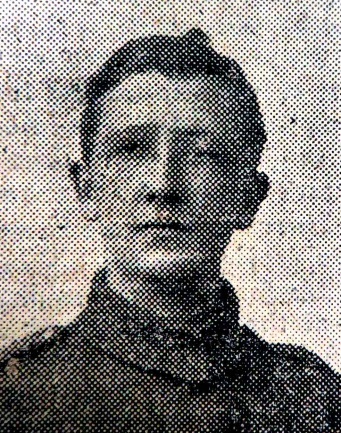
11th Company Machine Gun Corps, 18006
Private Thomas Banks of the 11th Company Machine Gun Corps (Infantry) (No. 18006) was killed on 1st July 1916 at Battle of Albert on the Somme.
Thomas was born in Preston during 1895, the son of John Banks and Hannah (nee Collinson) and the couple had ten children (two died in infancy). Shortly after Thomas’ birth, the family moved to 261 Blackburn Road, Darwen and, by the time the 1911 census was taken, they were living at 37 Devon Street, Darwen. Thomas worked as a creeler at a local cotton mill and later at Belgrave Mill. He attended St Joseph’s Roman Catholic Church and he was a member of the Darwen Athletic Club, where he took part in several boxing competitions.
On the outbreak of war, Thomas enlisted at Darwen and joined the Rifle Brigade (No. 2/2245) and went to France on 25th May 1915. When in France he was later transferred to the Machine Gun Corps (No. 18006 but some sources give his number as 16006). As his army record is not available, it is unclear.
By 11th June 1916, his Battalion was in the Somme area at Beauval where for the next nine days they carried out assault practices over trenches. On 22nd June, the Company marched to Vauchelles, north of Albert in preparation for the Battle of the Somme. Thomas lost his life on 1st July 1916 at the Battle of Albert.
Thomas’ family were first informed that he was missing and by August 1916 they received information from one of their son’s colleagues that he had been killed in action but his body was never found.
Thomas Banks is remembered on the Thiepval Memorial to the Missing on the Somme Pier and Face 5 C and 12 C, and has no known grave. He is also remembered on the St Joseph’s War Memorial.
At the end of the war his family received Thomas’ medals - Victory & British War Medals; 1914-1915 Star.