
 Loading more
Cotton riots 1878
The Cotton Riots of 1878 | Struck By Several Sods | A Spent Force? | A Negotiating Tool?
A Pandora's Box? | Drawing Conclusions | Bibliography
The Cotton Riots of 1878
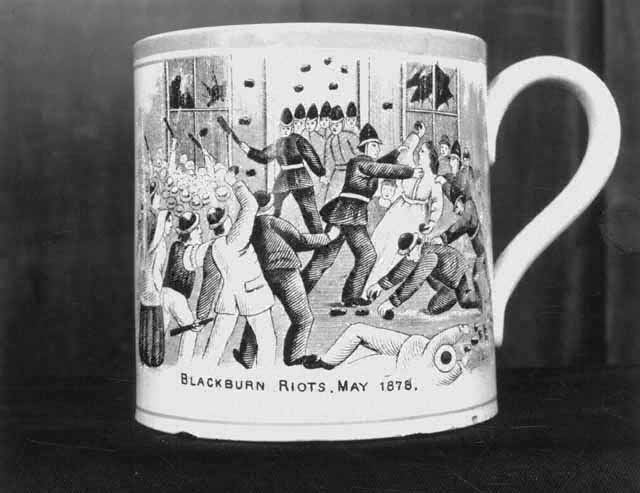
© BwD - terms and conditions
In stark contrast to the political radicalism which had been a major cause of the 1840's Plug-Drawing Riots, the riots that took place in Blackburn and Darwen during the spring of 1878 were the product of purely industrial difficulties and the breakdown of the processes of negotiation between the cotton masters and their workforce. Since the 1840s, the Combination Laws had allowed the establishment of the first Trade Unions - it was hoped that negotiation, rather than violence, could now be used to resolve industrial disputes.
Throughout its history, Lancashire's cotton industry suffered from a 'boom and bust' economy. When cotton was doing well, a Blackburn cotton weaver was one of the best-paid operatives in the industrial North West; but equally, when the industry was suffering from one of its periodic slumps, the same weaver could be forced onto short time working, or even into unemployment.
Such a slump occurred at the end of the 1870s. In such circumstances cotton masters and millowners restricted working hours, imposed pay-cuts and as a final measure, laid off workers and closed down mills. In 1878, a region-wide pay cut of 10% had been agreed by the Cotton Masters Association, chaired by a Blackburn millowner called Robert Raynsford Jackson.
The factory operatives' reaction to this cut was predictably negative. Even though there would have been a general appreciation of the current state of the industry, nobody likes having their pay cut! The operatives decided to fight the cut by going out on strike.
Although the strike was initially peaceful, the workforce became more frustrated as days and weeks passed with no resolution to the dispute. Inevitably, hunger began to bite. The first signs of trouble occurred in Darwen where starving weavers smashed the windows of the Bird I'th Hand pub, whose landlord had refused to dole out food and drink. The intervention of the local Constabulary on exacerbated the problem, the police station itself coming under seige. Cobblestones were hurled through the windows and the police surgeon's report records an alarming number of severe head injuries suffered by officers attempting to quell the riot.
It was only a matter of time before the unrest spread down to Blackburn. The immediate focus of the rioters attention were the mills themselves, particularly those owned my members of the Cotton Masters' Association who were sitting at the negotiating table in Manchester. The Phoenix and Harley Street Mills of Robert Raynsford Jackson had many of their rooflights and windows broken by cobblestones.
News of the negotiations filtered through to the Blackburn weavers - rumours that the Cotton Masters were close to capitulating circulated on several occasions, but were always dashed. By the middle of May, what seemed to have been the best chance of a reconciliation had failed. The weavers of Blackburn and Darwen were at their wit's end - they resolved to force the issue and take their greivances directly to Jackson who, as Chairman of the negotiations, was considered to be responsible for the impasse. Rousing speeches were given by certain ringleaders, in particular a man called Smalley who waved a sword aloft and threatened to run it through anyone who would not follow him to Jackson's house.
Returning from Manchester, Jackson narrowly escaped being molested by a mob who had gathered outside at Blackburn railway station. His carriage passed through another angry crowd on Whalley New Road - it was clear that they were heading up to his house at Clayton Grange in Salesbury. With no time to lose, Jackson managed to clear his family and a few personal possessions from the house before the mob arrived. He escaped with only minutes to spare - angry weavers soon battered down his front door, looted the house for valuables and burned it to the ground. They then dragged Jacksons carriage from the coach house, set it alight and dragged it through the town in a triumphal procession.
The events of the evening sent a shockwave through Blackburn's middle class and even made the pages of the 'Illustrated London News', where dramatic engravings depict the burning of Jackson's house and carriage. Unfortunately, the rash actions of the rioters had done their cause no good whatsoever, hardening the masters against the operatives. Robert Raynsford Jackson almost became a martyr - a long list of the possessions he lost in the fire was published in the local press and a set of ceramics commemorating the event was produced.
Once again, violence had acheived nothing. The ringleaders were arrested and within weeks the strike had been broken. The weavers returned to the mills....with a 10% pay cut.
By Nick Harling
Struck By Several Sods
Violence and the 1878 Blackburn Weavers' Strike
A BA Dissertation by Bob Haye
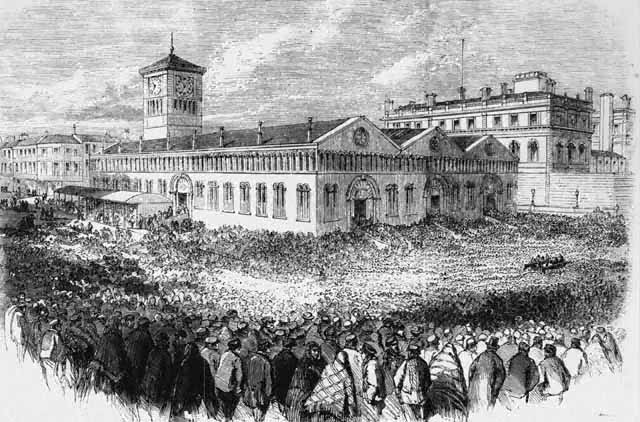
© BwD - terms and conditions
The fate of historical interpretations is usually to follow one of two paths. Some immediately become the subject of counter arguments and controversies, while others enjoy widespread acceptance. Consider, for example, Donald Reid's interpretation of 'Peterloo' and the subsequent, and radically differing, contributions to the debate by Edward Thompson and Robert Walmsley. In contrast, Friedrich Engels' interpretation of Chartism, as the first working-class movement, endured for well over a century until challenged by Gareth Stedman Jones. Historians may produce supportive, or challenging, responses to any given interpretation.
There is inevitably a wide gulf between the broad, thematic, national approach and the detailed local study. This dissertation will explore the possibility of bridging that gulf. It aims to do so by examining local evidence to ascertain the extent to which it conforms to two interpretative theses. In turn it also considers how broad themes influence research and interpretation of a local study. The two broad theses are related in that they both address crowd behaviour. The subject of the local study is the crowd mobilisation and violence accompanying the bitter 1878 weavers' strike and lock-out Blackburn, Lancashire. The interpretative works against which these events will be examined are drawn from the writings of George Rudè and Eric Hobsbawm.
In ‘The Crowd in History’, George Rudè argued the nature of 'the crowd' changed with the onset of the industrial era. Although there have subsequently been debates, and alternative perspectives, it is still a widely respected thesis. Of particular relevance to this dissertation is Rudè's assertion that:
[F]orms of popular action appropriate to the pre-industrial age, had no future in the new industrial society. (1)
In contrast Eric Hobsbawm contended that violent disorder was an integral aspect of many industrial disputes throughout much of the nineteenth century. In an essay, entitled ‘The Machine Breakers’, he declared:
It is, I think, fair to claim that collective bargaining by riot was at least as effective as any other means of bringing trade union pressure, and probably more effective than any other means available before the era of national trade unions to such groups as weavers, seamen and coal-miners (2) [Hobsbawm's emphasis].
It is evident the Rudè and Hobsbawm theses are markedly different and, consequently, they will be examined in separate chapters.
The aim of this dissertation is not to 'prove' or 'discredit' either of the theses. Rather its purpose is to consider how broader, historiographical themes relate to the research and interpretation of a local study. The nature of the dissertation is somewhat experimental. For this reason, methodological and research problems will be considered before the conclusion, rather than as an appendix. The conclusion will assess the relationship of the local study to the two theses, the effectiveness of the methodology and consider possibilities for further research.
A Spent Force?
© BwD - terms and conditions
A Spent Force?
When first published, in 1964, George Rudè's ‘The Crowd in History’ was a significant contribution to enlarging our understanding of the history of 'the masses'. This chapter examines one aspect of Rudè’s hypothesis relating to the impact of industrialisation upon crowd behaviour. Supporting and alternative theoretical arguments will be considered alongside the evidence from a range of events in the nineteenth and twentieth centuries. The Blackburn riots of 1878 will be examined in relation to the wider evidence and debates.
One of the key themes of Rudè's work is the changing nature of the crowd in the developing industrial society. He argued it became much less readily mobilised and was a much less influential instrument in the new industrial age. In particular, Rudè declared:
[F]orms of popular action appropriate to the pre-industrial age had no future in the new industrial society. (1)
It is the notion of a diminished role for the crowd that will be addressed in this chapter. Industrial conflict, crowd behaviour and violence in Blackburn during the period up to and including 1878 will be examined. A broader perspective of Rudè's thesis will also be considered, using examples from other areas of the country - both before and after 1878. The aim is to identify characteristics which were a continuation of past practices and those which were specific to that year.
The selection of a start-point inevitably commits the writer to a potentially arbitrary decision. I would suggest it is unwise simply to 'read back' through a series of crowd behaviour incidents. Pursuing such a method may create linkages based not upon historical continuities, but upon the ideas of twentieth century historians. The late eighteenth and early nineteenth centuries were characterised by particularly repressive governments. The end of the wars with France (1815) marked the beginning of a period that witnessed the gradual relaxation of some of the most draconian laws against workers combinations, public assembly, freedom of speech and the printed media. It was also from around this time that industrialisation began its rapid growth in Blackburn. This will be the - admittedly arbitrary - start-point for this study.
Industrial Revolution
Rudè's contention that there was 'no future' for popular disturbances in the industrial age must be considered in relation to ongoing debates about industrialisation. Was there an 'industrial revolution', or was it evolution? If it was a 'revolution', over what period did it take place? Historians remain divided over these debates. Different manufacturers and different localities industrialised at different paces. Consider, for example, handloom weaving and its supercession by the power loom and factory production. Although domestic handloom weaving was in sharp decline by the 1820s it, nonetheless, survived in isolated pockets for many years. While Blackburn, Accrington and Burnley embraced the factory system and became major weaving centres just a few miles away, in the village of Sabden, handloom weaving continued for several more decades.
Robert Holton has challenged Rudè's dividing line between pre-industrial and industrial societies. He observed that Rudè:
[E]mphasises sharp discontinuities between the crowd in pre-industrial and industrial societies (2).
At what point did a 'pre-industrial' society become an 'industrial' society? How long was the transformation? The 'industrial society' was not an all-embracing entity, which uniformly developed during the course of the late eighteenth and early nineteenth centuries. Changes in methods of production would not lead immediately to changes in the customs and conduct of the populace. Any change of this nature would have been as fragmented and protracted as the process of industrialisation.
New Blood
What was the impact of rural immigration into the industrial towns? By 1878, the proportion of first-generation immigrants in Blackburn would have been in decline. Nevertheless, a sizeable portion of the population would have been first - or second-generation immigrants. Historians have noted the transfer of pre-industrial forms of behaviour into the industrial society. John Stevenson observed:
Ritual elements survived in many industrial conflicts, strikers were called out by the local bellman, communal punishment visited on strike-breakers and parades and demonstrations organised (3).
The evidence of these 'traditions' and 'customs’ should not be overlooked if the events 1878 are to be critically assessed.
Edward Thompson identified a long tradition of crowd mobilisation and riots being used to enforce what he termed the 'moral economy'. Usually the crowd's ire was directed towards forestallers and regraters - those who forced-up food prices during times of shortage. Thompson noted the meticulous administration of many of these crowd actions. Food was not simply seized. It was sold at what was deemed a 'fair' price and the proceeds returned to the original owner. (4) The well-defined aims of many food riots may be seen as a harbinger of targeted rioting during later industrial disputes. In the industrial age cash wages replaced the price of bread as the focus of disturbances. However, the change of focus did not lead to a change of methods.
Brutal Blackburn
The strike and violence of 1878 was anything but an aberration in the history of public order in Blackburn. On many occasions during the preceding sixty years there were bitter industrial conflicts and crowd mobilisation. Trade union activity can be traced back to the earliest days of industrialisation. The town was said to have twenty-four workmen's combinations prior to the 1799 -1800 Combination Acts, which either drove them out of existence or forced them underground. Organised trade unions re-emerged in weaving from 1840. (5)
Historians have noted the emergence of the New Model Unions from the 1860s. The development of the so-called 'Aristocracy of Labour' amongst the skilled workers in well-organised trade unions was accompanied by declining militancy, the courting of respectability and a rejection of violent and illegal methods. However, well-organised, skilled workers formed only a small part of the waged industrial workforce. While cotton spinners have been aptly named 'Barefoot Aristocrats', weavers were nowhere near as well paid or organised. However respectable their leaders, and whatever their aspirations, weaving unions were not, in 1878, part of the 'Aristocracy of Labour’. The various weavers' associations in North East Lancashire were rarely able to unionise more than a third of weavers at any given time. It was often far less. Lower membership density, lower wages and smaller union contributions meant funds were quickly exhausted during strikes and lock-outs.
Rudè compared the characteristics of eighteenth century English labour disputes with subsequent developments. He argued that as the industrial society emerged:
[S]o the machine wrecker, rick burner, and "Church and King" rioter have given way to the trade unionist, labor militant and organized consumer of the new industrial society. (6) [US spellings in original]
What is the evidence from Blackburn? Peter Whittle, writing in 1852, cites eight major incidents of crowd intimidation or crowd violence between 1818 and 1847. He noted the powerful influence exercised by the crowd. Observing the 1847 strike at Hopwood's Mill, he recorded that the operatives "paraded the streets and menaced the inhabitants". (7) However, Whittles evidence must be treated with some caution. The tone of his work is laced with High Tory sentiments and condemnation. He is wholly suspicious of any activity in which the working-classes acted in any number. This tendency is illustrated in his account of a meeting, in 1850, in support of the Ten Hours Bill. It was attended by about two thousand operatives and the Reverend Thomas Sharples (Vicar of St. Peter’s Church of England church) took the chair. Whittle, with surprise, declares "the meeting passed off well" (8) - but then includes it in a section of his writing devoted to riots and disturbances! He appears unfamiliar with the emergence of Operative Conservatism in Blackburn. (This may be due to the fact that he resided in Preston.) Blackburn's Conservative elite supported this proposed legislation. Although Whittle's account is clearly highly partisan the record of eight disturbances during a period of twenty-nine years can be corroborated from other sources.
During industrial conflicts there was not only mass action, there were also individual acts of intimidation and sabotage and what is today termed 'direct action'. Observers - contemporary and twentieth century - noted the threat and use of violence against individuals and property. (9) Sometimes these appear to have been the independent acts of individuals. George Miller identified a number of incidents in nineteenth century Blackburn. In the 1831 strike, at Fielden and Townley's Mill, a certain Thomas Emmet held a gun to the head of a strike-breaker which, fortunately for the latter, misfired. (10) Methods of 'direct action’ had their articulate advocates. When Richard Oastler visited Blackburn, during his crusade against child labour in textile factories, he told a meeting of cotton operatives:
[B]ring [me] your children and tell them to ask their grandmothers for a few of their old knitting needles which I will instruct them how to apply to the spindles in a way which will teach the law-defying mill-owning magistrates to have respect even to ... factory law. (11)
A generation before the 1878 strike, not only was violence and sabotage a routine aspect of industrial conflicts, but the latter was also being advocated by a prominent campaigner for factory reform.
A generation before the 1878 strike, not only was violence and sabotage a routine aspect of industrial conflicts, but the latter was also being advocated by a prominent campaigner for factory reform.
William Abram (writing in 1894) recorded aspects of the town’s notorious reputation for violence during election campaigns. He observed that, during the 1868 municipal elections, both Tories and Liberals employed paid gangs of thugs. But there was also widespread mass participation. Abram observed that on nomination day there assembled:
[T]wo immense bodies of people, comprising the bulk of the adult inhabitants of the Borough, male and female ... roundly computed to number 20,000 or 25,000 in each. (12)
There was widespread violence and running battles. Only when a troop of cavalry arrived from Preston did the crowds gradually disperse. The disorders were sufficiently serious to come under the scrutiny of the 1868 Parliamentary Inquiry into electoral malpractice. (13) Throughout much of the nineteenth century there appears to have been a blase acceptance of election riots. John Bright, commenting on a Rochdale by-election in 1865, observed:
[T]he town was very excited all week; much drinking and fighting as usual. (14) [my emphasis]
It was not only industrial disputes and elections that were accompanied by riots. Blackburn also experienced anti-police and anti-Irish disturbances. Two examples provide a useful contrast. In 1861 - the year in which the Borough Police was established - serious disturbances followed the conviction and sentencing of several men charged with poaching. The Town Hall, Police Office, County Court, Pleasington Hall and private residences in wealthy areas of Preston New Road, Montague Street and King Street were attacked by large crowds which only dispersed after the Riot Act was read. (15)
The town's small Irish population, concentrated in the Penny Street area, was subjected to regular attacks. There were strong anti-Irish sentiments amongst the indigenous working-class population. The Irish were believed to be working for lower wages and taking jobs, and were said to lead a brutish lifestyle. Particularly violent attacks followed William Murphy's visit to Blackburn and the delivery of a vitriolic anti-Catholic sermon in 1867. (16)
While the methods were similar, the targets were different, as was the driving force behind the disturbances. The attacks on the police were rooted within working-class resentment. There was also resentment of the Irish, but the anti-Irish attacks were distinguished by the degree to which they were condoned, or even encouraged, by local elites - through the Orange Order, with its close links to Operative Conservatism.
While the methods were similar, the targets were different, as was the driving force behind the disturbances. The attacks on the police were rooted within working-class resentment. There was also resentment of the Irish, but the anti-Irish attacks were distinguished by the degree to which they were condoned, or even encouraged, by local elites - through the Orange Order, with its close links to Operative Conservatism.
Independent Thoughts and Actions
The extent of popular support for 'radical' causes will also be considered. (Where 'radical' appears within quotation marks, it refers to any policy for progressive change. Where it refers to a strand of Liberalism, Radical is identified by a capital initial.) This is not to presume that all crowd action was in support of 'radical' causes. Rather it is a premise of this dissertation that crowd behaviour always posed a potential threat to authority - even when it was fomented by elites. The significance of popular support for 'radical' causes is the extent to which it indicates the willingness of some sections of the working-classes to act independently of elites and their grip on power.
Political reform attracted varying degrees of support in Blackburn throughout the nineteenth century. As early as 1818, the town possessed a Female Reform Society, which was sufficiently well known to become the subject of one of George Cruikshank's cartoons. (17)
The London Reformer, Dr John Bowring, was attracted to Blackburn to contest the 1832 and 1835 general elections. Although the working-classes were not enfranchised, they showed their support for Bowring by their presence at the hustings and by physical attacks on other candidates, their meeting rooms and supporters. When a large crowd learned that Bowring had not been elected, the Tory headquarters at the Old Bull Hotel were attacked. The prominent Tory factory master, William Henry Hornby, was thrown into the River Blakewater, which was effectively an open sewer. William Fielden escaped dressed as an old women - an undignified exit for the newly elected Member of Parliament and Lord of the Manor. (18) Other outsiders were attracted by the towns 'radical' potential. William Prowting Roberts (the 'Miners' Attorney General' - so-called because of his often successful representations on behalf of colliers against mine owners) sought election as a Chartist candidate in 1847 and, in 1859, J.P. Murrough stood as an Independent Radical.
Blackburn also possessed its own 'radical' figures. Perhaps the best known was the reedmaker, George Dewhurst. Although by the end of his life he was a respected town councillor, his 'radical' reputation could be traced back through his active support for Chartism, campaigning with Bowring in 1832 and 1835, to his gaoling for sedition stemming from a fiery speech to striking colliers. Another of the town's long-standing 'radicals' was the newspaper seller, Henry "Harry" Baker, who maintained a newspaper shop for sixteen years until his death in 1866. Baker's reputation was sufficient for him to merit entry as one of William Abram's ‘Blackburn Characters’. Abram described him as a:
Newsman and Socialist ... who was on the field at 'Peterloo'; was a supporter of the Rev. Robert Taylor ('the Devil's Chaplain'), and a correspondent of Richard Carhle. (19)
Since he maintained the shop as his living for sixteen years, it is not unreasonable to assume there were customers for the 'radical' publications. However, without substantive evidence, it is only possible to speculate about the influence of individuals and organisations and the extent of working-class support for 'radical' politics.
Deference and Accommodation
Much has been written about the dominance of Tory politics in Blackburn and, particularly, the emergence and growth of Operative Conservatism. Patrick Joyce's study of this phenomenon has aroused some controversy. Two distinct strands have emerged. There are those, such as Derek Beattie, for whom the millowners - especially the Tories - dominated a town in which 'radical' views drew little or no support. Others, such as H.I. Dutton and John King, argue Joyce's 'factory paternalism’ was a chimera distorting an otherwise clear view of sharply antagonistic relations between capital and labour. Despite this, independent working-class views thrived. (20)
A close reading of Joyce's work suggests, however, a degree of 'accommodation’ between masters and workers. Working-class support for Operative Conservatism was balanced against the Tory factory masters' support for factory reform, opposition to the New Poor Law and provision of better wages and factory housing. With the enlargement of the franchise, in 1867, both parties were eager to solicit support. Mary Davis noted:
[T]he Tories were as keen as the Liberals to use it [working class support] to advantage. (21)
She also observed that it was a Conservative government's Criminal Law Amendment Act which decriminalised picketing from 1875.
A strong attachment to the dominant elite values of self-sufficiency and thrift was to be found amongst much of Blackburn's working-class. This is exemplified by the high levels of membership of sick and burial clubs such as the Blackburn Philanthropic Burial Society. Blackburn's Operative Conservatism was successful precisely because it embraced some of the progressive ideas that, in other towns, were the preserve of 'radical' politics. It would be a mistake, therefore, to equate Tory hegemony with an absence of 'radical' politics.
A Wider View
Crowd mobilisation and violent disorders continued to take place in the industrial era and throughout the nineteenth century. Prior to 1878, the Lancashire loom-breaking riots of 1826 and the 'Plug Strikes' of 1842 are two 'industrial' examples. Elections, Chartism and William Murphy's 'lectures' variously involved crowd mobilisation and violence. 'Bloody Sunday' in Trafalgar Square (in 1887) was the culmination of the authorities' growing disquiet at the use of the square for mass gatherings, in general, and political gatherings in particular.
These occurrences continued into the twentieth century. The Syndicalist storming of Manchester cathedral in 1911, and many other aspects of the massive wave of industrial unrest between 1911 and 1914, had their origins in pre-industrial methods. The attempt, by Northumberland miners, to de-rail the 'Flying Scotsman' during the 1926 General Strike is an example of targeted 'direct action'. More recently the 'Battle of Saltley Gate' saw the use of mass 'flying pickets' during the 1972 miners' strike. It is perhaps indicative of how well established such action had become, that Labour Cabinet Minister Shirley Williams joined the picket line during the Grunwick dispute in the 1970s. The News International dispute ('Wapping') and the 1984-5 miners' strike witnessed similar crowd mobilisation and violent conflicts in support of industrial action.
Arguably other 'customs' have continued into the present century. Strikebreakers have been 'sent to Coventry’ and ostracised not only by their colleagues, but also by local communities. Colliery bands and marches have played an important role in mining disputes. Demonstrations and rallies, complete with custom-made dispute banner, remain a way of showing solidarity with workers on strike or locked-out.
Political and social causes also witnessed crowd mobilisation in the nineteenth and twentieth centuries. Chartism mobilised huge crowds at rallies such as those at Kersal Moor, Salford, and Town Moor, Newcastle. Although both were peaceful, the sheer size and appearance (with banners and flaming torches) was intended to create an impact. The vast numbers and pageantry were as significant to 'moral force’ Chartists as they were to the supporters of 'physical force'. Rudè suggested the disciplined organisation of huge public gatherings may have been just as alarming to the authorities as their political objectives. (22) The prospect of a huge Chartist demonstration on London’s Kennington Common in 1848 - which only partially materialised - prompted the government to take extraordinary precautions. Queen Victoria left London for Osborne House on the Isle of Wight. Troops, under the command of the Duke of Wellington, were stationed on the Thames bridges and tens of thousands of special constables were sworn-in. (23)
Across the country William Murphy's vitriolic, anti-Catholic preaching provoked major civil disturbances. Following his 'lectures' crowds mobilised and attacked Catholic homes and churches. As Murphy's reputation spread crowds also mobilised to prevent him speaking. He was subsequently to die of injuries inflicted by one such anti-Murphy crowd.
The 'Battle of Cable Street', in 1936, saw the mobilisation of about 100,000 people determined to prevent the British Union of Fascists marching through the East End of London. More recently, tens of thousands gathered for a 1990 demonstration, in London, against the 'Poll Tax’. In both cases there was considerable violence.
Similarities can also be noted in the mobilisation of crowds in support of perceived 'rights'. In the pre-industrial era, during food shortages, the crowd mobilised to seize flour and bread to which everyone had a 'right’. During the early 1970s (prior to mainstream political parties eschewing the goal of full-employment) workers - and other local people - occupied the Upper Clyde Shipbuilders' yard demanding the 'right' to work.
No Future
It may be argued, in defence of Rudè, the ferocity of crowds in the industrial era declined. He noted the level of violence had declined by the middle of the nineteenth century, observing:
[P]olice, magistrates, and troops in Manchester and other manufacturing towns would have been quite incapable of preventing far more violent disorders if the strikers or their leaders had been determined to repeat on a larger scale the methods of the "No Popery" rioters ... of fifty years before. (24)
The suppression of major disorders in the industrial towns did pose logistical problems for the authorities. However, in these densely populated areas, news of repressive measures - such as troops opening fire on the crowds - would spread rapidly through the population. While desperation could provoke recklessness, the sedative influence of fear should not be overlooked. Was the shooting down of Blackburn strikers in 1826, 1842 and 1847 present in the minds of the 1878 strikers? And what of the sentences of transportation or hard labour imposed on rioters during those disturbances? It is not unreasonable to suggest the memory of earlier events would have been part of the weavers' popular memory in 1878.
A Necessary Substitute
Were Blackburn's weavers organised by an effective trade union during the 1878 dispute? The Blackburn Weavers, Winders' and Warpers' Association had its origins in the Blackburn Weavers' Friendly Society established in 1854. It successfully built-up membership as a 'burial club' - providing a £3 funeral benefit in return for a weekly contribution of one old penny. The Blackburn Association was a union founded on the principles of 'friendly benefits', not industrial militancy. The Association's outlook was reflected in its structure; a Board of Management rather than an Executive Committee conducted its affairs. Funds available to support members on strike, or locked-out, were inadequate for a prolonged dispute.
Furthermore, dispute pay was just four shillings per week, which was only about fifteen percent of a weaver's average weekly earnings. Although the Blackburn Association achieved one of the higher rates of unionisation, it only had about 5,500 members from around 16,000 who were eligible to join - a rate of 34.4 percent. (25) The Association's leaders were aware of their vulnerability and were correspondingly cautious. It was a weak union, which was virtually impotent when confronted (as in 1878) by intransigent employers. John Stevenson noted that violent disturbances, related to industrial disputes, began to decline during the first half of the nineteenth century. However, he rejected Rudè’s assertion that they had 'no future', arguing:
'Collective bargaining by riot' existed where it was necessary as a substitute or complement to other methods of bargaining? (26) In the absence of strong trade unions, it was more likely that 'traditional' methods of violence and intimidation would emerge during prolonged disputes.
Summary
I would suggest it has been established that pre-industrial crowd behaviour persisted into the industrial age. Rudè's arguments appear to disregard a range of conflicts in which crowd mobilisation, intimidation and attacks on property and people continued to be used. Disturbances occurred less frequently as alternative options for the resolution of industrial and other conflicts emerged. However, they continued to arise during bitter industrial disputes and sharply polarised political conflicts. Arguably, crowd mobilisation and riots continued so long as they remained what Martin Luther King termed "the language of the unheard.(27) Disturbances and riots of various kinds were part of the fabric of industrial and political life in Blackburn from the outset of industrialisation. It is evident they continued through the decades down to 1878. The next chapter will examine the role they played in the weavers' strike of that year.
A Negotiating Tool?
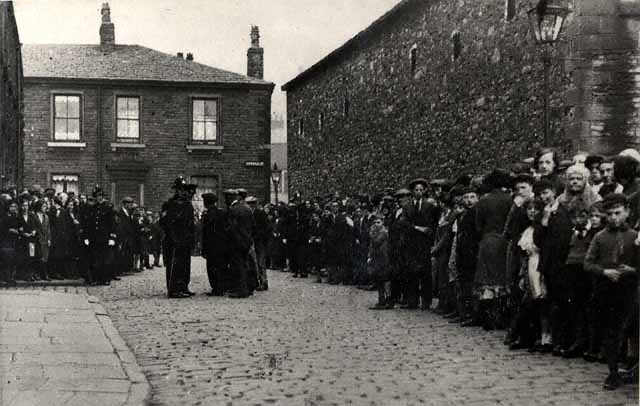
© BwD - terms and conditions
A Negotiating Tool?
Evidence from Blackburn suggests the crowd, contrary to what would be expected from Rudè's thesis, continued to play a role in the town. This chapter examines events in relation to Hobsbawm's thesis. It endeavours to establish whether, or to what extent, the 1878 disorders were 'collective bargaining by riot'. The composition of the crowd, its aims and actions will be examined. Possible explanations will be considered including resentment of factory discipline, antipathy towards the police, desperation, the influence of alcohol and the possible 'recreational' value of the disturbances. Consideration will be given to whether the violence and disorder stemmed from a variety of causes. The role of the trade unions will be explored - particularly their relationship with the whole body of weavers in the town. Finally, the various themes will be drawn together and related to Hobsbawm's concept of 'collective bargaining by riot'.
Faces in the Crowd
Participants in nineteenth century crowd disturbances are not easily identified. If Hobsbawm's thesis is to be considered, it is necessary to try to identify those in the crowd and those participating in the violence. Rudè noted the considerable problems encountered by historians attempting to identify participants in crowd action, observing:
To identify the crowd, we usually have to supplement what we can learn from the one-sided accounts of eyewitnesses with such samples of those killed, wounded, or arrested in the disturbances as we may find in police, judicial, and hospital records ... To say the least, the task of identifying "faces" is beset with obstacles and problems. (1)
Often those who may be identifiable form only a small (sometimes tiny) proportion of any given crowd - the arrested, hospitalised or killed. The disturbances in Blackburn, on 14 and 15 May 1878, involved very substantial crowds, but there were few injuries and a relatively small number of arrests. The Chief Constable, James Potts, estimated 20,000 - 30,000 (2) people assembled in the Market Place immediately prior to the disturbances. The forces of law and order were also substantial. The town s modest police establishment of eighty-nine (of whom sixty-nine were constables) (3), was strengthened by 800 special constables, 250 infantry and 120 cavalry. (4) Given the potential for a major confrontation injuries and arrests were remarkably low. (Compare the 'Peterloo Massacre', in which twelve were killed and over 600 injured amongst a crowd believed to have numbered 60,000. (5) Evidence of injuries at Blackburn is limited to witness statements and newspaper reporting of specific individuals - predominantly those upon whom the crowds vented their anger. This information is of little help in identifying those who made up the crowd.
Of those arrested a number were discharged due to lack of evidence. The remainder were tried by Blackburn magistrates, or sent for trial at the Lancaster Summer Assizes. An analysis of these individuals may provide some insight into the composition of the crowd.
John King has collated statistics of those convicted of rioting for the whole of North East Lancashire. He states that forty were convicted of riot in Blackburn. (6) King analysed the occupational backgrounds of the convicted. Table 1 sets out his numerical breakdown.
Table One
|
Occupation
|
Cotton Operative
|
Other
|
Not Stated
|
|
Number
|
28
|
2
|
10
|
|
Percentage
|
70 %
|
5 %
|
25%
|
Occupational background of those convicted of riot at Blackburn.
Source: John E. King "'We could eat the police!': Popular violence in the North Lancashire Cotton Strike of 1878." Victorian Studies Vol. 28, No. 3, Spring 1985, p460.
Source: John E. King "'We could eat the police!': Popular violence in the North Lancashire Cotton Strike of 1878." Victorian Studies Vol. 28, No. 3, Spring 1985, p460.
It should be noted the percentages shown record the "not stated" as a separate category. King, in his essay, produced different percentages as he chose to disregard those whose occupation was "not stated". He therefore computed that 93.3 percent (7) of those convicted were cotton operatives. However, when dealing with such small numbers, I believe it is wiser to recognise the uncertainty of the "not stated", rather than disregard them.
There are further reservations about King's methodology. Those convicted of riot were the subject of an 'exemplary' trial - Marxist scholars might suggest it was a ‘show trial'. They were tried before the Lord Chief Justice of England, and the case against them was largely based on police statements and evidence of co-defendants (such as Thomas Topping and Kate Caffrey) who turned Queen's Evidence. (8) No fewer than fifteen were convicted in connection with the destruction of Clayton Grange - the home of the Employers' Association president, Colonel Robert Raynsford Jackson. King offers no firm evidence that his forty rioters were representative of the crowd as a whole. I would argue it is unwise to rely on data from this unrepresentative series of trials.
Would it not seem reasonable that a majority of those convicted were employed in the trade which dominated the town? An examination of the Chief Constable's Annual Report statistics for 1877, 1878 and 1879 identifies the occupations of those convicted of all types of offence. Table 2 sets out the occupational breakdown.
Table Two
Occupational background of all those convicted during 1877,1878 and 1879.
|
Year
|
1877
|
1878
|
1879
|
|
Cotton Operative
|
782 (35.3%)
|
807 (38.3 %)
|
656 (37.9%)
|
|
Other
|
1431
|
1303
|
1079
|
|
Total
|
2213
|
2110
|
1735
|
Sources: Borough of Blackburn Annual Report of the Chief Constable to the Watch Committee 15th, 16th and 17th Reports (Blackburn, 1877,1878 and 1879) p14 in all reports.
The percentage of those convicted and described as "cotton operatives" varied between 35.3 and 37.9 percent. Comparison of Tables 1 and 2 reveals the occupational background of the convicted rioters is strikingly different to the average composition of those convicted for all offences in the years 1877-79. Cotton operatives comprised 70 percent of those convicted of riot. Contrast this with their average 'share' of convictions at 37.1 percent. Despite the reservations, cited above, the statistics indicate a strong presence of cotton operatives amongst those convicted of riot.
Thus far, emphasis has been placed upon those convicted of riot. What of those charged but not convicted? The convicted were a proportion of those charged who, in turn, were a very small proportion of the crowd. Twenty-five people were charged with felonious riot in connection with the destruction of Clayton Grange. At Lancaster Assizes Lord Chief Justice Cockburn promptly discharged eight of them due to lack of evidence. Of the remaining seventeen, fifteen were convicted and two acquitted.
What of those convicted of other offences during the disturbances? Charges ranged from drunkenness to attempted murder. A survey of those arrested and charged may provide a better representation of the crowd. It would potentially produce a larger statistical sample than provided by King's forty convicted rioters. The best source of information is newspaper reports. However, there are difficulties in following the progress of individuals through the charge, remand and trial process. Once again, a 'sampling' was felt to be appropriate.
During the weeks following the riots, people were brought before the courts charged with a variety of offences. Newspaper reports of the cases usually stated the age, employment and residence of the accused. Table Three summarises two 'samples’ of cases heard by Blackburn magistrates.
Table Three
|
Year
|
1877
|
1878
|
1879
|
|
Cotton Operative
|
782 (35.3%)
|
807 (38.3%)
|
656 (37.9%)
|
|
Other
|
1431
|
1303
|
1079
|
|
Total
|
2213
|
2110
|
1735
|
Sources: Blackburn Times 18.5.1878 p6 (May). Blackburn Standard 8.6.1878 p3 (June).
The first eleven cases were heard two days after the riots. All the accused were males, who ranged in age from 17 to 44 years. The average age was 24.7 years. Five were cotton operatives; four (including a collier and a pork butcher) were employed outside the cotton industry. Two were labourers who may - or may not – have worked in a cotton mill. Nine resided in Blackburn, one in Over Darwen and one in Accrington. (9) Cases were still being heard almost a month later. A further eleven cases provide another sample. Again all were males ranging in age from 13 to 38 years. The average age was 20.0 years. In this second sample only three were definitely employed in cotton mills. There was one labourer and the remaining seven (including a china dealer and two millers) worked outside the cotton industry.