
 Loading more
Page 2
The civil servants drafted into the Cotton Board to handle the scheme were trying to avoid making decisions, passing the buck to the inspectors who were local estate agents, and neither would say what was required by the word "scrap".
To make a start Robert, Billy Eccles and I took a hammer up to deserted Royal Mill and stood round the first loom
(34). The other two looked unhappy. I thought this was the dirtiest job we had ever been given, a director should do it, and I picked up the hammer.... I did not get much sleep that night.
We had little experience of bulk scrapping. We always had a small sorted scrap metal pile, cleared periodically at about £7 a ton. The looms we had scrapped slowly down the years would go on this pile, with usable spare parts preserved in a cellar.
We started cautiously by putting Royal weaving shed out for offers from several brokers we knew. There was a wide discrepancy in the bids received, so we took the highest.
We contacted other metal brokers outside the cotton trade some of whom were unfamiliar with cotton machinery and were talking in prices per ton, £8 to £8/10/-, and I started estimating weights. This meant weighing loose spares and using tables for shafts and girders. One loom, two dobbies
(35) and a jacquard actually went on the scales, in bits where necessary. With a weaving shed totted up and a basic figure of £8 a ton to work on, we did a lot better. Shafting went for re-rolling at £12 a ton and girders could be used again at £22. Steam engines need a lot of breaking and handling and £5 a ton was the best price offered. We had £200 offered for Swallow St engine and turned it down. Half a day's measuring and calculating gave me a figure of 140 tons, of which 62½ tons was in the 24 foot diameter flywheel, and we sold it for £800. The cinder path to it had to be strengthened to carry wagons and we buried old wooded sleys in it, with ashes on top.
For preparation machinery at Royal, one of our local two-generations-old pals offered £110, which we sold out of town for £271, which made us think the scrap metal trade even lower than cotton.
© BwD - terms and conditions
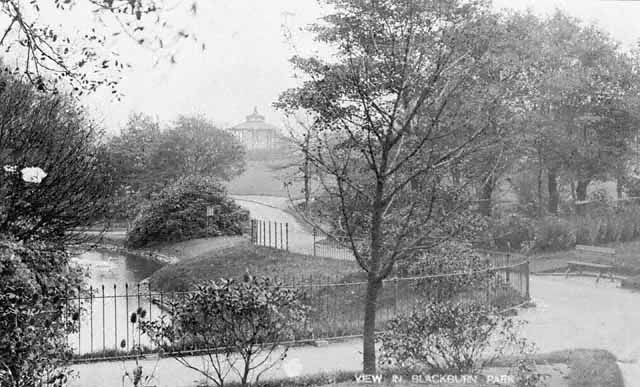
Image of Corporation Park, possibly one of the Blackburn and Darwen parks who bought heald staves for use as plant sticks.
Many weavers called to see what we had got, and we sold what and where we could. Blackburn and Darwen Corporation Parks bought heald (36) staves for plant sticks. In all we sold 7500 of these for around £40. Care had to be exercised in pricing the cost of dismantling. This could easily exceed the difference in price between scrap "as it lies" and the price "to run" dismantled and loaded. Most of the stuff was sold "as it lies", the buyer having to fetch it. One lot of about 600 bare beam barrels was sold at 6d each. We timed the buyer when he collected, and merely bringing them downstairs and putting them on a wagon worked out at 1½d in wages.
Prior to the auction we had sold just over £25,000, with the book value of all plant and machinery at September 1959 standing at £6,028, engines boilers and gearing £1,726. Most of the gearing was sold, but only one engine and one boiler. Some 90 automatic looms were sold to run, at the Cotton Board's request, and the compensation for these subtracted from the selling price before arriving at the above total. Shortly after Royal and Bastfield engines fetched £300 and £610.
Cloth in process was mostly to order, with the exception of our merchanting houses in New York and Bradford. Sundry stocks were small and cleared fairly well, including a small mountain of fents (37) out of the sample cupboard. A couple of merchants evidently thought they would make hay while they could and put in claims against making orders, which we settled reasonably. Bradford Office was cleared at about the stocktaking value at September. We gave the goodwill, such as it was.
By January 1960 we had twelve accounts to come in, by May one, for £12.
Buildings were rather a glut on the market. By the end of April we had recorded twenty-two potential buyers, besides some "nobbut looking". A factory had to fit the job to be of value. We only had one offer, which we accepted, but the buyer welched before signing. We had to make our own minds up about values, through market research. Professional advice was so inconsistent as to be valueless. It took 2½ hours to conduct a buyer round.
Bastfield Mill was subject to ground rent, with certain conditions of maintenance. The directors thought fit to buy this in, mainly to avoid these conditions, and did so very economically at 10 years' purchase.
© BwD - terms and conditions
Image of Brookhouse Mill, which, like Royal Mill and Bastfield Mill was gutted by fire.
Royal Mill had a fire in April, which wrecked the tape-room roof. Two hours before the fire-brigade had it out; some wreckers had been burning through shafting over the only wooden half floor in the place, so the cause (75%) was evident, even if it could not be proved. There was a large gap between the assessor's figure and the builder's, and the settlement took some sorting out. When we sold the mill to our neighbours as it stood, we stopped arguing.
There was a fire in Bastfield engine house from a similar cause, fortunately at lunchtime, and the sprinklers had it out by the time the brigade arrived. At Swallow St the brigade came to carry a wrecker down from a crane over the engine, with a broken leg. A piece of metal had been catapulted from this accident into a pub yard a quarter of a mile away. The publican phoned the police complaining of an air raid.
The sale of remnants was on 5 July 1960 and brought in a further £2,200. There were two rings operating and a few independents. Some prices were ridiculous, some better than expected, but it thoroughly justified our decision to sell the bulk piecemeal.
On August 8th 1960 the company went into voluntary liquidation, the directors retired and handed over authority to David Norris (38), the firm's auditor, as liquidator. The whole assets with the exception of the buildings had been converted to cash, government bonds and short term loans, and Royal Mill was practically sold (39). On 16 August 34/- a share was paid out. The liquidator gave three months' notice to the directors. As I could see little left to do, I refused this and asked to be released at the week-end.
Like other employees, the directors were entitled to compensation from the central trade fund, mine was about £400 based on age. Having been, as we thought unjustly, levied for the first contribution to this fund, we felt justified in claiming it. One condition was that we were "available for employment", the only acceptable practicable proof of which was to sign on at the Labour Exchange for three months. A side benefit was that after six months unemployment, "post-war credits" could be cashed. Income tax had been put up to 10/- at the beginning of the war, with the promised sop that about 1/- would be credited and repaid "after the emergency". What this promise was worth can be valued by the fact that fifteen years after the end of hostilities the emergency was apparently still on.
The word was passed around and a glut of elderly directors unlikely to get further employment were "signing on" for the qualifying period. For a limited time they were entitled to draw the dole and have their N.H.Insurance cards stamped.
© BwD - terms and conditions
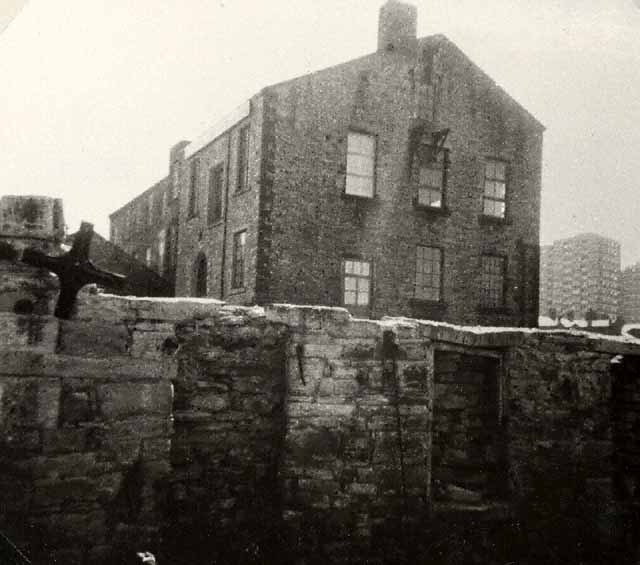
Image of Swallow Street during the process of demolition.
In my case a very humorous situation developed. After about ten days the Labour Exchange informed me I had left my employment without just cause (before my three months' notice) and would not therefore be entitled to unemployment pay (which I had not claimed) nor to have my cards stamped. Feeling awkward as usual, I appealed and was taken to the local industrial court, for the sake of about 30/- in stamps. In due course a representative of the Ministry and I sat on one side of a table, on the other the court, consisting of an employer, a trade union man, and an independent chairman. With the exception of the Ministry, we all had one of my cigarettes and stated our case. The trade union remarked it was the first time he had had a complaint of an employer sacking himself and they disqualified me for three weeks.
Bastfield Mill (40) was sold to Bancrofts, who owned the mill next door, long converted to bobbin-making. On 12 March 1963 the fifth instalment raised the total to 39/3 a share, but by the year end August 1965 part of Swallow St (41) was still held, without much prospect, and a new government credit squeeze was on. There was still about £11,000 banked with the Board of Trade, but this was chicken feed, about 11d a share, and the empty buildings just a nuisance.
Right or wrong, the job was done. In 1965 imported yardage was still well above home production and giving rise to bitter complaints which brought no government action.
In all my working life I never knew a government that was on our side. Our competitors were subsidised from our taxes. After 1946 our total taxes ran a very close second to our total wages. Free imports from India, Pakistan and Hong Kong in 1962/3 were running in excess of 500 million yds annually, about £40 million at an average price of 20d/yd. In only one of these years our government made a free gift of £50 million to India with no strings attached. In the same breath they were preaching "efficiency" to Lancashire. In 1965 India was still having famine. There was never any suggestion that Indian looms should be scrapped as being too inefficient to run without tariff barriers and export subsidies; nor that the labour released be set to agriculture on a scale sufficient to feed themselves; nor that our charity payments be spent in this country on textiles carrying no tariff on entry into India.
Footnotes
(1) The lightweight cotton fabric, also called dhoti, that is used for the manufacture of the long loincloth traditionally worn in southern Asia by Hindu men. The garment is usually white, often bordered in brightly coloured stripes
The lightweight cotton fabric, also called dhoti, that is used for the manufacture of the long loincloth traditionally worn in southern Asia by Hindu men. The garment is usually white, often bordered in brightly coloured stripes
(2) It was immediately next door to Clayton Manor, on the Ribchester side. A field, owned by Clayton Grange, separated the houses. As Clayton Manor’s Stable Wing external wall ran right along the boundary, the owners of Clayton Manor had to pay ‘Ancient Lights’ to Clayton Grange.
(3) Also known as alizarin, a red dye originally obtained from the root of the common madder plant, Rubia tinctorum, in which it occurs combined with the sugars xylose and glucose. The cultivation of madder and the use of its ground root for dyeing by the complicated Turkey red process were known in ancient India, Persia and Egypt. Laboratory methods of preparing alizarin from anthraquinone were discovered in 1868. Upon commercial introduction of the synthetic dye in 1871, the natural product disappeared from the market for textile dyes. Hence, presumably, why Ephraim gave it up!
(3) Also known as alizarin, a red dye originally obtained from the root of the common madder plant, Rubia tinctorum, in which it occurs combined with the sugars xylose and glucose. The cultivation of madder and the use of its ground root for dyeing by the complicated Turkey red process were known in ancient India, Persia and Egypt. Laboratory methods of preparing alizarin from anthraquinone were discovered in 1868. Upon commercial introduction of the synthetic dye in 1871, the natural product disappeared from the market for textile dyes. Hence, presumably, why Ephraim gave it up!
(4) For those unfamiliar with pre-decimal coinage 6 shillings! On 15 February 1971 the UK changed from a £1 made up of 20 shillings (1 shilling was 12 pence (d)) to a £1 made up of 100 new pence (p).
(5) A variety of muslin, a plain-woven cotton fabric made in various weights. The better qualities of muslin are fine and smooth in texture and are woven from evenly spun warps and wefts, or fillings. They are given a soft finish, bleached or piece-dyed, and are sometimes patterned in the loom or printed. The coarser varieties are often of irregular yarns and textures, bleached, unbleached, or piece-dyed and are generally finished by the application of sizing. Grades of muslin are known by such names as book, mull, swiss, and sheeting.
(6) The industrial town corporations realised that they had to provide effective supplies of fresh water and good sanitation systems if disease was to be kept under control in the rapidly increasing urban populations. Hence, particularly in the North West, the towns enclosed as much upland moor as they could to make collection grounds for surface water to be then stored in reservoirs.
(7) Cloth is defined, amongst other parameters, by the weight and density of the yarn in the cloth. The term 60s means 60 threads to the inch.
(8) I have seen this done!
(9) The same Robert who started to break up Royal's machinery in 1959 with Ian. (See later, page 18)
(10) Aged 40 & 41, but Olga was 10 years younger
(11) John went into partnership with Walter, founding the family firm of accountants, Haythornthwaite & Norris. I do not know if this was a successor to Manley, Haythornthwaite & Co. or a breakaway company.
(12) The effective original owner of Clayton Manor. Tradition has it that CM was originally built by a 'mad millionaire' who went around the country building houses which he never lived in. Hitchon bought the shell and converted it from the rectangular house existing then to the L-shape we know today. He added the Tower Block on the Wilpshire end and the coach house/stable block, pigeon-cote and gate lodge to the Ribchester side.
(13) Manufacturers of textile machinery. Eventually taken over by Mather & Platt who were absorbed by a multi-national in their turn. The H&B site has since been flattened.
(14) Of Manley, Haythornthwaite & Co.
(15) The Wall St. crash also nearly put paid to Frank Haythornthwaite, who had been investing heavily in buying shares on margin, the 1930's equivalent of 1990's futures market. His brothers bailed him out.
(16) A loom mechanic, responsible for the correct mechanical operation of the looms under his care. The weavers were only responsible for the actual process.
(17) A system of interchangeable punched cards that control the weaving of the cloth so that any desired pattern can be obtained automatically.
(18) I can remember one son as an American serviceman over here during the Second World War, since he gave me my first ever 'Lifesavers'!
(19) However he had been effectively out of the mill since mid 1937, when he suffered a serious stroke.
(20) Despite already holding a civilian 'A' flying licence. The RAF in their wisdom decided 29 years of age was too old to fly a Spitfire! so Ian asked them what were they short of ?
(21) The RAF diagnosed sugar diabetes in an overseas pre-draft medical.
(22) George Hindle was also a Justice of the Peace and Mayor of Blackburn around this time. He was also Chairman of Blackburn Rovers Football Club.
(23) They were less than half a mile apart. Swallow Street was much further away, probably about a mile and a half.
(24) Building for both domestic and commercial purposes was still controlled under wartime regulations.
(25) Pirns are large barrel-shaped packages used to hold the weft, or filling, yarn supply for the shuttle in weaving. It is an automatic method of providing weft supply, replacing the bobbin in a traditional shuttle. I assume Alhambra to be a trade name.
(27) The weaving union convenor for Bastfield! As Ian told the story in later years, it was the convenor who refused to go back to the old system.
(28) A cylindrical or conical mass of thread or yarn, wound on a quill or tube.
(29) Ian would quote that it would be necessary for a Hong Kong weaver to work a 30-hr. day if all the cloth was legitimate Hong Kong manufacture.
(30) When Macmillan the Prime Minister at the time, came to open the first stretch of motorway the Preston By-pass, later part of the M6 - Ian was invited to the celebratory dinner afterwards. He couldn't understand why he and so many other textile directors were there, until in his speech MacMillan devoted most of his attention to telling the cotton trade how it was going to be re-organised, rather than the glories of this new road system.
(31) The local Conservative MPs who had been briefed by their constituents were threatened with withdrawal of the whip if they forced a division. Fletcher Cooke, our local MP, made a speech opposing the reform which was almost verbatim what Ian had written for him. Two days later, Barbara Castle (the Labour MP for Blackburn) was holding a meeting outside Bastfield gate telling the work force how the Tory party had sold them down the river. The weaver's spokesmen came in to see Ian and were naturally somewhat distressed. Ian pulled out a copy of Hansard, which he had just received from Cooke as a thank you and demonstrated to them that Castle had been advancing the opposite argument in Parliament. At the next general election, she had her lowest majority ever, despite a national swing in the opposite direction. Ian had refused a request to stand as Conservative Candidate against her.
(32) Ian used to say, that by using the compensation money from Royal and Swallow St to fund the concentration of all automatics in Bastfield, the firm could pay a steady 20% dividend on the existing level of trade at the time.
(33) The shareholders could not sell their shares without the approval of the directors for both price and purchaser.
(34) I believe that this was an order for Marks & Spencer. Ian had spent 10 years trying to get it and the quality requirements were horrendous in comparison with the rest of the trade at that time. No other customer would demand to inspect the weaving sheds on a Sunday morning at 36 hours notice. It was, therefore, ironic & sad that this was his last order.
(35) The looms were in fact in good working order. Just in case there was an argument about compensation, since they had not been run since 1929, Ian and the senior tackler from Bastfield degreased one and got it running in less than 10 minutes. Not bad after 30 years standing idle in an unheated shed.
(36) An automatic method of producing allover figured fabrics. They are made on looms having a dobby attachment, with narrow strips of wood instead of jacquard cards. Dobby weaves are limited to simple, small geometric figures, with the design repeated frequently, and are fairly inexpensive to produce.
(37) A heald is a short length of wire or flat steel strip. It is used to deflect the warp to either side of the main sheet of fabric. They were supported by hanging from a wooden lath (heald stave), about 36" long and 1'/2" x'/4" cross-section. The heald (sometimes called heddle) is considered to be the most important single advance in the evolution of looms in general.
(38) Trade jargon for any leftover lengths of usable or saleable cotton in small quantities. A fent-dealer was considered a term of derision for small time operators! I used to raid the fent cupboard for material for my shirts and have them made-to-measure locally in Blackburn. It was cheaper than buying new ones!
(39) John's eldest son. He was the only remaining partner in H & N at this time. By the early 1980's he was approaching retirement and sold the business to a firm of accountants in Darwen.
(40) Royal was bought by Lion Brewery, which was directly opposite. They wanted the weaving sheds for warehousing.
(41) Bastfield is now practically demolished. Bancrofts leased (or sold ?) the weaving sheds to a tufted carpet machine company which did not last very long. By 1980, only the offices and the warehouse were standing, the latter being a discount wallpaper shop!
(42) Swallow St. got absorbed eventually in the redevelopment (civic vandalisation?) of Blackburn centre. In 1975 I tried to find it to show it to my children after Ian and Marjorie had died. I came to the conclusion it was buried under a new housing estate!