
 Loading more
Blackburns Market Cross
Blackburn's Market Cross
Throughout the towns and country side of Great Britain, there were many crosses erected in the past, and for differing purposes. There was the “Wayside Marker,” which stood on the road side, paths and tracks. One use for these markers could have been to guide the walker or rider to a parish church or monastery, they did not always have a cross shape but a lot of those that did were mutilated during the Commonwealth. Some wayside crosses are ancient, but others can be dated to the 15th century. Another type was the “Boundary marker,” again not necessarily in the shape of a cross. These were, as the name implies, used to mark the boundary of a parish or other pieces of land, sometimes Wayside markers were used for this purpose. Then there were “Memorial Crosses,” the most well known of these being the Eleanor Crosses. Eleanor was the wife of Edward I. She died at Harby in Nottinghamshire on the 24th of November 1290. Her body was taken to London for burial and it took twelve days to get there. At each place that the body rested overnight a cross was erected;only three of the original crosses now survive at Geddigton, Hardingstone and Waltham. And of course there was the “Market Cross”.
Market crosses can be found throughout the U.K.—in Scotland they are called mercat crosses. Some are plainly carved while others can be very elaborate. It is thought that its original use would have been religious, but also it could have become a place for people to meet and trade. In his book Early Markets and Market Crosses; George Williams says; “Many market towns and trading centres did exist at church or religious gatherings, but these might have followed pre-Christian or pagan sites, and similarly, the market cross itself may be related to the pre-Christian practice of constructing stone pillars to create trade sanctuaries or to represent divine witness. Such structures used as religious symbols, therefore are likely to have facilitated the emergence of impersonal market exchanges” If this is correct then a stone or wooden post used as a symbol to mark a trading place is much older than people think, with the cross being substituted for the pagan marker. The cross being looked on as a holy symbol would also, perhaps, give people more trust in who they were dealing with. Some market crosses became very elaborate such as those at Aberdeen, Wymondham, in Norfolk, and Malmesbury, Wiltshire. It is suggested that elaborate covers were built onto some crosses to protect traders form the weather.
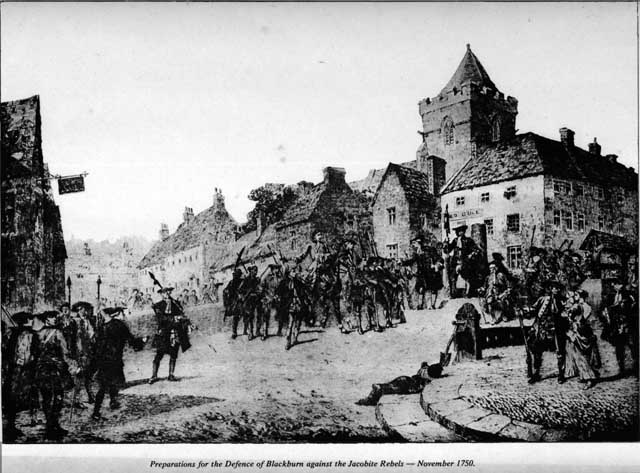
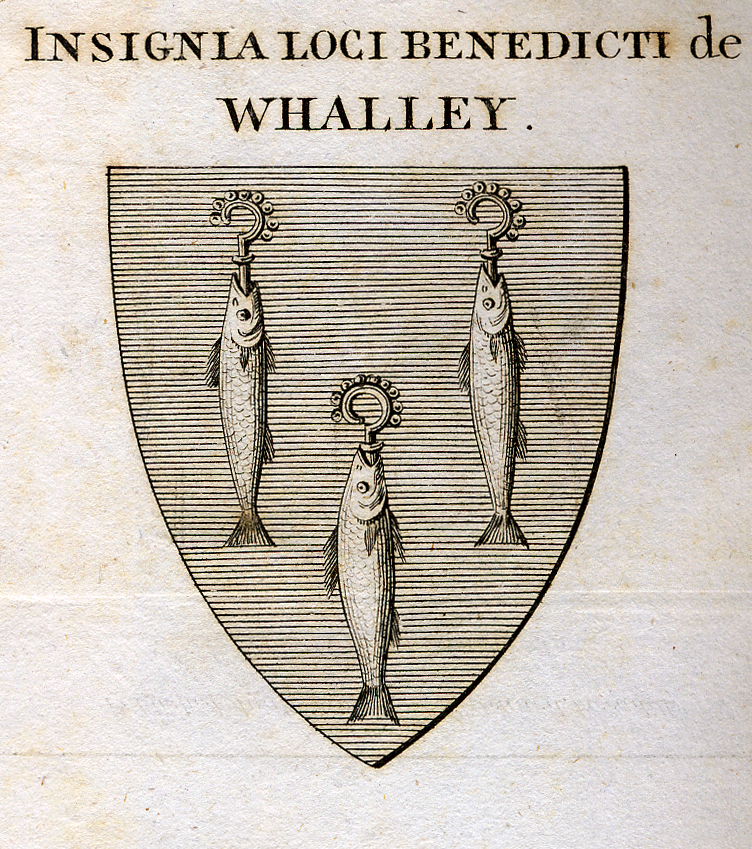
In his Book “Blackburn As It Is”, Whittle says the market cross was erected by John de Lacy about the year 1101, during the reign of Henry I, according to the Norman style. It had a niche, and on a corbelled base stood the figure of “Saint Mary, mother of Jesus, three steps led up to the cross. This stone cross erected by De Lacy could quite possibly have replaced an earlier wooden cross but that we shall never know. This cross-stood until 1537; the reign of Henry the VIII, but by then was in a very dilapidated state and so was replaced by John Paslew, Abbot of Whalley. The new cross had the insignia of Whalley Abbey carved into it, that is three salmon palewise, with demi croziers issuing from their mouths. Paslew also had inscribed onto it in Latin; “Grant that under the influence of Divine Grace I may during my whole life be found watching by the Cross, that when I die my soul may be admitted into the glory of Paradise.” This translation is taken from “History of Blackburn Parish Church” by W.H. Burnett. If the date 1537 is correct for the rebuilding of the cross then it must have been started late 1536 because on the 10th of March 1537 Paslew was executed.
In the book “Bygone Blackburn,” George Miller has an account of the old market square given by Thomas Ainsworth, who was a local solicitor; “Thomas Ainsworth, born 1808 died 1890, solicitor who resided for many years in King-street had clear recollections of the old Market Cross between 1810 and 1820 The cross itself had a base of square masonry, consisting of three steps, graduated, with a massive square stone which formed the socket of the actual cross itself, a portion of which, known as the “stump,” still remained. It must have been removed shortly afterwards, for there is no trace of it shown on an old plan of the market place dated 1819.
One story says that in 1642, during the Civil War it was partially destroyed by Parliamentary troops with only a stump left. However according to another story given in the Blackburn Times of 1868, the cross stood undamaged until about 1790, when, according to the story; “A party of gentlemen returning from a “Church and King festival” at the house of Major Clayton of Little Harwood Hall, being inflamed with wine, loyalty and intolerance, pulled down the cross round whose base succeeding generations, Sabbath after Sabbath had exchanged ideas, and talked over occurrences of the week.”
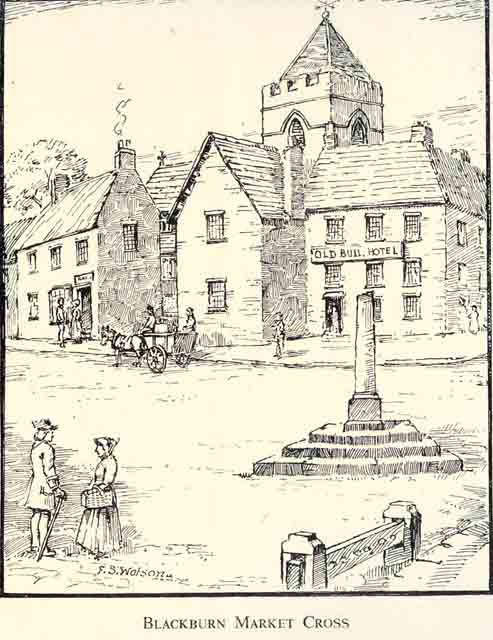
On the Glebe map, drawn by R. Lang in1759, on which the rectory lands belonging to the Archbishop of Canterbury are shown, in the top right hand corner is a detailed sketch of the centre of Blackburn, given in great detail, each individual house being marked. The market cross is shown standing at the Junction of Darwen-street (which on the map is called Church-street), Lower Church-street (Water-street on the map), and Upper Church-street. The cross is shown seemingly intact, had it be just a “stump” at the time the map was drawn surely Lang would have portrayed it that way on his map, and so some credence may be given to the report given in the news paper of 1868.
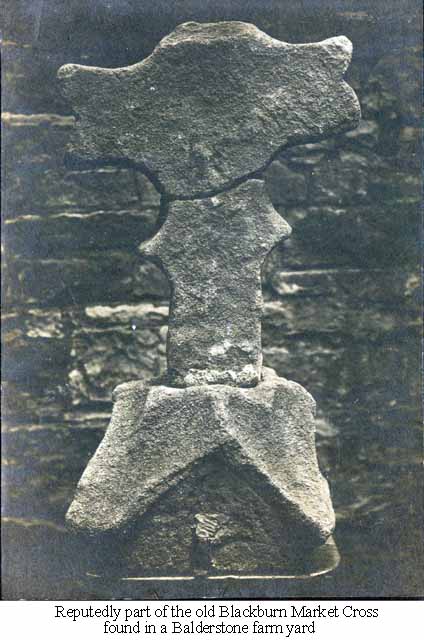
After the vandalism of the cross it is said that the broken pieces were moved to the parish church and remained there until its demolition in 1821. Later the vicar, J.W. Whittaker put it in the vicarage garden which at that time adjoined the parish church. In 1836 it was removed to St. Saviour’s church, Mellor Brook and for many years stood in the chancel, before again being removed to Mellor Brook School. In 1891 a Balderstone farmer, James Simm, informed the museum that for 20 years the cross had been in his farm yard, having been put there when alterations were being made to the school. He said the cross was in three pieces, the largest piece being the stone which formed the gothic capital of the lower column that rose from the base, there was also the lower limb of the cross that connected to the pedestal, and the third piece was the arms of the cross.
The pieces were offered to the museum and accepted, they planned to join the three pieces together and put it on display. Over the years however the cross was lost and the museum can no longer locate it. There is no proof that the cross found at the farm in Balderstone was the Blackburn Market Cross, but on the other hand there is no reason why it should not have been.
As I said earlier, the Market Cross stood at the Junction of three major roads. Here it was that for hundreds of years Blackburn’s weekly market was held, it was said that the market overflowed into Darwen-street, with rows of upturned carts and stalls selling all sorts of farm produce. It was not just food stuffs that were sold on the old market, Abram in the “Revised Chronological Notes on Blackburn” says that on the 1st of October 1796 there was; “Sold at Blackburn Market-cross, four spinning Jennies,
© BwD - terms and conditions
Although it is now difficult to visualise, standing on the west of the old market place, near to the cross were the town's stocks stood (They were set parallel to the road and would be somewhere near to where Lloyds TSB bank stands today.) Luke S Walmsley says about them, they were; “Of sound and solid English oak, and stout as the ribs of the sea dogs of old England, were the ancient stocks for punishing delinquents who profaned the Sabbath and for beery brawlers.” He adds that they were removed from the market square at the beginning of the nineteenth century and put into the old tower of the parish church and occasionally brought out for use.
Thomas Ainsworth, in his recollections, says about the stocks; “They were fixed close to the side stones and parallel with them at the corner in front of Mr. Roger Wood’s printing office. They were in constant use when I was young; I have seen three men sitting on the kerb stone with their feet fixed in the stocks at one time; so it must have been provided with three sets of holes for as many pair of legs.” I have not been able to find any reports in newspapers of them being used.
Also in the market square was the draw well, and again Luke Walmsley says it stood opposite the Fleming-square corner of the bank (Lloyds TSB).It would in all probability, have had a wall round it for safety with a windlass to get the water out. There would also, no doubt, have been a roof over the well to help keep the water clean. When the well was filled in is now forgotten, Thomas Ainsworth says; “The draw well must have been covered before this time, (1819)” In 1860 while the Corporation were constructing sewers for the town, they found the old well but there is no report that it was ever investigated.
To finish I would just like to say a word about Abbot John Paslew, who replaced the market cross. John Paslew was born at Wiswell Hall near Whalley. He was elected abbot of Whalley Abbey on the 7th of August 1507 and was to be the last abbot. After the dissolution of the monasteries by Henry the VII Abbot Paslew became involved in what was known as the Pilgrimage of Grace. When this failed he was arrested, tried and found guilty of high treason. The usual punishment for this was to be hanged and quartered, however, it was decided that he should not have to undergo this barbaric punishment and he was just hanged. The execution took place on the 10th March 1537 in a field called “The Holehouses” which was opposite to the place of his birth.
Tradition tells us that John Paslew had a Town House in Blackburn situated at the top of Church-street near to the old market place. It was eventually knocked down to make way for the Thwaites Arcade. It was for about seven years up until its demolition the home and shop of Luke Walmsley. Walmsley says about the house; “it was two storeys only, besides the cellar. Before its conversion into a shop it had been entered as a house by several steps. Inside was rambling and quaint the room to the front was bright and sunny and ever lively. The windows were constructed in domestic Gothic, with stone mullions and transoms, odd panes proudly glowing in goblin-like squints from a huge bulls-eye. To be sure the floor was a bit shaky and hollow here and round there. There is little doubt its pleasant aspect would afford the faithful Abbot many happy hours in peaceful days when never dreaming of his sad and tragic end.”
It is a pity that nothing can now be found of Blackburn’s market cross; it would have kept an important part of our town's history alive. But then trying to imagine what the area was like where the cross stood is now virtually impossible as it has changed so much. Times move on and things inevitably change, not I think always for the best
By Stephen Smith Cotton Town volunteer
© BwD - terms and conditions