
 Loading more
Page 4
Everything Starts in Blackburn: Andrew Graham speaks to One Voice Blackburn about Family, Innovation and the Soul of Graham & Brown, one of Blackburn’s Greatest Exports
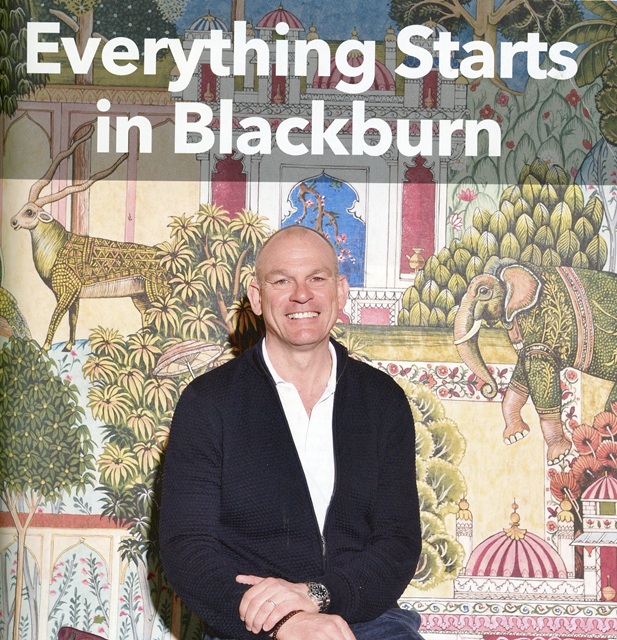
For Andrew Graham, the story of Graham & Brown begins, and still lives in Blackburn.
“Everything you trace back to the Graham & Brown story starts in Blackburn,” he says. “Harold and Henry, who are the founders of Graham & Brown, were born here. I was born here. I am third generation.” As the company celebrates 80 years in business, Graham reflects on a history rooted deeply in Lancashire industry, family continuity and constant reinvention. The company may now operate internationally, with ambitions stretching from London to New York, but he insists its identity remains inseparable from East Lancashire. “The business over the last 80 years has remained rooted in this community. So, yeah, Blackburn is massively important.”
That history nearly started earlier. The founders purchased their first wallpaper machinery in 1938 and stored it in a barn outside Blackburn before the Second World War interrupted their plans. “My dad could drive you to that barn today. If he got in the car, he could take you to where his father bought that first machine.” The war delayed the official launch until 1946. One founder, Henry Brown, saw active military service, while Graham’s grandfather remained in Blackburn running a munitions factory during the conflict.
They were absolutely rooted in their community
For decades, Graham & Brown became synonymous with wallpaper manufacturing in Lancashire, resisting the industry trend of moving production overseas. “We were the last remaining major manufacturer of analogue wallpaper. The company first transformed the industry in the 1980s with the launch of Superfresco wallpaper and pioneering screen-printing technology. My father, Roger Graham and David Brown brought the first screen-printing technology to the UK. It was so successful that the growth and development of the company over the next generation was driven by Superfresco.” Now, he believes the business is experiencing another technological revolution. This time through digital printing.
“Forty years after my father and David Brown revolutionised printing with screen printing, we’re now doing the same thing with digital. Much of that investment has happened recently. Within the last five years actually.” While traditional analogue wallpaper production is now carried out with partner factories across Europe, Graham says the company deliberately chose to invest in the future of manufacturing in Lancashire.
“All of our digital print product, the product in this very room (offices on Stanley Street in Blackburn) is made here in Lancashire.” At the heart of the business remains design. Despite advanced technology and digital tools, he insists the creative process still starts in the simplest possible way. “This is the heartbeat of the business. Everything is about designing our future. “Right at the heart of what our design team do is drawing. You go right back to that artisan creativity around putting pen to paper.”
The company’s extensive archive around 50,000 original artworks collected over eight decades remains a constant source of inspiration. “When we have a brief, the design team tend to go back to the drawing board and ask ‘How can we recreate something that is art?’ Because really, what we’re selling is art.”
Wallpaper itself, he believes, has returned to fashion in a major way. “Wallpaper has got a massive resurgence. We’re sort of going back to the 80s. Wallpaper on every wall, wallpaper on the ceiling.” But today’s interiors, he says, blend wallpaper and paint together. “You will very rarely have somebody use wallpaper on its own or paint on its own. They are almost always combined.”
The King’s Road and the Fourth Generation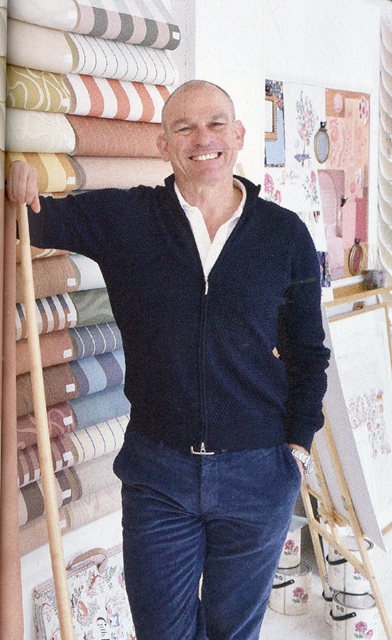
Graham and Brown are 80 years old this year
Despite the company’s Lancashire roots, Graham is also pushing the brand into new territory, including a retail showroom on London’s iconic King’s Road. “There is one road in London, the King’s Road, which is renowned for fashion retailing and design retailing. The move was driven partly by the arrival of the fourth generation into the business, two of my daughters, Iona and Zebbie. “We started to talk about, as a family, wouldn’t it be great if we could take the Graham & Brown story to London?” The next generation brought experience from the fashion industry and helped shape the showroom concept.“The girls have designed the showroom. Iona leads on the brand and the design and Zebbie runs the showroom in London.”
The result, he says, has introduced the company to a whole new audience. “We are really reaching out to new customers as a result of having that beautiful showroom on the King’s Road.” Graham joined the company after graduating from Newcastle University in 1992 with an economics degree, although he admits he once imagined a very different future. “I probably had it in my mind that I was going to go to London. Private equity or something like that. ”Instead a major acquisition changed everything. Graham & Brown bought Colouroll, doubling the size of the business overnight.
“My father very cleverly said, ‘look Andrew, the business is changing rapidly. It would be helpful to have younger people with different thought processes’ and I never left.” Still, he admits one regret. “I probably should have done something else before. My only experience is in this business. That belief has shaped the advice I have given to my own daughters. We strongly advised then: go and do something else. The business will always be here.”
As a leader, Graham says he has always been future-focused rather than nostalgic. “One of my greatest strengths or weaknesses is I always look forward. I like change. I like innovation.” He often references a lesson from tennis player Roger Federer. “The best tennis player ever only won just over half the points he ever played. His advice is always move forward, move on to the next point.
“The past is there, and we’re proud of it. But it doesn’t give us any God-given right to move forward.”
The Crisis that nearly ended the Business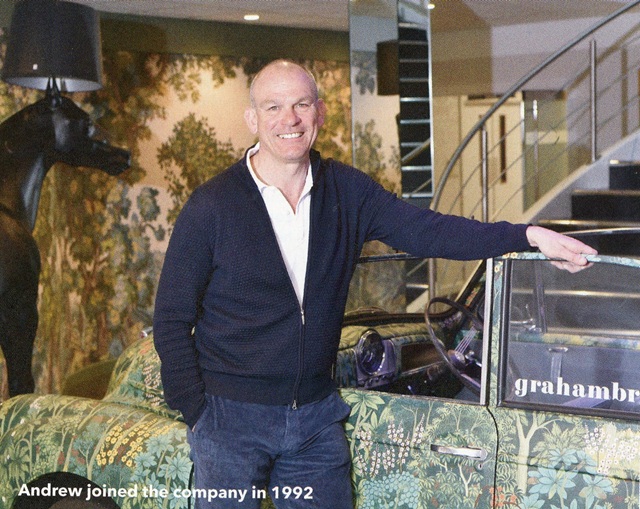
One of the defining moments of Graham’s leadership came when American retail giant Home Depot abruptly decided to stop stocking wallpaper. At the time, the retailer was Graham & Brown’s biggest customer in the world. “We were doing nearly $30 million worth of business with one customer alone, then came a meeting in Atlanta. They explained to me that they were going to stop buying wallpaper. I tried to persuade them, then tried to beg them.” The retailer gave the company one year to wind down operations. “If they hadn’t given us that year, we’d have gone bust. But the crisis forced Graham & Brown to rethink its entire business model. We started to think about how we could sell wallpaper differently if we didn’t have a retailer to sell it to.” That shift eventually led the company into direct-to-consumer retail and e-commerce.
“The demise of Home Depot started our e-commerce business, which has driven the growth of the business and brand across the world.” Andrew Graham speaks openly about the emotional burden of leadership, especially when difficult decisions affect employees. The hardest moment, he says, was closing a factory in Blackburn and informing 120 staff they would lose their jobs. “You are impacting people’s lives. But I genuinely believe the company handled it with transparency and care. We did it through consultation. Everybody got their full redundancy pay. The company organised retraining workshops, CV support and used local business connections to help staff find new jobs. Everybody who wanted to get a job got placed in another company.” Over more than two decades as chief executive, Graham says he has restructured the business eight times.
“Always when you do that, somebody gets hurt. But the whole team is more important than one individual, myself included.”
“The Soul of the Business will always be in Blackburn”
Beyond business, Graham has become a prominent figure in Blackburn’s wider community through philanthropy and youth initiatives. He says that instinct comes from a deeply held belief in helping people realise their potential. “I was always in the anti-bullying camp. I never understood why somebody in power would want to belittle or hurt somebody else.” That philosophy shapes the culture inside Graham & Brown. “If a young person joins this business, I will spend my time helping them become confident and helping them bring their value to life.” For Graham, leadership is ultimately about creating something that outlasts him. “The greatest legacy for me, would be that 10 years after I’ve retired, the business is doing even better without me in it at all.”
And while the future may stretch globally, he believes the company’s identity will remain tied to the town where it all began.
“The soul of the business, will always be in Blackburn.”
Article published in One Voice Blackburn, Issue 17 Summer 2026. Pages 17-20.
Transcribed by Shazia Kasim